
 1,1,1,
- 1School of Physical Sciences, The Open University, United Kingdom
- 2School of Physics & Astronomy, University of Leicester, United Kingdom
Caloris is Mercury’s largest confirmed impact basin and is distinctly asymmetrical in its shape and morphology [1]. This asymmetry has been attributed to a combination of an unusual formation process [2] and/or extensive subsequent modification of the basin interior, rim and exterior [3]. Some regional processes have been identified [4, 5], but while providing further insights, a complete, more detailed explanation of what processes have affected where remains elusive. Understanding this asymmetry will provide a better grasp of basin formation and surface processes on Mercury, helping to untangle the planet’s complex history, and has potential applications with other large impact basins on rocky planetary bodies.
We present ongoing work of a systematic study of the rim of Caloris, where we catalogue these variations and look to potential explanations for their existence. We have divided the rim initially into 9 sectors, based on changes in distance from a proxy centre, elevation and morphological features (Figure 1). All distances are computed as geodesic surface distances on Mercury’s IAU 2015 reference frame. We hypothesise that morphologically coherent sectors with similar positions reflect common process histories, while sector boundaries indicate process transitions. We have completed initial cataloguing of features related to formation and modification and highlighted zones of interest within each sector, using improved elevation and spectral datasets [6,7] alongside existing MESSENGER datasets in ArcGIS Pro.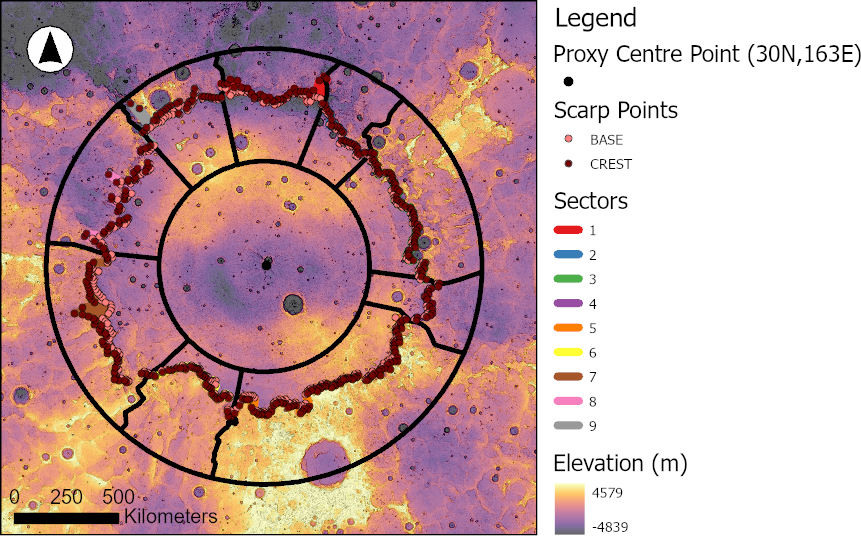
Figure 1: The Sectors around the Caloris Basin, with BASE and CREST points labelled, colour coded, layered onto an updated DEM [6]. Each sector takes into consideration both what is at the rim and immediately behind it, distinguishing regions with well developed ejecta against those without.
Work examining the position of the rim around Caloris is ongoing to assess if its position relative to the centre can distinguish between what is due to formation processes from subsequent modifications. 360 geodesic radial transects, originating from a proxy centre point, have been created, with the base and crest of the rim scarp along each transect identified (Figure 2). The mean centres of BASE and CREST points lie ~10 km apart at 30.7°N, 162.4-162.5°E. These lie 34.4 km northwest from the proxy centre point (30°N, 163°E) and 34.7 km southwest of the centre given in previous literature (31.5°N, 162.7°E) [8].
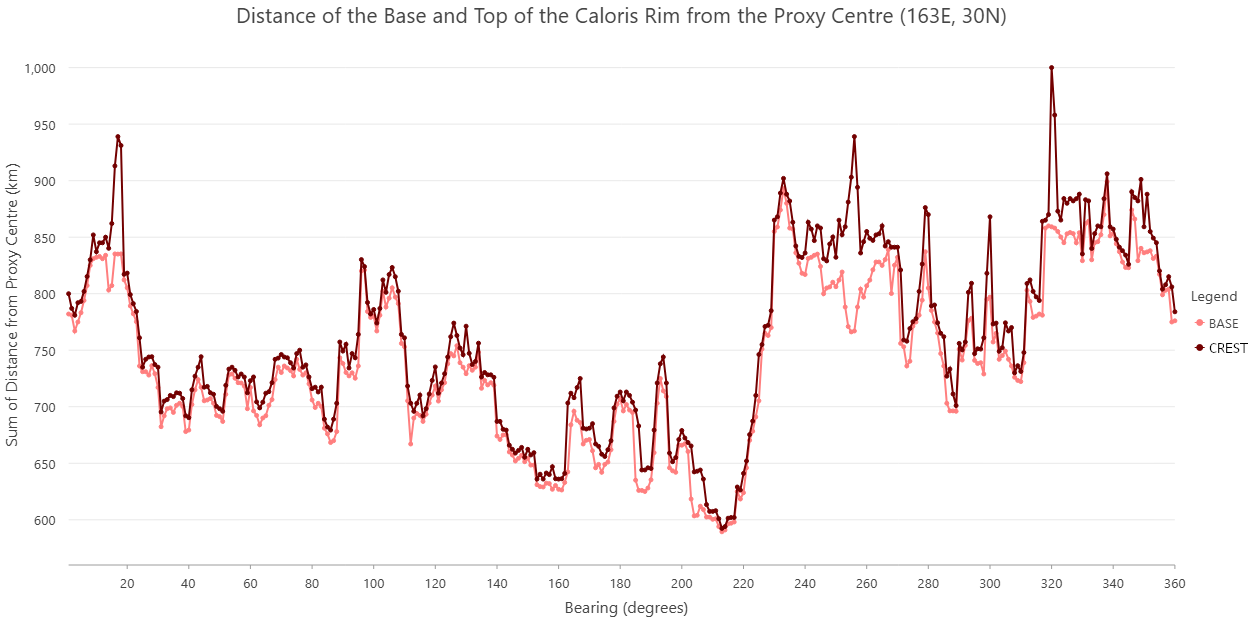
Figure 2: Distance of the BASE and CREST of the rim from a proxy centre of Caloris. Variation in the rim features, results in notable discrepancy between these two datasets.
Using both base and crest points, a sliding three-point circle fit, across five spacings, ranging from 20° to 60° in 10° steps, has been created. Base and Crest points that are clearly defined by subsequent modification, such as more recent craters, were skipped, to reduce noise in the results. This has produced a broad 3-armed pattern (Figure 3) that persists across all five spacings. This method was also applied with a spacing of 119°. This was chosen over 120° to avoid the geometric degeneracy that arises at exact 120°. This resulted in an oval shaped cloud of centre points orientated roughly NE-SW. This may hint at an oval shaped basin, akin to South Pole-Aitken on the Moon [9].
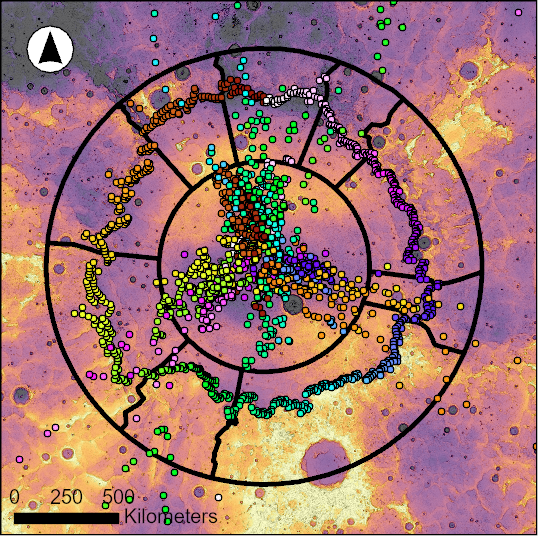
Figure 3: Centres derived from the sliding three-point circle fits, coloured by the bearing of the second point in each triplet. The points form a broad 3-armed pattern, starting at 1°.
Further work will focus on establishing whether the 3-armed pattern holds under further investigation using alternative centre points from previous studies [8] as well as through statistical examination to verify through Fourier decomposition of rim radius as a function of azimuth, to quantitatively test the significance of the three-fold component against alternative explanations. The relationship between morphologically defined sector boundaries and azimuthal transitions in rim geometry is currently under further investigation in parallel.
[1] Fassett et al., 2009, E&PSL. [2] Gosselin et al., 2023, JGR Planets. [3] Rothery et al., 2017, JGR Planets. [4] Schmidt et al., 2026, JGR Planets. [5] Hirata et al., 2025, JGR Planets. [6] Preusker et al., unpublished. [7] Tullo et al., 2026, 10.20371/INAF/DS/2026_00001. [8] Ernst et al., 2015, Icarus [9] Andrews-Hanna et al., 2025, Nature.
How to cite: Brooks, C., Rothery, D., Fawdon, P., and Wright, J.: The Evolution of the Caloris Basin Rim, Mercury, Europlanet Science Congress 2026, The Hague, The Netherlands, 7–11 Sep 2026, EPSC2026-964, https://doi.org/10.5194/epsc2026-964, 2026.


