
 3,3,4
3,3,4- 1Aix-Marseille University, CNRS, Polytech Marseille, IUSTI, Marseille, France
- 2Aix-Marseille University, CNRS, Centrale Méditerranée, M2P2, Marseille, France
- 3LIRA, Observatoire de Paris, Université PSL, Sorbonne Université, Université Paris Cité, CY Cergy Paris Université, CNRS, 92195 Meudon, France (sandrine.vinatier@obspm.fr)
- 4LEATP, Université Reims Champagne-Ardenne 51687 Reims, France
The spatial distribution of aerosols in Titan’s atmosphere is commonly retrieved from remote-sensing observations of the scattered solar light using one-dimensional plane-parallel or pseudo-spherical radiative transfer solvers. However, such approaches become limited for the analysis of pixels in JWST/NIRSpec observations close to the limb of Titan, because of the large emergent angles that cannot be appropriately treated with the above mentioned solvers. In this work, we present a novel three-dimensional retrieval framework based on the Monte Carlo radiative transfer code htrdr-planets used for the analysis of JWST/NIRSpec observations of Titan in the near-infrared spectral range acquired in November 2022.
htrdr-planets [1] is a fully spherical and heterogeneous Monte Carlo radiative transfer model developed for planetary atmospheres. This code is modified to simultaneously compute radiances and their sensitivities with respect to atmospheric parameters [2], allowing efficient gradient-based inversions. The present study uses this new radiative transfer solver on NIRSpec observations between approximately 1340 and 1400 nm. This spectral region includes both a methane transmission window and an absorption band, allowing us to probe the aerosol vertical profile at different altitudes from the middle stratosphere to the upper troposphere.
The atmospheric model includes methane absorption treated with the k-distribution method and two aerosol populations: haze above 80 km and mist below 80 km. Aerosol density retrievals are performed using the Jacobians matrix directly estimated by Monte Carlo sensitivity calculations.
The retrieved aerosol distributions are consistent with previous one-dimensional solver SHDOM-PP inversions of the same observed JWST/NIRSPec pixels close to the center of Titan’s disk [3] (with retrieved information restricted in the 25°S - 60°N region). Here the use of htrdr-planets allows us to analyze a significantly larger number of pixels close to or at the limb thanks to the full 3D treatment of the observation geometry (see Figures 1 and 2). We are then able to extend the probed region to the 60°S - 80°N latitudes range and to the west to east limb. However, we inferred systematic overestimations of the radiance for pixels mixing nadir and limb contributions.
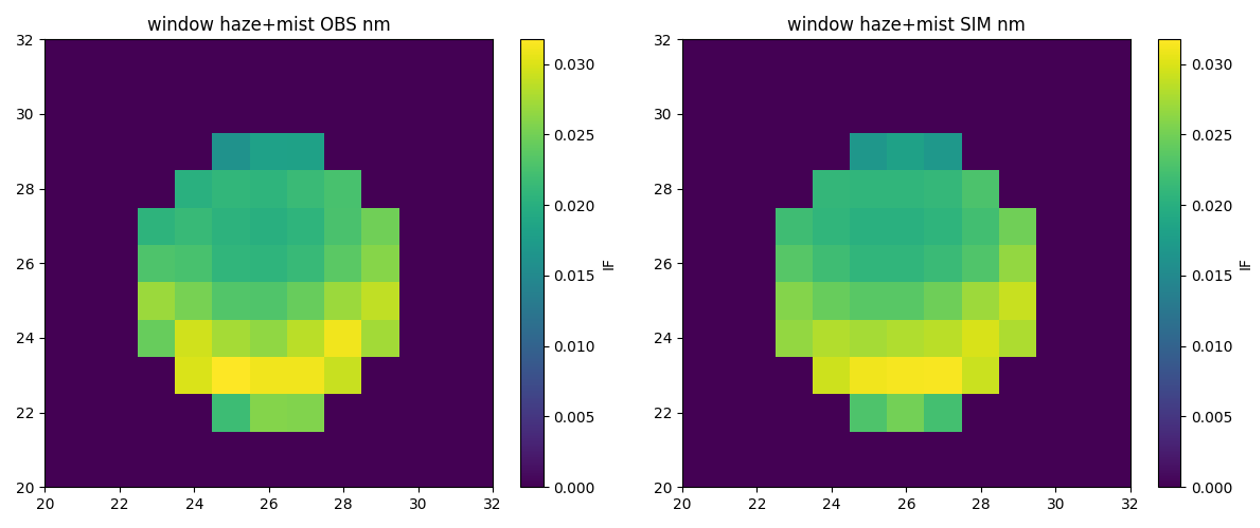
Figure 1: JWST/NIRSpec observation of Titan (left) and the htrdr-planets simulation (right) at 1340nm.
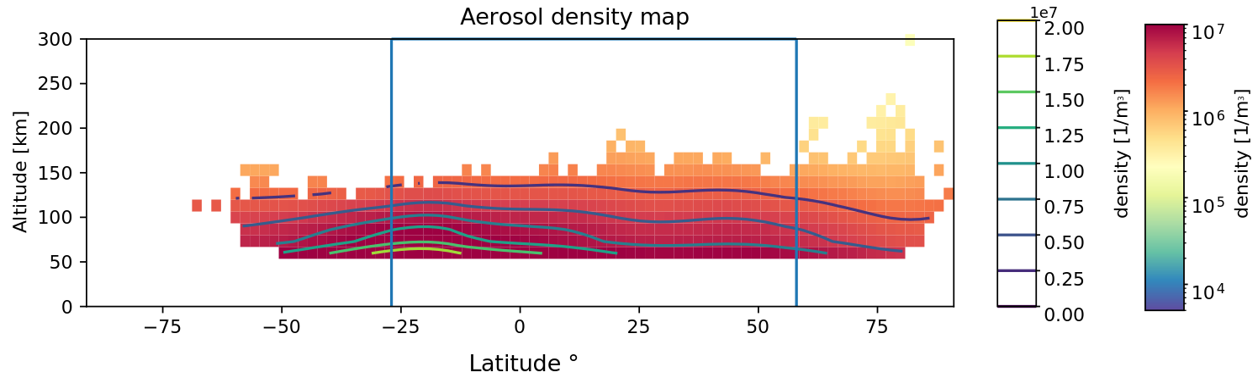
Figure 2: Retrieved aerosol density map using the spherical, heterogeneous Monte Carlo radiative transfer model htrdr-planets, which covers a larger validated area than the aerosol density map retrieved with the classical one-dimensional solver SHDOM-PP (highlighted by the blue frame).
To improve the fit, a multiplicative correction factor on the aerosol scattering albedo is introduced in the inversion procedure. This substantially reduces residuals without strongly modifying the retrieved aerosol density distribution. In addition, introducing longitudinal variations of scattering albedo improves the reproduction of the observed morning–evening asymmetry. This behavior may indicate aerosol condensation processes during Titan’s night side, although additional Monte Carlo realizations are required to confirm this interpretation.
These results demonstrate the capability of three-dimensional Monte Carlo retrieval methods for analyzing JWST/NIRSPec observations and provide new perspectives on studying Titan’s aerosol variability and atmospheric dynamics.
This work has been funded by the French National Research Agency (ANR), project RaD3-net, grant number ANR-21-CE49-0020.
References:
[1] htrdr-planets, https://www.meso-star.com/projects/htrdr/htrdr.html
[2] He, Zili, et al. "Simultaneous Estimation of Radiance and its Sensitivities to Radiative Properties in a Spherical-Heterogeneous Atmospheric Radiative Transfer Model by Monte Carlo: Application to Titan." 2026, JQSRT 350, 109722.
[3] Rannou P. et al., “Mapping Titan’s haze and mist with the near infra-red spectrometer onboard the James Webb space telescope”, 2026, Icarus 450, 116944.
How to cite: He, Z., Vinatier, S., Bézard, B., Arfaux, A., and Rannou, P.: Mapping Titan’s aerosol from JWST/NIRSpec observations with the spherical and heterogeneous Monte Carlo radiative transfer model htrdr-planets, Europlanet Science Congress 2026, The Hague, The Netherlands, 7–11 Sep 2026, EPSC2026-968, https://doi.org/10.5194/epsc2026-968, 2026.


