
 1,1,2,1
- 1Universitat Politècnica de Catalunya, Escola Tecnica Superior Enginyeria de Telecomunicacions de Barcelona, Departament Electronica, Barcelona, Spain (abel.palomas@upc.edu)
- 2Deutsches Zentrum für Luft- und Raumfahrt (DLR), Köln, Germany
Purpose of the work
Previous studies have demonstrated the efficacy of SiO2 composite ionic liquid gel polymer electrolyte (SiO2-CILGPE)-based capacitors as relative humidity (RH) sensors. These devices exhibit stable and unaltered electrical behaviours, specifically in their impedance module and phase, under both air and CO2 atmospheres, confirming their viability for planetary research applications such as Mars habitability studies. However, a critical limitation of the initial prototypes was their slow stabilization and response time. This was primarily attributed to the drop-casting fabrication method, which resulted in a relatively thick sensing layer of approximately 600 µm. To address this challenge, this work presents a refined fabrication technique utilizing spin coating to achieve a significantly thinner active layer. Furthermore, Al2O3 (alumina) nanowires have been incorporated into the polymer matrix. The primary purpose of this study is to evaluate, via electrochemical impedance spectroscopy (EIS), a technique chosen for its capability to comprehensively decouple the resistive and capacitive dynamics within the sensing layer, how this new composite and deposition method accelerates the sensor's dynamic response to humidity variations in controlled CO2 environments, overcoming the previous latency issues without compromising its established stability.
Novelty of the work with respect to the state of the art
While traditional relative humidity sensors often rely on rigid ceramics or standard conductive polymers, the use of a Composite Ionic Liquid Gel Polymer Electrolyte (CILGPE) provides a highly tuneable, cost-effective, and non-toxic platform for planetary environments. The primary novelty of this work lies in the structural and compositional engineering of this material. For the first time, we report the integration of alumina nanowires directly into an ultra-thin CILGPE layer. This unique architectural combination leverages the intrinsic ionic conductivity of the tailored gel alongside the massive surface-to-volume ratio introduced by the alumina nanowire network to create highly efficient diffusion pathways for water vapor molecules. Furthermore, these embedded alumina nanowires act as a structural scaffold, establishing interconnected routes that fundamentally enhance both the interaction dynamics and the charge transport throughout the sensing layer. This approach pioneers a new nanocomposite design in humidity sensing technologies, specifically targeted at overcoming the kinetic limitations of polymer-based sensors for rapid environmental monitoring.
Results of the work
Initial characterisation of the drop-casted SiO2-CILGPE sensors revealed prolonged stabilisation periods, which hindered their application for real-time atmospheric monitoring. The implementation of the newly engineered spin-coated nanocomposite is designed to drastically reduce this response latency. By replacing the bulk layer with an ultra-thin profile and integrating the alumina nanowire network, the sensor's stabilisation time is projected to shift from extended periods towards an optimal operational range. Furthermore, this architectural refinement aims to maintain the sensor's intrinsic stability. EIS measurements are expected to confirm that the device preserves its impedance module and phase curve trends under both air and controlled CO2 atmospheres. These advancements position the spin-coated alumina nanowire-CILGPE composite as a highly promising candidate for future humidity sensing in CO2-rich planetary environments, such as those encountered in Martian habitability studies.
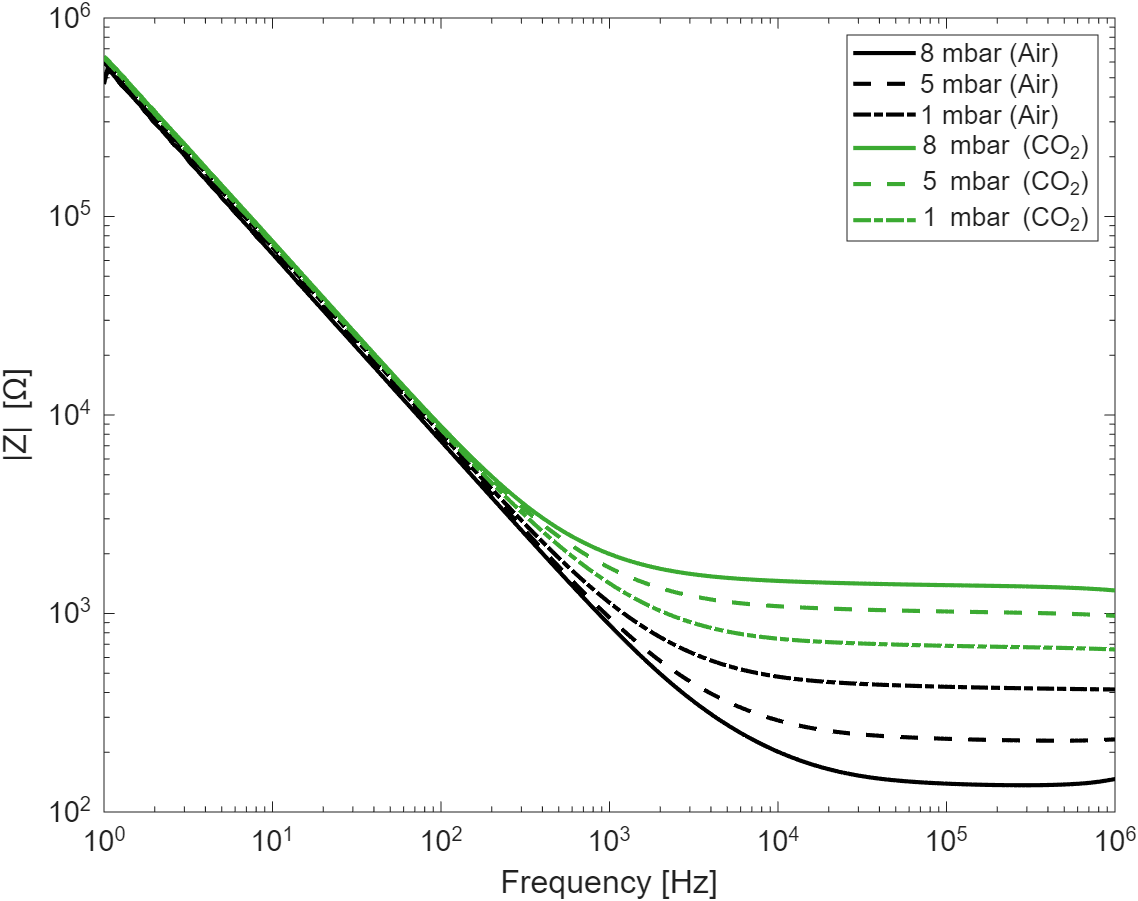
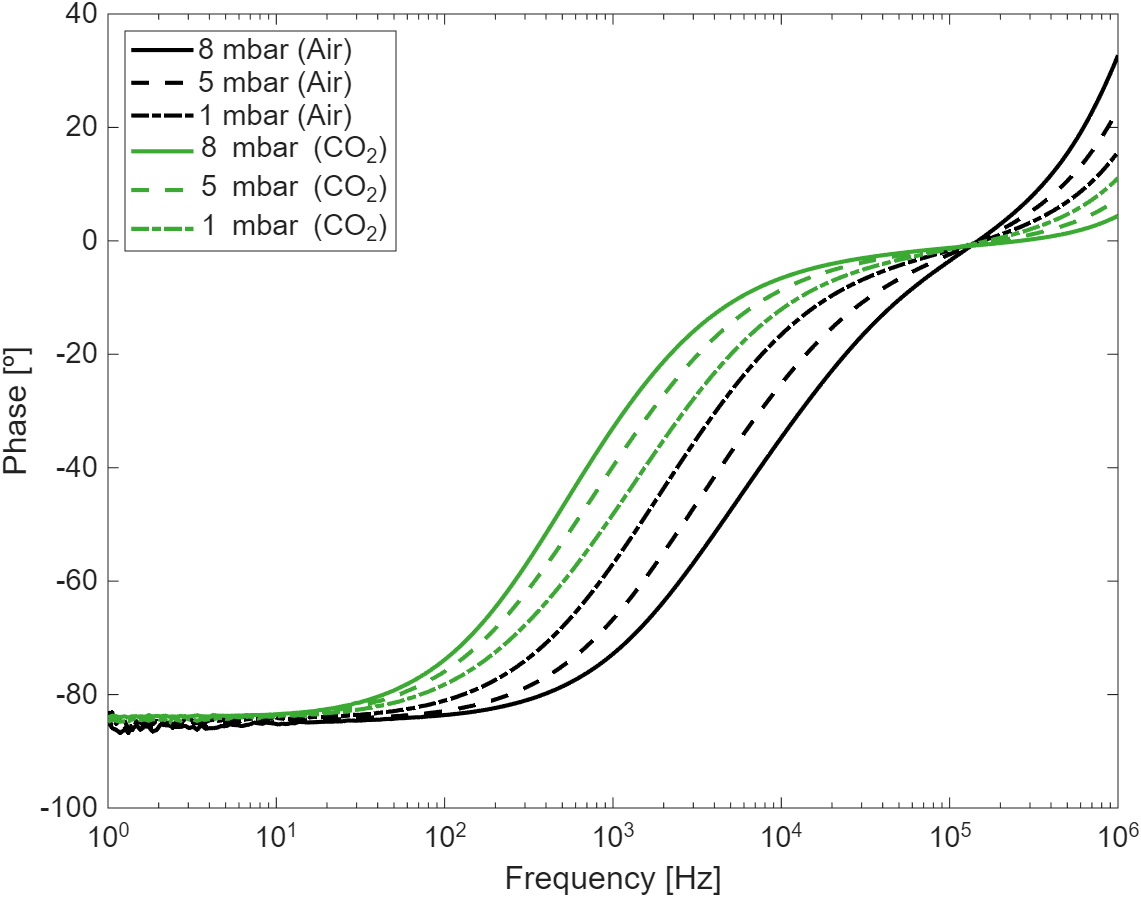
Figure 1. Z and phase responses of a SiO₂ CILGPE based capacitor under air and CO2 atmospheres at different pressures.
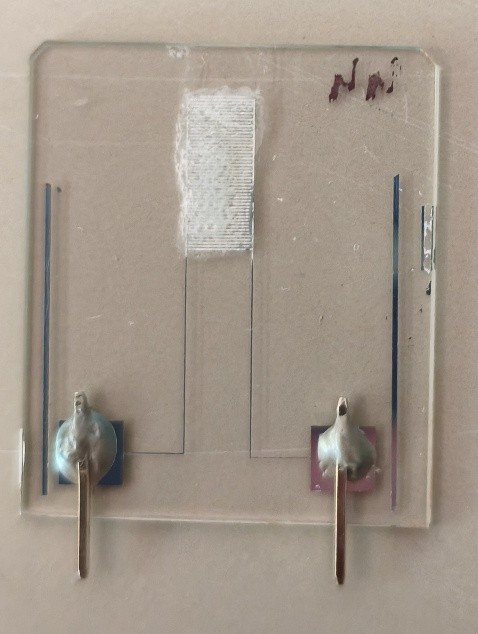
Figure 2. Final capacitive humidity sensor with alumina nanowires.
Acknowledgments
This work has been supported by the project PROD-UPC-2006-03, by the projects TED2021-131552B-C21/C22, by UPC-AGAUR 2026 and by the predoctoral program AGAUR-FI ajuts (2025 FI-1 01294) Joan Oró, which is backed by the Secretariat of Universities and Research of the Department of Research and Universities of the Generalitat of Catalonia, as well as the European Social Plus Fund.

How to cite: Palomas, A., Cedeño, M., Manyosa, X., Garland, S., Lorek, A., Domínguez-Pumar, M., and Bermejo, S.: Spin-Coated Nanowire-Polymer Electrolyte for Low-Latency Humidity Sensing in CO2 Atmospheres, Europlanet Science Congress 2026, The Hague, The Netherlands, 7–11 Sep 2026, EPSC2026-972, https://doi.org/10.5194/epsc2026-972, 2026.


