
 1,1,2,
- 1Institute of Astronomy, V.N. Karazin Kharkiv National University, 35 Sumska Str., 61022 Kharkiv, Ukraine
- 2LTE, Observatoire de Paris, Université PSL, Sorbonne Université, Université de Lille, LNE, CNRS, 75014 Paris, France
The study investigates the dynamical evolution of selected groups of small bodies of the Solar System using numerical simulations. The research focuses on the orbital evolution of Main Belt asteroids, near-Earth asteroids (NEAs), and meteoroids to reconstruct their dynamical history and identify bodies of common origin. The motion of these objects is studied under the combined influence of solar and planetary gravity, as well as non-gravitational forces such as the Yarkovsky and YORP effects. These mechanisms enable the identification of dynamically associated asteroid pairs and clusters, as well as the determination of their potential source regions. In the context of the global problem of asteroid hazard, the research also contributes to the identification of potentially hazardous objects, which is essential for risk assessment and the development of mitigation strategies.
Numerical modeling serves as the main tool for trajectory analysis and forecasting the long-term evolution of minor bodies. The application of numerical integration techniques permits solving the equations of motion of these bodies, whose complex and often chaotic dynamics are difficult or impossible to treat analytically due to nonlinearities and sensitivity to initial conditions. For this reason, numerical methods are the main methodological approach employed in this study.
A primary focus of this work is the identification and characterization of asteroid pairs, which are gravitationally unbound, genetically related bodies originating from disruptive events such as rotational fission, collisions, or the decay of binary systems. Initially formed on highly similar orbits, their components gradually diverge due to planetary perturbations and the Yarkovsky effect. The methodology relies on isolating candidate pairs based on their proximity in the space of osculating orbital elements, followed by statistical significance assessments and backward numerical integrations of their dynamics. To account for observational uncertainties, multiple orbital clones for each candidate are generated. A pair's formation age is established by identifying past epochs where the clones demonstrate close encounters, characterized by minimal relative distances and velocities.
The approach was validated using a test sample of known asteroid pairs with previously determined formation ages. After that, a comprehensive survey of the inner region of the main asteroid belt was conducted with phase-space distances of d ≤ 25 m/s, which yielded the discovery of 50 previously uncatalogued asteroid pairs. The estimated formation ages of these pairs span from 2,000 to 1 million years. Notably, the study identified one of the youngest known asteroid pairs with very close encounters. For this pair, the simulations explicitly incorporated the mutual gravitational attraction between the components, which was demonstrated to be an important factor in accurately modeling its orbital evolution (Fig. 1). Additionally, the search led to the discovery of a new asteroid cluster consisting of eight members, with an estimated formation age of 70,000 to 100,000 years (Fig. 2). It is assumed to be a part of the (25) Phocaea family, as the main body of the cluster 21028 (1989 TO) belongs to this family.
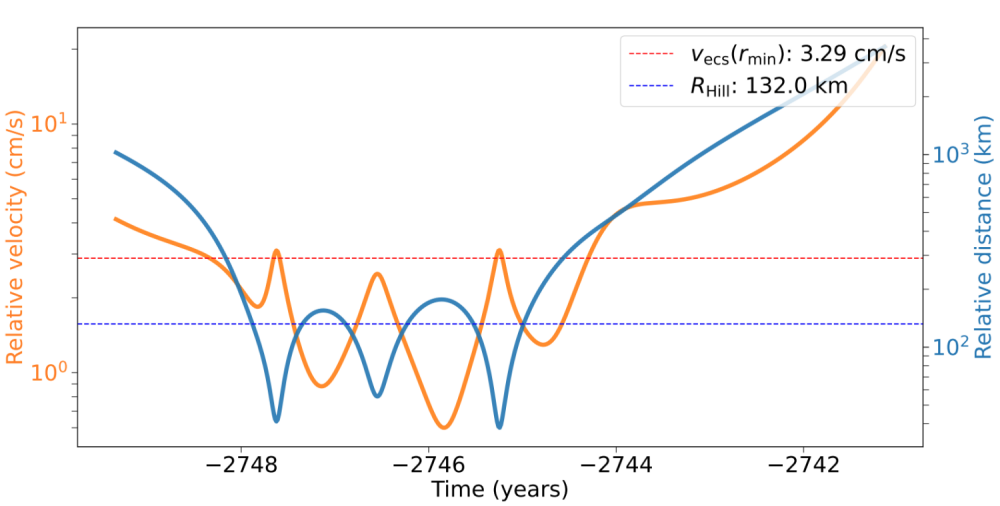
Fig. 1. Example of a close encounter between the clones of the pair 469759 (2005 QM29) - (2016 QZ123), where the mutual gravitational attraction influences the dynamics of the pair. The encounter led to gravitational capture, and clones revolved around the center of mass for 2-3 orbital periods.
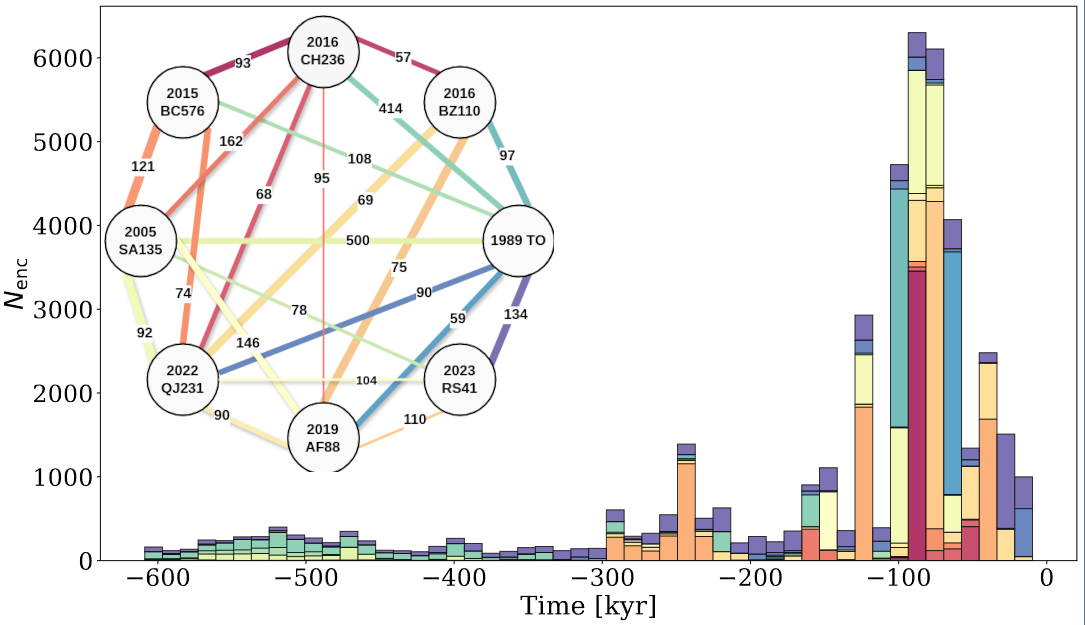
Fig. 2 Time distribution of close encounters for the cluster, where the colors of the links correspond to those of the histogram, while the width of connections illustrates the number of encounters between the components. The numbers on the lines represent the median of the encounter time distribution between the components.
The work also presents the results on identifying the source regions of individual meteoroids. It describes the methods and outcomes of utilizing instrumental observations of fireballs to reconstruct their atmospheric trajectories and their pre-atmospheric heliocentric orbits. The orbits were numerically integrated backward in time to search for potential source regions, close planetary encounters, and possible dynamical associations with selected asteroids. Candidate asteroids were selected based on proximity in orbital element space and similarity in Tisserand parameters. This approach was applied to the Adalen meteorite event (07 November 2020) and the Kyiv fireball (19 April 2023). A backward numerical integration of the meteoroid’s orbit over 1 million years was computed to search for potential parent bodies. The statistical estimates and the numerical results (Fig. 3) indicate that the Adalen meteoroid likely entered near-Earth space from the inner Main Belt either via the ν₆ secular resonance with Saturn (89%) or the 3:1 mean-motion resonance with Jupiter (10%). The meteoroid associated with the Kyiv fireball possibly originated from ν₆ secular resonance with Saturn (50%), 3:1 mean-motion resonance with Jupiter (19%), or the Hungary asteroid group (38%).
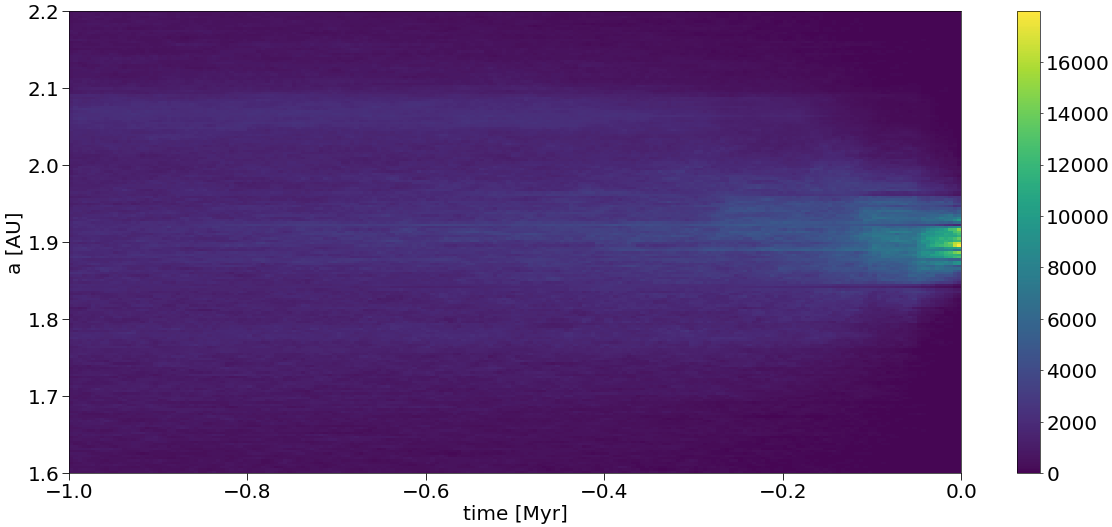
Fig. 3 Distribution of the semi-major axis of Adalen meteoroid clones in numerical integration up to 1 million years backward in time.
In the context of planetary defense, the dynamical evolution of the potentially hazardous asteroid (153201) 2000 WO107 was investigated. Utilizing photometric and radar observations from its 2020 opposition, the asteroid's shape, density, and rotational parameters were determined for the first time. The data confirmed a contact-binary structure, and the asteroid appears to contain a significant metallic component. Using data obtained, a refined Yarkovsky effect model was used to perform dynamical simulations of the asteroid and compute the probabilities of close planetary encounters. The analysis shows that the asteroid's dynamical evolution is governed by its highly elongated orbit and interactions with terrestrial planets, and that it poses no threat to Earth over the next 10,000 years (Fig. 4).
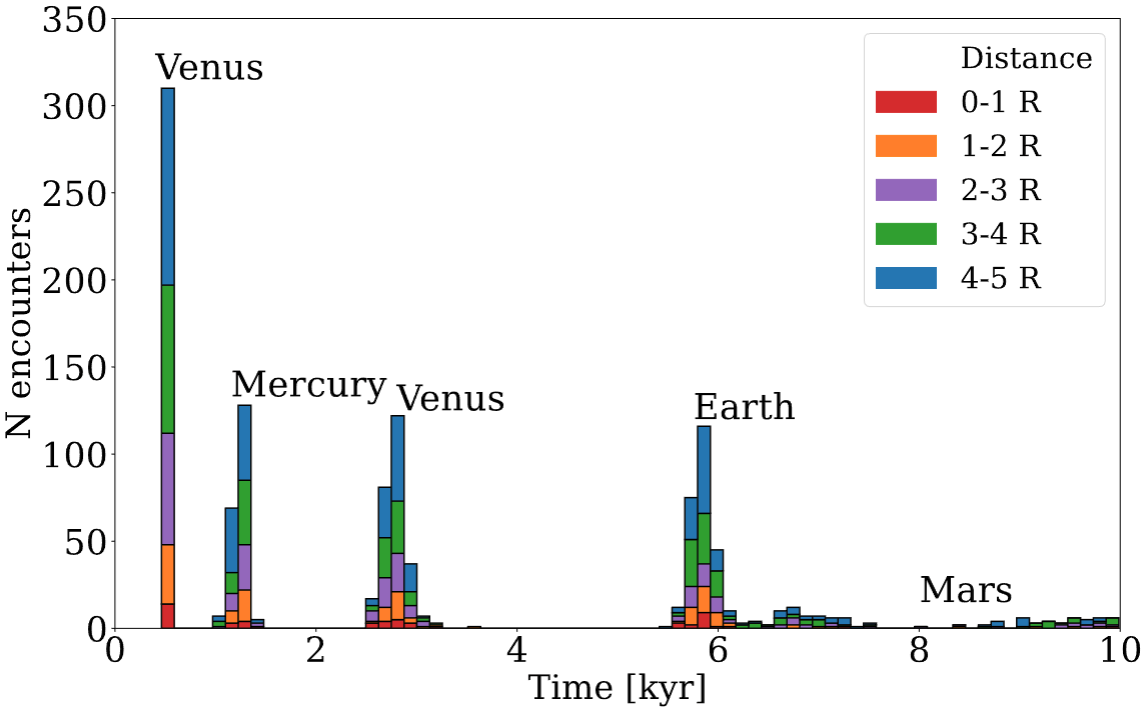
Fig. 4 Registered encounters of 200,000 clones of the 2000 WO107 asteroid with terrestrial planets in the simulation to 10 kyr into the future.
Acknowledgments
The authors are grateful to the Ukrainian soldiers who defend our lives and freedom from russian aggression. YK thanks the French PAUSE program, which provides support to scientists at risk.
How to cite: Kyrylenko, I., Kruhlyi, Y., and Golubov, O.: Numerical simulations of the asteroid dynamics: pairs, clusters, contact binaries, and the origin of meteorites , Europlanet Science Congress 2026, The Hague, The Netherlands, 7–11 Sep 2026, EPSC2026-975, https://doi.org/10.5194/epsc2026-975, 2026.


