
 1,1,3,
- 1Laboratoire Atmosphères Observations Spatiales (LATMOS), Guyancourt, France (guillaume.petzold@latmos.ipsl.fr)
- 2Instituto de Astrofísica de Andalucía (IAA), Granada, Spain
- 3Laboratoire de Météorologie Dynamique (LMD), Paris, France
Introduction
Dust is the main radiatively active component of the Martian atmosphere and the key driver of its thermal structure, its dynamics and thus of the water vapor distribution. Modelling the water cycle, in particular its upper atmospheric distribution, therefore relies on a dust scheme that produces a realistic representation of the dust vertical distribution in the atmosphere of Mars.
In the current Mars Planetary Climate Model (Mars PCM) [1], the dust size distribution is assumed to follow a log-normal distribution, characterized by moments  . The model scheme uses two of them [2] : M0 (the number of particles) and M3 (linked to the dust mass mixing ratio). From these two moments, the dust mean radius can be determined :

However, to permit this calculation, the variance σ02 is fixed (σ0= 0.64) everywhere in the model. This is a strong limitation, as sedimentation acts more efficiently on large particles than on small ones, so the size distribution naturally becomes narrower with altitude, and the variance is thus not constant. Since small particles dominate the radiative heating at high altitudes and act as condensation nuclei for water-ice clouds, a better representation of the size distribution, and especially of its variance, is critical for the simulated atmosphere as a whole.
Methods
We overcome this limitation by introducing a third moment, with the new tracer M2, transported by the model alongside M0 and M3. M2 is initialised from the two existing moments under the log-normal assumption and is then free to evolve. With three moments, the variance is now able to vary in space and time :

The mean radius and the effective radius are now obtained directly from the transported moments, without any prescribed variance :

The new tracer is included in every process that acts on the dust distribution. Sedimentation now redistributes M0, M2 and M3 in a way that depends on the size of the particles, so that the variance naturally decreases with altitude as small particles remain high longer than large ones. The cloud microphysics scheme [3] also needs the implementation of a new condensation nuclei tracer to ensure the conservation. The dust injection scheme is also adapted to provide the three moments in a consistent way. The radiative transfer, which is sensitive to the effective variance, now sees a distribution that varies with altitude and season, rather than a fixed one.
Results
Simulations with the new three-moment scheme show several improvements compared to the two-moment reference. The simulated column dust opacity is slightly closer to the dust climatology of Montabone et al. (2015) [4], both in amplitude and in seasonal distribution. More importantly, the effective radius now decreases with altitude (Figure 1), which is the direct signature of the improved sedimentation process, while we observe the same effect on the effective variance, which is not fixed anymore. This new vertical evolution of the dust distribution impacts the radiative rates and, through it, the water cycle.
The most important result concerns water vapor at high altitudes during the dusty perihelion season. The two-moment scheme underestimates the amount of water vapor observed by ACS (Atmospheric Chemistry Suite) [5] above the lower atmosphere at this season, a long-known issue of the model. With the three-moment scheme, more water vapor reaches the upper atmosphere and the agreement with ACS profiles is significantly improved (Figure 2). The implementation doesn’t only affect the vertical distribution of water vapor, the results also feature the water vapor column-integrated distribution. First results on the D/H cycle are also presented, looking at how the new size distribution changes the fractionation between HDO and H2O through cloud microphysics and through transport to the altitudes at which water can be photodissociated.
Conclusion
Adding a third moment to the Mars PCM dust scheme is a physically motivated modification of the model that lifts the fixed variance assumption and lets the dust distribution evolve more naturally with altitude and season. It brings the simulated dust opacity and the high-altitude water vapor closer to observations, and opens a new path to study the D/H cycle and water escape in a consistent framework.
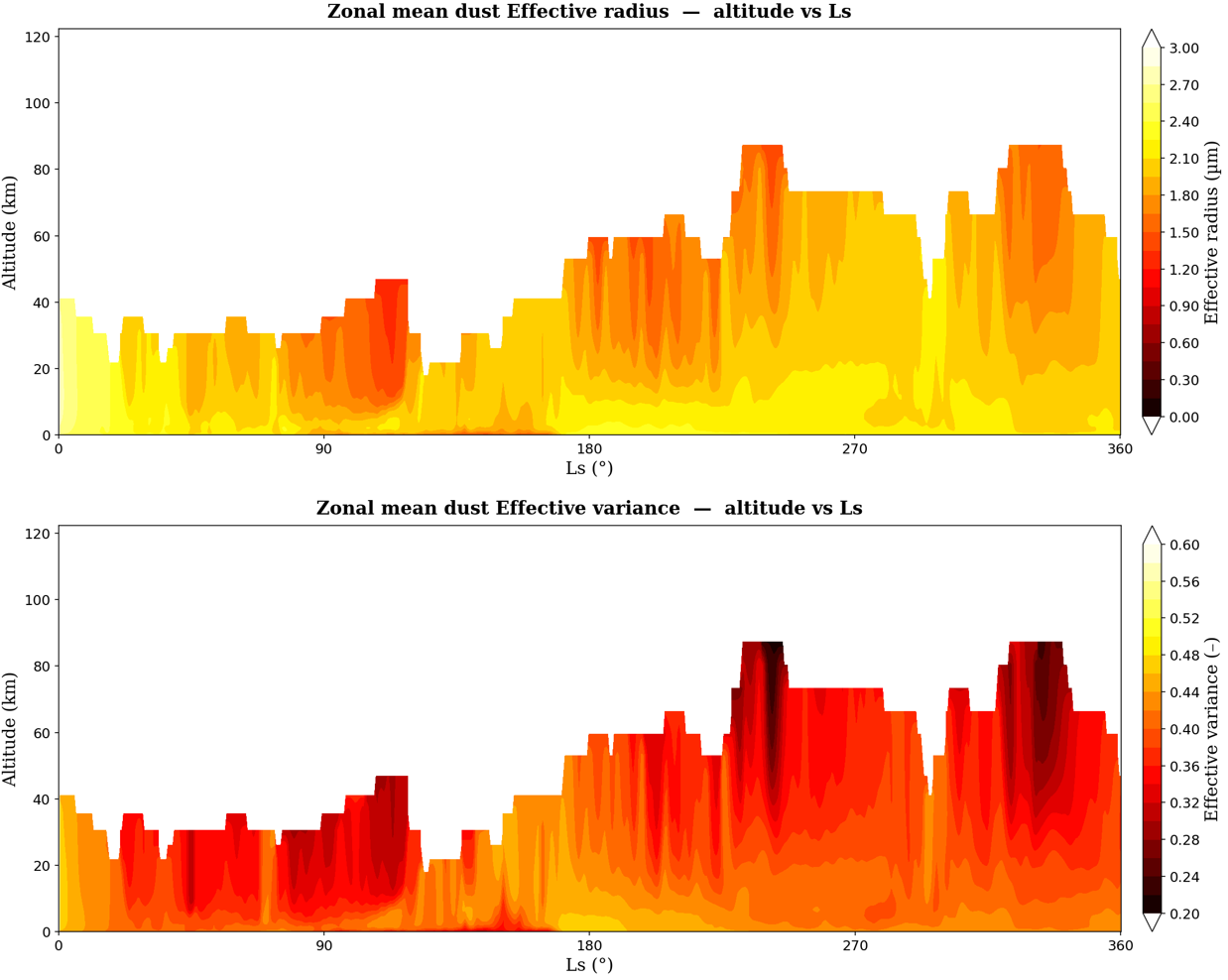
Figure 1. Zonal-mean effective radius (top) and effective variance (bottom) as a function of altitude and Ls, simulated with the three-moment scheme during MY33.
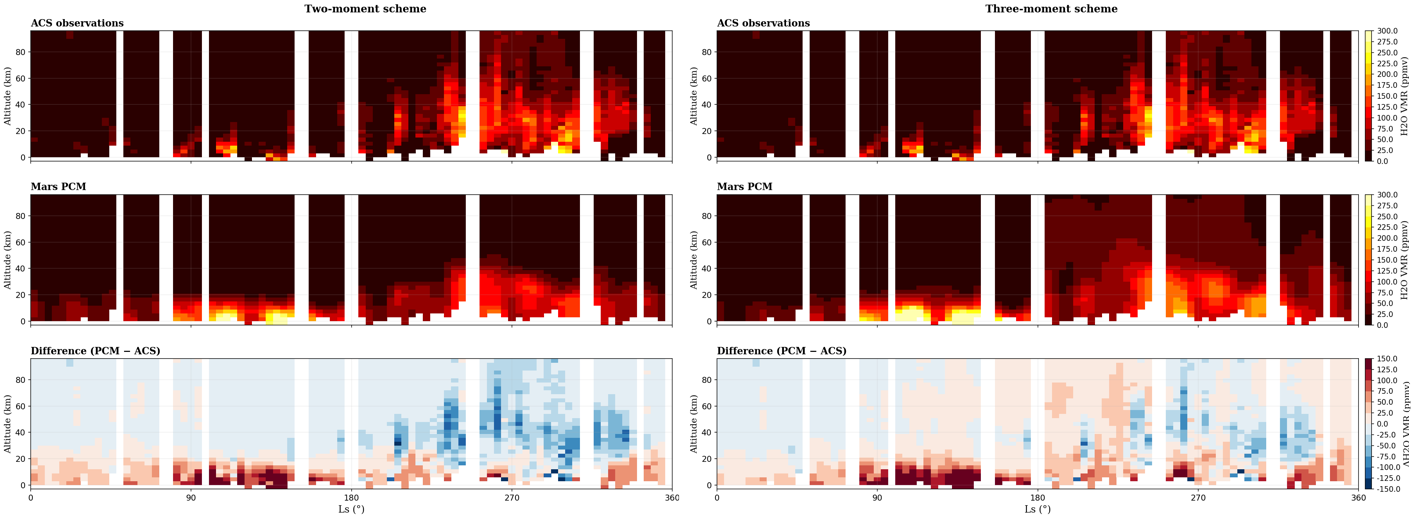
Figure 2. Alt–Ls distributions for ACS (top), PCM (middle) and their difference PCM−ACS (bottom) for MY35 with the two-moment scheme (left) and the new three-moment scheme (right)
References
[1] Forget, F., et al. (1999), Improved general circulation models of the Martian atmosphere from the surface to above 80 km, J. Geophys. Res., 104(E10), 24155–24175, doi:10.1029/1999JE001025.
[2] Madeleine, J.‐B., et al. (2011), Revisiting the radiative impact of dust on Mars using the LMD Global Climate Model, J. Geophys. Res., 116, E11010, doi:10.1029/2011JE003855.
[3] Navarro, T., et al. (2014), Global climate modeling of the Martian water cycle with improved microphysics and radiatively active water ice clouds, J. Geophys. Res. Planets, 119, 1479–1495, doi:10.1002/2013JE004550
[4] Montabone, L., et al. (2015), Eight-year climatology of dust optical depth on Mars, Icarus, Volume 251, 2015, Pages 65-95, ISSN 0019-1035, https://doi.org/10.1016/j.icarus.2014.12.034.
[5] Fedorova, A., et al. (2023). A two-Martian years survey of the water vapor saturation state on Mars based on ACS NIR/TGO occultations. Journal of Geophysical Research: Planets, 128, e2022JE007348. https://doi.org/10.1029/2022JE007348
How to cite: Petzold, G., Montmessin, F., Alday, J., Forget, F., Millour, E., and Verdier, L.: Implementing a third moment in the dust scheme of the Mars PCM : impacts on water vapor and D/H, Europlanet Science Congress 2026, The Hague, The Netherlands, 7–11 Sep 2026, EPSC2026-977, https://doi.org/10.5194/epsc2026-977, 2026.


