
 ,
,- Department of Physics, University of Helsinki, Finland (antti.i.penttila@helsinki.fi)
Optical cameras with wideband filters or color filters, or hyperspectral cameras, are typical instruments on board space missions. Before the actual imaging operations during the missions, these operations need to be planned and tested. Furthermore, the data processing pipelines for the image data need to be designed and tested. For both of these tasks, realistic simulated instrument data is needed.
We have been working together with the hyperspectral camera team from VTT Finland who are providing the Fabry-Pérot hyperspectral cameras for ESA’s Hera mission (ASPECT camera on Milani CubeSat) and for Comet Interceptor mission (NIR-MIR part of the MIRMIS instrument on the main spacecraft). We have developed a Blender/Python framework where camera simulations can be done. There are some important design goals we are concentrating on with our tool. They are: (1) Realistic and trackable surface scattering models typical to planetary science applications; (2) Physically correct volume scattering models for dust and gas in cometary coma; (3) Interoperations with SPICE kernels for target shape and attitude, camera location and attitude, and solar illumination direction; (4) Camera and detector simulations to produce the observed image in the internal digital numbers from the instrument including the noise components from the instrument.
To reach our goals, we have a Python module that can be loaded to be used in the internal Python console of the open-source Blender 3D rendering software for the image rendering tasks, and a stand-alone Python module for the image post-processing functions including expanding a single-wavelength rendered image into a hyperspectral datacube, and producing the instrument-dependent output. This output can be used to test the data processing pipelines of the instrument and should produce realistic radiances and instrumental errors.
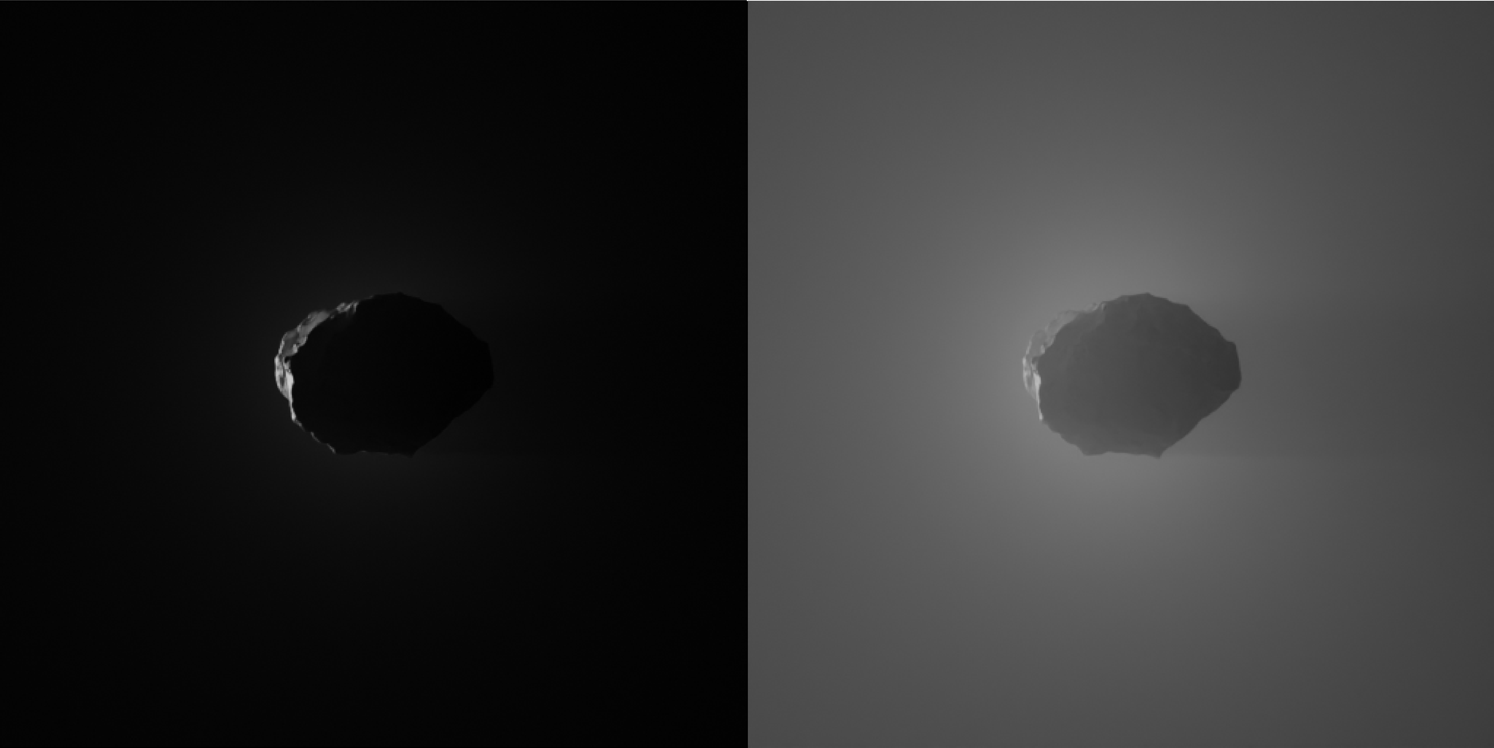
The development of the tool is an ongoing project, versions of the software are published as open source[1], but improved version is under work. The recent improvements include a complete rework of the Blender Python module design and including the gas and dust volume rendering for cometary environments. An example of two renderings of a comet nucleus with either nominal activity from the Comet Interceptor dust and gas model, or an extravagated activity, are shown in the figure. Using the tool in testing the Hera ASPECT and Comet Interceptor NIR-MIR part of MIRMIS data pipelines will be presented.
[1] Asteroid Image Simulator software at https://bitbucket.org/planetarysystemresearch/asteroid-image-simulator
How to cite: Penttilä, A., Kolehmainen, M., Keski-Vakkuri, A., and Negri, L.: Hyperspectral camera simulations using Blender with applications on the ESA Hera and Comet Interceptor missions, Europlanet Science Congress 2026, The Hague, The Netherlands, 7–11 Sep 2026, EPSC2026-984, https://doi.org/10.5194/epsc2026-984, 2026.


