
 1,1,2,2,4,3,5,6
- 1LATMOS/IPSL, UVSQ Université Paris‐Saclay, Sorbonne Université, CNRS, Guyancourt, France (yann.leseigneur@latmos.ipsl.fr)
- 2LIRA, PSL University, CNRS, Meudon, France
- 3LMD, IPSL, Sorbonne Université, CNRS, Paris, France
- 4Department of Earth and Planetary Sciences, Yale University, New Haven, CT, USA
- 5Centre for Mars Meteorology Monitoring, Paneureka, Le Bourget‐du‐Lac, France
- 6Space Science Institute, Boulder, CO, USA
Dust is a crucial parameter for planetary atmospheres, particularly for Mars. These mineral micrometre-sized particles absorb and diffuse incoming sun rays, which heat the atmosphere locally. Dust also affects many atmospheric processes, such as the circulation, the water cycle, the atmospheric escape, and the CO2 cycle. In this work, we will present a novel catalogue of local dust storms on Mars. Here, we consider the following dust storm definition: a large and optically thick dust cloud [1]. The dust storms reach different stages during their lifetime: formation, growth/evolution, and dissipation/sedimentation. These storms can be classified by their spatial extension, called local storms (< 1.6 106 km2), regional storms (> 1.6 106 km2) and planetary (global) storms [2]. Questions remain about the storm formation and growth mechanisms, which are relevant to storm forecasting.
While many studies dedicated to dust storms are focused on regional storms [3, 4, 5], studying dust activity at a local scale is key to better understanding the first stages of storm formation and growth. Here, we present our work on detecting dust storms in the OMEGA/Mars Express (near-IR imaging spectrometer) dataset, chosen for its high spatial resolution (0.36-4.8 km/pixel), allowing the detection of small storms. We developed a method to detect automatically storms from dust optical depth data (see Figure 1) computed at 0.9 µm [6] available from late Martian Year 26 to mid MY 30. The storm detections have been confirmed manually and compiled into the OMEGA Dust Storm Catalogue (ODSC) [7]. This catalogue is composed of 448 storm detections, from which ~81% are local storms and ~19% regional ones.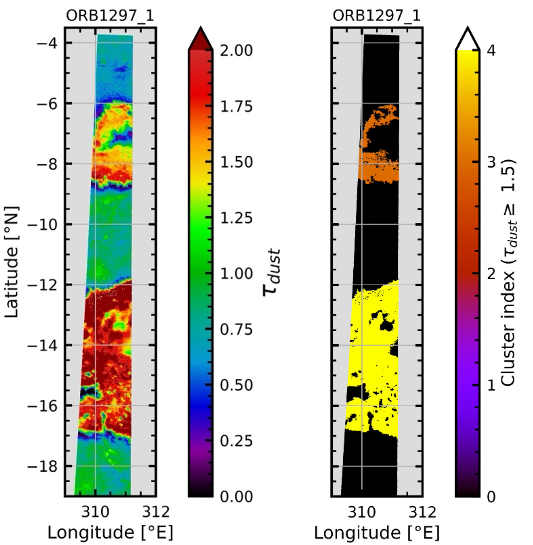
Figure 1: Automatic detections of two dust storms in an OMEGA/Mars Express observation. [Left] and [right] correspond respectively to the dust optical depth map of the observation derived by [6] and the storm detection mask number. Adapted from [8].
Using this catalogue, we studied the spatial, time and diurnal distribution of the detections [8], and we present here a summary of the results. The local storm activity is widespread on Mars (see Figure 2), with favoured areas such as southern polar cap edges, flushing dust storm channels, or Hellas Planitia and Valles Marineris [8]. Most of the storm detections have been made between 10:00 and 18:00, reaching a maximum at 14:00-16:00 [8]. The storm growth mechanisms seem to be less efficient during particular periods of the Martian year, as during the northern solstitial pause (Ls ~240-270°), when we are still detecting many local storms, while the regional storm activity is low. Regional storm detections are mostly concentrated during MY 29 and MY 28, more specifically during the early formation stage of the Global Dust Storm (Ls~265-270°) [8]. This suggests that the lifting and transport processes were stronger and more effective during this period.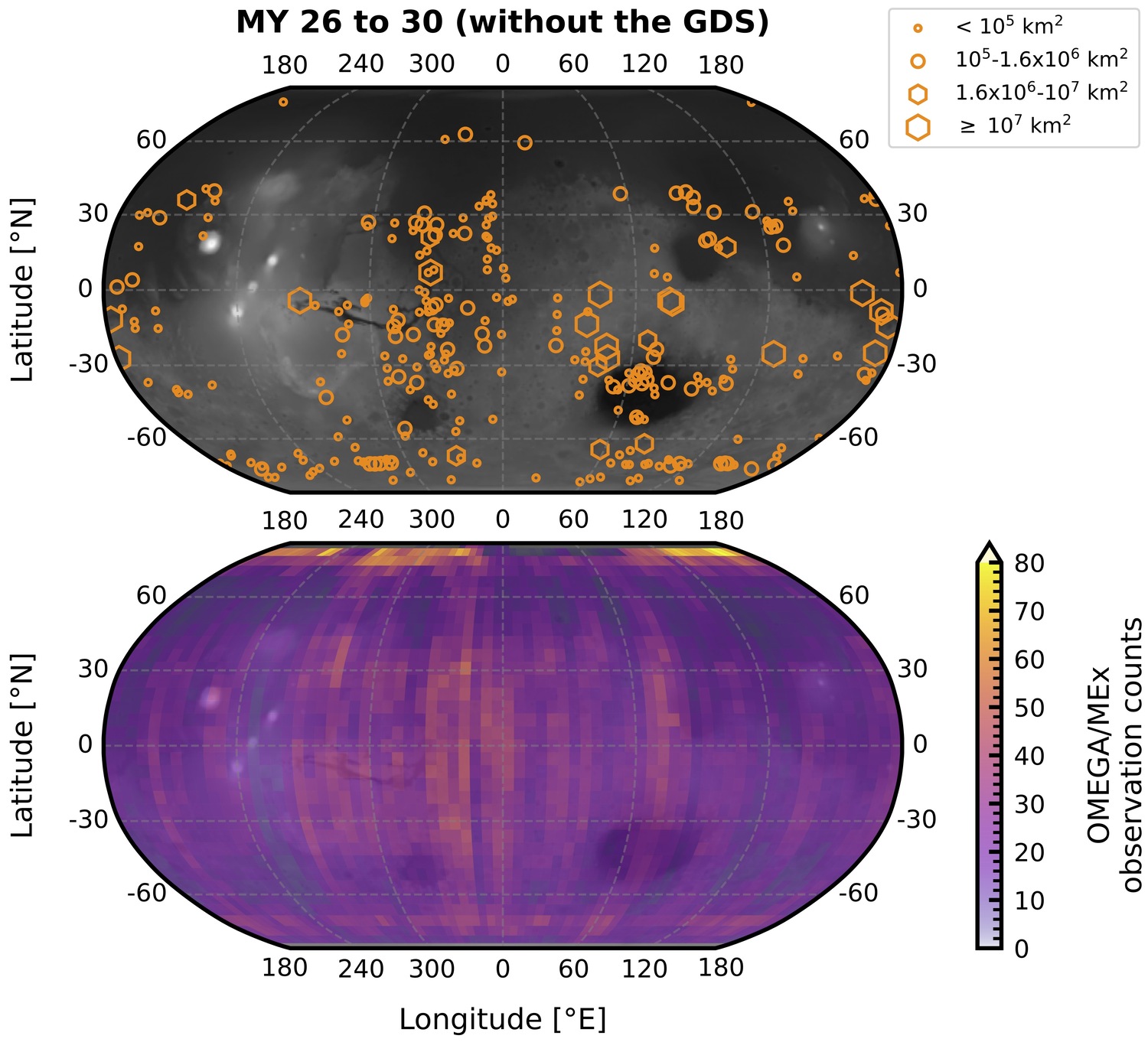
Figure 2: Spatial distribution of the OMEGA Dust Storm Catalogue detections [top] and OMEGA/Mars Express observations [bottom] from MY 26 to 30 without the MY 28 Global Dust Storm period (Ls~265-305°). For [top], the circles and hexagons symbolised respectively local and regional storms. Extracted from [8].
This new local and regional storm catalogue will also be useful for preparing observations of future missions such as the Martian Moons eXploration (MMX, JAXA), which will also study the Martian atmosphere [9] from 2027. Due to its equatorial orbit, MMX and its instrumental payload, especially the MMX InfraRed Spectrometer (MIRS, [10]), will give the opportunity to study diurnal variations of the storms, and therefore to constrain the storm formation and growth mechanisms. The ODSC, among other catalogues [3, 4, 5], is notably used to schedule Martian dust storm observations.
References:
[1] Kahre M. A. et al. (2017), Cambridge Univ. Press, The Atmosphere and Climate of Mars, 295-337. [2] Cantor, B. A et al. (2001) JGR, 106(E10), 23653–23687. [3] Battalio M. & Wang H. (2021) Icarus, 354, 114059. [4] Guha B. K. et al. (2024) JGR Planets, 129, e2023JE008156. [5] Lombard T. & Montabone L. (2024), 10th International Conference on Mars, abstract #3041. [6] Leseigneur Y. and Vincendon M. (2023) Icarus, 392, 115366. [7] Leseigneur Y. et al. (2025) Zenodo, 10.5281/zenodo.17380018. [8] Leseigneur Y. et al. (2026) JGR: Planets, 131, e2025JE009502. [9] Ogohara K. et al. (2021) Earth, Plan. and Space, 74, 1. [10] Barucci M. A. et al. (2021) Earth, Plan. and Space, 73, 211.
How to cite: Leseigneur, Y., Gautier, T., Bertrand, T., Spiga, A., Battalio, J. M., Lombard, T., and Montabone, L.: Chasing the Martian Dust Storms with the OMEGA Dust Storm Catalogue, Europlanet Science Congress 2026, The Hague, The Netherlands, 7–11 Sep 2026, EPSC2026-989, https://doi.org/10.5194/epsc2026-989, 2026.


