
 1,1,2,
- 1IRAP/CNRS, Planetary Science, Toulouse, France (agnes.cousin@irap.omp.eu)
- 2LGL-TPE, Lyon, France
- 3LIRA, Observatoire de Paris, France
- 4Purdue University, Lafayette, USA
Introduction: Martian regolith [1] is constituted with different mineral phases of various grain sizes that could originate from local, regional or global sources [2,3]. It corresponds to the ultimate stage of various erosion and weathering processes. Dust (<3microns) also constitutes the regolith and comes from a more global source. Understanding the different mineralogies with their associated grain sizes and shapes can help investigate the past conditions, as the regolith can record different aqueous alteration processes that Mars’ surface has undergone. This is also useful to decipher the different sources, from local to more regional or global, and therefore understand better the different physical processes forming the soils. Last, the study of the regolith can also help constrain some modern processes, such as the exchange between the surface and the atmosphere.
The MSL/Curiosity rover has been exploring Gale crater since 2012 [4], investigating first the crater floor (Aeolis Palus) and now climbing the central sedimentary mound, informally named Mount Sharp. Its traverse is documenting the climate evolution of early Mars. Indeed, the lower section of Mt Sharp stratigraphy corresponds mainly to ancient aqueous deposits, with abundant smectite signatures, whereas higher strata are dominated by sulfate-bearing rocks, representing a major environmental transition, probably with wet-dry cycles [5]. The SAM and CheMin instruments have analyzed a sieved regolith sampled (<150 microns), showing that the regolith was principally composed of primary igneous phases (40.8 wt% plagioclase, 22.4 wt% olivine, 14.6 wt% augite and 13.8 wt% pigeonite), along with some secondary phases (<10 %, no claysx) and around 30% of X-ray amorphous materials [6,7]. The ChemCam instrument also analyzed some regolith recurrently along the traverse. [8,9] have shown that the coarser grains (>500 microns) were felsic in composition and likely derived from the felsic rocks encountered early in the traverse. The active dunes were also slightly different in composition compared to the regolith, being depleted in the finest particles and in volatile elements [10,11]. [12] investigated the fine-grained regolith (<500 microns) during the first 200 sols of the traverse by ChemCam and found that the main carrier of the hydration in the regolith was related to the presence of Mg-rich sulfates in the amorphous component, probably derived from the weathering of olivine in water-limited acidic conditions.
The objective of this study is to better understand the volatile-element sources in the fine-grained regolith. In particular, we would like to explore the hypothesis that the amorphous sulfates found in Gale soils are derived from local inputs, more specifically the sulfate unit of Mt Sharp. Now that Curiosity has reached this unit, we would expect a higher abundance of sulfates in the regolith if the hypothesis is correct. On the other hand, we would like to explore the possible source of H and Cl in the fine-grained regolith at Jezero.
Method: ChemCam [13,14] uses the LIBS technique to retrieve the chemical composition of major elements and of some minor elements [15].
Results: The S signal has been monitored along the Curiosity traverse in the fine-grained regolith (<500 microns) analyzed by ChemCam up to sol 4160. One important thing to note is that most of the fine-grained regolith has been acquired with ChemCam during the first 60 meters of elevation, which correspond to the first 5 km of drive distance, in Aeolis Palus. Figure 1 shows some gaps in the data, with several intervals in the stratigraphy without any fine-grained regolith observations, such as between -4405 and -4285m. This is probably related to an observation bias.
Starting at elevation > -3845m, the median of the S signal is systematically higher than that found during the beginning of the traverse, in Aeolis Palus (the average of this region is shown with the red dashed line). Not only is the median overall higher, but the third quartile of the distribution is also overall higher than previous locations encountered. Moreover, the highest detections within the Mount Sharp observations do not correspond to outliers (but are included in the 3rd quartile), in contrast to the Aeolis Palus and the VRR and Glen Torridon observations (around -4185 to -4085m).
Discussion: These preliminary results suggest that there is a slight enrichment in sulfur in the fine-grained regolith that have been analyzed in the Mount Sharp terrains compared to those analyzed in Aeolis Palus, VRR or Glen Torridon. Sulfur (along with Cl and H) in soils is mostly carried by the finest particles, as seen in Bagnold Dunes observations [11]. These finest particles are known to be transported by wind and therefore are considered to represent a global component. However, the bedrock encountered in the sulfate-bearing unit are fine-grained [29] and therefore their erosion would generate fine-grained particles more easily, that could contribute directly to the formation of local soils, which can explain the enrichment in the regolith in this unit. This would explain the difference of the S signal between the Gale and Jezero regoliths.
More work needs to be done with the ChemCam data, such as also investigating the H signal and the trends of major elements in regolith along the traverse, in order to understand if this increase in S is correlated to the presence of Mg sulfates in the bedrock, or even to search for mixtures of Mg-Na sulfates as found by [30] in some bedrock.
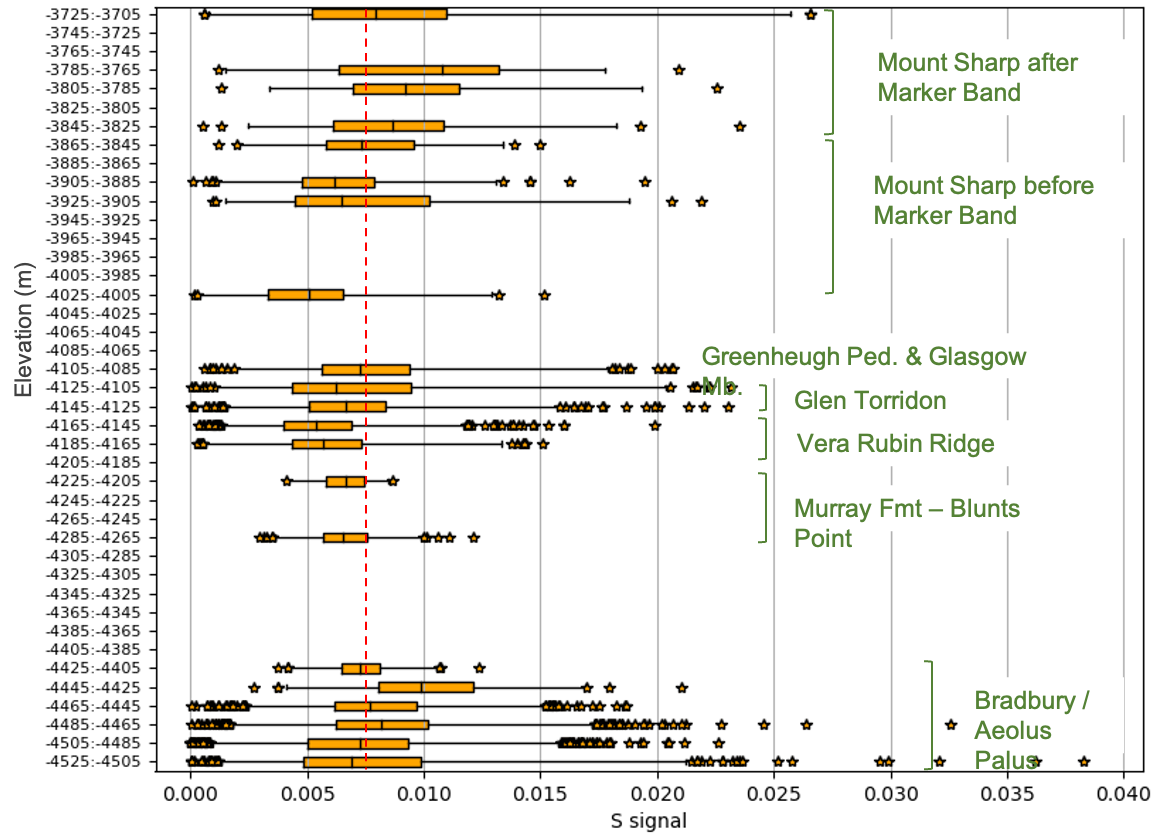
Figure 1: Boxplot representing the S signal in fine-grained ChemCam regolith as a function of the rover elevation (binned every 20m). Outliers are represented as stars. Red dashed line represents the average Aeolis Palus S signal.
[1] Certini et al., (2020) [2] McSween et al., (2010) [3] Yen et al., (2005) [4] Vasavada et al., Space Sci. Rev. 218 (2022) [5] Rapin et al., (2023) [6] Blake et al., (2013) [7] Rampe et al., (2018) [8] Meslin et al., (2013) [9] Cousin et al., (2015) [10] Cousin et al., (2017) [11] Ehlmann et al., (2017) [12] David et al ,(2022) [13] Maurice et al., (2012) [14] Wiens et al., (2012) [15] Clegg et al., 2017)) [16] Rudolph et al., (2024) [17] Hughes et al, (2024).
How to cite: Cousin, A., Rapin, W., Meslin, P.-Y., Dehouck, E., Forni, O., David, G., Pilleri, P., Wiens, R. C., and Gasnault, O.: Investigation of the sources of volatile elements in fine-grained regolith on Mars , Europlanet Science Congress 2026, The Hague, The Netherlands, 7–11 Sep 2026, EPSC2026-99, https://doi.org/10.5194/epsc2026-99, 2026.


