EXOA3 | AI for exoplanet and brown dwarf studies

EXOA3

AI for exoplanet and brown dwarf studies
Co-organized by MITM
Convener: Yann Alibert | Co-conveners: Jeanne Davoult, Sara Marques, Romain Eltschinger, Kai Hou (Gordon) Yip, Jo Ann Egger, Carles Cantero Mitjans
Orals TUE3
| Tue, 08 Sep, 14:00–15:30 (CEST)|Room Saturn (Jazz 3)
Posters MON-POS
| Attendance Mon, 07 Sep, 18:00–19:30 (CEST) | Display Mon, 07 Sep, 08:30–19:30|Foyer 3, F3.63
Tue, 14:00
Mon, 18:00
Artificial intelligence (AI) is revolutionizing planetary sciences, enabling new insights from vast and complex datasets, both for solar system exploration and the study of exoplanets and brown dwarfs.

This session will explore AI-driven approaches for studies, focusing on innovative techniques such as image analysis, curriculum learning, diffusion models, generative models for data augmentation and simulation, machine learning techniques for analyzing large-scale surveys. We will also discuss applications of natural language processing for scientific literature mining, and uncertainty quantification in AI-driven models. By bringing together experts in AI and exoplanetary science, this session aims to foster interdisciplinary collaborations and advance the field.

Orals: Tue, 8 Sep, 14:00–15:30 | Room Saturn (Jazz 3)

Chairperson: Romain Eltschinger
14:00–14:06
14:06–14:18
|
EPSC2026-276
|
On-site presentation
Emilie Panek, Alexander Roman, Gaurav Shukla, Leonardo Pagliaro, Katia Matcheva, and Konstantin Matchev

The rapid expansion of exoplanet atmospheric observations and the proliferation of a wide range of specialized modeling tools has created a need for flexible, accessible, and user-friendly workflows. Transmission spectroscopy, in particular, has become a key technique for probing atmospheric composition of transiting exoplanets. The analyses of these data require the combination of archival queries, literature search, the use of radiative transfer models, and Bayesian retrieval frameworks, each demanding specialized expertise. Modern large language models (LLMs) enable the coordinated execution of complex, multi-step tasks by AI agents with tool integration, structured prompts, and iterative reasoning.
In this study we present ASTER, an Agentic Science Toolkit for Exoplanet Research. ASTER is an orchestration framework that brings LLM capability to the exoplanetary community by enabling LLM-driven interaction with integrated domain-specific tools, workflow planning and management, and support for common data analysis tasks.
Currently ASTER incorporates tools for downloading planetary parameters and observational datasets from the NASA Exoplanet Archive, as well as the generation of transit spectra from the TauREx radiative transfer model, and the completion of Bayesian retrieval of planetary parameters within the TauREx framework. 
Beyond tool integration, the agent assists users by proposing alternative modeling approaches, reporting potential issues and suggesting solutions, as well as higher-level interpretations. We demonstrate ASTER's workflow through a complete case study of WASP-39b, performing multiple retrievals using observational data from different sources available on the archive. The agent efficiently transitions between datasets, generates appropriate forward model spectra and performs retrievals that recover atmospheric parameters reported in the literature. ASTER provides a unified platform for the characterization of exoplanet atmospheres.  Ongoing development and community contributions will continue expanding ASTER's capabilities toward broader applications in exoplanet research.

How to cite: Panek, E., Roman, A., Shukla, G., Pagliaro, L., Matcheva, K., and Matchev, K.: ASTER - Agentic Science Toolkit for Exoplanet Research, Europlanet Science Congress 2026, The Hague, The Netherlands, 7–11 Sep 2026, EPSC2026-276, https://doi.org/10.5194/epsc2026-276, 2026.

14:18–14:30
|
EPSC2026-582
|
ECP
|
Virtual presentation
Massimiliano Giordano Orsini, Francesco Ostuni, Alessio Ferone, and Laura Inno

Abstract. Atmospheric retrieval is a fundamental tool for the characterization of exoplanetary atmospheres, enabling a deeper understanding of planetary formation, evolution, and habitability. Yet, traditional Bayesian retrieval methods remain computationally prohibitive at the scale demanded by upcoming surveys such as the ESA Ariel mission.  We present Hierarchical Flow Matching Posterior Estimation (HFMPE), a novel simulation-based inference framework for exoplanetary atmospheric retrieval, which efficiently provides high-quality posterior distributions using a hierarchical formulation. Benchmarked on the Ariel Data Challenge 2023 dataset against neural- and sampling-based competitors, HFMPE achieves superior or on-par retrieval performance in terms of regression errors, posterior calibration, uncertainty quantification, and coverage at lower computational cost, highlighting its potential as an efficient and scalable tool for next-generation atmospheric characterisation.

Introduction. Atmospheric retrieval is the primary method for inferring the physical and chemical properties of exoplanetary atmospheres. including molecular abundances, thermal profiles, and cloud or haze properties, from observed spectroscopic data [1]. This technique is therefore fundamental to characterizing exoplanetary atmospheres, and by extension, to advancing our understanding of planetary formation, evolution, and the habitability conditions of these distant worlds. The next generation of exoplanet surveys, including the ESA Ariel mission [2], will observe thousands of targets, demanding accurate posterior inference at unprecedented scale. However, traditional Bayesian approaches, such as Markov Chain Monte Carlo and Nested Sampling [3], while providing asymptotically exact uncertainty estimates, are inherently sequential and computationally prohibitive for datasets of this magnitude. 

Background. Recent simulation-based inference methods, such as Flow Matching Posterior Estimation (FMPE) [4], address this challenge by significantly accelerating retrieval while maintaining highly competitive posterior accuracy. Specifically, FMPE is a simulation-based inference technique built on Continuous Normalizing Flows [5], which trains a neural network to learn a time-dependent velocity field that transports samples from a simple prior distribution to the target posterior. At inference time, this transport is simulated by integrating an ordinary differential equation (ODE), yielding high-quality posterior samples in a fraction of the time required by classical methods [6, 7]. Despite this advantage, FMPE still demands a substantial number of neural function evaluations (NFEs) to achieve accurate integration, and reducing this cost is key to further improving its scalability for large-scale surveys.

Contribution. Inspired by Hierarchical Rectified Flow [8], we introduce Hierarchical Flow Matching Posterior Estimation (HFMPE), a novel retrieval framework that hierarchically couples multiple ODEs operating in different domains (location, velocity, acceleration, etc.). This formulation produces straighter and more efficient sampling trajectories, substantially reducing the computational burden during inference. The proposed framework naturally extends our prior work [7], which jointly exploits transmission spectra, per-channel instrumental uncertainties, and auxiliary planetary system parameters to estimate the full posterior distribution of atmospheric parameters.

Validation. We benchmark HFMPE on the Ariel Data Challenge (ADC) 2023 dataset [9] against both state-of-the-art neural and sampling-based baselines, including the FMPE baseline, Neural Posterior Estimation (NPE) with discrete normalizing flows [10], and Nested Sampling. We adopt a comprehensive evaluation protocol encompassing regression errors, posterior calibration, uncertainty quantification, and coverage. HFMPE outperforms NPE across most predictive metrics and achieves superior or on-par performance relative to Nested Sampling and FMPE with fewer neural function evaluations, demonstrating its effectiveness and efficiency as a retrieval tool for large-scale atmospheric characterization.

Conclusion.  In this talk, I will present HFMPE, a novel, scalable atmospheric retrieval framework, focusing on its motivation, mathematical background and experimental validation. We show that HFMPE converges towards state-of-the-art performance with fewer neural function evaluations on the ADC dataset, and demonstrates even more promising retrieval performance at comparable inference budgets. These results highlight HFMPE’s potential as an efficient and scalable solution for next-generation exoplanet atmospheric characterization, particularly in the context of large-scale survey missions such as Ariel.

The authors acknowledge financial contribution from the European Union - Next Generation EU RRF M4C2 1.1 PRIN MUR 2022 project 2022CERJ49 (ESPLORA) "Finanziato dall'Unione europea- Next Generation EU, Missione 4 Componente 2 CUP Master C53D23001060006, CUP I53D23000660006".

References. [1] Madhusudhan, N. 2019, Annual Review of Astronomy and Astrophysics, 57(1), 617–663; [2] Gargaud, M. et al. (eds.) 2023, Atmospheric Remote-Sensing Infrared Exoplanet Large-Survey, Springer, Berlin, Heidelberg, pp. 275–275; [3] Feroz, F. et al. 2019, The Open Journal of Astrophysics, 2; [4] Wildberger, J.B. et al. 2023, Thirty-seventh Conference on Neural Information Processing Systems; [5] Chen, R.T.Q. et al. 2018, Advances in Neural Information Processing Systems, 31; [6] Gebhard, T.D. et al. 2025, Astronomy & Astrophysics, 693, 42; [7] Giordano Orsini, M. et al. 2025, IEEE Access, 1–1; [8] Zhang, Y. et al. 2025, Thirteenth International Conference on Learning Representations; [9] Changeat, Q. & Yip, K.H. 2023, RAS Techniques and Instruments, 2(1), 45–61; [10] Papamakarios, G. et al. 2021, J. Mach. Learn. Res., 22(1)

How to cite: Giordano Orsini, M., Ostuni, F., Ferone, A., and Inno, L.: Towards Scalable Exoplanet Atmospheric Retrieval with Hierarchical Flow Matching Posterior Estimation, Europlanet Science Congress 2026, The Hague, The Netherlands, 7–11 Sep 2026, EPSC2026-582, https://doi.org/10.5194/epsc2026-582, 2026.

14:30–14:42
|
EPSC2026-594
|
ECP
|
On-site presentation
Leonardo Pagliaro, Tiziano Zingales, Giampaolo Piotto, Ilaria Giovannini, and Giacomo Mantovan

Introduction

The deployment of the James Webb Space Telescope (JWST) and the forthcoming Ariel mission marks a new chapter in exoplanetary science, providing unprecedented spectroscopic observations of planetary atmospheres. To fully characterize the spectral features uncovered by these missions, we must employ increasingly complex atmospheric models that account for different phenomena, such as convection and chemical disequilibrium. However, the traditional approach to analyzing these spectra involves Bayesian retrieval frameworks, which can be extremely computationally expensive and time-consuming. Because these tools often require millions of atmospheric forward models to achieve convergence, they create a significant bottleneck that could slow down the rapid analysis of the thousands of spectra expected from next-generation telescopes. In this work, we address this challenge by introducing Exoformer, a novel transformer-based neural network designed to rapidly generate informative prior distributions for the atmospheric transmission spectra of hot Jupiters. By integrating deep learning with classical Bayesian methods, we aim to significantly enhance the efficiency of atmospheric retrieval tools without compromising their scientific accuracy.

The Exoformer Architecture

To overcome the limitations of previous architectures like convolutional neural networks or long-short term memory networks, we adopted the transformer architecture (Vaswani et al., 2017), which is uniquely capable of capturing long-range dependencies and correlations within sequential data. The core of our model is the multi-head self-attention mechanism, which allows the network to relate every element of a spectral sequence to all other elements.

Our architecture uses a series of transformer encoder blocks, each consisting of multi-head self-attention, residual skip connections, and layer normalization to ensure numerical stability, followed by a feed-forward neural network. Finally, we employ a prediction layer that uses average pooling and a two-layer multilayer perceptron to output the values of six target atmospheric parameters. To estimate parameter uncertainties, we implemented the Monte Carlo (MC) dropout technique (Gal & Ghahramani, 2016), which allows us to sample the outputs multiple times during the inference phase and retrieve approximated posterior distributions.


Training and Methodology

We trained Exoformer using a dataset of 10^7 atmospheric transmission spectra of hot Jupiters, which were generated using the TauREx analytical forward model (Zingales & Waldmann, 2018). These spectra were parameterized by seven free parameters, though we focused our regression task only on six of them: the abundances of H2O, CH4, CO, and CO2, the isothermal temperature, and the planetary radius. To ensure numerical stability and prevent the model from being biased by varying transit depth magnitudes, we applied a normalization scheme where each spectrum was divided into 14 wavelength bands, with the spectral points in each interval normalized between 0 and 1. We also applied min-max scaling to the atmospheric parameters themselves to facilitate the training process.

The training process was conducted using the AdamW optimizer and mean squared error (MSE) as our training loss function. We partitioned our dataset into training (90%), testing (9%), and validation (1%) subsets to reliably assess model performance and generalization while keeping computational demands low.


Performance on Simulated and Real Observations

We evaluated the performance of Exoformer through both simulated observations and the analysis of real JWST data. In our first test, we used the TauREx 3 model and the Pandexo tool to simulate a NIRSpec PRISM observation of a hot Jupiter, incorporating realistic Gaussian-distributed noise. We found that Exoformer’s predictions were consistent with the ground truth values within the 1-sigma error bars, even when spectral data from certain wavelengths were missing, demonstrating the model's ability to leverage correlations captured within its embeddings.

To demonstrate the robustness of our tool in real-world scenarios, we applied Exoformer to JWST transmission spectra of the hot Jupiters WASP-39b and WASP-17b. Despite these real observations containing atmospheric phenomena not present in our training set — such as traces of SO2 and H2S molecules or complex cloud effects — the posterior distributions recovered by Exoformer remain statistically compatible with those obtained through the classical Bayesian TauREx framework within 1-sigma. This comparison highlights that while Exoformer exhibits slightly lower accuracy than the Bayesian retrieval, it remains a reliable tool for characterizing real exoplanetary atmospheres.


Accelerating Bayesian Retrievals

The most significant application of our work is the development of a hybrid retrieval approach. Bayesian algorithms, such as those using nested sampling, benefit from informative prior distributions, which constrain the search to high-probability regions of the parameter space. By using Exoformer to generate informative priors, we can significantly reduce the time of the retrieval process.

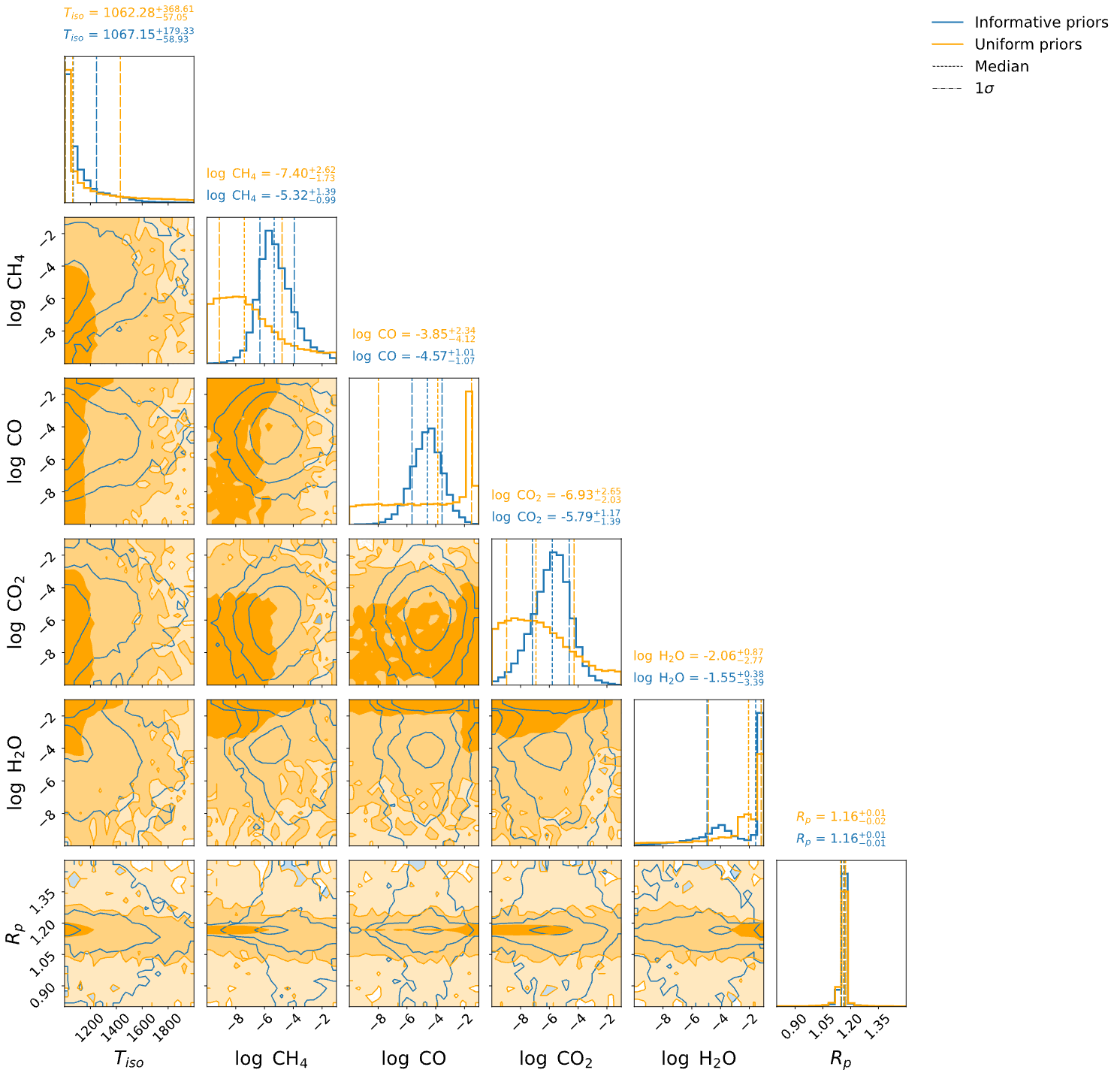
Our results demonstrate a significant improvement in computational efficiency. For WASP-17b (Figs 1 and 2), we observed a speedup of approximately three times. For the WASP-39b retrieval (Figs 3 and 4), our hybrid method achieved a speedup of nearly eight times compared to the classical approach using uniform priors. Crucially, we confirmed the statistical consistency of this hybrid approach by comparing the log-Bayesian evidence between the uniform and informative prior models. In both cases, the absolute difference in the Bayes factor was less than five, indicating no strong preference for either model (Kass & Raftery 1995; Trotta2007) and ensuring that our method does not compromise the integrity of the scientific results.


Conclusion

Exoformer can bridge the gap between the speed of deep learning and the rigour of Bayesian statistics. By providing informative priors, we enable Bayesian tools to focus their computational resources on the most relevant areas of the parameter space. While our current model is optimized for hot Jupiters, the fixed architecture of Exoformer allows for efficient retraining on new datasets, making it a scalable solution for exploring a wider range of exoplanet populations.

We acknowledge that further improvements, such as incorporating more sophisticated physical models and developing finer wavelength grids to match the high resolution of JWST and Ariel, will be necessary to increase accuracy. This paves the way for the rapid and efficient characterization of the vast amount of spectroscopic data that will be provided by the next generation of space-based observatories.

Fig 1: WASP-17 model fit

Fig 2: WASP-17 Corner Plot

How to cite: Pagliaro, L., Zingales, T., Piotto, G., Giovannini, I., and Mantovan, G.: Exoformer: Accelerating Bayesian atmospheric retrievals with transformer neural networks, Europlanet Science Congress 2026, The Hague, The Netherlands, 7–11 Sep 2026, EPSC2026-594, https://doi.org/10.5194/epsc2026-594, 2026.

14:42–14:54
|
EPSC2026-596
|
ECP
|
On-site presentation
Anoop Deepak Gavankar, Tanish Mittal, Rajarshi Barman, Joe Ninan, and Shravan Hanasoge

Planetary signal detection in stellar time-series observations is often limited by stellar variability, instrumental noise, and irregular sampling. Here, we present two related machine-learning approaches designed to recover weak planetary signals in two observational settings: solar extreme precision radial velocity (EPRV) observations and space-based photometric light curves. 

The first approach focuses on recovering low-amplitude injected planetary signals in solar EPRV data. Periodograms remain a standard tool for identifying periodic signals, but their performance can be limited when weak planetary signals are embedded in activity-driven stellar radial-velocity variations. We develop a model based on a Vision Transformer architecture that uses a reduced representation of spectroscopic time-series observations to predict the period and semi-amplitude of the injected signal. In injection-recovery tests using randomly selected 100-observation subsets from NEID solar data collected between 2020 and 2022, we find that the model improves signal recovery by about a factor of two over the Lomb-Scargle periodogram for systems with semi-amplitudes below 1 m/s. 

The second approach applies a related data-driven framework to transit detection and period estimation in TESS light curves. We use a Conv-Transformer architecture in which convolutional layers capture short transit-like dips, while transformer modules model longer temporal structure. The model is trained and validated using transit injections into TESS light curves, with additional tests on known TESS Objects of Interest. Injection-recovery experiments, including main-sequence stars and cool dwarfs, show consistent recovery of injected signals and stable period estimates under realistic noise conditions. Current work extends this framework to younger and more active stellar populations, including young stellar objects, where stellar variability can obscure or mimic transit signals. 

Together, these projects examine how deep-learning models can improve the recovery and characterization of weak planetary signals in spectroscopic and photometric time series. Overall, these results suggest that machine-learning methods can help identify promising periodic signals more efficiently in large astronomical data sets, supporting future searches for small planet candidates and other transit-like systems that require follow-up validation and classification.

How to cite: Gavankar, A. D., Mittal, T., Barman, R., Ninan, J., and Hanasoge, S.: Machine Learning for Planet Detection in the Presence of Stellar Variability: Applications to Solar EPRV Observations and TESS Light Curves, Europlanet Science Congress 2026, The Hague, The Netherlands, 7–11 Sep 2026, EPSC2026-596, https://doi.org/10.5194/epsc2026-596, 2026.

14:54–15:06
|
EPSC2026-610
|
ECP
|
On-site presentation
Sofia Paraskevaidou and Panayotis Lavvas

Simulating exoplanetary atmospheres is essential for characterizing their composition, hazes, clouds, and observational signatures. With the emergence of JWST (James Webb Space Telescope) and the upcoming ARIEL (Atmospheric Remote-sensing Infrared Exoplanet Large-survey) mission [8,9], the need for a fast implementation of classical forward models is increasing. Machine learning (ML) can address this by providing surrogate models that approximate selected model components and accelerate the simulation pipeline. In our research, we use a 1D, self-consistent forward model (FM) coupling stellar energy deposition, disequilibrium chemistry, and haze/cloud microphysics from the deep atmosphere (10³ bar) to the upper thermosphere (~10-¹⁰ bar) [1,2,7]. Here, we aim to develop a supervised neural-network surrogate model, inspired by previous ML applications [4], trained on the outputs of the FM and capable of rapidly approximating atmospheric responses over a range of parameters, including planetary mass, temperature-pressure structure, metallicity, gravity, and stellar flux, without repeated execution of the full model.

As a first step, we focus on the haze-microphysics component of the FM, a controlled test case before extending the method to more strongly coupled processes such as radiative transfer and disequilibrium chemistry. The haze module evolves the vertical distribution of particles through monomer production, coagulation, eddy diffusion, and gravitational settling, producing haze mixing-ratio profiles over a fixed pressure grid and multiple particle-size bins [6]. We first consider an isothermal setup, where temperature is constant throughout the atmospheric column, to isolate the ML model’s ability to learn the dependence of haze profiles on the main physical parameters. Synthetic training and validation datasets are generated by repeatedly running the isolated haze module for different isothermal temperatures (Tiso = 300–1400 K), constant eddy diffusion, and planetary mass scaling.

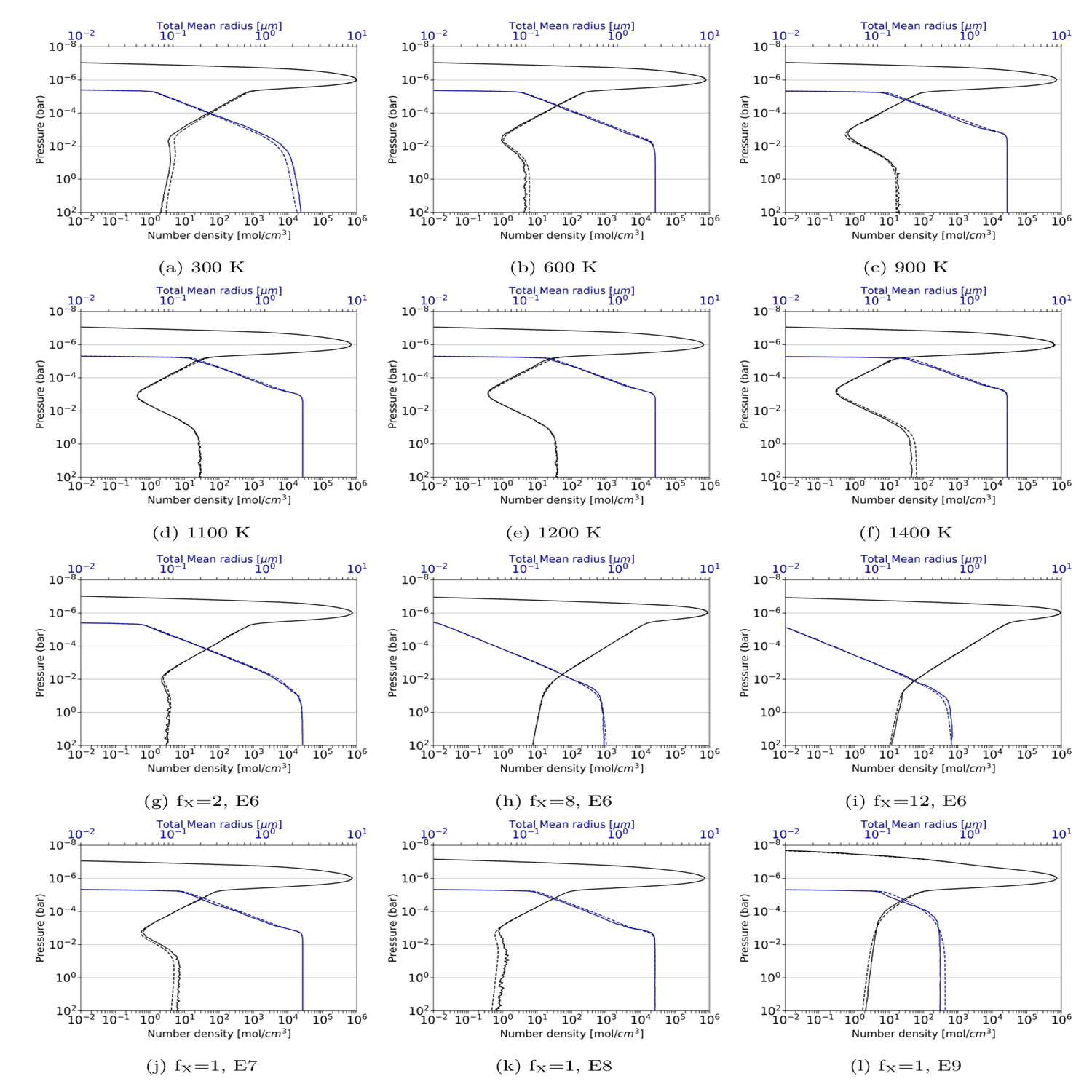
The resulting neural-network model, trained on isothermal structures and hereafter called the ISO model, combines encoders designed to simplify the physical structure of the problem. A temperature projection is used for the scalar thermal input, a pressure autoencoder compresses the vertical pressure grid, and species-specific LSTM (Long Short-Term Memory) autoencoders encode the vertical haze mixing-ratio profiles. These latent representations are combined in a core neural network that learns the coupling between atmospheric conditions and haze-species distributions before reconstructing the predicted profiles through decoder and denoising layers. The ISO model reproduces the main structure of the FM haze profiles, including the production region and general vertical behavior of the haze distribution (fig. 1a-f). The best agreement is obtained for small and intermediate particle-size bins and intermediate temperatures, while larger particles and the temperature-range edges remain more challenging. Sensitivity tests show that the model captures the dominant haze-profile response to variations in planetary mass scaling and eddy diffusion (fig. 1g-l).

To move towards more realistic atmospheres, we introduce a fine-tuning step based on non-isothermal temperature-pressure (TP) profiles and their corresponding haze-mixing ratios calculated by the FM. Instead of replacing the isothermal model completely, the TP profile is decomposed into a mean reference temperature and a vertical temperature-deviation profile. The mean temperature represents the closest isothermal approximation to the atmosphere, allowing the model to retain the haze-microphysics behavior already learned by the ISO model. The deviation profile, ΔT(P), provides information on how much the real atmosphere deviates from this approximation at each pressure level and is then embedded in the total temperature latent space. The temperature-deviation profile is encoded using one-dimensional convolutional layers, which are well suited to ordered vertical profiles because they can identify local thermal structures along the atmospheric column [3,5]. In this way, the fine-tuned model introduces pressure-dependent thermal information into the latent space while preserving the pretrained isothermal representation, enabling the predicted haze profiles to respond more realistically to non-isothermal atmospheric conditions.

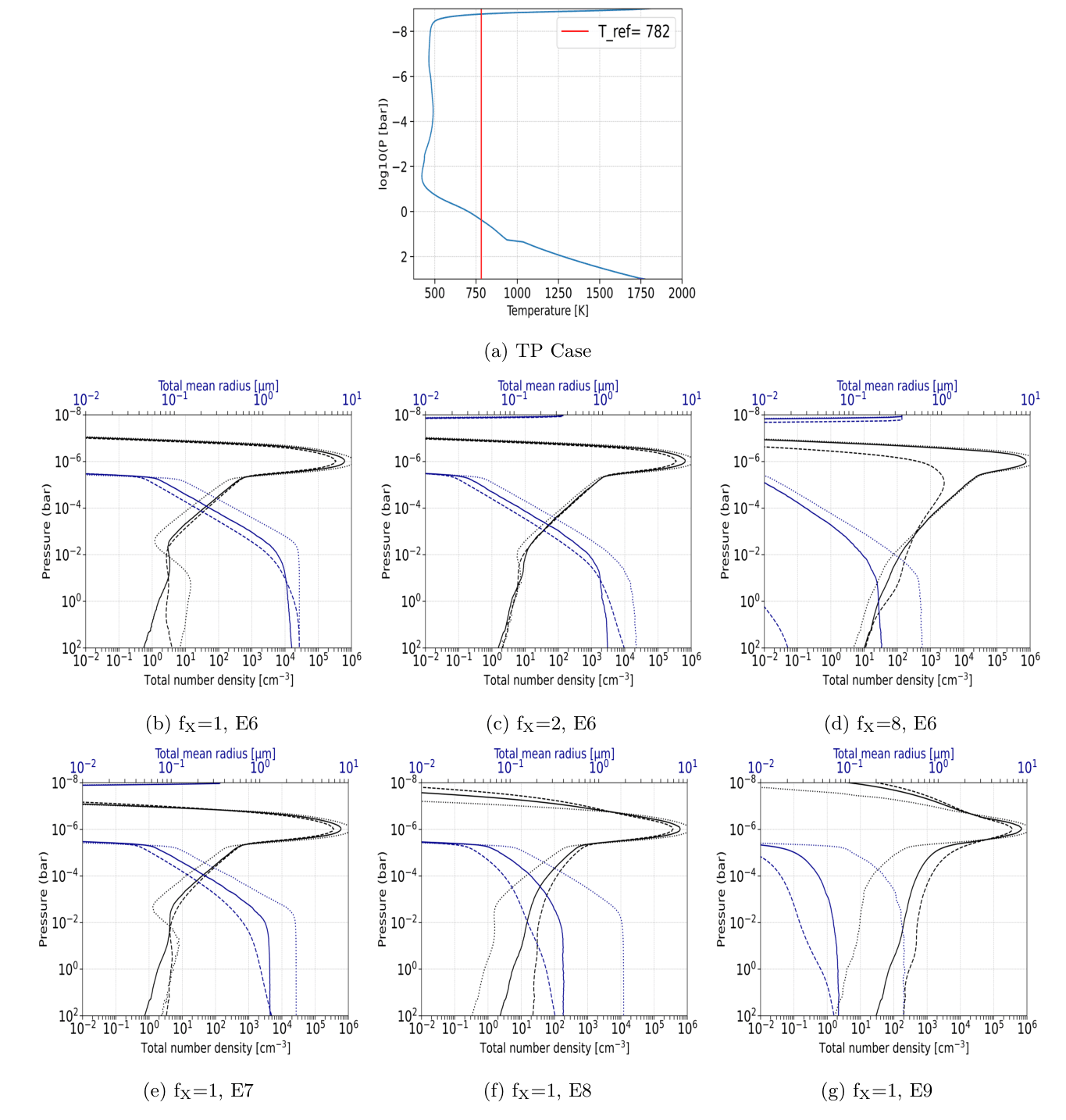
The fine-tuned model performs better than the original ISO model (fig. 2b,c,e), but it does not fully predict all non-isothermal cases. Adding TP information helps, especially for the main haze region and for smaller/intermediate particles, but the neural network still struggles when the atmosphere differs strongly from the original isothermal training cases (fig. 2d,f,g). This fine-tuning step therefore represents an intermediate stage toward a future model trained directly on fully non-isothermal atmospheres, which will be our next approach.

Figure 1: Comparison of the ISO model’s predictions (solid lines) with the calculations by the isolated-FM (dashed lines). (a)–(f): Temperature sensitivity test: each subplot is a summarized representation of all the available haze species, the number density (black lines) and total mean radius (blue lines), in the atmosphere, under fX = 1 (planetary mass scaling factor) and eddy diffusion coefficient 10⁶ cm²/s. (g)–(l): Mass scaling and eddy sensitivity test:each subplot shows the ISO model versus the FM by varying the fX and the eddy diffusion coefficient, e.g. E6 is 10⁶ cm²/s, under the same isothermal temperature 900 K.

Figure 2: Top panel:  TP profile that was used for the FM calculations. The red line indicates the reference isothermal temperature that was used for the prediction of the ISO model. Bottom plots: the corresponding average properties of the atmosphere, as a function of pressure. Plots (b) to (g) compare the TP-finetuned version (solid lines) with the FM solution (dashed) and the isothermal prior (dotted) predictions.

References

[1] A. Arfaux et al. Monthly Notices of the Royal Astronomical Society 515.4 (2022), pp. 4753–4779. doi: 10.1093/mnras/stac1772.

[2] A. Arfaux et al. Monthly Notices of the Royal Astronomical Society 522.2 (2023), pp. 2525–2542. doi: 10.1093/mnras/stad1135.

[3] S. Bai et al. arXiv e-prints (2018), arXiv:1803.01271. doi: 10.48550/arXiv.1803.01271.

[4] J. L. A. M. Hendrix et al. Monthly Notices of the Royal Astronomical Society 524.1 (2023), pp. 643–655. doi: 10.1093/mnras/stad1763.

[5] S. Kiranyaz et al. Mechanical Systems and Signal Processing 151 (2021), p. 107398. doi: 10.1016/j.ymssp.2020.107398.

[6] P. Lavvas et al. The Astrophysical Journal 847.1 (2017), p. 32. doi: 10.3847/1538-4357/aa88ce.

[7] P. Lavvas et al. The Astrophysical Journal 878.2 (2019), p. 118. doi: 10.3847/1538-4357/ab204e.

[8] E. Pascale et al. Space Telescopes and Instrumentation 2018: Optical, Infrared, and Millimeter Wave. Vol. 10698. SPIE Conference Series. 2018, 106980H. doi: 10.1117/12.2311838.

[9] G. Tinetti et al. Experimental Astronomy 46.1 (2018), pp. 135–209. doi: 10.1007/s10686-018-9598-x.

How to cite: Paraskevaidou, S. and Lavvas, P.: A Conditional Neural Autoencoder for Haze Microphysics Modeling in Exoplanet Atmospheres, Europlanet Science Congress 2026, The Hague, The Netherlands, 7–11 Sep 2026, EPSC2026-610, https://doi.org/10.5194/epsc2026-610, 2026.

15:06–15:18
|
EPSC2026-187
|
On-site presentation
Yuichiro Ishida and Eiichiro Kokubo
Terrestrial exoplanetary systems exhibit a wide diversity in masses and orbital architectures. Planetary population synthesis models are used to investigate the origin of this diversity. The final phase of terrestrial planet formation is the giant impact stage. During this stage, protoplanets undergo mutual collisions, altering their masses and orbits. This stage plays a key role in setting the final multiplicity, orbital excitation, and mass distribution of terrestrial planets. Planetary population synthesis models employ either semi-analytical models or N-body simulations for the giant-impact stage. However, both approaches suffer from important limitations: the latest semi-analytical models tend to overestimate the planet multiplicity over time and cannot treat orbital inclinations, while direct N-body simulations are computationally expensive and difficult to apply to large parameter surveys. Recently, machine-learning models have been proposed to accelerate these predictions; however, their applicability remains limited to close-in regions. 
To overcome these limitations, we develop a machine-learning emulator for the giant-impact stage that reproduces the time evolution of planetary systems and incorporates orbital inclinations. We adopt Graph Neural Networks (GNNs), as planetary systems can be naturally represented as graphs, with planets as nodes and mutual gravitational interactions as edges. To handle the decreasing number of planets caused by collisions, we employ a Transformer architecture that allows the model to process a variable number of planets. The emulator decomposes the planetary system evolution into two coupled tasks: (Task A) a GNN that predicts the next colliding planet pair and the time to collision, with predictive uncertainties quantified via Monte Carlo dropout; and (Task B) a probabilistic GNN that predicts changes in orbital elements due to collisions and secular perturbations occurring between collision events. By iteratively coupling Tasks A and B, the emulator generates sequences of collision events and emulates the full evolution of planetary systems through the giant impact stage. For training, we construct a dataset of 9000 samples derived from 800 N-body simulation runs by segmenting each simulation track into individual collisional events. 
The GNN emulator achieves a speedup of approximately four orders of magnitude compared to direct N-body simulations, while reproducing the key statistical properties of the final planetary systems.
As shown in Figure 1, the GNN emulator reproduces the N-body results across multiple statistical metrics, including the final number of surviving planets, mean orbital spacing, mean eccentricity, and mass dispersion. 
Furthermore, Figure 2 shows that the emulator tracks the time evolution of the number of planets due to collisions across different regions. This capability represents a improvement over previous semi-analytical approaches, particularly in capturing the time evolution of planet multiplicity.
 
Comparisons with both semi-analytical models and previous machine-learning approaches show that our GNN emulator maintains robust performance over a wider radial range. These results demonstrate that our approach enables efficient and accurate exploration of the giant-impact stage in planetary population synthesis.

How to cite: Ishida, Y. and Kokubo, E.: A graph neural network emulator predicting planet formation through the giant impact stage, Europlanet Science Congress 2026, The Hague, The Netherlands, 7–11 Sep 2026, EPSC2026-187, https://doi.org/10.5194/epsc2026-187, 2026.

15:18–15:30
|
EPSC2026-215
|
ECP
|
On-site presentation
Hendrik Schmerling, Rok Hribar, Sascha Grziwa, and Martin Pätzold

Advances in exoplanet detection methods have steadily increased the number of known planets. With more than 6000 confirmed by early 2026, exoplanet catalogs now enable increasingly powerful statistical studies of planetary populations. However, every detection technique — transits, radial velocity, microlensing, direct imaging — carries its own observational biases, and because the true underlying planetary population is unknown, these biases cannot themselves be fully characterized. Most demographic analyses have relied on classical statistical approaches, while data-driven, unsupervised machine-learning methods have been used less frequently for exploratory population studies. Here, we explore the Extrasolar Planets Encyclopaedia dataset using a range of unsupervised learning algorithms. We first select a subset of system features and complete missing entries by comparing several imputation strategies, ranging from simple statistical fillers to a feature-prediction model trained on the catalog itself. We then apply outlier-detection methods to identify objects with parameter combinations inconsistent with the bulk of the sample, and finally apply multiple clustering algorithms — in both an unweighted form and a weighted variant intended to mitigate selection effects — to search for latent structure. To assess how strongly observational selection shapes the results, we run this pipeline on four versions of the data: the full catalog as listed, a Kepler subset that has undergone careful bias mitigation, the full catalog with a deliberately bias correction applied to all entries, and a fully synthetic dataset constructed under known input distributions. The pipeline yields: (i) a feature-prediction engine that can infer previously missing system parameters with precision particularly high for stellar features, (ii) a set of catalog entries whose reported parameters may warrant re-examination, and (iii) clusters that reproduce known demographic patterns while also suggesting additional structure among small planets orbiting M-dwarf stars.

How to cite: Schmerling, H., Hribar, R., Grziwa, S., and Pätzold, M.: Clustering the Exoplanet Database; Unraveling Hidden Patterns in Exoplanet Populations using UnsupervisedMachine Learning Techniques, Europlanet Science Congress 2026, The Hague, The Netherlands, 7–11 Sep 2026, EPSC2026-215, https://doi.org/10.5194/epsc2026-215, 2026.

Posters: Mon, 7 Sep, 18:00–19:30 | Foyer 3

Display time: Mon, 7 Sep, 08:30–19:30
Chairperson: Romain Eltschinger
F3.63
|
EPSC2026-237
|
ECP
|
On-site presentation
Sara Marques and Yann Alibert

To characterise the diversity of planetary systems, we need to go beyond the properties of individual planets to capture the statistical relationships between planets within a system, but to also include the properties of their host star and protoplanetary disk. Physics-based population synthesis frameworks, such as the Bern model, provide valuable insight into the architecture of the planetary systems and correlations therein, but their high computational cost restricts their use for large-scale statistical inference and direct comparison with the observed population of exoplanets.

We present a novel hierarchical conditional generative model designed to produce synthetic planetary systems with both high fidelity and high efficiency. The architecture explicitly conditions on host star and disk properties, including stellar metallicity, disk lifetime, and gas disk mass, enabling the model to reproduce the multi-scale dependencies that shape the formation of these planets and system architectures. By jointly modelling several system- and planet-level properties, it captures more subtle correlations and structural features than the previous model in (Alibert et al. 2025).

The model is trained on synthetic populations from the Bern model rather than on observed catalogues, avoiding the detection biases while preserving the underlying physical relationships. Once trained, it generates new planetary systems orders of magnitude faster than the original simulations, while remaining statistically consistent with the training population. We validate the model by recovering known trends linking stellar and disk properties to planetary system architecture, and by verifying that the generated systems satisfy expected dynamical stability criteria and training probability distributions.

Finally, we illustrate the potential of this framework by applying it in the context of the TESS survey, demonstrating how the model can be used to predict planetary properties and inform the interpretation of current and forthcoming exoplanet observations.

How to cite: Marques, S. and Alibert, Y.: A hierarchical conditional generative model for planetary systems, Europlanet Science Congress 2026, The Hague, The Netherlands, 7–11 Sep 2026, EPSC2026-237, https://doi.org/10.5194/epsc2026-237, 2026.