
- 1University of Granada, Signal Theory, Telematics and Communications, Spain (gsus@go.ugr.es) [Equally contributing]
- 2University of Granada, Signal Theory, Telematics and Communications, Spain (gsus@go.ugr.es)
Smart cities aim to improve the quality of life of their residents through more efficient management of urban services and infrastructures. In this context, urban traffic monitoring helps improve mobility, reduce congestion, and optimize the management of urban infrastructures. Distributed Acoustic Sensing (DAS) is a particularly attractive technology for urban traffic monitoring in smart cities, since it can take advantage of optical fiber infrastructures already deployed in many urban environments and requires little maintenance. DAS detects vibrations along optical fiber cables generated by external disturbances, such as nearby traffic. With proper feature extraction, these DAS signals can be analyzed to locate events in both time and space, as well as to distinguish between different types of traffic, such as cars, buses, or environmental noise, as illustrated in Fig. 1

Figure 1: Signal labeled by traffic event type
Previous works in Granada (Fig. 2) have explored the use of DAS combined with exploratory data analysis methods to establish a methodological basis for urban traffic monitoring [1]. More recently, neural network-based approaches have also been proposed to automatically recognize traffic events, moving towards real-time monitoring systems without the need for manual labeling of the signals [2].
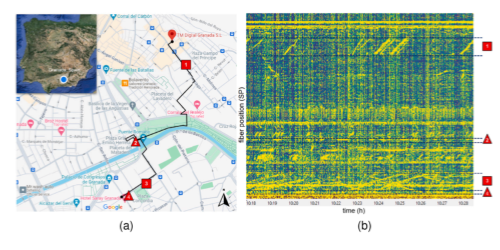
Figure 2: (a) DAS optical fibre path (b) DAS traffic recording
Our contribution focuses on the application of ASCA (ANOVA-Simultaneous Component Analysis) [3] to DAS signals recorded at different locations in Granada. ASCA is a combination of ANOVA and Principal Component Analysis (PCA) with great capabilities for statistical inference and exploratory data analysis of complex data with a high number of variables. Given the large volume of data and the complexity of the signals, we consider ASCA a suitable methodology to interpret and understand the underlying factors that explain the differences between traffic-related events. Recent works have studied the modelling of spatio-temporal signals with ASCA [4]
Through this approach, we expect not only to support the development of future monitoring systems, but also to develop knowledge and expertise about the structure of DAS data and the patterns present in these signals. Thanks to the interpretability of the analysis, this work is not limited to urban traffic applications, but can also be extended to other domains relevant to geosciences, such as structural health monitoring, seismic analysis, or risk surveillance in critical infrastructures.
[1] I. Fakhruzi, M. Titos, C. Benítez & L. García, “Urban traffic monitoring through Distributed Acoustic Sensing: trial analysis of a potent monitoring tool”.
[2] I. Fakhruzi, M. Titos, C. Benítez & L. García, “Distributed Acoustic Sensing for Urban Traffic Monitoring: Spatio-Temporal Attention in Recurrent Neural Networks”. arXiv:2603.13903, 2026.
[3] Smilde, A. K. et al. (2005). ANOVA-simultaneous component analysis (ASCA): a new tool for analyzing designed metabolomics data. Bioinformatics, 21(13), 3043-3048.
[4] Vallejo-España et al. (2026) Modeling cyclostationarity in time series using ASCA arXiv:2603.05065
This work is part of the MuSTARD project (Multi-scale Spatio-Temporal Analysis of Research Data, https://codas.ugr.es/mustard/en/), funded by grant PID2023-1523010B-IOO from the Spanish Agencia Estatal de Investigación and the European Regional Development Fund.
How to cite: Fernández Carrascosa, L., García Sánchez, J., Fakhruzi, I., Camacho, J., and García, L.: Monitoring urban traffic with Distributed Acoustic Sensing and ANOVA Simultaneous Component Analysis, Galileo conference: Fibre Optic Sensing in Geosciences, Aussois, France, 31 Aug–4 Sep 2026, GC14-FibreOptic-49, https://doi.org/10.5194/egusphere-gc14-fibreoptic-49, 2026.


