
 3
3- 1Division Geophysical and Planetary Sciences, California Institute of Technology, Pasadena, California, United States of America (zmilby@caltech.edu)
- 2Division Geophysical and Planetary Sciences, California Institute of Technology, Pasadena, California, United States of America (dekleer@caltech.edu)
- 3Center for Space Physics, Boston University, Boston, Massachusetts, United States of America (schmidtc@bu.edu)
INTRODUCTION
Io’s atmosphere is spatially variable, with evidence for a higher-density molecular SO₂ atmosphere bound to low-to-mid latitudes (Strobel & Wolven 2001) and global atomic coronae made of atomic S and O (Ballester et al. 1987). Interactions between Io’s atmosphere and electrons trapped by Jupiter’s magnetic field produce auroral emissions. Compared to the icy Galilean satellites Europa, Ganymede and Callisto, Io’s aurora have been studied much more extensively. These include both observations taken from Earth (e.g., Ballester et al. 1987; Roesler et al. 1999; Retherford et al. 2000; Bouchez et al. 2000; Schmidt et al. 2023) and during spacecraft fly-bys by Galileo (Geissler et al. 1999, 2001), Cassini (Geissler et al. 2004) and New Horizons (Retherford et al. 2007). Spatially resolved observations from these fly-bys and some UV observations from Earth orbit revealed distinctive emission morphologies, including bright spots at equatorial latitudes located near the sub and anti-Jovian longitudes, a diffuse global coronal glow and emissions from volcanic plumes. We combined high-resolution spectral observations of Io’s visible aurora in eclipse taken over six nights between 2022 and 2024 to characterize both the variability in the aurora and their connection to some of the physical properties of Jupiter’s plasma sheet.
OBSERVATIONS
Visible wavelength observations of aurora from the Galilean satellites require them to be eclipsed by Jupiter in order to suppress reflected sunlight from their surfaces. Eclipse observations from the ground require Jupiter to be near quadrature with Earth, permitting observers to view either the ingress (western quadrature) or egress (eastern quadrature) phases of the eclipse. We observed Io during six different eclipses between 2022 and 2024 using the High Resolution Echelle Spectrometer (HIRES), an instrument on the Keck I telescope at the summit of Maunakea with a resolving power of around 30,000. On five of these nights we observed Io during eclipse ingress and on the one remaining night during eclipse egress. We used a slit with a width of 1.722′′, which was wider than Io’s angular size on the sky, allowing the instrument to operate as a high-resolution imaging spectrometer for the monochromatic atomic auroral emissions. Each spectrum was a 5-minute integration with approximately 3 minutes of overhead between the end of one integration and the start of the next, yielding a high-cadence time series. We developed a data calibration pipeline (described in detail in Milby et al. 2024) which carefully characterizes and removes the background, isolating the auroral emissions despite often bright scattered light from Jupiter.
RESULTS
Prior to our observations, only six visible wavelength atomic auroral emissions had been identified at Io: the forbidden oxygen emissions at 557.7, 630.0 and 636.4 nm, the sodium doublet at 589.0 and 589.6 nm and the potassium line at 766.4 nm. The quality of the HIRES data combined with careful background subtraction allowed us to detect 13 additional lines at a signal-to-noise ratio greater than 2, tripling the number of optical emissions detected from Io’s eclipse atmosphere. Figure 1 shows an example of each of the emission lines identified in the HIRES spectra.
We used this set of emission lines in conjunction with both broadband and narrowband images of Io in eclipse taken by Cassini (Geissler et al. 2004) to map the locations of the emissions and connect them to discrete auroral features. The identification of additional atomic oxygen lines provides a powerful diagnostic for determining whether the auroral emission originated due to electron impact on atomic or molecular species. Schmidt et al. (2023) interpreted the 630.0∕557.7 nm emission ratio as evidence for emission from an atomic oxygen column. We updated our auroral emission model to include cross sections for electron impact on SO₂ and modeled the emission at 557.7, 777.4 and 844.6 nm from atmospheres composed of just O, a combination of O and SO₂, and finally a combination of O, SO₂ and O2, which we used as an isoelectronic proxy for SO. We found the three species atmosphere fit the data within the uncertainties assuming excitation by canonical 5 eV electrons.
The high cadence of the HIRES observations allowed us to explore the connection between the ambient electron density and the auroral brightness. We found the connection to be ambiguous, suggesting that plasma bombardment at Io is varies significantly beyond what simple modulation of the magnetic geometry provides.
Time permitting, we will provide a preview of preliminary conclusions of a similar time-series analysis of Europa’s optical aurora.
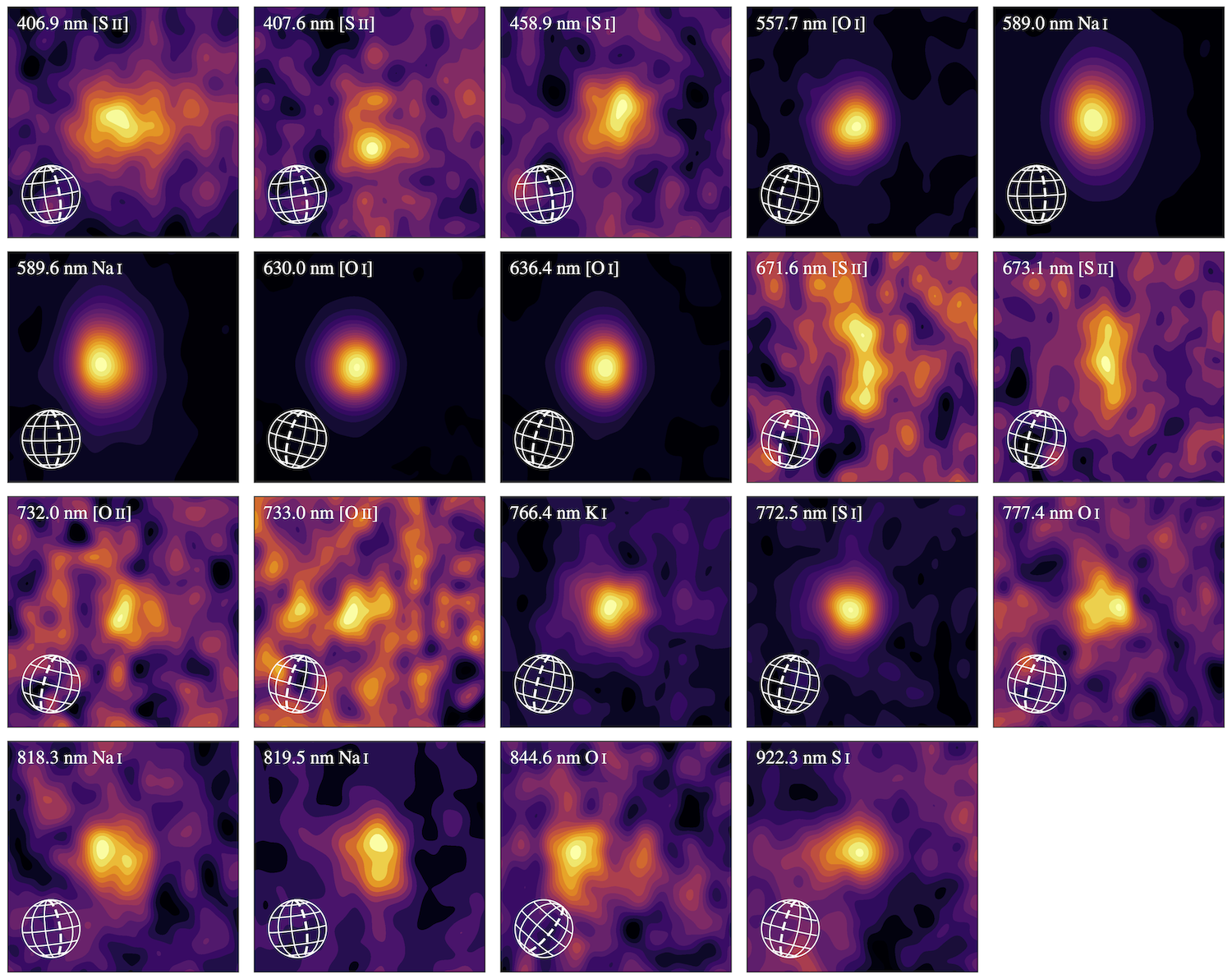
Figure 1. Auroral emissions from Io in eclipse including both new emissions and those previously detected at 557.7, 589.0, 589.6, 630.0, 636.4 and 766.4 nm. Note that each image is displayed using an individually scaled colormap in order to optimize the dynamic range available to the dimmer emissions. Wireframe globes show Io’s physical orientation at the time of the observation. Figure from Milby et al. (under review).
REFERENCES
Ballester, G. E., Moos, H. W., Feldman, P. D., et al. 1987, The Astrophysical Journal, 319, doi: 10.1086/184950
Bouchez, A. H., Brown, M. E., & Schneider, N. M. 2000, Icarus, 148, doi: 10.1006/icar.2000.6518
Geissler, P., McEwen, A., Porco, C., et al. 2004, Icarus, 172, doi: 10.1016/j.icarus.2004.01.008
Geissler, P. E., McEwen, A. S., Ip, W., et al. 1999, Science, 285, 870, doi: 10.1126/science.285.5429.870
Geissler, P. E., Smyth, W. H., McEwen, A. S., et al. 2001, J. Geophys. Res., 106, 26137, doi: 10.1029/2000JA002511
Milby, Z., de Kleer, K., & Schmidt, C. under review, The Planetary Science Journal
Milby, Z., de Kleer, K., Schmidt, C., & Leblanc, F. 2024, The Planetary Science Journal, 5, doi: 10.3847/PSJ/ad49a2
Retherford, K. D., Moos, H. W., Strobel, D. F., Wolven, B. C., & Roesler, F. L. 2000, Journal of Geophysical Research, 105, doi: 10.1029/2000JA002500
Retherford, K. D., Spencer, J. R., Stern, S. A., et al. 2007, Science, 318, doi: 10.1126/science.1147594
Roesler, F. L., Moos, H. W., Oliversen, R. J., et al. 1999, Science, 283, doi: 10.1126/science.283.5400.353
Schmidt, C., Sharov, M., de Kleer, K., et al. 2023, The Planetary Science Journal, 4, doi: 10.3847/PSJ/ac85b0
Strobel, D. F., & Wolven, B. C. 2001, Astrophysics and Space Science, 277, 271, doi: 10.1023/A:1012261209678
How to cite: Milby, Z., de Kleer, K., and Schmidt, C.: New Optical Aurora Detections at Io and Implications for Interactions with the Jovian Plasma Environment, EPSC-DPS Joint Meeting 2025, Helsinki, Finland, 7–12 Sep 2025, EPSC-DPS2025-1044, https://doi.org/10.5194/epsc-dps2025-1044, 2025.


