OPS3 | Jupiter’s Magnetosphere in the Juno Era and beyond: Insights from In-Situ and remote sensing Exploration

OPS3

Jupiter’s Magnetosphere in the Juno Era and beyond: Insights from In-Situ and remote sensing Exploration
Convener: Stavros Kotsiaros | Co-conveners: Bertrand Bonfond, George Clark, Scott Bolton, Caitriona Jackman, Christina Plainaki, Sadie Elliott
Orals THU-OB2
| Thu, 11 Sep, 09:30–10:30 (EEST)
 
Room Uranus (Helsinki Hall)
Orals THU-OB3
| Thu, 11 Sep, 11:00–12:24 (EEST)
 
Room Uranus (Helsinki Hall)
Orals THU-OB5
| Thu, 11 Sep, 15:00–16:00 (EEST)
 
Room Uranus (Helsinki Hall)
Posters THU-POS
| Attendance Thu, 11 Sep, 18:00–19:30 (EEST) | Display Thu, 11 Sep, 08:30–19:30
 
Lämpiö foyer, L1–12
Thu, 09:30
Thu, 11:00
Thu, 15:00
Thu, 18:00
Juno’s ongoing exploration of Jupiter’s system has provided groundbreaking insights into the planet’s magnetosphere, revealing complex interactions between Jupiter’s intense magnetic field, its dynamic plasma environment, and its moons. The extended mission, running through September 2025, has further broadened Juno’s scientific scope, offering unprecedented in-situ and remote observations of Io, Europa, and Ganymede, as well as Jupiter’s auroras and magnetospheric boundaries. This session welcomes contributions on Juno’s latest magnetospheric discoveries, including, but not limited to, plasma and energetic particle dynamics, magnetosphere-ionosphere-atmosphere coupling, and moon-magnetosphere interactions. Additionally, we encourage studies that integrate data from past missions and upcoming explorations, such as JUICE and Europa Clipper, Earth-based supporting observations as well as theoretical and numerical modeling efforts to advance our understanding of Jupiter’s vast magnetospheric environment in the broader context of outer planet systems.

Session assets

Orals THU-OB2: Thu, 11 Sep, 09:30–10:30 | Room Uranus (Helsinki Hall)

Chairpersons: Stavros Kotsiaros, Bertrand Bonfond, George Clark
09:30–09:42
|
EPSC-DPS2025-158
|
On-site presentation
Scott Bolton

Juno has transformed our view of Jupiter through major discoveries about its interior structure, origin, and evolution; atmospheric dynamics and composition; magnetic dynamo; and polar magnetosphere. The natural evolution of Juno’s polar orbit brings new regions within reach with every close passage to Jupiter, as the inbound equator crossing marches ever closer to the giant planet. The 1st extended mission began in August 2021 and provided the first close flybys of Io, Europa and Ganymede since the Galileo mission.  The second extended mission (EM2) begins in October 2025 and last 3 years.  The new mission provides opportunities for Juno to unexplore new regions in the Jovian system, and to follow up on Juno’s discoveries made during its prime and 1st extended missions.  The Juno spacecraft and instruments are in excellent health. During EM2, Juno will dive deep within Jupiter's inner radiation belts where the rings and inner moons reside. EM2 provides an opportunity for a thorough investigation of these components and their complex interaction, providing a unique data set to compare with other giant planet ring systems, including the ice giants. The migration of the periapsis northward creates an opportunity to explore in-situ Jupiter's ring-moon system, investigate Jupiter’s northern hemisphere and the unexplored regions of Jupiter's distant southern magnetospheric boundaries. During EM2, Juno’s polar perijoves will provide the opportunity to continue the exploration of Jupiter’s circumpolar cyclones over a wide range of altitudes/depths via imagery, occultations and microwave sounding. Radio science occultations will icharacterize the upper atmosphere to levels as deep as 0.5 bar. EM2 gravity passes over the north polar region will constrain the depth and mass of the polar cyclones and will also be compared to MWR's sounding of the same..  Juno’s 2nd extended mission proposal is currently being reviewed.  An overview of the new opportunities provided with EM2 will be presented. 

How to cite: Bolton, S.: The Juno 2nd Extended Mission, EPSC-DPS Joint Meeting 2025, Helsinki, Finland, 7–13 Sep 2025, EPSC-DPS2025-158, https://doi.org/10.5194/epsc-dps2025-158, 2025.

09:42–09:54
|
EPSC-DPS2025-26
|
ECP
|
On-site presentation
Zhi-Yang Liu, Nicolas Andre, and Michel Blanc

The Jovian magnetodisk refers to a thin disc of plasma and electric current near the equatorial plane of Jupiter’s magnetosphere. It serves as an “energy converter” within Jupiter’s planetary system, receiving rotational energy from Jupiter’s interior and upper atmosphere and converting it into the thermal and kinetic energy of the magnetospheric plasma. Juno’s in-situ observations of fields (MAG) and charged particles (JADE and JEDI) provide valuable data for revealing the structure and dynamics of the magnetodisk. 

By examining this dataset, we developed an empirical model of the magnetodisk, capturing the distributions of its magnetic field, electric current, and plasma. The results show that: (a) heavy ions dominate both the number density and pressure; (b) the number density and pressure of all species decrease with radial distance; (c) the temperature increases with radial distance for electrons and heavy ions, but decreases for protons; (d) on average, the parallel pressure exceeds the perpendicular pressure for all species; and (e) the magnetodisk exhibits strong local time asymmetry.

Based on this model, we investigated the equilibrium and stability of the magnetodisk. On average, the magnetodisk is in radial force balance, with the dominant forces being the inward magnetic stress and the outward plasma anisotropy force. However, signatures of ongoing non-equilibrium activity are also detected, ranging from global-scale magnetic dipolarization down to ion- and electron-scale plasma waves. A detailed data survey indicates that anisotropy in the pitch-angle distributions of charged particles plays a key role in these processes, both in determining marginal equilibrium states and in controlling the growth of plasma instabilities. A theoretical model incorporating this aspect could provide a better description of the magnetodisk and its role in the dynamics of the magnetosphere.

How to cite: Liu, Z.-Y., Andre, N., and Blanc, M.: Structure and Dynamics of the Jovian Magnetodisk Seen by Juno, EPSC-DPS Joint Meeting 2025, Helsinki, Finland, 7–13 Sep 2025, EPSC-DPS2025-26, https://doi.org/10.5194/epsc-dps2025-26, 2025.

09:54–10:06
|
EPSC-DPS2025-1194
|
ECP
|
On-site presentation
Omakshi Agiwal, Luke Moore, Paul Withers, Mariana Felici, Drew Coffin, Ingo Mueller-Wodarg, and Teo Bloch

Radio occultation measurements from the Galileo, Voyager, and Pioneer missions have unveiled many mysteries in the Jovian ionosphere. The altitudinal structure of the Jovian ionosphere appears to be highly variable, although it is difficult to distinguish if the variability is spatial or temporal; and clear evidence of non-solar produced local time and latitudinal trends are observed. We present a quantitative analysis of all available sub-auroral radio occultation data, including new data from Juno, showing that the ionosphere’s vertical structure depends strongly on local time, longitude, and magnetic field geometry. Consequently, we investigate the key drivers of spatially variable plasma transport at non-auroral latitudes, namely: ambipolar diffusion, equatorial electrodynamics, and neutral wind-driven field-aligned flows. Our results indicate that neutral wind-driven field-aligned transport effectively organizes the observed electron density profiles, where model predictions of upward or downward plasma motion corresponds to higher (>1500 km) or lower (<1000 km) ionospheric peaks, respectively. This suggests that altitudinal structure of the non-auroral Jovian ionosphere may be temporally stable but spatially variable. However, highly variable ionospheric structure persists in the dusk ionosphere in regions where no plasma motion is predicted. The complexity of this variability will be discussed further in our presentation.

How to cite: Agiwal, O., Moore, L., Withers, P., Felici, M., Coffin, D., Mueller-Wodarg, I., and Bloch, T.: Unraveling Jupiter's Enigmatic Ionosphere from Galileo and Juno Radio Occultations, EPSC-DPS Joint Meeting 2025, Helsinki, Finland, 7–13 Sep 2025, EPSC-DPS2025-1194, https://doi.org/10.5194/epsc-dps2025-1194, 2025.

10:06–10:18
|
EPSC-DPS2025-454
|
On-site presentation
Wenyu Zhang, Hao Cao, Jack Connerney, Jeremy Bloxham, and Krishan Khurana

Low latitude field-aligned current systems have been well documented at the Earth and reported at Saturn. Here we presented a comprehensive analysis of Juno magnetic field measurements in the low-latitude region within 1 Jovian radii from the surface of Jupiter. After removing the internal magnetic field (and its time variations) as well as the large-scale magnetodisk field, our analysis revealed a “sandwich” structure in the azimuthal component of the Jovian magnetic field, Bphi, with day-night asymmetries: on the dayside, Bphi is positive at mid-to-low latitudes but reverses sign at high latitudes; on the other hand, the pre-dawn side between 3am and 6am features a negative band of Bphi in the low-latitude region.

Based on the observed spatial structures, we propose a day-night asymmetric low-latitude field-aligned current (FAC) system at Jupiter: currents flow from the northern to the southern hemisphere along low-latitude magnetic field lines on the dayside, and reverse direction on the pre-dawn side. These FACs are closed via ionospheric Pedersen currents, forming meridional current loops. We will also discuss the Ohmic heating associated with this current system in the Jovian upper atmosphere.

How to cite: Zhang, W., Cao, H., Connerney, J., Bloxham, J., and Khurana, K.: Low latitude field-aligned currents (FACs) at Jupiter: perspective from Juno MAG , EPSC-DPS Joint Meeting 2025, Helsinki, Finland, 7–13 Sep 2025, EPSC-DPS2025-454, https://doi.org/10.5194/epsc-dps2025-454, 2025.

10:18–10:30
|
EPSC-DPS2025-287
|
ECP
|
On-site presentation
Ruobing Zheng, Yuming Wang, and Chuanbing Wang

Juno in-situ observations provide insightful data on plasma, electric, and magnetic fields associated with Jovian decametric (DAM) emission, while remote-sensing observations have the advantage of large spatial and temporal scales. Combining these two perspectives may help us understand the dynamic processes of DAM radiation. In this work, we present an Io-DAM emission continued intermittently for at least 2 hours combining Juno in-situ observation and remote-sensing observation from Wind and Stereo-A. The Io-DAM emission evolved from three discrete narrow arcs to one mixed broad arc within 11 minutes in remote-sensing dynamic spectra. This Io-DAM source is located at a lead angle of 6° from the main Alfvén wing spot (MAW) lasting for the observation. Juno/JADE detected peaks of electron energy fluxes and showed the loss-cone distribution in the upgoing direction. We set a series of resonant circles to estimate the maximum growth rate 8*10-4, which yields an electron energy range of 0.2–3 keV and an emission angle of 84°-88°. Meanwhile, we infer the properties of the source region of the event from the remote-sensing observations at 1 AU. The inversed results on electron energy, emission angle, and source locations are consistent with the Juno in-situ observations, which may indicate the consistent properties of this Io-DAM event over 2-hour observational intervals. This consistency also reinforces the reliability of the remote sensing inversion method. Our work contributes to the establishment of long-term stereoscopic remote monitoring, addressing limitations in local observational coverage and enhancing our understanding of the dynamic processes of DAM emission.

How to cite: Zheng, R., Wang, Y., and Wang, C.: A Jovian decametric emission event observed locally by Juno and remotely by Wind and STEREO-A at 1 AU, EPSC-DPS Joint Meeting 2025, Helsinki, Finland, 7–13 Sep 2025, EPSC-DPS2025-287, https://doi.org/10.5194/epsc-dps2025-287, 2025.

Orals THU-OB3: Thu, 11 Sep, 11:00–12:30 | Room Uranus (Helsinki Hall)

Chairpersons: Bertrand Bonfond, Stavros Kotsiaros, George Clark
11:00–11:12
|
EPSC-DPS2025-3
|
ECP
|
On-site presentation
Linus Head, Denis Grodent, Bertrand Bonfond, Ali Sulaiman, Alessandro Moirano, Guillaume Sicorello, Sadie Elliott, Marissa Vogt, Corentin Louis, Nicholas Kruegler, and Julie Vinesse

Introduction. Jupiter's ultraviolet aurora frequently shows a number of arcs between the dusk-side polar region and the main emission, which are denoted as “bridges” (Figure 1, left).  Thus far, the only dedicated study of the auroral bridge was part of a Master’s thesis which analysed three images of the aurora taken by the Space Telescope Imaging Spectrograph (STIS) instrument aboard the Hubble Space Telescope (HST) that contained bridges. The bridges were found to map to the dusk-side magnetosphere between 10 and 22 magnetic local time (MLT) and be largely confined to radial distances greater than 60 RJ. Other works have identified the appearance of dusk-side polar arcs with compression by the solar wind, though these conclusions were based a limited number of observations, and the origins of auroral bridges remain poorly understood.

Methods. We present a largely automated detection and statistical analysis of bridges over 248 HST-STIS observations, alongside a multi-instrument study of crossings of magnetic field lines connected to bridges by the Juno spacecraft during its first 30 perijoves. The detection of bridges in the large number of HST images is performed automatically using a bespoke arc-tracing algorithm (Figure 1, right), which is combined with manual arc designations and a random-forest filter to provide a model test accuracy of 82%. In the Juno-UltraViolet-Spectrograph (Juno-UVS) images, bridge locations (and hence bridge-crossing timestamps) were identified manually to avoid the introduction of artefacts of the automated method.

Results. Bridges are observed to arise on timescales of ~2 hours, can persist over a full Jupiter rotation, and are conjugate between hemispheres. The appearance of bridges is strongly associated with compression of the magnetosphere by the solar wind (Figure 2, left); there is a clear distinction between green points (cases where the magnetosphere was compressed) and red points (cases where the magnetosphere was uncompressed) in the total detected bridge length. Low-altitude bridge crossings are associated with upward-dominated, broadband electron distributions (Figure 2, left), consistent with Zone-II (Mauk et al. 2020; doi:10.1029/2019JA027699) aurorae, notable since similar regions in Earth and Saturn’s aurorae show no appreciable emission. Bridge crossings are also associated with plasma-wave bursts observed by Juno-Waves, in agreement with existing theoretical models for the generation of polar-region aurorae. Electron populations associated with crossings of field lines threading the main emission by Juno also become more downward-dominated when separate bridges are present in the nearby aurora. Figure 2 (right) shows that main emission crossings where bridges are present in the aurora (green) did not show the same bridge-like/Zone-II upward-travelling population of electrons as cases where no separate bridge was observed in the aurora (orange), which indicates that the “bridge” aurora was merely spatially indistinguishable from the main emission in these latter cases.

Conclusions. Combining these two sets of results, bridges are identified as Zone-II aurorae that have become spatially separated from the Zone-I aurorae under the influence of the solar wind. In the absence of separate bridges in the polar region, the main emission takes on a decidedly mixed Zone-I-II character (bidirectional electrons, plasma-wave bursts) which become uniquely Zone-I-like when bridges are present. This is consistent with the previously observed adjacency of the auroral Zone-I and Zone-II; the gap between the two is thus observed to increase during solar wind compression. The solar wind is thus implied to be able to exert a considerable influence on Jupiter’s internally driven magnetosphere that is reflected in the morphology of its aurora.

Figure 1: (left) An image of the northern jovian UV aurora captured by HST during the GO-15638 campaign (exposure ID: odxc01okq). A 15°-by-15° grid in System-III longitude and planetocentric latitude is included; the System-III longitude of certain meridians are given in white, and certain planetocentric latitudes in magenta. The average subsolar longitude during this exposure (170°) is denoted by a solid yellow line, and the positions of the dawn and dusk hemispheres are included to guide the reader. The approximate location of the polar collar is enclosed by red dashed lines, and that of the noon active region by a green dashed ellipse. Bridges are highlighted with yellow arrows. (right) Results of the bridge-detection algorithm after filtering. Red lines denote arcs accepted by the filter, and grey the arcs that have been discarded. The seed point of each arc is given in magenta. Manually designated arcs are given in yellow. White contours give the region of validity of the JRM33 flux-equivalence mapping along closed field lines.

Figure 2: (left) Detected average expansion of the main emission vs. the total detected magnetosphere-mapped bridge length for each northern HST-STIS series considered in this work. Negative expansions imply a contracted main emission. Bridge-length error bars are determined as described in Appendix A. Green crosses denote those cases where the magnetosphere was compressed, and red pluses those cases where the magnetosphere was uncompressed; grey points denote cases where the compression state of the magnetosphere is unknown. The least-squares best fit is given by the solid blue line. (right) Median-average properties of dusk-side (12<MLT<18), low-altitude (<3 RJ) bridge crossings (red, solid) and main-emission crossings, both with (green, dotted) and without (orange, dashed) local bridges, observed by Juno. From top to bottom: JEDI electron flux vs. pitch angle profiles; Waves-E LFR-Lo spectral intensity. The shaded regions denote the 25-to-75th percentile range.

How to cite: Head, L., Grodent, D., Bonfond, B., Sulaiman, A., Moirano, A., Sicorello, G., Elliott, S., Vogt, M., Louis, C., Kruegler, N., and Vinesse, J.: Jupiter's ultraviolet auroral bridge: the influence of the solar wind on polar auroral morphology, EPSC-DPS Joint Meeting 2025, Helsinki, Finland, 7–13 Sep 2025, EPSC-DPS2025-3, https://doi.org/10.5194/epsc-dps2025-3, 2025.

11:12–11:24
|
EPSC-DPS2025-368
|
ECP
|
On-site presentation
Kate Roberts, Luke Moore, Henrik Melin, James O'Donoghue, Tom Stallard, Katie Knowles, Carl Schmidt, Paola Tiranti, Omakshi Agiwal, Khalid Mohamed, and Emma Thomas

We present global temperature and density maps of Jupiter’s upper atmosphere from 15 nights of observation on Keck/NIRSPEC across 2022-2025 in support of the Juno mission. On average, each night provides ~12,000 pole-to-pole, L-band spectra over approximately 100 degrees of longitude. Within these spectra are emissions from the dominant molecular ion, H3+, which yield column-averaged temperatures and column-integrated densities at local noon. We find a median equatorial temperature of 760 ± 75 K, with night-to-night variation up to 130 K over a year. Temperatures decrease monotonically from pole to equator, consistent with the aurora being the primary source of heating at low latitudes. Mean auroral temperatures are approximately equal in the north and south, 1100  ± 100 K, and are far more variable—up to 300 K on long timespans. Our density map reveals the same highly structured features as presented in the Stallard et al. H3+ global emission map, proving this depleted emission is caused by low density regions of the upper atmosphere. Additionally, it highlights the permanence of these structures in Jupiter’s upper atmosphere due to their persistence for nearly 30 years.  


Long thought to be a highly variable system, we present the highest spatial resolution, first global, and first multi-epoch maps of Jupiter’s upper atmosphere which reveal morphologies that are remarkably consistent over year- to decades-long timespans. With our maps we contribute further evidence of the magnetosphere-ionosphere control seen in previous H3+ emission maps, and tie their features to longstanding magnetically-controlled density variations. Observed pole-to-pole temperature structure is consistent in time and attributed to the redistribution of auroral energy.


Stallard, T. S. et al. (2018). Identification of Jupiter’s magnetic equator through H3+ ionospheric emission. NatAs 2018 2:10, 2(10), 773–777. https://doi.org/10.1038/s41550-018-0523-z

**This material is based upon work supported by Future Investigators in NASA Earth, Space Science, and Technology Grant 80NSSC23K1637 and Keck Key Strategic Mission Support Grants 80NSSC22K095 and 80NSSC25K7727.

How to cite: Roberts, K., Moore, L., Melin, H., O'Donoghue, J., Stallard, T., Knowles, K., Schmidt, C., Tiranti, P., Agiwal, O., Mohamed, K., and Thomas, E.: Jupiter’s Stable Upper Atmosphere: Mapping Long-term Temperature Trends and Ionospheric Density Structures, EPSC-DPS Joint Meeting 2025, Helsinki, Finland, 7–13 Sep 2025, EPSC-DPS2025-368, https://doi.org/10.5194/epsc-dps2025-368, 2025.

11:24–11:36
|
EPSC-DPS2025-1592
|
ECP
|
On-site presentation
Marie Devinat, Zhi-Yang Liu, Michel Blanc, Yuki Nakamura, Yuxian Wang, Sariah Al-Saati, Noé Clément, Chongjing Yuan, Aneesah Kamran, Nicolas André, and Catherine Senior

Many current models of plasma transport in the Jovian equatorial plasma disk (magnetodisk) consider it to be azimuthally symmetric over radial distances extending from the outer edge of the Io torus (6 Jovian radii) to about 50 Jovian radii. But there are also many pieces of evidence pointing to a local time asymmetry in this system at such radial distances, and in the upper atmosphere to which it is coupled. In the magnetosphere, local-time asymmetries have been detected in the thickness of the magnetodisk and in high-energy particle fluxes; observations of magnetodisk radial and azimuthal current systems show that they vary with local time, in such a way that their divergence in the disk plane feeds a system of field-aligned currents similar to the so-called Region 2 currents observed at Earth. At ionospheric altitudes, local time asymmetries are systematically observed in the main auroral emissions, and have also been observed in neutral and ion winds detected in the near infrared by Earth-based telescopes. Finally, deep in the magnetosphere, local time asymmetries have been observed during ground-based surveys of the Io torus, as well as by JAXA’s Hisaki spacecraft observations which suggested they are modulated by the solar wind pressure. Many of these observed asymmetries have been interpreted as the result of a large-scale dawn-to-dusk electric field generated across the magnetospheric cavity by its interaction with the Solar Wind and which would be superimposed to the dominant corotation electric field. 

Despite this many pieces of evidence, no consistent model of this electric field, its generation and its penetration to different magnetospheric radial distances and ionospheric latitudes exists yet. In this study, we attempt to fill this gap by developing a simple semi-analytical model of electric fields, plasma convection and current flows in the Jovian ionosphere and magnetosphere, adapting models developed in the Earth case. We feed our model with the latest measurement of ionospheric resistive properties and magnetospheric magnetic field content. We calculate the latitudinal and local time distributions of the electrostatic potential and field-aligned currents for two particular cases, an abrupt onset of an external dawn-dusk electrostatic potential across the polar cap and a steady dawn-dusk potential, as well as various time variable external electric field, based on Solar Wind observation at the location of Jupiter. We compare these cases to the measurement of the electrostatic potential associated with the above mentioned observations of local time asymmetries, and find that observations fit well with a rapid forcing from the Solar Wind enabling an important penetration of the electric field inside the magnetosphere. 

How to cite: Devinat, M., Liu, Z.-Y., Blanc, M., Nakamura, Y., Wang, Y., Al-Saati, S., Clément, N., Yuan, C., Kamran, A., André, N., and Senior, C.: Local-time Variations In The Jovian System And Possible Connections To Solar Wind/Magnetosphere Interactions, EPSC-DPS Joint Meeting 2025, Helsinki, Finland, 7–13 Sep 2025, EPSC-DPS2025-1592, https://doi.org/10.5194/epsc-dps2025-1592, 2025.

11:36–11:48
|
EPSC-DPS2025-758
|
On-site presentation
Julie Vinesse, Bertrand Bonfond, Bilal Benmahi, Alessandro Moirano, Denis Grodent, Thomas Greathouse, Vincent Hue, Jean-Claude Gérard, Guillaume Sicorello, Linus Head, and Randy Gladstone

Resulting from the precipitation of magnetospheric particles into the upper atmosphere, planetary aurorae form an image of the dynamics of the magnetosphere and its coupling with the ionosphere and atmosphere. Hence, exploring the upper atmospheres of the Solar System's giant planets allows us to test our theories of the magnetosphere-ionosphere-thermosphere-atmosphere (MITA) interactions under very different conditions. At Jupiter, the coupling between the magnetosphere and the ionosphere has been the subject of numerous studies since the discovery of the Jovian ultraviolet (UV) aurorae by Voyager 1 in 1979 (Broadfoot et al., 1979). Each auroral feature arises from the precipitation of charged particles (mostly electrons) accelerated by a different magnetospheric process. The penetration depth of precipitating electrons in the atmosphere depends directly on their energy, and it is thus possible to use the absorption of UV light by the various hydrocarbons in the deepest layers to estimate their mean energy.

In this study, we compute the energy of the electrons precipitating in the auroral regions of Jupiter using observations from Juno’s UltraViolet Spectrograph (Juno-UVS), with the electron transport model TransPlanet (Lilensten et al., 1989; Benmahi et al., 2024). We compare the correlation between the H2 brightness and the electron energy to those predicted by several theoretical models to constrain the acceleration mechanisms that produce each auroral feature. Indeed, observational studies have established that such a correlation exists for some features but not others (Gérard et al., 2016), thus indicating that several acceleration processes are at play at Jupiter.

We find that most of the data recorded by Juno-UVS is well calibrated, but in some unique circumstances (especially times of very localized intense emissions) the calibration for some wavelength ranges can be unreliable due to higher order instrumental effects. To circumvent this problem, we define a new color ratio between unabsorbed and absorbed wavelengths. Utilizing these results, we can locate the specific Juno orbits and auroral regions most affected by the instrument effects which make the nominal color ratio values less accurate. Using the new ratio and the corresponding relationship between color ratio and energy of the precipitating electrons, we map the brightness and the electron energy (see fig 1) for each Juno orbit for both hemispheres. We will show results of how this new color ratio and the energies inferred from the modeling compare to the previous method. We then compute the correlation between H2 brightness and electron energy and determine if they follow a relation resembling the one predicted by Knight (1973), or not. These results thus constitute a test for the various explanations that were put forward to explain the complex morphology of the Jovian aurorae.

Figure 1 Electron energy map obtained from the CR(E) relation for an electron population with a kappa distribution of energies for the northern auroral region during PJ6. The subsolar longitude is marked by the yellow cross.

Bibliography :

Broadfoot et al., Science (1979), doi:10.1126/science.204.4396.979.

Lilensten et al., Annales Geophysicae. 7, 83–90 (1989).

Benmahi et al., A&A. 685, A26 (2024).

J.-C. Gérard et al., Planetary and Space Science. 131, 14–23 (2016).

Knight, Planetary and Space Science. 21, 741–750 (1973).


How to cite: Vinesse, J., Bonfond, B., Benmahi, B., Moirano, A., Grodent, D., Greathouse, T., Hue, V., Gérard, J.-C., Sicorello, G., Head, L., and Gladstone, R.: Characterizing Auroral Acceleration Mechanisms at Jupiter: Statistical Analyses of Juno-UVS-Derived Electron Energies., EPSC-DPS Joint Meeting 2025, Helsinki, Finland, 7–13 Sep 2025, EPSC-DPS2025-758, https://doi.org/10.5194/epsc-dps2025-758, 2025.

11:48–12:00
|
EPSC-DPS2025-776
|
Virtual presentation
Barry Mauk, Qianli Ma, Heidi Becker, John Jørgensen, Troelz Denver, John Connerney, Frederic Allegrini, Fran Bagenal, Scott Bolton, George Clark, Dennis Haggerty, Peter Kollmann, and Chris Paranicas

Jupiter’s poleward (Zone II) main aurora exhibits bi-directional electron acceleration; upward acceleration dominates but downward acceleration generates strong aurora. During Juno’s first perijove (PJ1), the upward acceleration manifested as narrow electron angular beams (within ~5° of the magnetic field) over the 30-1200 keV energy range of Juno’s Jupiter Energetic Particle Detector Investigation (JEDI).  These beams can be simply connected (non-uniquely) to >10 to perhaps 100’s of MeV electrons that penetrated the radiation shielding of the camera head of the Magnetometer Investigation’s Advanced Stellar Compass (ASC).  The most intense of those multiple MeV populations are shown to have been highly directional and propagating upwards. How auroral processes generate such beams is unknown.  With azimuthal symmetry assumed (not demonstrated here), these beams provided >1026 s-1 of >30 keV electrons to Jupiter’s vast magnetosphere.  That southern auroral source alone can completely replenish the >30 keV electron population within Jupiter’s vast magnetosphere, between 15 and 80 RJ, within 3.5 Earth days. The auroral source therefore may represent a critical and perhaps dominating source of energetic electrons to Jupiter’s magnetosphere and perhaps Jupiter’s electron radiation belts. (See Mauk et al., 2024)

Mauk, B. H., Ma, Q., Becker, H. N., Jørgensen, J. L., Denver, T., Connerney, J. E. P., et al. (2024). Upward, MeV-class electron beams over Jupiter's main aurora. Geophysical Research Letters, 51, e2024GL108799. https://doi.org/10.1029/2024GL108799

How to cite: Mauk, B., Ma, Q., Becker, H., Jørgensen, J., Denver, T., Connerney, J., Allegrini, F., Bagenal, F., Bolton, S., Clark, G., Haggerty, D., Kollmann, P., and Paranicas, C.: Upward, MeV-class electron beams over Jupiter’s Main Aurora;A critical seed population for Jupiter’s uniquely energetic radiation belts, EPSC-DPS Joint Meeting 2025, Helsinki, Finland, 7–13 Sep 2025, EPSC-DPS2025-776, https://doi.org/10.5194/epsc-dps2025-776, 2025.

12:00–12:12
|
EPSC-DPS2025-627
|
ECP
|
On-site presentation
Chiara Castagnoli, Alessandro Moirano, Alessandro Mura, Alberto Adriani, Francesca Altieri, Bianca Maria Dinelli, Alessandra Migliorini, Raffaella Noschese, Roberto Sordini, Federico Tosi, and Christina Plainaki

Since the discovery of Jupiter’s auroral footprints linked to the Galilean moons - Io, Europa, Ganymede, and Callisto - extensive efforts have been made to unravel the mechanisms behind these unique features, which have no direct analog on Earth. These auroral emissions arise from interactions between Jupiter’s magnetic field, co-rotating iogenic plasma, and the moons themselves, generating disturbances that propagate as Alfvén waves along magnetic field lines. Further insights into these aurorae have been made possible by NASA’s Juno mission, which has provided unprecedented access to Jupiter’s polar regions and significantly advanced our understanding of auroral processes and the coupling between the planet’s ionosphere and its moons. Central to this progress is the Jovian InfraRed Auroral Mapper (JIRAM), which combines an L-band imager (3.3–3.6 μm) with a spectrometer spanning the 2–5 μm range. Throughout the mission, JIRAM has provided numerous high-spatial-resolution images of H₃⁺ infrared emissions associated with the footprints of Io, Europa, and Ganymede, revealing fine-scale structures and enhancing our understanding of their morphology and the electrodynamic processes that shape them. Nonetheless, the spectral properties of these features remain poorly characterized.

This study investigates the infrared signatures observed by JIRAM’s spectrometer at the footprint locations. We analyze L-band images and spectra acquired during perijove (PJ) passes 1 through 40. The images provide the spatial context necessary to identify the spectra corresponding to the auroral footprints driven by Io, Europa, and Ganymede, which are the primary focus of this work. From these spectra, we derive key parameters such as the temperature and column density of H₃⁺ across the distinct spots that make up the footprints: the Main Alfvén Wing (MAW) spot, formed at the magnetic foot of Alfvén waves directly connected to the moon; the Reflected Alfvén Wing (RAW) spot, generated by wave reflection on the density gradient at the plasma sheet boundary; and the Transhemispheric Electron Beam (TEB) spot, produced by electrons accelerated away from Jupiter and precipitating into the opposite hemisphere (Figures 1 and 2).


Figure 1. JIRAM image-slit composite maps of the southern Io footprint, created by combining L-band images from (a) PJ 14 on July 7, 2018 (scanning session from 07:01:44 to 07:11:46) and (b) PJ 27 on June 2, 2020 (scanning session from 12:07:16 to 12:08:19), with simultaneously measured spectral slits (green lines). Red lines indicate the trajectories of the footprints, while red squares mark the positions of the footprints in the first and last images of the sequence, as predicted by the Con2020 magnetic field model.


Figure 2. JIRAM image-slit composite maps of the southern Ganymede footprint obtained from (a) PJ 33 on April 15, 2021, in the scanning session from 00:42:55 to 00:45:55, (b) PJ 8 on September 2, 2017, in the scanning session from 00:06:06 to 00:22:43, and (c) PJ 15 on November 8, 2020, in the scanning session from 03:25:19 to 03:34:51. Red lines indicate the trajectories of the footprints, while red squares mark the positions of the footprints in the first and last images of the sequence, as predicted by the Con2020 magnetic field model.


Here, we present the results of the analysis of the auroral footprints of Io and Ganymede (Figure 3), where JIRAM spectra sampled all three considered spots. We also compare the derived parameters with those from previous JIRAM spectral studies of the main aurora, providing a better understanding of how the footprints relate to the main emissions. The MAW spots of the Io and Ganymede footprints exhibit H3+temperatures and abundances comparable to those previously observed along the main auroral ovals. The Io footprint's MAW shows H₃⁺ temperatures ranging from 750 K to 1070 K and column densities between 0.47 and 1.6 x 1013 cm-2, while the Ganymede footprint's MAW displays H₃⁺temperatures ranging from 860 K to 1230 K and column densities between 4.3 and 9.2 x 1012 cm-2. Similarly, the RAWs of both footprints reveal H₃⁺ temperatures and abundances consistent with those found in the main aurora. In contrast, the TEB structures show divergent behaviors: the Io footprint’s TEB is approximately 75 K hotter than its MAW, whereas the TEB in Ganymede’s footprint is about 70–90 K cooler. These thermal profiles indicate that the TEBs associated with Io and Ganymede form at different altitudes in Jupiter’s upper atmosphere - above the MAW and RAW for Io, but below them for Ganymede - pointing to possible differences in magnetosphere-ionosphere coupling processes between the different moon-aurora systems.

Figure 3. Retrieved values of H3+ temperature and column density from the inversion of the JIRAM mean spectra of the MAW and TEB of the footprints of Io (a,b) and Ganymede (c,d).

How to cite: Castagnoli, C., Moirano, A., Mura, A., Adriani, A., Altieri, F., Dinelli, B. M., Migliorini, A., Noschese, R., Sordini, R., Tosi, F., and Plainaki, C.: Jupiter's Moon-Induced Infrared Aurorae: Spectral Insights from Juno's JIRAM, EPSC-DPS Joint Meeting 2025, Helsinki, Finland, 7–13 Sep 2025, EPSC-DPS2025-627, https://doi.org/10.5194/epsc-dps2025-627, 2025.

12:12–12:24
|
EPSC-DPS2025-727
|
ECP
|
On-site presentation
Katie Knowles, Henrik Melin, Tom Stallard, James O'Donoghue, Luke Moore, Carl Schmidt, Paola Tiranti, Kate Roberts, Emma Thomas, and Rosie Johnson

A striking feature of Jupiter’s aurora are the emissions induced by the Galilean satellites. Their auroral footprints represent the ionospheric signature of the electromagnetic interaction between the Galilean moons and Jupiter's co-rotating magnetospheric plasma. We present a new high-resolution view of the auroral footprints of Io and Europa in the near-infrared, as observed by the Near-Infrared Spectrograph (NIRSpec) onboard the James Webb Space Telescope (JWST). We report measurements of ionospheric H3+ spectral radiance, total emission, column-averaged temperature and ion density, as well as the spectral radiance from lower altitude CH4.

The H3+ spectral radiance for both footprints is found to be primarily driven by the ion densities, as opposed to the local thermospheric temperature, with significant variability on the timescales of ∼30 minutes observed in both the H3+ temperature (∼50%) and density (∼500%) at the core of the Io spot. A spatially confined cold structure was uniquely seen, localised to the centre of the Io spot, with extremely high H3+ densities and surrounded by a “halo” of relatively hot and less dense H3+ extending into the footprint tail. The variability in the ionization of H3+ at the Io spot is likely driven by changes in the precipitating electron flux and energy creating H3+ across different altitudes, therefore sampling various regions of the ionosphere’s altitudinal temperature profile, and/or NIRSpec’s changing observing geometry is revealing different vertical extents of the footprint. There are also suggestions of a similar, yet less extreme, cold and dense population of H3+ associated with the Europa footprint.   

Our findings highlight the unique insights gained from analysing the near-infrared emissions from the auroral footprints of the Galilean moons. Such observations can supply valuable context for the in-situ measurements acquired by Juno as it traversed within the moons’ orbits during its prime and extended missions, as well as to support future investigations made by JUICE and Europa Clipper.

How to cite: Knowles, K., Melin, H., Stallard, T., O'Donoghue, J., Moore, L., Schmidt, C., Tiranti, P., Roberts, K., Thomas, E., and Johnson, R.: Following Jupiter's Satellite Footprints with JWST, EPSC-DPS Joint Meeting 2025, Helsinki, Finland, 7–13 Sep 2025, EPSC-DPS2025-727, https://doi.org/10.5194/epsc-dps2025-727, 2025.

Orals THU-OB5: Thu, 11 Sep, 15:00–16:00 | Room Uranus (Helsinki Hall)

Chairpersons: George Clark, Bertrand Bonfond, Stavros Kotsiaros
15:00–15:12
|
EPSC-DPS2025-947
|
ECP
|
On-site presentation
Alessandro Moirano, Bertrand Bonfond, Alessandro Mura, Vincent Hue, Andrea Caruso, Bilal Benmahi, Denis Grodent, Linus Alexander Head, Jean-Claude Gérard, Guillaume Sicorello, Julie Vinesse, Thomas Greathouse, Luis Gomez Casajus, Paolo Tortora, and Marco Zannoni

The interaction between the four major moons of Jupiter - Io, Europa, Ganymede and Callisto - and the Jovian magnetic field generates satellite-induced auroral emissions, called footprints. These are caused by electrons precipitating into the ionosphere by wave-particle interaction with the Alfvén waves that are generated by the plasma flow impinging onto the moon. The position and inter-spot distance of the footprints mirror the shape of the wave-fronts of these Alfvén waves, whose propagation is mainly affected by the magnetic field and plasma density. Consequently, the footprint implicitly contains information on those quantities.

The Juno mission has been providing high-quality observations of the Io footprint in the infrared (IR) and ultraviolet (UV) bands since 2016. We propose an overview of the Io footprints from Juno’s perspective, with the goal of showing how the footprint can be used 1) to monitor the plasma conditions near the moon, and 2) to investigate the structure of the Jovian ionosphere. For the first aspects, we use the IR and UV observations of the Io footprint to constrain the density and temperature of the Io Plasma Torus around Jupiter from 2016 to 2022. To support this survey, we also include the radio occultations performed by the radio tracking systems, as they are sensitive to the electron content of the Io Plasma Torus. For the second goal, we are investigating the UV vertical profile of the Io footprint, which combines information about the hydrocarbon distribution in the upper atmosphere with the energy distribution of the precipitating particles. We will show how to determine the presence of methane, ethane and acetylene using the UV spectrum measured by Juno, and how to derive the energy distribution of the precipitating electrons from the vertical profile of the emission.

How to cite: Moirano, A., Bonfond, B., Mura, A., Hue, V., Caruso, A., Benmahi, B., Grodent, D., Head, L. A., Gérard, J.-C., Sicorello, G., Vinesse, J., Greathouse, T., Casajus, L. G., Tortora, P., and Zannoni, M.: The moon-induced auroral emissions at Jupiter: a natural probe of the atmosphere and magnetosphere, EPSC-DPS Joint Meeting 2025, Helsinki, Finland, 7–13 Sep 2025, EPSC-DPS2025-947, https://doi.org/10.5194/epsc-dps2025-947, 2025.

15:12–15:24
|
EPSC-DPS2025-1044
|
ECP
|
On-site presentation
Zachariah Milby, Katherine de Kleer, and Carl Schmidt

INTRODUCTION
Io’s atmosphere is spatially variable, with evidence for a higher-density molecular SO₂ atmosphere bound to low-to-mid latitudes (Strobel & Wolven 2001) and global atomic coronae made of atomic S and O (Ballester et al. 1987). Interactions between Io’s atmosphere and electrons trapped by Jupiter’s magnetic field produce auroral emissions. Compared to the icy Galilean satellites Europa, Ganymede and Callisto, Io’s aurora have been studied much more extensively. These include both observations taken from Earth (e.g., Ballester et al. 1987; Roesler et al. 1999; Retherford et al. 2000; Bouchez et al. 2000; Schmidt et al. 2023) and during spacecraft fly-bys by Galileo (Geissler et al. 1999, 2001), Cassini (Geissler et al. 2004) and New Horizons (Retherford et al. 2007). Spatially resolved observations from these fly-bys and some UV observations from Earth orbit revealed distinctive emission morphologies, including bright spots at equatorial latitudes located near the sub and anti-Jovian longitudes, a diffuse global coronal glow and emissions from volcanic plumes. We combined high-resolution spectral observations of Io’s visible aurora in eclipse taken over six nights between 2022 and 2024 to characterize both the variability in the aurora and their connection to some of the physical properties of Jupiter’s plasma sheet.

OBSERVATIONS
Visible wavelength observations of aurora from the Galilean satellites require them to be eclipsed by Jupiter in order to suppress reflected sunlight from their surfaces. Eclipse observations from the ground require Jupiter to be near quadrature with Earth, permitting observers to view either the ingress (western quadrature) or egress (eastern quadrature) phases of the eclipse. We observed Io during six different eclipses between 2022 and 2024 using the High Resolution Echelle Spectrometer (HIRES), an instrument on the Keck I telescope at the summit of Maunakea with a resolving power of around 30,000. On five of these nights we observed Io during eclipse ingress and on the one remaining night during eclipse egress. We used a slit with a width of 1.722′′, which was wider than Io’s angular size on the sky, allowing the instrument to operate as a high-resolution imaging spectrometer for the monochromatic atomic auroral emissions. Each spectrum was a 5-minute integration with approximately 3 minutes of overhead between the end of one integration and the start of the next, yielding a high-cadence time series. We developed a data calibration pipeline (described in detail in Milby et al. 2024) which carefully characterizes and removes the background, isolating the auroral emissions despite often bright scattered light from Jupiter.

RESULTS
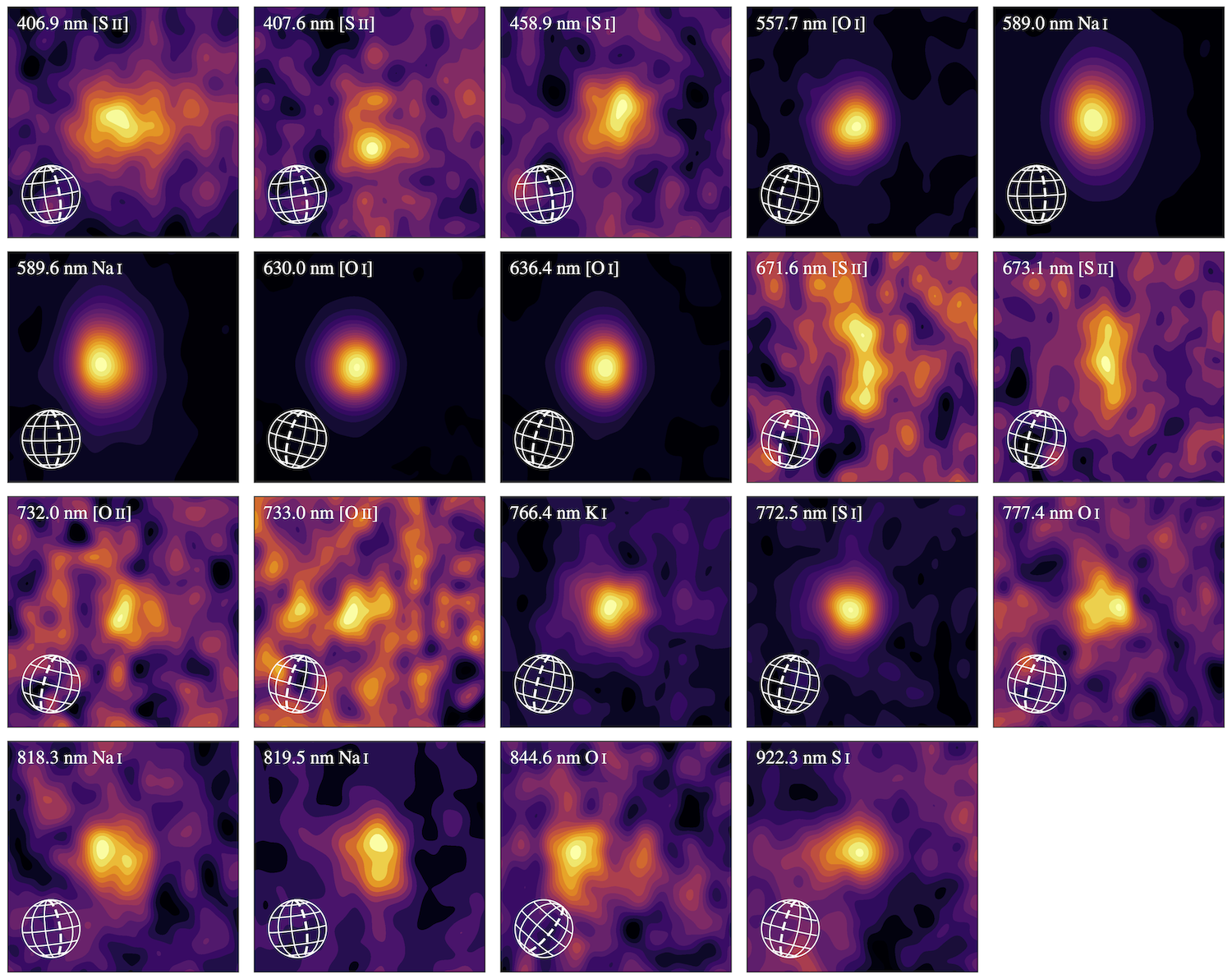
Prior to our observations, only six visible wavelength atomic auroral emissions had been identified at Io: the forbidden oxygen emissions at 557.7, 630.0 and 636.4 nm, the sodium doublet at 589.0 and 589.6 nm and the potassium line at 766.4 nm. The quality of the HIRES data combined with careful background subtraction allowed us to detect 13 additional lines at a signal-to-noise ratio greater than 2, tripling the number of optical emissions detected from Io’s eclipse atmosphere. Figure 1 shows an example of each of the emission lines identified in the HIRES spectra.

We used this set of emission lines in conjunction with both broadband and narrowband images of Io in eclipse taken by Cassini (Geissler et al. 2004) to map the locations of the emissions and connect them to discrete auroral features. The identification of additional atomic oxygen lines provides a powerful diagnostic for determining whether the auroral emission originated due to electron impact on atomic or molecular species. Schmidt et al. (2023) interpreted the 630.0∕557.7 nm emission ratio as evidence for emission from an atomic oxygen column. We updated our auroral emission model to include cross sections for electron impact on SO₂ and modeled the emission at 557.7, 777.4 and 844.6 nm from atmospheres composed of just O, a combination of O and SO₂, and finally a combination of O, SO₂ and O2, which we used as an isoelectronic proxy for SO. We found the three species atmosphere fit the data within the uncertainties assuming excitation by canonical 5 eV electrons.

The high cadence of the HIRES observations allowed us to explore the connection between the ambient electron density and the auroral brightness. We found the connection to be ambiguous, suggesting that plasma bombardment at Io is varies significantly beyond what simple modulation of the magnetic geometry provides.

Time permitting, we will provide a preview of preliminary conclusions of a similar time-series analysis of Europa’s optical aurora.

Figure 1. Auroral emissions from Io in eclipse including both new emissions and those previously detected at 557.7, 589.0, 589.6, 630.0, 636.4 and 766.4 nm. Note that each image is displayed using an individually scaled colormap in order to optimize the dynamic range available to the dimmer emissions. Wireframe globes show Io’s physical orientation at the time of the observation. Figure from Milby et al. (under review).

REFERENCES
Ballester, G. E., Moos, H. W., Feldman, P. D., et al. 1987, The Astrophysical Journal, 319, doi: 10.1086/184950
Bouchez, A. H., Brown, M. E., & Schneider, N. M. 2000, Icarus, 148, doi: 10.1006/icar.2000.6518
Geissler, P., McEwen, A., Porco, C., et al. 2004, Icarus, 172, doi: 10.1016/j.icarus.2004.01.008
Geissler, P. E., McEwen, A. S., Ip, W., et al. 1999, Science, 285, 870, doi: 10.1126/science.285.5429.870
Geissler, P. E., Smyth, W. H., McEwen, A. S., et al. 2001, J. Geophys. Res., 106, 26137, doi: 10.1029/2000JA002511
Milby, Z., de Kleer, K., & Schmidt, C. under review, The Planetary Science Journal
Milby, Z., de Kleer, K., Schmidt, C., & Leblanc, F. 2024, The Planetary Science Journal, 5, doi: 10.3847/PSJ/ad49a2
Retherford, K. D., Moos, H. W., Strobel, D. F., Wolven, B. C., & Roesler, F. L. 2000, Journal of Geophysical Research, 105, doi: 10.1029/2000JA002500
Retherford, K. D., Spencer, J. R., Stern, S. A., et al. 2007, Science, 318, doi: 10.1126/science.1147594
Roesler, F. L., Moos, H. W., Oliversen, R. J., et al. 1999, Science, 283, doi: 10.1126/science.283.5400.353
Schmidt, C., Sharov, M., de Kleer, K., et al. 2023, The Planetary Science Journal, 4, doi: 10.3847/PSJ/ac85b0
Strobel, D. F., & Wolven, B. C. 2001, Astrophysics and Space Science, 277, 271, doi: 10.1023/A:1012261209678

How to cite: Milby, Z., de Kleer, K., and Schmidt, C.: New Optical Aurora Detections at Io and Implications for Interactions with the Jovian Plasma Environment, EPSC-DPS Joint Meeting 2025, Helsinki, Finland, 7–13 Sep 2025, EPSC-DPS2025-1044, https://doi.org/10.5194/epsc-dps2025-1044, 2025.

15:24–15:36
|
EPSC-DPS2025-415
|
On-site presentation
Elias Roussos, Peter Kollmann, Norbert Krupp, Christopher Paranicas, Yixin Hao, Christina Plainaki, Davide Grassi, Melodie Kao, Betty Pei-Chun Tsai, and George Clark

Jupiter hosts the most intense electron radiation belts in our solar system—so energetic that relativistic electrons emit synchrotron radiation detectable at radio wavelengths. However, direct in-situ measurements of these belts are exceptionally challenging: the high fluxes of instrument-penetrating (ultra)relativistic electrons interfere with particle detectors, masking key information on energy spectra and angular distributions. As a result, remote sensing of synchrotron radiation has long been the primary method for probing the inner belts, with temporal variations in the observed radio emissions offering critical insight into the physical mechanisms shaping this extreme environment. Such variations have been observed on timescales ranging from days to years and have been linked to both external drivers—such as solar wind pressure changes, solar EUV control of Jovian upper atmosphere dynamics, and cometary impacts—and internal processes, including pitch-angle scattering by moons like Amalthea.

A fundamental limitation of synchrotron observations, however, is their integrated nature: even when spatial resolution is achieved, the signal combines emissions from a wide range of magnetic distances and electron energies along the line of sight. This complicates efforts to localize variability and disentangle overlapping physical processes. The Juno mission, with more than 65 close passes through Jupiter’s radiation environment between 2016 and 2025, presents a unique opportunity to complement remote observations with in-situ measurements of the same system. Although Juno's instruments (JADE, JEDI) cannot resolve spectra of >1 MeV electrons in the synchrotron-emitting region, the intensity of those instrument-penetrating electrons serves as a reliable proxy for tracking their content at different distances.

By subtracting a long-term average belt model from individual Juno passes, we extract the residual signal and track its temporal variations as a function of L-shell. This analysis reveals two dynamically distinct regions, separated near the orbit of Amalthea (L ~2.3), with largely decoupled variability. Both regions exhibit recurring quasi-periodic variations on ~100-day timescales, though often out of phase. In the outer belts (L > 2.3), this mid-term modulation is superimposed on a longer-term trend that develops into a flux minimum around the time of the solar minimum. The long-term perturbation propagates inward from Io’s orbit (L ~6) toward Amalthea over roughly one year. Surprisingly, a comparison with synchrotron belt variations observed by the Goldstone-Apple Valley Radio Telescope (GAVRT) shows a stronger correlation with the outer belt region, despite the inner belts dominating the synchrotron signal. These findings highlight the value of long-term, multi-instrument monitoring and provide a framework for interpreting remotely observed radiation belts in extrasolar systems, such as brown dwarfs.

How to cite: Roussos, E., Kollmann, P., Krupp, N., Paranicas, C., Hao, Y., Plainaki, C., Grassi, D., Kao, M., Pei-Chun Tsai, B., and Clark, G.: Probing Jupiter’s Inner Radiation Belts: Multi-Timescale Variability Revealed by Juno, EPSC-DPS Joint Meeting 2025, Helsinki, Finland, 7–13 Sep 2025, EPSC-DPS2025-415, https://doi.org/10.5194/epsc-dps2025-415, 2025.

15:36–15:48
|
EPSC-DPS2025-621
|
ECP
|
On-site presentation
Andrea Caruso, Luis Gomez Casajus, Drew Coffin, Dustin Buccino, Maria Smirnova, Eli Galanti, Edoardo Gramigna, Marzia Parisi, Andrea Togni, Marco Zannoni, Paolo Tortora, Ryan S. Park, Yohai Kaspi, Paul Withers, William Hubbard, Glenn Orton, Paul Steffes, and Scott Bolton

The Juno spacecraft, currently in orbit around Jupiter, provides a unique opportunity to investigate the planet’s atmospheric and ionospheric structure through radio occultation experiments. This study presents an analysis of radio signals transmitted between Juno and Earth-based antennas as the spacecraft passes behind Jupiter’s limb, offering vertical profiles of electron density in the ionosphere with unprecedented resolution.

A radio occultation experiment utilizes the precise tracking of a spacecraft’s radio signal as it is occulted by a planetary body from the line of sight of a ground-based antenna. As the signal propagates through the planetary atmosphere, it experiences bending and phase delay due to refractive index gradients. The passage of the radio signal through Jupiter’s ionosphere induces a frequency-dependent Doppler shift, superimposed on the non-dispersive contributions from the neutral atmosphere and spacecraft dynamics.

Juno's radio science subsystem employs a dual-frequency link, involving coherent X-band (8.4 GHz) and Ka-band (32 GHz) signals transmitted to Earth. By exploiting a linear combination of the sky frequencies recorded at the ground antenna in the two bands, it is possible to isolate the downlink dispersive effect, which is proportional to the integrated electron content along the ray path. This enables the retrieval of accurate vertical electron density profiles through an inversion process based on a ray-tracing technique, assuming Jupiter’s ionosphere to be oblate and axially symmetric. Additionally, an uncertainty quantification has been carried out  through a Monte Carlo simulation, providing confidence intervals for each altitude level above Jupiter’s 1 bar reference ellipsoid.

Within the Juno extended mission, starting from July 2023 radio occultations of Jupiter have been occurring at a cadence of approximately one per month, near perijove. In this context, we report on a series of occultation events spanning multiple perijoves, with particular attention to the most recent experiments that probed high latitudes near the auroral zone close to Jupiter’s north pole. Understanding auroral effects is essential for characterizing the coupling between Jupiter’s magnetosphere and ionosphere, and for evaluating their broader impact on the dynamics and thermal structure of the planet’s upper atmosphere.

Our findings contribute to the growing understanding of Jupiter’s upper atmosphere, demonstrating the unique capabilities of dual-frequency radio occultations and paving the way for future ionospheric studies in support of upcoming exploration missions such as JUICE and Europa Clipper.

How to cite: Caruso, A., Gomez Casajus, L., Coffin, D., Buccino, D., Smirnova, M., Galanti, E., Gramigna, E., Parisi, M., Togni, A., Zannoni, M., Tortora, P., Park, R. S., Kaspi, Y., Withers, P., Hubbard, W., Orton, G., Steffes, P., and Bolton, S.: Characterization of Jupiter’s Ionosphere using Juno’s Radio Occultation Measurements, EPSC-DPS Joint Meeting 2025, Helsinki, Finland, 7–13 Sep 2025, EPSC-DPS2025-621, https://doi.org/10.5194/epsc-dps2025-621, 2025.

15:48–16:00
|
EPSC-DPS2025-913
|
On-site presentation
Khalid Mohamed, Omakshi Agiwal, Luke Moore, Joe Huba, Carlos Martinis, and Ingo Müeller-Wodarg

We present the Jovian Atmospheric Model Making Ionospheric EStimates (JAMMIES), a new model for Jupiter's non-auroral ionosphere. JAMMIES is a 2D model of Jupiter’s non-auroral ionosphere that solves the ion continuity and momentum equations in a dipole coordinate system. It was recently adapted from SAMI2 (Huba+2000), a model that has successfully reproduced numerous ionospheric features on Earth. JAMMIES incorporates neutral atmospheric inputs from a new general circulation model, JTIM (Mueller-Wodarg+2024), and defines its grid based on the updated JRM33 magnetic field model (Connerney+2022). JAMMIES is able to reproduce structures globally in H3+ column density co-located with the long unexplained H3+ Dark Ribbon: a lack of emission from the dominant molecular ion — H3+ — coincident with Jupiter’s magnetic equator (Stallard+2018). We present how JAMMIES is able to recreate this ionospheric feature via Earth-like interhemispheric electrodynamic transport or neutral-wind driven-motion along magnetic field lines. We also present how we use JAMMIES to model electron density altitude profiles measured at dawn and dusk from radio occultations using the Galileo and Juno spacecrafts. Electron density altitude profiles from radio occultations are highly variable with no obvious systematic trends (Mendillo+2022). We find that much of that variability is captured in JAMMIES as a result of wind-driven field aligned plasma transport. Neutral winds from JTIM have strong westward zonal components and converge towards the equator. When combined with Jupiter’s complex magnetic geometry, this results in irregular patterns of effective upward and downward plasma transport, which are broadly consistent with observed plasma distributions. Additional modifications follow from vertical plasma drifts arising from electrodynamic interactions near the magnetic equator. The fact that plasma dynamics driven by a single neutral wind pattern can reproduce radio occultation morphologies from both the Galileo and Juno eras (spanning 30 years) suggests that Jupiter’s ionosphere is remarkably stable. Future JAMMIES simulations will further investigate this stability through comparisons with additional datasets and will enhance modeling capabilities by incorporating expanded chemistry and self-consistent plasma temperature calculations.

How to cite: Mohamed, K., Agiwal, O., Moore, L., Huba, J., Martinis, C., and Müeller-Wodarg, I.: Modeling Jupiter’s Ionosphere: Reproduction of Global H3+ Density Maps, and Electron Density Profiles from Galileo and Juno, EPSC-DPS Joint Meeting 2025, Helsinki, Finland, 7–13 Sep 2025, EPSC-DPS2025-913, https://doi.org/10.5194/epsc-dps2025-913, 2025.

Posters: Thu, 11 Sep, 18:00–19:30 | Lämpiö foyer

Display time: Thu, 11 Sep, 08:30–19:30
Chairpersons: Stavros Kotsiaros, Scott Bolton, Bertrand Bonfond
L1
|
EPSC-DPS2025-980
|
On-site presentation
Bertrand Bonfond, Denis Grodent, Guillaume Sicorello, Julie Vinesse, Linus Head, Jean-Claude Gérard, Alessandro Moirano, Bilal Benmahi, Vincent Hue, Thomas Greathouse, Randy Gladstone, and Rohini Giles

Juno's UltraViolet Spectrograph captures spectrally resolved images of Jupiter's aurorae by scanning a narrow swath across the planet for every rotation of the spacecraft. A mirror at the entrance of the instrument allows us to aim for specific targets up to 30° away from the spin plane. Following a pre-programmed plan designed for each perijove, the instrument can either stare at a given feature for several spins or create maps as complete as possible by shifting the mirror every few spins. Consequently, Juno-UVS does not look at its own magnetic footprint all the time, complicating direct comparisons with in situ instruments. Here we describe a method to recover brightness profiles as complete and as synchronous as possible along the Juno magnetic footprint track. Some additional data products are also built, such as profile of the color ratio between wavelength ranges unabsorbed by hydrocarbons and absorbed ones. Combined with the emission angle, which we also record, this ratio allows us to derive profiles of the mean energy of precipitating electrons. The electron mean energy, and the energy flux deduced from the UV brightness then allow us to compute profiles of the Hall and Pedersen conductance below Juno’s magnetic footpath. Finally, another time series extracted from the UVS data is the noise rate associated with the radiation (mostly relativistic electrons) penetrating the instrument. We will show how this data product allows us to identify bursts of relativistic electrons above Jupiter's poles and connect them to specific regions of the aurorae and/or of the magnetosphere.

How to cite: Bonfond, B., Grodent, D., Sicorello, G., Vinesse, J., Head, L., Gérard, J.-C., Moirano, A., Benmahi, B., Hue, V., Greathouse, T., Gladstone, R., and Giles, R.: A bright path under Juno's footprint, EPSC-DPS Joint Meeting 2025, Helsinki, Finland, 7–13 Sep 2025, EPSC-DPS2025-980, https://doi.org/10.5194/epsc-dps2025-980, 2025.

L2
|
EPSC-DPS2025-1448
|
On-site presentation
Stavros Kotsiaros, John E. P. Connerney, Joachim Saur, Yasmina Martos, Stephan Schlegel, and Bolton Scott

Juno’s highly elliptical polar orbits have enabled groundbreaking in-situ observations of the electrodynamic interaction between Jupiter and its volcanic moon, Io. These observations probe previously unexplored regions, including Io’s orbit, Jupiter’s ionosphere, and the intermediate space between them. Magnetic field data from multiple Juno traversals of field lines connected to Io’s orbit reveal intricate and dynamic magnetic signatures near flux tubes associated with Io’s position. This study introduces a methodology for modeling the distribution of currents along Io’s flux tube (IFT) and Alfvén wings, replicating the observed magnetic field signatures during Juno’s downstream encounters. We characterize the location, size, and morphology of the current-carrying regions and the current distribution within the IFT and Alfvén wings. The analysis reveals strong filamentation of field-aligned currents, with upward and downward currents splitting into secondary cells rather than forming uniform structures. A robust correlation between total field-aligned current intensity, particle energy flux, and Poynting flux highlights efficient energy transfer within the Jupiter-Io system. Using data from all Juno traversals up to perijove 42, we estimate the strength of this interaction, accounting for factors such as Io’s position within the plasma torus, its distance along the extended tail, and the magnetic field intensity at Jupiter’s ionospheric footprint. These findings provide critical new constraints on the complex interplay of electrodynamic processes in the Io-Jupiter system, advancing our understanding of magnetosphere-moon interactions in planetary environments.

How to cite: Kotsiaros, S., Connerney, J. E. P., Saur, J., Martos, Y., Schlegel, S., and Scott, B.: The Electrodynamic Interaction Between Io and Jupiter: Insights from Juno Observations , EPSC-DPS Joint Meeting 2025, Helsinki, Finland, 7–13 Sep 2025, EPSC-DPS2025-1448, https://doi.org/10.5194/epsc-dps2025-1448, 2025.

L3
|
EPSC-DPS2025-508
|
On-site presentation
Vincent Hue, Thomas Greathouse, Bertrand Bonfond, Alessandro Moirano, Jonas Rabia, Bilal Benmahi, Rohini Giles, Randy Gladstone, Denis Grodent, Josh Kammer, Ali Sulaiman, Jamey Szalay, Maarten Versteeg, and Scott Bolton

The vast Jovian magnetosphere is filled with plasma originating from Io's volcanic activity in the inner magnetosphere. This plasma is structured as a sheet in near-corotation with Jupiter's magnetic field and confined to the centrifugal equator. The Galilean moons act as physical obstacles to this plasma flow, generating Alfvén wings. The propagation and reflection of Alfvén waves between Jupiter's northern and southern polar ionospheres create several auroral spots, whose brightness and morphology are controlled by the moon's position within the plasma sheet. These initial Alfvén waves progressively lose energy as they undergo multiple partial reflections between Jovian hemispheres, characterized by the brightness decrease of the auroral footprint tail downstream of the main spot in ultraviolet and infrared spectra. Previous observing campaigns using the Hubble Space Telescope have characterized this brightness decrease, measuring an ultraviolet e-folding distance of 21,000 km, correponding to about 40˚ of longitude (Bonfond, et al. 2009, The Io UV footprint: Location, inter-spot distances and tail vertical extent, J. Geophys. Res., 114, A07224, doi:10.1029/2009JA014312.). Juno's unique vantage point in the Jovian system now allows for measurements of the entire Io footprint structure at almost every perijoves, using the Juno-UVS instrument. We extend previous work characterizing the Io footprint by analyzing the Juno-UVS dataset collected during the Juno prime mission.

How to cite: Hue, V., Greathouse, T., Bonfond, B., Moirano, A., Rabia, J., Benmahi, B., Giles, R., Gladstone, R., Grodent, D., Kammer, J., Sulaiman, A., Szalay, J., Versteeg, M., and Bolton, S.: The length of the Io footprint: Spectral characterization using Juno-UVS, EPSC-DPS Joint Meeting 2025, Helsinki, Finland, 7–13 Sep 2025, EPSC-DPS2025-508, https://doi.org/10.5194/epsc-dps2025-508, 2025.

L4
|
EPSC-DPS2025-525
|
ECP
|
On-site presentation
Marco Loncar and Andrew Jackson

With the Juno spacecraft in orbit about Jupiter, an extensive data set of magnetic field measurements now exists for the Jovian field. This has improved the coverage of the planet both in space and time by reaching greater latitudes as well as providing a continuous timeseries over a nine year period (2016-present). Such improved sampling of Jupiter has allowed for far more in-depth studies of its magnetic field, producing more complex field models to those found from earlier missions and the first claims of secular variation at a body other than Earth [1,2].

Although these models have revealed interesting new features of the Jovian magnetic field, they all suffer from large misfits in comparison with intrinsic satellite uncertainties: typical rms misfits of 500-1000 nT give weighted rms misfits of the order of ~10 (when published error budgets are adopted) [3]. Statistically, this underfitting strongly suggests that there are currently unmodelled processes that need to be considered.

Given the size of the Jovian magnetosphere, we believe this external field is responsible for the observed mismatch. The majority of field models take this external field as a low order l ~ 1, 2 spherical harmonic expansion, corresponding physically to Jupiter’s magnetodisc (a ring current, tilted with respect to the equatorial plane). This (near-)dipolar magnetosphere describes a simplified system in which small scale effects are neglected. A deterministic, higher order spherical harmonic expansion would provide a more accurate representation of the external field. However, there is still insufficient data to carry out this process to the desired level of accuracy.

The remaining approach to consider is a stochastic description of the system [4,5]. To do so, we model a distribution of randomly oriented currents around a planet, in a simplified spherical geometry. We find that measurements made within this region have non-zero, large scale correlations. This indicates that the presence of stochastic currents in the magnetosphere acts to relate measurements that would otherwise be considered independent.

We apply this method to the Juno data set for the case of a spherical magnetosphere geometry as described above. By taking into account these newfound correlations, we “pre-whiten” the Juno measurements (removing the effects of these stochastic currents in the magnetosphere). The resulting dataset is composed of entries that are more independent than the raw data itself. Through regularised inversion of this “pre-whitened” data, we find new models of Jupiter’s internally sourced magnetic field. For appropriately chosen current variance, these models fit the data well and account for the misfit seen in previous cases.

This is an encouraging result that shows the importance of a more full description of Jupiter’s magnetosphere. There is, however, more to consider in regards to further magnetosphere geometries and the interplay between these more complex magnetospheres and other contemporary models of Jupiter’s magentic field.


Acknowledgments:

The Planetary Data System (PDS) has proved invaluable in carrying out this work, to source data from both Juno and the earlier missions mentioned used throughout.


References:

[1] K. Moore et al. (2019) Nature, 561, 76-78

[2] J. Bloxham et al. (2022) JGR: Planets, 127

[3] S. Sharan et al. (2022) Geophysical Research Letters , 49

[4] R. Parker (1988) JGR: Solid Earth, 93, 3105

[5] A. Jackson (1990) GJI, 103, 657

How to cite: Loncar, M. and Jackson, A.: Stochastic Modelling of Jupiter's Magnetosphere , EPSC-DPS Joint Meeting 2025, Helsinki, Finland, 7–13 Sep 2025, EPSC-DPS2025-525, https://doi.org/10.5194/epsc-dps2025-525, 2025.

L5
|
EPSC-DPS2025-713
|
ECP
|
On-site presentation
Irene Doria, Daniele Durante, Paolo Cappuccio, Mauro Di Benedetto, and Luciano Iess

The volcanic activity of Io, the innermost of the Jupiter’s Galilean moons, is the main source of plasma in the Jupiter’s magnetosphere: the neutral particles ejected by Io’s volcanos are indeed ionized via electron collision and charge exchange processes (Thomas, N., et al., 2004). The produced ions are then affected by the electromagnetic force and by the gravitational and centrifugal forces, becoming confined in a torus around Io’s orbit called the Io plasma torus (IPT).

The IPT affects any radio signal travelling across this region, causing an additional frequency shift and a delay in, respectively, Doppler and range measurements between a deep space probe and the Earth. This effect can be exploited to analyze the IPT, in particular radio science data allow to study electron density models.

Radio occultation experiments have been performed with the Juno mission (Phipps, P.H., et al., 2021). The radio-tracking system enables a two-link configuration in X and Ka band but only Doppler measurements are performed, in two-way coherent mode. The two possible dual-link configurations are X/X + Ka/Ka and X/X + X/Ka and they allow isolating either the uplink or the downlink plasma contribution, which can be related to the total electron content and so to the electron density Ne. The Doppler plasma contribution can be integrated to derive the path delay which can be expressed in terms of the total electron content.

In this way it is possible to study electron density models for the IPT; in particular, we consider the empirical model proposed by (Phipps, P. H., and Withers, P., 2017): it divides the IPT into three main regions, the cold torus, the ribbon and the warm torus, plus the extended torus;  in each region Ne is modeled with a Gaussian-like distribution, and it is expressed as a function of the radial distance r from Jupiter in the centrifugal plane and the distance z away from the plane of the centrifugal equator. This is an axisymmetric model but there may be dependences of the density with the longitude or with time (due to Io’s volcanic activity). These dependences may be expressed with a Fourier expansion for the terms Ni and Hi, the central density and the scale height, respectively, for each region (Moirano, A., et al., 2021).

Juno performed many perijoves with occultation of the IPT allowing us to estimate the model parameters using a Markov Chain Monte Carlo (MCMC) algorithm; however, the model could be potentially further improved with future measurements from the JUICE mission (Grasset, O., et al., 2013).

The JUICE spacecraft is equipped with a radio-tracking system similar to BepiColombo (Iess, L., et al., 2021; Cappuccio, P., et al., 2025): a Deep Space Transponder can establish simultaneously X/X and X/Ka two-way coherent links, while a Ka-Transponder ensures an additional Ka/Ka one. In this way three links are simultaneously established, and the multi-frequency calibration scheme allows isolating the plasma contribution on both the uplink and downlink legs. Differently from Juno, JUICE can collect both Doppler and range data (in a coherent two-way mode) which give access to the absolute value of the total electron content. JUICE also hosts an Ultra Stable Oscillator (USO) (Shapira, A., et al., 2016) which can be used to perform dual frequency X-Ka IPT observations in non-coherent one-way downlink mode.

We report on an analysis performed to find the future optimal opportunities for the occultation of the IPT with the JUICE spacecraft. The occultation opportunities are identified using the SPICE kernels of the mission, then the path delay and the path delay rate are simulated.

The IPT morphology is not yet well understood, and the rich dataset collected by Juno together with the future torus occultations of JUICE gives the opportunity to study in more detail this plasma region and in particular to perform analyses on the electron plasma density.

How to cite: Doria, I., Durante, D., Cappuccio, P., Di Benedetto, M., and Iess, L.: Radio occultation experiments of the Io plasma torus: from Juno to JUICE, EPSC-DPS Joint Meeting 2025, Helsinki, Finland, 7–13 Sep 2025, EPSC-DPS2025-713, https://doi.org/10.5194/epsc-dps2025-713, 2025.

L6
|
EPSC-DPS2025-1011
|
On-site presentation
Jupiter’s magnetic field geometry and its relation with new decameter radiation events observed by Juno
(withdrawn)
Yasmina M Martos, Jack E. P. Connerney, Masafumi Imai, William S. Kurth, and Stavros Kotsiaros
L7
|
EPSC-DPS2025-1041
|
On-site presentation
Luke Moore, Henrik Melin, Kate Roberts, Tom Stallard, James O'Donoghue, Paola Tiranti, Omakshi Agiwal, Katie Knowles, Khalid Mohamed, and Carl Schmidt

We present observations and modeling of the state of Jupiter’s non-auroral upper atmosphere surrounding Juno perijove 54. Juno radio occultations sampled Jupiter’s dawn ionosphere near 38N planetocentric latitude around 12 UTC on 7 September 2023. Simultaneous IR spectroscopy was obtained by JWST/NIRSpec, Keck/NIRSPEC, and IRTF/iSHELL. Analysis of IR spectra yields maps of H3+ density and temperature in altitude, latitude, longitude, and local time, providing spatiotemporal context for Juno PJ54 observations. Model reproductions of the measured diurnal variation of H3+ also provide key insight into unconstrained giant planet ionospheric chemistry (the conversion of H+ to H3+ by an intermediate reaction with vibrationally-excited H2). We find that Jupiter’s mid-latitude ionosphere during this epoch was reasonably well-behaved in comparison to the range of dynamic plasma distributions seen in prior giant planet observations. H3+ temperatures are roughly 700 K, densities a few thousand ions/cc, and loss rates for H+ + H2 reactions are line with prior estimates in the literature.

This work was supported by Keck Key Strategic Mission Support Grant 80NSSC22K0954, JWST-GO-03665.002-A, and NASA SSW Grant 80NSSC20K1045.

How to cite: Moore, L., Melin, H., Roberts, K., Stallard, T., O'Donoghue, J., Tiranti, P., Agiwal, O., Knowles, K., Mohamed, K., and Schmidt, C.: Vertical and local time variability in Jupiter's ionosphere, EPSC-DPS Joint Meeting 2025, Helsinki, Finland, 7–13 Sep 2025, EPSC-DPS2025-1041, https://doi.org/10.5194/epsc-dps2025-1041, 2025.

L8
|
EPSC-DPS2025-1079
|
On-site presentation
Christina Plainaki, Elias Roussos, Norbert Krupp, Davide Grassi, Peter Kollmann, and Alessandro Mura

Jupiter’s radiation belts represent one of the most extreme particle environments in the solar system—not only due to their intense fluxes of energetic electrons and protons, but also because they host a diverse, high-flux population of heavy ions with energies extending well above 5 MeV/nucleon - a critical energy range, not accessible by Juno or future missions like JUICE. Understanding the composition and distribution of these ions is essential for constraining the sources, acceleration, and loss processes of charged particles across a mass and energy range not typically accessible in other planetary magnetospheres.
Different ion species act as powerful tracers of magnetospheric dynamics. For instance, ions of solar origin—such as carbon, neon, or silicon—can indicate periods of enhanced solar wind penetration, which may challenge the paradigm of Jupiter being dominated by internal processes. Conversely, ions generated internally, such as those from Io’s volcanic output, may trace moon-magnetosphere interactions processes and internal acceleration mechanisms. Beyond studying particle processes, high-energy heavy ions could also play a role in altering the surfaces and forming exospheres of Jupiter’s moons through implantation and sputtering and are therefore critical to understand the evolution of these materials. They also pose risks to spacecraft via single event upsets—making their detailed mapping important for mission planning and radiation shielding design.
The first and so far only comprehensive investigation of Jupiter’s energetic heavy ion composition above 5 MeV/nucleon was performed by NASA’s Galileo mission (1995–2003), using the Heavy Ion Counter (HIC). HIC consisted of two particle telescopes, LET-B and LET-E. LET-B was designed to measure ions with Z ≥ 6 in the ~5–25 MeV/nucleon range using a stack of four solid-state detectors within a 25° conical aperture. LET-E had a similar configuration, but with five detectors and a broader angular acceptance (25°–45°), optimized for ions between 15-50 MeV/nucleon. LET-E also included a channel for instrument-penetrating >50 MeV/nucleon ions, with a broader 75° effective aperture.
Previous HIC studies primarily focused on the dominant energetic ion species—carbon (C), oxygen (O), and sulfur (S). However, HIC was capable of resolving additional elements, including nitrogen (N), neon (Ne), sodium (Na), magnesium (Mg), silicon (Si), and trace species with Z > 16, which have received limited attention to date. While earlier work presented small samples of such detections, their occurrence, variability, and significance have not been systematically explored.
In our ongoing investigation, we are analyzing the full HIC dataset from the Galileo mission to characterize Jupiter’s energetic ion composition, with an extra focus on these lesser-studied species. We present preliminary results on their energy spectra and relative abundances, along with their spatial (radial) distributions. Our goal is to resolve variations that may reflect different source regions or mechanisms, essentially assessing whether these species are of external (e.g., solar) or internal (e.g., Iogenic) origin.
 
These findings offer new constraints on the nature and variability of Jupiter’s heavy ion environment, supporting the development of improved radiation belt models and informing the interpretation of current in-situ observations from missions such as Juno. They are particularly complementary for future missions like ESA’s JUICE, which lacks an instrument equivalent to HIC. Our results may help refine expectations of the energetic heavy ion environment that drives surface modification processes on Jupiter’s Galilean moons.

How to cite: Plainaki, C., Roussos, E., Krupp, N., Grassi, D., Kollmann, P., and Mura, A.: Determining the composition of Jupiter’s energetic ion environment: some preliminary results based on the analysis of Galileo/HIC observations , EPSC-DPS Joint Meeting 2025, Helsinki, Finland, 7–13 Sep 2025, EPSC-DPS2025-1079, https://doi.org/10.5194/epsc-dps2025-1079, 2025.

L9
|
EPSC-DPS2025-1112
|
On-site presentation
Drew Coffin, Paul Withers, Omakshi Agiwal, Dustin Buccino, Marzia Parisi, Ryan S. Park, Andrea Caruso, Luis Gomez Casajus, Edoardo Gramigna, Paolo Tortora, Marco Zannoni, Jack Hunter Waite, Paul Steffes, Scott Bolton, and Ananyo Bhattacharya

The magnetosphere of Jupiter is an excellent natural laboratory for plasma dynamics due to its strength and internal plasma source. However, a complication in understanding the flow of energy through the system is the closure of the driving current systems within the chaotic high-latitude ionosphere of Jupiter, a region that has been poorly surveyed. The polar orbit of the Juno spacecraft permits for the first time multiple observations of the high- and mid-latitude ionosphere through the radio occultation technique. Presented are electron density profiles derived from a series of such occultations sampling a range of magnetic latitudes, including multiple profiles within 5° of the main oval that are consistent with ionospheric response to high-energy electron influx. Magnetosphere-ionosphere coupling at high latitudes plays a critical role in maintaining energy and momentum balance through the magnetosphere, due to the Pedersen current in the ionosphere providing closure for the Alvénic current loop that accelerates magnetospheric plasma to near co-rotation with the magnetic field. However, the complex nature of the ionosphere near auroral features complicates analysis of these currents, with multiple case studies for MI coupling presented.

How to cite: Coffin, D., Withers, P., Agiwal, O., Buccino, D., Parisi, M., Park, R. S., Caruso, A., Gomez Casajus, L., Gramigna, E., Tortora, P., Zannoni, M., Waite, J. H., Steffes, P., Bolton, S., and Bhattacharya, A.: Juno-derived insights to the Alvenic coupling between Jupiter and its magnetosphere, EPSC-DPS Joint Meeting 2025, Helsinki, Finland, 7–13 Sep 2025, EPSC-DPS2025-1112, https://doi.org/10.5194/epsc-dps2025-1112, 2025.

L10
|
EPSC-DPS2025-1140
|
ECP
|
On-site presentation
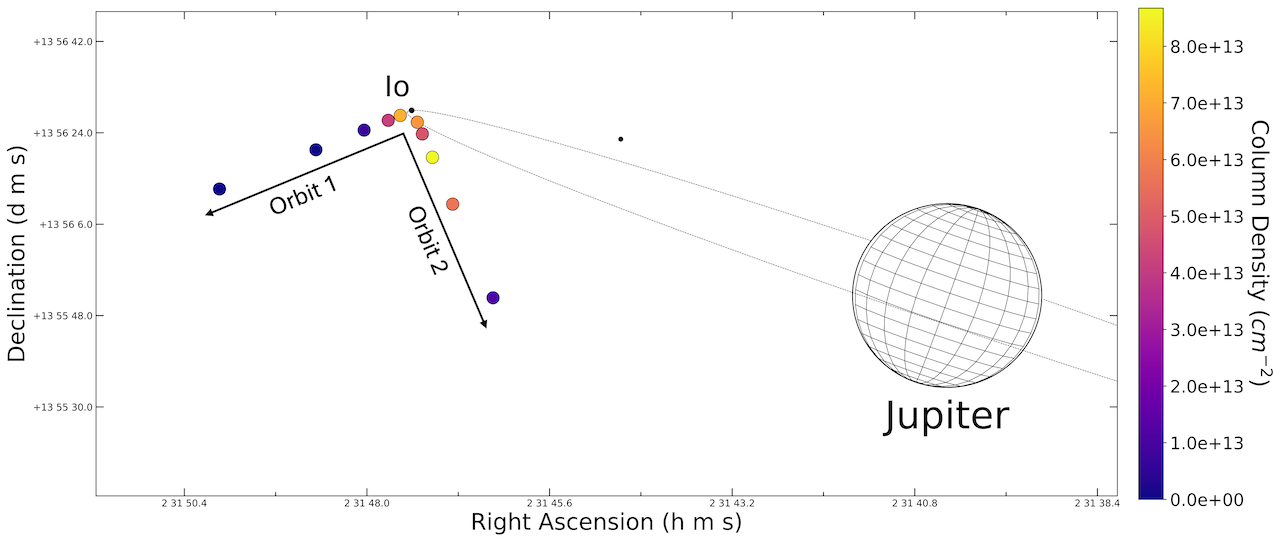
Simon Mendenhall and the Co-authors

Introduction: Oxygen in Io’s extended neutral cloud is difficult to observe due to its reliance on collisionally excited emission by electrons in the plasma torus. Previous studies have shown temporal and spatial asymmetries in OI emission brightness, possibly due to contributions from volcanic activity as well as seasonal variability (Koga et al., JGR: Space Phys., 2019; Bagenal & Dols, JGR: Space Phys., 2020). The observed brightness of the FUV emission from the OI] 135.6 nm multiplet results from a combination of multiple parameters like the electron density, electron temperature, neutral oxygen density, and integration of the emission along the line of sight. Our work offers additional observation points to constrain the spatial profile of Io’s neutral oxygen cloud.

Methodology: The Hubble Space Telescope’s (HST) Cosmic Origins Spectrograph (COS) performed an orthogonal step-scan of Io’s extended neutral cloud over two HST orbits, totaling 12 exposures. From the OI] 135.6 nm emission multiplet brightness of off-disk exposures, we estimated the column density of neutral oxygen, assuming a constant electron density and temperature along COS’s line of sight.

Results: We present our estimates of neutral oxygen column density for 10 off-disk exposures using COS, ranging in distance from 5 to 86 RIo from Io. We detect significant OI emissions up to 85 RIo from Io, extending ~1.6 RJ below the orbital plane. Our analysis suggests that oxygen is mostly confined inside Io’s orbit, in agreement with measurements from Hisaki (Koga et al., JGR: Space Phys., 2018). Our estimated peak column density of (8.67  1.48) × 1013 cm–2 measured near Io is as expected larger than the typical neutral cloud densities of 2-9 × 1012 cm–2 estimated by Smith et al. (JGR: Space Phys., 2022). Our future work will constrain the source of oxygen emissions as atomic O or SO2 in the context of neutral cloud and torus modeling by coauthors Smith et al. and Bagenal et al.


Figure 1. Step-scan geometry of Io’s neutral cloud at the east orbital ansa on Feb 24, 2024. Column densities for 10 exposures of the neutral cloud are shown to scale as shaded circles inside the 2.5” diameter COS aperture.

How to cite: Mendenhall, S. and the Co-authors: Constraining the Spatial Profile of Oxygen in Io’s Neutral Cloud with HST’s Cosmic Origins Spectrograph., EPSC-DPS Joint Meeting 2025, Helsinki, Finland, 7–13 Sep 2025, EPSC-DPS2025-1140, https://doi.org/10.5194/epsc-dps2025-1140, 2025.

L11
|
EPSC-DPS2025-1463
|
On-site presentation
Anatol Große-Schware, Lorenz Roth, Nickolay Ivchenko, Kurt Retherford, and Simon Mendenhall

The volcanism on Jupiter’s moon Io – generated by huge tidal forces exerted by the gas giant – is the most active in the whole solar system. It feeds a thin and short-lived atmosphere, consisting of mostly SO2, S2, O, SO and S. This sublimation-driven atmosphere loses around 1000 kg s-1 to the Jovian magnetosphere. The processes that drive this atmospheric escape of neutrals and the formation of neutral clouds within the plasma torus are not fully understood yet. The observation of far ultraviolet (FUV) emissions of Io’s atmosphere and its environment provide an opportunity to study the atmospheric escape. In this study, spectral data from the Space Telescope Imaging Spectrograph (STIS) instrument of the Hubble Space Telescope (HST) are analyzed. STIS observed Io for the first time in 1997, and until today a total amount of 122 datasets with exposure time > 500s is available. This large number of datasets and the ongoing HST campaign allow long-term studies of the FUV emissions. In these observations, STIS is used with a 52 times 2 arcseconds large slit capturing the complete ~1 arcsecond wide disk of the moon. The captured photons pass a grating, such that the 25 times 25 arcseconds large detector image contains both, spatial and spectral information and consists of one dispersion and one cross-dispersion axis. Figure 1 shows such a raw dataset of an observation carried out in October 2024. The corresponding observation geometry is displayed in Figure 2, including the Jovian magnetic field, the plasma torus and incoming solar radiation. The most prominent features are the HI-1216Å-line and the OI-1304Å-line, although the photons captured here do not originate from Io. These are foreground geocoronal emissions, i.e., scattered light from H and O atoms within Earths exosphere that need to be removed from the raw data. To analyze Io’s atmosphere, reflected sunlight from the Io disk needs to be removed as well. To do so, a synthetic model of reflected sunlight is generated, using a daily solar spectral model and the point-spread-function (PSF) of STIS. To obtain the albedo, the synthetic reflected sunlight is compared to the data between 1520Å and 1640Å, where no Io-genic emissions are expected. The wavelength-dependency of the albedo is neglected. The observed emissions – in all relevant wavelengths – consists of three main features: Bright equatorial spots that vary their position with the orientation of the Jovian background field, the limb glow and emissions from Io’s extended exosphere. The analysis’ focus lies on the long-term brightness variability in neutral and sulfur ion auroral ultraviolet emissions from Io's equatorial spots and the limb glow. Furthermore, emissions from Io's extended exosphere are evaluated to figure out spatial brightness variations along the instrument's slit. Since these extended exosphere emissions are proportional to the line-of-sight (LOS) column density, a simple analytical density model of Io’s escaping atmosphere proportional to r-2 is applied and compared to the extended emission profiles. The results are investigated regarding to correlations of neutral aurora, neutral extended emissions and ion emissions and compared to plasma torus density models and aurora models.

Figure 1: Detector raw image of an observation on 2024-10-22. Several O and S emission lines are displayed to indicate wavelengths where to expect Io-genic emissions.


Figure 2: Local geometry of STIS observing Io within the Jovian system (in scale) in LOS coordinates (y from HST towards Io, z towards Io North projected in the LOS plane). Top: 3D-image, bottom: slices along xy-, xz- (LOS), and yz-plane. STIS’ field of view is displayed in grey, the Jovian background magnetic field lines including the dipole axis and the magnetic equator in orange, the Io plasma torus in red and incoming solar radiation in yellow.

How to cite: Große-Schware, A., Roth, L., Ivchenko, N., Retherford, K., and Mendenhall, S.: Analysis of Io’s far-ultraviolet emission morphology using HST STIS spectral imaging data from 1997 to present, EPSC-DPS Joint Meeting 2025, Helsinki, Finland, 7–13 Sep 2025, EPSC-DPS2025-1463, https://doi.org/10.5194/epsc-dps2025-1463, 2025.

L12
|
EPSC-DPS2025-1569
|
ECP
|
On-site presentation
Saniya Sanada, Kazuo Yoshioka, Fuminori Tsuchiya, Natsuko Matsushita, Fran Bagenal, and Kurt Retherford

Jupiter forms the largest magnetosphere in the solar system, covering an area nearly 100 times the radius of Jupiter. Jupiter's magnetosphere has been observed by various instruments, including the HISAKI satellite and the Juno spacecraft. The HISAKI satellite observes Jupiter and its surrounding region out to ~8 R_J with a fixed field of view while orbiting the Earth. The Juno spacecraft, on the other hand, directly observes a wide area of the magnetosphere while orbiting Jupiter. It has been suggested that energy supplied by the solar wind and Jupiter's interior is stored in the outer magnetosphere and rapidly released by reconnection, causing plasma to flow toward Jupiter (Tao et al., 2018). In addition, previous studies have shown that volcanic activity on Jupiter's moon Io plays an important role in supplying the material that accumulates within Jupiter's magnetosphere, and data from the HISAKI satellite reinforces this understanding (Yoshioka et al., 2017). Continuous observations of Io's activity and the distant magnetosphere would clarify the impact of Io on Jupiter's magnetosphere and lead to a better understanding of the energy transport process in the magnetosphere. Therefore, in this study, we compare observation data from the HISAKI and Juno spacecraft to describe the average distribution of energy and density of Io-derived plasma particles as a function of distance from Jupiter (i.e., M-shell) in the vast magnetosphere. The electron temperature, electron density, and ion density were derived by fitting spectra obtained from remote sensing by the HISAKI satellite with a model using the atomic database CHIANTI. The orbital electron distribution was also obtained from particle measurement data obtained by in-situ observation of Juno, as being published by Sarkango et al. 2025. We focus our comparison on the plasma parameter distributions obtained from the HISAKI observation data and the Juno JADE instrument in the period when the observation areas of the two spacecrafts nearly overlap.

How to cite: Sanada, S., Yoshioka, K., Tsuchiya, F., Matsushita, N., Bagenal, F., and Retherford, K.: Electron distribution in the Jovian inner magnetosphere derived from multiple observations, EPSC-DPS Joint Meeting 2025, Helsinki, Finland, 7–13 Sep 2025, EPSC-DPS2025-1569, https://doi.org/10.5194/epsc-dps2025-1569, 2025.