

- University of Colorado, LASP, Astrophysical and Planetary Sciences, Boulder, CO 80303-7820, United States of America (larry.esposito@lasp.colorado.edu)
Saturn’s narrow, clumpy F ring is a region disturbed by chaotic orbital dynamics. We therefore model it as a stochastic process (specifically, a finite Markov chain). The ring appears dominated by dust in camera images, but the main mass of this ring resides in a core of elongated clumps called kittens, observed by ring occultations. Cassini UVIS sees such features about 1/3 of the time, the same frequency as the radio occultation detections of the F ring core; both have similar size distribution. We model the F ring core as kittens (transient aggregates with size100 m < 𝚫r < 3 km), including perturbations due to Prometheus encounters, resonance confinement, and mutual collisions. We solve for the stationary state. Without confinement, the probability of detecting the kittens is uniformly distributed. With corotation resonance confinement [1], the stationary state is sharply peaked, consistent with the longitudinal distribution of detections of the F ring by radio occultation. Considering shepherding alone, the Cassini radio observations are nonetheless better fit by the non-confinement stationary distribution, and even better by just 20% confined. We find acceptable fits for fractions up to 70% of the clumps shepherded in the 109:110 Prometheus CER. This alternative combines with the explanation of [1] to conclude that some fraction of the population, or some fraction of the time, the F ring is shepherded by Prometheus. We argue that the persistence of the F ring due to negative diffusion [2][3], where the ring is confined by Prometheus aligning particle when they are driven to collide when streamlines cross. We include the negative diffusion in the Markov chain using an Ehrenfest diffusion model [4]. A small asymmetry explains the distribution in resonant argument of the radio occultation detections. In all cases, Prometheus is the agent for confinement. The F ring is thus shepherded by a combination of a Prometheus corotation and a Lindblad resonance. When the center of mass of the material in the F ring is ever located at the Lindblad resonance with Prometheus, perturbations will drive negative diffusion to maintain that location. For our combined model: Shepherded fraction has the range fshep < 0.2; Diffusion asymmetry factor Pneg has the range 0.48 - 0.50. The negative diffusion thus can maintain the longitudinal distribution either alone, or in combination with shepherding, if the mean motion resonance coincides with the true core of the F ring
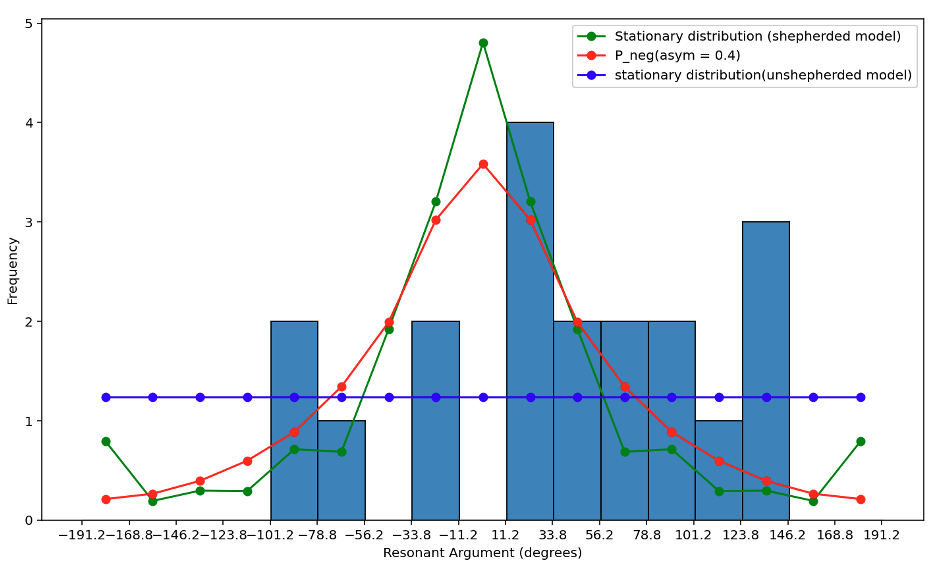
Comparing 3 models to the kittens detected in the Cassini radio occultations. Red line showing the purely negative diffusion model (no shepherding, only negative diffusion with Pneg = 0.40). The quality of the fit is similar to that of the Cuzzi et al. (2024) hypothesis (green line).
- Cuzzi, JN al. (2024). Saturn’s F ring is intermittently shepherded by Prometheus.
Science, 10 May 2024. - Lewis, MC al. (2012). Negative diffusion in planetary rings with a nearby moon. Icarus 213, 201.
- Sickafoose, AA and Lewis, MC (2024). Numerical simulations of Chariklo’s rings with a resonant perturber. Planetary Science Journal, February 2024.
- Feller, W (1968). An Introduction to Probability. Wiley.
How to cite: Esposito, L. W. and AlRebdi, A.: Saturn’s F Ring is Confined by Prometheus and Negative Diffusion, EPSC-DPS Joint Meeting 2025, Helsinki, Finland, 7–12 Sep 2025, EPSC-DPS2025-1052, https://doi.org/10.5194/epsc-dps2025-1052, 2025.


