OPS4 | Exploring the Saturn system

OPS4

Exploring the Saturn system
Conveners: Carly Howett, Axel Hagermann | Co-conveners: Georgina Miles, Günter Kargl, Katharina Otto, Stephan Zivithal
Orals TUE-OB2
| Tue, 09 Sep, 09:30–10:30 (EEST)
 
Room Mars (Veranda 1)
Orals TUE-OB3
| Tue, 09 Sep, 11:00–12:24 (EEST)
 
Room Mars (Veranda 1)
Orals TUE-OB5
| Tue, 09 Sep, 15:00–16:00 (EEST)
 
Room Mars (Veranda 1)
Orals TUE-OB6
| Tue, 09 Sep, 16:30–17:54 (EEST)
 
Room Mars (Veranda 1)
Orals WED-OB5
| Wed, 10 Sep, 15:00–16:00 (EEST)
 
Room Neptune (rooms 22+23)
Posters TUE-POS
| Attendance Tue, 09 Sep, 18:00–19:30 (EEST) | Display Tue, 09 Sep, 08:30–19:30
 
Lämpiö foyer, L10–28
Tue, 09:30
Tue, 11:00
Tue, 15:00
Tue, 16:30
Wed, 15:00
Tue, 18:00
The Saturn-system is a dynamic and intriguing place, with moons that are diverse, ocean-worlds or potential ones, and some of the best candidates to host life in our solar system. This session focuses on the entire Saturn system, including its atmosphere, rings and moons and welcomes submissions from all these areas. As both ESA and NASA consider returning to Saturn’s Moon Enceladus with a Large Class and Flagship missions respectively, we also encourage submissions specifically related to the science of Enceladus and its plumes.

Session assets

Orals TUE-OB2: Tue, 9 Sep, 09:30–10:30 | Room Mars (Veranda 1)

Chairperson: Carly Howett
Surface
09:30–09:42
|
EPSC-DPS2025-1307
|
ECP
|
On-site presentation
Jörn Helbert, Tara-Maria Bründl, Martin Haag, Martin Lindner, Björn Ordoubadian, and Sven Wittig and the The L4 Expert Committee and the L4 Payload Working Group

The ESA Voyage 2050 Senior Committee in 2021 recommended a mission to the “Moons of the Giant Planets” as one of the upcoming ESA Large missions. The scientific goals for this mission include exploring the habitability of ocean worlds, searching for biosignatures, and studying the connection between moon interiors and near-surface environments, as well as their implications for the overall moon-planet system. This theme follows the breakthrough science from the NASA-ESA Cassini-Huygens mission and the expected scientific return from the ESA JUICE mission in Cosmic Vision. The mission to the “Moons of the Giant Planets” will be ESA’s fourth Large-class mission – L4. 

Following the recommendation by the Voyage 2050 Senior Committee, ESA convened an Expert Committee [1] to define the scientific scope and target for this mission, considering the characteristics of each moon and future planned missions to Jupiter and Saturn's ocean worlds. Scientists identified Saturn’s moon Enceladus as the most compelling target, followed by Saturn’s moon Titan and Jupiter’s moon Europa. 

Figure 1: Summary of the Scientific objectives versus their relevance and whether they will be addressed by planned missions (JUICE, Europa Clipper, and Dragonfly) for each target (Europa, Ganymede, Enceladus, and Titan). Dark blue marked areas indicate most relevant objectives that will not be addressed by other forthcoming missions and are thus of highest interest for the L4 mission (from [1]).

The continued exploration of icy moons in the outer solar system suggests that subsurface oceans are common, although these oceans are hidden under thick ice shells. Their habitability can only be assessed indirectly. However, this changed with the Cassini mission in July 2005, which definitively detected water vapor plumes with jets of ice particles erupting from Enceladus during its third flyby. This was further supported by Magnetometer data returned at Cassini's first flyby in February 2005[1], [2], [3], [4], [5]. At its equator, which receives the most direct sunlight, surface temperatures on Enceladus average minus 193 degrees Celsius. The south pole, despite receiving less sunlight, was slightly warmer than the equator, at minus 188 degrees Celsius. The linear fractures, referred to as "tiger stripes," were as warm as minus 163 degrees Celsius in some areas, indicating active geological processes ([2], [6], [7], [8], [9]. These observations demonstrate that Enceladus is an active world. More importantly, it implies that Enceladus provides the opportunity to measure ocean water “in-situ” and directly search for biosignatures. Cassini demonstrated this capability by measuring the plume composition while passing through the plumes, despite the spacecraft and instruments not being designed for such measurements. 

It is now generally accepted that Enceladus has the three necessary conditions for a habitable environment capable of supporting life: the presence of liquid water, a source of energy, and a specific set of chemical elements [10], [11]. The L4 mission will build on this legacy with a mission design and payload complement focused on exploring the habitability of Enceladus and searching for biosignatures. The mission will take a significant step forward by not only placing an orbiter around Enceladus but also deploying a lander on the moon's south pole area. No space agency has previously landed on Enceladus, offering substantial potential for new scientific discoveries, particularly concerning habitability. Landing on Enceladus presents unique challenges as its environment is both familiar and alien: The moon’s surface is coated with fine, icy particles originating from active cryovolcanic plumes—effectively “snow” precipitating from the subsurface ocean beneath the ice shell. These particles may continuously fall onto the landing site and the lander [12], [13], potentially delivering material rich in salts, organics, and even biosignatures directly into the scientific instruments 

Since March 2025, the ESA study team has been working with a newly selected Payload Working Group and the Expert Committee to refine the science requirements and identify key technologies to achieve the ambitious goals of ESA’s Mission to Enceladus [15]. 

This new mission will advance European expertise in several scientific and technological fields, including in-orbit assembly, operating in extreme environments, landing technologies, and novel scientific instrumentation. These revolutionary technologies will have wide-ranging applications beyond ESA’s space science programme. 

How to cite: Helbert, J., Bründl, T.-M., Haag, M., Lindner, M., Ordoubadian, B., and Wittig, S. and the The L4 Expert Committee and the L4 Payload Working Group: The Mission to Enceladus – The ESA L4 mission , EPSC-DPS Joint Meeting 2025, Helsinki, Finland, 7–13 Sep 2025, EPSC-DPS2025-1307, https://doi.org/10.5194/epsc-dps2025-1307, 2025.

09:42–09:54
|
EPSC-DPS2025-1620
|
On-site presentation
Georgina Miles, Carly Howett, Francis Nimmo, and Douglas Hemingway

Enceladus maintains its global, unconsolidated ocean around its rocky, porous core by tidal dissipation with Saturn and torque from its resonance with Dione [1].  The active South Polar Terrain (SPT) region is associated with intense concentrations of endogenic heat, but it is the significantly lower-power conductive heat flow that dominates global heat loss as it occurs over the entire surface.  If Enceladus’ global ocean is to be sustained over a significant fraction of its existence, heating rates would have to be balanced endogenic heat loss. 

Estimates of heating rates from models vary from 1.5-150 GW [2].  The large range results from uncertainty in both the structure of the bodies’ interiors and their evolution.  Ice shell thickness/shape models, which interpret gravity, libration and topographic data, produce global conductive heat loss estimates of around 18-35 GW [3,4,5].

Endogenic heat loss from the SPT has been estimated using thermal observations from Cassini Composite Infrared Spectrometer (CIRS) to be between 5-19 GW [6,7,8], resulting in a conventional, combined heat loss estimate of around 50 GW [9].

Detecting endogenic heat loss using thermal observations presents a significant challenge, principally relating to limited data coverage and uncertainty about the surface thermal properties but is possible under some circumstances [10].

We use thermal observations CIRS to identify endogenic heat at the north pole of Enceladus in the form of conductive heat flow.   From this estimate we can infer global average heat loss.  We are then able to invoke the same mechanisms used to estimate the global average heat loss from ice shell thickness models [5, 9] to characterize the first north polar and global average ice shell thicknesses independently derived from thermal observations.

Acknowledgments: This work was made possible through NASA’s support of Cassini Data Analysis Program Grant Number 80NSSC20K0477.


References

[1] Nimmo, F., Barr, A.C., Behounková, M. and McKinnon, W.B., 2018. The thermal and orbital evolution of Enceladus: observational constraints and models. Enceladus and the icy moons of Saturn475, pp.79-94.

[2] Lainey, V., Casajus, L.G., Fuller, J., Zannoni, M., Tortora, P., Cooper, N., Murray, C., Modenini, D., Park, R.S., Robert, V. and Zhang, Q., 2020. Resonance locking in giant planets indicated by the rapid orbital expansion of Titan. Nature Astronomy4(11), pp.1053-1058.

[3] Thomas, P.C., Tajeddine, R., Tiscareno, M.S., Burns, J.A., Joseph, J., Loredo, T.J., Helfenstein, P. and Porco, C., 2016. Enceladus’s measured physical libration requires a global subsurface ocean. Icarus264, pp.37-47.

[4] Čadek, O., Tobie, G., Van Hoolst, T., Massé, M., Choblet, G., Lefèvre, A., Mitri, G., Baland, R.M., Běhounková, M., Bourgeois, O. and Trinh, A., 2016. Enceladus's internal ocean and ice shell constrained from Cassini gravity, shape, and libration data. Geophysical Research Letters43(11), pp.5653-5660.

[5] Hemingway, D.J. and Mittal, T., 2019. Enceladus's ice shell structure as a window on internal heat production. Icarus332, pp.111-131.

[6] Spencer, J.R., Pearl, J.C., Segura, M., Flasar, F.M., Mamoutkine, A., Romani, P., Buratti, B.J., Hendrix, A.R., Spilker, L.J. and Lopes, R.M.C., 2006. Cassini encounters Enceladus: Background and the discovery of a south polar hot spot. science311(5766), pp.1401-1405.

[7] Howett, C.J.A., Spencer, J.R., Pearl, J. and Segura, M., 2011. High heat flow from Enceladus' south polar region measured using 10–600 cm− 1 Cassini/CIRS data. Journal of Geophysical Research: Planets116(E3).

[8] Spencer, J.R., Nimmo, F., Ingersoll, A.P., Hurford, T.A., Kite, E.S., Rhoden, A.R., Schmidt, J. and Howett, C.J., 2018. Plume origins and plumbing: from ocean to surface. Enceladus and the icy moons of Saturn163.

[9] Nimmo, F., Neveu, M. and Howett, C., 2023. Origin and evolution of Enceladus’s tidal dissipation. Space Science Reviews219(7), p.57

[10] Miles, G., Howett., C., Spencer J., Vol. 16, EPSC2022-1190, 2022, https://doi.org/10.5194/epsc2022-1190

How to cite: Miles, G., Howett, C., Nimmo, F., and Hemingway, D.:  Independent constraint of Enceladus’ ice shell thickness using thermal observations, EPSC-DPS Joint Meeting 2025, Helsinki, Finland, 7–13 Sep 2025, EPSC-DPS2025-1620, https://doi.org/10.5194/epsc-dps2025-1620, 2025.

09:54–10:06
|
EPSC-DPS2025-1176
|
ECP
|
On-site presentation
Mallory Kinczyk, Chloe Beddingfield, Michael Bland, Emily Martin, and Douglas Hemingway

The complexity of Enceladus’ surface and the presence of young, heavily tectonized regions such as the South Polar Terrain make it a compelling exploration target for understanding icy satellite evolution and potential habitability. However, the current gap in our understanding of Enceladus’s thermal history limits our ability to constrain the longevity of its internal ocean and timescales of endogenic geologic activity. In contrast to the tectonized terrains, Enceladus’ ancient, heavily cratered surfaces preserve the earliest geologic events and preserve potential evidence of Enceladus’ thermal and geophysical history. Characterizing geologic features within the cratered terrains provides observation-based insight into the long-term evolution of the ice shell and can place constraints on the evolution of tidal stresses and heat flow affecting the surface geology.

Many craters within the cratered terrains appear to have undergone viscous relaxation, where their depths are shallower than what is expected for fresh craters and can be attributed to elevated heat flow in the subsurface [1]. Global models of present-day heat flux indicate that there are spatial variations in heat flow across the ice shell [2]. However, these models are a snapshot in time and do not represent temporal variations. Observational studies of the cratered terrains have found evidence of extreme viscous relaxation in regions where modeled present-day heat flux is relatively low [3], although these correlations have not been systematically analyzed.

Most, if not all, large craters on Enceladus show some degree of viscous relaxation with shallow floors and large central mounds. We present on the compilation of a global database of impact craters on Enceladus and how this data product feeds into our systematic campaign to identify signs of crater relaxation across Enceladus’ heavily cratered terrains. These data will feed into a larger effort to use the spatial distribution of relaxed craters and models of crater relaxation to gain insight into the thermal history of the cratered terrains. In comparing the distribution of relaxed craters to models of present-day heat flux, we may determine whether these models are sufficient to explain the observed relaxation states of craters and, in turn, whether there is observational evidence that Enceladus has experienced one or more past episodes of elevated heat flux.

References:

[1] Bland, M. T., Singer, K. N., McKinnon, W. B., & Schenk, P. M. (2012). Enceladus' extreme heat flux as revealed by its relaxed craters. Geophysical Research Letters39(17), [2] Hemingway, D. J., & Mittal, T. (2019). Enceladus's ice shell structure as a window on internal heat production. Icarus332, 111-131, [3] Kinczyk, M. J., Byrne, P. K., & Patterson, G. W. (2024). The Geological History of Enceladus' Cratered Terrains. Journal of Geophysical Research: Planets129(7), e2024JE008326.

How to cite: Kinczyk, M., Beddingfield, C., Bland, M., Martin, E., and Hemingway, D.: Early results on the global distribution of relaxed craters on Enceladus, EPSC-DPS Joint Meeting 2025, Helsinki, Finland, 7–13 Sep 2025, EPSC-DPS2025-1176, https://doi.org/10.5194/epsc-dps2025-1176, 2025.

10:06–10:18
|
EPSC-DPS2025-1378
|
ECP
|
On-site presentation
Guillaume Cruz Mermy, Thomas Cornet, Sébastien Rodriguez, Christos Ntinos, Rozenn Robidel, Frédéric Schmidt, François Andrieu, and Inès Belgacem

Enceladus is one of the most intriguing icy moons of the solar system, exhibiting active cryovolcanism and continuous plume activity at its south pole [1]. The surface in this region is geologically young and frequently resurfaced by plume fallout and tectonic activity [2]. While numerous studies have mapped compositional variations using Cassini-VIMS data [3,4], few have quantified the microphysical properties of water ice—including grain size, crystallinity and surface roughness—over the full VIMS spectral range. Understanding these parameters is critical for interpreting the thermal and geological evolution of the surface and for tracing exchanges between the subsurface ocean and the surface.


Here, we present a comprehensive study in which we fit VIMS reflectance spectra across the 1.0–5 µm range to estimate key microphysical properties of Enceladus's surface. We apply a Hapke-based radiative transfer model [5,6] in a Bayesian Markov Chain Monte Carlo (MCMC) framework [7] to retrieve the posterior distributions of ice crystallinity, grain size and surface roughness for selected observations. We use the optical constants of Mastrapa et al. [8], which provide laboratory measurements of crystalline and amorphous water ice at temperatures from 20 to 150 K. The full-spectrum inversion enables robust fitting of broad and narrow features, including the diagnostic absorption band at 1.65 µm, which appears only in crystalline ice [9]. This band is not used as an isolated fitting constraint but is reproduced by the model if crystalline ice is present at the appropriate temperature. We find that its shape and central wavelength are well matched in many spectra, especially in the South terrains, where the inversion yields low temperatures (<80 K) and small grain sizes (≈100 µm), consistent with recent deposition from plume fallout [10]. In more distant terrains, the 1.65 µm feature is attenuated or absent, consistent with amorphous or thermally evolved ice.


The retrieved parameters show coherent spatial patterns: the active fractures exhibit cold, fine-grained, highly crystalline ice, while surrounding plains display warmer, more amorphous and coarser-grained surfaces. These gradients are consistent with a combination of deposition, thermal metamorphism, and radiation-induced amorphization [11]. This work demonstrates the potential of full-spectrum Bayesian inversion using physically grounded optical constants to extract detailed microphysical information from VIMS data. The methodology provides quantitative estimate of abundances, grain size, and crystallinity—key parameters for understanding the surface evolution of Enceladus. 

References


[1] Porco, C. C., et al. (2006), Science, 311, 1393–1401.
 [2] Spencer, J. R., et al. (2009), in Saturn from Cassini-Huygens, Springer. 
[3] Brown, R. H., et al. (2006), Science, 311, 1425–1428. 
[4] Stephan, K., et al. (2010), Icarus, 206(2), 631–652. 
[5] Hapke, B. (1993), Theory of Reflectance and Emittance Spectroscopy, Cambridge Univ. Press. 
[6]  Andrieu, F., et al. (2015), J. Quant. Spectrosc. Radiat. Transf., 157, 108–120. 
[7] Cubillos, P. et al. (2016), The Astr. Jour. 
[8] Mastrapa, R. M. E., et al. (2008), Icarus, 197(1), 307–320. 
[9] Grundy, W. M., and Schmitt, B. (1998), JGR: Planets, 103(E11), 25809–25822.
[10] Jaumann, R., et al. (2008), Icarus, 193(2), 407–419. 
[11] Moore, M. H., et al. (2007), Icarus, 190(1), 260–273.

How to cite: Cruz Mermy, G., Cornet, T., Rodriguez, S., Ntinos, C., Robidel, R., Schmidt, F., Andrieu, F., and Belgacem, I.: Enceladus surface properties using Cassini/VIMS hyperspectral data, EPSC-DPS Joint Meeting 2025, Helsinki, Finland, 7–13 Sep 2025, EPSC-DPS2025-1378, https://doi.org/10.5194/epsc-dps2025-1378, 2025.

10:18–10:30
|
EPSC-DPS2025-797
|
ECP
|
On-site presentation
Md Salman Raza, Alice Le Gall, Frédéric Schmidt, Léa Bonnefoy, Ghislain Picard, Cyril Mergny, and Cédric Leyrat

Introduction and Abstract

The RADAR onboard Cassini probe (2004-2017), operating in active and passive (or radiometry) mode at 2.2-cm wavelength recorded the backscatter from the surface (through normalized radar backscatter cross section σ0 ) in its active mode, while it measured brightness temperatures (Tb) in its passive mode. Both resolved and unresolved observations of Enceladus have concluded on the extremely radar-brightness of Enceladus, the largest in the Solar system [1,2]. Such radar-brightness can be partially explained by the presence of ultra-clean water ice particles at Enceladus’s surface, in particular in the SPT (South Polar Terrain), which offers favorable medium for scattering. Nevertheless, so far none of the purely random wave scattering models had succeeded to reproduce the measured σ0 or radar albedos. Furthermore, during Cassini’s unique close flyby of Enceladus’ SPT (E16 flyby) swathing an area of few tens of kilometers, Cassini RADAR used as a radiometer revealed thermal anomalies that had not been detected in the infrared [3]. However, the amplitude of the internal heat flux remained to be constrained.

To understand better both the scattering and thermal anomalies of Enceladus’ SPT, we developed a model able to jointly simulate E16 Cassini active and passive observations. For the first time, our concurrent active and passive radar simulations considering a rough, undulating surface reproduces the observed radar brightness and thermal emission measurements at microwave wavelengths. This unified approach put constraints on the SPT’s subsurface properties, refining estimates of ice grain size, subsurface porosity, and endogenic heat flux.

Method

To predict backscatter (σ0) and thermal emission in the microwave domain we combine two models: (1) a thermal model providing depth profiles of the physical temperature beneath the surface at E16 flyby epoch (2) a radiative transfer model to simulate both active and passive observations.

Thermal Model

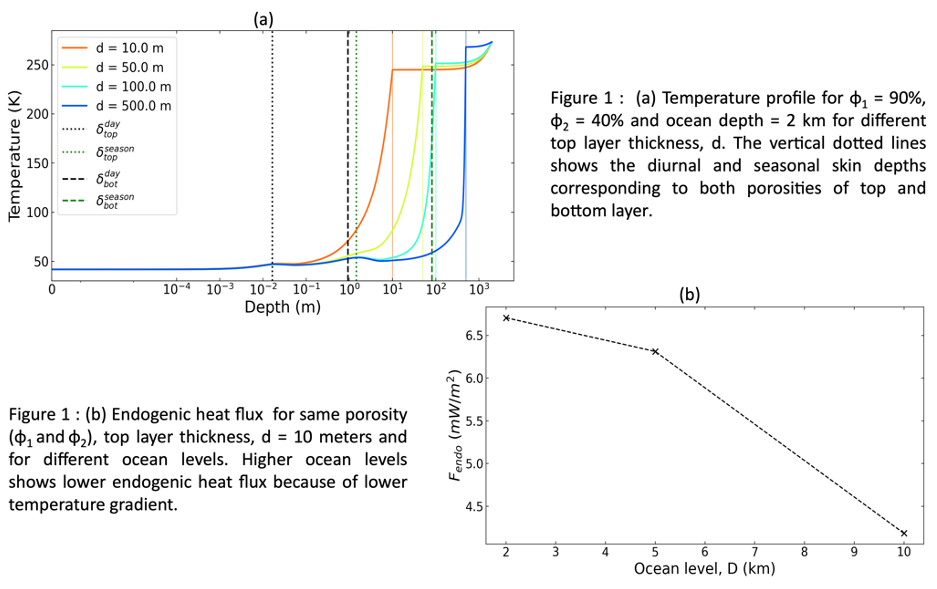
We adapted a multi-layer thermal model called MultIHeaTS [4] to the case of Enceladus. We account for Solar flux and radiative flux equilibrium at surface and a constant temperature at the bottom. The subsurface of Enceladus is modeled as  bi-layer medium with an icy porous regolith overlying a denser water ice substrate. Main parameters of model are porosities of the top and bottom layers ϕand  ϕ2 (primarily control effective thermal properties), thickness d of top layer and the ocean level i.e ice shell thickness, D at the SPT region. Based on plume deposition rate modeling [5] a value of up to 90% was assumed for ϕ1. The thickness d is unknown, but [5] suggest it could be up to 700 meters and at least few decimeters based on [6]. We thus vary d from 1 m to 500 meters. Lastly, ice shell thickness, D is assumed to be in the range 2 to 5 km as the average ice shell thickness in the SPT region falls within this range [10]. At these depths, we assume the presence of an ocean, where the temperature corresponds to the melting point of water ice. Once thermal equilibrium is reached, the heat flux driven by temperature gradient is calculated providing the endogenic heat flux for the given subsurface properties.

Fig. 1a displays simulated temperature profiles obtained for D = 2.0 km at the SPT for different values top layer thickness. Temperature profiles clearly show a discontinuity at transition from top to the bottom layer, top layer acting like an insulating layer (especially if very porous). Fig. 1b shows the endogenic heat flux for same porosities, top layer thickness, d = 10 meters and for different ocean levels.


 Radiative Transfer Model

We use  Snow Microwave Radiative Transfer model (SMRT), a multi-layer RT model initially designed for snow or sea-ice [8]. Permittivity of water ice is assumed constant with temperature [11], effective permittivity depends on its porosity and includes possible contaminants fraction, assumed as organic dust. The parameters of RT model are thus dust fraction and water ice grain radius size (r1, r2) in the top and bottom layers. It is consistent with the assumptions on ϕ1, ϕ2 and d considered in thermal model. We vary r from 100 microns to 1 mm [9]. We consider two types of surface- smooth where reflections and transmissions are specular in nature given by Fresnel coefficients and rough, gently undulating surface parameterized statistically by root mean squared slope (s), which applies geometrical optics solution with Kirchhoff’s approximation [12].


Results, conclusion and discussion

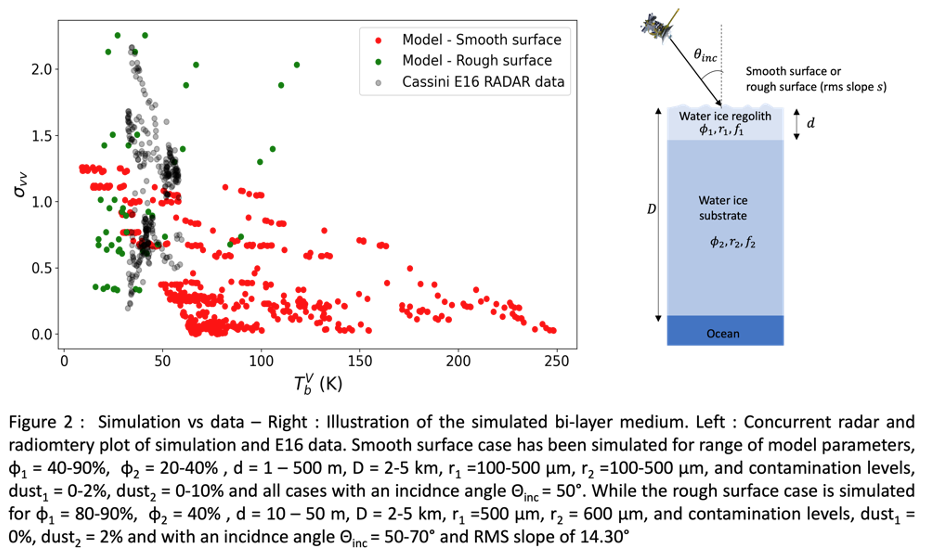
Figure 2 compares modeled radar backscatter and brightness temperatures for a bi-layer medium at one E16 swath location, using the thermal profile from our thermal model. Results shows a clear anti-correlation between σ0 and Tb. Smooth surface assumption fail to reproduce the observed high σ0, while a gently undulating rough surface of moderate RMS slope reproduces both high σ0 and Tb for a highly porous (more than 80%) layer of clean water ice having a thickness of around 50 meters and containing large ice grains (500–600 µm). This provides an insight to an outstanding puzzle, as no prior random scattering model could explain Enceladus’ extreme radar brightness. Rough surface causes diffuse reflection and transmission, consequently volume scattering from the diffused transmitted waves in the porous icy regolith favors the radar back-scatter. Surprisingly for these high σ0 cases, electrical skin depth is much shallower (around 3 m) than the expected for a homogeneous pure water ice substrate. Moreover, it is consistent with high similarity between the optical and SAR images of the SPT region observed during E16.


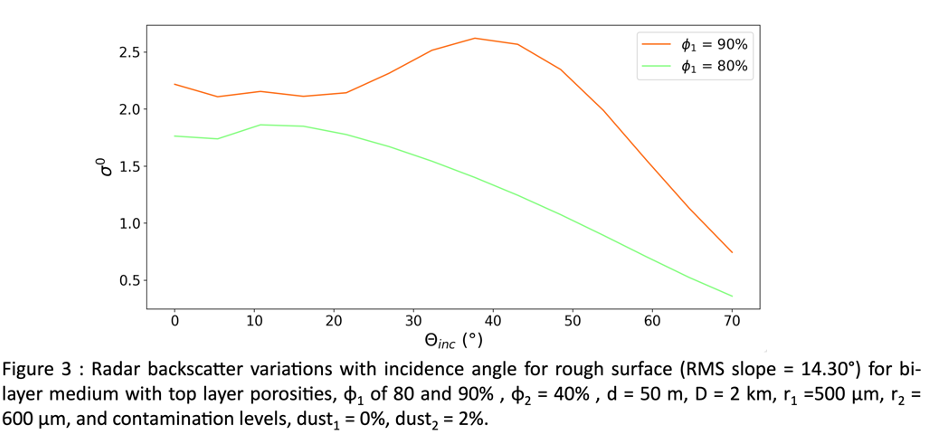
Figure 3 demonstrates that σ0 remains stable and as high as 2 across incidence angles (up to 50) for highly porous medium, which may explain Enceladus’ high disk-integrated radar albedo [2]. Finally, from the best deduced parameters (ϕ1, ϕ2, d and D), thermal model constrains endogenic heat flux to 4–6 mW/m2 (Figure 1b).


How to cite: Raza, M. S., Le Gall, A., Schmidt, F., Bonnefoy, L., Picard, G., Mergny, C., and Leyrat, C.: Enceladus’ SPT surface and subsurface properties as constrained by Cassini RADAR observations, EPSC-DPS Joint Meeting 2025, Helsinki, Finland, 7–13 Sep 2025, EPSC-DPS2025-797, https://doi.org/10.5194/epsc-dps2025-797, 2025.

Orals TUE-OB3: Tue, 9 Sep, 11:00–12:30 | Room Mars (Veranda 1)

Chairperson: Georgina Miles
Enceladus Interior and Plumes
11:00–11:12
|
EPSC-DPS2025-902
|
On-site presentation
Arnaud Mahieux, Melina Zaharias, David B. Goldstein, Philip L. Varghese, and Laurence M. Trafton

Enceladus, a moon of Saturn, is of great astrobiological interest due to Cassini mission discoveries [1–5]. Its southern polar region features "Tiger Stripes"—fractures that vent water vapor, gases, and particles, including molecular hydrogen (H₂), which likely originates from hydrothermal activity [5]. The intermittent presence of H₂ raises questions about plume dynamics and the subsurface environment. Models suggest that the ejection of gases and particles is influenced by the geometry of the conduits beneath the icy shell [1]. Recent studies propose volatile-driven eruptions, constrained by plume observations, that shed light on cryovolcanic processes [6]. Yet, the mechanisms of hydrogen transport and the chemical properties of the subsurface ocean remain unresolved.

This study investigates interactions between condensable (H₂O) and non-condensable (H₂) gases under varying subsurface conditions. Using the Direct Simulation Monte Carlo (DSMC) method, we model gas flow originating in a cavern, moving through a conduit, and expanding into vacuum.

To capture the complex flow regimes of Enceladus’ plumes, we use the DSMC method [7], which accurately simulates particle interactions and non-equilibrium effects across transitions from near-continuum to free-molecular flows. DSMC represents real gas molecules through computational particles, allowing detailed tracking of pressure gradients, thermal nonequilibrium, and energy exchange. We use the PLANET DSMC code [8–13] to simulate the flows.

The subsurface model assumes a "misty cavern" at the gas-liquid interface where H₂O vapor forms via sublimation and evaporation, while H₂ is added to reproduce the 99:1 H₂O:H₂ mass ratio seen by Cassini at the vent. The model geometry applies cylindrical symmetry and includes specified boundary conditions at the cavern and conduit walls. Simulation parameters such as cell size, time step, and convergence criteria are tightly controlled.

Next, we analyze how steady-state plume dynamics respond to changes in several parameters: conduit radius, depth above a constriction, temperature profile along the walls, H₂ inflow flux, and reservoir size. Variations in vent radius and wall temperature, in particular, have a notable impact on the resulting gas composition and distribution at the surface vent. These findings help constrain the physical characteristics of Enceladus’ subsurface vents and support the hypothesis that even very small concentrations of H₂ plays a role in sustaining long-term vent activity. A key finding is that flow through high aspect ratio conduits can lead to very large build ups of hydrogen in the underground reservoir.

References
[1] Porco, C.C., et al. (2006), Science, 311.
[2] Postberg, F., et al. (2018), Nature, 558.
[3] Hansen, C.J., et al. (2011), Geophys. Res. Lett., 38.
[4] Waite, J.H., et al. (2006), Science, 311.
[5] Waite, J.H., et al. (2017), Science, 356.
[6] Mitchell, K.L., et al. (2024), JGR: Planets, 129.
[7] Bird, G.A. (1994), Oxford, UK: Clarendon Press.
[8] Yeoh, S.K., et al. (2015), Icarus, 253.
[9] Stewart, B.D., et al. (2011), Icarus, 2015.
[10] McDoniel, W.J., et al. (2015), Icarus, 257.
[11] Prem, P., et al. (2019), Icarus, 326.
[12] Hoey, W. (2018), Austin, TX.
[13] Mahieux, A., et al. (2019), Icarus, 319.


How to cite: Mahieux, A., Zaharias, M., Goldstein, D. B., Varghese, P. L., and Trafton, L. M.: DSMC simulation of Enceladus underground conditions outgassing water vapor and dihydrogen , EPSC-DPS Joint Meeting 2025, Helsinki, Finland, 7–13 Sep 2025, EPSC-DPS2025-902, https://doi.org/10.5194/epsc-dps2025-902, 2025.

11:12–11:24
|
EPSC-DPS2025-351
|
On-site presentation
Douglas Hemingway

Knowledge of the interior structure of Enceladus is important for understanding its origin, evolution, ongoing behavior, and potential for habitability. In particular, the thickness of the ice shell tells us about the energy budget, thermal history, and the nature of its ocean-to-surface pathways. Despite this importance, however, the community has yet to converge on a robust internal structure model and ice shell thickness estimate for Enceladus.

Over the last ten years, researchers have produced an array of interior structure models for Enceladus, with mean ice shell thickness estimates ranging from as little as 14 km to as much as 60 km (Figure 1). These models incorporate a variety of different estimates for the various observational constraints and often adopt distinct sets of modeling assumptions, making it difficult to compare meaningfully between the models or to decide which to adopt in one’s analysis or for mission planning purposes.

Here, we attempt to clarify how interior model results (especially ice shell thickness) depend on each of the various input data estimates (i.e., shape, gravity, and librations) and model assumptions (i.e., related to equilibrium figure theory, isostatic compensation, ice shell dynamics, and other modeling choices). We do this using a framework that allows us to modify each input in isolation, permitting apples-to-apples comparisons and revealing the sensitivity of the outcomes to each input independently.

As an example, we compare the interior structure models of Hemingway & Mittal (2019) and Park et al. (2024)—two similar models but with significantly different preferred ice shell thicknesses (21 vs 30 km). Our analysis allows us to identify exactly which shifts in the input data account for this difference in shell thickness estimates (Figure 2). More generally, we show how sensitive interior models are to shifts in each of the different inputs, revealing which measurements and which modeling assumptions are the most consequential. We argue that our community will not be able to converge on interior models of Enceladus until we can converge on both our estimates of the observational constraints (including how uncertainties are reported) and our choices of modeling assumptions.

Such an effort could have benefits that extent far beyond our understanding of Enceladus. Enceladus is the icy moon for which we so far have the best observational constraints and therefore it makes for an important test case. Gaining a deeper understanding of the current state of diversity among interior models for Enceladus—and hopefully learning to move beyond some of this ambiguity—will thus be crucial as we prepare for new missions to Europa, Ganymede, and eventually the Uranian moons.

How to cite: Hemingway, D.: How can we converge on models of the interior of Enceladus?, EPSC-DPS Joint Meeting 2025, Helsinki, Finland, 7–13 Sep 2025, EPSC-DPS2025-351, https://doi.org/10.5194/epsc-dps2025-351, 2025.

11:24–11:36
|
EPSC-DPS2025-2003
|
On-site presentation
Ana-Catalina Plesa, Hauke Hussmann, Andreas Benedikter, William Byrne, and Tina Rückriemen-Bez

An outstanding question in planetary exploration addresses the habitability of icy moons in the outer Solar System. These bodies can harbor liquid water in substantial amounts over long time-scales, a necessary ingredient for habitable environments (Nimmo, 2018). Water on icy moons is located in a subsurface ocean covered by a global ice shell, and/or in local reservoirs within the ice shell itself. Moreover, for some of the satellites, in particular Europa and Enceladus and perhaps also Triton and the largest moons of Uranus, their oceans are in contact with the silicate interior. This allows for water-rock interactions potentially similar to those at the ocean floor on Earth. Such interactions would bring chemical compounds, in particular Carbon, Hydrogen, Nitrogen, Oxygen, Phosphorus, and Sulphur (CHNOPS) in contact with liquid water, creating the ‘right’ chemistry for a habitable environment. Due to tidal friction, which can be an important heat source in the moons’ interiors, energy that drives chemical cycles would be available and sustained over time, providing stable conditions for thermal and chemical reservoirs over billions of years.

Among the icy moons, Enceladus has been recommended as the top priority target in ESA’s Voyage 2050 plan covering the science theme “Moons of the Giant Planets” (Martins et al., 2024), because of its high astrobiological potential. Based on the current knowledge from mission data and theoretical modelling, Enceladus provides compelling evidence for habitable conditions. The presence of a global ocean is supported by the combined analysis of low-order gravity field and topography data (Iess et al., 2014), and by independent measurements of forced physical librations (Thomas et al., 2016). The subsurface ocean is kept in a liquid state due to tidal energy that represents an important source of heat in Enceladus’s interior. Tidal deformation is also thought to drive the water plume activity at Enceladus’ south pole that was observed by the Cassini spacecraft (Porco et al., 2006). Constraints on the composition of Enceladus’ ocean and ice chemistry come from the plume material sampled during NASA’s Cassini mission, suggesting that within the ocean and ice, chloride and carbonate salts, as well as ammonia/ammonium and silica are present, the latter with lower concentrations (Postberg et al., 2018). The detection of nanometer-size silica grains in Enceladus’ plume material supports the presence of high-temperature hydrothermal alteration that is thought to occur at the ocean floor (Hsu et al., 2015). Moreover, local topographic depressions observed by Cassini using stereo imaging analysis could indicate the presence of regional liquid water reservoirs at shallow depths (Shenk & McKinnon, 2009).  

A subsurface radar sounder has been suggested to be part of the core payload of a future mission to Enceladus (Martins et al., 2024), as radar sounders are the obvious means to detect and characterize subsurface water reservoirs in the interior of icy moons (Benedikter et al., 2022). The scientific goals for radar sounder measurements on icy moons can be summarized as follows:

  • Detection of global oceans by determining the ice-water interface and the spatial variation of the ice layer thickness
  • Detection of near-surface water reservoirs that could be embedded in the ice shell
  • The study of dynamic processes at active regions, in particular the connection of the ocean with the shallow subsurface/surface
  • Characterization the layering of the upper ice crust, e.g. snow, ice regolith, compact ice for determining the past evolution (intensity of jet activity and geological history)

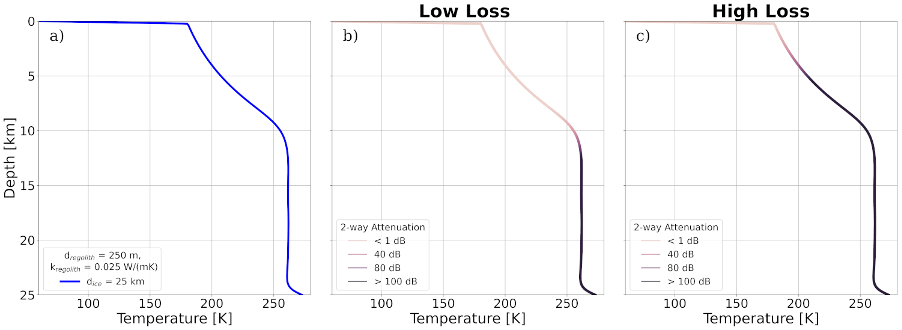
In this study we focus on the scientific goals of a radar sounder at Enceladus. We discuss the ice shell characteristics (thickness and variations, thermal structure, and layering) and their effects on the radar attenuation. We calculate the two-way radar attenuation on Enceladus considering a porous thermally insulating surface layer generated by the plume material that falls back onto Enceladus’ surface. Our models show that for regions with a thin ice shell, most likely in a thermal conductive state, such as the south pole of Enceladus, the ice-ocean interface is detectable independent of the ice shell composition (Byrne et al., 2024).  In regions covered by a thick insulating porous surface layer as suggested at least regionally, by the analysis of pit chains on the surface of Enceladus (Martin et al. 2023) a radar signal will not be able to reach the ice-ocean interface. However, for these same regions the high subsurface temperatures caused by a strong insulation due to the thick porous layer increase the likelihood that shallow brines are present (Byrne et al., 2024). Such brine reservoirs are fundamental to characterize potential habitable environments in the shallow subsurface, and the potential to directly access them with future measurements is much greater when compared to the accessibility of subsurface oceans (Wolfenbarger et al., 2022).

References:

Benedikter, A., Wickhusen, K., Hussmann, H., Stark, A., Damme, F., Rodriguez-Cassola, M., Krieger, G. (2022). Acta Astronautica.

Byrne, W., Plesa, A.-C., Rückriemen-Bez, T., Hussmann, H., Benedikter, A. (2024). JGR:Planets

Hsu, H. W., Postberg, F., Sekine, Y., Shibuya, T., Kempf, S., Horányi, M., ... & Srama, R. (2015). Nature.

Iess, L., Stevenson, D. J., Parisi, M., Hemingway, D., Jacobson, R. A., Lunine, J. I., ... & Tortora, P. (2014). Science.

Martins, Z. et al. (2024)

Martins, Z., Bunce, E., Grasset, O., Hamp, R., Jones, G., Le Gall, A., Lucchetti, A., Postberg, F., Prieto-Ballesteros, O., Roth, L., Tortora, P., & Vorburger, A. (2024) Expert Committee for the Large-class mission covering the science theme “Moons of the Giant Planets”.

Martin, E.S., Whitten, J.L., Kattenhorn, S.A., Collins, G.C., Southworth, B.S., Wiser, L.S., Prindle, S. (2023). Icarus

Nimmo, F. (2018). Oxford Research Encyclopedia of Planetary Science.

Porco, C.C., Helfenstein, P., Thomas, P.C., Ingersoll, A. P., Wisdom, J., West, R., ... & Squyres, S. (2006). Science.

Postberg, F., Clark, R. N., Hansen, C. J., Coates, A. J., Dalle Ore, C. M., Scipioni, F., ... & Waite, J. H. (2018). Enceladus and the icy moons of Saturn.

Thomas, P. C., Tajeddine, R., Tiscareno, M. S., Burns, J. A., Joseph, J., Loredo, T. J., ... & Porco, C. (2016). Icarus.

Wolfenbarger, N.S., Fox‐Powell, M.G., Buffo, J.J., Soderlund, K.M., & Blankenship, D.D. (2022). GRL.

How to cite: Plesa, A.-C., Hussmann, H., Benedikter, A., Byrne, W., and Rückriemen-Bez, T.: Enceladus' Subsurface Secrets: Scientific Rationale for Future Radar Sounder Measurements, EPSC-DPS Joint Meeting 2025, Helsinki, Finland, 7–13 Sep 2025, EPSC-DPS2025-2003, https://doi.org/10.5194/epsc-dps2025-2003, 2025.

11:36–11:48
|
EPSC-DPS2025-829
|
On-site presentation
Joseph Spitale, Mattie Tigges, Alexander Berne, Alyssa Rhoden, Terry Hurford, and Kevin Webster

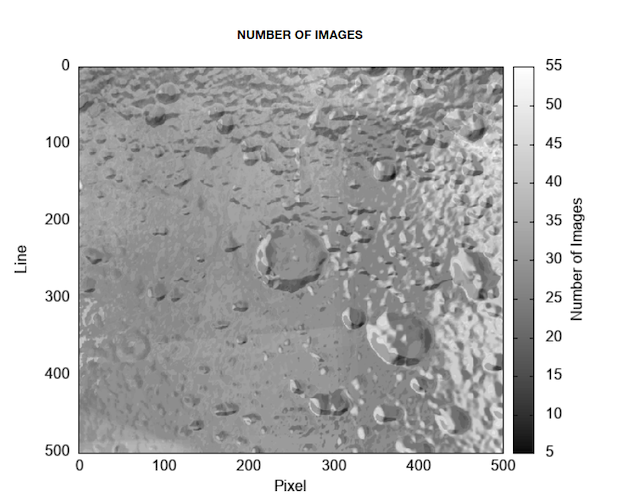
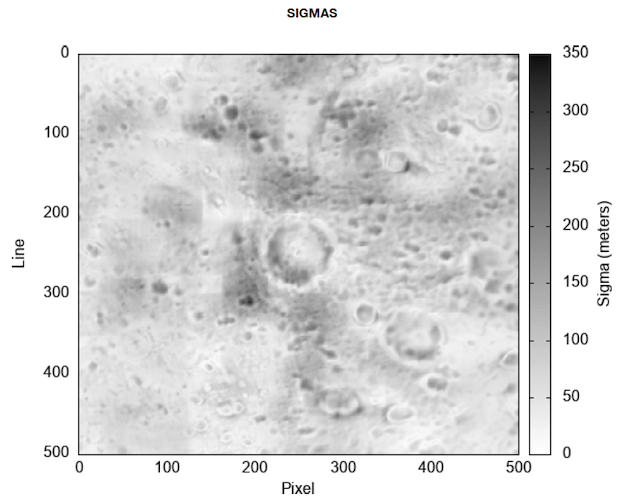
We map surface eruptive activity in Cassini images of Enceladus' south-polar terrain (SPT) at fifteen epochs spanning late 2009 to late 2015 using a refined curtain approach derived from that of our earlier work [1]. This refined approach gives a better representation of the uncertainties in identifying source fractures by allowing for multiple candidate sources to be identified for an observed eruption. Our analysis includes the five epochs studied in [1], which were independently re-examined here. Our results are summarized in Figure 1. About 80% of the currently active fracture system in the SPT (by length) was observed to be erupting at a level detectable in Cassini images during every epoch. On/off variability is observed almost exclusively at the fringes of the fracture system, possibly reflecting a thickening ice shell away from the pole. No definitive connection between surface activity and the roughly factor-of-three plume optical depth variation with mean anomaly [2,3] is made here, but our results do not rule out a scenario where the pattern of eruptive activity on the surface is correlated with mean anomaly, provided only the fractures at the fringe of the SPT ever turn completely off during the tidal cycle. Our results are best explained by eruptions sourced directly from the ocean.

Figure 1.  a) Averaged eruptive activity.  At each point, the intensity represents the number of times the point was determined to be active divided by the number of times it was observed (i.e., determined to be either active or inactive).  Indeterminate and degenerate points are not counted, except in cases where two fractures are so close to one another as to be effectively indistinguishable.  b) Number of observations used for each average in (a).  c) Standard deviation at each point in (a).  Blue points have zero standard deviation. (from [4])

References:
[1] Spitale et al. 2015; Nature 521
[2] Hedman et al. 2013; Nature 500
[3] Nimmo et al. 2014; AJ 148
[4] Spitale et al. 2025; PSJ 6:67


How to cite: Spitale, J., Tigges, M., Berne, A., Rhoden, A., Hurford, T., and Webster, K.: Inferred Eruptive Activity in Enceladus' South-Polar Terrain from Cassini ISS, EPSC-DPS Joint Meeting 2025, Helsinki, Finland, 7–13 Sep 2025, EPSC-DPS2025-829, https://doi.org/10.5194/epsc-dps2025-829, 2025.

11:48–12:00
|
EPSC-DPS2025-911
|
ECP
|
On-site presentation
Shannon M. MacKenzie and Matthew M. Hedman

From Cassini’s in situ and remote sensing characterizations, we know that Enceladus’ plume is made of primarily water vapor and ice particles (e.g. Waite et al. 2006, 2009, 2017; Postberg et al. 2011). Salts and organics make up the rest of the ice composition (Postberg et al. 2011, 2018, 2023; Khawaja et al. 2019), with salt-rich grains tending to be smaller than pure ice or organic-rich grains (Ershova et al 2024). Particles of different sizes are ejected at different velocities (Hedman et al. 2009; Sharma et al. 2023), and ejections vary in time and between the four tiger stripes (Hedman et al. 2013; Nimmo et al. 2014; Porco et al. 2014; Helfenstein & Porco 2015; Ingersoll & Ewald 2017; Ingersoll et al. 2020; Spitale et al. 2025). Variations in infrared spectra of ejections from different tiger stripes (e.g. Dhingra et al. 2017) suggest a difference in the grain composition and/or grain size. Enceladus’ plume is thus known to be a dynamic phenomenon, ultimately sourced from a subsurface ocean.

However, the nature of the connection between the ocean and the plume remains unknown. Whether the plume is fed directly or through some intermediary reservoir (e.g. Matson et al. 2012; Kite & Rubin 2016; Ingersoll & Nakajima 2016; Mitchell et al. 2024; Meyer et al. 2025) and whether the physical properties of conduits promote or inhibit fractionation (e.g. Neveu et al. 2024), for example, have critical implications for interpreting the more sensitive investigations into the organic content that would be made by return missions to Enceladus (e.g. Choblet et al. 2022; MacKenzie et al. 2023).

The plume particle size distribution is therefore an important parameter to understand as it is a function of how particles are formed and accelerated. To provide additional fodder for modeling plume ejection in the Cassini era, we investigate observations captured with the Imaging Science Subsystem (ISS) in visible color and polarization filters. We will compare these high phase observations to Mie scattering models for published plume particle size distributions (e.g. Gao et al. 2016, Porco 2018, Ershova et al. 2024), using three wavelengths corresponding to the effective central wavelengths of the UV3, GRN, and MT2 ISS filters.  

How to cite: MacKenzie, S. M. and Hedman, M. M.: Exploring Enceladus’ Plume in Polarization , EPSC-DPS Joint Meeting 2025, Helsinki, Finland, 7–13 Sep 2025, EPSC-DPS2025-911, https://doi.org/10.5194/epsc-dps2025-911, 2025.

12:00–12:12
|
EPSC-DPS2025-1885
|
ECP
|
On-site presentation
Flynn Ames, David Ferreira, Arnaud Czaja, and Adam Masters

Almost all the known ocean-bearing moons of our solar system orbit within the magnetosphere of their host planet. Given these oceans are expected to contain salt, any fluid flow therein will constitute a moving conductor within the ambient magnetic field, permitting ‘motional induction’, a mechanism where the deflection of moving ions and resulting electrical shorting gives rise to secondary magnetic fields. At Earth, the motionally-induced magnetic signature of the ocean tides has been successfully extracted from magnetometer data obtained at satellite altitude. The signature of Earth’s time-mean ocean circulation is yet to be detected at altitude but has been modelled numerically and extensively. In contrast, motional induction at icy moons has received little attention and, in the case of Enceladus, has not been explored.

At Enceladus, ocean salinity has been demonstrated as a fundamental control upon the stratification and time-mean ocean circulation, uncertainty in which leading to orders of magnitude of uncertainty in the bottom-to-top transit timescale of particulates from the ocean depths to the south polar plumes (Ames et al., 2025). Considering this, we set out to explore whether motional induction within Enceladus could be large enough to be detectable and, if so, whether it could be used to constrain the ocean salinity and, by extension, timescales of transport within the ocean.

To this end, we conduct fully global, 3D simulations of Enceladus’ ocean circulation using a general circulation model (MITgcm) at varying ocean salinity. The model is non-hydrostatic, and accounts for geothermal heating, non-linearity in the equation of state for water density, as well as variation in the pressure-dependant freezing temperature at the ocean top. Simulated time-mean ocean flow and conductivity fields are then inserted into GEMMIE (https://gitlab.com/m.kruglyakov/gemmie), a global 3D electromagnetic solver, to obtain the ocean induced magnetic field (OIMF) at Enceladus’ ice surface.

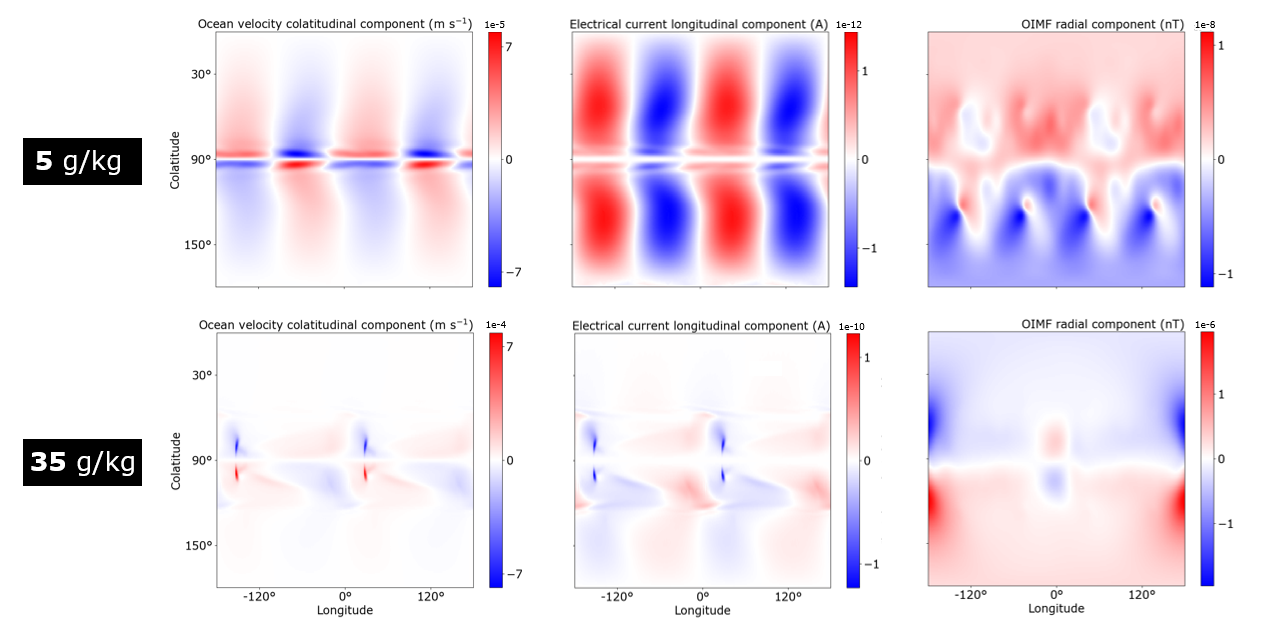
Our results show that different salinity oceans generate different magnetic signatures. For example, the polarity of the dipole in the radial OIMF component reverses at low vs high salinity (see figure 1). The OIMF is dominated by the meridional (north-south) and radial ocean flows, with weak contributions from zonal (east-west) flows owing to the near perfect alignment of Saturn’s rotation and magnetic dipole axis. We find 3D variability of the flow field to be important. Longitudinal variation in the ocean flows permit higher order components of the OIMF that can significantly raise the magnitude of the induced signature. However, we find that the magnitude of Enceladus’ OIMF is very likely beyond the detection capability of modern fluxgate magnetometers located on its ice surface, especially where the assumed ocean salinity is low. Reasons for a weaker OIMF at Enceladus vs Earth include a much weaker (~ two orders of magnitude) ambient magnetic field, a more sluggish ocean circulation and a weaker ocean conductivity (owing to lower temperatures). Our results provide a first estimate of the ocean induced magnetic field at Enceladus and inform future developments in the field.


Fig.1   Left: Simulated colatitudinal ocean flow velocity (m/s), here shown at the ocean top. Centre: Longitudinal component of the electrical current (amperes; also a function of the radial ocean flows) at the ocean top. Right: Radial component of the ocean induced magnetic field (nT; OIMF) at Enceladus’ ice surface. Solutions are shown at 5 (top) and 35 (bottom) g/kg ocean mean salinity. Note colour bars are saturated throughout.

References:

Ames, F., Ferreira, D., Czaja, A., Masters, A., 2025. Ocean stratification impedes particulate transport to the plumes of Enceladus. Communications: Earth and Environment. DOI 10.1038/s43247-025-02036-3


How to cite: Ames, F., Ferreira, D., Czaja, A., and Masters, A.: Simulating the motional induction of 3D time-mean ocean flows within Enceladus, EPSC-DPS Joint Meeting 2025, Helsinki, Finland, 7–13 Sep 2025, EPSC-DPS2025-1885, https://doi.org/10.5194/epsc-dps2025-1885, 2025.

12:12–12:24
|
EPSC-DPS2025-1124
|
Virtual presentation
Matthew Hedman and Shannon MacKenzie

A plume of both vapor and small particles constantly erupts from the South Polar Terrain on Saturn’s moon Enceladus. The particle component of this plume consists primarily of particles composed very pure water ice, but Cassini’s in situ investigations of the Enceladus’ plume with the Cosmic Dust Analyzer (CDA) revealed that subsets of these particles are rich in either salts or organics. These direct samplings of the plume provide detailed compositional information at discreet points in time along different sampling trajectories. However, plume activity clearly varies along individual fractures, between the tiger stripes, and location in Enceladus’ orbit. Remote sensing observations of plume composition could therefore complement the in-situ measurements by providing a broader picture of how the plume-particle’s composition varies with time and space. In this context, we describe a spectral signature at 0.5 µm in the visible spectrum observed by both Cassini’s Visual and Infrared Mapping Spectrometer (VIMS) and its Imaging Science Subsystem (ISS). This feature is consistent with the expected spectral signature of tholin-like organics within the ice particles, and therefore should provide a new tool for assessing variations in the plume particle’s composition with time and space.

How to cite: Hedman, M. and MacKenzie, S.:  Potential Spectral Signatures in the Visible Spectra of the Enceladus Plume , EPSC-DPS Joint Meeting 2025, Helsinki, Finland, 7–13 Sep 2025, EPSC-DPS2025-1124, https://doi.org/10.5194/epsc-dps2025-1124, 2025.

Orals TUE-OB5: Tue, 9 Sep, 15:00–16:00 | Room Mars (Veranda 1)

Chairperson: Axel Hagermann
Enceladus and Friends
15:00–15:12
|
EPSC-DPS2025-618
|
On-site presentation
Frank Postberg, Zenghui Zou, Yasuhito Sekine, Minori Koga, Jürgen Schmidt, Mark Fox-Powell, Fabian Klenner, Jon Karl Hillier, Nozair Khawaja, and Ralf Srama

Salt-rich ice particles constitute a major compositional group observed by Cassini’s Cosmic Dust Analyzer (CDA) in Enceladus' plume and Saturn’s E-ring. Previously, these particles were believed to be frozen aerosolized droplets of relatively homogeneous composition, formed through bubble bursting at the water table of Enceladus' salty subsurface ocean (Postberg et al. 2009, 2011). Here, we present an updated analysis based on approximately 1000 CDA mass spectra of individual salt-rich ice grains from Enceladus, typically ranging from 0.2 to 2 µm in size, focusing on the compositional diversity within this group.

We find at least five basic compositional subtypes, each usually dominated by one of the following salts: NaCl, NaHCO₃/Na₂CO₃, Na₂HPO₄/Na₃PO₄, NaOH, KCl and KOH. With the exception of the hydroxides, these individual salts are rarely found together within a single ice grain. We carried out freezing experiments on water droplets containing mixed salts accompanied thermodynamical modelling of the freezing process. We arrive at consistent boundary conditions and find that salt separation in agreement with CDA observations, occurs only under very specific conditions. From that, we infer that the freezing process of Enceladus ice grains is much more complex than the initially reported flash freezing of water droplets (e.g., Postberg et al. 2009). By combining CDA observations with experimental data, we now gain unprecedented insights into the physical and chemical conditions above the subsurface ocean within Enceladus’ ice vents, where ice grains freeze from a liquid ocean spray.

Previous studies have established that the plume composition is spatially heterogeneous (Ershova et al. 2024) and that organic material in different ice grains greatly varies in composition (Postberg et al. 2018; Khawaja et al. 2019). Our results further underscore the high level of compositional diversity of Enceladus' emitted ice grains. This reflects a range of processes shaping the plume, highlighting the need for future space missions to account for the plumes compositional diversity when analyzing plume material to assess the ocean’s composition and its habitability.

References:

  • Postberg, S. Kempf, J. Schmidt et al., Nature 459, 2009
  • Postberg, J. Schmidt, J.K. Hillier et al., Nature 474, 2011
  • Ershova, J. Schmidt, F. Postberg et al., A & A 689, 2024
  • Postberg. N. Khawaja, B. Abel et al., Nature 558, 2018
  • Khawaja, F. Postberg, J.K. Hillier et al., MNRAS 489, 2019

How to cite: Postberg, F., Zou, Z., Sekine, Y., Koga, M., Schmidt, J., Fox-Powell, M., Klenner, F., Hillier, J. K., Khawaja, N., and Srama, R.: Salt diversity observed in Enceladus' ice grains suggest a complex plume formation process from the subsurface ocean, EPSC-DPS Joint Meeting 2025, Helsinki, Finland, 7–13 Sep 2025, EPSC-DPS2025-618, https://doi.org/10.5194/epsc-dps2025-618, 2025.

15:12–15:24
|
EPSC-DPS2025-330
|
On-site presentation
Lina Hadid and the Cassini RPWS, MIMI, CAPS and MAG

The Cassini spacecraft has provided clear evidence that Enceladus and Saturn are electrodynamically coupled, through energetic ion measurements by the Magnetospheric Imaging Instrument (Jones et al. 2006; Roussos et al. 2007; Andriopoulou et al. 2014), thermal electron measurements from the Cassini Plasma Spectrometer (CAPS), and the EUV and FUV emission measurements by the Ultraviolet Imaging Spectrograph (Pryor and Rymer et al., 2011, Pryor et al., 2024), large-scale perturbations to the low-frequency magnetic field from MAG (Dougherty et al. 2006), and high-frequency plasma waves from the Radio and Plasma Wave Science Investigation (RPWS, Gurnett et al., 2011; Sulaiman et al., 2018). However, a systematic investigation of the detailed electromagnetic interactions between Enceladus and Saturn with all Cassini measurements has yet to be carried out.

Between 2004 and 2017, the Cassini spacecraft sampled the magnetic field lines connected to Enceladus’ orbit, offering a unique opportunity to investigate this coupling in detail. In this study, we explore the interaction region(s) between Saturn and Enceladus using comprehensive data from MAG, RPWS and electron instruments CAPS/ELS and MIMI/LEMMS. We report on 15 case studies that reveal enhanced Alfvénic activity linked to Enceladus, including the main Alfvén wing (MAW) and reflected Alfvén waves (RAW) in the moon’s tail. These observations not only shed new light on the spatial extent of the electrodynamic coupling between Saturn and its icy moon, but also show for the first time that the tail of Enceladus extends and persists up to about 100 Enceladus radii downstream of the moon illustrating the extensibility of the coupling processes with the gas giant Saturn.

How to cite: Hadid, L. and the Cassini RPWS, MIMI, CAPS and MAG: Alfvénic interaction along the Enceladus flux tube and its distant tail: Cassini’s in-situ multi-instrument observations, EPSC-DPS Joint Meeting 2025, Helsinki, Finland, 7–13 Sep 2025, EPSC-DPS2025-330, https://doi.org/10.5194/epsc-dps2025-330, 2025.

15:24–15:36
|
EPSC-DPS2025-1638
|
On-site presentation
Peter Strub, Jürgen Schmidt, Fredrik Johansson, and Mark Millinger

The Saturnian system with its extended ring system is a prime target for cosmic dust research. Dusty rings are fed by a variety of processes and form a complex dust environment: in the case of the E ring, ice volcanism on Enceladus acts as its source, but dust particles  are also generated on other moons by the impact ejecta mechanism.

Here we present the new results from our model of dust in the Saturnian system that is currently  being developed as part of an ESA activity to predict the hazards for space missions. This kind of effort also provides a wealth of opportunities to address scientific questions. We present the results from our simulation runs covering a variety of source moons, but also discuss the technical aspects of the model and the effort that went into creating an adequate representation of Saturn's plasma environment for this activity.

The Saturn Dust model traces test particles from source to sink, ejected in the plumes of Enceladus feeding the E ring, and from impact ejecta processes
generating a low number of particles from other airless bodies. Their trajectories are numerically integrated taking into account all relevant forces and mechanisms, i.e. gravity, radiation pressure, Lorentz force, plasma drag, electric charging in the plasma environment,
and sputtering. 

We give an overview over the first simulation results from various source moons, and show the status of the GUI tool facilitating the use of the model. We discuss the calibration using existing observations, based predominantly on results from the Cassini mission, and we show the dynamical phenomena associated with dust in this environment reproduced by our model.


How to cite: Strub, P., Schmidt, J., Johansson, F., and Millinger, M.: A New Dust Model for the Saturnian System: First results, EPSC-DPS Joint Meeting 2025, Helsinki, Finland, 7–13 Sep 2025, EPSC-DPS2025-1638, https://doi.org/10.5194/epsc-dps2025-1638, 2025.

15:36–15:48
|
EPSC-DPS2025-1800
|
ECP
|
On-site presentation
Max Goldberg and Konstantin Batygin

The dynamics of the outer regular satellites of Saturn are driven primarily by the outward migration of Titan, but several independent constraints on Titan's migration are difficult to reconcile with the current resonant orbit of the small satellite Hyperion. We argue that Hyperion's rapid irregular rotation greatly increases tidal dissipation with a steep dependence on orbital eccentricity. Resonant excitation from a migrating Titan is then balanced by damping in a feedback mechanism that maintains Hyperion's eccentricity without fine-tuning. The inferred tidal parameters of Hyperion are most consistent with rapid Titan migration enabled by a resonance lock with an internal mode of Saturn, but a scenario with only equilibrium dissipation in Saturn is also possible (Goldberg & Batygin 2024a).

Furthermore, an analytically tractable theory of the full 3D spin–orbit dynamics of Hyperion has not been developed. We derive the Hamiltonian for a spinning axisymmetric satellite in the gravitational potential of a planet without assuming planar or principal axis rotation and without averaging over the spin period. Using this model, we demonstrate the emergence of resonances between the nutation and orbital frequencies that act as the primary drivers of the spin dynamics (Goldberg & Batygin 2024b). This analysis reveals that, contrary to long-held belief, Hyperion is not tumbling chaotically. Instead, it lies near or in a nutation-orbit resonance that is first-order in eccentricity, allowing it to rotate quasi-regularly. The most reliable observations are consistent with either nonchaotic motion or chaos that is orders of magnitude smaller than originally claimed. A separate phenomenon, the so-called barrel instability, is shown to be related to a different set of nutation-orbit resonances that generalize the planar spin-orbit resonances.

How to cite: Goldberg, M. and Batygin, K.: The Chaotic Spin-Orbit Dynamics of a Migrating Hyperion, EPSC-DPS Joint Meeting 2025, Helsinki, Finland, 7–13 Sep 2025, EPSC-DPS2025-1800, https://doi.org/10.5194/epsc-dps2025-1800, 2025.

15:48–16:00
|
EPSC-DPS2025-232
|
ECP
|
On-site presentation
Impact Gardening on Iapetus and Insights into the Evolution of the Extreme Albedo Dichotomy
(withdrawn)
Emily Costello and Cynthia Phillips

Orals TUE-OB6: Tue, 9 Sep, 16:30–18:00 | Room Mars (Veranda 1)

Chairperson: Maryame El Moutamid
Saturnian Satellites
16:30–16:42
|
EPSC-DPS2025-433
|
ECP
|
On-site presentation
Mariana Blanco-Rojas and Michael Sori

At first glance, Saturn’s moon Mimas might seem like an unlikely candidate ocean world. Its small size, low bulk density, heavily cratered surface, and fairly eccentric orbit all suggest a solid interior primarily composed of H2O ice. This view was first challenged by measurements of Mimas’ physical librations from Cassini ISS data [1], whose amplitude exceeded what is expected from a completely frozen, hydrostatic interior—instead hinting at the presence of either an elongated core or a subsurface ocean. Recent work has further suggested that Mimas’ periapsis drift and current high eccentricity can be explained by a young, non-steady state ocean. This paints a picture in which Mimas’ ice shell has a thickness of 20–30 km and is currently thinning, resulting in an ocean that is only 10–25 Myrs old [2][3]. While this scenario is mathematically viable, more work is needed to reconcile it with surface observations, particularly the absence of compressional features [4] and the apparent lack of relaxation of large crater topography, both of which would typically be expected if an ocean were present.

Topographic relaxation, the process by which surface relief is lost as topographic stresses decay, has been widely used to probe the thermal history of icy moons [e.g., 5]. The rate of relaxation depends on the composition and thermal structure of the moon’s interior, as well as the size of the topographic feature in question. The existence of a subsurface ocean implies a warm, weak interior that would promote relaxation, seemingly contradicting the minimally relaxed state (< 10% [6]) of Mimas’ largest crater, Herschel. Given that bigger topography generates larger stresses and thus relaxes more rapidly, Herschel crater’s preserved relief offers a unique opportunity to test for the existence and longevity of the hypothesized ocean. Determining the conditions under which Herschel’s relief could be maintained can constrain whether its present-day topography is compatible with a young subsurface ocean, and if so, how long this ocean may have existed for.

In this work, we use the finite element software COMSOL Multiphysics to forward model the relaxation of Herschel crater over 25 Myr, the maximum proposed lifespan for the young ocean. We test 3 different ice shell temperature structures, varying our model’s effective surface temperature from 80 K (Mimas’ nominal surface temperature) to 100 and 120 K, corresponding to 35–50% porosity in the uppermost ~1 km of the ice shell. Our domain consists of a 2D axisymmetric shell of radius 198.2 km, with Herschel’s crater topography at the top (Figure 1A) and gravitational acceleration decreasing radially inwards from 0.064 ms-2 at the surface. Our initial crater has a diameter of 140 km, depth of 11 km, and a 6 km tall central peak, based on measurements by [7]. We test ice shell thicknesses ranging from 15–35 km, corresponding to surface heat fluxes between ~18–50 mWm-2. We assume a pure water ice, viscoelastic shell with no impurities, where viscous behavior is driven by dislocation creep and grain boundary sliding [8]. In terms of the temperature profile, our models assume the shell to be purely conductive, with a surface temperature between 80–120 K and a base temperature of 273 K, at which point the remainder of the domain becomes isothermal (Figure 1B). We use a temperature-dependent thermal conductivity for ice of 651/T.

We find that in models with a surface temperature of 80 K, Herschel retains most of its original relief after 25 Myr across all the ice shell thicknesses tested (15–35 km). During this time, the rim-to-floor depth decreases only by 210-947 m, corresponding to relaxation fractions between ~2–9% (Figure 2). These results suggest that in the absence of porosity, minimal relaxation of Herschel crater is consistent with the existence of a subsurface ocean. However, the addition of a near-surface porous layer— whose insulating effect is simulated by increasing the effective surface temperature of our models— significantly speeds up the relaxation process. For an effective surface temperature of 100 K (corresponding to a moderately porous, 1-km thick insulating layer) Herschel relaxes by >15% for the thinnest ice shells tested (Figure 2), far exceeding the currently observed relaxation fraction. Under these conditions, maintaining Herschel’s present-day relief over 25 Myr requires an ice shell thicker than 25 km. With an even higher near-surface porosity ( = 120 K), Herschel shallows by over 10% in merely 1.2 Myr to 2.4 kyr, strongly constraining the longevity of the proposed ocean.

Our results suggest that the relaxation state of Herschel could be consistent with the existence of a young ocean on Mimas only if its ice shell has negligible to no porosity. Our models highlight the significance of near-surface temperature variations and suggest that moderate-to-high porosity would be difficult to reconcile with Herschel’s observed morphology if the proposed ocean does indeed exist. However, we note that our results alone cannot confirm or reject the existence of an ocean, but rather place possible constraints on its longevity. Ongoing work aims to incorporate dynamic processes in the ice shell, particularly the thinning proposed by [3]. Ultimately, this will refine the range of ice shell thicknesses and structures that could be consistent with Herschel’s minimally relaxed state.

Figure 1. Model set up for an example 30 km thick ice shell.  A) Close-up of the geometry defined for Herschel, B) Ice sheet temperature gradient.

Figure 2. Modeled relaxation fraction of Herschel after 25 Myr as a function of ice shell thickness for a surface temperature of 80 and 100 K.

References:

[1] Tajeddine et al., Science, 346, 6207, 322–324 (2014). [2] Lainey et al., Nature, 626(7998), 280–282 (2024). [3] Rhoden et al., Earth and Planetary Science Letters, 635, 118689 (2024). [4] McKinnon et al., 56th Lunar Planet. Sci. Conf., Abstract #2897 (2025) [5] Bland et al., Geophysical Research Letters, 39(17) (2012) [6] Schenk et al., 56th Lunar Planet. Sci. Conf., Abstract #2435 (2025) [7] Moore et al., Icarus, 171, 2, 421–443 (2004) [8] Goldsby and Kohlstedt, JGR: Solid Earth, 106, 11017–11030 (2001).

How to cite: Blanco-Rojas, M. and Sori, M.: Does Mimas wear an ocean on its sleeve? Testing for a young ocean with crater topography and ice shell porosity, EPSC-DPS Joint Meeting 2025, Helsinki, Finland, 7–13 Sep 2025, EPSC-DPS2025-433, https://doi.org/10.5194/epsc-dps2025-433, 2025.

16:42–16:54
|
EPSC-DPS2025-1117
|
On-site presentation
Alyssa Rhoden, Matthew Walker, and Carly Howett

Introduction: Mimas is a small moon of Saturn with a heavily cratered surface and high eccentricity, suggesting an inactive past. It was, thus, surprising when Cassini measurements of Mimas’ libration and tracking of its pericenter precession revealed that Mimas maintains an ocean under an ice shell 20-30 km thick [5,12]. Subsequent investigations into how an ocean-bearing Mimas could have avoided developing tidally-driven fractures [7], its tidal heating budget  [8], constraints on shell thickness from the formation of the Herschel impact basin [3], and thermal-orbital evolution models [5,9] all point to a young ocean that has emerged within the past 10-15 Myr. These results suggest that Mimas may possess the youngest ocean in the Solar System, making it an important target for understanding the early stages of ocean development – such as for Enceladus’ ocean – and the habitability of ocean worlds through time. Uranus’ moon, Miranda, may also have developed an ocean relatively late in its history (e.g., [2]); understanding the evolutionary and geophysical processes at Mimas may help prepare us for a future mission to the Uranian system.

Here, we expand upon past work [8,9], in which we relied on globally-averaged tidal heating and constant surface temperature, to develop a map of plausible ice shell thicknesses and surface heat flows on Mimas assuming a present-day ocean. Our goals are to determine the variability in heat flow and ice shell thickness that result from spatial differences in surface temperature and strength of the tide and to quantify requirements that would enable ocean detection via heat flow measurements. Our results also provide estimates of tidal power, which affect the circularization timescale and ocean lifetime within thermal-orbital evolution models.

Methods: We utilize the numerical toolkit MATH [13] to compute tidal heating within Mimas’ ice shell and identify the equilibrium ice shell thickness and surface heat flux at a suite of locations across Mimas. These calculations depend on the surface temperature and the basal heat flux. Here, we develop a surface temperature map based on models of solar insolation, and informed by Cassini measurements (e.g., [4]), to obtain robust temperatures. We then vary the basal heat flux across a range that encompasses minimal heating from only radiogenic decay to high heat fluxes associated with dissipation in Mimas’ rocky interior. We use the inferred ice shell thickness of 20-30 km [5,12] to determine the basal heating cases that provide consistent results. From these maps, we can deduce the precision needed to use heat flow measurements to differentiate between a fully frozen Mimas, which likely produces endogenic heat flows of ~1 to several mW/m2 (e.g., [9]), and an ocean-bearing Mimas.

The ice shell thickness maps can also be used to compute the tidal dissipation associated with Mimas’ present-day orbit and interior structure. We will input these values into the numerical toolkit PISTES [11] to assess the extent to which Mimas’ ice shell evolution can occur over a longer timescale and/or begin at a higher eccentricity than in past models. These results are particularly important for understanding how Mimas came to possess an ocean. While we expect that Mimas’ ocean emerged due to a recent eccentricity-pumping event that increased its eccentricity to the point of melting, the cause and details are not well-understood. A gap in Saturn’s rings, known as the Cassini Division, appears to record Mimas’ phase of inward migration and increasing eccentricity [1,6]. However, models of this process require Mimas to reach a much higher eccentricity than the thermal-orbital evolution models predict; Mimas’ entire ice shell would have melted in that case, which is inconsistent with its geologic record (see discussion in [5]). In addition, the timescales for Mimas’ subsequent outward migration are in conflict. These discrepancies motivate further investigation into Mimas’ thermal-orbital evolution to determine whether the initial conditions and lifetime of the ocean can be extended.

Anticipated results: In Figure 1, we show maps of surface heat flow and ice shell thickness for Europa, assuming different basal heating values [10], which we created using the same tools and approach we are now applying to Mimas. We will present similar maps of ice shell thickness and heat flow across Mimas at its present-day eccentricity that are consistent with the inferred average ice shell thickness. We will also present the precision required for future heat flow measurements to detect the ocean and constrain the thickness of the ice shell, which we will compare to our recent Europa results. Finally, we will present revised thermal-orbital evolution models that account for differences in tidal dissipation between the globally-averaged and spatially-variable models of Mimas and discuss the implications of our findings on the development and age of Mimas’ ocean.

Figure 1: We show equilibrium ice shell thicknesses (left) and surface heat flows (right) for Europa assuming different values of the basal heat flux (rows) and applying surface temperatures from model fits to Galileo data (see [10]). Variations in tidal strength exert a strong control on the pattern of heat flow while surface temperature creates deviations in the shell thickness map from the purely tidal pattern. We are conducting a similar investigation of Mimas to better understand the current state of its ocean and ice shell, develop measurement requirements, and explore implications for the ocean’s evolution.

References: [1] Baillié, K., et al. (2019) MNRAS 486, p. 2933-2946. [2] Beddingfield, C.B. et al. (2022) PSJ 3, 174. [3] Denton, C.A., and A.R. Rhoden (2022) GRL 49, e2022GL100516. [4] Howett, C. J. A., et al. (2020) Icarus 348. [5] Lainey, V., et al. (2024) Nature 626, p. 280 – 282. [6] Noyelles, B., et al. (2019) MNRAS 486, p. 2947–2963. [7] Rhoden, A.R., et al. (2017) JGR – Planets 122, p. 400-410. [8] Rhoden, A. R., & Walker, M. E. (2022) Icarus 376. [9] Rhoden, A. R., et al. (2024a) EPSL 635. [10] Rhoden et al. (2024b) AGU, Abs P23E-3117 [11] Rudolph, M. L., et al. (2022) GRL 49.[12] Tajeddine, R., et al. (2014) Science 346, p. 322–324.  [13] Walker, M. E., & Rhoden, A. R. (2022) PSJ 3, 149.

How to cite: Rhoden, A., Walker, M., and Howett, C.: Diving deep into Mimas’ ocean: interior structure, evolution, and detection using heat flow, EPSC-DPS Joint Meeting 2025, Helsinki, Finland, 7–13 Sep 2025, EPSC-DPS2025-1117, https://doi.org/10.5194/epsc-dps2025-1117, 2025.

16:54–17:06
|
EPSC-DPS2025-1134
|
ECP
|
On-site presentation
Adeene Denton and Alyssa Rhoden

Introduction: Mimas is the smallest (r = 198 km) and innermost of Saturn’s mid-sized moons. Its heavily cratered surface, including the large impact basin Herschel (D = 139 km, Figure 1), has been interpreted as evidence for a largely inert geologic history. However, measurements of Mimas’ libration and pericenter precession favor the presence of an ocean, a possibility which can be reconciled with Mimas’ surficial geology if the ocean is young (~10 million years). Here, we revisit the timeline for the development of Mimas’s putative young ocean by reconsidering the conditions necessary to produce Herschel.

Figure 1. Mimas possesses a heavily cratered surface (left, PIA20523), which appears at odds with current hypotheses for its internal evolution, which include internal heating and a relatively young ocean. The formation of Herschel, Mimas’s large impact basin (right, N1644784749), could have occurred during the recent growth of the ocean and may provide further insight.

Methods: We simulate the formation of Herschel using the iSALE-2D shock physics code (Amsden et al., 1980; Collins et al., 2004; Wunnemann et al., 2006), approximating Mimas as a flat, two-layer target with water ice of variable thicknesses overlying a liquid water ocean. While previous work determined that a Herschel-like basin could be produced in a thick (³ 55 km) conductive ice shell overlying an ocean (Denton & Rhoden, 2022), thermal-orbital modeling of the growth of Mimas’ ocean from tidal heating suggest that ocean expansion is so rapid that the ice shell is only ³ 55 km for ~1 Myr (Rhoden et al., 2024). To assess the plausibility of Herschel’s formation under a broader range of pre-impact conditions for Mimas, and thus expand the window of time in which the basin may have formed, we consider two possibilities:

  • Mimas’ ice shell was entirely frozen at the time of impact, but was actively warming. Such a scenario encompasses the period in Mimas’ history when its eccentricity underwent pumping through resonance with another Saturnian satellite (Baillie et al., 2019; Noyelles et al., 2019), creating tidal heating that transitioned the bottom portion of the ice shell from conductive to isothermal. This period is thought to last up to ten million years.
  • Mimas was not entirely frozen at the time of impact, and instead possessed an emerging ocean with a thick (45-65-km) overlying ice shell. We consider the influence of a depressed melting point due to the presence of volatiles, which could reduce the basal temperature of Mimas’ ice shell to between 240-260 K. The influence of a colder ice shell on tidal dissipation in Mimas has not been explicitly modeled; however, we expect that the higher viscosity of colder ice would reduce tidal dissipation, prolonging ice shell thinning in an ocean-bearing Mimas.

Expanded conditions for the formation of Herschel: In our simulations, we seek to identify the suite of ice shell thicknesses and thermal structures that result in an impact basin whose morphology is consistent with that observed in the present day, including Herschel’s diameter (~139 km), depth (~10 km), and central peak (Moore et al., 2004; Schenk et al., 2018). We use these criteria to estimate “best fits” to Herschel, finding that a Herschel-like basin can indeed form in a fully frozen Mimas, provided that the ice shell is warm enough to possess an isothermal layer close to the melting point (260-270 K). Colder ice shells produce craters with poor fits to the basin, including diminished central peaks and depths in excess of 15 km. We find that it is also possible to reproduce a Herschel-like basin in a much colder ocean-bearing Mimas than assumed in previous work (Denton & Rhoden, 2022), provided that the ice shell is still at least 55 km thick. Producing a Herschel-like basin with thinner ice shells may be feasible, but the ice shell and ocean would have to be much colder than currently predicted (200 K rather than 260-270 K). The success of both fully frozen and ocean-bearing scenarios illustrates that Herschel may have formed either before or after the initiation of an ocean within Mimas, but the events are still connected. Herschel either forms during the warming phase of tidal heating that precedes melting and runaway growth of the ocean, or during the early stages of ocean evolution, when the ice shell is more than 75% of the total thickness of Mimas’ hydrosphere.

Conclusions: Our simulations indicate that, to adequately reproduce Herschel’s present-day morphology, either Mimas’ hydrosphere was fully frozen but close to its melting point or included a liquid ocean under an ice shell at least 55 km thick. These findings encompass a range of potential thermal structures, which depend on the ice shell’s composition and pre-impact thermal history. Further reconciliation of the surface geology of Mimas with the growth of its ocean can be more fully addressed through measurements by future spacecraft, as well as additional detailed modeling of the moon’s thermal-orbital evolution

How to cite: Denton, A. and Rhoden, A.: Leveraging the Herschel Impact Basin to Probe the Evolution of a Young Ocean on Mimas, EPSC-DPS Joint Meeting 2025, Helsinki, Finland, 7–13 Sep 2025, EPSC-DPS2025-1134, https://doi.org/10.5194/epsc-dps2025-1134, 2025.

17:06–17:18
|
EPSC-DPS2025-879
|
ECP
|
On-site presentation
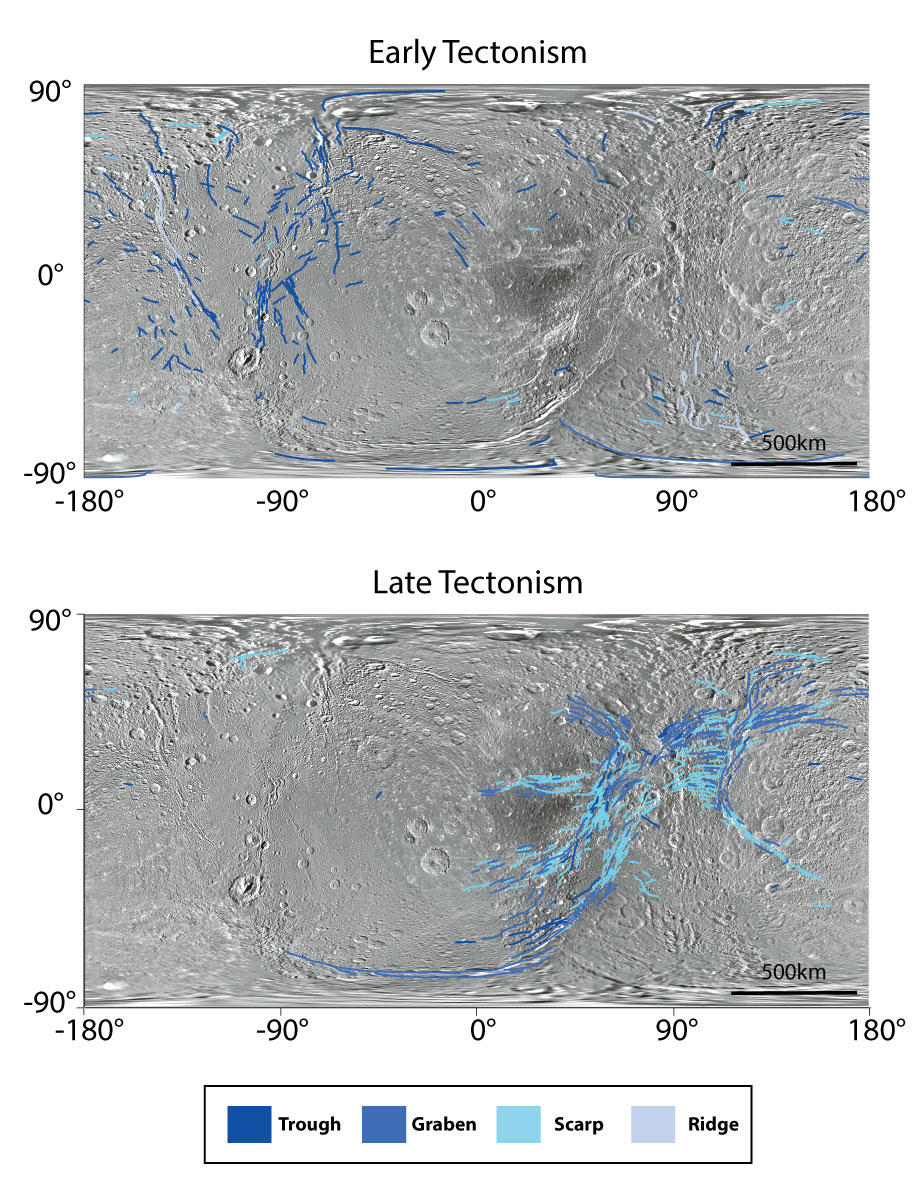
Fiona Nichols-Fleming, Emily S. Martin, D. Alex Patthoff, and Thomas R. Watters

 Dione, the fourth largest moon of Saturn, is primarily composed of water ice [1] with a surface that shows abundant evidence of tectonic resurfacing, both contractional and extensional [e.g., 2–4]. There appear to be at least two eras of tectonism on Dione: the more recent formation of the Wispy Terrains on the trailing hemisphere—some of the most recent tectonic landforms—and the leading hemisphere, dominated by more ancient tectonic features, including ridges (Figure 1) [5]. The pattern of fractures preserved in icy planetary shells forms in response to stresses, and those patterns can be diagnostic of the stress fields in which they formed [e.g., 3,6]. The long geological history of tectonism preserved on Dione can thus provide a temporal record of the stress history, which can be linked to changes in orbital dynamics and interior environments (e.g., formation or freezing of subsurface oceans) [7].

Figure 1. Global distribution of ancient (above) and recent (below) tectonic structures across Dione. Scarps are interpreted as normal fault scarps.


Here, we use SatStress [8,9] to create model stress fields to compare with Dione’s observed fracture pattern. We divide each mapped feature into 1-km segments and compare each segment to the predicted orientation from our models at that location on Dione’s surface. Preliminary results show that both diurnal stresses and stresses due to non-synchronous rotation (NSR) can replicate the fracture pattern of more recent tectonism observed in the Wispy Terrain. Predicted orientations of diurnal stresses match 63% and 82% of our observed orientations within 15° and 30°, respectively. Similarly, the predicted orientations of stresses due to NSR match 68% and 80% of observed orientations within 15° and 30°, respectively. In both cases, our modeled global stress mechanisms reproduce the observed orientations more accurately than an isotropic population with random orientations like what would be expected from ice shell thickening alone (Figure 2). While the predicted fractures from diurnal tides and NSR match the observations at a similar level, it is important to note that diurnal stresses are on the order of tens of kPa while NSR produces much higher stresses on the order of MPa.

Figure 2. Preliminary SatStressGUI modeling results for late tectonism. The angle between predicted and modeled fracture orientations, or the orientation misfit, for each 1-km segment of a mapped graben, scarp, or trough is shown for different stress models.


Future work will include the analysis of ancient tectonic features and including additional stress mechanisms such as orbital recession and despinning. This will enable us to determine if there has been a shift in the dominant stress mechanisms throughout Dione’s geologic history. Changes in stress magnitudes and mechanisms may indicate alterations in planetary interiors, such as variations in shell thickness or ocean depth, or modifications to orbital parameters like eccentricity or obliquity.


References: [1] Thomas, P. C. (2010) Icarus, 208, 395–401. [2] Kirchoff, M. R. and Schenk, P. (2015) Icarus, 256, 78–89. [3] Collins, G. C. et al. Planetary Tectonics, Cambridge University Press (2009). [4] Collins, G. C. (2010) AGU 2010, P24A-08. [5] Martin, E. S. et al. (2024) AGU 2024, P31A-09. [6] Kattenhorn, S. A. and Hurford, T. Europa, (2009), p. 199. [7] Martin, E. S. et al. (2015) 46th LPSC, Abstract No. 1620. [8] Wahr, J. et al. (2009) Icarus, 200, 188–206. [9] Patthoff, D. A. et al. (2019) Icarus, 321, 445–457.

How to cite: Nichols-Fleming, F., Martin, E. S., Patthoff, D. A., and Watters, T. R.: Constraining the Evolution of Dione from Changes to the Dominant Stress Mechanisms and Tectonic Record, EPSC-DPS Joint Meeting 2025, Helsinki, Finland, 7–13 Sep 2025, EPSC-DPS2025-879, https://doi.org/10.5194/epsc-dps2025-879, 2025.

17:18–17:30
|
EPSC-DPS2025-115
|
On-site presentation
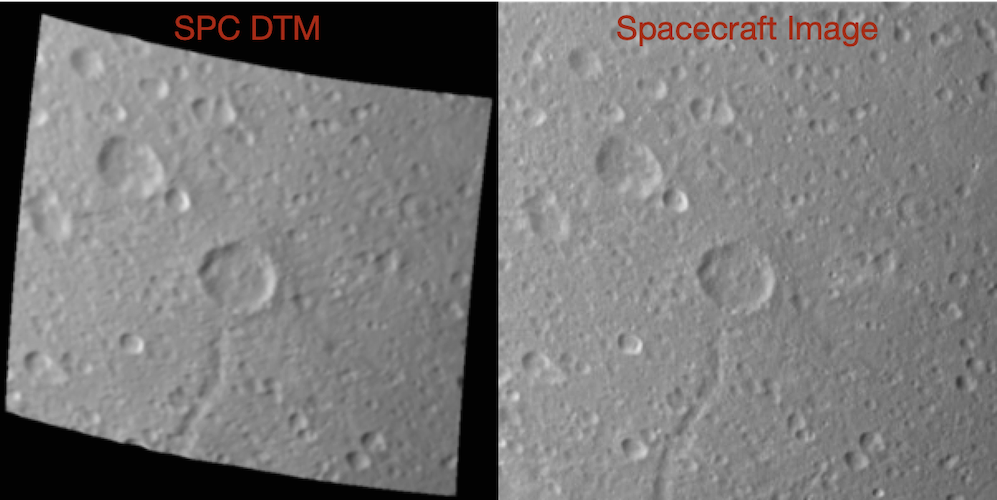
John Weirich, Deborah Domingue, Eric Palmer, and Robert Gaskell

Introduction: 

Digital terrain models (DTMs) form the basis of many science investigations, including geologic mapping, thermal modeling, and photometric modeling. Previous DTMs were constructed while the Cassini mission was ongoing, and contain limited images. We present global and regional DTMs (i.e., shape models) constructed using the entire Cassini spacecraft imaging campaign and the Stereophotoclinometry (SPC) software suite (Gaskell 2008, 2023). The efficacy of SPC was demonstrated during the OSIRIS-REx mission, where global and regional DTMs successfully guided the spacecraft to the surface of asteroid Bennu 77 cm from the center of the target landing site (Lauretta et al., 2021; Olds et al., 2022). These models are for the Saturnian moons Dione, Mimas, Phoebe, Rhea, and Tethys. Enceladus and Iapetus are forthcoming. These models are freely available on the NASA Planetary Data System (PDS), or will be upon completion.

In addition to the topography and albedo, we also provide detailed photometric data for each vertex of the regional models. For each image, we can provide the reflectance value, phase angle, emission angle, and incidence angle. This photometric data can be used to determine photometric parameters such as geometric albedo, single scattering albedo, and surface roughness for each DTM vertex.


Methods:

SPC uses two proven techniques, stereophotogrammetry and photoclinometry, and simultaneously solves for a single product. The stereophotogrammetry (stereo) solution is accomplished by triangulation of the spacecraft images to a single point on the surface. The multi-image photoclinometric solution uses each pixel from an image along with the image’s incidence and emission angles to calculate an x-slope, y-slope, and albedo for each DTM vertex. Every image contributes to the determination of the slopes and albedo value for each point on the surface. Stereo gives sparse absolute heights, while photoclinometry gives slopes that are then integrated to determine heights in between the stereo positions. The result can be a pixel-to-pixel DTM for the surface, with accurate data for both height and albedo.


Products:

The resulting DTMs can be used to generate views that are nearly indistinguishable from spacecraft images (Fig. 1).

Figure 1. Left shows a regional SPC DTM of Dione centered at -0.3 Lat 293.9 ELon rendered with the same viewing and lighting conditions as the spacecraft image on the right. Spacecraft image is a cropped view of Cassini image N1556123061 (726 m/px resolution).


To aid data users, we provide assessment data such as best image resolution and number of images  (Fig. 2 and 3). The data in Figs. 2 and 3 indicate where the topography is over- or under-sampled relative to the images, and can be used to determine topographic quality. Additional assessments, such as internal sigma values (Fig. 4), give another check on the quality of the topography. Internal sigma values worse than the best image resolution (a rare occurrence), indicate the sigma values more accurately describe the topographic quality.

Figure 2. Assessment data for regional DTM in Fig. 1. Shows the best image resolution for each vertex of the DTM.

Figure 3. Assessment data for regional DTM in Fig. 1. Shows the number of images used by SPC for each vertex of the DTM.


Figure 4. Assessment data for regional DTM in Fig. 1. Shows the SPC internal sigmas for each vertex of the DTM.


As part of SPC processing, each image will be aligned to the topography within 1 pixel. With such an accurate alignment and topography, the photometric data can be calculated on a pixel-to-pixel scale. This data is given in the United State Geological Survey (USGS) Integrate Software for Imagers and Spectrometers (ISIS) cube format. An example of the local emission angle is given in Fig. 5.

Figure 5. Graphical representation of the local emission angle of image N1556123061 for each vertex of the DTM. Black corresponds to 5 deg while white corresponds to 72 deg.

Conclusion:

An SPC global DTM, along with assessment data, of Phoebe (0.3 km/vertex) is currently available from the PDS (Weirich, Gaskell, et al., 2023). Global DTMs and assessment data of Dione (1.6 km/vertex), Mimas (0.6 km/vertex), Rhea (2.2 km/vertex), and Tethys (1.5 km/vertex) are under review at the PDS and will likely be available at the time of this conference. Regional DTMs, assessment data, and photometric data cubes of Dione (~0.4 km/vertex) and Tethys (0.3 to 0.4 km/vertex) are also under review. Similar products for Enceladus and Iapetus are forthcoming.

Though not part of the Saturn system, many other SPC products like these are available, including those for asteroid Bennu, Earth’s Moon (Weirich, Palmer, et al., 2023), Mercury (Weirich, Domingue, et al., 2024), and many other objects. These products are key in the assessment of surface morphology and regolith structure, each providing insight into surface processing of these icy worlds.


References:

Gaskell, R.W., Barnouin-Jha, O.S., Scheeres, et al., (2008). Characterizing and Navigating Small Bodies with Imaging Data. Meteoritics and Planetary Science 43 (September): 1049–61.

Gaskell, R.W., Barnouin, O.S., Daly, M.G., et al., (2023). Stereophotoclinometry on the OSIRIS-REx Mission: Mathematics and Methods. Planetary Science Journal 4: id 63, 15pp.

Lauretta, D. S., Enos, H. L., Polit, A. T., et al., 2021, in Sample Return Missions, ed. A. Longobardo (Amsterdam: Elsevier), 163, doi:10.1016/B978-0-12-818330-4.00008-2

Olds R.D., Miller C.J., Norman, C.D. et al., (2022). The Use of Digital Terrain Models for Natural Feature Tracking at Bennu. Planetary Science Journal 3: id 100, 11pp.

Weirich J.R., Gaskell R., et al., (2023). Phoebe SPC Shape Model and Assessment Products Bundle V1.0. urn:nasa:pds:satellite-phoebe.cassini.shape-models-maps::1.0. NASA Planetary Data System, doi:10.26033/3k3c-5713.

Weirich J.R., Palmer E.E., et al., (2023). Lunar Topography and Photometric Cube Data V1.0. urn:nasa:pds:lunar_lro_lroc_topography_domingue_2023::1.0. NASA Planetary Data System, doi:10.17189/jdpv-z697.

Weirich J.R., Domingue D.L., et al., (2024). Nathair Facula Topography and Photometric Cube Data V1.0. urn:nasa:pds:nathairfacula_messenger_mdis_topography_domingue_2022::1.0. NASA Planetary Data System, doi:10.17189/31AX-FT48.

How to cite: Weirich, J., Domingue, D., Palmer, E., and Gaskell, R.: Digital Terrain Models and Photometric Data of Five Large Saturnian Moons, EPSC-DPS Joint Meeting 2025, Helsinki, Finland, 7–13 Sep 2025, EPSC-DPS2025-115, https://doi.org/10.5194/epsc-dps2025-115, 2025.

17:30–17:42
|
EPSC-DPS2025-1187
|
ECP
|
On-site presentation
Sierra Ferguson, Alyssa Rhoden, and Michelle Kirchoff

The age and origin of the mid-sized Saturnian satellites are still outstanding questions. Accretion models for the formation of Mimas, Enceladus, Tethys, Dione, and Rhea (henceforth referred to as the MIMs) have explored formation from the proto-Saturn disk (refs) or from the rings themselves, migrating to their current orbital positions over the age of the Solar System (Canup 2010, Charnoz et al., 2010; 2011). Models of the post-accretion impact and orbital dynamics have suggested that the MIMs may be as young as 100 Myr old (Ćuk et al., 2016). Hence, there are two distinct endmember scenarios where either the current MIMs formed billions of years ago or formed in the most recent epoch of Solar System history. Geologic observations provide one approach to solving this dichotomy.

            Through an impact cratering lens, previous work on the cratering histories of the Saturnian system have found that the satellites have been heavily cratered and may be more in line with a formation age of ~4 Gyr ago (Kirchoff et al., 2010; 2015). However, many of the previous studies of the cratering histories have relied on the production functions of Zahnle et al., (2003), which assumed heliocentric impacts for both their Case A and Case B scenarios. While these production functions, particularly Case A, have appeared to better fit the data of the Jovian satellites and the Pluto/Charon system (Singer et al., 2019), the fits to the data of the Saturnian satellites and Triton aren’t as well matched (Ferguson et al., 2020; 2022b; 2024, Kirchoff et al., (2022).  For the Uranian system, craters with D > 10 km tend to follow the heliocentric shapes of the Jovian and Pluto systems. But at smaller diameters (D < 10 km), terrains on Miranda and Ariel differ in shape, suggesting a planetocentric origin (Kirchoff et al., 2022). This has led to the interpretation that the Saturnian and Uranian moons have likely been cratered by a combination of heliocentric and planetocentric material, further complicating the question of their ages and origins. Invoking planetocentric material as an impactor source adds in additional challenges towards building a chronology.

            Examining the planetocentric population of impactors at Saturn has proven to be a challenge because there are fewer constraints on the mass and size-frequency distribution of these objects. Our approach to characterizing this impactor source is to look at the elliptical craters present on the surfaces of Mimas, Tethys, Dione, and Rhea. Elliptical craters form in a low velocity and low impact angle collision with the surface. By looking at the distributions of elliptical craters and the orientations of their major axes, we can examine trends in the impact environment across the system. Due to the conditions in which elliptical craters are formed, we assume that these craters formed from planetocentric material. 

In our prior work (Ferguson et al., 2022a, 2024), we documented evidence of the elliptical crater populations on Mimas, Tethys, and Dione. We found that there is a concentration of elliptical craters oriented in the mid latitudes (30° S – 30° N) and across all longitudes that are oriented in an East/West direction on Mimas, Tethys, and Dione. We found an additional component of the elliptical craters on Mimas are oriented in a North/South direction closer to its north pole (i.e., oriented radially from the pole). This is in contrast to a more isotropic distribution of orientations in the polar areas of Tethys and Dione.

            Here, we present new results of the elliptical crater survey, extended to the largest of the MIMs, Rhea. Rhea’s location on the edge of the mid-sized moon system suggests the satellite may be best poised to reveal how this impactor source varied over time and/or distance to Saturn. Across the four satellites, we find that the densities peak at Tethys and drop off with increasing distance from Saturn for the mid-equatorial spatial densities or using the un-adjusted area for the total mapped terrain. When looking at the polar (60°-30°S, 30°- 60°N) regions, we find a slightly higher spatial density of elliptical craters on Mimas, a similarly high value on Tethys, and then increasingly lower spatial densities on Dione and Rhea.

Looking at the orientations of the elliptical craters (Figure 1), we observe a similar East/West trend on Rhea that we observe on the other satellites. Peculiarly, Rhea’s craters also show a Northwest/Southeast orientation in the polar latitudes. While unobserved at the other satellites, we have narrowed the location of this signal down to the leading Northern hemisphere of Rhea. On the other three satellites, the elliptical crater orientations maintain the same patterns seen in Figure 1. We will present additional findings, including comparisons between our Rhea data set and more regional scale mapping of Rhea’s surface, and discuss the implications of this work for the larger picture questions of the age and origin of the satellites.

Figure 1 Caption: Rose diagrams of elliptical craters across all four moons. 30° S - 30° N is referred to as the mid-equatorial regions. The other legend entry is considered our more polar terains and is shown in a contrasting color to the mid-equatorial data. 

References:

Canup, R. M. (2010) Nature, 468(7326), 943–946. https://doi.org/10.1038/nature09661

Charnoz, S., Salmon, J., & Crida, A. (2010). Nature, 465(7299), 752–754. https://doi.org/10.1038/nature09096

Charnoz, S., Crida, A., Castillo-Rogez, J. C, et al., (2011). Icarus, 216(2), 535–550. https://doi.org/10.1016/j.icarus.2011.09.017

Ćuk, M., Dones, L., & Nesvorný, D. (2016).  AJ, 820(2), 97. https://doi.org/10.3847/0004-637X/820/2/97

Ferguson, S. N., Rhoden, A. R., & Kirchoff, M. R. (2020). JGR: Planets, 125(9), 1–21. https://doi.org/10.1029/2020JE006400

Ferguson, S. N., Rhoden, A. R., Kirchoff, M. R., & Salmon, J. J. (2022a). EPSL, 593, 117652. https://doi.org/10.1016/j.epsl.2022.117652

Ferguson, S. N., Rhoden, A. R., & Kirchoff, M. R. (2022b) JGR: Planets, 127(6). https://doi.org/10.1029/2022JE007204

Ferguson, S. N., Rhoden, A. R., & Kirchoff, M. R. (2024). EPSL, 642. https://doi.org/10.1016/j.epsl.2024.118859

Kirchoff, M. R., & Schenk, P. (2010). Icarus, 206(2), 485–497. https://doi.org/10.1016/j.icarus.2009.12.007

Kirchoff, M. R., & Schenk, P. (2015) Icarus, 256, 78–89. https://doi.org/10.1016/j.icarus.2015.04.010

Kirchoff, M. R., Dones, L., Singer, K., & Schenk, P. (2022). PSJ , 3(2), 42. https://doi.org/10.3847/psj/ac42d7

Singer, K. N., McKinnon, W. B., Gladman, B., et al., (2019). Science, 959(March), 955–959. https://www.science.org/doi/10.1126/science.aap8628

How to cite: Ferguson, S., Rhoden, A., and Kirchoff, M.: Elliptical Craters on the Mid-Sized Saturnian Satellites and Their Relationship to the Impact Environment, EPSC-DPS Joint Meeting 2025, Helsinki, Finland, 7–13 Sep 2025, EPSC-DPS2025-1187, https://doi.org/10.5194/epsc-dps2025-1187, 2025.

17:42–17:54
|
EPSC-DPS2025-810
|
On-site presentation
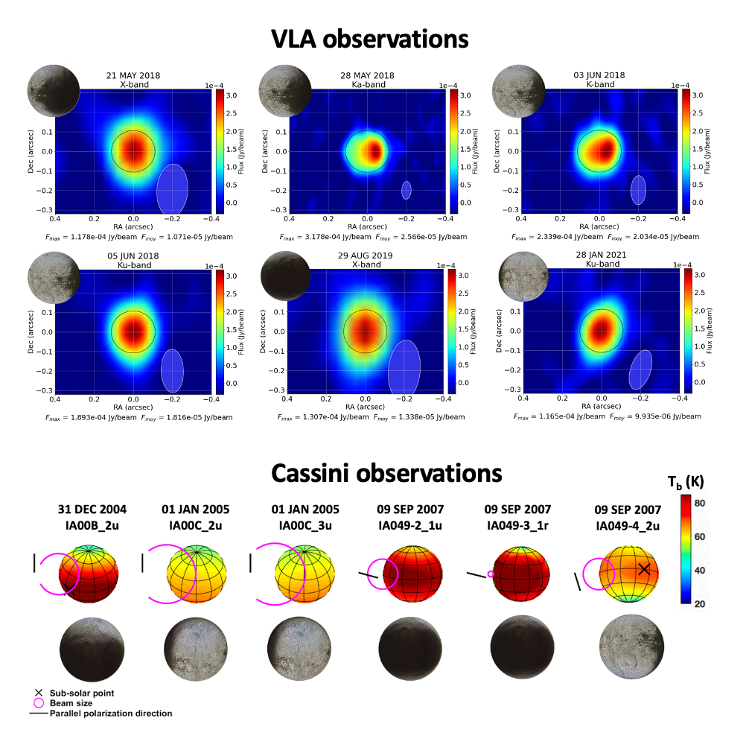
Alice Le Gall, Emmanuel Lellouch, Bryan Butler, Salman Raza, Léa Bonnefoy, Lucy Harrar, Cédric Leyrat, Frédéric Schmidt, Cyril Mergny, Colas Robin, and François-Xavier Meyer

Indubitably, the most dramatic albedo hemispheric dichotomy in the Solar system occurs at Iapetus. Its leading (L) side is covered by an optically low-albedo material, contrasting with its bright trailing (T) side. This dichotomy is also visible at microwave wavelengths, which sense not only the surface but also the subsurface and can thus bring insights into the vertical extent of the dark L side deposit layer and, in general, on the variations with depth of the composition and structure of Iapetus’ subsurface. We here present all available radio maps of Iapetus and the thermal emission model we have develop to interpret them. This model combines a multi-layer thermal and radiative transfer model and its comparison to VLA and Cassini RADAR observations provide new constraints on the physico-chemical properties of both the T and L hemispheres of Iapetus.

Introduction

The origin of Iapetus two-tone coloration has long been controversial; there now seems to be a consensus toward an exogenic deposition of low-albedo materials originating from Phoebe’s vast debris ring that crosses Iapetus’ orbit [e.g., 1, 2, 3]. However, questions remain about the composition and vertical extent of Iapetus’ L hemisphere dark deposit. Measuring the thermal emission from Iapetus at different wavelengths, thus probing different depths, can help answering these questions. In particular, probing the L side of Iapetus at multiple wavelengths in the microwave domain can put a firmer number on the thickness of the dark layer thus bringing key constraints for dynamical models aiming at reproducing dust distribution on Iapetus [e.g., 4].

Iapetus radio maps

Since 2018, the Very Large Array telescope (VLA) has been used at several instances to map the thermal emission from Iapetus at wavelengths ranging from 0.9 to 6.0 cm i.e., from the Ka-band to C-band. A total of ~30 hours of observations was collected resulting in 13 radio maps (see 6 of them in Fig. 1). VLA observations only probe Iapetus dayside but with different portions of the L and T sides in the visible disk. To complete the analysis, we also consider 6 data segments collected by the Cassini RADAR acting as a radiometer during 2 targeted flybys of Iapetus (Fig. 1). These data were acquired at a wavelength of 2.2 cm, sometimes at night, and sample either the L or T hemisphere.

Both VLA and Cassini spatially-resolved maps show a clear asymmetry in the emitted flux with more flux coming from the L face of Iapetus than from the T face (e.g., May 28, 2018). Yet, the radio maps do no perfectly mimic the optical maps thus bringing complementary information

Fig. 1: Radio maps of Iapetus collected by VLA and the Cassini RADAR (Cassini deconvolved maps are from [5]). For each map, the size of the primary beam and the albedo map of the visible disk are indicated.

Thermal emission model

The interpretation of Iapetus’ radio maps requires a thermal emission model combining a thermal model and a transfer radiative model, to produce brightness temperature (in K) maps of Iapetus that can be converted into radiance (erg.cm−2.s−1/sr−1).

Model parameters: In bright terrains, Iapetus subsurface is modeled as a homogeneous column of porous water ice. On the L side, we assume a two-layer subsurface with a porous dark layer overlying the ice substrate whose characteristics are the same as those of the bright terrains. More specifically, the model parameters are: the porosity of the dark layer  and of the icy substrate , the thickness of the dark layer  (which should not exceed a few meters [6]), the composition of the dark material (organics, silicates or a mixture) and the degree of volume scattering in the icy substrate .

Thermal model: We adapted the “Multi-layered Implicit Heat Transfer Solver” (MultIHeaTS) [7] to the case of Iapetus. The thermal properties of the subsurface are primarily controlled by  and  Because the sensed subsurface temperatures are a combination of diurnal and seasonal components, the thermal model is set to provide temperature profiles down to tens of meter depths.

RT model: We used the model proposed by [8] for RT in stratified agricultural soils adding a contribution from volume scattering () in the water ice substrate. Composition,  and  dictate the vertical variations of the subsurface electrical properties. Silicates are more radio absorbing /emitting than organics.

Results and discussion

Each radio observation is compared to model predictions looking for the parameter combination that best reproduces it (e.g., Fig. 2). One main result is that all observations including the T side point to the need for a significant degree of volume scattering in the water ice substrate (=20-40%). In addition, in most cases, assuming a silicate dark composition provides better fits than organic one. Yet, best-fit models for observations on the L dark side generally underestimate and/or mislocate the peak emission which suggests variations in the thickness of the dust layer (Fig. 3). This will be further investigated. Future work will also focus on adjusting all data together to the model to find the best combination and in particular put a firm constrain on the thickness of the dark layer. Lastly, we will test the hypothesis that some detected cold spots could be associated with geological features such as impact craters.

Fig. 2: VLA map of May 28 2018 (left), best-fit model (=1.55) (middle) and residual map. In the model, a uniform  value is assumed on the L side.

Fig. 3: Visible disk in May 28, 2018 (left) with best-fit model now assuming a thicker dust layer in the centre of the L side (right).

References:

1. Buratti et al., 2002, Icarus 155, 375–381

2. Verbiscer et al., 2009, Nature 461, 1098.

3. Dalle Ore et al., 2012, Icarus 221 (2), 735–743

4. Tamayo et al. 2011, Icarus 215, 260

5. Bonnefoy, 2020, PhD Thesis, Paris Observatory

6. Ostro et al., 2006, Icarus 183 (2), 479–490.

7. Mergny and Schmidt, 2024, Planet. Sci. J. 521

How to cite: Le Gall, A., Lellouch, E., Butler, B., Raza, S., Bonnefoy, L., Harrar, L., Leyrat, C., Schmidt, F., Mergny, C., Robin, C., and Meyer, F.-X.: Investigating Iapetus' dichotomy with multi-wavelength microwave observations, EPSC-DPS Joint Meeting 2025, Helsinki, Finland, 7–13 Sep 2025, EPSC-DPS2025-810, https://doi.org/10.5194/epsc-dps2025-810, 2025.

Orals WED-OB5: Wed, 10 Sep, 15:00–16:00 | Room Neptune (rooms 22+23)

Chairperson: Philip D. Nicholson
Rings
15:00–15:12
|
EPSC-DPS2025-1572
|
ECP
|
On-site presentation
liza verma, Abel George, and Ishan Sharma

Planetary rings comprise of innumerable particles with the largest solid bodies being kilometer sized, but
the abundant population is in the range of 1 − 10 cm. Such a particulate system may be modeled as a
continuum if the associated particle mean-free path λ is much smaller than the characteristic length scale
L of the problem, i.e. the Knudsen number, Kn = λ /L ≪ 1. Mean free path for rings is of the order of
particle dimensions, so Knudsen number is indeed small. Moreover, the aspect ratio of such ring systems
is generally very small. For example, Saturn’s ring system is 282, 000 km across and thickness is typically
about 10 m. These considerations motivate the present attempt to model planetary rings through shallow
water theory, with the added challenge that a radial gravity field due to the central planet is present. To
begin with, we consider an incompressible and inviscid rotating shallow fluid in an annular domain with a
radial gravity field. Modified shallow water equations are derived. The dependence of different
wave mode frequencies on the width of the annular domain and its location is investigated. Critical values
of these parameters are found for which some of the conventional shallow water wave modes cease to exist.
We also find that a radially varying central gravity field plays the same role as that of a topography with
cross-channel pressure gradient that are introduced in the usual analysis of topographic Rossby waves.

How to cite: verma, L., George, A., and Sharma, I.: Modelling planetary rings through shallow water theory, EPSC-DPS Joint Meeting 2025, Helsinki, Finland, 7–13 Sep 2025, EPSC-DPS2025-1572, https://doi.org/10.5194/epsc-dps2025-1572, 2025.

15:12–15:24
|
EPSC-DPS2025-1052
|
On-site presentation
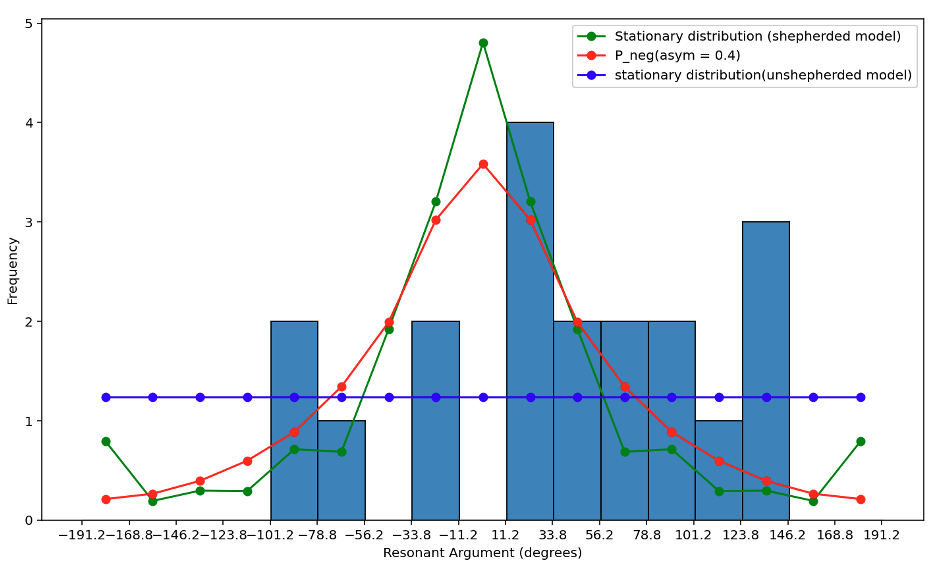
Larry W. Esposito and Abdulelah AlRebdi

Saturn’s narrow, clumpy F ring is a region disturbed by chaotic orbital dynamics. We therefore model it as a stochastic process (specifically, a finite Markov chain). The ring appears dominated by dust in camera images, but the main mass of this ring resides in a core of elongated clumps called kittens, observed by ring occultations. Cassini UVIS sees such features about 1/3 of the time, the same frequency as the radio occultation detections of the F ring core; both have similar size distribution. We model the F ring core as kittens (transient aggregates with size100 m < 𝚫r < 3 km), including perturbations due to Prometheus encounters, resonance confinement, and mutual collisions. We solve for the stationary state. Without confinement, the probability of detecting the kittens is uniformly distributed. With corotation resonance confinement [1], the stationary state is sharply peaked, consistent with the longitudinal distribution of detections of the F ring by radio occultation. Considering shepherding alone, the Cassini radio observations are nonetheless better fit by the non-confinement stationary distribution, and even better by just 20% confined. We find acceptable fits for fractions up to 70% of the clumps shepherded in the 109:110 Prometheus CER. This alternative combines with the explanation of [1] to conclude that some fraction of the population, or some fraction of the time, the F ring is shepherded by Prometheus. We argue that the persistence of the F ring due to negative diffusion [2][3], where the ring is confined by Prometheus aligning particle when they are driven to collide when streamlines cross. We include the negative diffusion in the Markov chain using an Ehrenfest diffusion model [4]. A small asymmetry explains the distribution in resonant argument of the radio occultation detections. In all cases, Prometheus is the agent for confinement. The F ring is thus shepherded by a combination of a Prometheus corotation and a Lindblad resonance.  When the center of mass of the material in the F ring is ever located at the Lindblad resonance with Prometheus, perturbations will drive negative diffusion to maintain that location. For our combined model: Shepherded fraction has the range fshep < 0.2; Diffusion asymmetry factor Pneg has the range 0.48 - 0.50. The negative diffusion thus can maintain the longitudinal distribution either alone, or in combination with shepherding, if the mean motion resonance coincides with the true core of the F ring

Comparing 3 models to the kittens detected in the Cassini radio occultations. Red line showing the purely negative diffusion model (no shepherding, only negative diffusion with Pneg = 0.40). The quality of the fit is similar to that of the Cuzzi et al. (2024) hypothesis (green line).


  • Cuzzi, JN al. (2024). Saturn’s F ring is intermittently shepherded by Prometheus.
    Science, 10 May 2024.
  • Lewis, MC al. (2012). Negative diffusion in planetary rings with a nearby moon. Icarus 213, 201.
  • Sickafoose, AA and Lewis, MC (2024). Numerical simulations of Chariklo’s rings with a resonant perturber. Planetary Science Journal, February 2024.
  • Feller, W (1968). An Introduction to Probability. Wiley.


How to cite: Esposito, L. W. and AlRebdi, A.:  Saturn’s F Ring is Confined by Prometheus and Negative Diffusion, EPSC-DPS Joint Meeting 2025, Helsinki, Finland, 7–13 Sep 2025, EPSC-DPS2025-1052, https://doi.org/10.5194/epsc-dps2025-1052, 2025.

15:24–15:36
|
EPSC-DPS2025-36
|
On-site presentation
Ryuki Hyodo

Saturn’s rings have been considered youthful—no more than a few × 108 years—because dark, non-icy micrometeoroids should steadily accumulate on the predominantly water-ice ring particles. Cassini measurements, however, show the ring is still remarkably clean. Hyodo, Genda & Madeira (2025) Nature Geoscience revisit this apparent contradiction with a three-stage, end-to-end numerical investigation that follows (i) hypervelocity impact vaporisation, (ii) post-impact vapour condensation, and (iii) electromagnetic removal of the impactor debris. Their work demonstrates that a pollution-resistance mechanism—rather than a recent origin—is sufficient to explain the rings’ pristine appearance. ​

1. Hypervelocity impact simulations
Typical interplanetary micrometeoroids 1–100 μm in size collide with ring particles at ~30 km s-1. Three-dimensional smoothed-particle-hydrodynamics (SPH) calculations using five-phase H₂O and SiO₂ M-ANEOS equations of state reveal peak temperatures ≥10,000 K and pressures ≥100 GPa throughout the projectile, causing complete vaporisation of its non-icy material. Only a micrometeoroid-sized volume of the icy target is vaporised; the rest is launched as slow, icy ejecta that remains in the ring plane. Consequently, no pristine, solid non-ice grains are emplaced into the rings at the moment of impact. ​

2. Vapour expansion and condensation
The mixed vapour cloud expands ballistically. Adiabatic cooling drives silicate gas to the liquid–vapour boundary, where homogeneous nucleation produces nanometre-sized condensates while ~60 % of the vapour remains atomic or molecular. In contrast, H₂O vapour almost never reaches the densities required for nucleation and therefore stays gaseous. 

3. Charging and dynamical evolution
Both the residual vapour and nano-condensates become ionised in Saturn’s magnetosphere. Hybrid N-body–Lorentz integrations track test particles across the full radial extent of the C, B and A rings while varying charge-to-mass ratios q/m = 10-7–10-6 e amu-1. Lorentz coupling deflects low-mass, highly charged particles out of the Keplerian mid-plane; most are either (a) precipitated into Saturn’s atmosphere (“ring rain”) or (b) accelerated along open field lines and ejected as high-speed dust streams. The fraction that re-impacts the rings—the accretion efficiency η—is only ~1–3 %, two orders of magnitude smaller than the ≥10 % assumed in earlier age estimates. ​

4. Implications for apparent ring youth
If η < 1 %, the timescale required to darken Saturn’s rings by micrometeoroid flux lengthens from ~102 Myr to several Gyr, consistent with the Solar System’s age. Thus the observed whiteness is not prima facie evidence of recent formation; it can be maintained by continuous self-cleaning of exogenic silicates. The same mechanism naturally produces (i) the nanometre-sized “stream particles” discovered by Cassini and (ii) the water-rich ion rain measured in Saturn’s ionosphere, reconciling multiple Cassini data sets with a single process chain. ​

5. Broader consequences
Pollution resistance should operate anywhere hypervelocity impacts strike porous ice in a strong planetary magnetosphere. It may therefore influence the colour and inferred ages of Uranus’ and Neptune’s dark rings and of bright terrains on icy moons. Future work must include porosity, grain-scale granularity, mixed silicate-metal chemistries, and time-dependent stochastic charging to refine η, but the first-order conclusion remains: ring cleanliness does not mandate ring youth.

How to cite: Hyodo, R.: Micrometeoroid Pollution Resistance Sustains the Pristine—and Possibly Ancient—Rings of Saturn, EPSC-DPS Joint Meeting 2025, Helsinki, Finland, 7–13 Sep 2025, EPSC-DPS2025-36, https://doi.org/10.5194/epsc-dps2025-36, 2025.

15:36–15:48
|
EPSC-DPS2025-336
|
Virtual presentation
Ronald-Louis Ballouz, Joseph N. Spitale, Joseph M. Hahn, and Stephen R. Schwartz

Introduction and Scope of Work:

Imaging of Saturn’s rings by the Cassini spacecraft revealed fine detailed structure of its dense rings [e.g., Spitale & Porco 2010, Tiscareno et al. 2019], including the existence of i) irregular vertical structures (IVS’s) on the edge of the A- and B-rings, ii) propeller structures created by embedded moonlets, and iii) mountain-like wall structures at the edges of rings from fully gap-opening satellites (Fig. 1). We have been investigating these vertical structures in order to better understand their formation mechanisms, to provide better quantitative constraints on the physical properties of ring particles, and to construct scaling relationships of structure properties with ring particle and moonlet properties. Furthermore, these physical features of Saturn’s rings provide a natural laboratory to explore the relationship between dense rings, embedded moonlets, and exterior satellites.  

Figure 1. (a) An example of an Irregular Vertical Structures (IVS) in the B-ring outer edge [Spitale  & Porco 2010]. (b) An embedded moonlit forming a propeller (named Blériot) on the unlit side of the rings [Tiscareno et al. 2019]. (c) Cassini image of the Keeler gap, showing Daphnis and the vertical structure of density waves induced on the edge casting shadows on the ring.

We use the N-body code pkdgrav to directly simulate the formation of i) IVS’s and ii) propeller structures from embedded moonlets. pkdgrav has the ability to model dense granular regimes by incorporating detailed multi-contact, frictional, and cohesive forces between particles through a Soft-Sphere Discrete Element Method (SSDEM) [Schwartz et al. 2012, Zhang et al. 2018, Ballouz et al. 2017]. For modelling IVS’s, we also use the N-body code epi_int [Hahn et al. 2025] to generate initial conditions for modeling the edge of the B-ring that is influenced by the Mimas 2:1 Linblad resonance [Spitale & Proco 2010]. 

While there have been previous simulation studies of vertical structure using hydrodynamic codes, which capture the scale of the phenomenon, and N-body simulations, which directly model the ring particle interaction, few prior studies have been able to directly model vertical structure formation at the appropriate physical scale for direct comparison with observations. Here, we leverage the highly-parallel nature of pkdgrav to directly simulation the formation of vertical structures with physically-realistic ring particle sizes (1-10 m). For the presentation, we will present progress in modeling the formation of IVSs and propeller structures from embedded moonlets. Here, we highlight some progress in the modeling of propeller structures.

Simulation Setup and Preliminary Results

We simulate a patch of particles with a differential size frequency distribution defined by a power law with exponent -2, and a radius range of 0.5 to 1.5 meters. We vary the bulk density of individual particles, and set a nominal value of 0.6 g/cm3. The radius of the embedded moonlet is 50-m. We vary the normal, 𝜀n, and tangential, 𝜀t, coefficients of restitutions. The friction parameters are chosen such that particle shave an angle of friction of ~ 32°. The simulations are initialized by creating a uniform density ring patch with a prescribed dynamical optical depth (𝜏dyn = 1.0) set in the B-ring (semi-major axis = 100,000 km). The azimuthal and radial extents of the patch are approximately 6 km and 1 km, respectively, which is approximately 85 x 15 embedded moonlet hill radii. The total number of ring particles simulated is N = 3.6 million. The simulations run for approximately 50 orbital periods, which is sufficient to reach a steady state configuration.

Fig. 2 shows examples of two simulations with different 𝜀n and 𝜀t. In both cases, we see the formation of propeller structures that extend to 4-5 km along the azimuthal direction. For the case with more dissipative collisions, we noted the formation of irregular dense vertical structures at the edges of the gaps (magenta box in Fig. 2b) that have a saw-tooth pattern, which have been observed in different regions of Saturn’s rings. Fig. 3 shows a closer look at some of these structures.

Figure 2. End-stage of embedded moonlet simulations with patch size of 1.1 km (radial) by 6 km (azimuthal). The propeller structure is evident and contained within the confines of the simulation box. a, case with less dissipative inter-particle collisions, 𝜀n = 0.8, 𝜀t = 0.8. b, case with less dissipative inter-particle collisions, 𝜀n = 0.5, 𝜀t = 0.5.

Figure 3. We highlight one of the regions with irregular saw-tooth structures in the simulation results shown in Fig. 2b. These structures are more pronounced for the case with more dissipative collisions between ring particles.

We analyzed the case shown in Fig. 2b case further to study how the structure seen in the simulations might control the appearance of the ring as seen by Cassini. We sub-divided the ring patch into a grid made of 20 m × 20 m cells and calculate the maximum height, H, of each cell, normalized by the embedded moonlet’s radius, rm. We find that parts of the vertical structure have H/rm > 1. Fig. 4 shows that the height of the ring patch is largest adjacent to the accretion tubes.

Figure 4. Sub-dividing the simulation shown in Fig. 2b into 20 m × 20 m cells, we measured the height range, H, normalized by the embedded moonlet’s radius (rm) in each cell to better compare with Cassini observations of Saturn’s dense rings. 

Acknowledgements

This work is supported by the NASA Cassini Data Analysis program through grant 80NSSC23K0220. This work also made use of a NASA High-End Computing allocation (SMD-24-30244393)


References

Ballouz et al. 2017 AJ 153, 146.

Ballouz et al. 2021 MNRAS 507, 5087.

Hahn, J.M., et al. 2025 ApJ, In Review.   

Schwartz, S.R., et al. 2012 Granular Matter 14, 363

Spitale, J.N., & Porco, C.C. 2010 AJ 140, 1747.

Tiscareno, M., et al. 2019 Science 364, 6445.

Zhang, Y., et al. 2018 AJ 857, 15.


How to cite: Ballouz, R.-L., Spitale, J. N., Hahn, J. M., and Schwartz, S. R.: Investigating Vertical Structure Formation in Saturn’s Rings with N-body simulations, EPSC-DPS Joint Meeting 2025, Helsinki, Finland, 7–13 Sep 2025, EPSC-DPS2025-336, https://doi.org/10.5194/epsc-dps2025-336, 2025.

15:48–16:00
|
EPSC-DPS2025-1101
|
Virtual presentation
Joshua Colwell, Elizabeth Faulkner, Ava Goforth, Richard Jerousek, and Larry Esposito

Stellar occultation measurements of Saturn’s rings from the Cassini Ultraviolet Imaging Spectrograph (UVIS) High Speed Photometer (HSP) reveal dozens of regions in the heart of the B ring that are opaque at the sensitivity level of the measurements (Colwell et al. 2021, 2024). We have identified 24 regions with an average transparency less than 0.25%, including 9 with an average transparency less than 0.1% and radial extents greater than 10 km. There are broad expanses within these opaque regions where the transparency is indistinguishable from zero.


Occultations of the star Beta Centauri with photon count rates of up to 600 per 1 ms integration period provide the strongest constraints on transparency. The elevation angle B (sin(B)=0.918) and brightness of Beta Centauri make it best suited among the UVIS stellar occultations to probe high optical depth regions. The radial resolution of these occultations is about 8 meters, while the azimuthal resolution in the frame co-moving with the ring particles is ~20-30 meters. Each measurement samples an area in the frame of the particles of ~400 m2. The average transparency of each designated opaque region is > 0 because of the presence of narrow, transient features we dub “phantoms” that increase the average transparency of the region. Phantoms are analogous to the ghosts observed by Baillie et al. (2013) and Green et al. (2024) in the C ring and Cassini Division. While ghosts were defined by being indistinguishable from 100% transparent in an otherwise moderate optical depth background, phantoms are defined as narrow, non-axisymmetric features with non-zero transparency in an otherwise opaque background (Figure 1).

Figure 1: Stacked and offset (by 5%) transparency profiles of the O1 opaque region in Saturn’s B2 ring region as measured by the Cassini UVIS HSP. The different curves are for different observations of the same star system: Beta Centauri. Narrow spikes in transparency are identified as phantoms. The vertical dashed lines indicate the boundaries of the opaque region.


We observed phantoms that are only a single HSP measurement, indicating a radial extent of < 10 m, but most span several measurements. Phantom transparencies range from a few percent up, but in some cases the transparency exceeds 10% and can approach 50%. There are 15 measurements of the B ring with Beta Centauri occultations, and the phantoms do not repeat from one occultation to the next, highlighting their non-axisymmetric and/or temporally variable nature. The Beta Centauri system has two stars that contribute to the HSP signal, and the projected separation of these two components in the ring plane enables us to place limits on the azimuthal extent of some phantoms, which in some cases is < 100 m.


At some locations there are clusters of phantom-like features that appear in all occultations at the same location. We identify these axisymmetric features “grassy regions” based on their appearance in plots of transparency (Figure 2). The average transparency of grassy regions is still low, typically less than 2%. The opaque regions are bordered by regions of higher optical depth (Figure 2).

Figure 2: Stacked and offset (by 5%) transparency profiles of an opaque region in Saturn’s B2 ring region as measured by the Cassini UVIS HSP. The different curves are for different observations of the same star system: Beta Centauri. This opaque region is home to phantoms (isolated spikes in transparency) as well as several grassy regions, identifiable by their presence at the same location in all occultation profiles and marked by blue dashed lines.


The measured optical depth of the opaque stretches between phantoms can exceed 6 in some cases (see for example the bottom curve in Figure 2 between 100,250-100,300 km). N-body simulations have struggled to reproduce such high optical depths. Individual ring particles in the simulations clump together due to their mutual gravity, leaving gaps which elevate the overal transparency of the region. We will present results of simulations with modified boundary conditions and particle properties to try to explain the existence of such high-optical-depth regions and the sub-structure of phantoms and grassy regions within them.


Baillié, K., J. E. Colwell, L. W. Esposito, and M. C. Lewis 2013. Meter-sized Moonlet Population in Saturn’s C Ring and Cassini Division. Astron J. 145, 171, doi:10.1088/0004-6256/145/6/171.


Colwell, J. E., M. Brooks, R. Jerousek, C. Coleman, M. S. Tiscareno, K.-M. Aye, M. Lewis, L. W. Esposito 2021. Irregular Structure in the Core of Saturn’s B Ring. 2021 AGU Fall Meeting P34A-01.


Colwell, J. E., A. Goforth, C. Coleman, R. Jerousek, L. W. Esposito 2024. Saturn’s B Ring Phantoms: Frequency, Properties, and Distribution. 2024 Meeting of the American Geophysical Union. P33F-2931.


Green, M. R., J. E. Colwell, L. W. Esposito, R. G. Jerousek 2024. Particle sizes in Saturn’s rings from UVIS stellar occultations 2. Outlier populatinos in the C ring and Cassini Division. Icarus 416, 116081.

How to cite: Colwell, J., Faulkner, E., Goforth, A., Jerousek, R., and Esposito, L.:  Opaque Expanses in Saturn’s B ring, EPSC-DPS Joint Meeting 2025, Helsinki, Finland, 7–13 Sep 2025, EPSC-DPS2025-1101, https://doi.org/10.5194/epsc-dps2025-1101, 2025.

Posters: Tue, 9 Sep, 18:00–19:30 | Lämpiö foyer

Display time: Tue, 9 Sep, 08:30–19:30
Chairperson: Stephan Zivithal
Saturnian Satellites
L10
|
EPSC-DPS2025-1258
|
On-site presentation
Andrea Magnanini, Valery Lainey, Luis Gomez Casajus, Marco Zannoni, and Paolo Tortora

The rapid outward migration of Titan presents a challenge to classical tidal theories, with recent analyses yielding conflicting results regarding its rate and the underlying mechanisms within Saturn.

Lainey et al. (2020) presented evidence for rapid migration, potentially driven by resonance locking, based on two independent analyses: 1) Radio science data from Cassini Titan flybys analyzed with MONTE software, and 2) Classical astrometry data spanning over a century analyzed with NOE software. While both methods produced statistically coherent results suggesting a low tidal quality factor (Q), the radio science solution yielded significantly more precise results, finding Q =124±9 (1-sigma).

However, a subsequent comprehensive analysis (Jacobson, 2022) merging astrometry and radio science data from Cassini, Voyager, and Pioneer 11 obtained a result for Q that diverged by an order of magnitude (Q=1224±119, 1-sigma). When considering only the astrometry dataset (removing Cassini and Voyager radio science), the estimated central value of Q from this later work became compatible with the Lainey et al. (2020) astrometry-only method (method 2), yielding Q=91±101 (1-sigma), though still statistically consistent with zero. It was noted that, to determine Saturn's dissipation at Titan's frequency, radio science data was essential, but only by combining Voyager 1 data with Cassini's, given that Cassini data alone proved insufficient in that analysis. This made the radio science data result an important discrepancy to resolve with respect to Lainey et al. (2020).

To address this discrepancy, we conducted a new analysis combining long-term astrometric observations (spanning over a century ) with Cassini radio science data processed into reduced normal points for Titan flybys. These normal points, derived using a multi-arc local approach, provide Titan's state vector at each closest approach, minimizing dependence on specific dynamical models.  This combined dataset was analyzed within a unified dynamical framework using the NOE software, solving for Saturn's gravitational field, pole orientation, moon masses, and tidal parameters (k2​ and k2​/Q) for major satellites, including Titan. 

Our combined analysis yields a Saturn’s tidal quality factor fully compatible with Lainey et al. (2020), confirming the rapid migration rate of Titan and further supporting the resonance locking hypothesis. The results reinforce the need for non-classical dissipation mechanisms to explain gas giant planet satellites tidal evolution, as they may be incompatible with standard equilibrium tide models.

How to cite: Magnanini, A., Lainey, V., Gomez Casajus, L., Zannoni, M., and Tortora, P.: Titan's Orbital Expansion: A Combined Analysis of Cassini Radio Science Normal Points and Astrometry, EPSC-DPS Joint Meeting 2025, Helsinki, Finland, 7–13 Sep 2025, EPSC-DPS2025-1258, https://doi.org/10.5194/epsc-dps2025-1258, 2025.

L11
|
EPSC-DPS2025-855
|
On-site presentation
Michelle Kirchoff, Emily Martin, Oliver White, and Paul Schenk

USGS SIM geologic maps are being produced for Saturn’s moons Dione and Tethys (Martin et al., 2023; White et al., 2024) at 1:5M scale. As part of these mapping efforts, two global crater databases for crater diameters (D) larger than 3 km on Dione and 4 km on Tethys are being compiled, although completeness at the smallest diameters are dependent on imaging in the mosaics. We are using the latest grayscale mosaics produced with an equatorial resolution of 153 m/pixel by the Cassini Team for Dione (e.g., Roatsch et al., 2013) and an equatorial resolution of 250 m/pix by Paul Schenk for Tethys. While all latitudes and longitudes are imaged for these mosaics, the imaging quality is not consistent. In some areas, the imaging has a slightly lower resolution, has solar incidence angles outside of the ideal for recognizing craters, 74-82° (Robbins et al., 2025), and/or has distortion associated with high emission angles. When the databases are complete, maps of where the imaging is outside of ideal for each mosaic will be provided (e.g., Fig. 1). Both databases start with crater measurements from previous work: Dione (Kirchoff & Schenk, 2015) and Tethys (Kirchoff & Schenk, 2010). The previous databases were compiled before Cassini completed its final flyby of each moon in the later part of Cassini’s Soltice Mission (2014-2016), which provided new, improved imaging for portions of each moon that are now being used in the new mosaics. We also lower the completion diameter for Dione from 4 km to 3 km. Furthermore, beyond the crater average diameter and central latitude/longitude included in the previous databases, the new databases include elliptical measurements (short & long axes, long axis orientation), the confidence that a feature is a crater, degradation state, whether the crater is in a cluster/chain, if the crater is polygonal (i.e., has a straight edge), if the crater interacts with tectonics, and morphology (e.g., central peaks, transitional, ejecta presence and type). The databases will be used to assign absolute model ages to mapped units, and also to help define the contacts of regional units. Here we present the latest progress for each database (Figs. 2, 3) and discuss comparisons.

References: Martin, E. S., et al. (2023). Progress on 1:5M Global Geologic Map of Saturn’s Moon Dione. 54th Lunar Planet. Sci. Conf., Abst. #1691. White, O.L., et al. (2024). A Forthcoming Global Geologic Map of Tethys. Annual Meeting of Planetary Geologic Mappers, Abst. #7007. Roatsch, Th., et al. (2013). Recent Improvements of the Saturnian Satellites Atlases: Mimas, Enceladus, and Dione. Planet. Space Sci., 77, 118–25, doi.org/10.1016/j.pss.2012.02.016. Robbins, S. J., et al. (2025). Crater Detection Dependence on Resolution, Incidence Angle, Emission Angle, and Phase Angle. Geophys. Res. Lett., 52, e2024GL110570, doi.org/10.1029/2024GL110570. Kirchoff, M. R. & P. Schenk (2015). Dione’s Resurfacing History as Determined from a Global Impact Crater Database. Icarus, 256, 78–89, doi.org/10.1016/j.icarus.2015.04.010. Kirchoff, M. R., & P. Schenk (2010). Impact Cratering Records of the Mid-Sized, Icy Saturnian Satellites. Icarus, 206, 485–97, doi.org/10.1016/j.icarus.2009.12.007.

Figure 1. Example of outlines of non-ideal imaging in the mosaic for Dione. Light pink – heavy shadows, dark pink – heavy shadows and stretched, yellow – low resolution, green – low resolution and stretched, blue-green – stretched, white – low sun angle, olive green – low sun angle and low resolution, lavender – low sun angle and stretched.

Figure 2. Current progress on Dione global crater database. Purple circles denote completed craters for D ≥ 3 km. Black circles denote completed craters for D < 3 km. White circles are craters in progress, mostly from the previous database produced from Kirchoff & Schenk (2015).

Figure 3. Current progress on Tethys global crater database. Colors are as in Fig. 2, but for D = 4 km and previous data is from Kirchoff & Schenk (2010).

How to cite: Kirchoff, M., Martin, E., White, O., and Schenk, P.: A Tale of Two Moons: Global Crater Databases for Saturn’s Moons Dione and Tethys, EPSC-DPS Joint Meeting 2025, Helsinki, Finland, 7–13 Sep 2025, EPSC-DPS2025-855, https://doi.org/10.5194/epsc-dps2025-855, 2025.

Enceladus Surface
L12
|
EPSC-DPS2025-1475
|
On-site presentation
Nozair Khawaja, Frank Postberg, Thomas O’Sullivan, Maryse Napoleoni, Sascha Kempf, Fabian Klenner, Yasuhito Sekine, Maxwell Craddock, Jon Hillier, Jonas Simolka, Lucía Hortal, and Ralf Srama

Enceladus ejects subsurface material into space in the form of ice grains and gas from fractures in the moon’s south polar region, the Tiger Stripes (Porco et al. 2006; Hansen et al. 2006). Most of the ice grains fall back to the surface and only a fraction escapes the moon’s gravity and populates Saturn’s E ring (Kempf et al. 2010). One of Cassini’s mass spectrometers — the Cosmic Dust Analyzer (CDA)— sampled emitted ice grains in the E ring, at velocities typically below 13 km/s and revealed both high-mass refractory and low-mass volatile organic compounds in these grains (Srama et al. 2004; Khawaja et al. 2019; Postberg & Khawaja et al. 2018). Cassini’s flybys of the Enceladus plume, however, provided a unique opportunity for CDA to collect freshly ejected subsurface oceanic material, most notably organic compounds prior to their distribution away from Enceladus in the E ring.

Previously, data from plume flybys was only used to classify ice grains based upon their spectral type, without performing in-depth compositional analysis (Postberg et al. 2011; Ershova et al. 2024). In this work, for the first time, we analyse time-of-flight mass spectral data from CDA of freshly ejected organic-bearing ice grains sampled at the higher velocity of nearly 18 km/s (the E5 flyby in 2008), significantly faster than Cassini’s E ring traversals. Our results confirm the presence of aromatic and oxygen-bearing species in freshly ejected ice grains, with their characteristic spectral features appearing even at such high impact velocities, the same compounds that were previously observed in the E ring at much lower impact velocities. In addition, CDA spectra of these freshly ejected organic-bearing grains also exhibit spectral features related to esters/alkenes, ethers/ethyl and N-O bearing compounds, which were not observed in the lower impact speed spectra of older E ring ice grains.

These new findings have implications regarding the subsurface geochemistry of Enceladus and hence impose further constraints on the moon’s habitability. This work will also provide a complementary framework for the detection of organics in ice and dust grains using impact ionisation mass spectrometers for ongoing and future space missions, such as the SUrface Dust Analyzer (SUDA; Kempf et al. 2025) and the Destiny Dust Analyzer (DDA; Simolka et al. 2024) onboard NASA’s Europa Clipper and JAXA’s Destiny+.

References

Porco et al. Science (2006), DOI: 10.1126/science.1123013

Hansen et al. Science (2006), DOI: 10.1126/science.1121254

Kempf et al. ICARUS (2010), DOI: 10.1016/j.icarus.2009.09.016.

Srama et al. Space Sci Rev (2004), DOI: 10.1007/s11214-004-1435-z

Khawaja et al. MNRAS (2019), DOI: 10.1093/mnras/stz2280

Postberg & Khawaja et al. Nature (2018), DOI: 10.1038/s41586-018-0246-4

Postberg et al. Nature (2011), DOI: 10.1038/nature10175

Ershova et al. A&A (2024), DOI: 10.1051/0004-6361/202450429

Kempf et al. Space Sci Rev (2025), DOI: 10.1007/s11214-025-01134-0

Simolka et al. RSTA (2024), DOI: /10.1098/rsta.2023.0199

How to cite: Khawaja, N., Postberg, F., O’Sullivan, T., Napoleoni, M., Kempf, S., Klenner, F., Sekine, Y., Craddock, M., Hillier, J., Simolka, J., Hortal, L., and Srama, R.: A New Look at Enceladus’s Organic Inventory , EPSC-DPS Joint Meeting 2025, Helsinki, Finland, 7–13 Sep 2025, EPSC-DPS2025-1475, https://doi.org/10.5194/epsc-dps2025-1475, 2025.

L13
|
EPSC-DPS2025-400
|
On-site presentation
Christos Ntinos, Sebastien Rodriguez, Nicolas Altobelli, Stephane Le Mouelic, Rozenn Robidel, Benoit Seignovert, Gabriel Tobie, Thomas Cornet, and Claire Vallat

The icy moons of the outer solar system (Ganymede, Enceladus, Titan, etc.) have been found in the forefront of planetary exploration, due to their diverse geomorphology coupled with numerous discoveries hinting to possible habitable conditions: geothermal activity, oceans of liquid water under the ice crusts, abundance of volatiles, and in some cases complex organics, to name a few. Of paramount importance for constraining the internal structure and properties of these bodies are high-precision cartographic products, allowing for linking surface morphologies and composition to internal activity. These cartographic products are constructed by reconciling numerous different observations, which, due to the complexities of an orbital tour, are recorded under a great range of different illumination and observation conditions, with varying spatial sampling. The aim of this study is to provide to the community a complete pipeline for producing super-resolution (SR) maps for icy moons, by combining all the overlapping observations for a specific target. The development and testing of our pipeline are carried out using the hyperspectral cubes recorded by the Visual and Infrared Mapping Spectrometer (VIMS) instrument, on board the Cassini Saturn orbiter, during its 13-year long investigation of the Saturn system that ended in 2017. We focus our efforts on Enceladus, a prime astrobiological target, which contrary to Titan does not possess a thick atmosphere, the influence of which needs to be removed from the data before implementing the super-resolution methodology for surface cartography. We first navigate the data, calculating accurate projections that can be combined into global mosaics of Enceladus. We then implement a global photometric correction model that compensates for the different acquisition conditions, allowing for the construction of global mosaics with diminished visible seams, improved homogeneity at the global scale and sharper definition of surface features at the local scale. In the third step of our methodology, we combine all the overlapping observations of the same area to calculate the new SR maps of Enceladus in the infrared. Utilizing the new, SR global map of Enceladus, we provide new insight into the moon’s geomorphology as revealed from its surface spectral heterogeneity, demonstrating the capability of the SR approach to augment our understanding of existing data sets of icy moons and help prepare for future observations.

How to cite: Ntinos, C., Rodriguez, S., Altobelli, N., Le Mouelic, S., Robidel, R., Seignovert, B., Tobie, G., Cornet, T., and Vallat, C.: Super-resolution maps of icy moons: Application to the Cassini-VIMS observations of Enceladus, EPSC-DPS Joint Meeting 2025, Helsinki, Finland, 7–13 Sep 2025, EPSC-DPS2025-400, https://doi.org/10.5194/epsc-dps2025-400, 2025.

L14
|
EPSC-DPS2025-1649
|
On-site presentation
Georgina Miles, Carly Howett, and Julien Salmon

We present work to update current maps of the thermal properties of Enceladus using thermal observations from the Cassini Composite InfraRed Spectrometer (CIRS).  In 2010, the first maps of Enceladus’ thermal inertia were published that used what CIRS data was available at the time (Howett et al., 2010). These maps were resolved into some latitude zones, and overall conveyed lower thermal inertia and albedo at higher latitudes, and confirmed that like other cold, icy moons of Saturn its surface had low (< 50 MKS) thermal inertia.  Improvements to these maps using the totality of the CIRS Focal Plane 1 data (10-600 cm-1 / 16.7-1000 μm) from the mission with updated error estimates will yield better spatial resolution in addition to higher precision estimates of thermal inertia and albedo.   This will be particularly useful for improving models of surface temperature or estimating endogenic heat fluxes, like those at Enceladus’ south pole, associated with dissipation of heat from beneath.

Acknowledgements: Thanks are given to the NASA Cassini Data Analysis program that funded this work (80NSSC20K0477 and 80NSSC24K0373).


Reference:

Howett, C.J.A., Spencer, J.R., Pearl, J. and Segura, M., 2010. Thermal inertia and bolometric Bond albedo values for Mimas, Enceladus, Tethys, Dione, Rhea and Iapetus as derived from Cassini/CIRS measurements. Icarus, 206(2), pp.573-593.

How to cite: Miles, G., Howett, C., and Salmon, J.: Update to thermal inertia and albedo maps of Enceladus, EPSC-DPS Joint Meeting 2025, Helsinki, Finland, 7–13 Sep 2025, EPSC-DPS2025-1649, https://doi.org/10.5194/epsc-dps2025-1649, 2025.

L15
|
EPSC-DPS2025-264
|
ECP
|
On-site presentation
Grace Richards, Richárd Rácz, Sándor Kovács, Victoria Pearson, Geraint Morgan, Manish Patel, Simon Sheridan, Duncan Mifsud, Béla Sulik, Sándor Biri, and Zoltán Juhász

Introduction

Saturn’s magnetosphere contains trapped plasma and energetic charged particles which constantly irradiate the surface of Enceladus. The plasma consists of a variety of charged particles including water-group ions (O+, OH+, H2O+, H3O+) with a wide energy range, formed primarily from high energy electrons interacting with plume material [Howett et al., 2018; Johnson et al., 2008; Tokar et al., 2009, 2008]. Observations by Cassini’s CIRS and ISS show that on Saturn’s inner icy satellites, such as Mimas and Tethys, irradiation by the cold plasma darkens UV-IR reflectance spectra and produces bullseye-shaped features on the moons’ surfaces [Howett et al., 2018]. However, at Enceladus, the effects of plasma bombardment are unknown and difficult to determine because of the competing processes of E-ring grain bombardment and plume deposition [Paranicas et al., 2014]. Therefore, laboratory experiments are necessary to both isolate and understand aspects of the irradiation process that modify the composition of the ice.


Methodology

In this study, Enceledean surface ice analogues containing H2O, CO2, NH3, and CH4 were irradiated by water-group ions (including O+, O3+, OH+, and H2O+ ions) with energies between 10-45 keV, the aim being to explore the physical chemistry of the ices and characterise the extent to which the surface material of Enceladus is weathered by ions in Saturn’s radiation environment. All experiments were carried out using the ATOMKI-Queen’s University Ice Laboratory for Astrochemistry (AQUILA) ice chamber at the HUN-REN Institute for Nuclear Research (HUN-REN ATOMKI), which is interfaced to the Atomki Electron Cyclotron Resonance Ion Source (ECRIS) [Biri et al. 2012, Biri et al. 2021, Rácz et al. 2024]. The ECRIS facility is unique in that it is capable of producing molecular beams of ions, which can be used to simulate the Saturnian plasma environment. The AQUILA chamber is capable of achieving temperatures and pressures suited to Enceladus’ surface (pressures of 10−7 mbar to 10−10 mbar [Waite et al., 2006] and temperatures between 33 K to 180 K [Spencer et al., 2006]).

Enceladus surface ice analogues were prepared at 20 K by co-depositing the gas and water vapour samples via their simultaneous introduction from the pre-mixing dosing lines into the main chamber. The thickness and composition of the ices were monitored throughout the deposition process using Fourier Transform Infrared (FTIR) transmission absorption spectroscopy across the 4000-650 cm–1 wavenumber range at a nominal resolution of 2 cm–1. Once at the required thickness (> 300 nm), the ices were warmed to 70 K, a temperature that is more representative of the Enceledean mean surface temperature [Spencer and Nimmo 2013].

In five separate experiments, ices were irradiated by 10 keV O+ ions, 45 keV O3+ ions, 10 and 15 keV OH+ ions, and 15 keV H2O+ ions. Radiation-induced chemical changes in the ices were studied in situ using FTIR. Ices were irradiated until the main H2O absorption peak appeared to be destroyed, with FTIR spectra acquired at pre-determined fluence intervals. At the end of each irradiation experiment, ices were thermally annealed at a rate of 2 K min–1, with FTIR spectra acquired at 10 K intervals.


Results

Examples of the FTIR spectra are shown in Figure 1, for the experiments using 15 keV H2O+ as the irradiating ion. Analysis of the spectra showed that every irradiation experiment resulted in the formation of CO, OCN, and NH4+. Post-irradiative thermal annealing produced carbamic acid, ammonium carbamate, and an alcohol (likely methanol or ethanol) in most experiments. Other organic species, such as acetylene, acetaldehyde, formamide, and CH2OH radicals, were also tentatively detected as radiolytic products. Although many of these products have not previously been detected on Enceladus’ surface, some have been detected in Enceladus’ plumes, which leads to questions about whether plume material is formed within the radiation-rich space environment or whether it originates in the subsurface ocean. Since our experiments have shown that the timescales over which these radiolytic products can form are on the same order of magnitude as the exposure timescales of ice material on the surface of Enceladus or within its plumes, caution is suggested if future studies attempt to use the plumes or near-plume surface ice composition as a proxy for the composition of the subsurface ocean.

Figure 1. FTIR spectra for the 15 keV H2O+ experiment. The top spectrum shows the initial ice at 70 K compared to the spectrum taken after irradiation, with all parent ice components labelled. The middle two spectra show regions of interest of a difference spectrum produced by subtracting the spectrum acquired before irradiation from that acquired at the end of the irradiation experiment. The radiolytic products are labelled. The bottom panel shows a difference spectrum produced by subtracting the spectrum acquired at the end of irradiation at 70 K from that acquired during the post-irradiative thermal annealing experiment at 160 K. AC/CA refers to ammonium carbamate/carbamic acid.


References

Biri, S. et al. (2012). Rev. Sci. Instrum., 83, 02A341. https://doi.org/10.1063/1.3673006

Biri, S. et al. (2021). Eur. Phys. J. Plus, 136, 831. https://doi.org/10.1140/epjp/s13360-021-01219-z

Howett, C. et al. (2018). Enceladus and the Icy Moons of Saturn, Univ. of Arizona Press, pp. 343–360.

Johnson, R. E. et al. (2008). Planet. Space Sci., 56, 1238–1243. https://doi.org/10.1016/j.pss.2008.04.003

Paranicas, C. et al. (2014). Icarus, 234, 155–161. https://doi.org/10.1016/j.icarus.2014.02.026

Rácz, R. et al. (2024). Rev. Sci. Instrum., 95, 095105. https://doi.org/10.1063/5.0207967

Spencer, J. R. et al. (2006). Science, 311, 1401–1405. https://doi.org/10.1126/science.1121661

Spencer, J. R., & Nimmo, F. (2013). Annu. Rev. Earth Planet. Sci., 41, 693–717. https://doi.org/10.1146/annurev-earth-050212-124025

Tokar, R. L. et al. (2008). Geophys. Res. Lett., 35, L14202. https://doi.org/10.1029/2008GL034749

Tokar, R. L. et al. (2009). Geophys. Res. Lett., 36, L13203. https://doi.org/10.1029/2009GL038923

Waite, J. H. et al. (2006). Science, 311, 1419–1422. https://doi.org/10.1126/science.1121290

How to cite: Richards, G., Rácz, R., Kovács, S., Pearson, V., Morgan, G., Patel, M., Sheridan, S., Mifsud, D., Sulik, B., Biri, S., and Juhász, Z.: Water-Group Ion Irradiation Studies of Enceladus Surface Analogues, EPSC-DPS Joint Meeting 2025, Helsinki, Finland, 7–13 Sep 2025, EPSC-DPS2025-264, https://doi.org/10.5194/epsc-dps2025-264, 2025.

L16
|
EPSC-DPS2025-544
|
On-site presentation
Thomas R. O'Sullivan, Partha P. Bera, Nozair Khawaja, Maryse Napoleoni, and Frank Postberg

Ice grains emitted by the geologically active Saturnian moon Enceladus were sampled by Cassini’s Cosmic Dust Analyzer (CDA) – an impact ionisation mass spectrometer [1, 2] – allowing their compositional analysis. CDA exploited the kinetic energy from hypervelocity impacts of ice grains onto its metal target to ionise and fragment molecular compounds embedded in a water ice environment. Cassini’s observations at Enceladus have revealed the presence of a diverse chemical inventory, with CDA detecting a wide range of organic and inorganic compounds incorporated into ice grains ejected through the south polar plume [3-8]. The observed species imply a rich (geo)chemistry in its subsurface liquid water ocean and ongoing hydrothermal activity at its rocky, warm seafloor [9, 10]. The combination of liquid water, rich and active chemistry, and a source of energy – which together hint at habitable conditions - have cemented Enceladus’ place as a prime target in the search for life beyond Earth.

Across the entire mass range of detected organic species, which include nitrogen- and oxygen-bearing compounds and span a wide range of chemical properties, aromatic compounds are common in ice grains sampled from both the fresh plume and Saturn's E ring [3, 6, 11]. The assignment of mass spectral features to specific aromatic parent molecules has hitherto been challenging, as single-ringed aromatics generally fragment via similar pathways during impact ionisation. Organic compounds in ice grains sampled at hypervelocity by CDA generally undergo a degree of fragmentation closely correlated with the impact speed and molecular structure [12]. Unlike other mass spectral techniques, little empirical data is available as a reference for spaceborne impact ionisation mass spectrometry, due to the technical difficulties of accelerating ice grains in the laboratory. Analogue techniques such as laser-induced liquid beam ion desorption (LILBID) mass spectrometry, can successfully recreate impact ionisation mass spectra and thus represent a critical mode of data analysis for past and future space missions [12, 13]. There remains, however, a need for a deeper theoretical understanding of the physics and chemistry behind impact ionisation mass spectrometry, enabling both the prediction of mass spectral appearances for a large variety of organic compounds and – vice versa – the reconstruction of parent molecules from a given mass spectrum.

As a first case study, we employ quantum chemical calculations using the ORCA theoretical chemistry package [14] to investigate the relative energies of various pathways for the dissociation of aromatic compounds in water matrices, representative of the (semi-)polar aromatics detected in ice grains by CDA. These dissociation channels are compared to LILBID mass spectra simulating those obtained from impacts of aromatic-containing ice grains onto a spacecraft detector. We discuss the general applicability of quantum chemistry to impact ionisation and its efficacy in explaining the observed fragment ions of LILBID. We investigate phenol in particular, which is a compound representative of the (semi-)polar aromatics detected by CDA in Enceladean ice grains. We also discuss the influence of the water ice matrix on fragmentation using an explicit solvation model. In general, we find that fragment ions in LILBID match those predicted by some low-energy dissociation channels, but find inconsistencies related to peak intensities. Our work here not only guides the interpretation of existing data from Cassini’s CDA, but will also assist in planning for the SUrface Dust Analyzer (SUDA) instrument, which is based on CDA heritage, onboard the recently launched Europa Clipper [15].

1. Postberg, F., et al., Icarus, 2008. 193: p. 438-454.

2. Srama, R., et al., Space Science Reviews, 2004. 114(1-4): p. 465-518.

3. Khawaja, N., et al., Monthly Notices of the Royal Astronomical Society, 2019. 489(4): p. 5231-5243.

4. Postberg, F., et al. Plume and Surface Composition of Enceladus. 2018.

5. Postberg, F., et al. Nature, 2009. 459(7250): p. 1098-1101.

6. Postberg, F., et al. Nature, 2018. 558(7711): p. 564-568.

7. Postberg, F., et al. Nature, 2011. 474: p. 620-622.

8. Postberg, F., et al. Nature, 2023. 618: p. 489-493.

9. Hsu, H.-W., et al. Nature, 2015. 519(7542): p. 207-210.

10. Sekine, Y., et al. Nature Communications, 2015. 6(1): p. 8604.

11. Khawaja, N. et al. Cassini's New Look at Organic Material in Enceladus' Plume Ice Grains with CDA: Implication for the Habitability of Ocean Worlds. in Europlanet Science Congress 2024. Berlin, Germany.

12. Klenner, F., et al. Rapid Communications in Mass Spectrometry, 2019. 33(22): p. 1751-1760.

13. Klenner, F., et al. Earth and Space Science, 2022. 9(9): p. e2022EA002313.

14. Neese, F., WIREs Computational Molecular Science, 2025. 15(2).

15. Kempf, S., et al. Space Science Reviews, 2025. 221(1): p. 10.

How to cite: O'Sullivan, T. R., Bera, P. P., Khawaja, N., Napoleoni, M., and Postberg, F.: Towards understanding mass spectra from icy moons using quantum chemistry: A case study for aromatic compounds., EPSC-DPS Joint Meeting 2025, Helsinki, Finland, 7–13 Sep 2025, EPSC-DPS2025-544, https://doi.org/10.5194/epsc-dps2025-544, 2025.

L17
|
EPSC-DPS2025-1574
|
On-site presentation
Tara-Marie Bründl, Stephanie Cazaux, Ko-Ju Chuang, Jeroen Terwisscha van Scheltinga, and Harold Linnartz

Introduction:

Once considered enigmatic, Enceladus has attracted steadily growing scientific interest over the past 20 years since the first visual detection of cryovolcanic plumes venting from the tiger stripes in 2005 [1]. A combination of magnetospheric and gravity data revealed that under a kilometer's thick icy crust, Enceladus harbours a warm subsurface ocean maintained by tidal dissipation and hydrothermal vents on the oceanic floor [2, 3, 4]. This ocean escapes the icy crust through plumes that expel a mixture of vapour and icy grains composed mainly of water, salts and traces of organic material [5]. Material from these plumes feeds the E-ring or falls back to the surface depending on the particle’s velocity. While the surface of Enceladus is mostly rich in water, patches of CO2 ice have been observed in-between the tiger stripes, possibly due to gas exsolution from the ocean and diffusion through small fissures in the icy crust [6]. Despite the wealth of these new discoveries, many of the moon’s endogenic and surface processes remain unresolved to date. For instance, how material is exchanged between the ocean and the surface, or how surface ice is affected by the external environment are key questions of interest. In this work, we studied the UV-photolysis of H2O and CO2-rich ices under Enceladus environmental conditions to determine the products of photo-induced reactions as well as the lifetime of these ices [7, under review]. 


Methods:
 

To this end, we use a cryogenic ultra-high vacuum (UHV) setup housed at Leiden University’s Laboratory for Astrophysics that is employed to investigate the formation of complex organic molecules through energetic processing of simulated Enceladus ices. Thin CO2-rich ice films are grown at a base pressure of 10-11 mbar on a substrate that is cryogenically cooled and thermally controlled.  These ices are photo-irradiated using a specialized microwave discharge hydrogen-flow lamp, producing vacuum ultraviolet (VUV) light with an SED including Ly-α and H2-emissions. The UHV system is equipped with two diagnostic tools for the spectroscopic analysis of thin ices across a range of compositions and temperatures, allowing for detailed investigation of the physico-chemical processes within the ice. Changes in the solid phase are tracked via Fourier-transform infrared (FTIR) spectroscopy, while a quadrupole mass spectrometer provides complementary detection of gas-phase species that desorb during linear warming of the substrate from 70 to 200 K.   


Results and Discussion: 


By systematically probing VUV-photolysed pure (H2O, CO2, and NH3) and mixed ices (H2O:CO2:NH3), the detection of photo-induced ozone in an Enceladus-like ice at 70 K is verified spectroscopically, besides other O and N-bearing chemical products forming in the ice. We found that ozone entrapment in CO2-rich ice occurs at temperatures as high as 88 K. Most likely, ozone is produced from the photodissociation of segregated CO2into CO + O, followed by consecutive O-atom addition reactions that form molecular oxygen (O2) and, finally, ozone (O3). Further, the survival of the VUV-irradiated parent molecules, CO2 and NH3, is quantified based on the fitted UV photodestruction cross-sections and half-lives, assuming first-order kinetics. The molecular half-lives are found to range from a few to several weeks on Enceladus. Our experimental work highlights that such short geological timescales possibly suggest an ongoing replenishing process that supplies surface CO2 as a key precursor for the formation of ozone. Future in-situ or remote-sensing detections of this molecule may serve as an indicator of geological activity involving surface renewal processes. We showed that ozone remains trapped in the solid-state in CO2-rich ices at temperatures up to 88 K and may therefore be found on Enceladus - or other sufficiently cold Solar System bodies that are exposed to comparable or higher levels of UV-radiation.  

References:
[1] Porco, C. C., et al.: Cassini observes the active South Pole of Enceladus, Science, Vol. 311, pp. 1393-1401, 2006.
[2] Dougherty, M., et al.: Identification of a dynamic atmosphere at Enceladus with the Cassini magnetometer, Science, Vol. 311, pp. 1406-1409, 2006.
[3] Iess, L., et al.: The gravity field and interior structure of Enceladus, Science, Vol. 344, pp. 78-80, 2014.
[4] Waite, J. H., et al.: Cassini finds molecular hydrogen in the Enceladus plume: Evidence for hydrothermal processes, Science, Vol. 356, pp. 155-159, 2017.
[5] Postberg, F., et al.: A salt-water reservoir as the source of a compositionally stratified plume on Enceladus, Nature, Vol. 474, pp. 620-622, 2011.
[6] Combe, J.-P., et al.: Nature, distribution and origin of CO2 on Enceladus, Icarus, Vol. 317, pp. 491-508, 2019.
[7] Bründl, T.-M., et al.: The photochemistry of Enceladus ice analogues – Implications for the formation of ozone and carbon trioxide, Icarus – under review (2025). 

How to cite: Bründl, T.-M., Cazaux, S., Chuang, K.-J., Terwisscha van Scheltinga, J., and Linnartz, H.: Ozone in Planetary Ices: Solid-State Detection under Enceladus-like conditions, EPSC-DPS Joint Meeting 2025, Helsinki, Finland, 7–13 Sep 2025, EPSC-DPS2025-1574, https://doi.org/10.5194/epsc-dps2025-1574, 2025.

Enceladus Sub-surface and Interior
L18
|
EPSC-DPS2025-2027
|
On-site presentation
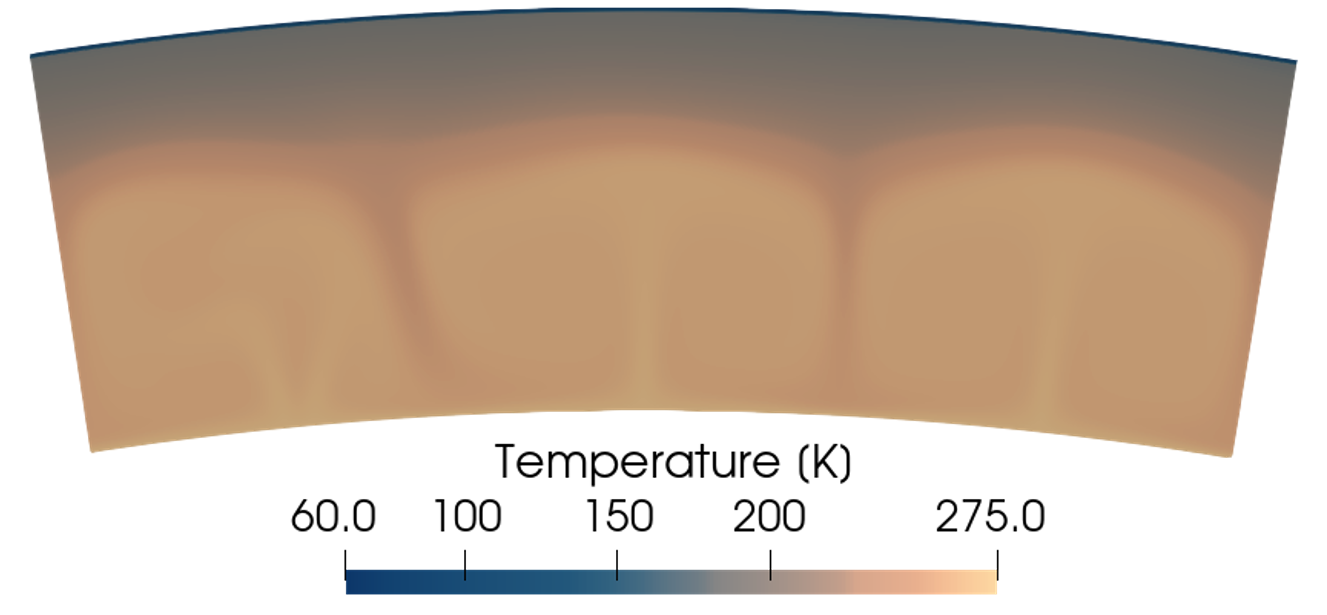
Evan DeMers, William Byrne, Ana-Catalina Plesa, Andreas Benedikter, and Hauke Hussmann

The presence of an ocean beneath the Enceladus’ ice shell makes this Saturnian moon a high priority target for future planetary exploration [1]. Water jets that have been observed at the south pole by NASA’s Cassini mission [2] are thought to originate from a global ocean and provide a direct window into the subsurface composition [3]. These jets generate a highly porous material that, due to its low thermal conductivity, affects the thermal state of the ice shell.

The analysis of pit chains on the surface of Enceladus indicates that locally the porous layer can be as thick as 700 m [4]. Such a thick porous layer can locally increase the temperature of the ice shell, leading to a low viscosity. This may promote solid-state convection in regions where the ice shell is covered by such a layer, whereas regions with thin porous layers could be characterized by conductive heat transport. Moreover, due to its effect on the ice shell temperature, the porous layer can strongly attenuate the signal of radar sounders that have been proposed to investigate the Enceladus’ subsurface [5, 6].

Here, we use the geodynamical code GAIA-v2 [7] to investigate the effects of a porous layer on the thermal state and dynamics of Enceladus’ ice shell. GAIA-v2 was originally built to model convection in the rocky mantle of terrestrial planets [8,9,10] but has recently been adapted to investigate large-scale dynamics in the shells of icy moons [11,12]. Our initial simulations use a 2D cylindrical geometry with an 18° arc computational domain, free-slip boundaries, and an Arrhenius rheology with diffusion creep, dislocation creep, as well as basal slip and grain-boundary sliding deformation mechanisms.

Using the resulting thermal state, we calculate the associated two-way radar attenuation at each location within the ice shell. We test different values of the ice shell thickness (5 – 35 km, [13]), porous layer thickness (d = 0 – 750 m), and its thermal conductivities (k = 0.1 – 0.001 Wm-1K-1 [14,15]). To account for chemical impurities within the ice shell we test a “low” loss scenario that considers a pure water ice shell and a “high” loss case that assumes a homogeneous mixture of water ice and chlorides in concentrations extrapolated from the particle composition of Enceladus’ plume [5].

Fig. 1: Modeled convection pattern in an ice shell with an ice shell thickness of 25 km, a porous layer thickness of 250 m, and porous layer thermal conductivity of 0.025 Wm-1K-1.


Fig. 2: Laterally averaged profiles for Fig. 1 showing a) temperature with depth b) 2-way radar attenuation under low-loss pure water ice assumption c) 2-way radar attenuation under high-loss 300 µmol chloride assumption. We assume here an attenuation limit of 100 dB [16].

Our results show that the porous layer thickness and its distribution have a first order effect on the thermal state and dynamics of the ice shell. Regions covered by a thick porous layer are characterized by a warm ice shell temperature and thus a lower viscosity, becoming more prone to undergo solid-state convection (Fig. 1). The vigor of convection depends on both the temperature-dependent ice shell viscosity and the temperature difference across the ice shell. While a thick porous layer would result in a low ice shell viscosity, thus increasing the convection vigor, such thick porous layers lead to an almost isothermal ice shell, due to their strong insulation, which, in turn, decreases the convection vigor. In ice shell regions covered by a thick porous layer, the penetration depth of a radar sounder is limited (Fig. 2), but as discussed in a recent study that only investigated a purely conductive ice shell [6], the high temperatures obtained in this case may lead to the formation of shallow brines detectable by radar measurements.

Next, we will increase the angular size of our models and allow the ice-ocean interface at the lower boundary to vary to capture spatial variations of the ice shell thickness. The upper part of the computational domain in our model will be treated as the solid ice shell, while the lower part will mimic a water ocean layer with a lower viscosity. The viscosity of the water ocean will be set to several orders of magnitude lower than that of the overlying ice shell. We will vary the viscosity contrast between the ice shell and the water layer to investigate whether ice flow can occur and possibly dampen the variations in the ice shell thickness. This will help us understand how convection can dynamically alter ice shell thickness, in contrast to previous modeling which assumes a purely conductive ice shell [6].

In future models, we will extend our models to include the effects of chemical impurities and tidal forces on the thermal state of Enceladus’ ice shell. We will track the redistribution of chemical anomalies due to solid-state convection in the ice shell. To this end, we will test different initial distributions of chemical heterogeneities and include tidal heating. Both the presence of chemical anomalies and tidal heating can affect the convection vigor and the convection pattern that characterizes large-scale dynamics in the ice shell. We will compare these more complex models with previous chemically homogeneous models in order to examine the effects of chemical anomalies and tidal heating on the thermal and dynamical state of the ice shell, and on the 2-way radar attenuation.


References:

[1] Choblet et al. (2021), Experimental Astronomy; [2] Porco et al. (2006), Science; [3] Postberg et al. (2009), Nature; [4] Martin et al. (2023), Icarus; [5] Souček et al. (2023), GRL; [6] Byrne et al. (2024), JGR:Planets; [7] Hüttig et al., (2013), PEPI; [8] Laneuville et al. (2013), JGR:Planets; [9] Tosi et al. (2015), GRL; [10] Plesa et al. (2016), JGR:Planets; [11] Rückriemen-Bez et al. (2023), Galilean Moons Workshop; [12] Plesa et al. (2023), Galilean Moons Workshop; [13] Hemingway & Mittal (2019), Icarus; [14] Seiferlin et al. (1996), PSS; [15] Ferrari et al. (2021), A&A; [16] Kalousova et al. (2017), JGR:Planets.


How to cite: DeMers, E., Byrne, W., Plesa, A.-C., Benedikter, A., and Hussmann, H.: Modeling Convection Dynamics in the Ice Shell of Enceladus, EPSC-DPS Joint Meeting 2025, Helsinki, Finland, 7–13 Sep 2025, EPSC-DPS2025-2027, https://doi.org/10.5194/epsc-dps2025-2027, 2025.

L19
|
EPSC-DPS2025-1531
|
On-site presentation
Klára Anna Šindlerová, Martin Kihoulou, and Ondřej Čadek

Introduction 

Icy moon Enceladus has been mostly studied for its South Polar region and geysers gushing out from a series of faults called Tiger Stripes. Less attention has been dedicated to several depressions, nearly 3.5-km-deep and 100-km-wide, scattered over the moon’s surface (1,2,3). Absence of fractures, no correlation with geological boundaries, and overall smooth profiles seemingly disprove an impact or a tectonic origin. Instead, they are thought to be associated with local thinning of the ice shell above hydrothermal vents from the moon’s porous core (4). However, this hypothesis has yet to be investigated. Here, we do so by modeling a response of a viscous ice shell to spatial variations in the heat flux coming from the subsurface ocean. In order to relate our results to Cassini mission observations, we evaluate the depth and the width of our modeled depressions, together with the stress in their vicinity.

How to cite: Šindlerová, K. A., Kihoulou, M., and Čadek, O.: Do deep depressions on Enceladus originate from hydrothermal vents?, EPSC-DPS Joint Meeting 2025, Helsinki, Finland, 7–13 Sep 2025, EPSC-DPS2025-1531, https://doi.org/10.5194/epsc-dps2025-1531, 2025.

L20
|
EPSC-DPS2025-1889
|
ECP
|
On-site presentation
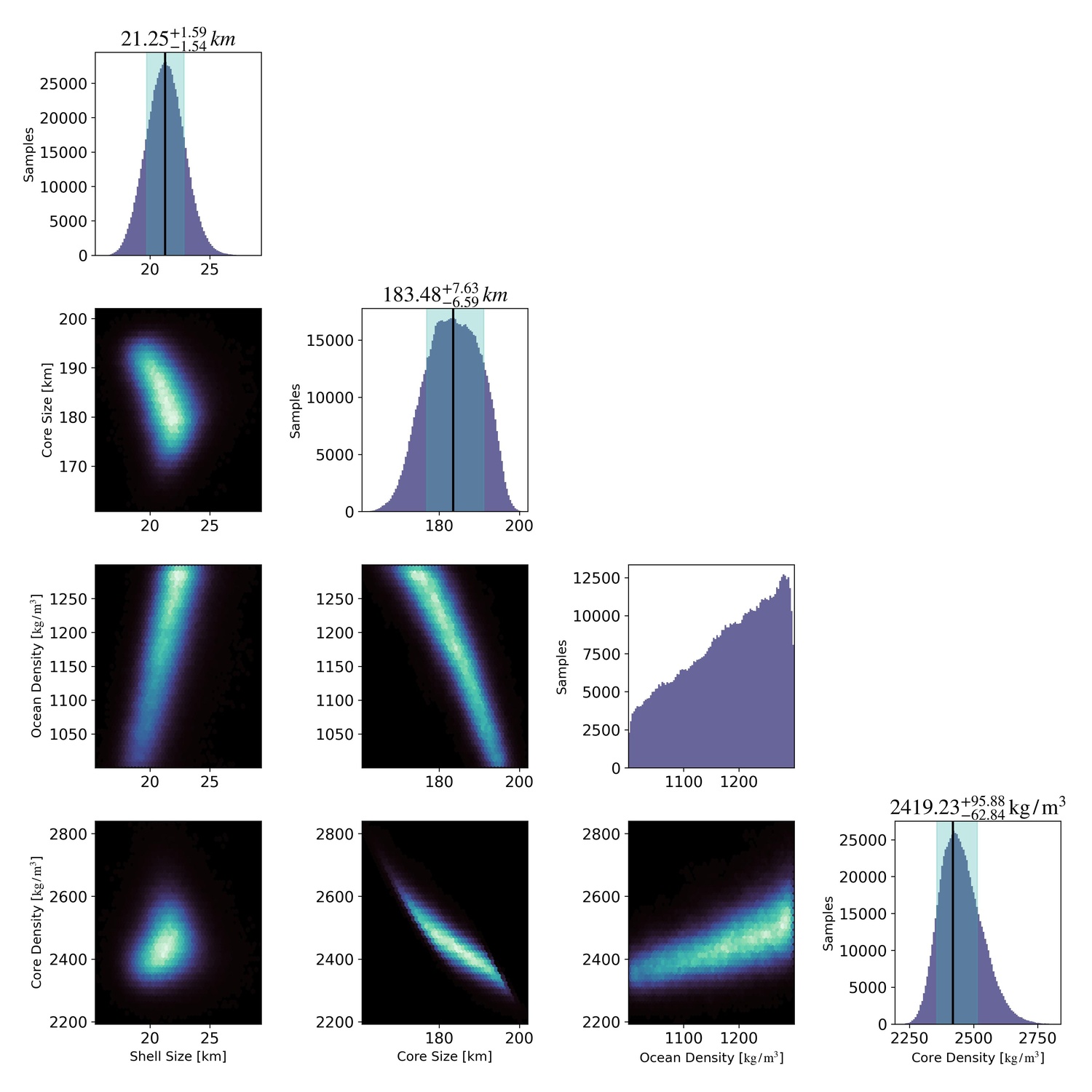
Martina Ciambellini, Antonio Genova, Anna Maria Gargiulo, and Gabriele Boccacci

Introduction: One of the most compelling discoveries in planetary science is the potential existence of habitable subsurface oceans within icy moons. Among these, Saturn's moon Enceladus stands out due to its remarkable geological activity, characterized by the continuous venting of water vapor, ice particles, and organic compounds from its south polar region [1]. Cassini's comprehensive suite of measurements, including gravity data, confirmed the existence of a global subsurface ocean [2]. Accurately modeling the internal structure of Enceladus is crucial for assessing its habitability. Geophysical parameters, such as total mass and moment of inertia (MoI), are effective at constraining the total thickness of the hydrosphere, but they provide limited information on the separate contributions of the ice shell and the underlying liquid ocean. In contrast, measurements of physical librations in longitude are particularly sensitive to the internal structure of the hydrosphere, as they are influenced by the degree of mechanical decoupling provided by the liquid layer and the rigidity of the overlying ice shell. By combining mass and the moment of inertia measurements with libration amplitude estimate, a Bayesian inference approach enables tighter constraints on the deep interior and hydrosphere properties. This study presents an internal structure framework based on the Markov Chain Monte Carlo (MCMC) method that is well-suited for the estimation of Enceladus’ interior properties with rigorously quantified uncertainties by exploring the parameter space.

Methods: The mass, MoI and libration amplitude provide constraints that are integrated into a Bayesian inference framework, which is used to infer the internal properties of the investigated body. In particular, we implemented a MCMC algorithm to invert interior models by varying the free parameters associated with the structure of an icy moon. In accordance with the methodologies employed and tested in previous studies [3-4], our approach considers the body to be a multi-layered structure with free parameters of layer size, density, and rheology. These parameters are iteratively refined within the MCMC framework using the Metropolis–Hastings algorithm, which generates a diverse set of interior models. To ensure robust mapping of the parameter space, 20 independent chains are employed, each generating approximately 50,000 accepted models. Following the convergence of all chains, probability distributions for each parameter are derived, yielding constraints on the likely internal structure that are consistent with the observed geophysical data.

Enceladus Interior Model Inversion: The internal structure of Enceladus is constrained using a combination of geophysical parameters derived from Cassini mission data. The mass of Enceladus, determined from radio science data, is 1.08022 ± 0.00108 × 10²⁰ kg [5], while the normalized MoI is estimated at 0.335 ± 0.002 [6]. These parameters place fundamental constraints on the total thickness of the hydrosphere, while remaining insensitive to the separate contributions of the ice shell and the subsurface ocean [6]. Physical librations, however, offer a crucial complementary constraint, as it is highly sensitive to the thickness and mechanical properties of the ice shell. The libration amplitude of Enceladus was determined from optical tracking of surface features by the Cassini spacecraft, revealing a physical libration of 0.120 ± 0.007°, which corresponds to an equatorial displacement of approximately 530 ± 30 m [7].

In this work, we implement the elastic libration model [8], which accounts for the gravitational torques acting on both the periodic and static tidal bulges and includes the complex gravitational interactions between the individual layers of the icy moon arising from their mutual misalignment and the pressure forces exerted by the liquid ocean on the surrounding solid layers. The model captures the contributions from both the direct external gravitational torque and the internal gravitational coupling between layers, as well as the pressure feedback from the ocean.

The moon is modeled with a three-layer structure comprising a rocky core, a subsurface ocean, and an ice shell. The thicknesses of the core and ice shell were treated as free parameters, while the ocean thickness was determined based on Enceladus’ known radius. The free parameters included the densities of the core and ocean, while the ice shell density was fixed at 917 kg m-3. The viscosities and shear moduli of the shell and core were included as free parameters. Within the MCMC framework, each proposed interior model starts from a simplified spherical approximation, characterized by an average radius and the densities of each layer. The hydrostatic shapes of the internal interfaces are then computed assuming hydrostatic equilibrium, calculating the polar and equatorial eccentricities of each layer using a fourth-order formulation [9].

The results suggest that incorporating libration amplitude can significantly improve the characterization of the internal differentiation withing Enceladus' hydrosphere, providing an estimate of the ice shell thickness with an uncertainty of approximately 1.5 km around a mean value of 21 km, consistent with previous studies.

Summary: The application of MCMC inversion with libration constraint offers a powerful approach to precisely determine the ice shell thickness of Enceladus, achieving a constraint accuracy of approximately 1.5 km. This framework can be readily adapted to other icy moons, providing a valuable tool for probing the internal structures of ocean worlds throughout the solar system.


References:

[1] Glein et al. (2015) GeCoA, 162, 202. [2] Iess et al. (2014), Sci, 344, 78. [3] Genova A. et al (2019) GRL 46(7), 3625–3633. [4] Petricca et al. (2023) GRL, 50, e2023GL104016. [5] Hemingway et al. (2018) in Enceladus and the Icy Moons of Saturn, Univ. Ariz. Press, 57. [6] Genova et al. (2024) PSJ, 5(2), 40. [7] Thomas et al. (2016) Icarus, 264: 37-47. [8] Van Hoolst et al. (2013) Icarus, 2013, 226.1: 299-315. [9] Tricarico (2014) ApJ, 782(2), 99.

How to cite: Ciambellini, M., Genova, A., Gargiulo, A. M., and Boccacci, G.: Constraining Enceladus' interior structure by using libration measurement in a Bayesian framework, EPSC-DPS Joint Meeting 2025, Helsinki, Finland, 7–13 Sep 2025, EPSC-DPS2025-1889, https://doi.org/10.5194/epsc-dps2025-1889, 2025.

Plumes, Induction, Ionospheres and Magnetospheres
L21
|
EPSC-DPS2025-675
|
ECP
|
On-site presentation
Detecting cellular biosignatures from Sphingopyxis alaskensis exposed to Enceladus plume and surface conditions
(withdrawn)
Mirandah Ackley, Alvaro Del Moral Jimenez, Marie Dannenmann, Karen Olsson-Francis, Zoe Emerland, Matthew Sylvest, Frank Postberg, and Manish Patel
L22
|
EPSC-DPS2025-963
|
On-site presentation
Alexander Grayver and Joachim Saur

Enceladus possesses all key requirements for habitability (liquid water, essential chemical elements, and source of energy) and is currently the top target for the next Large-class mission in the ESA’s Voyage 2050 plan. Measurements of the magnetic field around and/or at the surface of Enceladus will enable electromagnetic sounding of Enceladus to provide quantitative constraints on key thermo-chemical properties and structure in the moon’s interior. The case of Enceladus is rather peculiar as Cassini observations provided strong evidence for a very heterogeneous non-axisymmetric structure of its ice shell, suggesting ice is much thinner at the poles than at the equator.

This poses a challenge for conventional electromagnetic induction techniques that are mostly limited to 1-D geometries. Here, we present a first comprehensive study of 3-D electromagnetic induction effects in the non-axisymmetric Enceladus’s interior based on the observationally constrained heterogeneous ice shell thickness and ocean depth models. We analyse the variability of the induced fields over the surface at a range of periods, but focusing on recently quantified mechanisms of the external inducing field [1]. We discuss both challenges of detecting induced magnetic signals and new opportunities offered by the complexity of Enceladus’s interior.


[1] Saur, J., Duling, S., Grayver, A., & Szalay, J. R. (2024). Analysis of Enceladus’s Time-variable Space Environment to Magnetically Sound its Interior. The Planetary Science Journal, 5(11), 245.

How to cite: Grayver, A. and Saur, J.: Modeling 3-D Electromagnetic Induction Effects in Enceladus, EPSC-DPS Joint Meeting 2025, Helsinki, Finland, 7–13 Sep 2025, EPSC-DPS2025-963, https://doi.org/10.5194/epsc-dps2025-963, 2025.

L23
|
EPSC-DPS2025-1280
|
Virtual presentation
Marianna Felici, Sarah Badman, Licia Ray, Omakshi Agiwal, H. Todd Smith, Rob J. Wilson, Carley martin, Nicholas Achilleos, Jamie M Jasinski, Philip W. Valek, Alessandro Mura, and Luke Moore

It is well known that the ionosphere is an important mass source at Earth during periods of intense geomagnetic activity, but less attention has been dedicated to studying the ionospheric mass source at Saturn.
 Felici et al., 2016 described an ionospheric outflow event from Saturn's magnetotail, when Cassini was located at ≃ 2200 h Saturn local time at 36 RS from Saturn. During several entries into the magnetotail lobe, a tailward flowing cold ion beam was observed directly adjacent to the plasma sheet and extending deeper into the lobe. These ions,  which were mostly H+,  appeared to be dispersed, dropping to lower energies with time. The ion composition showed mainly H+. Ultraviolet auroral observations showed a dawn brightening, and upstream heliospheric models suggested that the magnetosphere was being compressed by a region of high solar wind ram pressure.

Here, we report the results of a survey of ionospheric outflow events using data from the Cassini Plasma Spectrometer Singles (CAPS) collected in Saturn's magnetosphere. By examining the spacecraft's position relative to the plasma sheet, flow direction, and ion composition using Cassini Magnetometer data and CAPS Time of Flight data, as described by Felici et al., 2016, we confirmed that these were ionospheric outflow events and mapped them within Saturn's magnetosphere.

Auroral and solar wind activity during these events were analyzed using data from the Cassini Ultraviolet Imaging Spectrograph and results from the ENLIL solar wind propagation model.

We obtained number flux values at 10000 km altitude ranging from 5.24 x10⁶ to 1.63 x109 cm-2 s-1. These values are within the range reported by Glocer et al., 2007, which is 7.3 x10⁶ to 1.7 x108 cm-2 s-1 However, our values are lower than those estimated by Felici et al., 2016, which range from 2.95 x10⁹ to 1.43 x1010 cm-2 s-1. We attribute this discrepancy to the fact that their study assumed completely cold ions, overestimating speeds and therefore the number flux, for the differential energy flux calculations. In contrast, calibrated moments for Cassini CAPS data are available at the time of this study. From the number flux, source rate could be estimated if the knowledge of the area of the emitting region could be inferred without too many assumptions.  Felici et al., 2016 postulated that the outflow could have originated from regions different from the polar cap,  and estimated the mass rate provided by an active region that covered the main auroral oval - as aurora images were available in their case -  which resulted to be between 49.7 and 239 kg/s (assuming all ions to be H+), revealing that the ionosphere could release a mass quantity the same order of magnitude as Enceladus (60–100 kg/s).

Future work will include an analysis of ionospheric outflow in the Jovian system, and  comparisons with models of ionospheric outflow at the Gas Giants, and between observed outflow at the two planets.

Acknowledgments

This work was supported by NASA under award numbers 80NSSC23K1275 and 80NSSC19K0892. Any opinions, findings, and conclusions or recommendations expressed in this material are those of the authors and do not necessarily reflect the views of the National Aeronautics and Space Administration.

References
Felici et al. (2016), doi:10.1002/2015JA021648.
Glocer et al., (2007), doi:10.1029/2006JA011755.


How to cite: Felici, M., Badman, S., Ray, L., Agiwal, O., Smith, H. T., Wilson, R. J., martin, C., Achilleos, N., Jasinski, J. M., Valek, P. W., Mura, A., and Moore, L.: Ionospheric Outflow in the Magnetosphere of Saturn, EPSC-DPS Joint Meeting 2025, Helsinki, Finland, 7–13 Sep 2025, EPSC-DPS2025-1280, https://doi.org/10.5194/epsc-dps2025-1280, 2025.

L24
|
EPSC-DPS2025-1196
|
ECP
|
On-site presentation
Omakshi Agiwal, Luke Moore, Carlos Martinis, Joe Huba, and Ingo Mueller-Wodarg

We introduce the Saturn Model of Ionospheric Transport and Electrodynamics (SMITE), a new model that incorporates inter-hemispheric plasma transport using a dipole magnetic field aligned grid, and a range of dynamic processes that influence Saturn's ionosphere. SMITE includes tunable parameters for inflow of exogenous material, seasonal and local time atmospheric variations, the ring shadow, and plasma transport driven by neutral winds and low latitude electrodynamics. SMITE is an adaptation of the terrestrial SAMI2 model, which has successfully reproduced numerous ionospheric phenomena at Earth. SMITE is the first model to show that strong plasma density gradients, such as those caused by Saturn's ring shadow in the winter hemisphere, drive inter-hemispheric field-aligned transport from the sunlit hemisphere to the winter hemisphere, which has previously been hypothesized from Cassini spacecraft measurements. In this presentation, we will show that SMITE can reproduce latitudinal trends in total electron content and altitudinal electron density distributions observed by the Cassini spacecraft, and will further present model-data comparisons between SMITE and in-situ measurements of Saturn’s ionosphere from the Cassini Grand Finale. We will also present model-data comparisons which show that diurnally variable low latitude electrodynamics may intermittently be active at Saturn.

How to cite: Agiwal, O., Moore, L., Martinis, C., Huba, J., and Mueller-Wodarg, I.: A New Saturn Model of Ionospheric Transport and Electrodynamics (SMITE), EPSC-DPS Joint Meeting 2025, Helsinki, Finland, 7–13 Sep 2025, EPSC-DPS2025-1196, https://doi.org/10.5194/epsc-dps2025-1196, 2025.

L25
|
EPSC-DPS2025-1903
|
On-site presentation
Angélica Sicard, Elias Roussos, Kostas Dialynas, Yixin Hao, Quentin Nénon, Aneesah Kamran, Piers Jiggens, and Fredrik Leffe Johansson

Missions are being studied to the systems of outer planets, including extended observation periods by local orbiters or possible landers, that require careful evaluation of the local radiation and plasma environment for design of both platform and science payload. Radiation impact potentially includes total cumulative doses, single event effects from short term enhancements and internal charging risk whilst plasma environments present risks of surface charging.

Under the ESA Project TRAPPED (Testbed for Radiation and Plasma Planetary Environments), a consortium comprising ONERA, IRAP, MPS and Academy of Athens has developed a flexible and easy-to-use environment model framework and related software for gas giant planet systems based on the wealth of data from visiting missions. Within this activity, derived specific models for radiation and plasma were developed for the Saturnian system.

Here, we will present the TRAPPED framework and more particularly the new specification model for Saturn’s radiation environment. This empirical model based on the last version of Cassini data (LEMMS, CHEMS and INCA) provides electron, proton and water-group ion fluxes in the magnetosphere of Saturn

How to cite: Sicard, A., Roussos, E., Dialynas, K., Hao, Y., Nénon, Q., Kamran, A., Jiggens, P., and Johansson, F. L.: A new flexible and easy-to-use environment model framework for Saturn’s system, EPSC-DPS Joint Meeting 2025, Helsinki, Finland, 7–13 Sep 2025, EPSC-DPS2025-1903, https://doi.org/10.5194/epsc-dps2025-1903, 2025.

Rings
L26
|
EPSC-DPS2025-1069
|
ECP
|
On-site presentation
Whittney Easterwood and Matthew Hedman

Saturn’s E ring is a broad and diffuse ring extending from 180,000 to 482,000 km from the planet’s center. This ring is composed of small water ice particles launched from the moon Enceladus. The brightness of the E ring varies in complex ways with distance from the planet and longitude relative to the Sun. In particular, the sunward side of the ring appears to be persistently brighter than the side of the ring closer to Saturn’s shadow. While the orientation of these patterns indicates that forces such as solar radiation pressure are involved, it is still not clear how these asymmetries are produced and maintained. We investigate these asymmetries using images obtained by Cassini while the spacecraft flew through the planet’s shadow. Understanding the brightness variations in these images is challenging since the ring’s observed brightness depends on both the density of the particles and how light is scattered through the particles in various geometries. We remove the effects of observation geometry by comparing data obtained at the same radius and phase angle, enabling us to map out the variations in the particle density with longitude throughout the ring. We will discuss the features seen in these maps and their implications for the origins of the E ring asymmetries.

How to cite: Easterwood, W. and Hedman, M.:  Quantifying Asymmetries in Saturn’s E Ring, EPSC-DPS Joint Meeting 2025, Helsinki, Finland, 7–13 Sep 2025, EPSC-DPS2025-1069, https://doi.org/10.5194/epsc-dps2025-1069, 2025.

L27
|
EPSC-DPS2025-1769
|
ECP
|
On-site presentation
Evolution of Viscous Overstability in Saturn’s Rings:Insights from Large-Scale N-Body Simulations
(withdrawn after no-show)
Annabella Mondino Llermanos and Heikki Salo
L28
|
EPSC-DPS2025-397
|
On-site presentation
Richard Jerousek, Melody Green, Cody Peterson, Joshua Colwell, Stephanie Eckert, Larry Esposito, Tracy Becker, Stephanie Jarmak, Richard French, Matthew Hedman, and Philip Nicholson

We present a comparative occultation analysis of narrow, eccentric ringlets in the Saturnian and Uranian ring systems, focusing on how mesoscale structure and particle size distributions vary with orbital phase (true anomaly). Our study combines the full suite of Cassini stellar and radio occultation profiles of Saturn’s narrow ringlets, obtained by Cassini’s UVIS (λ = 150 nm), VIMS (λ = 2.84 μm), and RSS (Ka-, X-, S-band experiments). We compare our results with a reanalysis of Voyager 2 PPS and RSS occultations of Uranus’s ε, α, β, η, and δ rings.

We group Saturn ringlet profiles into four orbital quadrants—periapsis, apoapsis, and the streamline divergence/convergence sectors—to isolate phase-dependent structure (Figure 1). In each quadrant, we model viewing-geometry dependent normal optical depth using the irregularly spaced, three component, granola bar self-gravity wake model of Esposito et al. (2025) (Figure 2). The model fits the dimensional ratios and cant angles of aligned structures such as self-gravity wakes, particle-depleted lanes, or both. 

Following Green et al. (2024), we compute the normalized central moments of UVIS HSP occultation transparencies to constrain the size of the largest ring particles (amax) and to characterize the clumpiness of the ringlets with orbital phase. We compare these moments to predictions from Esposito et al. (2025) for wake-dominated rings. Simultaneously, we perform multi-wavelength  particle size distribution fits by selecting UVIS, VIMS, and RSS profiles at similar orbital phase and with similar viewing geometries to constrain the power-law index (q) and minimum particle radius (amin) (Figure 3).

For the Uranian rings, we use the σ-Sagittarii and β-Persei Voyager 2 PPS occultations to extract radial optical depth profiles of the dense narrow rings, supplemented by RSS S/X-band differential attenuation. While the geometry does not allow for true-anomaly-resolved comparisons, we compare Voyager 2 PPS occultation statistics and RSS S and X band optical depths to enable structural comparison.

Our approach incorporates a self-consistent model of wavelength and viewing-geometry dependent optical depths with an analysis of photon counting statistics (Cassini UVIS HSP and Voyager 2 PPS).  We find that Saturn’s ringlets exhibit significant variation in both self-gravity wake dimensions and inferred size distributions between quadrants (Figure 4).

By applying a common framework across two planetary ring systems, we aim to identify techniques to constrain the phase-dependence of the particle size distribution, surface densities, and structure of dense narrow rings from in-situ occultations. This approach is intended not only to advance current understanding but also to inform the design of future occultation experiments at Uranus.

Figure 1. Ringlet edge radii from UVIS, VIMS, and RSS occulations colored by sine of the ring opening angle for the Maxwell Ringlet. Occultations are separated into quadrants (Groups 1 – 4) in true anomaly for orbital phase-dependent analysis.

Figure 2. The irregularly spaced granola bar self-gravity wake model of Esposito et al. (2025). 𝐸[𝜆T] is the expected value of the Toomre critical wavelength or the largest unstable wavelength toward gravitational collapse (Julian and Toomre 1966): λΤ = 4π2GΣ/κ2 where Σ is the local surface mass density and κ is the local epicyclic frequency.  The black dashed arrow is the line of sight from Cassini to the occulted star (or to Earth in the case of radio occultations.  The red square is the area over which light is collected during a single integration of the UVIS instrument. (see Jerousek et al. (2024) for details on the integration area).

Figure 3. The Maxwell ringlet contains a prominent spiral density wave driven by an outer Lindblad resonance (OLR). We fit optical depths in the first trough of the wave. Structure  nearly disappears at apoapsis when particle streamlines are most widely separated. At other orbital phases, the model best matches a structure with broad radial spacing and variable vertical extent.

Figure 4. Example of particle size distribution fits for the Maxwell ringlet at two orbital phases.. Best-fitting parameters are consistent with Jerousek et al. (2020) for the background C ring near periapsis where q is much larger. Ring particle radii generally range from several millimeters up to 5 – 10 m.

References:

Green, M. R., Colwell, J. E., Esposito, L. W., & Jerousek, R. G. (2024). Particle sizes in Saturn’s rings from UVIS stellar occultations 2. Outlier Populations in the C ring and Cassini Division. Icarus, 416, 116081.

Esposito, L. W., Colwell, J. Ε., Eckert, S., Green, M. R., Jerousek, R. G., & Madhusudhanan, S. (2025). Statistics of Saturn's ring occultations: Implications for structure, dynamics, and origins. Icarus, 429, 116386.

Jerousek, R. G., Colwell, J. E., Esposito, L. W., Tiscareno, M. S., Lewis, M. C., Pohl, L., & Benavides, D. A. (2024). The smallest structures in Saturn’s rings from UVIS stellar occultations. Icarus, 415, 116069.

How to cite: Jerousek, R., Green, M., Peterson, C., Colwell, J., Eckert, S., Esposito, L., Becker, T., Jarmak, S., French, R., Hedman, M., and Nicholson, P.: A Comparison of Orbital Phase-Resolved Mesoscale Structure and Particle Sizes in the Narrow and Eccentric Rings of Saturn and Uranus, EPSC-DPS Joint Meeting 2025, Helsinki, Finland, 7–13 Sep 2025, EPSC-DPS2025-397, https://doi.org/10.5194/epsc-dps2025-397, 2025.