
 1,2,3
1,2,3- 1Southwest Research Institute, Planetary Science, Boulder, United States of America (alejandro.soto@swri.org)
- 2Massachusetts Institute of Technology, Cambridge, MA, United States of America (jms4@mit.edu)
- 3Planetary Science Institute, Tucson, AZ, United States of America (jsteckloff@psi.edu)
Introduction:
The Cassini mission has observed surface changes that may represent the formation and dissipation of ephemeral lakes, i.e., transient lakes that dry-up on a geologically short timescale. As with ephemeral lakes on Earth, Titan’s ephemeral lakes result from the interaction of a generally arid climate with the variability of annual weather. Understanding the physics of ephemeral lakes will provide insight into the local, arid hydrological (methanological) cycle on Titan.
We have limited observations of the formation and dissipation of ephemeral lakes on Titan. Our best evidence is for two events: astorm and related ponding of liquid methane on the equator and the formation of a lake in the Arrakis Planitia region. Here we focus on the ephemeral lake in Arrakis Planitia, with particular interest in the mechanisms for the removal of the lake.
Arrakis Planitia Observations:
The formation of an ephemeral lake at Arrakis Planitia began in 2004. From 2004 to 2005, the Imaging Science Subsystem on the Cassini Mission along with a handful of ground-based telescopes observed both extensive cloud activity and darkening of the surface in the Arrakis Planitia region of Titan. Turtle et al. (2009) [1] identified darkening in Arrakis Planitia likely due to liquid methane rain produced by the storm seen in late 2004. The surface was observed to still be dark ∼9 months after the cloud activity [1,2], thus the presumed surface liquid remained at this time. By January 2007 (27 months after the cloud activity), the previously darkened region had brightened [2] however, there were at least some pockets of liquid standing on the surface in May 2007 (31 months after the cloud activity) as evidenced by specular reflections of sunlight observed by VIMS [2]. The darkening observed in Arrakis Planitia is in one region and corresponds with topography observed by the Cassini Synthetic Aperture Radar (SAR). The observations suggest that at least a few decimeters of liquid had pooled in this area.
Investigating the Evaporative Loss of the Ephemeral Lake:
We created a map of Arrakis Planitia as the surface boundary condition for our simulations, which were conducted using the Mesoscale Titan WRF (mtWRF) model. We then integrated new estimates of the volume and longevity of the Arrakis Planitia ephemeral pond into mtWRF, and we simulated several ephemeral lake scenarios for Arrakis Planitia. The simulations were run for 10 tsols (i.e., Titan days), to allow the environment to reach a quasi-steady state.
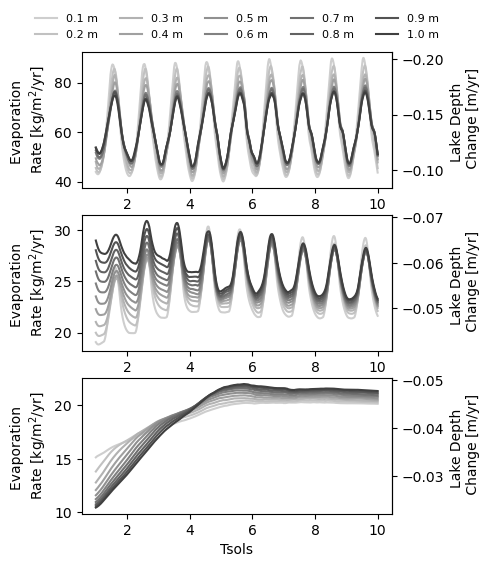
With these simulations we estimated lake-scale evaporation rates and compared these rates with the observed surface changes. In Figure 1, we show the evaporation rate as a function of initial lake depth for three different Titan solar longitudes, that correspond to the beginning, middle, and end of the ephemeral lake. In each plot, the curves represent the average lake evaporation rate over multiple tsols, starting at the end of tsol 1. In the top row of Figure 1, the evaporation rate changes over a diurnal cycle. The simulation of Ls =142 (middle plot in Figure 1) is now further into southern winter, when the amount of insolation has begun to drop [3], and thus the evaporation rate has dropped by roughly half compared to the Ls = 305 evaporation rates. For the Ls = 35 simulations (bottom row of Figure 1), the diurnal cycle is completely gone. Instead, the evaporation of methane from the lake surface reaches a steady, day-long rate that is similar in magnitude to the nighttime evaporation rates seen in Ls = 305 simulations. This is what we expect for surface liquid methane in the polar south during the winter.
Rafkin et al., (2020) [4] have shown that convectively driven storms can form in the southern polar regions and can deposit up to 0.3 meters equivalent of methane rain over regions spanning 200 km. With pooling, it is possible to get ephemeral lake depths of a meter or greater. Thus, the delivery of methane rain and the range of lake depths that we have studied is consistent with modeling of storms on Titan.
For shallow lake depths, it may be possible for the ephemeral lake to disappear solely due to evaporation. Around 0.14 meters of liquid methane is evaporated per Earth year at the start of the ephemeral lake existence (i.e., 2005 or Ls = 305). Since most of the lake was gone by 2007 (Soderblom, 2024), two years later, an initial lake depth of roughly 0.3 meters could be removed in that time solely through evaporation. These estimates, however, are rather optimistic, since as time moves forward from 2005 to 2007, the evaporation rates over the lakes decreases. Deeper initial lakes, however, would also require infiltration of liquid methane to lower lake levels fast enough to match Cassini observations.
Conclusion:
Mesoscale modeling of the ephemeral lake at Arrakis Planitia demonstrates that evaporation may be able to completely remove the shallowest possible depths for this lake. A deeper lake, however, requires infiltration of methane liquid into the subsurface to explain the observed changes in the lake extent. Regardless, evaporation remains an important mechanism for the ephemeral lake evolution, particularly at the early stages of the lake’s existence, when the evaporation rates were double the rates experienced during polar night.
References:
[1] Turtle, E. P. et al. Cassini imaging of Titan’s high-latitude lakes, clouds, and south-polar surface changes. Geophys. Res. Lett. 36, L02204 (2009).
[2] A Soderblom, J.M., (2024) personal communication.
[3] Lora, J. M.. et al. Insolation in Titan’s troposphere. Icarus 216, 116–119 (2011).
[4] Rafkin, S. C. R. & Soto, A. Air-sea interactions on titan: Lake evaporation, atmospheric circulation, and cloud formation. Icarus 351, 113903 (2020).
How to cite: Soto, A., Soderblom, J., and Steckloff, J.: Potential Evaporation of Ephemeral Lakes on Titan, EPSC-DPS Joint Meeting 2025, Helsinki, Finland, 7–12 Sep 2025, EPSC-DPS2025-1096, https://doi.org/10.5194/epsc-dps2025-1096, 2025.


