OPS5 | Exploration of Titan

OPS5

Exploration of Titan
Co-organized by MITM
Conveners: Audrey Chatain, Thomas Gautier | Co-conveners: Shannon M. MacKenzie, Sandrine Vinatier, Bruno de Batz de Trenquelléon, Nicholas Teanby, Robin Sultana, Nicholas Lombardo
Orals MON-OB2
| Mon, 08 Sep, 09:30–10:30 (EEST)
 
Room Mars (Veranda 1)
Orals MON-OB4
| Mon, 08 Sep, 14:00–16:00 (EEST)
 
Room Mars (Veranda 1)
Orals MON-OB5
| Mon, 08 Sep, 16:30–17:45 (EEST)
 
Room Mars (Veranda 1)
Orals WED-OB6
| Wed, 10 Sep, 16:30–18:30 (EEST)
 
Room Mars (Veranda 1)
Posters MON-POS
| Attendance Mon, 08 Sep, 18:00–19:30 (EEST) | Display Mon, 08 Sep, 08:30–19:30
 
Lämpiö foyer, L37–58
Mon, 09:30
Mon, 14:00
Mon, 16:30
Wed, 16:30
Mon, 18:00
Saturn's moon Titan, despite its satellite status, has nothing to envy the planets: it has planetary dimensions, a substantial and dynamic atmosphere, a carbon cycle, a variety of geological features (dunes, lakes, rivers, mountains and more), seasons, and a hidden ocean. It even now has its own mission: Dragonfly, selected by NASA in the frame of the New Frontiers program. In this session, scientific presentations are solicited to cover all aspects of current research on Titan: from its interior to its upper atmosphere, using data collected from the Cassini-Huygens mission (2004-2017) and/or from telescopes (e.g., ALMA, JWST) and/or based on modelling and experimental efforts to support the interpretation of past and future observations of this unique world.

Session assets

Orals MON-OB2: Mon, 8 Sep, 09:30–10:30 | Room Mars (Veranda 1)

Chairpersons: Thomas Gautier, Audrey Chatain
Clouds and methane cycle
09:30–09:42
|
EPSC-DPS2025-1312
|
ECP
|
On-site presentation
Bruno de Batz de Trenquelléon, Pascal Rannou, Sandrine Vinatier, and Sébastien Lebonnois

Introduction:

Titan's atmosphere features intricate chemical and meteorological dynamics, particularly the seasonal development of polar stratospheric clouds, which were extensively studied by the Cassini mission. These clouds were initially observed during the northern winter, completely covering the North Polar Region between 2004 and 2012 [1]. As Titan transitioned into northern spring, the northern cloud dissipated, and a similar cloud emerged over the South Pole from 2012 until the mission concluded in 2017 [2, 3, 4].

Spectroscopic analyses have revealed that these clouds are composed of various ices, including hydrocarbons such as C6H6, as well as nitriles like HCN [5, 2, 6].

Nevertheless, the full seasonal behavior of these polar clouds and the relationship between their northern and southern occurrences remain poorly understood. Key questions persist: What processes lead to their formation? How do their structure and composition evolve? Are the northern and southern clouds manifestations of a single overarching system? Is there an asymmetry between them? And what becomes of the condensed chemical species?

Results & Discussion:

To address these questions, we employ a microphysical cloud model that simulates key processes—nucleation, condensation, and sublimation—for six primary species involved in Titan’s cloud dynamics: CH4, C2H2, C2H6, C6H6, HCN, and HC3N. This model is integrated with the Titan Planetary Climate Model (Titan PCM) [7, 8], which provides atmospheric constraints and simulates three-dimensional transport and mixing.

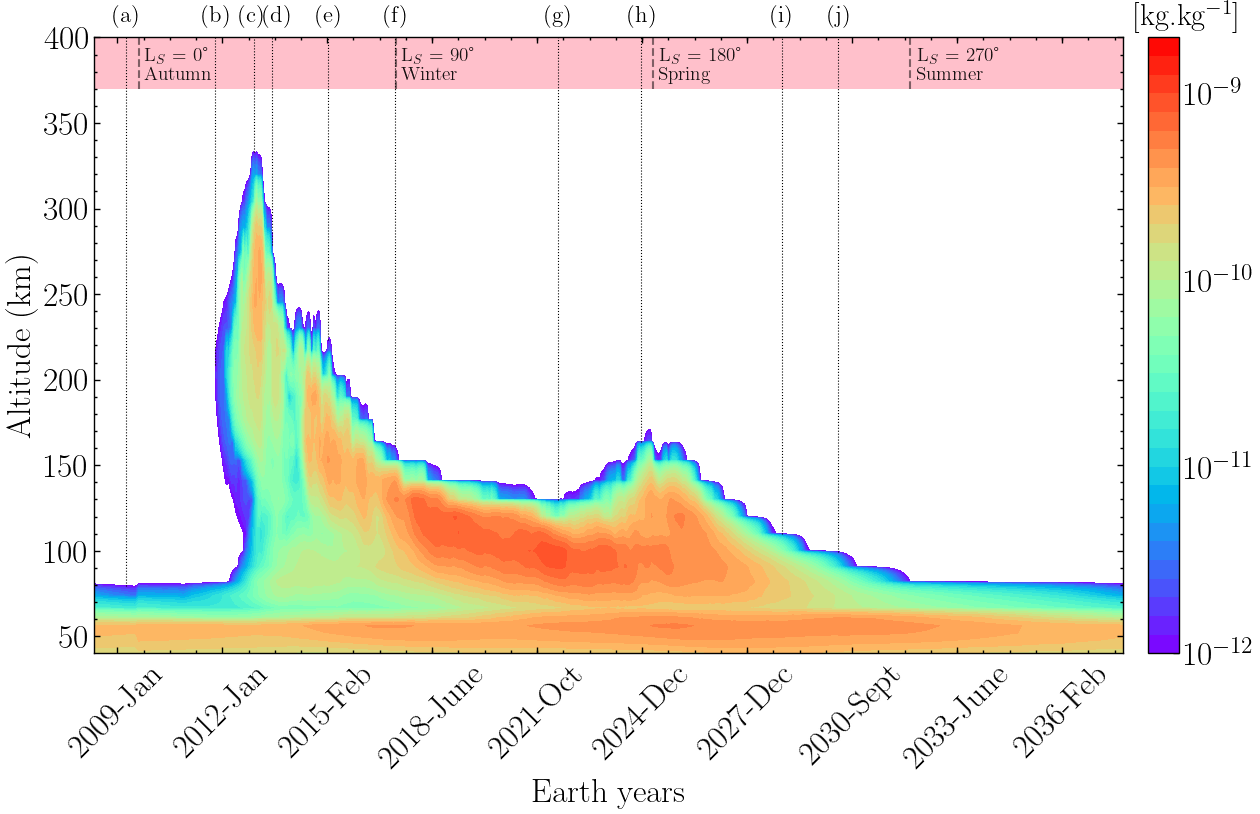
Our simulations indicate that Titan's polar clouds begin forming in early autumn at altitudes around 330 km, confined within the polar vortex, triggered by pronounced stratospheric cooling and a buildup of trace gases driven by the planet's general circulation (Figure 1). During autumn and winter, the clouds undergo significant evolution in altitude, extent, and composition. Enhanced atmospheric subsidence during late autumn causes the cloud layer to descend to below 160 km and spread horizontally to about 59° latitude. By late winter, the cloud reaches a final development phase before fully dissipating roughly four years after the spring equinox, driven by warming in the stratosphere and depletion of condensable species in the polar region.

Figure 1. Vertical evolution of the mass mixing ratio of ices at Titan’s South Pole (> 60°S) in the Titan PCM. Vertical lines correspond to key phases in the polar cloud’s evolution.

While these clouds facilitate the formation of ices in Titan’s lower atmosphere, their surface precipitation rates remain minimal compared to that of methane. Due to their high-altitude origin, most of the cloud particles re-evaporate before reaching the surface.

We will present Titan’s polar cloud cycle, the observed variations in altitude and composition between early autumn and late winter, as well as the connection between the clouds observed in the northern and southern hemispheres.

References: [1] Le Mouélic et al (2012) Planet. Space Sci., 60, 1. [2] de Kok et al (2014) Nature, 514, 7520. [3] West et al (2016) Icarus, 270. [4] Le Mouélic et al (2018) Icarus, 311. [5] Griffith et al (2006) Science, 313, 5793. [6] Vinatier et al (2018) Icarus, 310. [7] de Batz de Trenquelléon et al (2025a) Planet. Sci. J., 6, 4. [8] de Batz de Trenquelléon et al (2025b) Planet. Sci. J., 6, 4.


How to cite: de Batz de Trenquelléon, B., Rannou, P., Vinatier, S., and Lebonnois, S.: Complex Seasonal Cycle of Titan's Polar Clouds, EPSC-DPS Joint Meeting 2025, Helsinki, Finland, 7–13 Sep 2025, EPSC-DPS2025-1312, https://doi.org/10.5194/epsc-dps2025-1312, 2025.

09:42–09:54
|
EPSC-DPS2025-279
|
ECP
|
On-site presentation
Antoine Damiens and Panayotis Lavvas

Titan's atmosphere is mainly composed of nitrogen and methane. The solar flux triggers complex photochemical reactions that produce organic compounds, leading to the formation of photochemical aerosols. Further down in the atmosphere, temperatures drop sufficiently to allow the photochemical species to condense on the surface of the aerosols and form clouds. Titan is subject to strong seasonal variations due to its inclination, resulting in a global circulation that generates dynamics from the deep stratosphere to the mesosphere [1].

Many studies based on Cassini observations show the spatial and temporal evolution of cloud formation on Titan as a consequence of seasonal variations [2,3]. Data from the Visible and infrared mapping spectrometer (VIMS) on board Cassini, were used to study the seasonal changes that occur between the two poles. The polar cloud observed in the north during winter gradually disappears, only to reappear in the south during spring in the north [4]. The location at which species condense depends on their abundance and the temperature profile. For different times and locations, changes in the temperature and the transport of photochemical species by the meridional circulation allow some species to condense at different altitudes. The formation of HCN and C6H6 clouds has been observed between 250 and 300 km at the South Pole after the equinox [5,6,7], when a high concentration of gaseous species is observed, which may explain the cooling required to form clouds at these altitudes. Hanson et al. 2023 [8] demonstrated through a 1D simulation the formation of HCN clouds near 300 km and descends to the lower stratosphere followed by precipitation to the surface. Batz de Trenquelléon et al. 2025 [9] obtained results on the formation of winter polar clouds from 60 to 300 km after enrichment with trace compounds using the Titan Planetary Climate Model (3D model).

Here we advance further on the details of the interplay between gases, haze and clouds, by investigating the condensation of all major gases in Titan’s atmosphere. We use a 1D numerical model previously applied to Titan and Pluto [10,11], which combines radiative transfer, photochemistry, microphysical evolution of haze and clouds, condensation and nucleation. The model also takes into account atmospheric mixing, molecular diffusion, particle sedimentation and diffusion. Primary particles form in the upper atmosphere and then coagulate to form aggregates. The growth mode of settling haze particles is controlled by the fractal dimension of the aerosol. Cloud particle formation is initiated by heterogeneous nucleation of gas on a haze particle under supersaturated conditions. We introduce 23 gaseous species into cloud formation. The rates of condensation and evaporation are given by the mass flux of condensing species into and out of the particle surface.

We first demonstrate the validity of the model used at the equator, where more observational constraints for hazes and clouds are available for gas abundances and optical properties. We will then present the results of the simulation at the South Pole, during the post-equinox period, where we compare the evolution of the condensation of gaseous species and the haze and cloud profiles with equatorial conditions. To account for the photochemical and haze particle enrichment occurring  at the South Pole post-equinox, we incorporate a circulation contribution, derived from observations, into our model. This addition contributes significantly to the observed mass of chemical species and haze particles involved in cloud formation. We further validate the model using the Composite Infrared Spectrometer (CIRS) observations of gas abundance and haze abundance & extinction.


[1] de Batz de Trenquelléon, B., Rosset, L., Vatant d’Ollone, J., et al. The New Titan Planetary Climate Model. I. Seasonal Variations of the Thermal Structure and Circulation in the Stratosphere, PSJ, 6, 78 (2025). https://doi.org10.3847/PSJ/adbbe7

[2] R.A. West, A.D. Del Genio, J.M. Barbara, D. Toledo, P. Lavvas, P. Rannou, E.P. Turtle, J. Perry, Cassini Imaging Science Subsystem observations of Titan’s south polar cloud, Icarus, Volume 270, 2016, Pages 399-408, ISSN 0019-1035, https://doi.org/10.1016/j.icarus.2014.11.038.

[3] S. Vinatier, B. Schmitt, B. Bézard, P. Rannou, C. Dauphin, R. de Kok, D.E. Jennings, F.M. Flasar, Study of Titan’s fall southern stratospheric polar cloud composition with Cassini/CIRS: Detection of benzene ice, Icarus, Volume 310, 2018, Pages 89-104, ISSN 0019-1035, https://doi.org/10.1016/j.icarus.2017.12.040.

[4] S. Le Mouélic et al. Mapping polar atmospheric features on Titan with VIMS: From the dissipation of the northern cloud to the onset of a southern polar vortex, Icarus, Volume 311, 2018, Pages 371-383, https://doi.org/10.1016/j.icarus.2018.04.028.

[5] Teanby, N. A., Sylvestre, M., Sharkey, J., Nixon, C. A., Vinatier, S., & Irwin, P. G. J. (2019). Seasonal evolution of Titan's stratosphere during the Cassini mission. Geophysical Research Letters, 46, 3079–3089. https://doi.org/10.1029/2018GL081401

[6] de Kok, R., Teanby, N., Maltagliati, L. et al. HCN ice in Titan’s high-altitude southern polar cloud.Nature 514, 65 - 67 (2014). https://doi.org/10.1038/nature13789

[7] Vinatier, S. et al. Seasonal variations in Titan’s middle atmosphere during the northern spring derived from Cassini/CIRS observation. Icarus, Volume 250 (2015), Pages 95-115, https://doi.org/10.1016/j.icarus.2014.11.019.

[8] Hanson, L. E., Waugh, D., Barth, E., & Anderson, C. M. Investigation of Titan’s South Polar HCN Cloud during Southern Fall Using Microphysical Modeling, PSJ, 4, 237 (2023). https://doi.org//10.3847/PSJ/ad0837

[9] Bruno de Batz de Trenquelléon et al. The new Titan Planetary Climate Model. II. Titan’s Haze and cloud cycles. Planet. Sci. J. 6 79 (2025). https://doi.org/10.3847/PSJ/adbb6c

[10] P. Lavvas, C.A. Griffith, R.V. Yelle, Condensation in Titan’s atmosphere at the Huygens landingsite,Icarus,Volume215,Issue2,2011,Pages732-750. https://doi.org/10.1016/j.icarus.2011.06.040.

[11] Lavvas, P., Lellouch, E., Strobel, D.F. et al. A major ice component in Pluto’s haze. Nat Astron 5,289–297 (2021). https://doi.org/10.1038/s41550-020-01270-3

How to cite: Damiens, A. and Lavvas, P.: Simulation of the interplay between haze and clouds at equatorial and polar conditions of Titan's atmosphere, EPSC-DPS Joint Meeting 2025, Helsinki, Finland, 7–13 Sep 2025, EPSC-DPS2025-279, https://doi.org/10.5194/epsc-dps2025-279, 2025.

09:54–10:06
|
EPSC-DPS2025-1616
|
ECP
|
Virtual presentation

Enora Moisan, Aymeric Spiga, and Audrey Chatain

Titan is the largest moon of Saturn, with a radius around 2575 km, and it is surrounded by a thick atmosphere composed of nitrogen, methane, and many other organic compounds. The temperature and pressure profiles on Titan enable the condensation of several gases in the atmosphere, including methane, forming clouds. Here we focus on the methane clouds.

Titan has been observed up close during the Cassini mission, between 2004 and 2017. Some of the methane clouds observed then seem convective (see Figure 1 for an example). We want to reproduce these clouds in a numerical model, to try to answer some of these questions:

  • what are the conditions that enable convective methane clouds on Titan? (temperature, methane concentration, global scale influence, topography, ...)
  • do we form shallow convection? deep convection?
  • how does convection organize itself on Titan?
  • what is the size of the cloud particles?
  • how do the scales of the convective systems on Titan and on Earth relate?

Figure 1 : Tropospheric methane clouds over the south pole of Titan, July 2004 (Cassini/ISS, infrared filters). The cloud diameter is around 500 km.

To tackle these questions, we need a mesoscale model of Titan's atmosphere, i.e. a local model (approximately above a 100 km zone). The current Titan mesoscale model used at LMD couples the physics of the Titan-PCM model (Trenquelléon et al. 2025a) with the dynamics of the WRF model (a weather forecasting model also used for Earth previsions), see for instance Lefevre, Bonnefoy, and Spiga 2024. In our study, we include the new microphysics modules (i.e. the aerosols and clouds modules, described in Trenquelléon et al. 2025b) and use the last version of WRF (WRF-V4). The microphysics schemes we use enable to study the formation of cloud particles, and their size distribution. We use a horizontal resolution of a few kilometers: this enables us to resolve the clouds, i.e. to consider each grid cell to be either completely a cloud or completely clear, without subcell cloud parameterization. Such a model is called a cloud resolving model. For Titan, several cloud resolving models have been developped (Hueso and Sánchez-Lavega 2006, Barth and Rafkin 2010), based on other dynamical cores and physical schemes.

Our first test cases are a "warm bubble" and a "cold bubble", over a very small domain (40x40 km, the top of the model is 30 km high). Such simulations are useful to check the behavior of the model. We obtain respectivelly a rising and a falling air parcel, with for each case methane condensation (when the air reaches colder atmospheric layers for the warm bubble case, and due to low temperatures in the bubble for the cold bubble case).

Our next steps will be to perform more testing (e.g. abundant methane zone). Then, we will study the different formation mechanisms for clouds (in particular convective clouds): solar heating, topographic clouds, methane accumulation due to the global circulation, lake evaporation, ... We will try to explore the parallels and discrepancies between Earth's water convective clouds and Titan's methane convective clouds.

References
     Barth, Erika L. and Scot C. R. Rafkin (Apr. 1, 2010). “Convective cloud heights as a diagnostic for methane environment on Titan”. In: Icarus. Cassini at Saturn 206.2, pp. 467–484. issn: 0019-1035. doi: 10.1016/j.icarus.2009.01.032. url: https://www.sciencedirect.com/science/article/pii/S0019103509000591
     Hueso, R. and A. Sánchez-Lavega (July 2006). “Methane storms on Saturn’s moon Titan”. In: Nature 442.7101. Number: 7101 Publisher: Nature Publishing Group, pp. 428–431. issn: 1476-4687. doi: 10.1038/nature04933. url: https://www.nature.com/articles/nature04933
     Lefevre, Maxence, Léa Bonnefoy, and Aymeric Spiga (July 3, 2024). Mesoscale Modelling of Titan’s Shangri-La region. doi: 10.5194/epsc2024-408. url: https://meetingorganizer.copernicus.org/EPSC2024/EPSC2024-408.html
     Trenquelléon, Bruno de Batz de et al. (Mar. 31, 2025a). “The New Titan Planetary Climate Model. I. Seasonal Variations of the Thermal Structure and Circulation in the Stratosphere”. In: The Planetary Science Journal 6.4. Publisher: IOP Publishing, p. 78. issn: 2632-3338. doi: 10.3847/PSJ/adbbe7. url: https://iopscience.iop.org/article/10.3847/PSJ/adbbe7/meta
     Trenquelléon, Bruno de Batz de et al. (Mar. 31, 2025b). “The New Titan Planetary Climate Model. II. Titan’s Haze and Cloud Cycles”. In: The Planetary Science Journal 6.4. Publisher: IOP Publishing, p. 79. issn: 2632-3338. doi: 10.3847/PSJ/adbb6c. url: https://iopscience.iop.org/article/10.3847/PSJ/adbb6c/meta

How to cite: Moisan, E., Spiga, A., and Chatain, A.: Developping a new cloud resolving model for Titan’s methane clouds, EPSC-DPS Joint Meeting 2025, Helsinki, Finland, 7–13 Sep 2025, EPSC-DPS2025-1616, https://doi.org/10.5194/epsc-dps2025-1616, 2025.

10:06–10:18
|
EPSC-DPS2025-40
|
On-site presentation
Erich Karkoschka, Brent Archinal, and Lynn Weller

We analyzed 16,000 Cassini ISS (Imaging Science Subsystem) images of Titan in the 935 nm CB3 filter.  The apparent changes during the 13-years of observations are a complex superposition of atmospheric changes, changes due to geometry, and physical surface changes.  Because atmospheric changes dominate and the signal from the surface is attenuated by the atmosphere by about two orders of magnitude, the signal from the surface in single images is too noisy to allow detection of surface changes, except for the largest ones that have been published.

However, when stacking hundreds or thousands of images, good signal-to-noise ratios can be restored, but the challenge lies in the accuracy of stacking since surface data are influenced by the changing atmosphere.  We tried to account for atmospheric effects that create shifts, smear, and attenuation.

Once we use all 16,000 suitable ISS images for stacking, we find that low-contrast surface changes show a richness of types of changes, yet most of them have the same temporal variability:  features stayed constant from 2004 to 2010 and from 2011 to 2017, but changed significantly between both periods.  Three examples are displayed in Fig. 1.  The data are consistent with a sudden change in September 2010, which corresponds to the time of the strongest storm observed during the Cassini period (https://www.nasa.gov/image-article/titans-arrow-shaped-storm/).  Detected surface changes extend over essentially all longitudes and most latitudes that were observed both before and after 2010.  This suggests that the September 2010 storm may have caused global resurfacing on Titan.

We will archive our image products on the Imaging PDS in 2026.  We plan to archive one set of 16,000 images that shows each original  ISS image in about six versions and projections.  We also plan to archive on the order of 100 global mosaics for different time periods so that the timing of detected surface changes can be constrained.

This work was supported by NASA grant 80NSSC21K0866.


Fig. 1: The evolution of three selected areas as seen by ISS from 2004 to 2017, centered on 280W 28N (left), 85W 34N (center), and 278W 19S (right), each 1500 km wide.  The color panel at the top shows average images 2004-2010 in blue and 2011-2017 in orange.  Blue and orange areas indicate decreasing and increasing albedo, respectively.  The left panel shows a very dark area with a dark streak toward the northeast until 2010 and toward the north afterwards.  Apparent variations within both time periods may be due to variation in data quality.  The center panel shows the appearance of a bright streak after 2010 that varied and moved.  The right panel shows a region with many changed features between both time periods.  Also, the 2004 image appears to be significantly different from the images 2005-2010.  Note that imperfect calibration can change brightness and contrast, but not the shape of features.

How to cite: Karkoschka, E., Archinal, B., and Weller, L.: Archiving Titan's surface changes: the global change in 2010, EPSC-DPS Joint Meeting 2025, Helsinki, Finland, 7–13 Sep 2025, EPSC-DPS2025-40, https://doi.org/10.5194/epsc-dps2025-40, 2025.

10:18–10:30
|
EPSC-DPS2025-1087
|
ECP
|
On-site presentation
Sooman Han and Juan Lora

Understanding Titan’s Planetary Boundary Layer (PBL)—the lowest part of the atmosphere directly influenced by surface conditions—remains challenging due to Titan’s dense atmosphere and limited direct observations. Previous modeling efforts have produced a wide range of estimates for surface temperature and PBL behavior, particularly regarding diurnal variations, but have not clearly examined how subsurface parameters—specifically thermal conductivity, volumetric heat capacity, and their combined effect as thermal inertia—influence these outcomes. In this study, we revisit this issue using the Titan Atmospheric Model (TAM), a General Circulation Model (GCM) specifically developed for Titan (Lora et al. 2015; Lora 2024). Alongside, we present a theoretical framework that links the surface temperature variations to surface energy balance, providing a physically grounded interpretation of the simulation results.

First, we present simulation results under a dry setup to allow direct comparison with previous studies. Our theoretical framework explains the weak sensitivity of seasonal surface temperature structure to local thermal inertia, as reported by MacKenzie et al. (2019), who applied a global thermal inertia map to a GCM. This insensitivity arises from the minimal role of subsurface heat conduction in modulating surface temperature over Titan’s long annual cycle, where atmospheric damping is the dominant control. In contrast, at diurnal timescales, subsurface heat conduction plays a more significant role than atmospheric damping. As a result, diurnal surface temperature variations become sensitive to local thermal inertia, reaching magnitudes on the order of  O(10-1) [K] near the equator during midsummer. Specifically, high thermal inertia surfaces (Hummocky terrain: 1,962 [TIU]; TIU is Thermal Inertia Unit [J•m-2•s-0.5•K-1]) exhibit variations of approximately 0.1 [K], while low thermal inertia surfaces (Dunes: 246 [TIU]) show variations of up to 0.4 [K]. These thermal differences influence PBL structures as well: larger temperature amplitudes lead to higher daytime maximum surface temperatures, which in turn result in deeper adiabatic layers, increasing the PBL depth by several hundred meters to over 1,000 meters. These findings support the interpretation of the Huygens data as capturing the diurnal evolution of the PBL during the local morning (Charnay and Lebonnois, 2012).

Furthermore, we investigate the role of Titan’s methane cycle in shaping PBL structure. Our simulations show that including the methane cycle reduces the equator-to-pole temperature gradient, improving agreement with observational constraints and highlighting the importance of latent heat, consistent with previous studies (e.g., Mitchell et al., 2009; Lora and Adamkovics, 2017). The simulations also produce a nearly constant methane mole fraction up to 5 km near the equator throughout the year, corresponding to the model’s simulated lifting condensation level. This result aligns with the Huygens probe observations of a constant methane humidity layer up to 5 km (Niemann et al., 2005; 2010). These findings underscore the importance of incorporating Titan’s methane cycle for realistic simulations of surface temperature and PBL dynamics. 

References:

Charnay, B., & Lebonnois, S. (2012). Two boundary layers in Titan’s lower troposphere inferred from a climate model. Nature Geosci., 5 , 106–109.

Lora, J. M., Lunine, J. I., & Russell, J. L. (2015). GCM simulations of Titan’s middle and lower atmosphere and comparison to observations. Icarus, 250 , 516–528

Lora, J. M., & Adamkovics, M. (2017). The near-surface methane humidity on Titan. Icarus, 286 , 270–279.

Lora, J. M. (2024). Moisture transport and the methane cycle of Titan’s lower atmosphere. Icarus, 422 , 116241. 

MacKenzie, S. M., Lora, J. M., & Lorenz, R. D. (2019). A thermal inertia map of Titan. J. Geophys. Res. Planets, 124 , 1728–1742.

Mitchell, J. L., Pierrehumbert, R. T., Frierson, D. M. W. & Caballero, R. (2009). The impact of methane thermodynamics on seasonal convection and circulation in a model Titan atmosphere. Icarus, 203, 250-264.

Niemann, H. B. et al. (2005). The abundances of constituents of Titan's atmosphere from the GCMS instrument on the Huygens probe. Nature, 438, 779-784.

Niemann, H. B. et al. (2010). Composition of Titan's lower atmosphere and simple surface volatiles as measured by the Cassini-Huygens probe gas chromatograph mass spectrometer experiment. J. Geophys. Res., 115, E12006.

How to cite: Han, S. and Lora, J.: Diurnal and Seasonal Variations of Titan’s Surface Temperature and Planetary Boundary Layer Structure Simulated with Dry and Moist GCMs, EPSC-DPS Joint Meeting 2025, Helsinki, Finland, 7–13 Sep 2025, EPSC-DPS2025-1087, https://doi.org/10.5194/epsc-dps2025-1087, 2025.

Orals MON-OB4: Mon, 8 Sep, 14:00–16:00 | Room Mars (Veranda 1)

Chairpersons: Sandrine Vinatier, Nicholas Lombardo
Lakes
14:00–14:12
|
EPSC-DPS2025-1096
|
Virtual presentation
Alejandro Soto, Jason Soderblom, and Jordan Steckloff

Introduction: 

The Cassini mission has observed surface changes that may represent the formation and dissipation of ephemeral lakes, i.e., transient lakes that dry-up on a geologically short timescale. As with ephemeral lakes on Earth, Titan’s ephemeral lakes result from the interaction of a generally arid climate with the variability of annual weather. Understanding the physics of ephemeral lakes will provide insight into the local, arid hydrological (methanological) cycle on Titan.

We have limited observations of the formation and dissipation of ephemeral lakes on Titan. Our best evidence is for two events: astorm and related ponding of liquid methane on the equator and the formation of a lake in the Arrakis Planitia region. Here we focus on the ephemeral lake in Arrakis Planitia, with particular interest in the mechanisms for the removal of the lake.

Arrakis Planitia Observations:

The formation of an ephemeral lake at Arrakis Planitia began in 2004.  From 2004 to 2005, the Imaging Science Subsystem on the Cassini Mission along with a handful of ground-based telescopes observed both extensive cloud activity and darkening of the surface in the Arrakis Planitia region of Titan. Turtle et al. (2009) [1] identified darkening in Arrakis Planitia likely due to liquid methane rain produced by the storm seen in late 2004. The surface was observed to still be dark ∼9 months after the cloud activity [1,2], thus the presumed surface liquid remained at this time. By January 2007 (27 months after the cloud activity), the previously darkened region had brightened [2] however, there were at least some pockets of liquid standing on the surface in May 2007 (31 months after the cloud activity) as evidenced by specular reflections of sunlight observed by VIMS [2]. The darkening observed in Arrakis Planitia is in one region and corresponds with topography observed by the Cassini Synthetic Aperture Radar (SAR). The observations suggest that at least a few decimeters of liquid had pooled in this area.

Investigating the Evaporative Loss of the Ephemeral Lake:

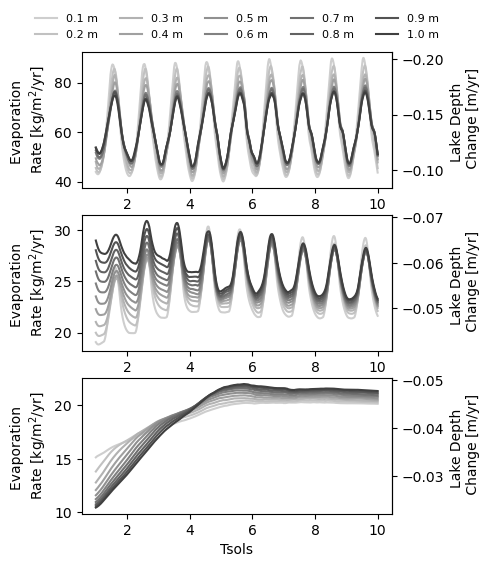
We created a map of Arrakis Planitia as the surface boundary condition for our simulations, which were conducted using the Mesoscale Titan WRF (mtWRF) model. We then integrated new estimates of the volume and longevity of the Arrakis Planitia ephemeral pond into mtWRF, and we simulated several ephemeral lake scenarios for Arrakis Planitia. The simulations were run for 10 tsols  (i.e., Titan days), to allow the environment to reach a quasi-steady state.

With these simulations we estimated lake-scale evaporation rates and compared these rates with the observed surface changes. In Figure 1, we show the evaporation rate as a function of initial lake depth for three different Titan solar longitudes, that correspond to the beginning, middle, and end of the ephemeral lake. In each plot, the curves represent the average lake evaporation rate over multiple tsols, starting at the end of tsol 1. In the top row of Figure 1, the evaporation rate changes over a diurnal cycle. The simulation of Ls =142 (middle plot in Figure 1) is now further into southern winter, when the amount of insolation has begun to drop [3], and thus the evaporation rate has dropped by roughly half compared to the Ls = 305 evaporation rates. For the Ls = 35 simulations (bottom row of Figure 1), the diurnal cycle is completely gone. Instead, the evaporation of methane from the lake surface reaches a steady, day-long rate that is similar in magnitude to the nighttime evaporation rates seen in Ls = 305 simulations. This is what we expect for surface liquid methane in the polar south during the winter.

Rafkin et al., (2020) [4] have shown that convectively driven storms can form in the southern polar regions and can deposit up to 0.3 meters equivalent of methane rain over regions spanning 200 km. With pooling, it is possible to get ephemeral lake depths of a meter or greater. Thus, the delivery of methane rain and the range of lake depths that we have studied is consistent with modeling of storms on Titan.

For shallow lake depths, it may be possible for the ephemeral lake to disappear solely due to evaporation. Around 0.14 meters of liquid methane is evaporated per Earth year at the start of the ephemeral lake existence (i.e., 2005 or Ls = 305). Since most of the lake was gone by 2007 (Soderblom, 2024), two years later, an initial lake depth of roughly 0.3 meters could be removed in that time solely through evaporation. These estimates, however, are rather optimistic, since as time moves forward from 2005 to 2007, the evaporation rates over the lakes decreases. Deeper initial lakes, however, would also require infiltration of liquid methane to lower lake levels fast enough to match Cassini observations.

Conclusion:

Mesoscale modeling of the ephemeral lake at Arrakis Planitia demonstrates that evaporation may be able to completely remove the shallowest possible depths for this lake. A deeper lake, however, requires infiltration of methane liquid into the subsurface to explain the observed changes in the lake extent. Regardless, evaporation remains an important mechanism for the ephemeral lake evolution, particularly at the early stages of the lake’s existence, when the evaporation rates were double the rates experienced during polar night.

References:

[1] Turtle, E. P. et al. Cassini imaging of Titan’s high-latitude lakes, clouds, and south-polar surface changes. Geophys. Res. Lett. 36, L02204 (2009).

[2] A Soderblom, J.M., (2024) personal communication.

[3] Lora, J. M.. et al. Insolation in Titan’s troposphere. Icarus 216, 116–119 (2011).

[4] Rafkin, S. C. R. & Soto, A. Air-sea interactions on titan: Lake evaporation, atmospheric circulation, and cloud formation. Icarus 351, 113903 (2020).

How to cite: Soto, A., Soderblom, J., and Steckloff, J.: Potential Evaporation of Ephemeral Lakes on Titan, EPSC-DPS Joint Meeting 2025, Helsinki, Finland, 7–13 Sep 2025, EPSC-DPS2025-1096, https://doi.org/10.5194/epsc-dps2025-1096, 2025.

14:12–14:24
|
EPSC-DPS2025-1891
|
ECP
|
On-site presentation
Letizia Gambacorta, Marco Mastrogiuseppe, Maria Carmela Raguso, Valerio Poggiali, Daniel Cordier, and Kendra K. Farnsworth

1. Introduction
Cassini’s RADAR altimetry data enabled the investigation of suspended particles and nitrogen gas bubbles in Titan’s hydrocarbon lakes and seas. These bodies, composed primarily of methane and ethane with dissolved nitrogen, may contain inclusions such as water ice, organic particles (e.g., tholins, nitriles), and nitrogen gas. Solid particles can originate from atmospheric haze, fluvial erosion, or precipitation, and may accumulate through sedimentation or surface runoff. Nitrogen bubbles are thought to form via supersaturation processes, triggered by temperature changes or increased ethane concentration during rainfall, leading to nitrogen exsolution and bubble formation near the seabed [1-3].
We present a methodology to constrain the size and density of both solid and gaseous inclusions using Cassini RADAR altimetric returns. A physical model based on Mie scattering and radiative transfer theory, compares modeled and observed surface-to-volume power ratios (SVR) to assess the inclusion detectability in Titan's liquid environments [4].

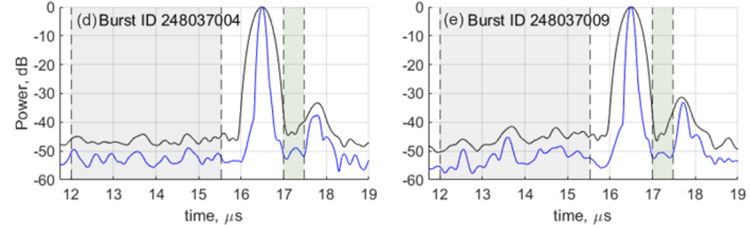
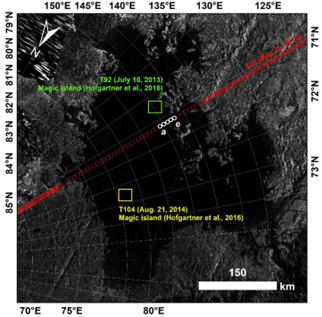
Figure 1. Selected bursts from T91 altimetric observation acquired by the Cassini RADAR.

2. Dataset, modelling and assumptions
We analyze altimetric data from the Cassini RADAR acquired at Ku-band (13.78 GHz, λ = 2.17 cm) acquired during fly-by T91 (Fig. 1). The data were processed using the Cassini Processing of Altimetric Data (CPAD), including incoherent averaging and range compression [5]. To enhance the nominal 35-m resolution, we applied super-resolution (SR) method based via Burg algorithm [6,7], improving surface/subsurface peak separation.
Nadir-looking radar observations in altimetry mode allow for the analysis of suspended inclusions in a homogeneous liquid medium. The received waveform enables surface, subsurface, and volume-scattered power measurement from which constrain inclusion size and density. With the objective of obtaining an expression for the Surface-to-Volume scattering power Ratio (𝑆𝑉𝑅), we model a liquid column containing uniformly distributed spherical particles and evaluate the volume backscattered power based on radiative equilibrium. Reflected and transmitted powers are defined using the surface Fresnel coefficient, dependent on the host dielectric constant, and a two-way transmissivity term. The total volume backscattering cross section includes both this transmissivity and the individual particle backscatter cross sections. Signal attenuation from particle scattering and absorption—mainly influenced by size and loss tangent—is also considered. The model assumes identical dielectric properties, no polarization or multiple scattering effects, and neglects shadowing, valid for particles smaller than the radar wavelength. The final expression, obtained for the case of a beam limited configuration, is

where 𝑃𝑆 and 𝑃𝑉 are the power reflected by the surface interface and through the volume respectively, 𝜎𝑜𝑉 and 𝑘𝑒 are the volume backscattering and extinction coefficients , 𝜃3,𝑑𝐵2 is the antenna beamwith at -3 dB, 𝑧1 and 𝑧2 are the integration depths [4].

Figure 2. Two of the selected altimetric observations acquired during fly-by T91 over Ligeia Mare, before and after super-resolution processing, in black and blue respectively. The area highlighted in green refers to the integrated waveform, while the gray one to the integrated noise.

3. Methodology and SVR Measurement
SVR was measured using T91 data over Ligeia Mare, where a consistent seabed echo was detected at approximately 160 m depth [5]. To improve seabed detectability, windowing has applied to the waveform, leading to degradation of the range resolution and limiting the available integration window. This required the application of super-resolution techniques to widen the final integration window between the surface and the subsurface, as shown in Fig.2.
The presence of volume scattering has then been evaluated by comparing the measured SVR with the integrated Signal-to-Noise Ratio (SNR𝑖𝑛𝑡). The measured volume power resulted falling between the integrated noise level across all observations, with lesser variation than 2-𝜎, indicating no clear evidence of volume scattering. Therefore, measured SVR served as an upper limit, constraining the possible size and density of inclusions. This upper bound defines a solution space where, for a given density, a maximum particle size is established—and vice versa—based on the modeled relationship between volume scattering and inclusion properties.

4. Results
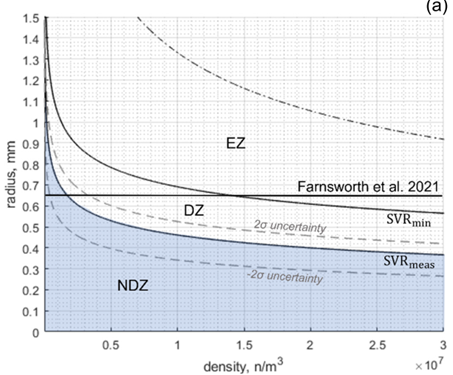
Assumed a host medium composed of a liquid mixture of nitrogen-methane-ethane, with dielectric properties defined by a relative permittivity ε′ₕ = 1.72 and loss tangent tgδ = 3.5×10⁻⁵. Our analysis includes both suspended particles and nitrogen gas bubbles as potential inclusions. In Fig. 3, the measured SVR value of 45.92 dB delineates the boundary between two regimes: Non-Detection (ND) zone, where no volume scattering is observed, the Detection Zone (DZ), where scattering would be detectable by the radar, and an Extinction Zone (EZ), where excessive scattering or absorption would fully attenuate the signal, is also shown. By incorporating particle radius estimates from previous literature, the EZ allows us to define the maximum volume fraction at which inclusions become undetectable due to attenuation. Conversely, the DZ indicates the specific volume density required to match the measured SVR.

Figure 3. The figure shows the SVR derived from T91 Cassini RADAR data, modeled using a methane/ethane/nitrogen liquid host with nitrogen gas bubbles. The blue area represents combinations of particle size and density consistent with the absence of volume scattering. Horizontal lines indicate particle sizes from previous studies, while the black solid lines mark the measured SVR, setting upper limits on bubble density for a given size—or maximum size at varying densities.

For nitrogen-gas bubbles with radius of 0.65 mm from laboratory data, the maximum undetectable volume fraction was estimated at 0.19% [2]. For solid inclusions, the study found that particles smaller than approximately 0.34 mm (water ice), 0.5 mm (nitriles), and 0.84 mm (tholins) remain undetectable without causing extinction of the radar signal. Considering a realistic particle size range of 0.025–1.25 mm, the maximum detectable volume fractions were calculated to be 0.02%–3.49% for water ice, 0.03%–1.43% for nitriles, and 0.16%–1.52% for tholins. These results offer constraints on inclusions properties and inform detectability limits of radar systems, guiding future missions planning to Titan or similar icy moons [4].

References

[1] Barnes et al. 2011

[2] Farnsworth et al., 2019

[3] Cordier and Liger-Belair, 2018

[4] Gambacorta et al., 2024

[5] Mastrogiuseppe et al., 2014

[6] Raguso et al., 2024

[7] Gambacorta et al., 2022

How to cite: Gambacorta, L., Mastrogiuseppe, M., Carmela Raguso, M., Poggiali, V., Cordier, D., and Farnsworth, K. K.: Titan lakes and seas: estimation of nitrogen and solid particleS content via Cassini RADAR data, EPSC-DPS Joint Meeting 2025, Helsinki, Finland, 7–13 Sep 2025, EPSC-DPS2025-1891, https://doi.org/10.5194/epsc-dps2025-1891, 2025.

14:24–14:36
|
EPSC-DPS2025-1178
|
ECP
|
On-site presentation
Cece Thieberger, Jennifer Hanley, Anna Engle, Sugata Tan, Will Grundy, Gerrick Lindberg, Jordan Steckloff, and Stephen Tegler

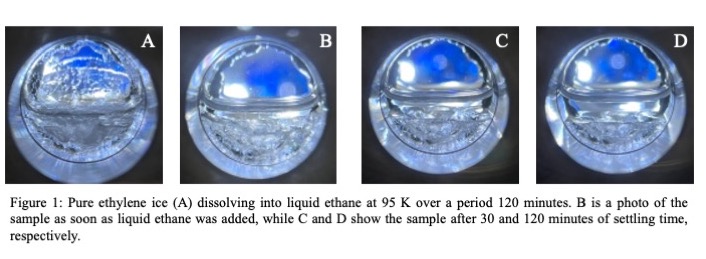
Titan is the only extraterrestrial environment known to support bodies of standing liquid on its surface. The Cassini mission provided important composition measurements of a few lakes and seas, which suggest they may contain anywhere from 5 - 80 % methane and 8 - 79 % ethane mixtures, in addition to dissolved nitrogen from the atmosphere. Cassini also measured trace amounts of higher-order hydrocarbons, such as propane, ethylene, and acetylene, in Titan’s atmosphere. When these trace species rain down onto the surface and mix with the lakes and seas, they create unique chemical conditions and alter the phase behavior, solubility, and stability of Titan’s surface liquids. In an effort to study these environments, we present our experimental work done in the Astrophysical Materials Lab at Northern Arizona University (NAU). We studied two different trace species, ethylene and acetylene, in methane-ethane mixtures under a nitrogen atmosphere of 1.5 bar to replicate Titan lakes. Specifically, we incorporated 1-10% additions of either ethylene or acetylene to the methane-ethane-nitrogen system and performed cooling and warming cycles of our sample between 70 - 100 K. Through a combination of visual inspection and Raman spectroscopy, we found that these mixtures undergo phase changes at different temperatures than their individual end members. The observed phase changes under these conditions have exciting implications for Titan’s lakes and seas, including compositional stratification of surface liquids, bubbles, and ice formation. We also measured the solubilities of both ethylene and acetylene in pure methane and pure ethane at 95 K. We will present the results of these experiments, in addition to thermodynamic models and how they relate to Titan environments. 

This work was supported by NASA SSW grant 80NSSC21K0168, the John and Maureen Hendricks Foundation, and the Lowell Observatory Slipher Society.


How to cite: Thieberger, C., Hanley, J., Engle, A., Tan, S., Grundy, W., Lindberg, G., Steckloff, J., and Tegler, S.: Laboratory Experiments of Ethylene and Acetylene in Titan Lakes, EPSC-DPS Joint Meeting 2025, Helsinki, Finland, 7–13 Sep 2025, EPSC-DPS2025-1178, https://doi.org/10.5194/epsc-dps2025-1178, 2025.

Atmospheric chemistry
14:36–14:48
|
EPSC-DPS2025-338
|
On-site presentation
H. Todd smith, Robert Robert, and Johnson

The Saturnian system provides an example of a complex environment that includes a gas giant, numerous satellites and rings encompasses by a large magnetosphere. During its 13-year mission at Saturn from 2004-2017, the NASA provided numerous transformative observations and accumulated so much data that discoveries are still occurring from further analysis. These results have painted an unexpected picture of the Saturnian system as a very complex and dynamic system.

Perhaps one of the most intriguing results was that the large moon, Titan appeared to be having a much smaller impact on the Saturnian system despite it being extremely large (the 2nd largest in the solar system and large than the planet Mercury) with an unprotected atmosphere that is denser than the Earth’s. Cassini observations revealed that Saturn’s magnetosphere material is dominated by cryogenic plumes from the much smaller icy moon Enceladus. Although the Enceladus plumes are somewhat variable, on average, this moon provides ~285 kg/s of water vapor to Saturn’s magnetosphere (Smith et al. 2021) while Titan’s atmosphere likely only provides <40 kg/s of N2 & CH4 (Johnson et al. 2009).

Thus, the magnetosphere is dominated by water gas from Enceladus rather than nitrogen and hydrocarbons from Titan’s atmosphere. These particles are ejected into the magnetosphere as neutral charged atoms & molecules but unfortunately, such particles are generally much more difficult to detect (with the exception of certain species with specific spectral qualities. Fortunately, charged particles are generally much easier to detect at lower densities. Thus, charged particle observations of ion produced by ionizations of the source neutral particles are used as a proxy for the observing neutral particles. Throughout most of Saturn’s magnetosphere, water-group ions (H3O+, H2O+, OH+ & O+, also referred to as “W+” collectively) originating from the Enceladus plumes’ water vapor generally account for up to 90% of all ions (Thomsen et al. 2010) with hydrogen accounting for the next largest population followed by nitrogen ions presumably from Titan and Enceladus (Smith et al. 2007). Carbon ions exist as a very minor species Saturn’s magnetosphere with global relative abundances remaining pretty steady at ~1% relative to W+. These ions likely originate from the Enceladus plumes as well as hydrocarbons from Titan’s atmosphere. This, abundances and locations of minor/trace species in Saturn’s magnetosphere provide significant insight into source composition and activity.

Tidal forces cause Enceladus plume source rate to vary on the its orbital timescale which is much shorter than particle interactions rates. Thus, the amount of global magnetospheric neutral water particles remains relatively stable over time as shown using UV observations of total oxygen content (Melin et al. 2009). This allows for a stable comparison to examine the spatial and temporal distribution of minor/trace species to provide unique insight into composition and activity of sources of these particles. More specifically, we examine the relative abundances of significant trace species to water-group particles to explore unusual magnetospheric activity. The observations were collected by the CHarge Energy Mass Spectrometer (CHEMS) of the Cassini Magnetosphere Imaging Instrument (MIMI) (Krimigis et al. 2004) which measures mass and mass/charge of ~3-220 keV ions. We conducted a detailed analysis of the relative abundance of C+ to W+ over the entire 13-year mission (2004-2017) and surprising discovered an abrupt feature in the data. The relative abundance of C+ remains fairly constant at ~1% until early in 2014. At this point the relative abundance of C+ rather abruptly increases by half an order of magnitude (to ~5%) and then appears to exponentially fall off and has almost completely recovered by the end of the mission.      

In this presentation, we show that this global magnetospheric ion composition modification was observed resulting from an abrupt increase in Titan atmospheric loss most likely from a collisional event, surface activity, solar wind exposure or a interruption in the methane precipitation cycle. Titan was not thought to exhibit such enhanced atmospheric loss but this evidence indicates that such activity can impact the entire magnetosphere and opens up the possibility for similar additional atmospheric loss events on Titan as well as on other bodies.

How to cite: smith, H. T., Robert, R., and Johnson, : An unexpected and intense period of Titan atmospheric loss  , EPSC-DPS Joint Meeting 2025, Helsinki, Finland, 7–13 Sep 2025, EPSC-DPS2025-338, https://doi.org/10.5194/epsc-dps2025-338, 2025.

14:48–15:00
|
EPSC-DPS2025-341
|
ECP
|
On-site presentation
Rafael Rianço-Silva, Pedro Machado, Giovanna Tinetti, Zita Martins, Pascal Rannou, Jean-Christophe Loison, Michel Dobrijevic, João Dias, and José Ribeiro

The atmosphere of Titan is a unique natural laboratory for the study of atmospheric evolution and photochemistry akin to that of the primitive Earth (1), with a wide array of complex molecules discovered through infrared and sub-mm spectroscopy (2)(3). A recent work by our team (4) has shed light on Titan’s visible High-Resolution Spectrum - a poorly explored part of Titan’s spectrum, which may nonetheless contain relevant absorption features that could enable a more complete understanding of this moon’s rich atmospheric chemistry (4). On these archived high-resolution VLT-UVES spectra (R < 100 000), it was possible to identify tens of previously unidentified CH4 visible high-resolution features and obtain the first tentative detection of C3 on Titan through its 405 nm “comet”-band.

Despite these encouraging results, further observations covering the entirety of Titan’s visible spectrum at a higher spectral resolution were still required to obtain more conclusive answers regarding the presence of C3 in Titan’s atmosphere, and in order to complete the search for previously uncharacterized CH4 absorption features across the entirety of the visible spectrum (for which dedicated HR linelists are still currently unavailable (5)). We performed these observations with VLT-ESPRESSO at its Ultra High-Resolution (R = 190 000) mode in December 2024 and we present their results here for the first time, as the observations of Titan with the highest spectral resolution conducted so far.

This unprecedented spectral resolution at a considerably high signal-to-noise ratio (SNR > 300) allows for a complete survey of non-solar absorption features on Titan’s visible spectrum, enabling the extraction of a more comprehensive methane visible High-Resolution linelist, from 400 to 780 nm. Using our original Doppler-based line detection method (4) for backscattered planetary atmosphere spectra, we retrieve an updated empirical, low Temperature (T < 200K), ultra high resolution (R = 190.000) line list of methane absorption on Titan, from 400 nm to 780 nm, for which no similar theoretical line lists are yet available (5) and significantly complementing our previous work which was limited to the 520 nm to 620nm range (4). On this new work we identify and characterise hundreds of new high energy CH4 lines, retrieving a number of new CH4 absorption features one order of magnitude higher than the empirical linelist obtained by VLT-UVES presented in our previous work (4). Interestingly, these newly detected individual absorption lines explain previous low-resolution and low-temperature (T < 200K) profiles of visible methane absorption bands (6).

Beyond the CH4 visible band, VLT-ESPRESSO observations' increased spectral resolution and spectral coverage enable the search for other minor chemical compounds on Titan’s atmosphere – namely C3, for which 2 updated linelists have recently been published (7)(8). Here we present the application to this new dataset of Titan’s visible spectrum at an unprecedented spectral resolution this more recent and complete C3 linelist, which, following a preliminary analysis, appears to point to a more study detection of C3 compared to (4). This is since 7 matching features to C3 lines are found in this analysis, with a line depth consistent with the presence of C3 at the upper atmosphere of Titan, with a column density of 1013 cm−2. We also present the search for C2 spectral features on this high-resolution visible spectrum of Titan (9).

This study of Titan's atmosphere with ultra-high-resolution visible spectroscopy presents a unique opportunity to observe a planetary target with a CH4-rich atmosphere, from which CH4 optical proprieties can be studied (10). It also showcases the use of a close planetary target to test new methods for chemical retrieval of minor atmospheric compounds, in preparation for upcoming studies of cold terrestrial exoplanet atmospheres (11).

Figure 1: Line detection with the Doppler Method for Spectral line identification at a section of the 6200 Å CH4 band. Here we compare one nightly VLT-UVES spectra of Titan (in red), with the new VLT-ESPRESSO spectrum of Titan (in blue) and the Kurucz solar spectrum (in black). The many non-solar spectral line on both Titan spectra, originating from a visible CH4, absorption band, illustrate the increased detectability of fainter spectral features in the higher-resolution VLT-ESPRESSO spectrum.

References: (1) Hörst S., 2017; J. Geophys. Res. Planets, doi:10.1002/2016JE005240; (2) Nixon C., et al, 2020; The Astronomical Journal, doi:10.3847/1538-603881/abb679; (3) Lombardo N., et al, 2019, The Astrophysical Journal Letters, 2019 doi:10.3847/2041658213/ab3860; (4) Rianço-Silva R., et al, 2024, Planetary and Space Sciences, 240, 105836, https://doi.org/10.1016/j.pss.2023.105836. (5) Hargreaves R., et al, 2020; The Astrophysical Journal Supplement Series, doi:10.3847/1538-4365/ab7a1a; (6) Smith, W.H., et al., 1990, Icarus, 85; (7) Fan, H., et al, 2024, A&A, 681, A6 https://doi.org/10.1051/0004-6361/202243910; (8) Lynas-Gray, A., et al, 2024, MNRAS, 535, https://doi.org/10.1093/mnras/stae2425; (9); Yurchenko, S., et al, 2018, MNRAS, 480, doi:10.1093/mnras/sty2050; (10) Thompson M., et al, 2022; PNAS, doi.org/10.1073/pnas.2117933119; (11) Tinetti G., et al, 2018; Experimental Astronomy, doi:10.1007/s10686-018-9598-x


How to cite: Rianço-Silva, R., Machado, P., Tinetti, G., Martins, Z., Rannou, P., Loison, J.-C., Dobrijevic, M., Dias, J., and Ribeiro, J.: The atmosphere of Titan as seen by VLT-ESPRESSO: the first search for minor compounds with Ultra High-Resolution visible spectra on Titan’s atmosphere, EPSC-DPS Joint Meeting 2025, Helsinki, Finland, 7–13 Sep 2025, EPSC-DPS2025-341, https://doi.org/10.5194/epsc-dps2025-341, 2025.

15:00–15:12
|
EPSC-DPS2025-1444
|
ECP
|
On-site presentation
Floor Stikkelbroeck, Alessandra Candian, and Manuel López Puertas

Motivation. The atmosphere of Titan is a key environment for studying complex organic chemistry in a cold, oxygen-poor and nitrogen-rich environment. Photochemistry of CH4 triggers a rich chemistry, leading to the detection of several organic molecules, including benzene [1]. In addition, Polycyclic Aromatic Hydrocarbons (PAH) molecules have been invoked to explain the signal leftover from the non-LTE modelling of CH4 in VIMS limb data [2]. Nevertheless, questions remain about PAH formation and evolution on Titan.

Methodology. In this work, we reanalyse Cassini VIMS limb spectra using a new extended version of the NASA Ames PAH IR Spectroscopic Database [3], containing more than 3000 PAH molecules, with sizes up to 169 rings. We model the PAH emission mechanism, considering the solar irradiance spectrum at the date of the observations and extending the photo-absorption cross-section down to the near infrared. A Non-Negative Least Square (NNLS) fitting is used to obtain information on average PAH size that best fits the VIMS data at 1000, 950 and 900 km and uncertainty on this value is evaluated using a Monte Carlo technique. We included both neutral and anions PAHs. We follow up with Non-Negative Least Chi-square minimisation [4] fitting to gain insight on the type of single PAHs that could reproduce the VIMS residual features.

Results. Preliminary results show that, even considering a larger database of PAHs with different sizes, the average number of aromatic rings of the best-fitting PAHs is only slightly higher than the 10-11 rings found in the earlier study [1]. Also, surprisingly, the largest PAHs are found at higher altitude, up to 1000 km, which is counterintuitive given that PAHs are believed to be the seeds for aerosols formation and their size should increase as the altitude decreases. This could be explained if new formation routes, for example ion-molecule reactions, currently not included in the models, are available at these altitudes. Averaging data over different dates and geolocations could also have an effect. When looking at which single PAH molecule best fit the data, we find the asymmetric, catacondensed PAHs are preferred. These findings challenge existing models of PAH growth and survival in Titan’s atmosphere and call for new modelling efforts.

References:

[1]  Coustenis A. et al. 2003 Icar 161 383

[2] M. López-Puertas et al 2013 ApJ  770 132

[3] C.W. Bauschlicher Jr. et al 2018 ApJS 234 32

[4] P Désesquelles et al 2009 J. Phys. G: Nucl. Part. Phys. 36 037001

How to cite: Stikkelbroeck, F., Candian, A., and López Puertas, M.: Revisiting PAHs contribution to Titan’s upper atmosphere., EPSC-DPS Joint Meeting 2025, Helsinki, Finland, 7–13 Sep 2025, EPSC-DPS2025-1444, https://doi.org/10.5194/epsc-dps2025-1444, 2025.

15:12–15:24
|
EPSC-DPS2025-1144
|
ECP
|
On-site presentation
Paul Corlies, Jason Barnes, Jason Soderblom, Shannon MacKenzie, and Matthew Hedman

Background/Motivation:

Titan’s atmosphere is an organic factory, producing high-order hydrocarbons from the photolysis of methane by solar ultraviolet radiation [Lavvas et al. 2008]. These organics aggregate together to form tholins, which then sediment out of the atmosphere to the surface. Constraining the temporal evolution and distribution of Titan’s aerosols is required to understand the roles of haze production in the Titan system including radiative heating, dynamics, atmospheric chemistry, and surface erosion/dune formation. Studies of Titan’s hazes have demonstrated significant variability in haze abundance over the course of the Cassini mission and beyond [Rannou et al. 2010, West et al. 2018, Nicols-Fleming et al. 2021]. We seek to expand on this work by considering newly analyzed data from the Cassini Visual and Infrared Mapping Spectrometer (VIMS) in combination with state-of-the-art radiative transfer (RT) models.

Here, we present an analysis of all the VIMS solar occultation data over the course of the Cassini mission. These unique data offer the ability to sample fine vertical structure in both gaseous composition and aerosol abundance. Past studies have leveraged the occultation data occurring in the first half of the mission [Bellucci et al. 2009, Hayne et al. 2014, Maltagliati et al. 2015, Rannou et al. 2022]. Now, we double the dataset, including data from the second half of the mission, providing both a longer temporal baseline and greater spatial coverage through which to understand the formation and distribution of Titan’s aerosols. The final profile of derived vertical abundance permits both a study of the spatio-temporal variability in Titan’s aerosols and more accurate atmospheric profiles for RT modelling, which generally assume constant profiles as derived from the Huygens probe. Accurate RT is critical for atmospheric compensation and interpretation of retrieved surface properties.

Methods:

Occultation observations were attempted on 10 different flybys of Titan over the Cassini mission, with 6 flybys offering data on both the ingress and egress of the flyby for a total of 16 datasets. However, of these 16 datasets, one resulted in no data of the Sun, which was like result of bad VIMS pointing while an additional 7 datasets suffered from significant variability because of Cassini’s thrusters being activated during the acquisition resulting in significant drifts in intensity as the Sun moved about the focal plane. As the occultation requires an accurate baseline of the solar flux prior to the event to determine relative transmission, these observations were discarded from the analysis.

Of the remaining 8 datasets, all were analyzed with a similar approach built around the methodology as described in [Maltagliati et al. 2015]. First, a 2D Guassian was fit to each wavelength-dependent image from the occultation and removed to determine the background residuals. For cases where stray light from Titan was present through the non-solar port, a 2D plane was used to fit and remove the background residuals. After, the 2D Gaussian was refit and the total flux summed across the focal plane. Transmission was then determined for each timestep through division by the average solar flux taken from all altitudes greater than 1000 km. As a final correction, a linear polynomial was fit to all transmission data to account for any additional slow variability in source drift over the course of the acquisition.

Preliminary Results:

Figure 1 displays the results of the occultation data reduction. As evident in Figure 1, significant variability in sampling resolution is observed between the datasets. This results from differences in the integration time, image frame size, and distance of Cassini from Titan at the time of acquisition. Resolutions range from 5-40 km on average. All plots have been color coded to correspond to similar altitudes ranging from 50-500 km. Strong absorptions are observed around 2.3- and 3.3-µm from methane, with additional weaker absorptions around 1.2- and 1.4-µm. Also evident in most observations is the strong carbon monoxide (CO) doublet at 4.8-µm. However, this signature appears to be significantly weaker in later observations, suggesting the potential for spatio-temporal variability in CO on Titan. Variability in the spectral slopes in the continuum from 1.0 - 2.2-µm also demonstrate changes in vertical aerosol abundance over the course of the observations. Most notable is decreased transmission on the T103/T116 ingress datasets, corresponding to similar latitudes at ~30°N, at ~150km altitudes. These data suggest a significant increase in aerosol abundance at mid-latitudes later in the Cassini mission and will be used to place constraints on seasonal circulation of Titan’s atmosphere.

Figure 1: Derived spectral transmission files from eight occultation datasets range from the T10 flyby (Jan. 2006) to the T116 flyby (Feb. 2016). The color corresponds to the sampled altitude for each profile. Strong absorptions from CH4 and CO are observable in the spectra. Variability in spectral slopes are indicative at changes to the vertical aerosol abundance between flybys.

How to cite: Corlies, P., Barnes, J., Soderblom, J., MacKenzie, S., and Hedman, M.: Understanding Titan’s Chemical Factory: An Analysis of VIMS Occultation Data, EPSC-DPS Joint Meeting 2025, Helsinki, Finland, 7–13 Sep 2025, EPSC-DPS2025-1144, https://doi.org/10.5194/epsc-dps2025-1144, 2025.

15:24–15:36
|
EPSC-DPS2025-1950
|
ECP
|
On-site presentation
Zachary McQueen, Curtis DeWitt, Antoine Jolly, Juan Alday, Nicholas Teanby, Véronique Vuitton, Panayotis Lavvas, Joseph Penn, Patrick Irwin, and Conor Nixon

Introduction
Saturn’s largest moon, Titan, has a dense atmosphere comprised mostly of nitrogen and methane. The photolysis and ionization of these major components
leads to complex chemical reactions, which create substantial diversity among Titan’s minor atmospheric constituents. Remote sensing and molecular  pectroscopy historically have been a critical tool for detecting trace gases in Titan’s atmosphere and help corroborate predictions of Titan’s atmospheric composition from photochemical models. Following the Voyager and Cassini missions, which provided a wealth of spectroscopic studies of Titan’s  atmosphere, ground-based measurements have been useful for detecting elusive trace gases. The Echelon-Cross-Echelle Spectrometer (EXES) is a high-resolution (R ∼ 90, 000) mid-infrared spectrometer that was previously operated aboard NASA’s Stratospheric Observatory For Infrared Astronomy (SOFIA)(1 ). EXES benefited from the high altitude flights during the SOFIA mission to make observations above the bulk of the atmosphere to avoid strong telluric absorption lines that inhibit ground based mid-IR spectrometers such as its sister instrument TEXES.
Here we present EXES observations of Titan which were made in an attempt to detect two trace gases, triacetylene (C6H2) and dicyanoacetylene (C4N2). C6H2 is an important polyyne and is predicted to form readily from the addition of the ethynyl (C2H) radical with diacetylene (C4H2). It remains yet to
be detected, though, and the previous upper limit study was limited by the lower spectral resolution of Voyager’s IRIS (R ∼ 145)(2 ). Delpech et al. 1994 derived an upper-limit of 6 × 10⁻¹¹ which would be detectable by EXES.
Gas-phase C4N2 formation is primarily completed through C3N addition to HCN or, alternatively, CN addition to HC3N(3 ). The ice-phase C4N2, which is formed through solid-state photochemical reactions on the surface of HC3N ice grains, has been detected in spectra measured by Voyager’s IRIS and CIRS
during the Cassini mission (4, 5 ), yet C4N2 in the gas-phase remains elusive to spectroscopic detections. Again, previous studies of the gas-phase upper limits (3σ = 1.53 × 10⁻⁹) were performed using spectra collected by CIRS (R ∼ 1240) which has a resolving power significantly lower than EXES(6 ). The high-resolution of EXES will help improve on the upper limits of both of these species and allow for an updated comparison to photochemical model predictions of their vertical profiles in Titan’s atmosphere.

Observations and Modeling
Mid-infrared observations of Titan were made in June of 2021, using EXES. These observations aim to detect the ν11 out-of-plane bending mode of C6H2 at 621 cm−1 and the perpendicular ν9 stretch of the gasphase C4N2 at 472 cm−1. Figure 1 shows a small portion of the EXES spectrum measured at the 621 cm−1 spectral setting. In this region there are strong emission features from diacetylene (C4H2) and propyne (C3H4) which must be fit before analyzing the C6H2 upper limits. Highlighted in the blue box is the region where the ν11 vibrational mode for C6H2 should be present.
To model the collected spectra, we use the arch-NEMESIS radiative transfer package which is a new Python implementation of the NEMESIS radiative transfer code (7, 8 ). The radiative transfer modeling of the measured spectra occurs in two steps. The initial step is to retrieve the atmospheric profiles of the aerosols and known gases using the archNEMESIS optimal estimation algorithm. For the 621 cm−1 spectral setting, the vertical profiles of C4H2, C3H4, and aerosol continuum are retrieved, however, at the 472 cm−1 region, there are no emission features to fit and just the continuum level is retrieved by adjusting the aerosol profile. For both spectral regions, we use a temperature profile and initial gas profiles defined in Vuitton et al. 2019 photochemical model (3 ). The quality of each retrieval is determined by a goodnessof-fit metric (χ2) which compares the residual of the modeled spectrum to the noise of the measurement. Following the retrieval, we derive the upper limits by building forward models of the spectral regions where the abundance of each target species is iteratively increased and a subsequent χ2 is determined. We then take the difference, Δχ2, between the retrieved and updated forward model χ2 to find where the abundance causes significant deviation from the retrieved spectrum. Step-profiles, which have a cutoff altitude and constant abundance above this cutoff, were used to determine the upper-limits for each species. This method has been applied for many different upper limits studies of gases predicted in Titan’s atmosphere (9, 10 ).


Results
Based on these observations, C6H2 and gas-phase C4N2 remain undetected and therefore, we derive the upper limits to their atmospheric abundance. We improve upon the upper limits of C6H2 and C4N2 by an order of magnitude for both species. Figure 2 shows Δχ2 increase sharply with increased abundance for both C6H2 and C4N2. For C6H2 the 3σ upper limit (Δχ2 = 9) is on the order of 10−11 and for C4N2, 10−10. These new upper limits improve on the previously derived upper limits by an order of magnitude for each target species. More work is still being done to precisely determine the upper limits and compare these values to the current photochemical model predictions of their abundance. The values of the 1σ, 2σ, and 3σ upper limits for each species will be reported in the presentation. The upper limits derived improved upon the previous upper limits by an order of magnitude and we are currently working on comparing these upper limits to photochemical models of Titan’s atmospheric composition to build a better understanding of the chemical pathways in Titan’s atmosphere which will also be discussed in the presentation. 

Acknowledgments

The material is based upon work supported by NASA under award number 80GSFC24M0006.

References
1. Richter et al., 2018
2. Delpech et al., 1994
3. Vuitton et al., 2019
4. Samuelson et al, 1997
5. Anderson et al, 2016
6. Jolly et al., 2015
7. Alday et al, 2025
8. Irwin et al., 2008
9. Nixon et al., 2010
10. Teanby et al., 2013

How to cite: McQueen, Z., DeWitt, C., Jolly, A., Alday, J., Teanby, N., Vuitton, V., Lavvas, P., Penn, J., Irwin, P., and Nixon, C.: Using SOFIA’s EXES to improve the upper limits for C6H2 and C4N2 in Titan’s atmosphere, EPSC-DPS Joint Meeting 2025, Helsinki, Finland, 7–13 Sep 2025, EPSC-DPS2025-1950, https://doi.org/10.5194/epsc-dps2025-1950, 2025.

15:36–15:48
|
EPSC-DPS2025-1211
|
ECP
|
On-site presentation
Alexander Thelen, Katherine de Kleer, Nicholas Teanby, Amy Hofmann, Martin Cordiner, Conor Nixon, Jonathon Nosowitz, and Patrick Irwin

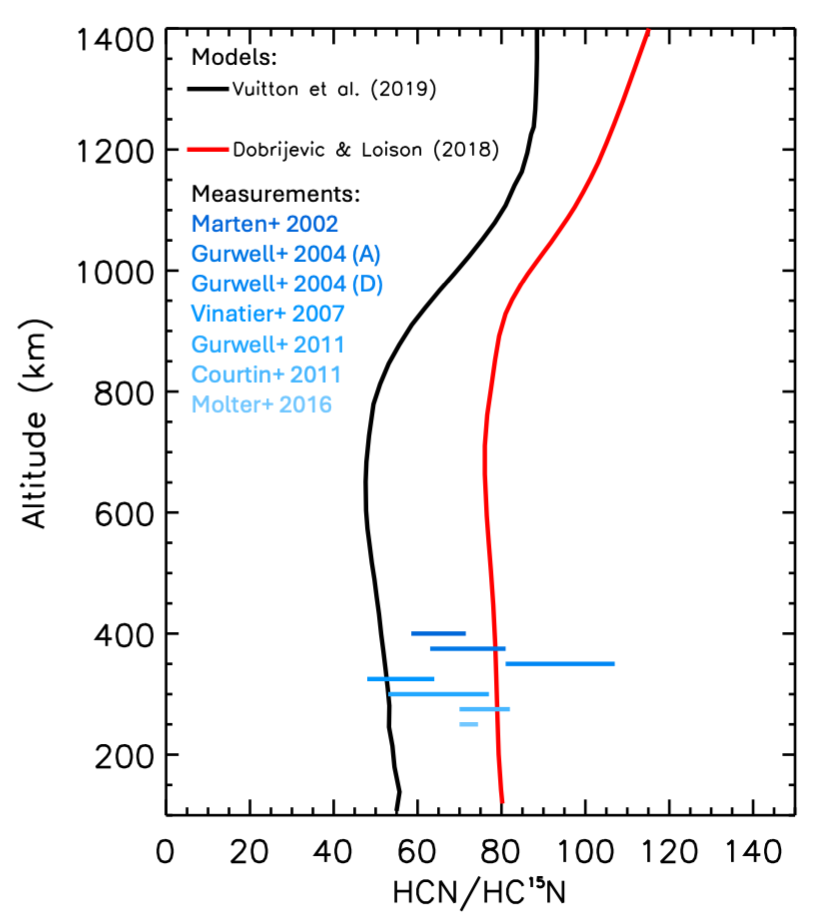
Titan’s substantial atmosphere is primarily composed of molecular nitrogen (N2) and methane (CH4), which are dissociated by solar UV photons and subsequently generate a vast chemical network of trace gases. The composition of Titan’s atmosphere is markedly different than that of Saturn, including both the complex molecular inventory and the hitherto measured isotopic ratios – including that of nitrogen (14N/15N). Atmospheric and interior evolution models (e.g., Mandt et al., 2014) indicate that the atmospheres of Saturn and Titan did not form in the same manner or from the same constituents, and that Titan’s atmospheric N2 may have originated from its interior as NH3. The evolution of 14N/15N in Titan’s atmosphere over time does not result in a value comparable to that measured on Saturn and instead is closer to cometary values; this indicates that the origin of Titan’s atmosphere appears to be from protosolar planetesimals enriched in ammonia and not from the sub-Saturnian nebula. However, selective isotopic fractionation of molecular species in Titan’s atmosphere complicates this picture, as the isotopic ratios may vary as a function of altitude (Figure 1). To further constrain the evolution of Titan’s atmosphere – and indeed, its origin – isotopic ratios must be measured throughout its atmosphere, instead of being interpreted from bulk values likely only representative of the stratosphere.

While the measurement of Titan’s 14N/15N in N2 (167.7; Niemann et al. 2010) places it firmly below the lower limit derived for Saturn (~350; Fletcher et al., 2014), Titan’s atmospheric nitriles (e.g., HCN, HC3N, CH3CN) are further enriched in 15N, resulting in ratios closer to 70 (Molter et al., 2016; Cordiner et al., 2018; Nosowitz et al., 2025). The variation in nitrogen isotopic ratios between the nitriles and N2 is thought to be the result of higher photolytic efficiency of 15N14N compared to N2 in the upper atmosphere (~900 km), resulting in increased 15N incorporated into nitrogen-bearing species (Liang et al., 2007; Dobrijevic & Loison, 2018; Vuitton et al., 2019). As these species are advected to lower altitudes, the nitrogen isotope ratio may vary vertically (Figure 1, red and black profiles), but previous measurements have only presented bulk atmospheric isotope ratios primarily representing Titan’s stratosphere (Figure 1, blue lines).

Recent observations with the Atacama Large Millimeter/submillimeter Array (ALMA) have allowed for the derivation of vertical abundance profiles of Titan’s trace atmospheric species and measurements of N, D, and O-bearing isotopologues (Molter et al., 2016; Serigano et al., 2016; Cordiner et al., 2018; Thelen et al., 2019; Nosowitz et al., 2025). However, vertical isotopic ratio profiles have yet to be derived. Here, we utilize observations acquired with ALMA in July 2022 containing high sensitivity measurements of the HC15N J=4–3 transition at 344.2 GHz (~ 0.87 mm) to investigate vertical variations in the 14N/15N of Titan’s HCN. We compare the results of the vertical 14N/15N profile to those predicted by photochemical models to determine the impact of the isotopic-selective photodissociation of nitrogen-bearing molecular species in Titan’s atmosphere, and the impact of the Saturnian and space environments that vary between model implementations.

Figure 1. 14N/15N profile for HCN predicted by photochemical models from Vuitton et al. (2019; black line) and Dobrijevic & Loison (2018; red line). Blue colored bars in the lower atmosphere represent previous HCN nitrogen isotope ratios from Cassini, Herschel, and ground-based (sub)millimeter observations (see Molter et al., 2016, and references therein). Measurements are offset vertically for clarity, and all refer to HC14N/HC15N measurements for the bulk stratosphere.

References:

Cordiner et al., 2018, The Astrophysical Journal Letters, 859, L15.

Dobrijevic & Loison, 2018, Icarus, 307, 371.

Fletcher et al., 2014, Icarus, 238, 170.

Liang et al., 2007, The Astrophysical Journal Letters, 644, L115.

Mandt et al. 2014, The Astrophysical Journal Letters, 788, L24.

Molter et al., 2016, The Astronomical Journal, 152, 42.

Niemann et al., 2010, Journal of Geophysical Research, 115, E12006.

Nosowitz et al., 2025, The Planetary Science Journal, 6, 107.

Serigano et al., 2016, The Astrophysical Journal Letters, 821, L8.

Thelen et al., 2019, The Astronomical Journal, 157, 219.

Vuitton et al., 2019, Icarus, 324, 120.

How to cite: Thelen, A., de Kleer, K., Teanby, N., Hofmann, A., Cordiner, M., Nixon, C., Nosowitz, J., and Irwin, P.: Investigating the Vertical Variability of Titan’s 14N/15N in HCN, EPSC-DPS Joint Meeting 2025, Helsinki, Finland, 7–13 Sep 2025, EPSC-DPS2025-1211, https://doi.org/10.5194/epsc-dps2025-1211, 2025.

15:48–16:00
|
EPSC-DPS2025-133
|
ECP
|
On-site presentation
Devin Hoover, Tommi Koskinen, Panayotis Lavvas, and Nathan Le Guennic

Titan is the only solar system satellite that possesses a significant atmosphere, which is composed mainly of N2 and CH4.  Within Titan’s upper atmosphere, solar UV photolysis of N2 and CH4 initiates the production of hydrocarbons and nitriles, and the photochemical growth terminates with the formation of a thick organic haze (Waite et al., 2005).  These products descend to Titan’s surface and lakes, possibly engaging on prebiotic chemistry with materials from these environments (Raulin et al., 2012).  The distributions of N2 and CH4 in Titan’s upper atmosphere, where photochemistry and haze formation are initiated, are highly variable for reasons that are poorly understood.  In particular, the Cassini Ultraviolet Imaging Spectrograph (UVIS) and Ion Neutral Mass Spectrometer (INMS) probed densities and temperatures in Titan’s thermosphere (Esposito et al., 2004; Waite et al., 2004).  N2 and CH4 densities within Titan’s thermosphere were retrieved from UV solar occultations (Capalbo et al., 2013, 2015), UV stellar occultations (Koskinen et al., 2011; Kammer et al., 2013; Yelle et al., 2021), UV dayglow (Stevens et al., 2015), and INMS in-situ observations (Yelle et al., 2006; Cui et al., 2009; Snowden et al., 2013). During Cassini’s Titan observations, the N2 and CH4 densities both varied by about one order of magnitude.  The density profiles do not appear to exhibit strong correlations with geophysical variables such as latitude, longitude, solar zenith angle, and local solar time (Müller-Wodarg & Koskinen, 2025).  UVIS scans of Titan’s airglow between 2004 and 2017 provide a global view of the atmosphere, which can help to uncover the origin of the variations.  However, most of the 635 UVIS scans were previously unanalyzed.  Having analyzed multiple UVIS scans, we present results based on our investigation of variability in Titan’s upper atmosphere.

We implement a fast, simplified optimal estimator to retrieve N2, CH4, and H densities from UVIS scans of Titan’s far ultraviolet (FUV) dayglow (Lavvas & Koskinen, 2022).  Our approach’s validity depends on the assumption that solar-driven processes dominate Titan’s dayglow emissions, which we previously demonstrated (Hoover et al., 2024).  To characterize variations in temperature and vertical mixing across latitude and time, we construct a Titan atmospheric structure emulator.  We create a parametrized pressure-temperature (P-T) profile in the mesosphere and thermosphere. For the lower atmosphere, we incorporate the SVRS temperature profile (Lombardo & Lora, 2023).  The SVRS dataset is strongly anchored in Cassini Composite Infrared Spectrometer observations of Titan’s lower atmosphere and simulations of Titan’s stratospheric dynamics.  We set the CH4 volume mixing ratio at the stratopause (0.0146063) and use a parametrized Kzz profile (Yelle et al., 2008) to model the CH4 mixing ratio profile throughout the atmosphere.  Our fit parameters are the mean temperature in the upper atmosphere (P < 3.9 ∗ 10−10 bar), mesopause temperature, Kzz value in the upper atmosphere, and a scale factor needed to match the H density profile from a photochemical model with the observations.  We use emcee (Foreman-Mackey et al., 2013) to retrieve atmospheric structure parameters by fitting the emulator model to the retrieved density profiles.

Based on these algorithms, we present N2, CH4, and H density profiles, as well as atmospheric structure parameters, retrieved from our dataset of UVIS scans.  Near the equator, the mean upper atmospheric temperature varies significantly over timescales below one year.  For some observations, we perform retrievals at multiple latitudes; in most of these cases, Titan’s mean upper atmospheric temperatures exhibit little change over latitude.  Changes in mean upper atmospheric temperature do not appear to be correlated with solar activity, suggesting that other factors, such as activity from Titan’s lower atmosphere or Saturn’s magnetosphere, may influence variations in Titan’s upper atmosphere more significantly.  To test the hypothesis that variability in Titan’s upper atmosphere is driven by waves and circulation patterns from the stratosphere (the "intrinsic variability" hypothesis), we compare our retrieved densities and temperatures with output from a Titan Thermosphere General Circulation Model (Müller-Wodarg et al., 2008; Müller-Wodarg & Koskinen, 2025).  Upper atmospheric Kzz values derived from our CH4 profiles are more than one order of magnitude higher than those derived from Ar profiles measured by INMS (Yelle et al., 2008), indicating that CH4 is undergoing significant escape.


References:

  • Capalbo, F. J., Bénilan, Y., Yelle, R. V., & Koskinen, T. T. 2015, ApJ, 814, 86, doi: http://doi.org/10.1088/0004-637X/814/2/8610.1088/0004-637X/814/2/86
  • Capalbo, F. J., Bénilan, Y., Yelle, R. V., et al. 2013, ApJL, 766, L16, doi: http://doi.org/10.1088/2041-8205/766/2/L1610.1088/2041-8205/766/2/L16
  • Cui, J., Yelle, R. V., Vuitton, V., et al. 2009, Icarus, 200, 581, doi: http://doi.org/10.1016/j.icarus.2008.12.00510.1016/j.icarus.2008.12.005
  • Esposito, L. W., Barth, C. A., Colwell, J. E., et al. 2004, SSR, 115, 299, doi: http://doi.org/10.1007/s11214-004-1455-810.1007/s11214-004-1455-8
  • Foreman-Mackey, D., Hogg, D. W., Lang, D., & Goodman, J. 2013, PASP, 125, 306, doi: http://doi.org/10.1086/67006710.1086/670067
  • Hoover, D., Koskinen, T., Lavvas, P., & Le Guennic, N. 2024, in AAS/Division for Planetary Sciences Meeting Abstracts, Vol. 56, AAS/Division for Planetary Sciences Meeting Abstracts, 408.04
  • Kammer, J. A., Shemansky, D. E., Zhang, X., & Yung, Y. L. 2013, PSS, 88, 86, doi: http://doi.org/10.1016/j.pss.2013.08.00310.1016/j.pss.2013.08.003
  • Koskinen, T. T., Yelle, R. V., Snowden, D. S., et al. 2011, Icarus, 216, 507, doi: http://doi.org/10.1016/j.icarus.2011.09.02210.1016/j.icarus.2011.09.022
  • Lavvas, P., & Koskinen, T. 2022, in EPSC, EPSC2022–447, doi: http://doi.org/10.5194/epsc2022-44710.5194/epsc2022-447
  • Lombardo, N. A., & Lora, J. M. 2023, Icarus, 390, 115291, doi: http://doi.org/10.1016/j.icarus.2022.11529110.1016/j.icarus.2022.115291
  • Müller-Wodarg, I. C. F., & Koskinen, T. T. 2025, Chapter 6 - Titan’s neutral upper atmosphere and ionosphere (Titan After Cassini-Huygens, COSPAR Series), 121–156
  • Müller-Wodarg, I. C. F., Yelle, R. V., Cui, J., & Waite, J. H. 2008, JGR (Planets), 113, E10005, doi: http://doi.org/10.1029/2007JE00303310.1029/2007JE003033
  • Raulin, F., Brasse, C., Poch, O., & Coll, P. 2012, CSR
  • Snowden, D., Yelle, R. V., Cui, J., et al. 2013, Icarus, 226, 552, doi: http://doi.org/10.1016/j.icarus.2013.06.00610.1016/j.icarus.2013.06.006
  • Stevens, M. H., Evans, J. S., Lumpe, J., et al. 2015, Icarus, 247, 301, doi: http://doi.org/10.1016/j.icarus.2014.10.00810.1016/j.icarus.2014.10.008
  • Waite, J. H., Lewis, W. S., Kasprzak, W. T., et al. 2004, SSR, 114, 113, doi: http://doi.org/10.1007/s11214-004-1408-210.1007/s11214-004-1408-2
  • Waite, J. H., Niemann, H., Yelle, R. V., et al. 2005, Science, 308, 982, doi: http://doi.org/10.1126/science.111065210.1126/science.1110652
  • Yelle, R. V., Borggren, N., de la Haye, V., et al. 2006, Icarus, 182, 567, doi: http://doi.org/10.1016/j.icarus.2005.10.02910.1016/j.icarus.2005.10.029
  • Yelle, R. V., Cui, J., & Müller-Wodarg, I. C. F. 2008, JGR (Planets), 113, E10003, doi: http://doi.org/10.1029/2007JE00303110.1029/2007JE003031
  • Yelle, R. V., Koskinen, T. T., & Palmer, M. Y. 2021, Icarus, 368, 114587, doi: http://doi.org/10.1016/j.icarus.2021.11458710.1016/j.icarus.2021.114587

How to cite: Hoover, D., Koskinen, T., Lavvas, P., and Le Guennic, N.: Titan’s Upper Atmospheric Structure from Cassini/UVIS Observations, EPSC-DPS Joint Meeting 2025, Helsinki, Finland, 7–13 Sep 2025, EPSC-DPS2025-133, https://doi.org/10.5194/epsc-dps2025-133, 2025.

Orals MON-OB5: Mon, 8 Sep, 16:30–18:00 | Room Mars (Veranda 1)

Chairpersons: Bruno de Batz de Trenquelléon, Nicholas Teanby
Atmospheric structure
16:30–16:42
|
EPSC-DPS2025-175
|
ECP
|
On-site presentation
Lucy Wright, Nicholas Teanby, Patrick Irwin, Conor Nixon, Nicholas Lombardo, Juan Lora, and Daniel Mitchell

Titan’s entire stratosphere is in superrotation (Flasar et al. 2005) and appears to rotate about an axis offset from its solid body rotation axis by around 4o (Achterberg et al. 2008). The stratospheric tilt axis has been estimated previously through temperature measurements (Achterberg et al. 2011; 2008), composition retrievals (Sharkey et al. 2020; Teanby 2010), and by analysis of stratospheric haze (Kutsop et al. 2022; Roman et al. 2009; Snell and Banfield 2024; Vashist et al. 2023) and a polar cloud (West et al. 2016). Despite this, the mechanism causing the tilt is not well understood. This challenge is further heightened as Titan General Circulation Models (GCMs) are yet to resolve a tilt consistent with observations (e.g., Lombardo and Lora (2023a; 2023b)).Understanding the cause of Titan’s stratospheric tilt may provide insight into the underlying dynamics that drive superrotation in Titan’s atmosphere and the behaviour of superrotating atmospheres in general. Furthermore, due to the strength of Titan’s zonal winds, the offset of the stratospheric rotation axis may have a significant effect on the atmospheric descent of the upcoming Dragonfly mission to Titan. Thus, improved constraints on the tilt axis may better inform the landing site calculations for Dragonfly.

We determine the evolution of Titan’s stratospheric tilt axis over 13 years (Ls = 293—93o), which spans almost half a Titan year. The tilt was determined by inspecting zonal symmetry in the (i) thermal and (ii) composition structure of Titan’s stratosphere. These two independent methods probe different latitude regions. We use infrared observations acquired by the Composite Infrared Spectrometer (CIRS) (Flasar et al. 2004; Jennings et al. 2017; Nixon et al. 2019) instrument onboard the Cassini spacecraft, which toured the Saturn system from 2004 to 2017. We use nadir CIRS observations acquired at a low apodised spectral resolution (FWHM∼13.5–15.5 cm−1). This data set provides excellent spatial coverage of Titan’s middle atmosphere throughout the Cassini mission and achieves the best horizontal spatial resolution of any of the CIRS observations. Despite the subtle and often blended spectral features in these data, Wright et al. (2024) show that they can be reliably forward modelled. Vertical profiles of temperature and gas volume mixing ratios (VMRs) are estimated from CIRS FP3/4 spectra using the Non-linear Optimal Estimator for MultivariatE Spectral AnalySIS (NEMESIS) radiative transfer and retrieval code (Irwin et al. 2008). The observations probe pressure levels of ~10—10-3 mbar in Titan’s atmosphere, with peak contributions at around 1 mbar. These data enable us to reveal Titan’s stratospheric thermal and composition structure in the highest meridional resolution to date and facilitate an independent study of the tilt offset of Titan’s stratosphere.

We find that the tilt axis in the mid-latitudes (from (i)) and the equatorial region (from (ii)) are in good agreement, which supports the theory that Titan’s entire stratosphere is tilted relative to its solid body (Achterberg et al. 2008). In addition to this, we present the best evidence yet that the pointing direction of Titan’s stratospheric tilt axis is constant in the inertial reference frame (Wright et al. in press), consistent with previous studies (Achterberg et al. 2011; Kutsop et al. 2022; Sharkey et al. 2020; Snell and Banfield 2024). The tilt azimuth is determined to be 121± 7o West of the sub-solar point at Titan’s northern spring equinox (Ls = 0o). Put another way, the pointing direction of the tilt axis would appear constant to an observer looking down on the Solar System.

In addition, we present new evidence that the magnitude of Titan’s stratospheric tilt axis may have a seasonal dependence, oscillating between values of approximately 2o to 10o with a period similar in length to half a Titan year. If this pattern is real, it suggests that the tilt of Titan’s stratosphere is impacted by seasonal forcing, even though the direction of the tilt remains constant.

Fig 1: Schematic showing the direction of Titan’s stratospheric tilt axis from Wright et al. (in press). Titan and Saturn are shown at some example times in their orbit. The tilt direction is determined to be approximately constant in the inertial reference frame, that is, fixed with respect to the Titan-Sun vector at northern spring equinox (Ls = 0◦). The approximate size of the tilt magnitude, β, is indicated by font size.


References:

Achterberg, R. K., et al. 2008. Icarus 197 (2): 549–55. https://doi.org/10.1016/j.icarus.2008.05.014.

Achterberg, R. K., et al. 2011. Icarus 211 (1): 686–98. https://doi.org/10.1016/j.icarus.2010.08.009.

Flasar, F. M., et al. 2005. Science 308 (5724): 975–78. https://doi.org/10.1126/science.1111150.

Flasar, F. M., et al. 2004. Space Science Reviews 115 (1–4): 169–297. https://doi.org/10.1007/s11214-004-1454-9.

Irwin, P.G.J., et al. 2008. Journal of Quantitative Spectroscopy and Radiative Transfer 109 (6): 1136–50. https://doi.org/10.1016/j.jqsrt.2007.11.006.

Jennings, D. E., et al. 2017. Applied Optics 56 (18): 5274. https://doi.org/10.1364/AO.56.005274.

Kutsop, N. W., et al. 2022. The Planetary Science Journal 3 (5): 114. https://doi.org/10.3847/PSJ/ac582d.

Lombardo, N. A., and J. M. Lora. 2023a. Journal of Geophysical Research: Planets 128 (12): e2023JE008061. https://doi.org/10.1029/2023JE008061.

Lombardo, N. A., and Juan M. Lora. 2023b. Icarus 390 (January):115291. https://doi.org/10.1016/j.icarus.2022.115291.

Nixon, C. A., et al. 2019. The Astrophysical Journal Supplement Series 244 (1): 14. https://doi.org/10.3847/1538-4365/ab3799.

Roman, M. T., et al. 2009. Icarus 203 (1): 242–49. https://doi.org/10.1016/j.icarus.2009.04.021.

Sharkey, J., et al. 2020. Icarus 337 (February):113441. https://doi.org/10.1016/j.icarus.2019.113441.

Snell, C., and D. Banfield. 2024. The Planetary Science Journal 5 (1): 12. https://doi.org/10.3847/PSJ/ad0bec.

Teanby, N. A. 2010. Faraday Discussions 147:51. https://doi.org/10.1039/c001690j.

Vashist, Aadvik S, et al. 2023. The Planetary Science Journal 4 (6): 118. https://doi.org/10.3847/PSJ/acdd05.

West, R. A., et al. 2016. Icarus 270 (May):399–408. https://doi.org/10.1016/j.icarus.2014.11.038.

Wright, L., et al. 2024. Experimental Astronomy 57 (2): 15. https://doi.org/10.1007/s10686-024-09934-y.

Wright, L., et al. in press. The Planetary Science Journal. https://doi.org/10.3847/PSJ/adcab3.

How to cite: Wright, L., Teanby, N., Irwin, P., Nixon, C., Lombardo, N., Lora, J., and Mitchell, D.: The Rise and Fall of a Mid-West Tilt: Seasonal Evolution of Titan’s Stratospheric Tilt Axis, EPSC-DPS Joint Meeting 2025, Helsinki, Finland, 7–13 Sep 2025, EPSC-DPS2025-175, https://doi.org/10.5194/epsc-dps2025-175, 2025.

16:42–16:54
|
EPSC-DPS2025-1905
|
ECP
|
On-site presentation
Jonathon Nosowitz, Martin Cordiner, Conor Nixon, Alexander Thelen, Richard Cosentino, and Steven Charnley

Titan, Saturn’s largest satellite, is host to an intricate chemical and dynamical environment. Its atmosphere is composed primarily of molecular nitrogen (N2) and methane (CH4) that form the basis for a complex organic chemistry. But there are known to be temporal and spatial variations in the abundances of the chemical species that compose Titan’s atmosphere. Zonal winds traverse an object along lines of latitude, parallel to the equator. Titan’s zonal winds can reach speeds up to ~ 350 m/s in the upper stratosphere (z ~ 250-350 km) and are responsible for horizontal mixing. They are primarily a result of the seasonally varying solar forcing, and they play an important role in Titan’s global climate and atmospheric circulation (Hörst 2017). The superrotation of Titan’s atmosphere can dominate the transport and mixing of high-altitude photochemical species as well as produce significant east-west asymmetries in the thermosphere.

Considering its global importance, there remain major gaps in our understanding of the detailed behavior of Titan’s wind field. From Hubbard et al. (1993) who first inferred the presence of zonal winds on Titan using stellar occultation observations to de Batz et al. (2025) who improved upon current GCM models, there have been many studies of Titan’s zonal winds. One of the more recent observational studies using ALMA, Lellouch et al. (2019), found a thermospheric, equatorial jet, which is difficult to reproduce in current atmospheric models and raises many questions about the origin of such a fast jet.

In this work, we investigate the temporal evolution of Titan’s high-altitude winds, focusing mainly on the less well studied equatorial region, to help inform our understanding of their physical basis, origin, and climatological implications. Using archival ALMA band 7 (275-373 GHz; ~0.8-1.1 mm) data from 2012-2016, we determined Titan’s zonal wind speeds as a function of latitude and time. We measured the Doppler shifts of molecular emission lines, an example of the Doppler shift is shown for an archival ALMA dataset in Figure 1, by fitting a Moffat function to the emission line profile in each spatial pixel. The data cubes have sufficient spectral resolution (< 300 kHz) to accurately measure Doppler shifts and spatial resolution (< 0.7”) to resolve the East and West limbs of Titan. Using the methods of Cordiner et al. (2020), the data were deconvolved and analyzed to obtain the intrinsic zonal wind speed profile as a function of latitude for each dataset. These profiles will be collated into a time series and compared with current Titan climate and circulation models such as those described by Newman et al. (2011) and Lora et al. (2015). Due to their different contribution functions, different molecules sound wind speeds at different altitudes (Lellouch et al. 2019): HC3N probes the altitude range z ~ 500-900 km, where an equatorial wind speed variation of 116 ± 3 m/s was previously found between 2016-2017 (Cordiner et al. 2020). We extend the altitudinal range of our analysis and include other molecules such as CH3CN (probing altitudes z ~ 200-450 km). Through this work, we further improve the constraints on the temporal variability of Titan’s wind field and better determine the conditions that lead to the formation of the thermospheric jet.

Figure 1: Left: ALMA archival HC3N (J=39-38) continuum subtracted, integrated emission map of Titan observed in 2015, from ALMA project 2013.1.00446.S. The 'x' notes the regions of the limbs where the East and West limb spectra were extracted. Right: Extracted East and West limb spectra, showing a strong Doppler shift due to high-altitude, prograde zonal winds.


This work was supported by NSF grant AST-2407709

References:

Hörst 2017, J. Geophys. Res. Planets, 122, 432-482

Hubbard et al., 1993, A&A, 269, 541-563

Bruno de Batz de Trenquelléon et al., 2025, Planet. Sci. J. 6, 78

Lellouch et al., 2019, Nature Astronomy, 5, 614-619

Cordiner et al., 2020, ApJL, 904, L12 

Newman et al., 2015, Icarus, 213, 636-654

Lora et al., 2015, Icarus, 250, 516-528

How to cite: Nosowitz, J., Cordiner, M., Nixon, C., Thelen, A., Cosentino, R., and Charnley, S.: Temporal Variability of Titan’s Equatorial Zonal Winds Between 2012-2016, EPSC-DPS Joint Meeting 2025, Helsinki, Finland, 7–13 Sep 2025, EPSC-DPS2025-1905, https://doi.org/10.5194/epsc-dps2025-1905, 2025.

16:54–17:09
|
EPSC-DPS2025-1150
|
ECP
|
On-site presentation
Nicholas Lombardo, Bruno de Batz de Trenquelléon, Jacob Shultis, Juan Lora, Pascal Rannou, Darryn Waugh, Yuan Lian, and Claire Newman

The atmosphere of Titan, the largest moon of Saturn, is unique in the Solar System.  Like Earth, its atmosphere is mostly composed of molecular nitrogen, though unlike Earth, there is no molecular oxygen and instead the second most abundant molecule is methane.  The interactions between the products of the photodissociation of these two dominant molecules give rise to a complex suite of hydrocarbons (molecules of the form CxHy) and nitriles (CxHyNz) [1].  Continued reactions (through their collision and agglomeration) between these species ultimately lead to Titan’s characteristic orange haze, which shields Titan’s surface from most shortwave sunlight.  Akin to the absorption of ultraviolet light by Earth’s stratospheric ozone, shortwave radiative heating by Titan’s haze and methane leads to the formation of Titan’s stratopause, the local thermal maximum that separates the stratosphere (about 40 to 250 km above the surface) and mesosphere (about 250 to 600 km above the surface).

Across all latitudes, the zonal winds in Titan’s middle atmosphere are westerly, exclusively blowing from the west towards the east, and have been inferred to reach speeds up to ~280 m/s [2,3,4].  This is in stark contrast to the zonal winds of Earth’s stratosphere, which include both westerly and easterly blowing winds.  The maintenance of Titan’s stratospheric superrotation is thought to be by the Gierasch-Rossow-Williams mechanisms [5,6]: Zonal angular momentum is delivered to the stratosphere from ascending motion from the surface and then transported to the high latitude by the meridional circulation; this transport is then balanced by the transport of zonal momentum equatorward by atmospheric eddies, likely made up of Rossby-Kelvin waves [7,8,9].

Trace molecules (e.g., C2H6, C2H4, C2H2, HCN) in Titan’s stratosphere are enriched above the winter pole, in some cases by several orders of magnitude [10,11].  The enrichment is generally thought to be driven by the descending branch of Titan’s meridional overturning circulation delivering molecules from their high-altitude source region into the lower stratosphere.  Once delivered to the high-latitude stratosphere, the molecules are thought to be trapped by the strong stratospheric jet.  Some molecules (e.g., C2H6) exhibit ‘tongues’ extending away from the high latitude, suggestive of mixing processes transporting high latitude air into the mid latitudes [12].  This, however, has yet to be confirmed.

In this presentation, we directly compare three Titan general circulation models (GCM) to determine the characteristics of Titan’s middle atmosphere that are robustly present across different model assumptions and parameterizations.  Included in this intercomparison are the Titan Atmospheric Model (TAM, [13]), Titan Planetary Climate Model (Titan PCM, [14]), and TitanWRF [9].  This intercomparison of fully three-dimensional GCMs aims to provide the first multi-model resource to explain the observed seasonal-scale changes in Titan’s middle atmospheric thermal, dynamical, and compositional structure.

References

[1] Vuitton et al., Icarus, 2019

[2] Sharkey et al., Icarus, 2021

[3] Achterberg, PSJ, 2023

[4] Vinatier et al., A&A, 2020

[5] Gierash, JAS, 1975

[6] Rossow & Williams, JAS, 1979

[7] Lombardo & Lora, JGR: Planets, 2023

[8] Lewis et al., PSJ, 2023

[9] Lian et al., Icarus, 2025

[10] Teanby et al., GRL, 2019

[11] Mathe et al., Icarus, 2020

[12] Shultis et al., PSJ, 2022

[13] Lombardo & Lora, Icarus, 2023

[14] de Batz de Trenquelléon, et al., PSJ, 2025

How to cite: Lombardo, N., de Batz de Trenquelléon, B., Shultis, J., Lora, J., Rannou, P., Waugh, D., Lian, Y., and Newman, C.: The Titan Middle Atmosphere Intercomparison Project, EPSC-DPS Joint Meeting 2025, Helsinki, Finland, 7–13 Sep 2025, EPSC-DPS2025-1150, https://doi.org/10.5194/epsc-dps2025-1150, 2025.

Haze & radiative transfer
17:09–17:21
|
EPSC-DPS2025-701
|
On-site presentation
Pascal Rannou, Emmanuel Lellouch, Bruno Bézard, Erich Karkoschka, Benoit Seignovert, and Conor Nixon

 The photochemical haze layer in the stratosphere and the condensation haze (hereafter, mist) in the lower stratosphere and troposphere completely cover Titan and play a dominant role in its climate. These hazes determine the atmospheric radiative balance and are also good tracers of the atmospheric circulation. These particles also prevent from seeing clearly the surface except in methane windows that provide narrow keyholes through which surface can be perceived. Titan has been observed by many means over time and in this work we used the results of three instruments; the STIS/HST, NIRSpec/JWST and VIMS/Cassini. Our goal is to compare the spectra that were obtained by each and to use these data to gain information on the haze and mist properties and about the surface reflectivity. Recently, the James Webb Space Telescope (JWST) has provided observations of very high spectral quality (in resolution and uncertainties). These images and spectra provide information on the latitudinal distribution of haze, from the lower stratosphere (100-150 km) down into the troposphere with good vertical resolution. With this dataset, we are able to describe the mist layer in five distinct sublayers: the deepest layer between 0 and 40 km and four layers of 10 km thickness between 40 and 80 km. The retrievals performed allow us to reconstruct a map of the haze and mist layer on the date of observation (5 November 2022) and thus highlight haze distributions related to circulation. Besides knowledge about the haze itself, a good haze retrieval allows access to the surface properties (i.e., reflectivities), in general, with uncertainty levels that allow us to detect differences between different terrains. With NIRSpec/JWST, we obtain information with relatively low spatial resolution. These surface reflectivities differ from previous analysis made with VIMS. With the same model adapted to VIMS/Cassini observation, we also analyzed a selected part of the VIMS/Cassini dataset collected from 2004 to 2017. We could monitor, albeit with a lower vertical resolution, how these hazes evolve over season and we retrieve surface albedo too. These results allow us to put in context the results obtained with the NIRSpec/JWST and also offer an interesting comparison to the results obtained with NIRSpec/JWST since Cassini observed the opposite season, in 2007. In our work we found that VIMS/Cassini and NIRSpec/JWST do not produce exactly the same retrieval and the difference is beyond what is expected from a seasonal difference. Concerning the surface, retrieved spectra differ substantially. To clarify this, we used STIS/HST data as a third constraint to better understand the causes of the differences. We consequently propose a new way to analyze VIMS observations and especially for retrieving the surface albedo more in line with expectations based on in-situ observations (Figure 1). With the upcoming very large telescopes (Extremely Large Telescope, Thirty Meter Telescope,...) with high sensitivity and spectral resolution, this work shows it is important to fully understand past observations and to obtain as much information as possible from them. Finally, fully characterizing Titan’s atmosphere and surface with models to obtain the most accurate analysis and results from them is a major present-day objective to prepare for future missions to Titan such as Dragonfly.


Figure 1 : At Left : Selk crater and its surrounding as observed with VIMS (1578263500 1) during the flyby T40 on 5 Jan 2008 with a RGB composition. The red line shows the parallel at 6.95°N along which we perform analysis. The pixel A and B, located at 6.94°N,160.24°E and 6.94°N,165.50°E are used for testing purpose in our work. The other letters along the parallel 6.95°N indicate the various types of terrain, as reported by Bonnefoy et al. (The Planetary Science Journal, 3(8):201, 2022), where different units are identified as plains (”p”), crater rim (”r”), dune field (”d”), crater ejecta (”e”) and hummocky (”h”). At right : Proxy of haze (Fh) and mist (Fm1 and Fm2) opacities (top), outgoing radiance factor I/F at 2.20 μm (middle) and retrieved surface reflectivity along the parallel at 6.95°N (bottom)


How to cite: Rannou, P., Lellouch, E., Bézard, B., Karkoschka, E., Seignovert, B., and Nixon, C.: Titan haze and surface observed with the NIRSpec/JWST, VIMS/Cassini and STIS/HST, EPSC-DPS Joint Meeting 2025, Helsinki, Finland, 7–13 Sep 2025, EPSC-DPS2025-701, https://doi.org/10.5194/epsc-dps2025-701, 2025.

17:21–17:33
|
EPSC-DPS2025-681
|
ECP
|
On-site presentation
zili he, Sandrine Vinatier, Bruno Bézard, Anthony Arfaux, Vincent Eymet, Vincent Forest, Pascal Rannou, Sébastien Rodriguez, Emmanuel Marcq, Richard Fournier, Stéphane Blanco, Nada Mourtaday, Yaniss Nyffenegger-Péré, Sébastien Lebonnois, and Anni Määttänen

Retrieving planetary atmospheric parameters from observational data is particularly challenging under large observation angles, in thick and highly scattering media (such as Titan and Venus), and in the presence of horizontal heterogeneities, like clouds and hazes. Traditional radiative transfer models, often based on plane-parallel or pseudo-spherical approximations, typically assume horizontally homogeneous layers, which limits their applicability in such scenarios.

To overcome these limitations, we have developed a novel 3D radiative transfer solver, htrdr-planets, based on the Monte Carlo method that solves models considering spherical and heterogeneous atmospheres[1]. This solver leverages recent advances from the computer graphics and statistical physics communities to ensure computational efficiency.

htrdr-planets supports arbitrary ground geometry, represented as triangular meshes with user-defined surface materials, and atmospheric properties defined on unstructured tetrahedral meshes. Gas absorption is modeled using the k-distribution method, and multiple aerosol and cloud populations with their own radiative properties can be described on separate spatial grids.

Critically, we address the need for gradients (i.e., sensitivities) in parameter retrieval. Since conventional finite-difference methods are inefficient or infeasible with Monte Carlo, we differentiate the Monte Carlo estimator itself [2]. By reusing the same radiative paths, we construct a Monte Carlo estimator that computes both the radiance and its gradient with respect to atmospheric and surface parameters at negligible additional time cost.

We apply this method to Titan and Venus, producing spatially resolved maps of sensitivity with respect to scattering, absorption, and surface-reflection properties. This framework enables retrievals in geometrically complex cases that defy traditional models, including Titan’s polar cloud structure and haze distribution, using Cassini and JWST datasets. This work is supported by the Agence National de la Recherche (ANR) through the RaD3-net project (ANR-21-CE49-0020-01).

[1] htrdr-planets, https://www.meso-star.com/projects/htrdr/htrdr.html
[2] He, Zili, et al. "Simultaneous Estimation of Radiance and its Sensitivities to Radiative Properties in a Spherical-Heterogeneous Atmospheric Radiative Transfer Model by Monte Carlo: Application to Titan." (Submitted to Journal of Quantitative Spectroscopy and Radiative Transfer.)

How to cite: he, Z., Vinatier, S., Bézard, B., Arfaux, A., Eymet, V., Forest, V., Rannou, P., Rodriguez, S., Marcq, E., Fournier, R., Blanco, S., Mourtaday, N., Nyffenegger-Péré, Y., Lebonnois, S., and Määttänen, A.: 3D Monte Carlo Radiative Transfer for Parameter Retrieval in Planetary Atmospheres, EPSC-DPS Joint Meeting 2025, Helsinki, Finland, 7–13 Sep 2025, EPSC-DPS2025-681, https://doi.org/10.5194/epsc-dps2025-681, 2025.

17:33–17:45
|
EPSC-DPS2025-1294
|
ECP
|
On-site presentation
Anthony Arfaux, Sandrine Vinatier, Vincent Eymet, Vincent Forest, Zili He, Bruno de Batz de Trenquelléon, Pascal Rannou, Ehouarn Millour, and Sébastien Lebonnois

Titan and particularly its thick atmosphere, unique among solar system objects, has been a center of interest for many decades. Titan’s atmosphere has been thoroughly studied, notably with the use of Global Climate Models (GCM) (Lebonnois et al. 2012; Lora et al. 2015; de Batz de Trenquelléon et al. 2025a;
de Batz de Trenquelléon et al. 2025b). All of them currently consider a plane-parallel atmosphere for the radiative transfer calculation (Lora et al. 2015; de Batz de Trenquelléon et al. 2025a). However, this assumption has limitations in the case of Titan.

First, its thick atmosphere makes sphericity effects prominent. For instance, the Titan PCM (Planetary Climate Model, developed mainly at IPSL) simulates up to 500 km altitude, while Titan radius is 2575 km, therefore the atmosphere extension is not negligible, representing 20% of Titan’s radius. In such a case,
sphericity effects are important, especially at high altitudes, and may result in variations of the radiative budget with retroactions on the circulation and cloud formation. Another effect from sphericity is the absence of polar night above ∼300 km altitude, matching the altitude of the polar cloud observed by West
et al. 2016. We also note that the multiple scattering in a 3D atmosphere can allow for the propagation of light into the polar night at lower altitudes. Both effects can affect the thermal properties of the polar regions with implications for the formation of the polar clouds.

Additionally, the horizontal heterogeneity of the atmosphere can have a role in the radiative transfer. Indeed, the radiative budget can be affected by the optical properties of neighboring columns, which is not accounted for in GCMs, where the radiative transfer calculations are performed independently for each
column. For instance, the shadowing produced by large polar clouds or sharp haze variations in the optical properties affecting the horizontal propagation of light, can reduce or increase the radiative budget in the neighboring columns.

Therefore accounting for those effects necessitates a more sophisticated approach. We have developed a new 3D radiative transfer model, with spherical geometry and heterogeneous layers: htrdr-planets (https: //www.meso- star.com/projects/htrdr/htrdr.html; He et al. submitted), to be implemented in Titan
PCM and study its atmosphere. This model is based on a reversed Monte Carlo algorithm incorporating recent developments in computing science (Villefranque et al. 2019), able to calculate radiative budget within each GCM cell with very little approximations.

We present here comparisons between simulated radiative budget computed with the new model and the two stream plane-parallel model used in the Titan PCM and we explore the expected effects on the cloud microphysics and atmospheric circulation.


Acknowledgements:
This work is supported by the Agence National de la Recherche (ANR) through the RaD3-net project (ANR-21-CE49-0020-01).


References:

de Batz de Trenquelléon, Bruno et al. (Apr. 2025a). “The New Titan Planetary Climate Model. I. Seasonal Variations of the Thermal Structure and Circulation in the Stratosphere”. In: The Planetary Science Journal 6, p. 78. issn: 2632-3338. doi: 10.3847/PSJ/adbbe7.

de Batz de Trenquelléon, Bruno et al. (Apr. 2025b). “The New Titan Planetary Climate Model. II. Titan’s Haze and Cloud Cycles”. In: The Planetary Science Journal 6, p. 79. issn: 2632-3338. doi: 10.3847/PSJ/adbb6c.

He, Zili et al. (submitted). “Simultaneous Estimation of Radiance and Its Sensitivities to Radiative Properties in a Spherical- Heterogeneous Atmospheric Radiative Transfer Model by Monte Carlo Method: Application to Titan”.

Lebonnois, Sébastien et al. (Mar. 2012). “Titan Global Climate Model: A New 3-Dimensional Version of the IPSL Titan GCM”. In: Icarus 218.1, pp. 707–722. issn: 0019-1035. doi: 10.1016/j.icarus.2011.11.032.

Lora, Juan M., Jonathan I. Lunine, and Joellen L. Russell (Apr. 2015). “GCM Simulations of Titan’s Middle and Lower Atmosphere and Comparison to Observations”. In: Icarus 250, pp. 516–528. issn: 0019-1035. doi: 10.1016/j.icarus.2014.12.030.

Villefranque, Najda et al. (2019). “A Path-Tracing Monte Carlo Library for 3-D Radiative Transfer in Highly Resolved Cloudy Atmospheres”. In: Journal of Advances in Modeling Earth Systems 11.8, pp. 2449–2473. issn: 1942-2466. doi: 10.1029/2018MS001602.

West, R. A. et al. (May 2016). “Cassini Imaging Science Subsystem Observations of Titan’s South Polar Cloud”. In: Icarus. Titan’s Surface and Atmosphere 270, pp. 399–408. issn: 0019-1035. doi: 10.1016/j.icarus.2014.11.038.

How to cite: Arfaux, A., Vinatier, S., Eymet, V., Forest, V., He, Z., de Batz de Trenquelléon, B., Rannou, P., Millour, E., and Lebonnois, S.: A reversed Monte Carlo radiative transfer model for Titan PCM, EPSC-DPS Joint Meeting 2025, Helsinki, Finland, 7–13 Sep 2025, EPSC-DPS2025-1294, https://doi.org/10.5194/epsc-dps2025-1294, 2025.

Lightning talks

Orals WED-OB6: Wed, 10 Sep, 16:30–18:30 | Room Mars (Veranda 1)

Chairpersons: Shannon M. MacKenzie, Robin Sultana
Dragonfly mission & surface
16:30–16:42
|
EPSC-DPS2025-209
|
On-site presentation
Jason W. Barnes, Elizabeth P. Turtle, Melissa G. Trainer, Ralph D. Lorenz, Scott L. Murchie, Shannon M. MacKenzie, Alexandra Pontefract, and the Dragonfly Science Team

NASA’s fourth New Frontiers mission, Dragonfly (Turtle & Lorenz 2024), will land a robotic octocopter on Saturn’s moon Titan in 2034 to study its prebiotic chemistry, constrain its habitability, and search for potential chemical biosignatures. The target landing site will be a portion of the Shangri-La sand sea just south of Selk Crater, an 80-km impact structure (Lorenz et al. 2021). Taking advantage of Titan’s low gravity and thick air, Dragonfly will aerially traverse to over twenty distinct landing sites on dune, interdune, and icy crater terrains (Lorenz et al. 2018).

Figure 1.  Dragonfly is a large 4.5-meter long, almost 1000 kg aerial rover with a sophisticated and high-mass scientific payload. It will spend its 3.3-year nominal surface mission exploring and sampling Titan’s sand dunes, interdunes, and the icy 80-km Selk Crater impact structure.

On the ground at those sites we will employ our four scientific instruments: a mass spectrometer (DraMS Trainer et al. 2022), a gamma-ray/neutron spectrometer (DraGNS), seven cameras (DragonCam), and a geophysical and meteorological suite (DraGMet). The DrACO sampling system will drill into the surface and ingest surface samples by means of a hydraulic vacuum cleaner. The vehicle spends over 99% of its time on the ground, and therefore while it can and will fly, the term “relocatable lander” brings to mind a better sense for the operations that we expect to execute on Titan.

We seek to determine how far organic chemistry has progressed, to ground-truth the global methane meteorological cycle, to measure the modes and rates of surface geologic processes, to constrain when and where water and organics might have mixed, and to look for evidence that either water- or hydrocarbon-based life may have existed on Titan (Barnes et al. 2021). Our science objectives with respect to organic chemistry are to measure compositions of materials in different geologic settings and to determine presence and abundance of key molecules for Earth-like life. We have goals to characterize Titan’s methane cycle by constraining the atmospheric methane moisture budget at our tropical landing site and assaying the abundance of stored liquid methane in the near-subsurface.

To place our samples into context, we will need to assess their provenance which we will do by determining the conditions for aeolian transport, by determining the transport mode and history of clastic saterials, and by establishing the geologic context of sampled materials. Our fourth goal is to determine where and how liquid water may have mixed with organic material, which we will do with a seismometer to measure current lithospheric activity and, if Titan is sufficiently active seismically, to constrain the depth to Titan’s liquid-water ocean. Other instrumentation will determine the availability of near-surface water ice and constrain past geologic processes.

Dragonfly finally has a goal to search for any potential chemical biosignatures on Titan as may have been produced by either extinct or extant life. Our objectives on this front are to determine enantiomeric abundance of chiral molecules, to determine if patterns exist in molecular masses and distribution, and to follow up on Huygens hydrogen indications with more and more accurate hydrogen profiles of the lower atmosphere.

Dragonfly recently passed its Critical Design Review and we are fabricating hardware ahead of the launch period that opens on 2028 July 5.

Figure 2.  Dragonfly is a single-element mission, and will communicate to Earth directly by means of an 85-cm radial line slot array high-gain antenna, as can be seen here deployed on the ventral (top) side of the vehicle. 

REFERENCES
Barnes, J. W., Turtle, E. P., Trainer, M. G., et al. 2021,
Science Goals and Objectives for the Dragonfly Titan
Rotorcraft Relocatable Lander, The Planetary Science
Journal, 2, 130, doi: 10.3847/PSJ/abfdcf

Lorenz, R. D., Turtle, E. P., Barnes, J. W., et al. 2018,
Dragonfly: a Rotorcraft Lander Concept for scientific
exploration at Titan, Johns Hopkins APL Technical
Digest, 374

Lorenz, R. D., MacKenzie, S. M., Neish, C. D., et al. 2021,
Selection and Characteristics of the Dragonfly Landing
Site near Selk Crater, Titan, The Planetary Science
Journal, 2, 24, doi: 10.3847/PSJ/abd08f

Trainer, M. G., Brinckerhoff, W. B., Grubisic, A., et al.
2022, Dragonfly Mass Spectrometer Investigation at
Titan, in The Astrobiology Science Conference
(AbSciCon) 2022, 239–03

Turtle, E. P., & Lorenz, R. D. 2024, Dragonfly: In Situ
Aerial Exploration to Understand Titan’s Prebiotic
Chemistry and Habitability, in 2024 IEEE Aerospace
Conference, IEEE, 1–5


How to cite: Barnes, J. W., Turtle, E. P., Trainer, M. G., Lorenz, R. D., Murchie, S. L., MacKenzie, S. M., Pontefract, A., and Dragonfly Science Team, T.: NASA's Dragonfly Rotorcraft Lander Mission to Titan, EPSC-DPS Joint Meeting 2025, Helsinki, Finland, 7–13 Sep 2025, EPSC-DPS2025-209, https://doi.org/10.5194/epsc-dps2025-209, 2025.

16:42–16:54
|
EPSC-DPS2025-320
|
ECP
|
On-site presentation
Maxence Lefevre, Léa Bonnefoy, Aymeric Spiga, Sébastien Lebonnois, and Bruno de Batz de Trenquelléon

1. Introduction
Titan’s weather is particularly active at all spatial scales: global (e.g., super-rotating winds), intermediate / mesoscale (e.g., convective thunderstorms, air-sea circulations), local (e.g., turbulence in the planetary boundary layer, the atmospheric layer in direct contact with the surface). The aeolian environment of Titan is active, with a fifth of Titan’s surface being covered by dunes fields and the organic dust particles at the surface being potentially transported by wind circulations at all scales. In 2034 NASA’s Dragonfly quadcopter will land and explore Selk impact crater structure in the dark Shangri-La region [1], characterized by a surface rich in organic dust particles organized as dune fields whose peculiar morphology probably involves two distinct wind regimes that remain to be understood [2].

2. Model
To study the near-surface dynamics, a new model was developed based on the Weather-Research Forecast (WRF) non-hydrostatic dynamical core [3] and coupled with the LMD Titan PCM physics package [4, 5]. The domain of interest is centered on Selk crater and Shangri-La region. The horizontal resolution is set to 5 km. Synthetic high-resolution topography and surface characteristic maps such as albedo, thermal inertia and surface roughness, set constant in the PCM respectively to 0.2, 335 J K−1 m−3 and 5 cm, were created based on Cassini SAR images. The meteorological fields initial states are taken from LMD Titan PCM outputs. The mesoscale boundary conditions are forced with the LMD Titan GCM.

3. Results
Fig 1 shows Snapshots map of horizontal winds 10 m above local surface (m s−1) at noon. The topography, plains and mountains, affects the direction of the surface winds. The vast majority of the wind is between ± 0.5 m s−1, consistent with observations. The high mountains are able to engender mountain waves with horizontal wind reaching 1.0 m s−1. The diurnal cycle has an impact on the amplitude and direction of wind, with preferably anabatic winds during the day and katabatic winds at night. Different synthetic topography maps were tested and will be presented. The impact of albedo, thermal inertia and surface roughness spatial variability due to terrain type of these parameters will be discussed. The near-surface dynamics seasonal variability is sensitive to the seasonal variability of the Hadley cell between roughly 100 and 400 km. At both Equinoxes, the Hadley cell will be composed of a cell in each hemisphere, whereas is northern winter, for example, there will only have a large cell with a jet in the Northern Hemisphere. This seasonal variability will affect the tropospheric circulation and therefore the near-surface winds at the synoptic scale. To capture this variability at the mesoscale level, five solar longitudes were selected, thought to be representative of each four region and will be discussed.

Figure 1: Snapshots map of horizontal winds 10 m above local surface (m s−1 ) at noon in the center of the domain. The red circle represents the landing site of Dragonfly [1].

References
[1] Lorenz, R. D. et al. Selection and Characteristics of the Dragonfly Landing Site near Selk Crater, Titan. Planet. Sci. J. 2, 24 (2021).
[2] Malaska, M. J. et al. Geomorphological map of the Afekan Crater region, Titan: Terrain relationships in the equatorial and mid-latitude regions. Icarus 270, 130–161 (2016).
[3] Skamarock, W. C. & Klemp, J. B. A time-split nonhydrostatic atmospheric model for weather research and forecasting applications. Journal of Computational Physics 227, 3465–3485 (2008).
[4] de Batz de Trenquelléon, B., L. Rosset, J. V. d’Ollone, S. Lebonnois, P. Rannou, J. Burgalat, and S. Vinatier The New Titan Planetary Climate Model. I. Seasonal Variations of the Thermal Structure and Circulation in the Stratosphere. The Planetary Science Journal, 6, 78. (2025)
[5] de Batz de Trenquelléon, B., P. Rannou, J. Burgalat, S. Lebonnois, and J. V. d’Ollone The New Titan Planetary Climate Model. II. Titan’s Haze and Cloud Cycles. The Planetary Science Journal, 6, 79. (2025)

How to cite: Lefevre, M., Bonnefoy, L., Spiga, A., Lebonnois, S., and de Batz de Trenquelléon, B.: Mesoscale Modelling of Titan’s Shangri-La reigon:the impact of surface properties on surface winds, EPSC-DPS Joint Meeting 2025, Helsinki, Finland, 7–13 Sep 2025, EPSC-DPS2025-320, https://doi.org/10.5194/epsc-dps2025-320, 2025.

16:54–17:06
|
EPSC-DPS2025-1262
|
ECP
|
On-site presentation
Baptiste Chide, Xavier Jacob, Ralph D. Lorenz, Audrey Chatain, Alice Le Gall, Florent Hassenforder, and Yanis Perrier

The connection between Titan's atmosphere and its surface is unique: it is at the origin of a variety of surface processes, in particular of surface-atmosphere interactions – liquid methane flows, waves, rainfall, dune movements, saltation, dust devils, and rainstorms, etc.- all play an important role in surface alteration and atmospheric dynamics. Interestingly, Titan's atmosphere is dense enough to propagate the acoustic waves generated by these phenomena. Therefore, they can be studied quantitatively and remotely by recording their acoustic signatures. In the mid-2030s, the Dragonfly mission will explore Titan near an equatorial impact crater with a relocatable rotorcraft lander. Key geophysical and meteorological measurements will be provided by the DraGMet package, a suite of 12 experiments, including three microphones.

In preparation for this acoustic exploration, modeling of sound propagation under Titan's atmospheric conditions is a prerequisite for assessing the levels and detection ranges of geophysical sound sources for the DraGMet microphone. As a first step in this modeling, acoustic attenuation calculations showed that Titan's unique N2-CH4 atmosphere at ~90 K can sustain acoustic waves over long distances due to relatively low absorption compared to Earth. In addition, tracking sound velocity and acoustic attenuation on Titan could help constrain the minor component fraction in the atmosphere. In this presentation we report on the second step of the modeling, which consists of a parabolic equation solver that computes the sound field produced by a sound source for given atmospheric parameters (wind and temperature profiles, ground properties, see Fig. 1). Booming sand, a possible sound source at the Dragonfly landing site, is propagated into the model to assess the maximum distance at which such an event could be recorded.

Fig. 1. Sound pressure level distribution for the propagation of a 250 Hz sound source located at 35m from a perfectly reflecting ground. (Top) Terrestrial atmosphere at 293 K and with a constant wind speed of 2 m/s. (Bottom) Titan atmosphere at 90 K and with a constant wind speed of 0.5 m/s. Sound propagates in the upwind direction.

How to cite: Chide, B., Jacob, X., Lorenz, R. D., Chatain, A., Le Gall, A., Hassenforder, F., and Perrier, Y.: Titan Acoustics: Assessing the detectability of natural sound sources with the Dragonfly microphones, EPSC-DPS Joint Meeting 2025, Helsinki, Finland, 7–13 Sep 2025, EPSC-DPS2025-1262, https://doi.org/10.5194/epsc-dps2025-1262, 2025.

17:06–17:18
|
EPSC-DPS2025-186
|
ECP
|
On-site presentation
Gabriel Steward, Jason Barnes, William Miller, and Shannon MacKenzie

Titan has one of the least understood surfaces in the entire Solar System, due largely to its thick haze-filled atmosphere that is opaque at many wavelengths of light. Some exceptions exist, such as eight spectral windows in the near-infrared through which light passes through the atmosphere with relatively minimal gaseous absorption, but even these clearer wavelengths are subject to the effects of haze scattering.

To combat this complexity, we turn to radiative transfer models of Titan's atmosphere that calculate the influence the atmosphere has on the received signal, allowing for surface effects to be identified. These radiative transfer models depend on accurate knowledge of Titan's atmosphere and are thus most accurate when modeling the equator’s southern spring, since this is when the Huygens probe made in situ measurements critical to capturing the properties of the atmospheric haze. Many surface characterization studies attempting to filter out the influence of the atmosphere have been performed in the past. However, the majority of them make a notable assumption: that the surface behaves as a Lambertian, uniform reflector. Assuming a Lambertian surface is a reasonable first approach, but planetary surfaces across the solar system show decidedly non-Lambertian behavior. For instance, the Moon’s surface shows strong retroreflectivity (opposition surge), and we know the mirror-smooth lakes are decidedly not Lambertian. Therefore, we expect a diversity of surface phase functions on Titan as well. In this work, we seek to demonstrate the degree to which Titan's equatorial surface terrains exhibit non-Lambertian behavior. We compare a Lambertian simulation of Titan to observations of the major equatorial terrain types.

Cassini VIMS acquired spectral mapping cubes of Titan at a variety of viewing geometries. Many non-Lambertian effects manifest most strongly at the extreme viewing angles that plane-parallel-based radiative transfer schemes cannot handle. To gain the useful information contained within observations at non-ideal viewing geometries, the spherical nature of Titan's atmosphere must be accounted for. 

We therefore use SRTC++ (Spherical Radiative Transfer in C++), a Monte Carlo radiative transfer code built to model Titan in full spherical geometry at the infrared wavelengths probed by Cassini's VIMS (Visual and Infrared Mapping Spectrometer) instrument. 

As the equatorial regions are the best characterized atmospherically, we choose to examine various terrain types and the Huygens Landing Site (HLS) across all viewing geometries with observations of sufficient quality across the entire Cassini VIMS dataset. Our results qualitatively validate the SRTC++ simulation against real data and reveal which terrains deviate from Lambertian behavior.

How to cite: Steward, G., Barnes, J., Miller, W., and MacKenzie, S.: Surface Phase Function Behavior and Deviation from Lambertian Across Titan's Tropics, EPSC-DPS Joint Meeting 2025, Helsinki, Finland, 7–13 Sep 2025, EPSC-DPS2025-186, https://doi.org/10.5194/epsc-dps2025-186, 2025.

17:18–17:30
|
EPSC-DPS2025-99
|
ECP
|
On-site presentation
Eito Hirai, Hiroshi Itoh, Yasuhito Sekine, Ken Nakajima, Yuuki Yasui, Makiko Ito, Yoshiaki Sugimoto, Motohiro Kasuya, and Takenori Saito

Introduction: Saturn’s largest moon, Titan, has a dense reducing atmosphere, where organic aerosols are formed from CH4 and N2 via photochemical reactions [1]. These organic aerosols would eventually deposit on the surface [2] and could affect the formation of organic sediments [3]. Thick organic sediments exist as dunes only at low latitude regions of Titan, but not in the middle latitude regions [4, 5], although both low and middle latitude regions are generally arid [6]. Given no thick organic sediments exist on middle latitude regions where potentially H2O ice crust exposed [7], organic aerosols at middle latitudes may have been transported spontaneously. Previous studies, however, have considered that saltation of organic aerosols would occur only by strong winds due to CH4 storms at low latitudes [8], but would not occur by seasonal wind at low and middle latitudes based on the high cohesiveness of Titan tholin measured at room temperature [9, 10]. Cohesion force, however, would be different at Titan’s surface temperature (~93 K) [11] because surface energy of organic materials would have temperature dependence. Nevertheless, temperature dependence of cohesion force and the surface energy of Titan’s organic analog materials have been poorly understood.

Here we report our experimental results of cohesion force measurements of Titan tholin at low temperatures (117–300 K) using an atomic force microscope (AFM). We investigated temperature dependence of the surface energy of Titan tholin. Using obtained results, we discussed saltation threshold wind speed of organic sands on Titan’s surface temperature (~93 K) [11].

Methods: The methodology of the formation of laboratory analog of Titan’s organic aerosols (so-called Titan tholin) was based on the previous studies and described elsewhere [3, 12]. An Au-coated cantilever (SI-DF3-A, Seiko Instruments Inc.) and a Si wafer substrate (~5 × ~5 mm; thickness 0.5 mm; SI-500443, Niraco Inc.) were set in a quartz-glass chamber. Films of Titan tholin were formed on the tip of cantilever and the Si wafer substrate after cold plasma irradiation onto gas mixture of CH4/N2 = 10/90 at ~200 Pa.

Cohesive forces of organic materials were measured at temperatures of 117–300 K and under a pressure of 2.0 × 10⁻⁴ Pa using an atomic force microscope (AFM) (SII Nanonavi E-sweep, SII technology Inc.). The force curve measurements were conducted 3–10 times in total at 2–5 different locations on the sample. The morphology of Titan tholin-coated tip of the cantilever was observed using a FE-SEM to estimate contact radius during measurements. Surface energy of Titan tholin was estimated by applying DMT theory. The surface energy  was fitted with a curve using Arrhenius equation.

Results & Discussion: Our results suggest that the cohesion force decreases as the temperature decreases. We have confirmed reproducibility of the experiments before and after measurements at 117 K. Temperature dependence of cohesion force would be derived from 1) decreasing of surface energy of Titan tholin or 2) decreasing of contact radius due to increasing of the elasticity with temperature drop. If the former is the case, the surface energy can be estimated from cohesion forces and constant contact radius. Based on FE-SEM images, the diameter of the Titan tholin-coated tip is estimated to be 83 ± 5 nm, which corresponds to the maximum contact radius.  Using the values of the maximum contact radius, the surface energy of Titan tholin was calculated. Our also results suggest that the surface energy of Titan tholin decreases as temperature decreases, following the Arrhenius equation with an activation energy Esurf = 1760 ± 190 J mol−1 and γ0= 180 ± 20 mJ m-2. Similar trend of temperature dependence of surface energy of H2O ice has been reported in the previous study [14].

Implications for Titan: Our results suggest that given the temperature dependence of surface energy of Titan tholin, cohesiveness of organic particles would be weaker at lower temperature compared to 300 K (e.g., a factor of 5–6 lower at 93 K). As a result, the threshold wind speed u* of saltation of organic materials on Titan can be as low as 0.05 m/s, which is about 1/3 times the previously estimated u* for saltation based on the surface energy of Titan tholin at 300 K [9, 10]. Since the wind speed of tidal winds at middle latitudes would reach to 0.07 m/s during summer [15], our results suggest that organic particles would saltate by the tidal winds. Given that the direction of tidal winds is equatorward [4, 15, 16], organic particles at middle latitudes can be transported toward low latitudes, where large-scale dunes of organic materials exist.

Acknowledgments: This study was financially supported by KAKENHI JSPS (Grant JP24KJ1047) and supported by "Advanced Research Infrastructure for Materials and Nanotechnology in Japan (ARIM)" of the Ministry of Education, Culture, Sports, Science and Technology (MEXT). Proposal Number JPMXP1222AT5000.

References: [1] Waite J. H. et al. (2007) Science 316(5826), 870–875. [2] Rannou P. et al., (2016) Icarus 270, 291–306. [3] Hirai E. et al., (2023), Geophys. Res. Lett. 50, e2023GL103015. [4] Lorenz R. D. et al., (2006) Science 312(5774), 724–727. [5] Lopes R. M. C. et al., (2020) Nature Astron. 4, 228–233. [6] Mitchell J. L. & Lora J. M., (2016) Annu. Rev. Earth Planet. Sci. 44(1), 353–380. [7] Solomonidou A. et al., (2018) JGR Planets 123(2), 489–507. [8] Charnay B. et al., (2015) Nature Geosci. 8(5), 362–366. [9] Comola F. et al., (2022) Geophys. Res. Lett. 49, e2022GL097913. [10] Yu X. et al., (2017) JGR Planets 122(12), 2610–2622. [11] Jenning D. E., (2019) ApJL 877(1), L8. [12] Khare B. N. et al., (1984) Icarus 60(1), 127–137. [13] Derjaguin B. V., et al., (1999) J. Colloid Interface Sci. 53(2), 314–326. [14] Jabaud B. et al., (2024) Icarus 409, 115859. [15] Tokano T., (2008) Icarus 194(1), 243–262. [16] Tokano T., (2002) Icarus 158(2), 499–515.

How to cite: Hirai, E., Itoh, H., Sekine, Y., Nakajima, K., Yasui, Y., Ito, M., Sugimoto, Y., Kasuya, M., and Saito, T.: Temperature dependence of cohesion force of organic aerosols on Titan., EPSC-DPS Joint Meeting 2025, Helsinki, Finland, 7–13 Sep 2025, EPSC-DPS2025-99, https://doi.org/10.5194/epsc-dps2025-99, 2025.

17:30–17:42
|
EPSC-DPS2025-923
|
ECP
|
On-site presentation
Guillaume Masson, Arnaud Buch, David Boulesteix, Melissa Trainer, Caroline Freissinet, Sarah Hörst, Sarah Johnson, Jennifer Stern, Cara Pesciotta, Anaïs Roussel, and Cyril Szopa

Introduction:

During its years of activity, the Cassini spacecraft alongside the Huygens probe unveiled some of the mystery surrounding Titan, depicting it as an active world where molecules of great complexity have been detected1,2. Building upon the results of the Cassini-Huygens Mission, the investigation of Titan’s prebiotic chemistry has been set as one of the main scientific objectives of the NASA Dragonfly New Frontiers Mission4. The organic aerosols produced by Titan’s atmospheric chemistry serve as hydrocarbon-based starting material from which complex oxygenated prebiotic molecules can be synthesized at the surface, via hydrolysis during local melt of the icy crust or putative cryovolcanic events5–8. Dragonfly will land on the dune area south of the Selk crater, a site that might have held liquid water for up to 103 to 104 years after impact9,10 and thus may have been favorable for the production of prebiotic molecules. In order to sustain its interior liquid water ocean, the ices of Titan are thought to be mixed with ammonia11 which would allow for faster and more extensive chemistry at the location of the Selk liquid pool12. Modelling work done by Sittler et al. (2020)13 estimates that 0.4% of the incoming Galactic Cosmic rays (GCR) energy is deposited to the surface of Titan. Over extended periods of time, the GCR interactions produce a non-negligeable quantity of radiation (~30 krad / 108 year) that could also help to activate the chemistry of a reactive medium like the Selk-crater liquid pool, allowing for even more complex molecules to be synthesized and potentially preserved and detectable by the Dragonfly instrumental suite. When compared to other planetary bodies of the solar system such as Mars or Europa, the relatively low energy GCR dose deposited at or near  the surface of Titan could be sufficient to trigger some chemistry without extensively degrading key prebiotic molecules8. Inorganic salts are also expected to have been present in the Selk crater liquid medium, either endogenously present or brought by the impactor. These components offer a broader array of reactivities for aerosols organic material, potentially catalyzed by the mineral phases of the remains of the meteorite impactor. Indeed, meteorite mineral phases mixed with formamide ices under GCR-like proton irradiations have been shown to enable the synthesis of complex organics such as nucleosides14. The effects of sodium carbonate6 and magnesium sulfate8 on the alkaline hydrolysis of tholins – artificial chemical analogs of the Titan aerosols – have already been proven to broaden and accelerate the transformation of organic molecules in Titan like conditions and allow the productions of biomolecules such as nucleobases and amino acids. So far, the effect of phosphate on the transformation of organic molecules in similar conditions has never been investigated, and it could be one of the salts present in the Selk liquid pool brought by the impactor. Phosphates are ubiquitously used by living organisms on Earth as constituting parts of the nucleotides that make up DNA and RNA and are therefore salts of prime interest to study for astrobiology purposes.

Experimental plan:

This on-going study is centered around understanding the effect of phosphate coupled to GCR-like irradiation on the transformation of organic matter at a Titan impact crater after impact. Different types of organic samples have been subjected to room temperature hydrolysis in various aqueous media coupled to gamma irradiation to understand which prebiotic molecules could be expected to be found in the ices that will be analyzed by Dragonfly. Various reaction parameters have been explored: presence of 5% ammonia, presence of 0.01% of sodium phosphate (Na2HPO4), presence of a suspension of 1% of mineral phases analogs of CI chondrite asteroids from Space Resource Technologies, and five gamma-ray irradiation doses ranging from 10-3 to 300 krad meant to be representative of GCR surface irradiation doses for the duration of the Selk liquid pool lifetime. The doses are based on Sittler et al. (2020)’s model13 and data from the MIMI instrument of Cassini15 that were previously used to simulate Titan’s surface radiative environment8. The samples were prepared in flame-sealable ampules before irradiation using the 60Co gamma-ray source at NASA Goddard Space Flight Center. The samples have then been analyzed using analytical techniques that will be present on Dragonfly : Laser Desorption – Mass Spectrometry (LDMS) and Gas Chromatography – Mass Spectrometry (GCMS) with wet chemistry pre-treatment, as well as complementary techniques: Matrix Assisted Laser Desorption Ionization – Ion Trap (MALDI-IT) and High Performance Liquid Chromatography – Mass Spectrometry (HPLC-MS) to confirm the presence of key organic products.

A primary organic component that has been irradiated in liquid media is tholin synthesized from the PHAZER Titan simulation chamber (95:5 N2/CH4 gas mixture energized by a cold plasma source), meant to be representative of the endogenous organic material that Dragonfly will analyze. These irradiated samples give us information on what sort of molecules can realistically have been synthesized at the location of Selk crater. A particular attention is given to the detection of nucleotide products, one of the most interesting molecules potentially synthesized via the presence of phosphate. To understand whether the abiotic synthesis and polymerization of nucleotide is indeed possible in our Selk-like reactive conditions, standards of either (D)-ribose and a set of nucleobases (adenine, guanine, cytosine, uracil, thymine, hypoxanthine) or a set of ribonuleotides (ATP, GTP, CTP, UTP, ITP) have also been subjected to the same radiative hydrolysis. Finally, as tholin mixtures contain organic condensing agents capable of favoring the synthesis of nucleosides16, tholins spiked with ribose and nucleobases have also been hydrolyzed under gamma-irradiation to see if the synthesis of nucleoside and nucleotides is helped by the presence of tholins.


1. Nixon CA, 2018. doi:10.1016/j.pss.2018.02.009

2. Hörst SM, 2017. doi:10.1002/2016JE005240

3. Barnes JW, 2021. doi:10.3847/PSJ/abfdcf

4. Neish CD, 2009. doi:10.1089/ast.2009.0402

5. Brassé C, 2017. doi:10.1089/ast.2016.1524

6. Poch O, 2012. doi:10.1016/j.pss.2011.04.009

7. Boulesteix D. 2024. https://theses.fr/2024UPASJ017

8. O’Brien DP, 2005. doi:10.1016/j.icarus.2004.08.001

9. Wakita S, 2023. doi:10.3847/psj/acbe40

10. Tobie G, 2005. doi:10.1016/j.icarus.2004.12.007

11. Farnsworth KK, 2024 doi:10.1021/acsearthspacechem.4c00114

12. Sittler EC, 2020. doi:10.1016/j.icarus.2019.03.023

13. Saladino R, 2015. doi:10.1073/pnas.1422225112

14. Borucki WJ, 1987. doi:10.1016/0019-1035(87)90056-X

15. Hulshof J, 1976. doi:10.1007/BF00926938

How to cite: Masson, G., Buch, A., Boulesteix, D., Trainer, M., Freissinet, C., Hörst, S., Johnson, S., Stern, J., Pesciotta, C., Roussel, A., and Szopa, C.: Study of gamma-ray activated aqueous chemistry on Titan: the impact of phosphate salts on the organic transformations at Selk Crater towards prebiotic chemistry., EPSC-DPS Joint Meeting 2025, Helsinki, Finland, 7–13 Sep 2025, EPSC-DPS2025-923, https://doi.org/10.5194/epsc-dps2025-923, 2025.

Clathrates, ices & interior
17:42–17:54
|
EPSC-DPS2025-1545
|
ECP
|
On-site presentation
Larissa Lopes Cavalcante, Helen Maynard-Casely, Robert Hodyss, Morgan Cable, Edith Fayolle, Tuan Vu, and Courtney Ennis

Titan, Saturn's largest moon, offers a unique natural laboratory for exploring planetary and prebiotic chemistry. Its dense atmosphere, dominated by nitrogen and methane, undergoes extensive photochemistry and radiolysis driven by solar UV radiation, cosmic rays and energetic particles from Saturn's magnetosphere [1-3]. These processes generate a range of organic molecules, some of which can condense in the lower atmosphere, where they may aggregate into multi-component ice structures [4]. 

One consequence of the co-condensation is their assembly into co-crystals, materials with defined stoichiometry and molecular arrangement distinct from their pure components [4]. Co-crystals are of particular interest for their potential to further chemical complexity [5], potentially facilitating the formation of nitrogen-containing polycyclic aromatic hydrocarbons (NPAHs)—key species of astrobiological interest due to their stability and relevance to prebiotic chemistry. 

To date, nine co-crystals have been identified as possible cryominerals to be found on Titan’s surface [6]. Among them, a pyridine:acetylene (1:1) co-crystal has been identified as structurally stable under Titan-relevant temperature and pressure conditions [7]. Although pyridine has not been directly detected in Titan’s atmosphere, models suggest its formation via reactions between C3N radicals and ethane [8], with estimated upper limits of 1.15 ppb above 300 km altitude [9]. Notably, pyridine+ ions have been shown to react exothermically with acetylene to yield NPAHs in the gas phase at cold temperatures [10]. Consequently, the pyridine:acetylene co-crystal is one of the key Titan cryominerals to be investigated for their potential to act as vessels for in situ reactions towards the formation of NPAHs. 

We investigated the reactivity of pyridine:acetylene ices (amorphous and co-crystalline) when exposed to vacuum ultraviolet (VUV) irradiation, performing analysis by a combined thin-film Infrared (IR) spectroscopy, temperature-programmed desorption (TPD) and quadrupole mass spectrometry (QMS) protocol. Our results show that VUV exposure leads to the formation of NPAHs and precursors from pyridine:actyelene ices; however, the extent of reactivity is strongly dependent on the ice phase. While amorphous and “dynamic” co-crystalline phases exhibited chemical activity, the fully stabilized co-crystal significantly reduced reactivity [11]. 

Building on this, we investigated the behavior of pyridine in binary mixtures with diacetylene, ethane, and acrylonitrile. IR and Raman spectroscopy, along with neutron and X-ray diffraction, were used to identify potential co-crystal formation, followed by energetic processing of thin-films using VUV or electron irradiation. In the case of mixed ices between pyridine and diacetylene, we found spectroscopic evidence of co-crystal formation, and irradiation results are consistent with the pyridine:acetylene co-crystal, indicating a lower degradation of pyridine when co-crystallized. In contrast, ethane and acrylonitrile did not co-crystallize with pyridine but instead induced a phase transition in crystalline pyridine. Among these systems, only the pyridine:acrylonitrile mixture yielded a new product (m/z = 102) upon irradiation with 5 keV electrons. 

The results indicate that co-crystallization or otherwise strong interactions with other Titan-relevant molecules may stabilize pyridine toward energetic processing, allowing its preservation and deposit on Titan’s surface, where further geophysical processing could drive molecular evolution. The induction of phase transitions instead of co-crystallization is a phenomenon that needs to be considered when searching for new co-crystals. 

References 

[1] He, C., Smith, M. A. (2014). Icarus, 238, 86-92. 

[2] Raulin, F., Brassé, C., Poch, O., Coll, P. (2012). Chem. Soc. Rev., 41, 5380. 

[3] Hörst, S. M. (2017). J. Geophys. Res. Planets. 122, 432-482. 

[4] Cable, M. L., Runčevski, T., Maynard-Casely, H. E., Vu, T. H., Hodyss, R. (2021). Acc. Chem. Res., 54, 3050-3059. 

[5] Gudipati, M., Jacovi, R., Couturier-Tamburelli, I., Lignell, A., Allen, M. (2013). Nat. Commun., 4, 1648. 

[6] Czaplinski, E. C., Vu, T. H., Maynard-Casely, H., Ennis, C., Cable, M. L., Malaska, M. J., Hodyss, R. (2025). ACS Earth Space Chem. 9, 253-264. 

[7] Czaplinski, E. C., Vu, T. H., Cable, M. L., Choukroun, M., Malaska, M. J., Hodyss, R. (2023). ACS Earth Space Chem. 7, 597-608. 

[8] Kranopolsky, V.A. (2009). Icarus, 201, 226-256. 

[9] Nixon, C. (2024). ACS Earth Space Chem. 8, 406-456. 

[10] Rap, D. B., Schrauwen, J. G. M., Marimuthu, A. N., Redlich, B., Brünken, S. (2022). Nat. Astron., 6, 1059-1067. 

[11] Lopes Cavalcante, L., Czaplinski, E. C., Maynard-Casely, H. E., Cable, M. L., Chaouche-Mechidal, N., Hodyss, R., Ennis, C. (2024). Phys. Chem. Chem. Phys., 26, 26842-26856. 

This work was supported by an AINSE Ltd. Postgraduate Research Award (PGRA) and the Marsden Fund Council from Government of New Zealand, managed by Royal Society Te Aparangi (Proposal: 21-UOO-123). We also acknowledge the Australian Centre of Neutron Scattering for provision of instrument through program proposal 13601. We thank New Zealand eScience Infrastructure (NeSI) for high performance computing resources (Project UOO03077). X-ray diffraction and Micro-Raman spectroscopy experiments were conducted at the Jet Propulsion Laboratory – NASA/Caltech as part of the JPL Visiting Student Research Program. We thank additional contributions from Prof. Brendan Kennedy (University of Sydney), Dr. Samuel Duyker (University of Sydney), Dr. Ellen Czaplinski (JPL) and Dr. Naila Chaouche (University of Otago).

How to cite: Lopes Cavalcante, L., Maynard-Casely, H., Hodyss, R., Cable, M., Fayolle, E., Vu, T., and Ennis, C.: Titan cryomineralogy: pyridine-containing ices and their role in Titan's chemical evolution , EPSC-DPS Joint Meeting 2025, Helsinki, Finland, 7–13 Sep 2025, EPSC-DPS2025-1545, https://doi.org/10.5194/epsc-dps2025-1545, 2025.

17:54–18:06
|
EPSC-DPS2025-1433
|
ECP
|
On-site presentation
Katarzyna Skrzyńska, Olivier Bollengier, Erwan Le Menn, Pauline Leveque, Gabriel Tobie, Alexander Kurnosov, Tiziana Boffa Ballaran, Mohamed Mezouar, and Anna Pakhomova

Gas hydrates plausibly occur in large icy satellites of Jupiter and Saturn, and their presence has important implications for the chemical evolution of these planetary bodies [1]. Despite the importance of gas hydrates, especially inside Titan, their behavior under conditions relevant to large icy moons, where pressure exceeds a few hundred MPa, remains poorly understood and is still the focus of scientific debates [2, 3, 4, 5, 6, 7]. Previous high-pressure (HP) studies have applied mainly X-ray and neutron powder diffraction and Raman spectroscopy [1] and have focused solely on pure end-member compositions, while mixed clathrates – incorporating multiple types of guest molecules – are envisaged to occur in Nature. In this work, we have aimed to explore the behavior of pure CH4 and mixed CH4:CO2 gas hydrates under HP using single-crystal X-ray diffraction (SC-XRD) in diamond anvil cells. The samples were synthesized in a pressurized vessel from controlled gas mixtures and their chemical compositions subsequently analyzed by gas chromatography and Raman spectroscopy at the Laboratory of Planetology and Geosciences in Nantes, France. Diffraction experiments were conducted at the ID27 beamline of the European Synchrotron Radiation Facility (Grenoble, France). The evolution of pure CH4 hydrate was investigated at ambient temperature up to 2.47 GPa. In agreement with previous observations, above 0.88 GPa, CH4 hydrate transformed from a cubic sI structure to a sH hexagonal structure (P6/mmm; a = 11.9546(7) Å; c = 10.023(6) Å; V = 1240.5(7) Å3). However, upon further compression, a previously unreported hexagonal structure was found above 1.28 GPa.
The new structure, so-called sH-II, crystallizes in the P-62m space group with unit cell parameters, a = 11.6203(1) Å; c = 9.836(8) Å; V = 1150.2(9) Å3. The change in symmetry arises from the ordering of guest molecules within the large cage of the clathrate structure. Interestingly, considerable softening of the sH-II crystal structure was observed above 2 GPa. The sample with mixed CH4:CO2 (~69:31) composition was compressed at room temperature up to 2.12 GPa. Below 1.75 GPa, sI and sH clathrates hosting only CH4 wereobserved, while CO2 presumably remained dissolved in liquid water. Above this pressure, the mixed clathrate containing CO2 and CH4 was formed. The mixed CH4:CO2 clathrate adopts a new sH-II structure, found in the pure CH4-water system (sp. gr. P-62m), with the following unit cell parameters: a = 11.7652(5) Å; c = 9.828(4) Å; V = 1178.2(5) Å3. In the case of the mixed clathrate, the large cage hosts three sites of CO2 and two sites of CH4 (Fig. 1).

Figure 1:  51268 cage of mixed sH-II clathrate containing two CH4 molecules, in the upper and bottom parts, and three CO2 molecules around the waist. The red spheres represent O atoms; red lines indicate hydrogen bonds; the brown spheres represent carbon atoms.

In this work, the usage of synchrotron-based SC-XRD allowed us for the first time to provide unambiguous evidence of the presence of two different guest molecules in the structure of clathrate hydrate under conditions relevant for the interior of Titan, and other large icy moons (Ganymede and Callisto), as well as to resolve the long-lasting controversy of the HP structure of CH4 clathrate above 0.8 GPa. We demonstrate that SC-XRD is a powerful tool that enables tracking of subtle pressure-induced changes in the clathrate hydrates, in particular changes in occupancy and ordering of guest molecules. These new results have implications for the evolution of the CH4/CO2 reservoir in the thick hydrosphere of Titan, with potential impact on the thermal structure of the hydrosphere and the replenishment of atmospheric methane.

Acknowledgments: We acknowledge the financial support provided by the Agence Nationale de la Recherche (ANR) through the project CAGES (“High pressure clathrate hydrates in large ocean worlds”, ANR-23-CE49-0002, PI A. Pakhomova).

References

[1] Hirai, H.; Kadobayashi, H., Prog Earth Planet Sci 2023, 10 (1), 3.

[2] Loveday, J. S.; Nelmes, R. J.; Guthrie, M., Physics Letters 2001, 350 (5), 459–465.

[3] Hirai, H.; Uchihara, Y.; Fujihisa, H.; Sakashita, M.; Katoh, E.; Aoki, K.; Nagashima, K.; Yamamoto, Y.; Yagi, T.,The Journal of Chemical Physics 2001, 115 (15), 7066–7070.

[4] Kurnosov, A., Dubrovinsky, L., Kuznetsov, A., & Dmitriev, V., Zeitschrift für Naturforschung B 2006, 61(12), 1573-1576.

[5] Bezacier, L., Le Menn, E., Grasset, O., Bollengier, O., Oancea, A., Mezouar, M., & Tobie, G., Physics of the Earth and Planetary Interiors 2014, 229, 144-152.

[6] Bollengier, O., Choukroun, M., Grasset, O., Le Menn, E., Bellino, G., Morizet, Y., ... & Tobie, G., Geochimica et Cosmochimica Acta 2013, 119, 322-339.

[7] Scelta, D., Fanetti, S., Berni, S., Ceppatelli, M., & Bini, R., The Journal of Physical Chemistry C 2022, 126(45), 19487-19495.

How to cite: Skrzyńska, K., Bollengier, O., Le Menn, E., Leveque, P., Tobie, G., Kurnosov, A., Boffa Ballaran, T., Mezouar, M., and Pakhomova, A.: Experimental investigations of gas hydrates of CH4 and CO2 at high-pressure conditions in the interior of Titan, EPSC-DPS Joint Meeting 2025, Helsinki, Finland, 7–13 Sep 2025, EPSC-DPS2025-1433, https://doi.org/10.5194/epsc-dps2025-1433, 2025.

18:06–18:18
|
EPSC-DPS2025-1311
|
ECP
|
On-site presentation
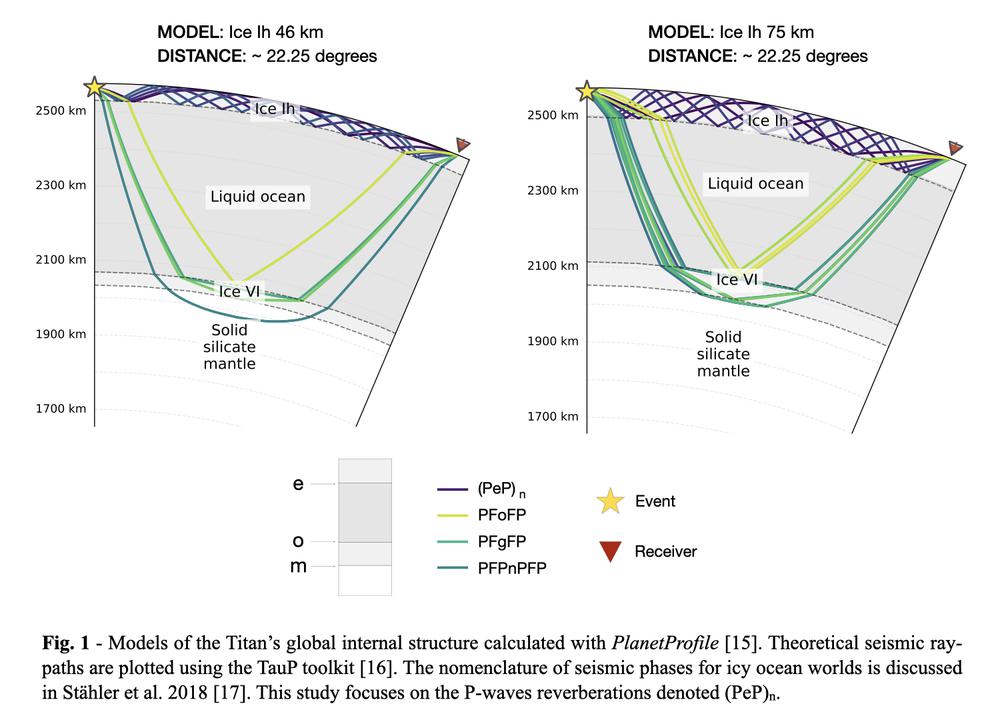
Lorraine Delaroque, Taichi Kawamura, Antoine Lucas, Sébastien Rodriguez, Keisuke Onodera, Hiroaki Shiraishi, Ryuhei Yamada, Satoshi Tanaka, Mark Panning, and Ralph Lorenz

The NASA Dragonfly mission, selected in 2019 as the 4th mission of the New Frontiers mission program, is set to explore Saturn's largest moon, Titan, in the mid-2030s [1]. Titan remains a prime target for astrobiological research due to its dense atmosphere, active organic chemistry, and suspected subsurface liquid ocean beneath an icy crust [2]. One of the Dragonfly’s key science goals is to detect potential biosignatures and to study the coupling between Titan’s internal, surface, and atmospheric layers through the characterization of the transport of materials across the entire body with the tectonic processes that might drive or influence this global circulation. To date, the composition and thickness of internal layers – the outer ice shell, global ocean, possible high-pressure ice phases, and silicate mantle – remain poorly constrained, limiting our understanding of Titan’s habitability potential [3,4].

To address this, the mission will carry the DraGMet SEIS instrument (uniaxial velocity-sensing short-period seismometer and 3-axis geophones mounted on each skid), designed to perform seismic measurements to probe Titan’s subsurface and deeper internal structure. Titan displays a wide variety of surface features, such as large equatorial dune fields [5], mountain chains [6], and impact craters [7], along with multiple lines of evidence of resurfacing processes [8,9], as documented by the Cassini-Huygens mission (2004–2017). These observations suggest ongoing internal and surface geological activity that could produce signals recordable by a single-station seismometer. Among the anticipated seismic sources, icequakes generated by tidal-induced stress are also expected to occur in icy satellite environments [10,11,12]. Our recent investigations focus on the detectability of seismic body wave reverberations of such events within the icy crust under realistic noise conditions, which includes updated experimental data on DraGMet short-period seismometers’ instrumental self-noise under cryogenic temperatures and models of environmental noise based on Titan’s atmospheric dynamics. 

As a first step, we select a seismic source event whose source mechanism and location are consistent with diurnal tidal stress models and surface observations [13]. The event seismic magnitude is set to Mw 4.0, representing an end-member scenario consistent with predictions on Titan seismicity modeled with tidal dissipation energy budgets [14]. Given the uncertainty in ice thickness estimated to range between 50 and 200km [15], we also construct a suite of 1D self-consistent internal structures and anelastic attenuation scenarios, assuming a homogeneous outer water-ice shell (Figure 1).

We simulate high-frequency waveforms with the wavenumber integration method of CPS (Computer Programs in Seismology; [18]), where results are displayed in Figure 2, and then compare the amplitude of the P-wavetrain window content with noise models in the spectral domain.

Atmospheric turbulence is considered as one of Titan's dominant environmental noise sources [22,23]. To enable direct comparisons with synthetic waveform amplitudes, the expected noise level range induced by atmospheric turbulence was modeled for two end-member surface conditions: a highly porous regolith-like material and a rigid icy substrate [24]. In the Fourier domain, environmental noise is predominant at high frequencies (i.e.,≥1Hz), whereas instrumental noise tends to dominate at lower frequencies.

Our results suggest that a Mw≥4.0 event, relatively strong and marginal on Titan, could be detectable within the frequency band where body waves dominate (i.e., 0.1–1Hz) under a low-attenuation scenario. Regardless of the attenuation model, detection becomes increasingly difficult at higher frequencies when the surface is poorly consolidated (i.e., analogous to Martian regolith), limiting the usable frequency range to around 2Hz, or even below 1Hz if the ice is highly attenuating. In the worst-case scenario, involving a thick and strongly attenuating ice shell, the amplitude of these phases is significantly reduced, severely hindering their detection even within the body-waves frequency band (Figure 2). 

When multiples are detectable – for instance, during nearby events, strong enough magnitude, or in low-attenuation ice – reverberations can be used to estimate ice thickness. Assuming a uniform crustal thickness, the time separation between multiples can be directly linked to the ice thickness (see Figure 3). The picking of these multiples using this method is illustrated in Figure 2 with dashed-red lines.

References

[1] Barnes et al. (2021). Planet. Sci. J., 2, 130. [2] Iess et al. (2012). Science, 337, 457-459. [3] Vance et al. (2018). Astrobiology, 18, 37-53. [4] Marusiak et al. (2021). Planet. Sci. J., 2, 150. [5] Lorenz et al. (2006). LPSC XXXVII, abstract #1249. [6] Radebaugh et al. (2007). Icarus, 192, 77-91. [7] Wood et al. (2005). LPSC XXXVI, abstract #1117. [8] Tomasko et al. (2005). Nature, 438, 765-778. [9] Moore et al. (2011). Icarus, 212, 790-806. [10] Greenberg et al. (1998). Icarus, 135, 64-78. [11] Smith-Konter and Pappalardo (2008). Icarus, 198, 435-451. [12] Pappalardo et al. (1997). Icarus, 135, 276-302. [13] Burkhard et al. (2022). Icarus, 371, 114700. [14] Panning et al. (2021). SEG Techn. Progr., 3539-3542. [15] Vance et al. (2018). JGR: Planets, 123, 180-205. [16] Crotwell et al. (1998). Seism. Res. Lett., 70, 154-160. [17] Stähler et al. (2018). JGR: Planets, 123, 206-232. [18] Herrmann (2013). Seism. Res. Lett., 84, 1081-1088. [19] Cammarano et al. (2006). JGR: Planets, 111, E12009. [20] Kuroiwa (1964). Contrib. Inst. Low Temp. Sci., A18, 49-62. [21] Dapré and Irving (2024). Icarus, 408, 115806. [22] Jackson et al. (2020). JGR: Planets, 125, e2019JE006238. [23] Lorenz et al. (2021). Planet. Space Sci., 206, 105320. [24] Onodera et al. (2025). 56th LPSC, abstract #1145. 

How to cite: Delaroque, L., Kawamura, T., Lucas, A., Rodriguez, S., Onodera, K., Shiraishi, H., Yamada, R., Tanaka, S., Panning, M., and Lorenz, R.: Preparing Dragonfly to Titan: Detection of Body Waves to Constrain Ice Shell Thickness, EPSC-DPS Joint Meeting 2025, Helsinki, Finland, 7–13 Sep 2025, EPSC-DPS2025-1311, https://doi.org/10.5194/epsc-dps2025-1311, 2025.

18:18–18:30
|
EPSC-DPS2025-1715
|
ECP
|
On-site presentation
Apurva Oza, Yuk Yung, Gabriel Tobie, Danica Adams, Jennifer Park, Ashley Schoenfeld, Steven Vance, Jeehyun Yang, Amirhossein Bagheri, Stuart Bartlett, Michael Malaska, Flavio Petricca, Nivedita Thiagarajan, and Rosaly Lopes

Cassini/INMS observations of Saturn’s largest moon Titan, a frigid world T0~ 94 K,  hosting a terrestrial-like atmosphere composed predominantly of N2, strongly suggest a missing flux of H2 and CH4 gas in its ~ 1.4 bar atmosphere. Indeed, modeling efforts to date have explored the possibility of extant life on this habitable world, via the process of methanogenesis akin to Enceladus. However, the precise atmospheric influence of cryovolcanism on this likely active body has been understudied, a mechanism Europa Clipper is set to probe at Jupiter’s moon Europa. Here we show that if H2 is sourced from the interior of Titan it is not implausible that it is in thermal equilibrium with its atmosphere. This implies a component of Titan’s atmosphere is indeed sourced by subterranean outgassing and possibly hydrothermal vents, both of which have significant astrobiologic implications. In our surface-atmosphere model, non-equilibrium photochemistry determines the lifetime of the outgassed volatiles, which may in principle, be stochastic. Given that Titan’s high-eccentricity suggests its orbit has undergone significant dynamical evolution, experiencing a range of gravitational tides from ~100 Myr – 4.5 Gyr, it is difficult to determine the current state of Titan’s outgassing without an in-situ Geophysics and Meteorology package, such as the upcoming Dragonfly/DraGMet with a mission launch date set for July 2028. Synthetic Aperture Radar features by Cassini RADAR however do suggest that a putative cryovolcano such as Doom Mons may have fully supplied the hydrocarbon atmosphere against its photodissociation and escape rates over geologically recent timescales.  Another putative cryovolcano Erebor Mons, along with geomorphological evidence of equatorial maar-like pits, implies Titan’s volcanic output over time, is far larger than the current venting rate at Enceladus. Although atmospheric hydrocarbon measurements appear to be energetically favorable for possible subterranean life, it is unclear whether the venting hydrocarbons are a product of a subsurface ocean. Future measurements by the Dragonfly Mass Spectrometer (DraMS) will be able to distinguish subsurface end-members under various thermal equilibrium and non-equilibrium chemical conditions.

How to cite: Oza, A., Yung, Y., Tobie, G., Adams, D., Park, J., Schoenfeld, A., Vance, S., Yang, J., Bagheri, A., Bartlett, S., Malaska, M., Petricca, F., Thiagarajan, N., and Lopes, R.: Hydrothermal and Tidal Energy Flux at Titan, Enceladus, and Europa, EPSC-DPS Joint Meeting 2025, Helsinki, Finland, 7–13 Sep 2025, EPSC-DPS2025-1715, https://doi.org/10.5194/epsc-dps2025-1715, 2025.

Posters: Mon, 8 Sep, 18:00–19:30 | Lämpiö foyer

Display time: Mon, 8 Sep, 08:30–19:30
Chairpersons: Audrey Chatain, Thomas Gautier
Clouds & methane cycle
L37
|
EPSC-DPS2025-1282
|
ECP
|
On-site presentation
Xinting Yu and Xi Zhang

Titan is a unique planetary body that allows us to test our understanding of the physics of cloud formation beyond Earth. The Cassini-Huygens mission has identified various organic clouds in Titan's atmosphere (Anderson et al. 2018), many of which form under conditions vastly different from those on Earth. Contrary to Earth, where the condensate species is predominantly water, Titan’s clouds are composed of methane (CH4), ethane (C2H6), acetylene (C2H2), and hydrogen cyanide (HCN), many of which are photochemically formed and then condense in Titan’s cold atmosphere (e.g., Yu et al 2023). On Earth, aerosol particles made of a range of compositions could serve as the cloud condensation nuclei (CCN) to initiate heterogeneous nucleation. While on Titan, the CCN is dominantly the photochemically-formed refractory haze particles due to their ubiquity in the atmosphere. Titan thus serves as the perfect testbed to test our classical nucleation theory, where the materials involved in the cloud formation process are completely different from Earth. 

In this work, we apply classical nucleation theory, using the experimentally determined surface properties of both potential condensates and haze particles to evaluate the viability of cloud formation in different regions of Titan’s atmosphere. By computing the critical supersaturation required for nucleation, we assess whether observed and hypothesized clouds can realistically form via vapor deposition onto haze particles with varying surface energies.

Our results indicate that classical nucleation theory can explain the formation of many observed clouds in Titan’s atmosphere, including CH4 and C2H6 (in both liquid and solid phases), C2H2, acrylonitrile (C2H3CN), propionitrile (C2H5CN), and HCN. These species are able to nucleate efficiently on haze particles with moderate critical supersaturation (see Figure 1). However, challenges arise for high-altitude clouds, including benzene (C6H6), cyanoacetylene (HC3N), and dicyanoacetylene (C4N2) clouds. We find that clouds of C6H6 and HC3N can form through vapor deposition only if the haze particles have relatively high surface energy, consistent with haze analogs produced using cold plasma in laboratory experiments (Li et al. 2022). This supports that hazes made with cold plasma are better analogs of actual hazes on Titan, which is consistent with previous works (Coll et al., 2013). In contrast, C4N2 clouds require unrealistically high supersaturation levels to form via heterogeneous nucleation, regardless of the haze surface energy, suggesting instead a solid-state photochemical origin (Anderson et al. 2016). This is also consistent with the observations that C4N2 is only observed in the solid phase and is deficient in the gas phase.

We further explore nucleation behavior across Titan’s vertical structure. In the upper stratosphere (80–140 km), haze particles serve as primary ice nuclei for several species. The detection of C6H6 and HC3N clouds in this region provides valuable constraints on haze surface properties. In the lower stratosphere (50–80 km), although multiple species are thermodynamically expected to condense, only C2H2 clouds have been detected. We attribute this discrepancy to compositional changes in the CCN population, likely involving condensation of HCN onto haze particles, consistent with the retrieved DISR/Huygens aerosol property that showed an increase in single scattering albedo of the aerosols in this region (Tomasko et al. 2008). These HCN-coated particles likely inhibit nucleation for other species, such as propyne (C3H4) and propane (C3H8). In the troposphere, cloud formation mechanisms become more complex, involving both deposition and freezing nucleation. Our results suggest that HCN-coated haze particles would still act as efficient CCN and ice nuclei for CH4 and C2H6 cloud formation, depending on whether supercooling occurs before freezing.

Altogether, this work highlights the critical role of particle surface properties in controlling nucleation efficiency. Thus, in future cloud formation studies, solely assessing condensation curves to determine whether a type of condensate can form a cloud is not enough. We need to consider the condensate's properties and the potential CCN to assess whether an atmosphere can provide realistic supersaturation levels to form clouds.

Figure 1: The critical supersaturation ratio (Scric) that is needed when the timescale of the nucleation and settling equals each other for each type of condensate in Titan's atmosphere, where photochemical haze particles are the main INs. Here we use a range of possible surface energies of Titan haze analogs (“tholins") from Li et al. (2022) to perform the calculation, considering the uncertainty of the properties of tholins.

References:

Anderson, C. M., Samuelson, R. E., Yung, Y. L., & McLain, J. L. (2016). Solid‐state photochemistry as a formation mechanism for Titan's stratospheric C4N2 ice clouds. Geophysical Research Letters, 43(7), 3088-3094.

Anderson, C. M., Samuelson, R. E., & Nna-Mvondo, D. (2018). Organic ices in Titan’s stratosphere. Space Science Reviews, 214, 1-36.

Coll, P., Navarro-González, R., Szopa, C., Poch, O., Ramírez, S. I., Coscia, D., ... & Israël, G. (2013). Can laboratory tholins mimic the chemistry producing Titan's aerosols? A review in light of ACP experimental results. Planetary and Space Science, 77, 91-103.

Li, J., Yu, X., Sciamma-O’Brien, E., He, C., Sebree, J. A., Salama, F., ... & Zhang, X. (2022). A cross-laboratory comparison study of Titan haze analogs: Surface energy. The Planetary Science Journal, 3(1), 2.

Tomasko, M. G., Doose, L., Engel, S., Dafoe, L. E., West, R., Lemmon, M., ... & See, C. (2008). A model of Titan's aerosols based on measurements made inside the atmosphere. Planetary and Space Science, 56(5), 669-707.

Yu, X., Yu, Y., Garver, J., Li, J., Hawthorn, A., Sciamma-O’Brien, E., ... & Barth, E. (2023). Material properties of organic liquids, ices, and hazes on Titan. The Astrophysical Journal Supplement Series, 266(2), 30.

How to cite: Yu, X. and Zhang, X.: Cloud Formation on Titan through Heterogenous Nucleation, EPSC-DPS Joint Meeting 2025, Helsinki, Finland, 7–13 Sep 2025, EPSC-DPS2025-1282, https://doi.org/10.5194/epsc-dps2025-1282, 2025.

L38
|
EPSC-DPS2025-1817
|
ECP
|
On-site presentation
Haozhe Dong, Alessandra Candian, Annemieke Petrignani, Duncan Mifsud, Richárd Rácz, Maëva Louis, Sergio Ioppolo, Béla Sulik, Sandor Biri, and Zoltán Juhász

Motivation. Polycyclic Aromatic Hydrocarbon (PAH) molecules are believed to be abundant and widespread on Titan. Cassini indeed detected large amounts of positive ions in the moon's ionosphere via mass spectrometry that have been identified as PAHs and PAH derivatives containing up to 24 carbon atoms [1]. Remote sensing infrared measurements have also suggested the presence of PAHs/PANHs up to 10-11 rings in the atmosphere [2,3]. They are considered key ingredients for the formation of the aerosol responsible for the orange haze layer and they can also end up closer to the surface, where they would condensate as it happens to benzene C6H6 and other hydrocarbons. What is the fate and role of condensed PAHs and hydrcarbons in Titan's lower atmosphere? Can they promote new chemistry?

Methodology. We used the AQUILA chamber at the ECRIS Facility at HUN-REN ATOMKI to investigate the energetic processing of pure ices phenanthrene (C14H10) and acetonitrile (CH3CN) and their mixtures by 10 keV H+ (protons). Phenanthrene was chosen as a prototypical PAH molecule and acetonitrile has been detected by [4]   The ice samples were prepared in situ by depositing the molecule onto the cold substrate (20 K) placed in the AQUILA UHV chamber. The ices are then irradiated with proton fluences in the range [2.5 1012-1.5 1016] cm2.  In the chamber the evolution of the ices is monitored by an FTIR spectrometer.

Results. The irradiation of phenanthrene ice as function of  proton fluences show a decrease of all the typical IR peaks of phenanthrene with simialr rates and no clear emergence of new features.  We interpreted this as the proton bombardment  leads to a compactification of the ices.  In the case of acetonitrile irradiation, we observe the formation of new strong peaks at around ~3130 cm-1 and ~1645 cm-1, which are consistent with the formation of HCN and H3CHNH. Interestingly, the ice mixture C14H10:CH3CN shows  the formation of the same peaks as for the acetonitrile ice only but their strength increases at a lower rate than for the pure sample.  This can be interpreted as if phenanthrene molecules within the mixture partially protects the acetonitrile from creating new species. Future analysis of the gas-phase QMS data taken at the same time as the irradiation will allow us to gain better insight in the processes happening within the ices. The result of this study has implication for our understanding of hydrocarbon ices evolution in Titan’s lower atmosphere.

References.

[1] Haythornthwaite et al 2021, Planet. Sci. J, 2, 26

[2] López-Puertas et al 2013, ApJ, 770 132

[3] Stikkelbroeck et al 2025, ID EPSC-DPS2025-1444

[4] Coustenis et al 2007, Icar., 189, 35

Acknowledgements. The authors gratefully acknowledge support from the Europlanet RI through the Transnational Access Project Grant no. 22-EPN3-053. The Europlanet RI has received funding from the European Union’s Horizon 2020 Research Innovation Program under grant agreement no. 871149.

How to cite: Dong, H., Candian, A., Petrignani, A., Mifsud, D., Rácz, R., Louis, M., Ioppolo, S., Sulik, B., Biri, S., and Juhász, Z.: Energetic processing of pure and mixed hydrocarbon ices for application to Titan's atmosphere, EPSC-DPS Joint Meeting 2025, Helsinki, Finland, 7–13 Sep 2025, EPSC-DPS2025-1817, https://doi.org/10.5194/epsc-dps2025-1817, 2025.

L39
|
EPSC-DPS2025-108
|
ECP
|
On-site presentation
Lucie Rosset, Audrey Chatain, Yassin Jaziri, Nathalie Carrasco, Bruno de Batz de Trenquelléon, Clément Petetin, and Enora Moisan

1. Introduction

The thick atmosphere of Titan is home to complex, tightly coupled dynamics, photochemistry and microphysics. Methane is abundent, and the conditions of pressure and temperature allow for the development of a methane cycle similar to that of water on Earth, with convective methane clouds forming in the troposphere [1]. In addition to the methane cycle, stratiform hydrocarbon clouds at the poles, or HCN clouds at high altitude have also been observed [2]. Knowledge of Titan’s clouds mostly comes from the data collected during the Cassini-Huygens mission (2014-2017). In this context, climate models are invaluable tools for understanding the mechanisms at work and deepening our interpretation of these observations. The characteristics and conditions of formation of Titan’s clouds depends on many parameters and mechanisms, among which the atmospheric conditions, but also the properties of the photochemical aerosols that serve as privileged cloud condensation nuclei. The aim of this presentation is to assess the impact of these different factors on cloud formation and composition, and their repercussions on Titan's climate.

2. Methods

The Titan Planetary Climate Model (Titan PCM [3]), first developed at the Pierre-Simon Laplace Institute (IPSL), is a 3D model that can simulate Titan’s Climate at a global scale. By integrating couplings between dynamics, radiative transfer, chemistry and microphysics, it enables to study the interaction between these various processes and their influence on each other. In particular, it now includes a microphysical model in moments for haze and clouds [4]. Nevertheless, discrepancies with observations persist, and in its current state, the model only takes into account the condensation of a limited number of species (CH4, C2H2, C2H6, HCN) in the form of ice only, and independently of each other. Certain parameters, such as wettability or density of the aerosols, also remain poorly constrained. We want to further develop the microphysical model in order to improve the description of clouds on Titan and better understand the mechanisms of cloud formation and the methane cycle.

3. Results and objectives

Previous studies have hypothesized the existence of different cloud layers in the troposphere, with solid mehane cloud forming around 25 km of altitude, and liquid methane-nitrogen clouds closer to the surface, around 10 km [5,6]. While the model reproduces cloud formation at these two altitudes at a latitude and period coherent with observations, it does not consistently discriminate two distinct layers between 10 and 30 km (see Fig. 1). Therefore, forthcoming studies will focus on the implementation of the various phases of the droplets (solid and liquid), which would enable the impact of mixtures and interactions between species to be taken into account at a later stage. First, we will investigate the formation of liquid-phase clouds in the troposphere. In particular, the role of ethane and nitrogen in the condensation and stabilization of liquid methane will be studied. Model results will be compared with observations. These developments will first be tested in a 1D study before being incorporated into the 3D model.

Fig. 1 : Comparison between the modeled cloud extinction profile at 0.7 μm (in red) and the modeled temperature profile (in black dashed line) at low latitudes (30°N) during the middle of northern summer (Ls=135°). The extinction peak between 30-80 km corresponds to a mist layer of minor species condensates, while the extinction below is associated with methane clouds. The altitude scale on the right axis is approximate.


References

[1] Turtle, E. P., J. E. Perry, J. M. Barbara, A. D. Del Genio, S. Rodriguez, S. Le Mouélic, C. Sotin, et al. « Titan’s Meteorology Over the Cassini Mission: Evidence for Extensive Subsurface Methane Reservoirs ». Geophysical Research Letters 45, no 11 (2018): 5320‑28. https://doi.org/10.1029/2018GL078170.

[2] West, R. A., Del Genio, A. D., Barbara, J. M., Toledo, D., Lavvas, P., Rannou, P., . . . Perry, J. (2016). « Cassini Imaging Science Subsystem observations of Titan’s south polar cloud ». Icarus, 270 , 399-408. doi:10.1016/j.icarus.2014.11.038

[3] De Batz De Trenquelléon, Bruno, Lucie Rosset, Jan Vatant d’Ollone, Sébastien Lebonnois, Pascal Rannou, Jérémie Burgalat, et Sandrine Vinatier. « The New Titan Planetary Climate Model. I. Seasonal Variations of the Thermal Structure and Circulation in the Stratosphere ». The Planetary Science Journal 6, no 4 (1 avril 2025): 78. https://doi.org/10.3847/PSJ/adbbe7.

[4] De Batz De Trenquelléon, Bruno, Pascal Rannou, Jérémie Burgalat, Sébastien Lebonnois, et Jan Vatant d’Ollone. « The New Titan Planetary Climate Model. II. Titan’s Haze and Cloud Cycles ». The Planetary Science Journal 6, no 4 (1 avril 2025): 79. https://doi.org/10.3847/PSJ/adbb6c.

[5] Wang, Chia C., Sushil K. Atreya, et Ruth Signorell. « Evidence for Layered Methane Clouds in Titan’s Troposphere ». Icarus 206, no 2 (avril 2010): 787‑90. https://doi.org/10.1016/j.icarus.2009.11.022.

[6] Curtis, Daniel B., Courtney D. Hatch, Christa A. Hasenkopf, Owen B. Toon, Margaret A. Tolbert, Christopher P. McKay, et Bishun N. Khare. « Laboratory Studies of Methane and Ethane Adsorption and Nucleation onto Organic Particles: Application to Titan’s Clouds ». Icarus 195, no 2 (juin 2008): 792‑801. https://doi.org/10.1016/j.icarus.2008.02.003.

How to cite: Rosset, L., Chatain, A., Jaziri, Y., Carrasco, N., de Batz de Trenquelléon, B., Petetin, C., and Moisan, E.: Cloud formation and composition on Titan with a Planetary Climate Model, EPSC-DPS Joint Meeting 2025, Helsinki, Finland, 7–13 Sep 2025, EPSC-DPS2025-108, https://doi.org/10.5194/epsc-dps2025-108, 2025.

L40
|
EPSC-DPS2025-1397
|
ECP
|
On-site presentation
Clément Petetin, Pascal Rannou, Sébastien Lebonnois, and Bruno De Batz de Trenquelleon

1 Introduction
In Titan’s atmosphere and on its surface, methane plays a crucial role in the global climate. Since the methane cycle resembles Earth’s water cycle, and one important aspect of Earth’s water cycle is infiltration into the ground and storage in underground aquifers, it is reasonable to draw parallels. We know from the Cassini mission (2004 -2017) that methane precipitation occurs on Titan’s surface [1], and from the Huygens probe that the surface is moist [2]. It is therefore easy to imagine that, just like on Earth, methane infiltrates Titan’s soil, creating a subsurface cycle that alters the soil’s properties and its temperature. Certain aspects of the methane cycle are not well understood, and models struggle to reproduce some observations. The lack of data on many parameters of Titan’s soil and atmosphere makes accurate modeling challenging. Understanding the distribution of methane in the subsurface and its overall effect on surface temperature could improve the interpretation of observations of lakes and surface moisture, as well as predict regions of precipitation. Like the asymmetry of the seasons which creates an uneven distribution of methane across Titan’s surface and atmosphere. The Titan Planetary climate model of Titan, first developed at the Institut Pierre-Simon Laplace [3], is a useful tool for exploring the interaction between the surface and the atmosphere. Adding a subsurface model to this existing framework which already includes surface precipitation and evaporation would make it possible to visualize the distribution of methane within Titan’s soil and its interaction with atmospheric dynamics. The microphysical processes associated with the clouds of various species present in Titan PCM allow for a better representation of cloud formation through nucleation and condensation.


2 Method and objective
For the inclusion of a liquid infiltration and diffusion model in Titan’s PCM, inspired by [4], the subsurface is  given the ability to retain liquid methane within its layers. A liquid flux through a porous medium is added to the thermal transfer processes, based on mass conservation and Darcy’s law. The transfer of liquid mass within the subsurface impacts the soil’s energy balance. Transfers are calculated in three dimensions, with diffusion and gravity driving the movement of the liquid. Vertically, the gravitational potential dominates, but horizontally, the slope between a flat surface and that inferred from the topography is weaker. The subsurface reservoir creates methane storage zones that can become lakes, depending on the height of the saturated layer and Titan’s topography. A sufficiently detailed topography could reproduce methane basins where underground methane forms shorelines at the surface. This would affect the availability of surface methane. Many parameters, particularly the characteristics of the soil, remain unknown. By comparing model results to observations, refining the free parameters can provide estimates of Titan’s subsurface conditions such as soil porosity, tortuosity, and the degree of saturation with liquid methane. In this presentation we will present the result of simulations perfomed with the PCM that accounts for surface methane without and with interaction with the subsurface. We will focus on the difference in the cloud maps, precipitations and methane planetery flux in the atmoshere and in the subsurface. Several scenario will be considered and our model will be combared to available data.

References
[1] E. P. Turtle, J. E. Perry, J. M. Barbara, A. D. Del Genio, S. Rodriguez, S. Le Mou´elic, C. Sotin, J. M. Lora, S. Faulk, P. Corlies, J. Kelland, S. M. MacKenzie, R. A. West, A. S. McEwen, J. I. Lunine, J. Pitesky, T. L. Ray, and M. Roy. Titan’s Meteorology Over the Cassini Mission: Evidence for Extensive Subsurface
Methane Reservoirs. , 45(11):5320–5328, June 2018.
[2] H. B. Niemann, S. K. Atreya, S. J. Bauer, G. R. Carignan, J. E. Demick, R. L. Frost, D. Gautier, J. A. Haberman, D. N. Harpold, D. M. Hunten, G. Israel, J. I. Lunine, W. T. Kasprzak, T. C. Owen, M. Paulkovich, F. Raulin, E. Raaen, and S. H. Way. The abundances of constituents of Titan’s atmosphere from the GCMS
instrument on the Huygens probe. , 438(7069):779–784, December 2005.
[3] Sébastien Lebonnois, J´er´emie Burgalat, Pascal Rannou, and Benjamin Charnay. Titan global climate model: A new 3-dimensional version of the IPSL Titan GCM. , 218(1):707–722, March 2012.
[4] Sean P. Faulk, Juan M. Lora, Jonathan L. Mitchell, and P. C. D. Milly. Titan’s climate patterns and surface methane distribution due to the coupling of land hydrology and atmosphere. Nature Astronomy, 4:390–398, January 2020.

How to cite: Petetin, C., Rannou, P., Lebonnois, S., and De Batz de Trenquelleon, B.: Effect of subsurface on the methane cycle in Titan’s atmosphere with a Planetary Climate Model, EPSC-DPS Joint Meeting 2025, Helsinki, Finland, 7–13 Sep 2025, EPSC-DPS2025-1397, https://doi.org/10.5194/epsc-dps2025-1397, 2025.

Lakes
L41
|
EPSC-DPS2025-2044
|
ECP
|
On-site presentation
Audrey Chatain, Léa E Bonnefoy, Enora Moisan, Scot Rafkin, Alejadro Soto, Juan Lora, Aymeric Spiga, Maxence Lefèvre, and Ricardo Hueso

Titan hosts quite Earth-like weather patterns. This is mainly due to the fact that its surface pressure is very close to the Earth’ (1.5 bar) and that methane is abundant and with atmospheric conditions near its triple point. It can therefore be a gas, a liquid or a solid with small variations in the temperature or pressure. We then observe similar landscapes and weather processes as on Earth: clouds, rain, rivers, lakes, seas (Hayes, 2016, Ann Rev EPS; Turtle et al., 2018, GRL)…

The Cassini-Huygens mission gave us insights on the surface conditions and topography on Titan. The future Dragonfly mission will allow an in-depth analysis of an equatorial location just after the Northern winter solstice with many meteorological sensors (Barnes et al., 2021, PSJ).

In the meantime, and to help prepare future Dragonfly operations, we can run climate models in Titan’s conditions to investigate typical weather patterns in the atmosphere. Here we focus on surface-atmosphere local interactions with an idealized mesoscale model (with a horizontal resolution of 1-4 km) based on the WRF (Weather Research and Forecasting) model developed by NCAR for Earth weather predictions. We call it mtWRF (“mesoscale Titan WRF”). This model can in particular simulate a methane lake (Rafkin & Soto, 2020, Icarus), in 3D (Chatain et al., 2024, Icarus), with topography (Moisan et al., PSJ, in review) and includes the diurnal influence of radiations (Chatain et al., 2022, PSJ). We use input atmospheric profiles from the global scale Titan Atmospheric Model (Lora et al., 2022, Icarus) at various locations and seasons. We investigate the influence of topography with idealized maps as well as synthetic topography maps based on radar data at specific locations on Titan (Bonnefoy et al., EPSC 2024).

Results show that lakes cool down by evaporating methane into the atmosphere. This induces a local cooling of the atmosphere and strong winds at the shores. We observe strong diurnal, latitudinal and seasonal variations, showing that solar heating plays a major role.

These results will help us understand the general absence of waves in lake observations, the possibility of fog in depressions, the evaporation rate of ponds after heavy rains and the intensity of winds created by local slopes.


References:

Barnes, J. W., Turtle, E. P., Trainer, M. G., Lorenz, R. D., MacKenzie, S. M., Brinckerhoff, W. B., Cable, M. L., Ernst, C. M., Freissinet, C., Hand, K. P., Hayes, A. G., Hörst, S. M., Johnson, J. R., Karkoschka, E., Lawrence, D. J., Gall, A. Le, Lora, J. M., McKay, C. P., Miller, R. S., … Stähler, S. C. (2021). Science goals and objectives for the Dragonfly Titan rotorcraft relocatable lander. Planetary Science Journal, 2(4), 130. https://doi.org/10.3847/PSJ/abfdcf

Bonnefoy, L. E., Lefèvre, M., Chatain, A., Spiga, A., Hayes, A. G., Rodriguez, S., & Lucas, A. (2024). Synthetic topography, roughness, albedo, and thermal inertia maps for mesoscale modeling on Titan. Europlanet Science Congress 2024, 907. https://doi.org/10.5194/epsc2024-907

Chatain, A., Rafkin, S. C. R., Soto, A., Hueso, R., & Spiga, A. (2022). Air – Sea Interactions on Titan: Effect of Radiative Transfer on the Lake Evaporation and Atmospheric Circulation. The Planetary Science Journal, 3(10), 232. https://doi.org/10.3847/PSJ/ac8d0b

Chatain, A., Rafkin, S. C. R., Soto, A., Moisan, E., Lora, J. M., Le Gall, A., Hueso, R., & Spiga, A. (2024). The impact of lake shape and size on lake breezes and air-lake exchanges on Titan. Icarus, 411(December 2023), 115925. https://doi.org/10.1016/j.icarus.2023.115925

Hayes, A. G. (2016). The Lakes and Seas of Titan. Annual Review of Earth and Planetary Sciences, 44(1), 57–83. https://doi.org/10.1146/annurev-earth-060115-012247

Lora, J. M., Battalio, J. M., Yap, M., & Baciocco, C. (2022). Topographic and orbital forcing of Titan’s hydroclimate. Icarus, 384(May), 115095. https://doi.org/10.1016/j.icarus.2022.115095

Moisan, E., Chatain, A., Rafkin, S. C. R., Soto, A., Mackenzie, S. M., & Spiga, A. (n.d.). Ramparts around lakes on Titan impact winds and methane evaporation. In Revision for the Planetary Science Journal.

Rafkin, S. C. R., & Soto, A. (2020). Air-sea interactions on Titan: Lake evaporation, atmospheric circulation, and cloud formation. Icarus, 351, 113903. https://doi.org/10.1016/j.icarus.2020.113903

Turtle, E. P., Perry, J. E., Barbara, J. M., Del Genio, A. D., Rodriguez, S., Le Mouélic, S., Sotin, C., Lora, J. M., Faulk, S., Corlies, P., Kelland, J., MacKenzie, S. M., West, R. A., McEwen, A. S., Lunine, J. I., Pitesky, J., Ray, T. L., & Roy, M. (2018). Titan’s Meteorology Over the Cassini Mission: Evidence for Extensive Subsurface Methane Reservoirs. Geophysical Research Letters, 45(11), 5320–5328. https://doi.org/10.1029/2018GL078170


How to cite: Chatain, A., Bonnefoy, L. E., Moisan, E., Rafkin, S., Soto, A., Lora, J., Spiga, A., Lefèvre, M., and Hueso, R.: The local effect of surface liquid methane and topography on Titan’s weather, EPSC-DPS Joint Meeting 2025, Helsinki, Finland, 7–13 Sep 2025, EPSC-DPS2025-2044, https://doi.org/10.5194/epsc-dps2025-2044, 2025.

L42
|
EPSC-DPS2025-844
|
On-site presentation
Samuel Birch, Rose Palermo, Una Schneck, Andrew Ashton, Alexander Hayes, Jason Soderblom, W. Hamish Mitchell, and J. Taylor Perron

Earth's coastlines serve as the intersection for numerous physical and chemical processes between terrestrial and marine systems. Liquids of different compositions meet, materials eroded from the continents are concentrated in sedimentary deposits, and the diverse planform morphologies of coastal landforms are shaped by erosional and sediment transport processes. Accordingly, coastal landscapes preserve valuable records of processes that govern Earth's climate, materials, and tectonic history. Applying our understanding from Earth to the coastlines around Titan's liquid hydrocarbon seas allows us to investigate the climate history of the only other known active hydrological system. The study of Titan's coastlines, particularly its deltas, however, remains challenging due to the limitations of Cassini Synthetic Aperture Radar (SAR) data and the transparency of Titan's fluids to microwave radiation. To understand these limitations, we developed a numerical model to simulate Earth's coastlines as they would appear in Cassini SAR images. We show that multi-kilometer-scale landforms are detectable on Titan, provided there is sufficient contrast between the land surface and seafloor. We revisit Titan and show that many of its large coastal rivers do not terminate in deltas, in contrast to Earth. Additionally, we uncover submerged features on Titan's seafloors, suggesting sea-level cycling and/or active sub-aqueous flow. We propose preliminary hypotheses to explain the presence or absence of various coastal landforms on Titan, offering directions for future investigations into Titan's climate and materials. Moreover, we emphasize the opportunities and benefits a superior imaging system at Titan could provide to both Titan science and studies of Earth's changing coasts.

How to cite: Birch, S., Palermo, R., Schneck, U., Ashton, A., Hayes, A., Soderblom, J., Mitchell, W. H., and Perron, J. T.: Detectability of Coastal Landforms on Titan with theCassini RADAR, EPSC-DPS Joint Meeting 2025, Helsinki, Finland, 7–13 Sep 2025, EPSC-DPS2025-844, https://doi.org/10.5194/epsc-dps2025-844, 2025.

L43
|
EPSC-DPS2025-1245
|
On-site presentation
Jordan Steckloff, Jason Soderblom, Alejandro Soto, and Gerrick Lindberg

Diffusive Saturation of Titan’s Lakes

In our everyday lives and laboratories, molecules diffuse from relatively high concentrations to relatively low concentrations, as is stated by Fick’s Law of Diffusion (diffusive molar flux is proportional to the concentration gradient).  However, Fick’s Law is an empirical law derived from Fourier’s mathematical description of heat flow (Fick, 1855), which only spontaneously flows from hot to cold. Fick literally notes that: “One only needs to swap the word ‘quantity of heat’ with ‘quantity of dissolved substance’ and the word ‘temperature’ with ‘concentration’” (Fick, 1855, p.65). However, it is now known that diffusing molecules follow gradients in chemical potential, rather than gradients in concentration. 

For many systems, including all that Fick considered, these two quantities are effectively analogous and behave interchangeably. Nevertheless, deviations from Fick’s Law, including the well-studied phenomenon of “uphill diffusion” against concentration gradients(e.g., Krishna, 2015), can occur when equilibrium thermodynamic conditions nevertheless sufficiently vary across a system to significantly affect the chemical potentials throughout the system.

Such is the case within Titan’s lakes, where the pressure gradient within the lake due to hydrostatic pressure causes these deviations. Titan’s lakes are composed primarily of methane-ethane mixtures that dissolve atmospheric nitrogen, with higher pressures promoting higher solubility of N2. According to Fickian diffusion, these lakes would dissolve N2 until the entire lake matches the concentration of N2 at the surface in Vapor-Liquid Equilibrium (VLE). However, this ignores the higher solubility of N2 at depth, which “pulls” additional N2 downward to greater depths to equilibrate the chemical potentials. Thus, as chemical potentials equilibrate, N2 concentrations at depth will increase above those at the surface, leading to N2 diffusing “uphill” against the concentration gradient.


Energy Minimization

Upon dissolution of atmospheric nitrogen, Titan’s lakes will release energy to the environment until saturation is achieved. Imagine a lake on Titan not yet saturated in nitrogen (N2 may even be increasing with depth, but is not yet saturated) and consider a nitrogen molecule in the lake that randomly diffuses to a deeper layer, opening up room for a molecule from a higher layer to diffuse down. This ultimately enables another N2 molecule to dissolve from the atmosphere (releasing its latent heat of condensation). Over time, the lake releases this latent heat until it becomes saturated in nitrogen.


Entropy Maximization

In statistical mechanics, the entropy of a system is proportional to the natural log of the number of microscopic states accessible to the system, with each state equally probable. Thus, maximizing the number of unique microscopic states maximizes the entropy of the system.  Because nitrogen concentrations at saturation increase with depth, the number of available microscopic states for N2 similarly increases with depth.  Thus, were a nitrogen molecule to randomly diffuse to a deeper layer and enable additional N2 molecules to dissolve into the lake, the system would suddenly have access to a much larger number of states: nearly the same number of microscopic states that it previously had access multiplied by the number of states that this newly dissolved molecule can be found in. Thus, the lake would continue dissolving atmospheric N2, driving uphill diffusion until it fully saturates.


Random Walk

In a three-dimensional random walk, a particle has an equal probability of moving in any direction at each step; in diffusion, these steps are motion between collisions with other molecules. Eventually, a particle diffusing in an inert box is equally likely to be in any position in that box; this is a direct result of the particle having no preferential interaction with the box. This is not the case for N2 diffusing through a methane lake, which interacts ever more strongly with nitrogen at depth. Under pressure, methane  “holds on” to the nitrogen more strongly, causing any diffusing N2 molecule to spend more time at depth than near the surface, and thus be preferentially found at depth.  With these same dynamics playing out over a grand canonical ensemble of particles, the effect is increasing N2 concentrations with depth.

This random walk framework further allows us to estimate the timescale of this process.  In a three-dimensional random walk, the standard deviation (σ) of the average distance (d) traveled from the starting point is 

Where N is the number of steps in the random walk and λ is the mean free path of a nitrogen molecule 

Where n is the molecular density of the liquid and R is the scattering radius of the molecule. The kinetic diameter of a nitrogen molecule is 3.64 angstroms, and the molecular densities of liquid nitrogen (1.7x1028 molecules/m3) and liquid methane (2.2x1028 molecules/m3) correspond to a mean free path of ~3-4 angstroms for liquid nitrogen and methane.

Thus, the number of steps needed for the standard deviation (σ) of this random walk to equal a distance d is

Also consider that the time required for each step is just the time required for a nitrogen molecule to move a distance λ while traveling at the thermal speed

which is ~260 m/s for a nitrogen molecule at 90 K. Thus, by multiplying the number of steps by  τ, we obtain the timescale τdiffusive required for the standard deviation of diffusing nitrogen to grow to a depth d is:

This shows that Titan’s deepest (~100m lakes) diffusively saturate over timescales of ~1-10 millennia in the absence of a mechanism changing the system, such as overturn, which can degas the lake. This timescale drops to centuries for lakes ~40 m deep and decades for lakes ~10 m deep. Thus stagnant lakes on Titan will diffusively saturate over relatively short timescales.


References

Fick, A. (1855) Ueber Diffusion. Annalen der Physik 170, 59-86


Krishna, R. (2015) Uphill Diffusion in Multicomponent Mixtures. Chemical Society Reviews 44, 2812-2836

How to cite: Steckloff, J., Soderblom, J., Soto, A., and Lindberg, G.: Diffusing "Uphill" Against the Concentration Gradient and the Saturation of Stagnant Lakes on Titan, EPSC-DPS Joint Meeting 2025, Helsinki, Finland, 7–13 Sep 2025, EPSC-DPS2025-1245, https://doi.org/10.5194/epsc-dps2025-1245, 2025.

L44
|
EPSC-DPS2025-2014
|
On-site presentation
Jason Soderblom, Jordan K. Steckloff, Alejandro Soto, and Samuel P.D. Birch
  • Introduction

Titan is the only extraterrestrial body known to have surface liquids with an associated hydrologic cycle, complete with rivers, lakes, seas, evaporation/condensation and precipitation; albeit with cycling mixtures of methane, ethane, and large, temperature-dependent quantities of dissolved atmospheric nitrogen [1–2]. Unlike water and its common solutes on Earth, however, the physical properties of methane–ethane–nitrogen mixtures are highly sensitive to composition, temperature, and pressure/depth. Understanding these variations is crucial for understanding the behavior of Titan’s surface liquids and its broader climate and weather patterns.

Deriving these properties, however, is not trivial. These three species can interfere with each other’s intermolecular bond strengths. As such, methane, ethane, and nitrogen don’t ideally mix; i.e., they differ significantly from Raoult’s Law [3]. As a result, the physical properties of methane–ethane–nitrogen mixtures under Titan-like conditions are much more complicated to compute accurately than if they could be treated as an ideal mixture.


  • Methods

We use TITANPOOL [4], which computes the properties of liquid methane–ethane–nitrogen mixtures on Titan that are in vapor–liquid equilibrium (VLE) with the atmosphere. For a given temperature and relative methane–ethane ratio; TITANPOOL numerically determines the equilibrium nitrogen concentrations and then uses this composition to compute the physical properties of the liquid (e.g., density, surface, tension, viscosity, etc.). TITANPOOL integrates down the liquid column by adding the hydrostatic pressure from the liquid column overlying the material at the depth in question to compute the pressure from which equilibrium properties are derived.

TITANPOOL uses the GERG-2008 [5–6] equation of state (EOS) for methane–ethane–nitrogen mixtures, as published in REFPROP10 by NIST [7]. The GERG-2008 EOS has been benchmarked against laboratory studies under Titan-relevant conditions and is accurate to within a few percent [4]. As noted above, our results assume that the liquid is in VLE with the atmosphere, and that the liquid is saturated in nitrogen. The justification for this assumption is presented in this EPSC-DPS2025 session, in “Diffusing "Uphill" Against the Concentration Gradient and the Saturation of Stagnant Lakes on Titan” (Steckloff et al.).


  • Results

We consider 90–94K isothermal 140m-deep lakes and a 1.47-bar surface pressure [6]. We use 2m integration steps for depth and parse the methane–ethane composition in 5% methane–alkane fraction steps (defined as the molar concentration of methane divided by the sum of the molar concentrations of methane and ethane). Nitrogen saturation includes dependencies on T, P (derived from the density of the overlying liquid column) and methane–alkane fraction.

The densities of the three liquids differ significantly, liquid nitrogen being the densest and methane the lightest. Nitrogen is significantly more soluble in methane-rich mixtures, however, leading to curious behavior at low temperatures (e.g., 90 K) where, at high pressure/depth, the liquid density is highest for methane-dominated and ethane-dominated mixture, and lower for more equal methane–ethane mixtures.

The viscosities of these liquids (which describe resistance to flow) also differ significantly, with liquid nitrogen having the lowest viscosity (REFPROP computes viscosities of hydrocarbon mixtures to within ~4% [9]). This leads to the strange behavior on Titan where, as depth increases (and thus nitrogen concentration), viscosity decreases.  The lower layers Titan’s lakes flow more readily than their surfaces, with viscosities at depth ~10–100% lower than at the surface—this is extremely foreign to us, as there are no common analogous lakes on Earth.

Surface tension (which measures how strongly liquids cohere) increases with ethane concentration. Like water, surface tension does not show much dependance on pressure, except at the coldest temperature considered. At 90K, surface tension increases with depth for ethane-dominated mixtures but decrease with depth/pressure for methane-dominated mixtures. We caution, however, as the surface tension of ethane is not as well studied as it is for methane and nitrogen [9].


  • Discussion

These properties will influence the dynamics of Titan’s lakes. Methane-rich lakes exhibit larger density gradients than ethane-rich lakes and thus are more stable against overturn/mixing, and more resistant to non-density-driven circulation. If circulation were to begin in a methane-rich lake and push nitrogen-saturated materials to shallower depths, the liquid would exsolve nitrogen [10], reducing its density, further driving circulation.

Liquid properties influence the initiation and growth of wind-driven capillary-gravity waves on liquid bodies [11]. Our methane-rich liquid properties are similar to those used in pervious wave modeling [12] and thus support their conclusions. Our surface tension for ethane-rich liquids, however, are ~2X larger than those of [12], which would result in a greater restoring force that shifts the transition from capillary waves to capillary-gravity waves to larger wavelengths and result in waves most easily excited by wind that have higher phase speeds and longer wavelengths.

Fluid properties also influence how liquids interaction with landscapes. Surface tension governs capillary draw-up; lower surface tensions imply less groundwater supply into Titan’s rivers. Groundwater instead would be more readily sequestered, potentially following topography and affecting only locations of large liquid bodies. Density governs the dynamics of fluid runoff and sediment transport. As temperate may evolve within a Titan river [13], its ability to transport sediment may change as it traverses from Titan's highlands to its seas, influencing the formation and morphology of bedforms, and erosion of channel beds.


Acknowledgments: We acknowledge support from NASA grants NNX15AL48G and 80NSSC18K0967, and the Heising-Simons Foundation.

References: [1] Lunine et al. (1983) Science 222:1229–1230; [2] Mitri et al. (2007) Icarus 186:385–394; [3] Glein and Shock (2013) Geochimica Cosmochimica Acta 115, 217–240; [4] Steckloff et al. (2020) PSJ 1:26; [5] Kunz et al. (2007) European Gas Reserach Technical Monograph, 15; [6] Kunz & Wagner (2012) J. Chemical Engineering Data, 57:3032–3091; [7] Lemmon et al. (2010) REFPROP, V.9.0, Maryland; [8] Lindal et al. (1983) Icarus 53:348–363; [9] Huber et al. (2022) Industrial Engineering Chemistry Res. 61:15449–15472; [10] Cordier et al. (2017) Nature Astronomy 1:0102; [11] Kinsman (1984) ISBN 0486646521; [12] Hayes et al. (2013) Icarus 225:403–412; [13] Corlies et al. (2023) Titan Through Time VI, Paris, France.


How to cite: Soderblom, J., Steckloff, J. K., Soto, A., and Birch, S. P. D.: The Properties of Titan’s Surface Liquids, EPSC-DPS Joint Meeting 2025, Helsinki, Finland, 7–13 Sep 2025, EPSC-DPS2025-2014, https://doi.org/10.5194/epsc-dps2025-2014, 2025.

Atmospheric chemistry, haze & plasma
L45
|
EPSC-DPS2025-331
|
ECP
|
Virtual presentation
Konstantin Kim, Lina Z. Hadid, and Niklas J.T. Edberg

Waves in plasmas play a significant role in the transfer of energy between various plasma populations. As an example, the moon-plasma interaction of Titan’s ionosphere and Saturn’s magnetosphere can exhibit processes requiring wave generation. However, wave signatures have not been systematically analysed at Titan and have only been analysed for a few flybys, e.g., Russel et al., 2016. In this work, we characterise low-frequency waves in Titan’s plasma environment based on observations from Cassini. We use magnetometer data (MAG) to identify low-frequency wave signatures in Titan’s exosphere/ionosphere. We also analyse moments from the ion and electron Cassini Plasma Spectrometer (CAPS) when the data is available. We find 10 flybys with the wave signatures around the local ion cyclotron frequency. We also find that most of the wave signatures are found on the anti-Saturn face of Titan. The average amplitude of a wave is < 1 nT in most cases. Finally, we discuss how these waves can affect plasma dynamics around Titan and contribute to Titan’s upper ionosphere dynamics.

How to cite: Kim, K., Hadid, L. Z., and Edberg, N. J. T.: Characterisation of low-frequency waves in Titan’s plasma environment, EPSC-DPS Joint Meeting 2025, Helsinki, Finland, 7–13 Sep 2025, EPSC-DPS2025-331, https://doi.org/10.5194/epsc-dps2025-331, 2025.

L46
|
EPSC-DPS2025-85
|
ECP
|
On-site presentation
Ryushi Miyayama, Laura Schaefer, Hiroshi Kobayashi, and Andrea Zorzi

Meteoroid entry into planetary atmospheres generates bow shocks, resulting in high-temperature gas conditions. In shocked gas, high temperatures accelerate chemical reactions, leading to significant compositional changes. However, as the gas expands and cools, the reaction rate decreases (cf. Arrhenius's law) and eventually becomes slower than the cooling timescale, causing chemical reactions to freeze out. Thus, the final chemical composition is governed by two key fliud dynamical processes: shock heating and subsequent cooling. 

However, many previous studies have estimated the final chemical products under the assumption of equilibrium neglecting fluid dynamics. In this paper, we perform three-dimensional hydrodynamic simulations of meteoroid entry using the Athena++ code, coupled with chemical kinetics calculations via Cantera to model the non-equilibrium chemistry triggered by atmospheric entry. Our aerodynamical simulations reveal the formation of complex shock structures, including secondary shock waves, which influence the thermodynamic evolution of the gas medium. By tracking thermodynamic parameters along streamlines, we analyze the effects of shock heating and subsequent expansion cooling on chemical reaction pathways.

Our results demonstrate that chemical quenching occurs when the cooling timescale surpasses reaction rates, leading to the formation of distinct chemical products that deviate from equilibrium predictions. We show that the efficiency of molecular synthesis depends on the object’s size and velocity, influencing the composition of the post-entry gas mixture. Applying our model to Titan, we demonstrate that organic matter can be synthesized in the present environment of Titan. Also, we find that nitrogen, the dominant atmospheric component, remains stable, while water vapor is efficiently removed, a result inconsistent with equilibrium chemistry assumptions. Moreover, we compare our simulation results with laser experiments and find good agreement in chemical yields. Subsequent impact on the ground surface generates vaporized gas, which can also contribute to atmospheric alteration. Finally, we assess the relative contributions of atmospheric entry heating and impact-induced vaporization in driving atmospheric evolution.

How to cite: Miyayama, R., Schaefer, L., Kobayashi, H., and Zorzi, A.: Modeling Atmospheric Alteration on Titan: Hydrodynamics and Shock-Induced Chemistry of Meteoroid Entry, EPSC-DPS Joint Meeting 2025, Helsinki, Finland, 7–13 Sep 2025, EPSC-DPS2025-85, https://doi.org/10.5194/epsc-dps2025-85, 2025.

L47
|
EPSC-DPS2025-1081
|
On-site presentation
joseph ajello, emilie royer, saurav aryal, scott evans, richard eastes, greg holsclaw, victoir veibell, and larry esposito

The far ultraviolet (FUV) dayglow emissions have been observed from Titan and Earth by the Cassini Ultraviolet Imaging Spectrograph (UVIS) and Global-scale Observations of the Limb and Disk (GOLD), respectively, operating in the same wavelength range between 135–165 nm. Both Solar System Objects (SSO) are fascinating environments where N2 is the most abundant thermosphere-ionosphere (T-I) species.  They both exhibit similar UV spectra.  The UV spectra consist of strong emissions from the Lyman-Birge-Hopfield (LBH) band system a 1Πg → X 1Σg+ of N2 excited from photoelectrons. The dayglow’s of both SSOs are most intense at its own ionosphere altitude [900 km at Titan vs 120-150 km at Earth] with similar thermodynamic conditions for atmospheric N2 density [1010-1011 cm-3]. Titan and Earth have vastly different T-I temperatures (150 K vs ~700K) and the presence of minor constituents [ CH4 on Titan vs O, O2 on Earth]. The FUV dayglow spectra of both SSOs are shown over plotted in Fig. 1. Titan’s nitrogen dominated atmosphere is the densest of any moon in the solar system and Earth’s nitrogen dominated atmosphere has the densest N2 content of any planet in the solar system. We propose to present a new model analysis of the full FUV (115–190 nm) disk airglow observations of Titan’s and Earth’s atmosphere based on UV laboratory optically thin electron impact fluorescence studies of the LBH band system. The experiments will be performed at SSO atmospheric T-I density and temperature that must occur to accurately determine the relevant emission cross sections. The experimental apparatus at the University of Colorado  has installed a new high energy resolution electron gun to study the threshold energy (10-30 eV) behavior of the LBH band system, where photoelectron distribution functions peak in energy. 

This work is under contract to the University of Colorado by NSF Aeronomy and NASA Cassini Data Analysis Program Offices.

Fig. 1 A comparison of GOLD (2019) and Cassini UVIS (2009)

FUV dayglow spectra between 136-155 nm, both containing the LBH bands.

The rotational temperatures of both SSO are very different and represent

the upper atmosphere T-I kinetics temperature.

How to cite: ajello, J., royer, E., aryal, S., evans, S., eastes, R., holsclaw, G., veibell, V., and esposito, L.: Comparison of Planetary UV Dayglow: Analysis of Titan-Cassini and Earth-GOLD UV Airglow Observations By Laboratory Spectroscopy of N2, EPSC-DPS Joint Meeting 2025, Helsinki, Finland, 7–13 Sep 2025, EPSC-DPS2025-1081, https://doi.org/10.5194/epsc-dps2025-1081, 2025.

L48
|
EPSC-DPS2025-1186
|
On-site presentation
Hideo Sagawa, Hideyo Kawakita, Hitomi Kobayashi, Boncho P. Bonev, Neil Dello Russo, Ronald J. Vervack, and Michael A. DiSanti

Titan, Saturn's largest moon, possesses a dense atmosphere (1.5 bar at the surface) rich in nitrogen—unique among the moons of our solar system. Dominated by nitrogen with a methane fraction of several percent, this atmosphere hosts remarkably complex photochemical processes [e.g., 1]. Ultraviolet radiation and energetic particles trigger a cascade of reactions in the upper atmosphere, leading to the formation of a wide range of hydrocarbons and nitrile compounds. These include simple molecules such as ethane (C2H6), acetylene (C2H2), ethylene (C2H4), and hydrogen cyanide (HCN), as well as more complex organic species that may serve as precursors to prebiotic chemistry. The chemical diversity observed in Titan's atmosphere offers a natural laboratory for investigating processes analogous to those that may have occurred on early Earth.

The complexity of Titan's atmospheric chemistry is further enhanced by pronounced seasonal variations. Due to Saturn's 29.5-year orbital period and Titan's axial tilt of 26.7°, the moon undergoes extended seasons that significantly impact temperature gradients and atmospheric circulation. These seasonal dynamics, coupled with differences in solar insolation between hemispheres, lead to observable changes in the abundances and spatial distributions of minor species. Notably, several trace compounds exhibit pronounced hemispheric asymmetries that evolve over time as Titan progresses through its seasonal cycle [e.g., 2-4].

Over the past two decades, substantial progress has been made in understanding Titan's atmospheric chemistry through a combination of spacecraft and ground-based observations. The Cassini spacecraft's Composite Infrared Spectrometer (CIRS) provided an unprecedented wealth of high-resolution infrared spectral data during its 13-year mission in the Saturnian system [5]. In parallel, Earth-based infrared and radio telescopes, including the Atacama Large Millimeter/submillimeter Array (ALMA), have offered complementary views of Titan’s atmosphere, with steadily improving spatial and spectral resolution, as well as measurement sensitivity [e.g., 6-8]. Although Cassini delivered continuous coverage for nearly half a Titan year, it was unable to capture a complete seasonal cycle. This limitation underscores the importance of ongoing ground-based monitoring to develop a more comprehensive understanding of Titan's atmospheric processes.

In this study, we obtained high-resolution near-infrared spectra of Titan around 3 microns using the NIRSPEC spectrometer mounted on the Keck II telescope. The observations were conducted on October 31 and November 1, 2024, when Titan's solar longitude was approximately 173°, corresponding to northern autumn on Titan. The spectral range from 2.8 to 3.8 microns was covered at a resolving power of ~37,000 using a 0.288-arcsecond-wide slit. Distinct spectral features of CH4, CH3D, C2H2, C2H6, and HCN were clearly detected, consistent with previous studies [9-12]. Radiative transfer calculations indicate that the broad absorption feature near 3.3 microns, attributed to strong CH4 bands, is highly sensitive to the optical thickness of Titan’s haze layer. In this presentation, we present the inferred distributions of haze and minor species in Titan’s atmosphere based on our spectral data, and discuss their seasonal variations by comparing them with results from previous Cassini and ground-based observations. 


[1] Nixon, C. A. (2024), ACS Earth Space Chem., 8, 406-456.
[2] Coustenis, A., et al. (2013), Astrophysical Journal, 779, article id. 177, 9 pp.
[3] Coustenis, A., et al. (2019), Astrophysical Journal Letters, 854, article id. L30, 7 pp.
[4] Achterberg, R. K. (2023), Planetary Science Journal, 4, id.140, 20 pp.
[5] Nixon, C. A., et al. (2019), Astrophysical Journal Supplement Series, 244, article id. 14, 47 pp.
[6] Penteado, P. F., et al. (2005), Astrophysical Journal, 629, pp. L53-L56.
[7] Thelen, A. E., et al. (2019), Icarus, 319, p. 417-432.
[8] Cordiner, M. A., et al. (2019), Astronomical Journal, 158, article id. 76, 14 pp.
[9] Geballe, T. R., et al. (2003), Astrophysical Journal, 583, pp. L39-L42.
[10] Kim, S. J., et al. (2005), Icarus, 173, p. 522-532.
[11] Coustenis, A., et al. (2006), Icarus, 180, p. 176-185.
[12] Seo, H., et al. (2009), Icarus, 199, p. 449-457.

How to cite: Sagawa, H., Kawakita, H., Kobayashi, H., Bonev, B. P., Dello Russo, N., Vervack, R. J., and DiSanti, M. A.: Probing seasonal variations of trace gases in Titan's atmosphere using Keck/NIRSPEC, EPSC-DPS Joint Meeting 2025, Helsinki, Finland, 7–13 Sep 2025, EPSC-DPS2025-1186, https://doi.org/10.5194/epsc-dps2025-1186, 2025.

L49
|
EPSC-DPS2025-220
|
On-site presentation
Panayotis Lavvas, Nadia Balucani, Audrey Chatain, Athena Coustenis, Ralf I. Kaiser, Luisa Lara, Alexander M. Mebel, Conor A. Nixon, Anezina Solomonidou, Nick Teanby, Sandrine Vinatier, and Véronique Vuitton

Titan’s atmosphere is an active organic laboratory instigated by the photolysis of its main components, N2 and CH4, and terminating with the formation of photochemical hazes (Hörst et al. 2017, Coustenis et al. 2021). Its complex chemical inventory has been characterized through observations with multiple space-born and ground-based observatories and with dedicated space missions such as Cassini-Huygens (NASA-ESA-ASI) that explored the Saturnian system from 2004 to 2017 providing an unprecedented view of Titan’s complexity. The characterization of the neutral inventory has revealed a plethora of hydrocarbons with up to 6 carbons atoms as well as multiple nitrile species (Nixon 2024). The corresponding ion characterization has revealed multiple ions up to mass of 100 Da as well as larger macromolecules up to 10 000 Da/q that are considered the embryos of haze formation (Waite et al. 2007). To interpret this complexity, photochemical models include hundreds of chemical species involved in chemical networks of ion-neutral processes containing thousands of reactions (Vuitton et al. 2019, Loison et al. 2019, Willacy et al. 2022). However, despite this profound complexity these networks contain limited information on the different isomers that could be formed for a given stoichiometric structure. For small hydrocarbons up to two carbon atoms isomerization is not a major issue but the possible number of structural forms rapidly increases from three carbon atoms and above. While observations have identified the main isomers for small mass hydrocarbons, an understanding for the abundance of minor isomers is useful for exploring their possible detection in Titan’s atmosphere. Moreover, isomers not typically considered in photochemical models can partake in chemical processes that lead to rapid chemical growth and foster different pathways of chemical evolution (Thomas et al. 2019). This is particularly important given recent advance in spectroscopic observations sensitivity that allow observational constraints on the less abundant isomers, unlocking the potential for powerful constraints on the chemical schemes.


In this work we explore the photochemistry of isomers in Titan’s atmosphere. We first investigate isomers of C3Hx stoichiometry (Fig. 1) as for those there are observational constraints. We then progressively expand the investigation to larger molecules. Our simulations demonstrate two main mechanisms controlling the formation of the different isomers from neutral processes. Forward mechanisms lead to the growth of isomers by the chemical reaction of smaller molecules/radicals and is drastically limited by the low temperature conditions in Titan’s atmosphere. Backward mechanisms due to the photodissociation of larger molecules that allows for the formation of isomers that are not accessible through molecular collisions alone. A third mechanism involves reactions with ions or ion recombination for the formation of different isomers. Information for these mechanisms is not always available. Particularly, details for the photodissociation channels and yields for different isomers from either experimental or theoretical studies becomes sparser with increasing molecular mass. We will present the dominant mechanisms for different isomers and discuss the current assumptions/limitations in the estimation of their abundances.


Figure 1. Simulated mole fractions of different isomers of hydrocarbons with 3 carbon atoms in Titan’s atmosphere.


References

  • Coustenis 2021. The atmosphere of Titan. Oxford Research Encyclopedias.
  • Hörst et al. 2017. Titan’s atmosphere and climate, JGR:Planets, 122, 432
  • Loison et al. 2019. The photochemical production of aromatics in Titan’s atmosphere. Icarus, 329, 55-71.
  • Nixon 2024. The composition and chemistry of Titan’s atmosphere. ACS Earth Space Chem., 8, 406
  • Thomas et al. 2019. Combined Experimental and Computational Study on the Reaction Dynamics of the 1‐Propynyl (CH3CC)−1,3-Butadiene (CH2CHCHCH2) System and the Formation of Toluene under Single Collision Conditions. J. Phys. Chem. A, 123, 4104
  • Vuitton et al. 2019. Simulating the density of organic species in the atmosphere of Titan with a coupled ion-neutral photochemical model. Icarus,324,120
  • Waite et al. 2007. The Process of Tholin Formation in Titan’s Upper Atmosphere. Science,316,870
  • Willacy et al. 2022. Vertical distribution of cyclopropenylidene and propadiene in the atmosphere of Titan. Ap.J. 933:230

How to cite: Lavvas, P., Balucani, N., Chatain, A., Coustenis, A., Kaiser, R. I., Lara, L., Mebel, A. M., Nixon, C. A., Solomonidou, A., Teanby, N., Vinatier, S., and Vuitton, V.:  Isomer specific photochemistry in Titan’s atmosphere, EPSC-DPS Joint Meeting 2025, Helsinki, Finland, 7–13 Sep 2025, EPSC-DPS2025-220, https://doi.org/10.5194/epsc-dps2025-220, 2025.

L50
|
EPSC-DPS2025-541
|
On-site presentation
Athena Coustenis, Therese Encrenaz, David Jacquemart, Thomas Greathouse, Panayotis Lavvas, Conor Nixon, Pascale Soulard, Benoit Tremblay, Krim Lahouari, Rohini Giles, Bruno Bézard, and Sandrine Vinatier

1) Introduction:

The atmosphere of Titan is known to host a complex organic chemistry [1,2,3]. From the Voyager missions, and later the Cassini-Huygens mission, several hydrocarbons and nitriles have been detected and their seasonal variations have been monitored during a period of one Titan season (30 years). Photochemical models that have also predicted the presence of other minor species, among which some have infrared transitions in the 5-25 mm spectral range. We have observed Titan with IRTF/TEXES in September 2022, searching for two complex nitriles C4H3N and C4H7N. We published an analysis of the data with the support of updated spectroscopic databases (like in HITRAN and GEISA) and new data from recent laboratory work [4].

2) Photochemistry:

  • Cyanopropyne (CH3C3N) was detected in the mm range with Alma [5], in band 6 (∼230 – 272 GHz). We have selected to search for cyanopropyne (C4H3N) because it has a strong band (n10) with a Q-branch at 499 cm-1 [6]. We have used a photochemical model previously applied to Titan, Pluto and Triton [7a] to simulate the profile of CH3C3 Dominant formation is through reaction of C2N with ethylene (C2H4), reactions of CN with methylacetylene (CH3C2H) and allene (CH2CCH2), and the recombination of CH3C3NH+, while below 900 km the dominant CH3C3N loss mechanism is photolysis. The measured cross sections allow for decreased uncertainties in the photolysis of CH3C3N [7b]. The simulations suggest a C4H3N abundance of a few 10-10 in the stratosphere.
  • Isobutyronitrile (C3H7CN) has not yet been detected, but has a band at 538 cm-1; production is dominated by the C2H4CN + CH3 and CN + C3H8 reactions and loss is driven by photodissociation. Its present upper limit is ~10-7 in the thermosphere and ~10-11 in the stratosphere.

3) Observations

We observed Titan in September 2022 using the TEXES thermal infrared imaging spectrometer at the Infrared Telescope Facility (Mauna Kea, Hawaii) to search for C4H3N and C4H7N in the 20-micron region and to monitor the infrared signatures of hydrogen cyanide (HCN) and cyanoacetylene (HC3N), along with acetylene (C2H2 and C2HD).

The TEXES data were also used for a study of the variations of HCN and HC3N and for a retrieval of D/H from C2HD/C2H2.

4) Spectroscopic data:

Absorption coefficients and absorption cross-sections have been obtained for the two noncyclic cyanopropyne (CH3C3N) and the isobutyronitrile (i-C3H7CN) organic molecules at room temperature. The gas phase spectra of the nitriles were recorded between 160 and 3500 cm-1 using an infrared Fourier transform spectrometer. The spectral resolution was 0.056 cm-1. For the 18-20 μm spectral region an additional resolution of 0.01 cm-1 was used. Among the various absorption bands observed, some, as the ν10 band of cyanopropyne around 500 cm-1, are particularly interesting for detecting and quantifying these molecules in astrophysical objects other than Titan.

The retrieved absorption cross-sections were used in radiative transfer simulations of the observations using the PSG radiative transfer code by [9] and a radiative code for Titan used in analyzing CIRS data. We published the results and perspectives [4].

5) TEXES analysis results

  • 499 cm-1 range: with current TEXES data, we derive an upper limit for cyanopropyne of about 3×10⁻⁹ (Fig. 1). The C2HD line intensity is in reasonable agreement with the nominal value of C2H2 at the equator (2.5×10⁻⁶), with D/H = 5×10⁻⁴. The HC3N band is not visible because the value at the equator (3×10⁻¹⁰) is too low (detection limit: around 10-9; [1,2]).
  • 538 cm-1 range: The upper limit of isobutyronitrile is around 3×10⁻⁷. The band is weak and there is no apparent structure. Even with a resolution of 0.01 cm-1, the instrumental spectrum is not resolved. The C2HD is consistent with the nominal value C2H2 = 2.5×10⁻⁶ with D/H = 5×10⁻⁴.
  • 746 and 1247 cm-1 ranges: TEXES data appear to be in good agreement with CIRS measurements and the nominal model for the continuum and the band wings. In the future, we plan to investigate the Cassini/CIRS large averages in order to search for the nitriles in the FP1 and FP3 spectral ranges.

6) Conclusions and future prospects

The spectroscopic data covering both FIR and MIR are available and should allow future quantitative detection of these two molecules. They will be included in the 2024 update of HITRAN. Measurements at lower temperature and pressure should also be performed since they will improve the quality of the detection in astrophysical object such as the stratosphere of Titan. Although no detection was achieved with these observations, we plan to use the new laboratory data in conjunction with larger telescopes in the future, like the 8-m telescope Gemini, to improve the limit of detection. Such observations should provide significant insights in our understanding of the Titan nitrile chemistry, in particular for C4Hx species.

References

  • [1] Coustenis, A., 2021. In Read, P. (Ed.), Oxford Research Encyclopedia of Planetary Science. Oxford University Press.
  • [2] Nixon, C., 2024. ACS Earth and Space Chemistry 8 (3), 406-456.
  • [3] Waite et al., 2007. Science 316, 870.
  • [4] Jacquemart et al., 2025. JQSRT 2025, 109466.
  • [5] Thelen et al., 2020. https://arxiv.org/pdf/2010.08654.pdf
  • [6] Cerceau, F., et al., 1985. Icarus 62, pp. 207–220.
  • [7] a. Lavvas et al. 2021 Astr. 5, 289-297; b. Lammarre et al. 2016, JQSRT 182, 286-295
  • [8] Coustenis et al., 1993. Icarus, 102, 240−260.
  • [9] Villanueva et al., 2018. https://arxiv.org/abs/1803.02008


Figure 1: simulations and results for cyanopropyne in the region around 500 cm-1.


Figure 2: simulations and results for isobutyronitrile in the region around 538 cm-1.


How to cite: Coustenis, A., Encrenaz, T., Jacquemart, D., Greathouse, T., Lavvas, P., Nixon, C., Soulard, P., Tremblay, B., Lahouari, K., Giles, R., Bézard, B., and Vinatier, S.: Search for complex nitriles in Titan’s stratosphere, EPSC-DPS Joint Meeting 2025, Helsinki, Finland, 7–13 Sep 2025, EPSC-DPS2025-541, https://doi.org/10.5194/epsc-dps2025-541, 2025.

L52
|
EPSC-DPS2025-257
|
On-site presentation
Sebastien Rodriguez, Mael Es-sayeh, Pascal Rannou, Maélie Coutelier, Luca Maltagliati, Thomas Cornet, Stéphane Le Mouélic, and Christophe Sotin

Introduction:  The Huygens probe gave unprecedented information on the properties of Titan’s aerosols (vertical distribution, opacity as a function of wavelength, phase function, single scattering albedo) by in-situ measurements [1]. Being the only existing in-situ atmospheric probing for Titan, this aerosol model currently is the reference for many Titan studies (e.g. by being applied as physical input in radiative transfer models of the atmosphere). A reanalysis of the DISR dataset, corroborated by data from the Downward- Looking Visible Spectrometer (DLVS), was carried out by the same group [2], leading to significant changes to the indications given by [1]. Recent work from [3] also refine the optical properties of Titan’s haze particle, leading in particular to a change in their required fractal dimension.

Here we present the analysis of the Emission Phase Function observation (EPF) performed by VIMS during the Cassini Titan flyby T88 (November 2012) in terms of aerosol optical properties.

Observations: An EPF observes the same spot on the surface (and thus the same atmosphere) with the same incidence angle but with different emergence and phase angles. In this way, our VIMS EPF allows, for the first time, to have direct information on the phase function of Titan’s aerosols, as well as on other important physical parameters as the behavior of their extinction as a function of wavelength and the single scattering albedo (also as a function of wavelength) for the whole VIMS range (0.8-5.2 μm). The T88 EPF is composed of 26 VIMS datacubes spanning a phase angle range approximately from 0°to 70°.

Model:  We used the radiative transfer model described in [4] as baseline, updated with improved methane (+ related isotopes) spectroscopy and aerosol description [5]. By changing the aerosol description in the model, we found the combination of aerosol optical parameters that fits best a constant aerosol column density over the whole set of the VIMS datacubes of the EPF sequence of observations.

Result:  We confirmed that the results from [2] and [3] do improve the fit for what concerns the vertical profile and the extinction as a function of wavelength. However, a different phase function with respect to what they propose must be employed, especially towards the backscattering region. This has important implications in terms of aerosol physical (size and structure) and chemical (composition and mixing with liquids) properties.

References: [1] Tomasko et al. (2008) Planetary and Space Science, 56, 669. [2] Doose et al. (2016) Icarus, 270, 355. [3] Coutelier et al. (2021) Icarus, 364, 114464. [4] Hirtzig et al. (2013) Icarus, 226, 470. [5] Es-sayeh et al. (2023), PSJ, in reviews.

Figure 1: Location and geometries (incidence, emergence, and phase angles, and spatial sampling) of the T88 EPF VIMS sequence of observations.

How to cite: Rodriguez, S., Es-sayeh, M., Rannou, P., Coutelier, M., Maltagliati, L., Cornet, T., Le Mouélic, S., and Sotin, C.: A new description of Titan’s aerosol optical properties from the analysis of VIMS Emission Phase Function observations, EPSC-DPS Joint Meeting 2025, Helsinki, Finland, 7–13 Sep 2025, EPSC-DPS2025-257, https://doi.org/10.5194/epsc-dps2025-257, 2025.

Dragonfly mission, surface & interior
L53
|
EPSC-DPS2025-970
|
On-site presentation
Aymeric Spiga, Maxence Lefèvre, and Sébastien Lebonnois

Characterizing the dynamics of Titan's Planetary Boundary Layer by turbulence-resolving modeling is a means to broaden the knowledge on this key part of the atmosphere in contact with the surface and to bridge the gap from the environmental conditions unveiled during the Huygens descent twenty years ago to the atmospheric diversity to be experienced and explored by Dragonfly about ten years from now.

We leverage large-eddy simulations for Titan in which turbulent dynamics in the Planetary Boundary Layer is resolved (using the WRF hydrodynamical solver) with the full daytime cycle of Titan environmental conditions represented by online radiative transfer and soil modeling inherited from Titan global-climate modeling (Titan PCM).

While our large-eddy simulations reproduce the correct vertical extent of the mixed PBL estimated by Huygens instruments during the descent of the probe in the morning, the mixed PBL is predicted to extend up to 2.2 km above the surface in the afternoon, close to the largest possible values reported in the literature based on dune spacing and interpration of the Huygens descent profile (including recent revisit of the dataset). This value is compliant with the profile obtained by global-climate modeling in similar conditions; at the same time, global-climate modeling is found to yield significantly distinct estimates for the vertical extent of the mixed PBL depending on the environmental conditions of the considered site as well as model assumptions. 

Large-eddy simulations offer a good plateform to explore the plausible atmospheric dynamics to be experienced by Dragonfly. Turbulent variability of wind and temperature, vertical variations of turbulent kinetic energy and vertical eddy heat flux, possible occurrence of convective vortices -- all within reach of Dragonfly's measurements which, we are able to argue using large-eddy simulations as illustrative predictions, would be particularly interesting to perform during flights.

The possible interest of large-eddy simulations extends well above the altitudes at which Dragonfly will be able to fly in the Titan atmosphere. Our turbulence-resolving simulations of daytime Titan PBL also showcase gravity wave activity above the top of the mixed PBL, with wave packets propagating above the mixing layer as a result of perturbations caused by dry, turbulent, convective plumes.

How to cite: Spiga, A., Lefèvre, M., and Lebonnois, S.: Resolving turbulence in the boundary layer of Titan to interpret Cassini-Huygens measurements and to prepare Dragonfly explorations, EPSC-DPS Joint Meeting 2025, Helsinki, Finland, 7–13 Sep 2025, EPSC-DPS2025-970, https://doi.org/10.5194/epsc-dps2025-970, 2025.

L54
|
EPSC-DPS2025-167
|
On-site presentation
Numerical Simulation of Lava Flow Emplacement on Titan using a Cellular Automata Model
(withdrawn)
Daniel Cordier, Bastien Bodin, and Ashley Davies
L55
|
EPSC-DPS2025-476
|
ECP
|
On-site presentation
Alizée Amsler Moulanier, Olivier Mousis, Alexis Bouquet, and Ngan H.D. Trinh


Titan, visited by the Huygens probe in 2005, possess a nitrogen-rich atmosphere, surprisingly depleted in primordial noble gases such as 38Ar, Kr, and Xe. Since these gases would be expected to be present in Titan’s primordial composition if its ice content was delivered by volatile-rich planetesimals and solids, a mechanism should have occurred to explain such depletion. One plausible scenario is their sequestration in clathrate hydrates. This process could have occurred either after the formation of Titan's ice crust or shortly after the moon's accretion, during the “open-ocean” phase, when Titan’s surface was initially liquid.

Our work focuses on the impact of clathrate formation on the composition of the primordial atmosphere during Titan's early history. To do this, we first compute the composition of Titan's primordial hydrosphere, assuming a cometary-like volatile bulk composition. We take into account the vapor-liquid equilibrium between water and various volatiles, as well as the CO₂-NH₃ chemical equilibrium that occurs in the ocean at shallow depths. We then use a statistical thermodynamic model to study the effect of surface clathrate formation on the volatile distribution in the primordial atmosphere. If the stability conditions for clathrates are met, we calculate their composition and whether or not they could have sufficiently depleted the atmosphere of noble gases. In particular, we estimate the thickness of the clathrate crust required to explain the absence of noble gases in the primordial atmosphere.

Our calculations suggest that Titan should have possessed a thick CO₂- and CH₄-rich primordial atmosphere if Titan's water budget was supplied by icy planetesimals with a comet-like composition. Despite being delivered in a significant fraction, NH₃ should remain mostly dissolved as ammonium ions in the water ocean due to the chemical equilibrium with CO₂ in the ocean. Furthermore, we calculated that clathrates could begin to form when the surface temperature drops below 280 K. Specifically, at 273.15 K we calculate that both krypton and xenon can be sufficiently trapped to be undetectable by Huygens' GCMS for a clathrate crust of tens of kilometers. However, since 38Ar is not trapped as efficiently as other noble gases, our calculations emphasize that such a sequestration process could not justify its absence from the atmosphere.

How to cite: Amsler Moulanier, A., Mousis, O., Bouquet, A., and Trinh, N. H. D.: Sequestration of noble gases in clathrate during the open ocean phase of Titan, EPSC-DPS Joint Meeting 2025, Helsinki, Finland, 7–13 Sep 2025, EPSC-DPS2025-476, https://doi.org/10.5194/epsc-dps2025-476, 2025.

L56
|
EPSC-DPS2025-1525
|
On-site presentation
Storage of methanol and ammonia in high-pressure clathrate hydrates at conditions of large icy worlds 
(withdrawn)
Anna S. Pakhomova, Katarzyna Skrzyńska, Baptiste Journaux, Alexander Kurnosov, Tiziana Boffa Ballaran, Gabriel Tobie, Olivier Bollengier, Erwan Le Menn, Pauline Leveque, Mohamed Mezouar, and Michael Hanfland
L57
|
EPSC-DPS2025-152
|
On-site presentation
Paul Lagouanelle, Ethan Reuchin, Alice Le Gall, Grégoire Deprez, Jean-Jacques Berthelier, and Ralph D. Lorenz

I. Introduction

Many evidence suggest the presence of an internal global ocean on Titan [1,2]. Notably, the Permittivity, Wave and Altimetry (PWA) analyzer on board the Huygens’ probe in 2005 might have detected a Schumann-like resonance (SR) [3]. On earth, SR are extremely low frequency waves propagating between the Earth’s surface and the ionosphere [4]. Theoretically, SR could be observed on other planets and therefore, can be used as a tool to obtain information on the various planetary cavities [5]. Although the detection of SR by Huygens is still in doubt [6], the Dragonfly mission (NASA) to Titan, will embark an electrical-field sensor designed to detect the first three harmonics of SR, if any [7]. On Titan, SR are believed to propagate between the ionized atmospheric layer (60–70 km altitude) and a subsurface layer (40–80 km depth), presumably a subsurface salty water ocean. Thus, the detection of SR by Dragonfly would provide better constraints on the depth of this buried ocean and would therefore be key to better assess Titan’s habitability.

Fig.1: Structure and parameters of Titan’s cavity [8]

A numerical model has been develop to accurately approximate the behavior of Titan's planetary cavity (see figure 1) [8]. This model showed that the assumptions on SR made on Huygens observations, does not provide any specific constraint on the depth of Titan’s ocean in the range 5-200 km contrary to what is advanced in [3]. This work present the extension on what can be done with this model in order to investigate notably the uncertainty at estimating Titan's crust thickness. Current simulations are including the actual EFIELD electrodes along with the drone body of Dragonfly to study their effect on measurements of the location and polarization of the possible sources of SR.

II. Numerical simulations of the EFIELD experiment

With the current design of the EFIELD experiment, frequencies could be measured in the range 1-100 Hz which allows the measurement of the first three SRs with their corresponding quality factor. Considering the three input parameters of our model: the thickness of the ice crust z_c, its conductivity σ_c and its permittivity ε_c, their existing domains can be integrated into the model to compute the measurement uncertainty of the EFIELD experiment. 

Fig.2: Standard deviation of the EFIELD inversion against the thickness of the ice crust z_c for two different uncertainties on σ_c in percentage of z_c

For example on figure 2, the standard deviation at estimating z_c with the current uncertainties on the electromagnetic properties of the ice crust from Hamelin et al. [9] can be computed. This allows us to investigate the potential results from another experiment of the Dragonfly Geophysics and Meteorology Package (DraGMet): the DIEL experiment which aims at measuring the electrical properties of Titan's surface. On figure 2, a better constraint on σ_c (in red) which could be measured with DIEL compared to the existing constraint from [9] (in blue) would greatly decrease the measurement uncertainty on z_c.
The current simulations are taking into account the actual EFIELD electrodes accommodated on the Dragonfly (conductive) body. Similarly as with the electromagnetic properties of the surface, the drone could influence the inversion of the EFIELD experiment and thus the estimation of the thickness of the ice crust z_c. On figure 3, the deformation of the equipotentials and the differential potential between the two probes for a SR at f=36 Hz with a vertical polarization are shown around a simplification of the drone body. 

(a)

(b)

Fig.3: Influence of the drone body with a Schumann resonance at f=36 Hz} on the equipotential (a) and the differential potential between the two probes (b)

The EFIELD experiment will measure the electrical potential at the two probes. Given the vertical polarization of a single mode as shown on figure 3, the Schumann resonance can be accurately measured in both frequency and power and the effect of the metallic body properly quantified. But realistically, the wave polarization is unknown and the SRs are a spectrum with various modes instead of individual peaks. The next step is to include a full wave spectrum with various polarizations. Given the different orientation and altitude of the drone and the two EFIELD electrodes, at least two components of the electrical field could be measured with the third component captured by rotating the drone. Further studies could also include the sources of the SRs. Such further developments will be presented at EPSC2025.

References

[1] R.-M. Baland, T. Van Hoolst, M. Yseboodt, ¨O. Karatekin, Astronomy & Astrophysics 530, A141 (2011).
[2] L. Iess et al., Science 337, 457–459 (2012).
[3] C. Béghin et al., Icarus 218, 1028–1042 (2012).
[4] W. O. Schumann, Zeitschrift für Naturforschung A 7, 149–154 (1952).
[5] F. Simões et al., The Astrophysical Journal 750, 85 (2012).
[6] R. D. Lorenz, A. Le Gall, Icarus 351, 113942 (2020).
[7] J. W. Barnes et al., The Planetary Science Journal 2, 130 (2021).
[8] P. Lagouanelle, A. Le Gall, Icarus 428, 116372 (2025).
[9] M. Hamelin et al., Icarus 270, 272–290 (2016).


How to cite: Lagouanelle, P., Reuchin, E., Le Gall, A., Deprez, G., Berthelier, J.-J., and Lorenz, R. D.: Measuring Schumann Resonances on Titan: expected performances of future EFIELD/Dragonfly observations, EPSC-DPS Joint Meeting 2025, Helsinki, Finland, 7–13 Sep 2025, EPSC-DPS2025-152, https://doi.org/10.5194/epsc-dps2025-152, 2025.

L58
|
EPSC-DPS2025-1111
|
On-site presentation
A Post-Cassini Investigation of Titan's Interior Evolution
(withdrawn)
Julia W. Miller, Ula Jones, Baptiste Journaux, and Samuel Birch