
 1,1,2
1,1,2- 1University of Central Florida, Physics, Orlando, United States of America (josh@ucf.edu)
- 2LASP, University of Colorado, Boulder, United States of America (Larry.esposito@lasp.colorado.edu)
Stellar occultation measurements of Saturn’s rings from the Cassini Ultraviolet Imaging Spectrograph (UVIS) High Speed Photometer (HSP) reveal dozens of regions in the heart of the B ring that are opaque at the sensitivity level of the measurements (Colwell et al. 2021, 2024). We have identified 24 regions with an average transparency less than 0.25%, including 9 with an average transparency less than 0.1% and radial extents greater than 10 km. There are broad expanses within these opaque regions where the transparency is indistinguishable from zero.
Occultations of the star Beta Centauri with photon count rates of up to 600 per 1 ms integration period provide the strongest constraints on transparency. The elevation angle B (sin(B)=0.918) and brightness of Beta Centauri make it best suited among the UVIS stellar occultations to probe high optical depth regions. The radial resolution of these occultations is about 8 meters, while the azimuthal resolution in the frame co-moving with the ring particles is ~20-30 meters. Each measurement samples an area in the frame of the particles of ~400 m2. The average transparency of each designated opaque region is > 0 because of the presence of narrow, transient features we dub “phantoms” that increase the average transparency of the region. Phantoms are analogous to the ghosts observed by Baillie et al. (2013) and Green et al. (2024) in the C ring and Cassini Division. While ghosts were defined by being indistinguishable from 100% transparent in an otherwise moderate optical depth background, phantoms are defined as narrow, non-axisymmetric features with non-zero transparency in an otherwise opaque background (Figure 1).
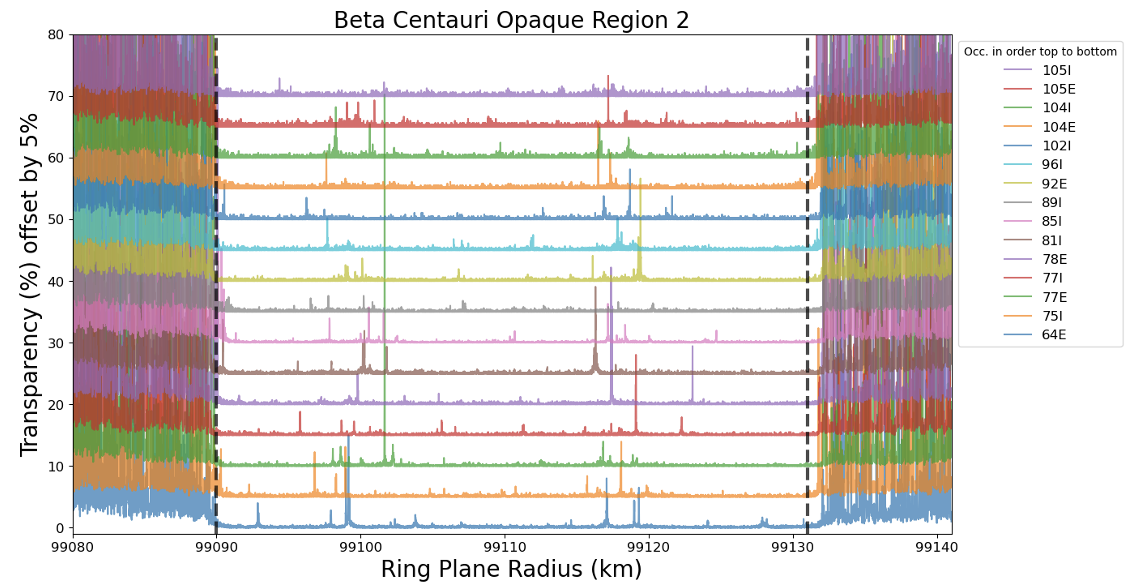
Figure 1: Stacked and offset (by 5%) transparency profiles of the O1 opaque region in Saturn’s B2 ring region as measured by the Cassini UVIS HSP. The different curves are for different observations of the same star system: Beta Centauri. Narrow spikes in transparency are identified as phantoms. The vertical dashed lines indicate the boundaries of the opaque region.
We observed phantoms that are only a single HSP measurement, indicating a radial extent of < 10 m, but most span several measurements. Phantom transparencies range from a few percent up, but in some cases the transparency exceeds 10% and can approach 50%. There are 15 measurements of the B ring with Beta Centauri occultations, and the phantoms do not repeat from one occultation to the next, highlighting their non-axisymmetric and/or temporally variable nature. The Beta Centauri system has two stars that contribute to the HSP signal, and the projected separation of these two components in the ring plane enables us to place limits on the azimuthal extent of some phantoms, which in some cases is < 100 m.
At some locations there are clusters of phantom-like features that appear in all occultations at the same location. We identify these axisymmetric features “grassy regions” based on their appearance in plots of transparency (Figure 2). The average transparency of grassy regions is still low, typically less than 2%. The opaque regions are bordered by regions of higher optical depth (Figure 2).
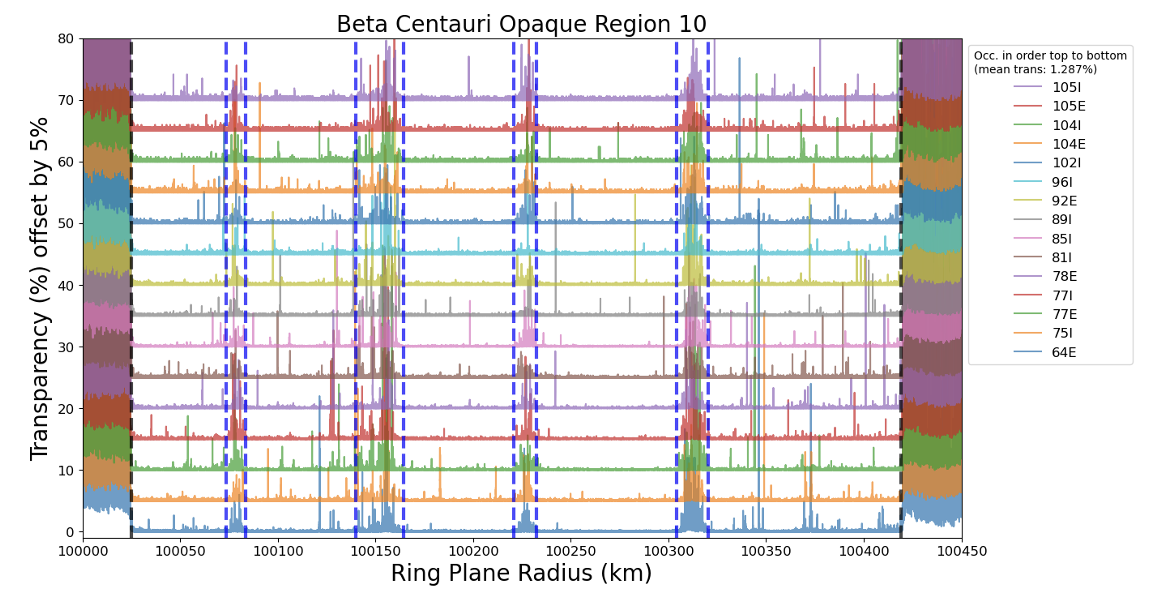
Figure 2: Stacked and offset (by 5%) transparency profiles of an opaque region in Saturn’s B2 ring region as measured by the Cassini UVIS HSP. The different curves are for different observations of the same star system: Beta Centauri. This opaque region is home to phantoms (isolated spikes in transparency) as well as several grassy regions, identifiable by their presence at the same location in all occultation profiles and marked by blue dashed lines.
The measured optical depth of the opaque stretches between phantoms can exceed 6 in some cases (see for example the bottom curve in Figure 2 between 100,250-100,300 km). N-body simulations have struggled to reproduce such high optical depths. Individual ring particles in the simulations clump together due to their mutual gravity, leaving gaps which elevate the overal transparency of the region. We will present results of simulations with modified boundary conditions and particle properties to try to explain the existence of such high-optical-depth regions and the sub-structure of phantoms and grassy regions within them.
Baillié, K., J. E. Colwell, L. W. Esposito, and M. C. Lewis 2013. Meter-sized Moonlet Population in Saturn’s C Ring and Cassini Division. Astron J. 145, 171, doi:10.1088/0004-6256/145/6/171.
Colwell, J. E., M. Brooks, R. Jerousek, C. Coleman, M. S. Tiscareno, K.-M. Aye, M. Lewis, L. W. Esposito 2021. Irregular Structure in the Core of Saturn’s B Ring. 2021 AGU Fall Meeting P34A-01.
Colwell, J. E., A. Goforth, C. Coleman, R. Jerousek, L. W. Esposito 2024. Saturn’s B Ring Phantoms: Frequency, Properties, and Distribution. 2024 Meeting of the American Geophysical Union. P33F-2931.
Green, M. R., J. E. Colwell, L. W. Esposito, R. G. Jerousek 2024. Particle sizes in Saturn’s rings from UVIS stellar occultations 2. Outlier populatinos in the C ring and Cassini Division. Icarus 416, 116081.
How to cite: Colwell, J., Faulkner, E., Goforth, A., Jerousek, R., and Esposito, L.: Opaque Expanses in Saturn’s B ring, EPSC-DPS Joint Meeting 2025, Helsinki, Finland, 7–12 Sep 2025, EPSC-DPS2025-1101, https://doi.org/10.5194/epsc-dps2025-1101, 2025.


