
- 1University of Texas at San Antonio, San Antonio, TX, USA
- 2Southwest Research Institute, San Antonio, TX, USA
- *A full list of authors appears at the end of the abstract
Introduction: Oxygen in Io’s extended neutral cloud is difficult to observe due to its reliance on collisionally excited emission by electrons in the plasma torus. Previous studies have shown temporal and spatial asymmetries in OI emission brightness, possibly due to contributions from volcanic activity as well as seasonal variability (Koga et al., JGR: Space Phys., 2019; Bagenal & Dols, JGR: Space Phys., 2020). The observed brightness of the FUV emission from the OI] 135.6 nm multiplet results from a combination of multiple parameters like the electron density, electron temperature, neutral oxygen density, and integration of the emission along the line of sight. Our work offers additional observation points to constrain the spatial profile of Io’s neutral oxygen cloud.
Methodology: The Hubble Space Telescope’s (HST) Cosmic Origins Spectrograph (COS) performed an orthogonal step-scan of Io’s extended neutral cloud over two HST orbits, totaling 12 exposures. From the OI] 135.6 nm emission multiplet brightness of off-disk exposures, we estimated the column density of neutral oxygen, assuming a constant electron density and temperature along COS’s line of sight.
Results: We present our estimates of neutral oxygen column density for 10 off-disk exposures using COS, ranging in distance from 5 to 86 RIo from Io. We detect significant OI emissions up to 85 RIo from Io, extending ~1.6 RJ below the orbital plane. Our analysis suggests that oxygen is mostly confined inside Io’s orbit, in agreement with measurements from Hisaki (Koga et al., JGR: Space Phys., 2018). Our estimated peak column density of (8.67 1.48) × 1013 cm–2 measured near Io is as expected larger than the typical neutral cloud densities of 2-9 × 1012 cm–2 estimated by Smith et al. (JGR: Space Phys., 2022). Our future work will constrain the source of oxygen emissions as atomic O or SO2 in the context of neutral cloud and torus modeling by coauthors Smith et al. and Bagenal et al.
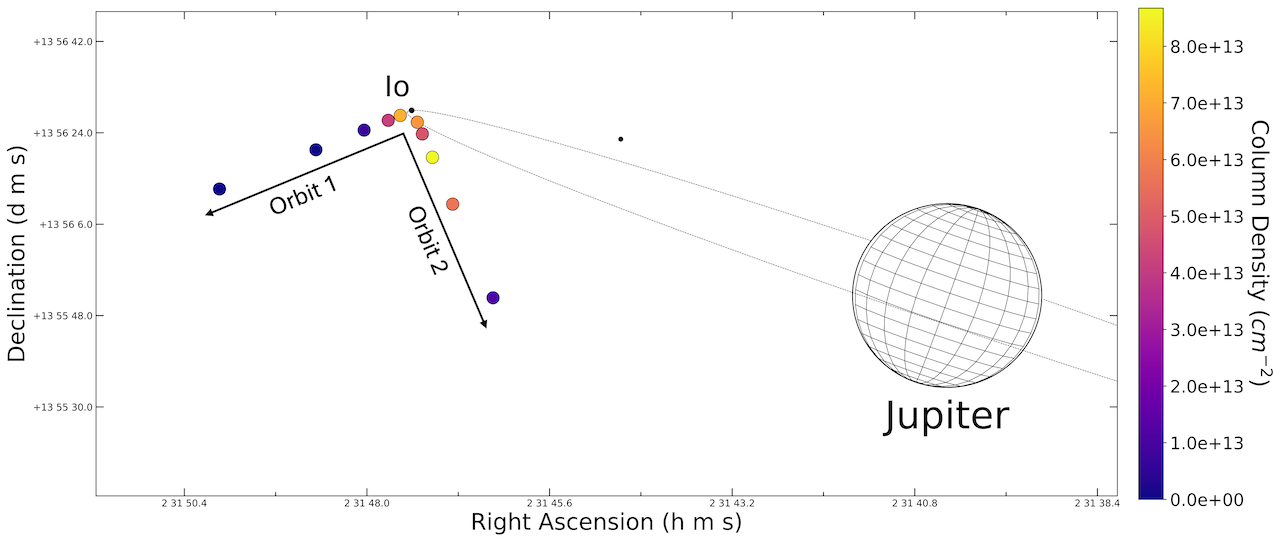
Figure 1. Step-scan geometry of Io’s neutral cloud at the east orbital ansa on Feb 24, 2024. Column densities for 10 exposures of the neutral cloud are shown to scale as shaded circles inside the 2.5” diameter COS aperture.
Kurt Retherford (1,2), Carl Schmidt (3), Lorenz Roth (4), Fran Bagenal (5), John Spencer (2), Tracy Becker (2), Philippa Molyneux (2), Glenn Orton (6), KandisLea Jessup (7), Nathaniel Cunningham (8), Melissa McGrath (9), Amanda Hendrix (10), Vincent Hue (11), Joachim Saur (12), Matthew Burger (13), Todd Smith (14), Edward Nerney (15), Michael Velez (1,2), Joshua Kammer (2), Vincent Dols (5), Lori Feaga (16), Thomas Greathouse (2), Anatol Groβe-Schware (4). (1) University of Texas at San Antonio, San Antonio, TX, USA, (2) Southwest Research Institute, San Antonio, TX, USA, (3) Boston University, Boston, MA, USA, (4) KTH Royal Institute of Technology, Stockholm, Sweden, (5) University of Colorado at Boulder, Boulder, CO, USA, (6) Jet Propulsion Laboratory, Pasadena, CA, USA, (7) Southwest Research Institute, Boulder, CO, USA, (8) Nebraska Wesleyan University, Lincoln, NE, USA, (9) SETI Institute, Mountain View, CA, USA, (10) Planetary Science Institute, Tucson, AZ, USA, (11) Aix-Marseille Université, CNRS, CNES, Institut Origines, LAM, Marseille, France, (12) Universität zu Köln, Cologne, Germany, (13) Space Telescope Science Institute, Baltimore, MD, USA, (14) Johns Hopkins University Applied Physics Laboratory, Laurel, MD, USA, (15) Laboratory for Atmospheric and Space Physics, Boulder, CO, USA, (16) University of Maryland, College Park, MD, USA.
How to cite: Mendenhall, S. and the Co-authors: Constraining the Spatial Profile of Oxygen in Io’s Neutral Cloud with HST’s Cosmic Origins Spectrograph., EPSC-DPS Joint Meeting 2025, Helsinki, Finland, 7–12 Sep 2025, EPSC-DPS2025-1140, https://doi.org/10.5194/epsc-dps2025-1140, 2025.


