
 1,2,2,1,1,2,3,3,5,
- 1Northern Arizona University, Department of Astronomy and Planetary Science
- 2Lowell Observatory
- 3Planetary Science Institute
- 4Northern Arizona University, Department of Chemistry
- 5UT Austin
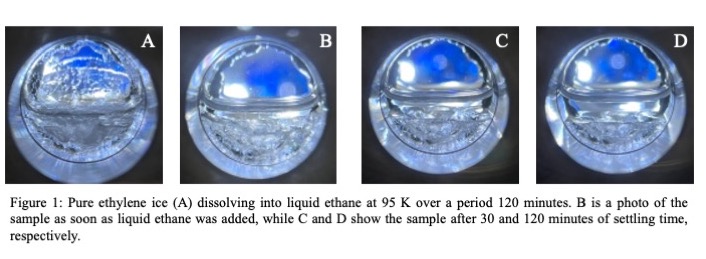
Titan is the only extraterrestrial environment known to support bodies of standing liquid on its surface. The Cassini mission provided important composition measurements of a few lakes and seas, which suggest they may contain anywhere from 5 - 80 % methane and 8 - 79 % ethane mixtures, in addition to dissolved nitrogen from the atmosphere. Cassini also measured trace amounts of higher-order hydrocarbons, such as propane, ethylene, and acetylene, in Titan’s atmosphere. When these trace species rain down onto the surface and mix with the lakes and seas, they create unique chemical conditions and alter the phase behavior, solubility, and stability of Titan’s surface liquids. In an effort to study these environments, we present our experimental work done in the Astrophysical Materials Lab at Northern Arizona University (NAU). We studied two different trace species, ethylene and acetylene, in methane-ethane mixtures under a nitrogen atmosphere of 1.5 bar to replicate Titan lakes. Specifically, we incorporated 1-10% additions of either ethylene or acetylene to the methane-ethane-nitrogen system and performed cooling and warming cycles of our sample between 70 - 100 K. Through a combination of visual inspection and Raman spectroscopy, we found that these mixtures undergo phase changes at different temperatures than their individual end members. The observed phase changes under these conditions have exciting implications for Titan’s lakes and seas, including compositional stratification of surface liquids, bubbles, and ice formation. We also measured the solubilities of both ethylene and acetylene in pure methane and pure ethane at 95 K. We will present the results of these experiments, in addition to thermodynamic models and how they relate to Titan environments.
This work was supported by NASA SSW grant 80NSSC21K0168, the John and Maureen Hendricks Foundation, and the Lowell Observatory Slipher Society.
How to cite: Thieberger, C., Hanley, J., Engle, A., Tan, S., Grundy, W., Lindberg, G., Steckloff, J., and Tegler, S.: Laboratory Experiments of Ethylene and Acetylene in Titan Lakes, EPSC-DPS Joint Meeting 2025, Helsinki, Finland, 7–12 Sep 2025, EPSC-DPS2025-1178, https://doi.org/10.5194/epsc-dps2025-1178, 2025.


