
 1,
1,- 1New Mexico State University, Astronomy, United States of America
- 2Northumbria University, Maths, Physics and Electrical Engineering Department, United Kingdom
Although past and ongoing observations of Uranus have provided insights into its atmospheric composition and dynamics, key questions remain regarding its radiative balance and vertical mixing. Uranus’ extreme obliquity and low internal heat flux suggest an atmospheric circulation distinct from that of the other giant planets, yet the mechanisms governing its energy transport remain poorly constrained. Understanding how its obliquity shapes atmospheric temperatures, circulation patterns, and energy exchange is critical for accurate modeling of ice giant atmospheres.
Hydrogen (H2) molecules exist in two nuclear spin isomers: ortho-H2 (parallel spins) and para-H2 (antiparallel spins). The equilibrium ortho-to-para ratio is a function of local temperature, but interconversion requires external interactions with paramagnetic species or surfaces—processes introduced through vertical mixing. An equilibrated sample follows a strict temperature-dependent distribution at or below 270 K. Deviations from this distribution indicate inhibited mixing, particularly at levels where conversion timescales exceed transport timescales. Because the conversion from ortho- to para-H2 is weakly exothermic, it also contributes to the thermal energy budget. The para-H2 fraction can be inferred from the shape and strength of pressure-induced H2–H2 and H2–He collision-induced absorption (CIA) features in the near-infrared, particularly in the 2.0–2.5 μm range (Figure 1). These features are shaped by both the total H2 abundance and the ortho/para ratio, making them a sensitive diagnostic of vertical mixing and thermal disequilibrium.
We present efforts to retrieve the vertical para-H2 profile of Uranus using near-infrared spectra obtained in January 2023 with the James Webb Space Telescope (JWST) Near-Infrared Spectrograph (NIRSpec), covering the target 2.0–2.5 μm at R~2700. This region includes the strong CIA bands of H2 and absorption features from other gases, especially methane (CH4), which must be modeled accurately to isolate the CIA signal. The spectra, drawn from the Mikulski Archive for Space Telescopes, include approximately 3.15 hours of NIRSpec integration time, resulting in high signal-to-noise observations. We reduced the data using the most up-to-date version of the JWST calibration pipeline.
We use the Non-linear Optimal Estimator for Multivariate Spectral Analysis (NEMESIS) and archNEMESIS radiative transfer and retrieval frameworks to simultaneously retrieve the vertical profiles of para-H2, CH4 abundance, and atmospheric temperature. These tools solve the radiative transfer equation for a layered planetary atmosphere, incorporating gas absorption, thermal emission, and aerosol scattering. The forward model computes top-of-atmosphere radiance given an atmospheric state, while the inverse model iteratively adjusts that state to minimize residuals between observed and simulated spectra. Our retrieval framework avoids biases associated with fixed a priori profiles by treating each quantity as a free parameter, allowing us to quantify degeneracies and cross-dependencies between para-H2, CH4, and temperature.
Preliminary retrievals are expected to reveal a vertical gradient in the para-H2 fraction, highlighting any potential regions of sluggish vertical mixing. In an atmosphere where vertical mixing is efficient, the para-H2 profile should track the local thermodynamic equilibrium (LTE) distribution. However, in regions where vertical transport is weak relative to interconversion timescales, the para-H2 fraction will depart from LTE, particularly near the tropopause. Such deviations are diagnostic of the transport regime and mixing efficiency in Uranus’ atmosphere, which is thought to be shaped by seasonally modulated circulation and inhibited meridional exchange.
The results from this study will represent a direct retrieval of Uranus’ present-day para-H2 vertical profile from space-based data. Improved constraints on the disequilibrium distribution of ortho- and para-H2 provide key insights into vertical mixing rates, energy transport, and atmospheric circulation on Uranus. By characterizing a thermochemical tracer sensitive to both dynamical and radiative processes, this work contributes toward resolving broader questions about the structure and evolution of ice giant atmospheres—both within our solar system and in exoplanetary contexts. This work was supported by NASA’s Future Investigators in NASA Earth and Space Science and Technology (FINESST) program through grant number 80NSSC24K1816.
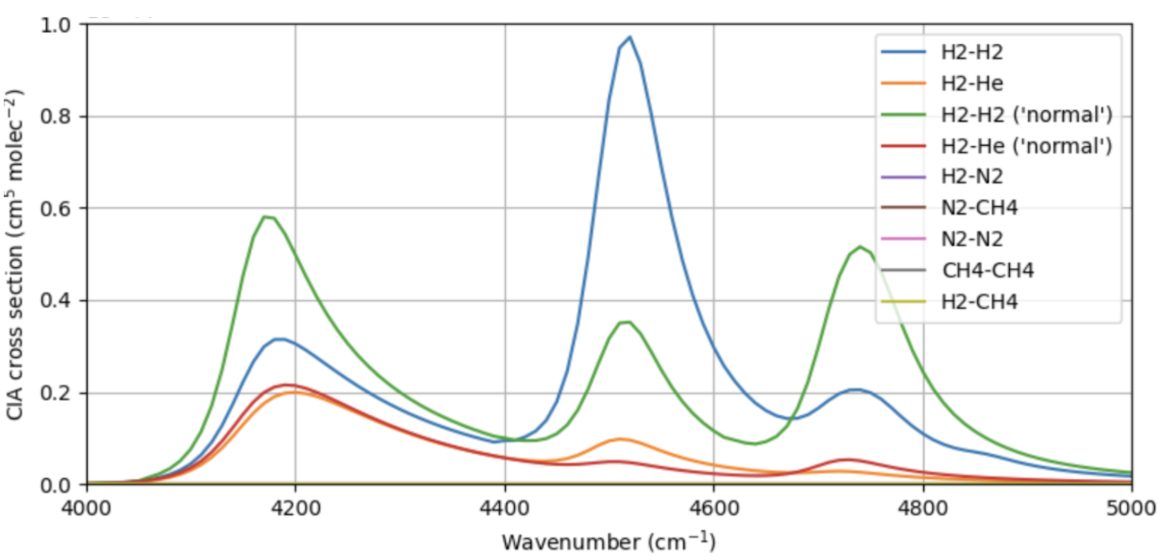
Figure 1. Collision-induced absorption cross sections across the 2.0-2.5 micron range.
How to cite: Conly, A., Chanover, N., Peck, A., and Thomas, E.: Investigating the Vertical Distribution of Para-H2 in Uranus’ Atmosphere, EPSC-DPS Joint Meeting 2025, Helsinki, Finland, 7–12 Sep 2025, EPSC-DPS2025-1195, https://doi.org/10.5194/epsc-dps2025-1195, 2025.


