
 1,4,5,1
- 1NASA ARC, Space Science and Astrobiology Division, Moffett Field, CA, USA (ella.m.sciammaobrien@nasa.gov)
- 2Pinhead Institute, Boulder, CO, USA
- 3NASA JPL, California Institute of Technology, Pasadena, CA, USA
- 4SETI Institute, Mountain View, CA, USA
- 5LESIA, Observatoire de Paris, Meudon, France
- 6BAER Institute, Moffett Field, CA, USA
- 7ETH, Zurich, Switzerland
Introduction: The flyby of Pluto by the New Horizons mission unveiled a world with surprisingly diverse surface compositions and colors as well as an extensive atmospheric haze. In the enhanced color images returned by the Multispectral Visible Imaging Camera (MVIC), Pluto’s surface appears covered with a range of brown to yellow- and red-brown hues (cf. Fig. 1a). The main ices identified on Pluto’s surface (N2, CH4, CO, H2O, CH3OH) are all colorless at visible wavelengths in their pure form. The observed surface colors therefore indicate the presence of one or more colored components mixed in or superimposed on the ices.
In Pluto’s atmosphere, the CH4 mixing ratio has been observed to vary with altitude (from 0.3% < 350 km to 5% at ~700 km in 2015) and is predicted to vary from 0.01% to 5% over annual or astronomical timescales. The CO atmospheric mixing ratio (0.05% in 2015) is not expected to vary much over time. Haze particles resulting from the photolysis and radiolysis of gaseous N2, CH4, and CO in Pluto’s atmosphere are expected to settle and accumulate onto the surface and could thus darken the surface and contaminate the ices.
Here we present the results of an interdisciplinary investigation combining experimental, modeling and observation research efforts to assess the contribution of Pluto’s atmospheric haze particles to the dark materials present on various regions across Pluto’s surface, in order to reach a better understanding of the processes that result in the surprising diversity of colors and spectral features observed by New Horizons. We focused our study on three main regions of interest that are covered with dark materials of very different colors and spectral features: Lowell Regio (yellow), Sputnik Planitia (pale orange), and Cthulhu Macula (red) (cf. Fig. 1a).
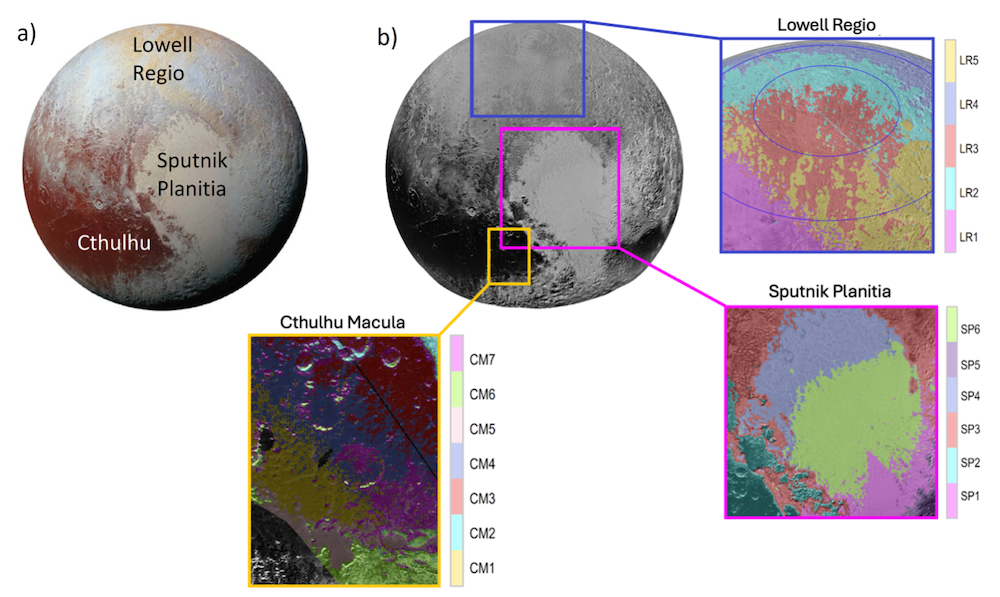
Figure 1. (a) Enhanced colored MVIC image of Pluto showing the different colors of the regions of interest for this study. (b) LOng-Range Reconnaissance Imager (LORRI) and MVIC global basemap of Pluto showing the location of the MVIC and LEISA datasets used in this study for the three regions of interest (image credit: NASA/JHUAPL/SwRI). Insets show, for each region, the distribution of the surface compositional units derived using the clustering technique.
Method: This project was divided into four main tasks:
(1) A Global Circulation Modeling (GCM) task where numerical global circulation climate simulations were used to determine the variations in Pluto’s atmospheric composition over seasonal and astronomical timescales as well as at different altitudes, in order to guide experiments.
(2) An experimental task where laboratory analogs of Pluto’s atmospheric aerosols (or tholins) were produced from gas phase plasma chemistry at low temperature with the NASA Ames COsmic SImulation Chamber (COSmIC) from various N2:CH4:CO gas mixtures representative of the expected variations in Pluto’s atmospheric composition with seasons and epochs, as determined by GCM. The complex refractive indices (optical constants) of these Pluto tholins were then determined from spectroscopic measurements conducted with the NASA Ames Optical Constants Facility (OCF).
(3) An observational task were observational data returned by the New Horizons MVIC and LEISA (Linear Etalon Imaging Spectral Array) instruments were processed using an unsupervised machine-learning clustering tool to segregate sub-regions of Pluto’s surface into clusters based on their spectral signature, hence mapping the distribution of surface composition in the three regions of interest (cf. Fig. 1b).
(4) A reflectance modeling task where the optical constants of Pluto tholins of different compositions were used along with those of relevant ices (N2, CH4, H2O…) as input parameters in a reflectance model to analyze the processed New Horizons observational data and investigate the contribution of atmospheric aerosols to the composition of the three regions of interest.
Results:
(1) Using Pluto GCM, we determined three atmospheric mixing ratios representative of different altitudes, seasons, or epochs and used those to define the N2:CH4:CO gas mixtures we used in our experiments: 94.95:5:0.05, 98.95:1:0.05, and 99.90:0.05:0.05.
(2) We produced three Pluto tholins in the COSmIC facility from the GCM-defined N2:CH4:CO gas mixtures and determined their complex refractive indices from 0.4 up to 2.5 µm (cf. Fig. 2). To assess the effect of CO on the optical properties, we also produced a Titan tholin from N2:CH4 (95:5) and determine its optical constants.
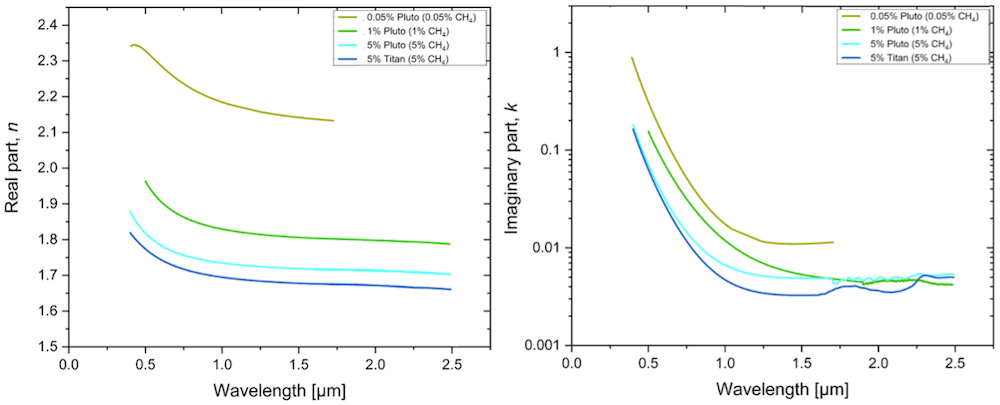
Figure 2. Real (n) and imaginary (k) parts of the complex refractive index for the COSmIC Pluto and Titan tholins.
(3) We analyzed the LEISA and MVIC data using the principal component reduced Gaussian mixture model (PC-GMM), which is an unsupervised machine learning clustering technique. Our analysis of the three regions resulted in the classification of Cthulhu Macula into seven spectral clusters, Sputnik Planitia into six spectral clusters, and Lowell Regio into five spectral clusters (cf. Fig. 1b).
(4) For each of the three regions of interest, synthetic reflectance spectra of mixed materials were generated using optical constants of various ices and of tholins of different compositions (cf. Fig. 2) as inputs to a Hapke spectral reflectance model. They were then compared to the spectra resulting from the clustering of MVIC and LESIA data to determine what combination of organic refractory materials and ices resulted in the best fit.
We will present more detail on the experimental work, observational analysis efforts, and our findings from the reflectance modeling of the different clusters for each of the three regions of interest, which allowed us to assess the climatic context and epochs of formation for the dark materials observed in each region.
Acknowledgments: The authors acknowledge the support of the NASA SMD ROSES NFDAP (NNH20ZDA001N) program and NASA SMD PSD ISFM.
How to cite: Sciamma-O'Brien, E., Cook, J. C., Emran, A., Dalle Ore, C. M., Wooden, D. H., Roush, T. L., Bertrand, T., Jovanovic, L., Drant, T., Ricketts, C. L., and Salama, F.: A Multidisciplinary Investigation of the Origins of Pluto’s Dark Surface Materials, EPSC-DPS Joint Meeting 2025, Helsinki, Finland, 7–12 Sep 2025, EPSC-DPS2025-1243, https://doi.org/10.5194/epsc-dps2025-1243, 2025.


