OPS7 | Aerosols and clouds in planetary atmospheres

OPS7

Aerosols and clouds in planetary atmospheres
Co-organized by TP/EXOA
Convener: Panayotis Lavvas | Co-conveners: Anni Määttänen, Audrey Chatain, Ella Sciamma-O'Brien, Sarah M. Hörst, Thomas Drant
Orals WED-OB5
| Wed, 10 Sep, 15:00–16:00 (EEST)
 
Room Venus (Veranda 3)
Orals WED-OB6
| Wed, 10 Sep, 16:30–18:30 (EEST)
 
Room Venus (Veranda 3)
Posters TUE-POS
| Attendance Tue, 09 Sep, 18:00–19:30 (EEST) | Display Tue, 09 Sep, 08:30–19:30
 
Lämpiö foyer, L29–43
Wed, 15:00
Wed, 16:30
Tue, 18:00
Atmospheric aerosols and cloud particles are found in every atmosphere of the solar system, as well as, in exoplanets. Depending on their size, shape, chemical composition, latent heat, and distribution, their effect on the radiation budget varies drastically and is difficult to predict. When organic, aerosols also carry a strong prebiotic interest reinforced by the presence of heavy atoms such as nitrogen, oxygen or sulfur.

The aim of the session is to gather presentations on these complex objects for both terrestrial and giant planet atmospheres, including the special cases of Titan’s, Pluto's and Triton's hazy atmospheres. All research aspects from their production and evolution processes, their observation/detection, to their fate and atmospheric impact are welcomed, including laboratory investigations and modeling.

Session assets

Orals WED-OB5: Wed, 10 Sep, 15:00–16:00 | Room Venus (Veranda 3)

Chairpersons: Audrey Chatain, Ella Sciamma-O'Brien, Panayotis Lavvas
Titan
15:00–15:12
|
EPSC-DPS2025-221
|
ECP
|
On-site presentation
Lavender Hanson, Darryn Waugh, Carrie Anderson, Erika Barth, and Robert French

Fall and winter on Titan are marked by the formation and persistence of a vast polar “hood” cloud, covering the cold pole and extending equatorward as far as 40° latitude [e.g., 1]. Extending from the upper troposphere into the lower stratosphere, a polar hood cloud was present in the northern hemisphere during the Voyager I flyby and then again when Cassini arrived during the next northern winter in 2004 (Ls ~ 290°) [2]. Although the full lifecycle of Titan’s polar hood cloud has not been observed, the Cassini mission provided observations of the north polar hood from mid-winter through northern spring, as well as observations of south polar clouds that started forming early in southern fall. In 2012 (Ls ~ 32°), near-infrared imagery from early southern fall revealed the formation of a vast south polar cloud near the top of the stratosphere, over 150 km higher than any previously observed cloud [3,4]. By combining observations of south polar fall with observations of north polar winter and spring, others have started to construct a story of the formation, evolution, and dissipation of Titan’s polar hood [1]. Despite the polar hood cloud’s optical thickness, details of the cloud composition remain vague. While signs of HCN, benzene, and cyanoacetylene ices have been identified in this fall south polar cloud, and radiative transfer retrievals indicate the presence of mixed ices, the abundances of less radiatively active species like methane or ethane is not as well constrained [2]. We contribute to the story of the polar hood lifecycle using a combination of cloud microphysical modeling and image analysis [5,6]. Through careful analysis of imagery, we track south polar cloud’s spatial evolution and find that it descends from an altitude of about 300 km in 2012 to below 230 km by 2016 (Ls = 79°), while expanding equatorward following the terminator [6]. We show using microphysical modeling that a pure HCN cloud with the observed characteristics [3,4] requires temperatures below 110 K at an altitude of 300 km over the pole [5]. Finally, using simulations of several additional volatile species, we trace the evolving chemical composition, and estimate the impact of condensation and precipitation on the stratospheric volatile budget.

[1] Le Mouelic et al. 2018, Icarus, 311, 371–383. [2] Anderson et al. 2018, Space Sci Rev, 214, 125. [3] West et al. 2016, Icarus, 270, 399. [4] de Kok et al. 2014, Nature, 514, 65. [5] Hanson et al. 2023, Planetary Sci J, 4, 237. [6] Hanson et al. 2025, Geophys Res Lett, 52, e2024GL113415.

How to cite: Hanson, L., Waugh, D., Anderson, C., Barth, E., and French, R.: Evolution of Titan’s Fall and Winter Polar Hood Cloud, EPSC-DPS Joint Meeting 2025, Helsinki, Finland, 7–13 Sep 2025, EPSC-DPS2025-221, https://doi.org/10.5194/epsc-dps2025-221, 2025.

15:12–15:24
|
EPSC-DPS2025-288
|
ECP
|
On-site presentation
Nathan Le Guennic, Panayotis Lavvas, Tommi Koskinen, and Devin Hoover

Aerosols, the main product of Titan’s atmosphere, significantly influence the moon’s global climate, and photochemical processes [2, 7, 6, 3]. Characterizing this haze is crucial to constrain and validate theoretical microphysics models [8], and understand the complex prebiotic processes occurring in what is considered as a primitive Earth-like environment [10, 4].

The Cassini spacecraft’s instruments can help characterize aerosols by the extinction they provoke, through stellar occultation measurements performed by VIMS [1] or UVIS [5], retrievals from thermal emission observed by CIRS [14], or by direct imaging with ISS [12]. Extinction, however, depends on both the density and size of aerosol particles, and determining these two quantities remains a challenge as well as a necessity. Huygens measurements analyzed by Tomasko et al. [13] constrained these physical properties, but only for a narrow range of altitude on a specific Titan location. Some studies [1, 14] derived density profiles assuming these size properties. Scattered light observations with ISS allowed to constrain the haze radius and density at the detached haze layer near 500 km [11, 15]. However, at higher altitudes where the haze formation takes place, there are no constraints for the haze microphysical properties.

We present a new analysis of Cassini’s Ultraviolet Imaging Spectrograph (UVIS) data allowing to retrieve both haze particle size and density as altitude profiles at different latitudes across time during the mission. UV light is suitable to derive haze properties at high altitudes where the early stages of photochemistry and haze formation and growth take place [8, 9]. We use FUV channel airglow spectra, where the strong effect of haze scattering can be seen as a continuous radiance feature between 1600 and 1900 Å. We integrate this wavelength range to obtain a single radiance value and we use limb observations to derive the radiance profile as a function of altitude.

To reproduce these profiles, we forward model the radiative transfer processes (from gases and aerosols) and the N2 airglow based on each observation geometry. We model the atmosphere as spherical layers, considering a log-normal distribution of haze particle radius, with mean radius and particle density set as free parameters in each layer. With sufficient observations at different phase angles, we fit the aerosol phase function curve, which directly depends on the aerosol bulk radius. Thus we retrieve the particle radius and the particle density. We fit for this reason the radiance profiles of all observations in a given year at once, assuming the atmospheric structure remains stable throughout the year.

Observations for each fly-by are binned by altitude and latitude to increase signal-to-noise ratio while keeping a sufficient spatial resolution. Our radiance profiles cover altitudes from 1500 km to the surface. We retrieve haze properties between 200 km and about 800 km. The whole Cassini mission coverage is used to derive haze properties across different latitude locations, and across the years to derive time-dependant characteristics (on annual timescale) and seasonal changes. Simultaneous analysis of both limbs allow to differentiate morning and evening parts of Titan and derive differences on a Titanian day scale.

Several fly-bys performed limb observation with a very high phase angle (>150°), giving us unique opportunities to observe both sunrise and sunset limbs in similar illumination conditions. We report an unforeseen feature in the radiance profiles observed during such flybys. Peak radiance is produced at notably different altitudes and haze properties are not sufficient to explain such daily difference. We present the analysis conducted to confirm this feature and explore potential phenomena explaining its specific characteristics.

References

[1] Bellucci, A., et al. “Titan Solar Occultation Observed by Cassini/VIMS: Gas Absorption and Constraints on Aerosol Composition”. Icarus, (2009)

[2] Courtin, R. “Aerosols on the Giant Planets and Titan”. Space Science Reviews, (2005)

[3] De Batz De Trenquelléon, B., et al. “The New Titan Planetary Climate Model. II. Titan’s Haze and Cloud Cycles”. The Planetary Science Journal, (2025)

[4] Hasenkopf, C., et al. “Potential Climatic Impact of Organic Haze on Early Earth”. Astrobiology, (2011)

[5] Koskinen, T., et al. “The Mesosphere and Lower Thermosphere of Titan Revealed by Cassini/UVIS Stellar Occultations”. Icarus, (2011)

[6] Larson, E., et al. “Simulating Titan’s Aerosols in a Three Dimensional General Circulation Model”. Icarus, (2014)

[7] Lavvas, P., et al. “Condensation in Titan’s Atmosphere at the Huygens Landing Site”. Icarus, (2011)

[8] Lavvas, P., et al. “Surface Chemistry and Particle Shape: Processes for the Evolution of Aerosols in Titan’s Atmosphere”. The Astrophysical Journal, (2011)

[9] Lavvas, P., et al. “Aerosol Growth in Titan’s Ionosphere”. Proceedings of the National Academy of Sciences, (2013)

[10] Sagan, C., and Chyba, C. “The Early Faint Sun Paradox: Organic Shielding of Ultraviolet-Labile Greenhouse Gases”. Science, (1997)

[11] Seignovert, B., et al. “Aerosols Optical Properties in Titan’s Detached Haze Layer before the Equinox”. Icarus, (2017)

[12] Seignovert, B., et al. “Haze Seasonal Variations of Titan’s Upper Atmosphere during the Cassini Mission”. The Astrophysical Journal, (2021)

[13] Tomasko, M., et al. “A Model of Titan’s Aerosols Based on Measurements Made inside the Atmosphere”. Planetary and Space Science, (2008)

[14] Vinatier, S., et al. “Analysis of Cassini/CIRS Limb Spectra of Titan Acquired during the Nominal Mission II: Aerosol Extinction Profiles in the 600–1420 cm-1 Spectral Range”. Icarus, (2010)

[15] West, R., et al. “The Seasonal Cycle of Titan’s Detached Haze”. Nature Astronomy, (2018)

How to cite: Le Guennic, N., Lavvas, P., Koskinen, T., and Hoover, D.: Aerosol properties and evolution at different timescales in Titan's atmosphere from Cassini UVIS observations throughout the mission, EPSC-DPS Joint Meeting 2025, Helsinki, Finland, 7–13 Sep 2025, EPSC-DPS2025-288, https://doi.org/10.5194/epsc-dps2025-288, 2025.

15:24–15:36
|
EPSC-DPS2025-1384
|
On-site presentation
Veronique Vuitton, Filip Matuszewski, Elsa Hénault, Julia Shouse, Naila Chaouche, Richard Rácz, Laurène Flandinet, Thomas Gautier, Eric Quirico, François-Régis Orthous-Daunay, Rosario Brunetto, Philippe Boduch, Alicja Domaracka, Hermann Rothard, Zoltan Juhász, Béla Sulik, Fabien Stalport, and Hervé Cottin

The Cassini-Huygens mission revealed that energetic (1 – 1000 keV) water ions (OHx+, x = 0,1,2), originating from Enceladus' geysers, precipitate in Titan's upper atmosphere where molecules reaching a mass-to-charge (m/z) of several thousand atomic mass units have been detected. These aerosol embryos, that were not expected at such high altitudes, have been attributed to polycyclic aromatic (nitrogen bearing) hydrocarbons (PANHs) that would result from the ionization and dissociation of the major atmospheric compounds, N2 and CH4 by solar photons [1].

A fraction of the Enceladus’ water ions must collide with Titan’s macromolecules but the impact on the atmospheric chemistry is unclear. Do the ions trigger the formation of more complex organic species, maybe including oxygen? Do they sputter some organic material back into the gas phase? Since aerosols sediment towards the surface, the formation of complex oxygenated molecules in the upper atmosphere would add a new dimension with strong exobiological implications to the carbon / nitrogen / hydrogen chemistry endogenous to Titan.

Titan’s photochemistry has inspired many to simulate these conditions in the laboratory [2]. The complex organic compounds resulting from photolysis or radiolysis of N2/CH4 mixtures have been deemed “tholins” and numerous studies have attempted to characterize their properties. Infrared spectroscopy has shown that the tholins chemical functions include primary and secondary amines, (iso)cyanides, carbodiimides, aliphatic and heteroaromatic groups. Exact mass Fourier transform mass spectrometry (FT-MS) has demonstrated that their constituent molecules extent to ~500 Da and have unsaturation levels consistent with high degrees of both cyclization and aromaticity, favoring PANH-type structures.

Despite the important literature on tholins, the chemical evolution of nitrogen-rich organics upon interaction with energetic particles has been largely unexplored. One study simulated in the laboratory how vacuum ultraviolet irradiation affects the tholins optical properties as probed by infrared spectroscopy [3]. This work provided evidence that photochemistry could deplete the sensitive primary and secondary amine functions while preserving nitrogen-bearing functionalities that are more strongly bound, such as tertiary amines, imines and nitriles. Adenine (C5H5N5) is a simple heterocyclic aromatic molecule that has been identified in Titan’s tholins [4]. Infrared spectroscopy of adenine samples irradiated by photons, electrons or ions over a wide energy range shows its destruction as well as the formation a solid residue probably of macromolecular nature [5,6]. However, neither the molecular content of the organic residue or the sputtering into the gas phase have been investigated so far.

In this work, we have irradiated under ultra-high vacuum thin film samples of adenine. Adenine was deposited homogeneously in several hundred nm thin layers onto MgF2 or ZnSe windows [10]. Irradiation experiments were performed either at the ARIBE beam line at GANIL (Caen, France), at the SIDONIE isotope separator (Orsay, France) or at the HUN-REN Institute for Nuclear research (Atomki) in Debrecen, Hungary [7,8,9]. Adenine samples were irradiated with either Ne𝑞+, O𝑞+, OH𝑞+ or H2O𝑞+ at various energies from 10 to 70 keV, temperatures (150, 300 K), and fluences (up to 2x10¹⁵ ions.cm−2). Infrared absorption spectra of the adenine samples were obtained in situ during the irradiation with a FTIR spectrometer while the residual gas in the experimental chamber was measured with in-situ quadrupole mass spectrometry, analyzing the material that was sputtered into the gas phase during irradiation. The molecular content of the soluble phase of the irradiated samples was obtained with a very high-resolution mass spectrometer at the Institut de Planétologie et d’Astrophysique de Grenoble (France).

We show that the energetic ion irradiation of the samples leads to their destruction, through both chemical processes forming new species in the solid phase and sputtering into the gas phase. The macromolecules detected in the solid phase far exceed the molecular mass of adenine, reaching up to m/z 500. They show great chemical diversity and can be expressed as (HCN)z-R families, where z can reach 17 and R can be C, H, N, NH, CH or CN. In total, nearly 100 individual families have been identified, 28 of which can be found in every irradiated sample. Their aromaticity equivalent is higher than that in other N rich samples such as Titan tholins and HCN-polymers, corresponding to polycyclic aromatic nitrogen-bearing hydrocarbons. A number of small adenine fragments, including N2, nitriles and hydrocarbons, are sputtered into the gas phase, throughout the irradiations. Larger species like intact adenine are only detected at the on-set of the irradiations.

These experimental results suggest that ion deposition in Titan’s atmosphere may play a role in the rapid molecular growth occurring at high altitudes and should be considered in photochemical-microphysical models.


Acknowledgments

This work is supported by the Programme National de Planétologie (PNP), the French National Research Agency in the framework of the "Investissements d’avenir” program (ANR-15-IDEX-02) and the generic call for proposals (ANR-22-CE49-0017). The experiments were performed at the Grand Accélérateur National d’Ions Lourds (GANIL) by means of the CIRIL Interdisciplinary Platform, part of CIMAP laboratory, Caen, France. We acknowledge the fundings from ANR IGLIAS grant ANR-13-BS05-0004 of the French Agence Nationale de la Recherche. INGMAR is a IAS-IJCLab facility funded by the French Programme National de Planétologie (PNP), Faculté des Sciences d’Orsay, Université Paris-Sud (Attractivité 2012), P2IO LabEx (ANR-10-LABX-0038) in the framework Investissements d’Avenir (ANR-11-IDEX-0003-01). We acknowledge the funding from Europlanet 2024 RI (under the grant agreement No 871149).


References

[1] V. Vuitton et al., In : Titan After Cassini-Huygens, 157 (2024)

[2] M. L. Cable et al., Chem Rev, 112, 1882 (2012)

[3]   N. Carrasco et al., Nature Astronomy, 2, 489 (2018)

[4] J. A. Sebree et al., Astrophys. J., 865, 133 (2018)

[5] O. Poch et al., Icarus, 242, 50 (2014)

[6] G. S. Vignoli Muniz et al., Astrobiology, 17, 298 (2017)

[7] B. Augé et al., Rev. Sci. Instrum., 89, 075105 (2018)

[8] N. Chauvin et al., Nucl. Instrum. Meth. A, 521, 149 (2004)

[9] S. Biri et al., Eur. Phys. J. Plus, 136, 247 (2021)

[10] K. Saïagh et al., Planet. Space Sci., 90, 90 (2014)

How to cite: Vuitton, V., Matuszewski, F., Hénault, E., Shouse, J., Chaouche, N., Rácz, R., Flandinet, L., Gautier, T., Quirico, E., Orthous-Daunay, F.-R., Brunetto, R., Boduch, P., Domaracka, A., Rothard, H., Juhász, Z., Sulik, B., Stalport, F., and Cottin, H.: Ion irradiation of adenine: Implications for molecular growth in Titan’s atmosphere, EPSC-DPS Joint Meeting 2025, Helsinki, Finland, 7–13 Sep 2025, EPSC-DPS2025-1384, https://doi.org/10.5194/epsc-dps2025-1384, 2025.

15:36–15:48
|
EPSC-DPS2025-1180
|
ECP
|
On-site presentation
Jose Raul Montes Bojorquez, Xinting Yu, Cara Psciotta, Ella Sciamma-O'Brien, Ryan Blase, Joshua Sebree, Sarah Hörst, Farid Salama, and Edward Patrick

Introduction: In Titan’s nitrogen–methane atmosphere, photochemistry leads to the production of complex organic particles. These photochemical hazes play a crucial role in radiative transfer processes, absorbing solar radiation and influencing atmospheric chemistry. While photochemical models can reproduce the formation of simple organic molecules up to a few carbons and nitrogens [Lavvas et al., 2008], they cannot simulate the rich organic chemistry and haze formation observed in Titan. This limitation, combined with the lack of returned samples for direct analysis, has made laboratory simulation experiments especially important for investigating the properties of Titan’s hazes. These experiments typically simulate Titan’s atmospheric composition and use energy sources such as UV light or plasma to drive chemical reactions. The resulting products, referred to as “tholins” [Sagan et al., 1979] serve as analogs for Titan’s atmospheric aerosols and are widely used to study their optical behavior and chemical complexity.

Over the last few decades, multiple laboratories with different experimental setups have synthesized tholins that broadly captured the general characteristics of Titan’s hazes. However, substantial variations still exist in the data reported across different research groups [Brassé et al., 2015 and references therein].  These variations can be attributed to several factors during sample production – such as the different gas mixtures, energy sources, pressures, and temperatures employed. The technique and methodology used to characterize tholins can further complicate comparisons [Drant et al., 2024]. Other factors, such as substrate employed and atmospheric exposure can impact both production and measurement conditions.

To address this gap, the goal of this work is to conduct a comprehensive and systematic comparative study of the optical properties that cover a broad wavelength range (0.19-30 µm) of multiple tholin samples produced in four independent laboratory facilities and characterized at a single facility using standardized protocols.

Sample Preparation: Tholin samples were produced across four independent laboratory facilities: the COSmIC facility at NASA Ames Research Center (ARC) employing cold plasma discharge; the PHAZER chamber at John Hopkins University (JHU) utilizing both cold plasma discharge and UV lamp irradiation; the Tholinator at Southwest Research Institute (SwRI) employing cold plasma discharge; and the PAC chamber at the University of Northern Iowa (UNI) employing UV lamp irradiation (see Figure 1). In all facilities a common set of gas mixtures was used, ranging from 0.01-10% CH4 in N2.

To minimize variability introduced during handling and analysis, all tholin samples were deposited on identical substrates cleaned using the same protocol, transported in specialized vacuum sealed vessels and stored under N2 atmosphere to preserve sample integrity.

Methodology: Sample characterization was performed at a dedicated facility: the Planetary Characterization Facility (PMCHEF) at the University of Texas at San Antonio (UTSA). The optical constants of haze samples were measured across a broad spectral range (0.19-30 micron) using two J.A. Woollam ellipsometer systems (M-2000 and IRVASE). To avoid degradation from air exposure and atmospheric interference, both instruments are housed in inter-connected dry-nitrogen-supplied MBraun glove boxes (see Figure 2).

Results: Spectroscopic Ellipsometry (SE) measures the change in polarization of light upon reflection on the sample to determine the complex reflectance ratio: the ratio of amplitude change and the relative phase difference. To then determine the properties of interest, a model-based analysis is used, and regression analysis is required. As seen in Figure 3, the optical constants of tholin samples exhibit broad absorption features from electronic interband transitions at the short wavelength range, as well as wide transparent regions. On the other hand, the numerous sharp and overlapping phonon features in the IR data arising from amines, nitriles, and hetero-aromatics vibrational modes [Gavilan et al., 2018], poses additional challenges when modeling SE data, often resulting in inadequate models that are unable to resolve sharp features and weak absorptions [Brassé et al., 2015]. We addressed this issue by using Kramer-Kronig-consistent B-spline parametrization [Mohrmann et al., 2020].

Despite being fabricated under nominally identical conditions (5% CH₄ in N₂, cold plasma discharge) and characterized identically, the two samples in Figure 3 show noticeable differences in their dispersion curves. The observed differences may be attributed to factors such as variations in plasma discharge uniformity, which can lead to non-uniformities in either the optical constants or thickness. These variations may occur both between nominally identical samples and within different regions of a single sample, contributing to discrepancies in optical properties. To address these uncertainties, mapping capabilities will be utilized. A custom-designed sample holder was developed, and the data was processed and visualized using tailored analysis scripts. An example of this mapping feature is shown in Figure 4.

The analysis of the complete set of samples, including those synthesized with varying precursor ratios, will provide further insight into how these variations influence the optical constants across the spectrum. Expanding the dataset will help determine whether the observed differences in optical constants are intrinsic to the materials themselves or arise from extrinsic factors during fabrication. This comprehensive analysis will enhance our understanding of the optical properties of tholins and their potential applications as planetary analogs to better understand Titan’s atmosphere and climate.

Figure 1: Schematics of the four independent tholin production laboratory facilities used in this work: (a) PHAZER/JHU; (b) PAC/UNI; (c) COSmIC/ARC; (d) Tholinator/SwRI.

Figure 2: The ellipsometry system at PMCHEF/UTSA for optical constant characterization.

Figure 3: Derived optical constant comparison between two Titan haze analog samples generated using a 5% CH₄ in N₂ gas mixture. The Spectroscopic Ellipsometry (SE) measured data are compared with existing spectrophotometry data measured by FTIR [10].

Figure 4: Tholin thickness (nm) vs position (cm) for JHU/PLA 5% CH₄ in N₂ sample.

How to cite: Montes Bojorquez, J. R., Yu, X., Psciotta, C., Sciamma-O'Brien, E., Blase, R., Sebree, J., Hörst, S., Salama, F., and Patrick, E.: The Optical Properties of Titan’s Haze Analogs: A Cross-Laboratory Study , EPSC-DPS Joint Meeting 2025, Helsinki, Finland, 7–13 Sep 2025, EPSC-DPS2025-1180, https://doi.org/10.5194/epsc-dps2025-1180, 2025.

15:48–16:00
|
EPSC-DPS2025-1740
|
ECP
|
On-site presentation
Thomas Drant, Ella Sciamma-O'Brien, Lora Jovanovic, Zoé Perrin, Louis Maratrat, Ludovic Vettier, Enrique Garcia-Caurel, Diane Wooden, and Pascal Rannou

The observations of planetary atmospheres and surfaces strongly rely on the use of experimental data to understand the interaction between light and particles. The intrinsic optical properties of these particles, also known as the refractive indices, describing light dispersion (i.e., n) and absorption (i.e., k), are required to consider the influence of their chemical composition. Only with these data can we interpret observations and avoid large degeneracy in the retrieval data analyses. Climate modeling is also strongly sensitive to these experimental data as atmospheric particles absorb and scatter radiations, and thus modify the temperature profile.

Photochemical hazes are observed in the atmospheres of the different objects in the outer Solar System (Titan, Pluto, Triton, Jupiter, Saturn) as well as in exoplanet atmospheres (e.g., GJ1214 b). The observations of these different objects as well as the modeling suggest that the composition of photochemical hazes varies from one object to the next following changes in the irradiation efficiency, temperature, pressure and gas composition. These differences in composition suggest that the refractive indices of photochemical hazes are also function of pressure, temperature, irradiation efficiency and gas composition. In the present work, we produced laboratory analogs of these hazes from various gas mixtures with controlled abundances. We used 6 different gas compositions to mimic the atmospheric compositions of Titan, Pluto and exoplanets. Among the 6 conditions, we modified the N2/CH4 and CO/CH4 abundance ratios in the gas mixture to assess the influence of N2 and CO on the refractive indices of the haze material. In addition, we compared the influence of the experimental setup by using haze analogs produced with the PAMPRE (LATMOS, France) and COSmIC (NASA Ames, USA) experimental setups. This cross-laboratory comparison allows us to assess the influence of temperature, pressure, gas residence time and irradiation which are changing between PAMPRE and COSmIC. Using several optical measurements, we covered a broad spectral range from UV to far-IR (up to 200 microns) which is essential for climate calculations and to interpret the various remote-sensing observations of these planetary bodies.

Our results revealed a significant difference between the refractive indices obtained on PAMPRE and COSmIC analogs, even for similar gas compositions. Based on previous elemental analyses of the haze analogs, we know that the COSmIC analogs are richer in nitrogen relative to carbon compared to the PAMPRE analogs.  Here, we show that this difference in composition leads to higher n and k values for the COSmlC analogs in the entire spectral range. We found that changes in the CO/CH4 gas ratio have a rather poor influence on the refractive indices compared to the effect of the N2/CH4 ratio. We also found that hazes produced without nitrogen are more transparent in the entire spectral range from UV to IR with very different mid-IR absorption features that could help distinguish between N-rich and N-poor exoplanet atmospheres. These data should be used for future observational analyses and modeling simulations of sub-Neptune atmospheres and Solar System gas giants.

How to cite: Drant, T., Sciamma-O'Brien, E., Jovanovic, L., Perrin, Z., Maratrat, L., Vettier, L., Garcia-Caurel, E., Wooden, D., and Rannou, P.: Refractive indices of Titan, Pluto and Exoplanet photochemical haze analogs from UV to far-IR : a comparative study between the PAMPRE and COSmIC experimental setups, EPSC-DPS Joint Meeting 2025, Helsinki, Finland, 7–13 Sep 2025, EPSC-DPS2025-1740, https://doi.org/10.5194/epsc-dps2025-1740, 2025.

Orals WED-OB6: Wed, 10 Sep, 16:30–18:30 | Room Venus (Veranda 3)

Chairpersons: Panayotis Lavvas, Thomas Drant, Anni Määttänen
Exoplanets
16:30–16:42
|
EPSC-DPS2025-326
|
ECP
|
On-site presentation
Louis Maratrat, Nathalie Carrasco, Yassin Adam Jaziri, Ludovic Vettier, and Maeva Millan

Deciphering the origin of organo-sulphur hazes: an exploration of the actual limits of sulphur chemistry with potential implications for prebiotic chemistry, the Early-Earth, and habitability of sulphur exoplanets

Introduction

 Sulphur volatiles are components currently observed in the atmospheres of planetary bodies. This is true for the solar system with the examples of Venus and Io, but also for extrasolar systems as suggested by the recent findings of the James Webb Space Telescope (JWST). Infrared Transit spectroscopy performed with this instrument revealed SO2 signatures in several different types of exoplanets such as hot-Jupiter, warm-Neptunes, temperate Sub-Neptune , or Super-Earth. This highlights the extended diversity of objects in term of atmospheric conditions which host sulphur species. In many of these very diversified contexts, photochemical processes implying sulphur volatiles are known to play a key role in the chemistry of the global atmosphere. However, despite the recurrence of sulphur in planetary/exoplanetary atmospheres and the importance of the photochemistry induced by such species, sulphur atmospheric reactivity remains in some respects poorly understood. One of the most relevant examples to illustrate this lack of knowledge concerns sulphur aerosol formation processes. Several laboratory experiments revealed the existence of organo-sulphur hazes which are currently not predicted by atmospheric simulation models . To overcome this discrepancy between experimental observations and model, the chemical mechanisms leading to the formation of such aerosols need to be identified. The understanding of such mechanism could notably have great implications for the Early-Earth at the Archean era. During this period, the atmospheric composition, containing significative amount of CO2, and CH4, coupled with emission of sulphur volatiles from volcanic activity could have favoured the formation of such hazes. In this context, organo-sulphur hazes represent a new sink in the sulphur atmospheric budget which could considerably change the description of sulphur chemistry. This unexplored reactivity could change our current understanding of the origin of sulphur isotopic fractionation (Sulphur-Mass Independent Fractionation S-MIF) observed in ancient rocks which is one of the most relevant paleo-climate indicator.

Methods

In this work we adopt an experimental approach to better constrain the mechanisms of formation of organo-sulphur aerosols. The objectives were more precisely to characterise the molecular signatures of the organo-sulphur molecules contained in such hazes with their chemical functions, and to identify potential precursors of these aerosols in gas phase. To do so, we synthetise organo-sulphur aerosols in a N2/CH4/S (where S represents either SO2 either H2S) plasma mixtures. We deliberately considered more concentrated conditions in sulphur volatiles than the previous experiments (from 0.1% up to 10%) to enhance the sulphur signatures in the synthetised hazes. Such high sulphur proportions are also necessary to identify the sulphur volatiles precursors in the gas phase, which constrain the first elementary steps leading to the formation of hazes.

Results

 The analyses have revealed several sulphur volatiles (such as CS2, H2S, OCS, CH3SH) but none of them have been observed specifically in presence of organo-sulphur hazes. This suggests that the incorporation of sulphur into the organic matter is mainly done by direct addition of sulphur radicals/intermediates on existing organic chains and not by an organic growth implying organo-sulphur volatile precursors. Analyses were also performed on the solids produced. In the figure below, spectra of two of the organo-sulphur aerosol samples show a strong organo-sulphur band around 2060cm-1attributed to isothiocyanate function (-N=C=S). This could result from an addition of sulphur into an isonitrile group of the organic chain. This remark is consistent with the anti-correlation observed between the nitrile/isonitrile band and the isothiocyanate one. Finally, GC-MS measurements performed on the solid particles produced allow to identify the corresponding isothiocyanate organics with the detection of methyl-isothiocyanate, ethyl-isothiocyanate and butyl-isothiocyanate (see Fig.2). Thiocyanide ethers (R-SCN) were also observed. It is the first time that such functions are observed in organo-sulphur hazes matrix. This finding provides new elements in the understanding of the formation of such hazes by highlighting the strong coupling existing between nitriles/isonitriles and sulphur chemistry. These results prompt us to consider more deeply the heterogenous reactivity of sulphur on organic matrix which appears to be the dominant source of organo-sulphur hazes in the conditions studied.

Chemical characterisation of organo-sulphur aerosol as well as their formation route have potentially great impacts for the habitability of sulphur exoplanets. Indeed, their organic composition may include complex molecules composed of C,H,N,O,S which are five of the six indispensable elements to life on Earth: the CHNOPS. These hazes strongly differ from the inorganic Sx/H2SO4 clouds which have been the main sulphur condensed forms considered so far for this type of atmosphere. These remarks also highlight the prebiotic potential of such material which can give clues about the origin of sulphur in the organic matter of life.

Fig. 1. Comparison between the Infrared spectrums of an organic aerosol produced without sulphur in green, and two organo-sulphur samples produced with an input of H2S in blue and an input of SO2 in red. The details of the composition used to form these deposits are indicated in the legend. An intense band at 2060cm-1 is specific to sulphur samples. This suggests the presence of isothiocyanate -N=C=S which gives indication about the sulphur functions present in the sample. Moreover, the blue spectrum (produced with H2S) present strong differences with the two others. The analysis of its differences gives clues to the mechanism associated in the formation of these organo-sulphur samples.

Fig. 2. Example of chromatogram of one organo-sulphur aerosol sample produced (N2/CH4/Ar/H2S 85.5/4.5/9/1) got after a pyrolysis between 200 and 400°C with a ramp of 35°C/min.  Several organic isothiocyanate (2=Methyl, 4=Ethyle, 5=Isopropyle, 6=Butyle) and thiocyanide ethers (1=Methyl, 3=Ethyl) are observed in this chromatogram. The different peaks are associated to their corresponding species with the arrows. 

How to cite: Maratrat, L., Carrasco, N., Jaziri, Y. A., Vettier, L., and Millan, M.: Deciphering the origin of organo-sulphur hazes: an exploration of the actual limits of sulphur chemistry with potential implications for prebiotic chemistry, the Early-Earth, and habitability of sulphur exoplanets, EPSC-DPS Joint Meeting 2025, Helsinki, Finland, 7–13 Sep 2025, EPSC-DPS2025-326, https://doi.org/10.5194/epsc-dps2025-326, 2025.

16:42–16:54
|
EPSC-DPS2025-333
|
ECP
|
On-site presentation
Sarah Moran, Matt Lodge, Natasha Batalha, Sanaz Vahidinia, Mark Marley, Kazumasa Ohno, and Hannah Wakeford

We introduce new functionality to treat fractal aggregate aerosol particles for planetary, exoplanetary, and substellar atmospheres within the Virga cloud modeling framework. Previously, the open source cloud modeling code Virga assumed spherical particles to compute particle mass and size distributions throughout the atmosphere. The initial release of Virga also assumed spherical particles to compute Mie scattering properties. However, extensive evidence from solar system aerosols, astrophysical disks and dust, and Earth climate studies suggests that aggregate particles are common compared to idealized compact spherical particles. Following recent advances in microphysical and opacity modeling, we implement a simple parametrization for dynamical and optical effects of fractal aggregate particles into Virga. We then use this new functionality to perform case studies of canonical cloudy exoplanets. We compare previous fractal aggregate particle treatments to our methods and show how our new fractal treatment affects theoretical spectra of cloudy atmospheres, which has important implications for observations from Hubble, JWST, and eventually Roman and Ariel. Overall, our model is faster and more flexible for a wider range of parameter space than previous studies. We explore the limitations of our modeling set-up and offer guidance for future investigations using our framework.

How to cite: Moran, S., Lodge, M., Batalha, N., Vahidinia, S., Marley, M., Ohno, K., and Wakeford, H.: Aggregate Aerosols in the Virga Cloud Code: First Model Results, EPSC-DPS Joint Meeting 2025, Helsinki, Finland, 7–13 Sep 2025, EPSC-DPS2025-333, https://doi.org/10.5194/epsc-dps2025-333, 2025.

16:54–17:06
|
EPSC-DPS2025-190
|
On-site presentation
Thaddeus Komacek, Julia Cottingham, Emeline Fromont, Peter Gao, Diana Powell, Eliza Kempton, and Xianyu Tan

Recent JWST transmission and emission spectroscopic observation of hot Jupiters have demonstrated that mineral clouds are likely common in hot Jupiter atmospheres. These mineral clouds have long been predicted to form and persist on the nightside and western dayside of hot Jupiters by cloud microphysical models and 3D General Circulation Models. Given the capability of JWST and recent advancements in modeling techniques, the time is right to determine the prevalence and distribution of mineral clouds across the parameter regime of hot Jupiters in order to provide a detailed test of our theoretical understanding of cloud nucleation, transport and growth processes, and the radiative feedback of clouds on the atmospheric circulation and climate of hot Jupiters. In this work, we develop an indirectly coupled cloud microphysics and atmospheric dynamics framework in order to present theoretical expectations for the 3D distribution of mineral clouds across hot Jupiter planetary parameter space. To do so, we develop a fundamental understanding of the cloud speciation alongside particle size and spatial distribution by feeding the results of 3D cloud-free GCMs into 1D CARMA cloud microphysics simulations. We then use these results to drive 3D MITgcm simulations of hot Jupiters with cloud-radiative feedback. We use a grid of GCM simulations to assess the radiative impact on clouds of the climates of hot and ultra-hot Jupiters. Notably, we find that mineral cloud particle size distributions are not ubiquitously unimodal and log-normal, leading to potentially stark differences between the 3D cloud distributions in our work compared to previous work that assumed a single log-normal cloud particle size distribution. Finally, we will discuss paths forward toward coupling the cloud microphysics and atmospheric dynamics of hot Jupiters using a modeling hierarchy encompassing multi-dimensional cloud microphysics and atmospheric dynamics. 

How to cite: Komacek, T., Cottingham, J., Fromont, E., Gao, P., Powell, D., Kempton, E., and Tan, X.: The impact of cloud microphysics on the atmospheric dynamics of hot Jupiters, EPSC-DPS Joint Meeting 2025, Helsinki, Finland, 7–13 Sep 2025, EPSC-DPS2025-190, https://doi.org/10.5194/epsc-dps2025-190, 2025.

17:06–17:18
|
EPSC-DPS2025-1597
|
ECP
|
On-site presentation
Nishil Mehta and Vivien Parmentier

Clouds play a crucial role in shaping the atmospheres of exoplanets, influencing their albedo, heat distribution, and spectrum. While most past studies focused on hot and ultra-hot planets, JWST now allows an in-depth characterisation of warm objects, where the interactions between cloud, circulation, and radiative transfer are yet to be studied in detail.

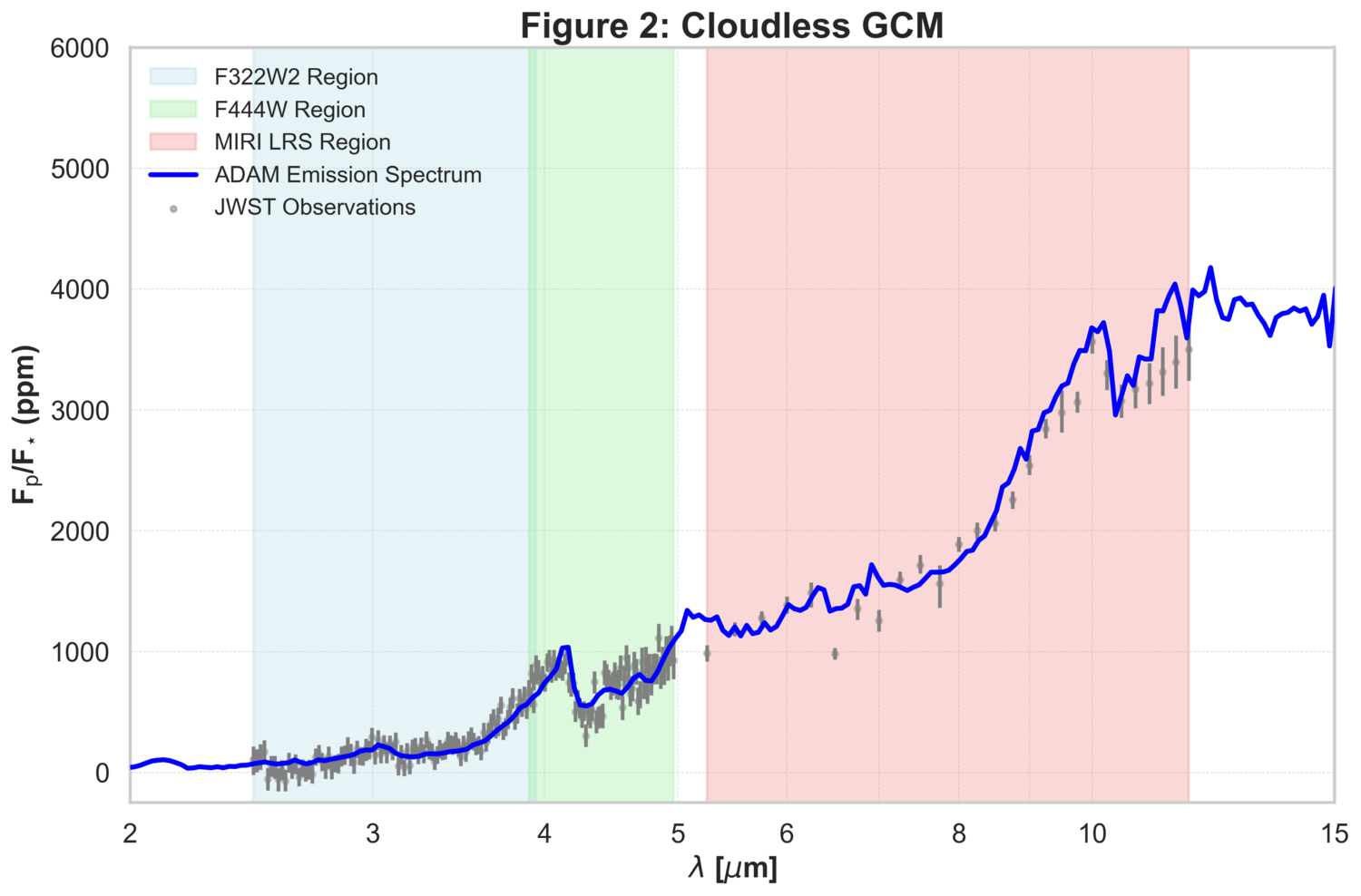
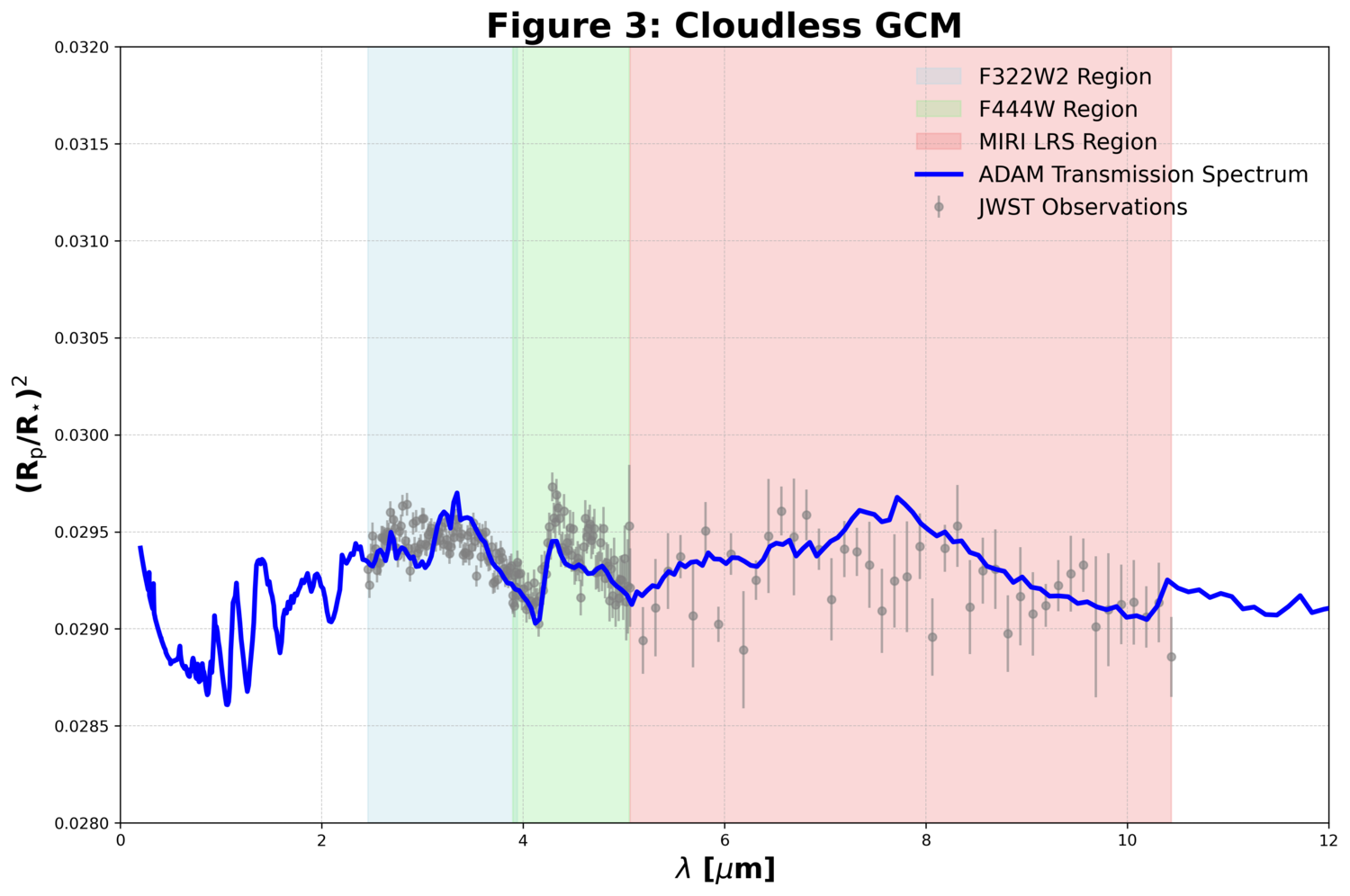
In this study, we integrate physically motivated, radiatively active, tracer-based clouds in General Circulation Models (GCM) (ADAM, former SPARC) to analyze the atmosphere of WASP-80b, a warm Jupiter orbiting an M-dwarf star. This planet, with an equilibrium temperature of ~800 K, is analogous to warm sub-Neptunes, making it a crucial target for understanding sub-Neptune atmospheres. We take advantage of the high-quality dataset from JWST obtained through the MANATEE GTO collaboration, allowing us to jointly interpret both high-quality panchromatic emission and absorption spectra ranging from 2.5 to 12 microns with the outputs from a GCM. We provide an in-depth characterisation of the planet’s atmospheric dynamics and possible cloud distribution. By comparing our models to the data, we constrain the likelihood of different expected cloud species, such as silicate, sulfide, or chloride clouds, on this planet. 

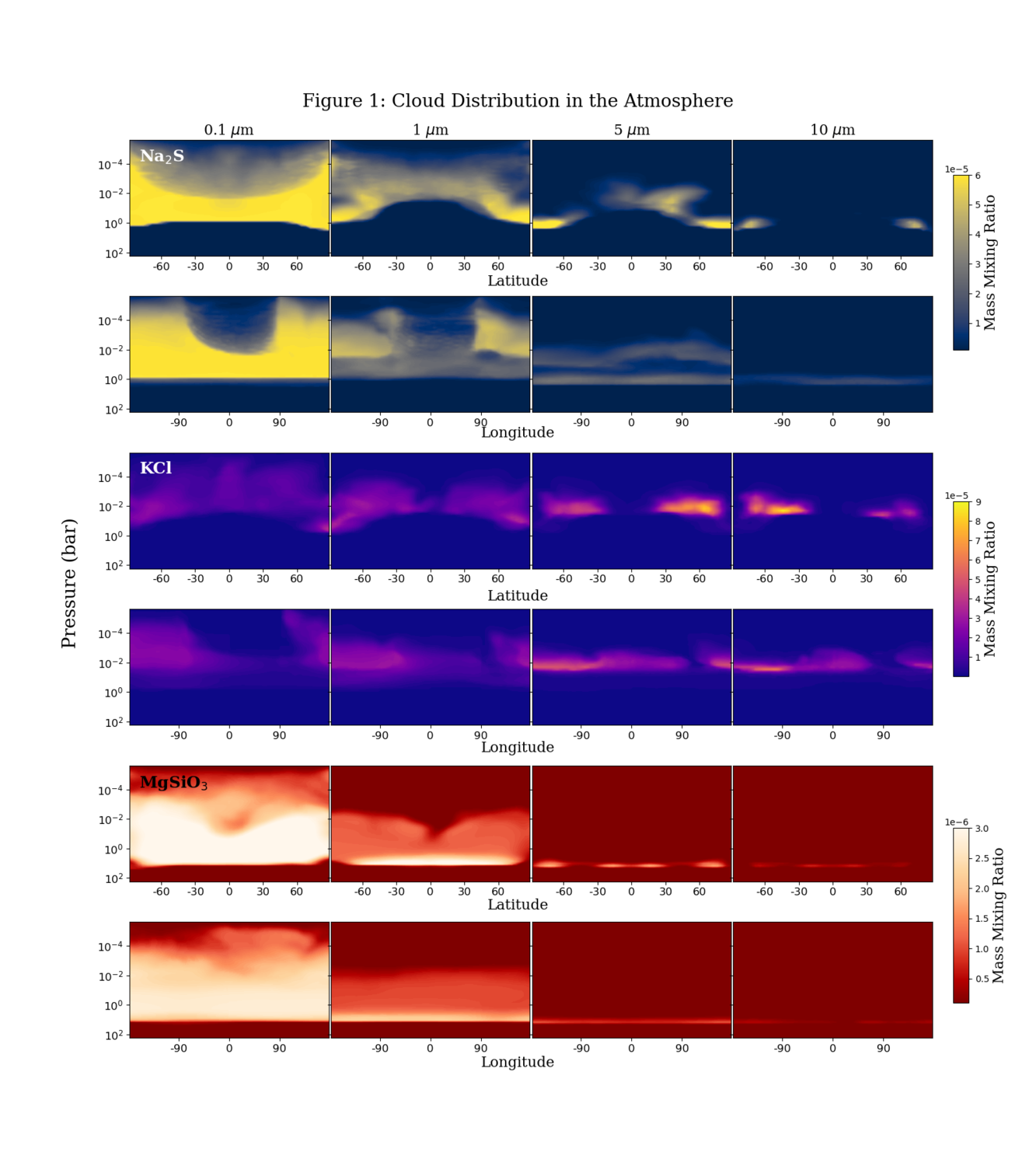
Figure 1 shows the zonal mean averaged over latitudes and longitudes of the mass mixing ratio distribution of the cloud particles in the atmosphere. The region around 0° latitude (Row: 1, 3, 5) is the region around the equator averaged over all longitudes. The region around 0° longitude (Row: 2, 4, 6) is the dayside region averaged over all latitudes. 


Figure 2: Emission Spectrum from ADAM-GCM plotted over the JWST observations from the MANATEE-GTO program, with the colored regions indicating the instruments. Figure 3: Transmission Spectrum from ADAM-GCM plotted over the JWST observations from the MANATEE-GTO program, with the colored regions indicating the instruments.

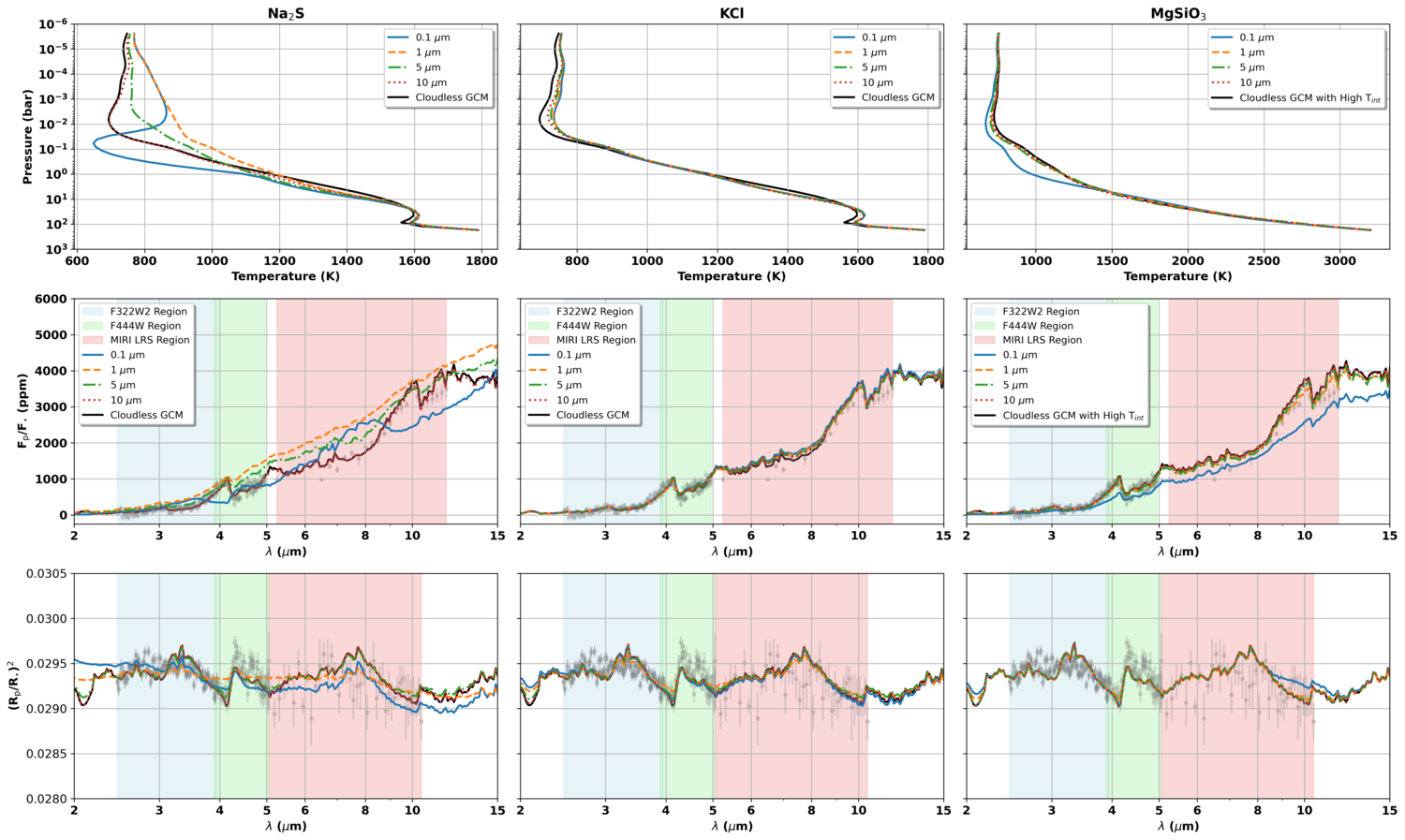
While both emission and transmission spectra are very well fitted by cloudless GCMs (Figures 2 and 3), the data also appear compatible with small KCl cloud particles, but Na2S condensates can be ruled out due to the strength of their radiative feedback.

Figure 4 shows the dayside average temperature-pressure profiles (Row 1) and the corresponding emission (Row 2) and transmission spectra (Row 3) for different clouds and particle sizes.

This showcases the unique insights that can be obtained from global modeling of exoplanet atmospheres. Our results point towards a homogeneous atmosphere with minimal temperature contrast between the day and night sides, suggesting efficient heat redistribution. Additionally, the relatively low abundance of CH4 points to active atmospheric chemistry and the possibility of a high internal heat flux, which can lead to quenching of CH4 in the atmosphere.

This work not only provides a comprehensive framework for interpreting JWST observations but also enhances the capabilities of GCMs in characterizing the global atmospheres of exoplanets in the JWST era.

How to cite: Mehta, N. and Parmentier, V.: Combining JWST data and General Circulation Models for a 3D study of the clouds on warm Jupiter WASP-80b, EPSC-DPS Joint Meeting 2025, Helsinki, Finland, 7–13 Sep 2025, EPSC-DPS2025-1597, https://doi.org/10.5194/epsc-dps2025-1597, 2025.

Back to the Solar System
17:18–17:30
|
EPSC-DPS2025-1100
|
ECP
|
On-site presentation
Jaylen Shawcross, Eliot Young, Danica Adams, Yuk Yung, Ed Thiemann, Erika Barth, Ella Sciamma-O'Brien, and David Dubois

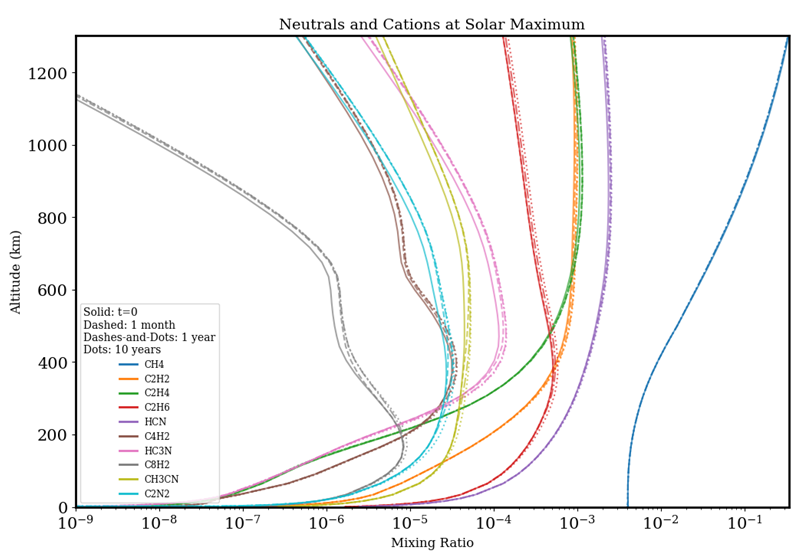
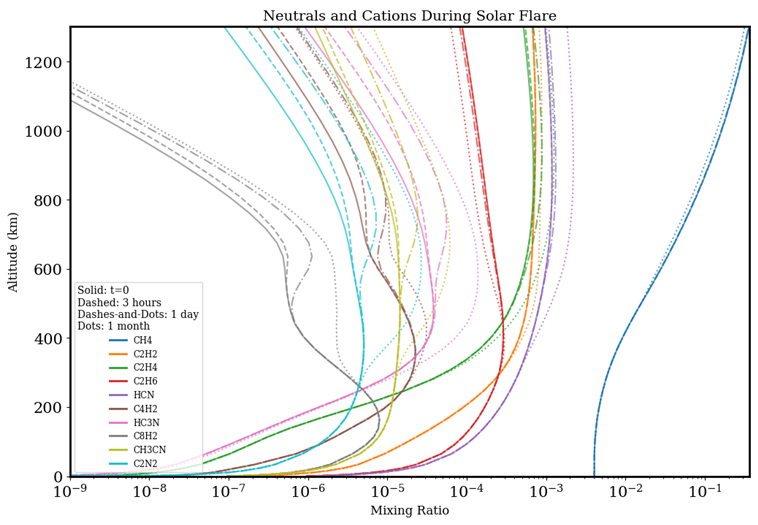
The New Horizons flyby of Pluto mapped temperature profiles, vertical profiles of N2, CH4, C2H2, C2H4, C2H6, and the vertical profile of hazes in Pluto’s atmosphere [1]. Zhang et al. 2017 showed that Pluto’s hazes can explain the colder-than-predicted upper atmosphere [2]. Previous stellar occultations reported large changes in haze optical depths on timescales of a few years. The observed presence and variability of hazes in Pluto’s atmosphere and its impact on the atmosphere motivates this work. We used KINETICS, a 1-D photochemical model and PlutoCARMA, a microphysical transport model, to study how Pluto's atmosphere responds to changes in solar UV flux. We simulated two scenarios (a sudden turn-on of a solar flare and a sudden transition from a solar minimum to solar maximum) with KINETICS to investigate formation and destruction timescales and abundances for species expected to be present in Pluto's atmosphere. Cation reactions were added to KINETICS, resulting in a substantial decrease (up to 5x) of certain C2Hx production rates at high altitudes compared to a neutrals-only case.


The main means of formation for all haze precursor species originates with photodestruction of and reactions involving CH4. These form CH3, 1CH2, and C2H4 in roughly equal amounts. CH3 forms HCN and C2H6, C2H4 forms C2H2, and the majority (> 90%) of 1CH2 eventually forms the methylidyne radical (CH) which is free to react with anything in the atmosphere. Reaction of the methylidyne radical with methane is responsible for > 90% of C2H4 production. C2H4 either reacts with CH or photodissociates to form C2H2, which is the major chemical bottleneck for production of the other species. C2H2 is the predecessor of several other haze precursor reactions, notably C8H2 (for which we observe one of the greatest increases in mixing ratio in response to a change in solar flux), HCN, C4H2, and HC3N. C2N2, another species which observes a dramatic increase in mixing ratio, forms mainly (>90% of production) from the reaction CN + HNC. 


KINETICS simulations show that photochemical formation of haze precursors occurs on timescales of hours during a solar flare and months during a solar maximum. PlutoCARMA simulations demonstrate settling timescales of several days for micron-size particles. The mixing ratio of key haze precursors at certain times is shown in Fig. 1. These results suggest that photochemical changes to haze opacity will not be detected on solar flare timescales but could be detectable over an 11-year solar cycle. The high haze optical depths were measured in 2002 by ground-based observation and in 2015 during New Horizons’ flyby, i.e., at a time close to the peaks of the 23 and 24 solar cycles. This correlation between haze opacity and solar cycle was one of the motivations for this work. Results from KINETICS simulations show that some haze precursor species are created or destroyed in significant amounts on timescales that are shorter than a solar cycle, but the simulations do not match the amplitude of τHAZE change measured between 2002 and 2007 (at least a 30x decrease) or between 2007 and 2015 (at least a 2.8x increase) [3]. In other words, photochemistry due to changing solar UV flux cannot be the sole explanation for the changes in haze optical depths that have been observed from occultations. 

Fig. 1a: mixing ratio of key haze precursors for the version of the model including neutrals and cations at key time steps run with flux associated with solar flare

Fig. 1b: mixing ratio of key haze precursors for the version of the model including neutrals and cations at key time steps run with flux associated with solar maximum

References:

[1] Young, L. A. et al. (2018) Icarus, 300, 174–199. [2] Zhang, X., Strobel, D. F., Imanaka, H. (2017). 551(7680), 352–355. [3] Young, E., Young, L., & Buie, M. (2023, October). Abstract presented at the 55th Annual Meeting of the Division for Planetary Sciences, Bulletin of the American Astronomical Society, 55(8), 308.03.


How to cite: Shawcross, J., Young, E., Adams, D., Yung, Y., Thiemann, E., Barth, E., Sciamma-O'Brien, E., and Dubois, D.: Response of Haze Precursors on Pluto to Solar Variability , EPSC-DPS Joint Meeting 2025, Helsinki, Finland, 7–13 Sep 2025, EPSC-DPS2025-1100, https://doi.org/10.5194/epsc-dps2025-1100, 2025.

17:30–17:42
|
EPSC-DPS2025-1656
|
ECP
|
On-site presentation
Francesco Biagiotti, Davide Grassi, Tristan Guillot, Leigh N. Fletcher, Sushil Atreya, Giuliano Liuzzi, Geronimo Villanueva, Pascal Rannou, Patrick Irwin, Giuseppe Piccioni, Alessandro Mura, Federico Tosi, Alberto Adriani, Roberto Sordini, Raffaella Noschese, Andrea Cicchetti, Giuseppe Sindoni, Christina Plainaki, Cheng Li, and Scott Bolton

Jupiter, the largest planet in our solar system, is a vital reference point for understanding gaseous exoplanets and their atmospheres. While we know its upper tropospheric chemical composition well, the nature and structure of its clouds remain puzzling. We, therefore, rely on theoretical models and remote sensing data to address this.

While traditional equilibrium chemistry condensation models (ECCM) are sensitive to input parameters, advanced models [1] offer more realistic cloud property predictions. Remote sensing data can help determine cloud properties and test theoretical predictions thanks to the application of multiple scattering atmospheric retrieval. Still, the process is highly degenerate and, therefore, computationally demanding. The predicted tropospheric layers are upper ammonia ice (∼0.7 bar) and ammonium hydrosulfide (∼2 bar) clouds [2], but their spectral detection has been limited to small, dynamically active regions (<2% of the disk) [3, 4].

This study analyzes JIRAM/Juno data [5] to investigate Jovian clouds and aerosols, focusing on viewing conditions relevant to future exoplanet missions. Preliminary radiative transfer simulations (using PSG [6]) indicated aerosol signatures are most prominent in the 2.6-2.8 μm and 4.5-5 μm high gas transmittance windows. The low gas opacity makes the aerosol contributions observable by JIRAM in terms of reflection of the incident solar radiation (2.6-2.8 μm) and attenuation of thermal black body radiation from the planet (4.5-5 μm). In particular, the observed solar reflection necessitates a vertically extended tropospheric haze layer consistent with previous observations [7] and Titan-adapted microphysical models [8, 9], suggesting stratospheric formation via methane photochemistry [10].

Retrievals across the full 2-5 μm JIRAM range were performed using PSG [6], varying cloud/haze parameters and gas mixing ratios, employing a single haze layer and two cloud layers (main and deep). Three compositions were tested for the main cloud: pure ammonia ice, tholins [11], and “Jupiter-adapted” tholins ([11] data removed of the 4.7 μm feature). Haze and deep cloud were modeled as reflecting and grey absorbers, respectively.

Results confirm the necessity of a haze and constrain its size and density. “Adapted” tholins provided the best spectral fit. Retrieved main cloud densities were significantly lower than ECCM and [1] predictions, with particle radii around 2-3 μm. Deep cloud densities aligned with the predicted ammonium hydrosulfide cloud top. These results may suggest that photochemistry may play a huge role in shaping the aerosol layers of Jupiter, combined with classic condensation. The observation of photochemistry in cold gaseous exoplanets such as GJ-1214b [12] makes Jupiter's troposphere a remarkably accessible laboratory for investigating these processes up close.

We formulate at least two options regarding the creation of these “adapted” tholins. The first is that they are the result of successful coagulation of some haze hydrocarbon small particles and the products of (gaseous) ammonia photolysis at pressures between 0.2 and 0.7 bar. However, we have to test if this process can efficiently create large particles around 3 microns. Alternatively, the tholins can be produced at the top of freshly produced ammonia ice clouds. Here, UV radiation can easily dissociate larger ice particles that successively can react with hydrocarbons and the gaseous ammonia photolysis products. This scenario is particularly intriguing as it should be consistent with the so-called “chromophore model” [13].  More accurate chemical models and laboratory measurements are, however, needed to verify our hypothesis.

References:

[1] Ackerman A. S., Marley M. S., 2001, ApJ, 556, 872

[2] Atreya S. K., Wong M. H., Owen T. C., Mahaffy P. R., Niemann H. B., dePater I., Drossart P., Encrenaz T., 1999, Planet. Space Sci., 47, 1243

[3] Baines K. H., Carlson R. W., Kamp L. W., 2002, Icarus, 159, 74

[4] Biagiotti, F., Grassi, D., Liuzzi, G., et al. 2025, Monthly Notices of the Royal Astronomical Society, staf38

[5] Adriani, A., Filacchione, G., Di Iorio, T., et al. 2017, Space Sci. Rev., 213, 393

[6] Villanueva G. L., Smith M. D., Protopapa S., Faggi S., Mandell A. M., 2018, Quant. Spec. Radiat. Transfer, 217, 86

[7] Dahl E. K. et al., 2021, Planet. Sci. J., 2, 16

[8] McKay, C. P., Pollack, J. B., & Courtin, R. (1989). Icarus, 80(1), 23–53.

[9] Rannou, P., McKay, C. P., & Lorenz, R. D. (2003). Planetary and Space Science, 51(14–15), 963–976.

[10] Moses, J. I., Fouchet, T., Bézard, B., et al. 2005, JGRE, 110, E08001

[11] Imanaka H., Cruikshank D. P., Khare B. N., McKay C. P., 2012, Icarus, 218, 247

[12] Kreidberg L. et al., 2014, Nature, 505, 69

[13] Baines K. H., Sromovsky L. A., Carlson R. W., Momary T. W., Fry P. M., 2019, Icarus, 330, 217

How to cite: Biagiotti, F., Grassi, D., Guillot, T., Fletcher, L. N., Atreya, S., Liuzzi, G., Villanueva, G., Rannou, P., Irwin, P., Piccioni, G., Mura, A., Tosi, F., Adriani, A., Sordini, R., Noschese, R., Cicchetti, A., Sindoni, G., Plainaki, C., Li, C., and Bolton, S.: A comprehensive picture about Jovian clouds and hazes from Juno/JIRAM infrared spectral data, EPSC-DPS Joint Meeting 2025, Helsinki, Finland, 7–13 Sep 2025, EPSC-DPS2025-1656, https://doi.org/10.5194/epsc-dps2025-1656, 2025.

17:42–17:54
|
EPSC-DPS2025-1347
|
ECP
|
On-site presentation
Lora Jovanovic, Ella Sciamma-O'Brien, Thomas Drant, Emma Dahl, Ashwin Braude, Claire Ricketts, Diane Wooden, Kevin Baines, and Farid Salama

The identity of the coloring agent, or chromophore, in Jupiter’s atmosphere that causes the planet’s striking red clouds and storms is an area of active research. Despite being studied for more than 50 years across multiple observational missions, including the Pioneer and Voyager flybys, Galileo and Cassini missions, Hubble Space Telescope (HST) observations, and recent data from the Juno spacecraft and the James Webb Space Telescope, the precise mechanisms behind the origins of Jupiter’s red color remain unknown (e.g., West et al., 2004, Sánchez-Lavega et al., 2024). Simon-Miller et al. (2001) using HST images of Jupiter identified three components contributing to Jupiter’s brightness variations. They found that gray spectral brightness variations accounted for ~91% of variation within the images, a strongly blue-absorbing chromophore was responsible for ~8% of variation in or around the tropospheric cloud deck, and a second blue/green coloring agent was necessary to explain the remaining ~1% of variation in upper tropospheric clouds or hazes, including the Great Red Spot (GRS), an anticyclonic storm located 22° south of the planet’s equator.

Various hypotheses have been proposed regarding the chemical composition of the coloring agents or chromophores responsible for the red color of Jupiter’s atmosphere. These chromophores can be divided into three main hypothesized categories:

  • Compounds resulting from sulfur chemistry (e.g., Lewis and Prinn, 1970, Sill, 1976, Loeffler et al., 2016, Loeffler and Hudson, 2018);
  • Compounds resulting from phosphorus chemistry (e.g., Prinn and Lewis, 1975, Prinn and Owen, 1976, Noy et al., 1981);
  • Organic compounds resulting from methane and ammonia photochemistry (e.g., Ferris and Ishikawa, 1988, Carlson et al., 2016).

Different studies have shown that the most promising chromophore analog for fitting spectra of various Jovian atmospheric features, including the GRS and major atmospheric cloud bands such as the Equatorial Zone and Northern Equatorial Belt is the refractory organic material synthesized by Carlson et al. (2016) from the ultraviolet photolysis of a mixture of ammonia and acetylene (Sromovsky et al., 2017, Baines et al., 2019, Braude et al., 2020, Dahl et al., 2021). While the Carlson et al. (2016) chromophore analog shows promise as the likeliest candidate, it remains uncertain due to both a) the complexities and degeneracies with aerosol properties present in radiative transfer models at wavelengths dominated by scattered sunlight, and b) the fact that Carlson et al. (2016) measured the transmission spectrum of the chromophore analog over a limited wavelength range at intermittent times during the sample production and did not determine the chemical composition or the complex refractive index directly over time.

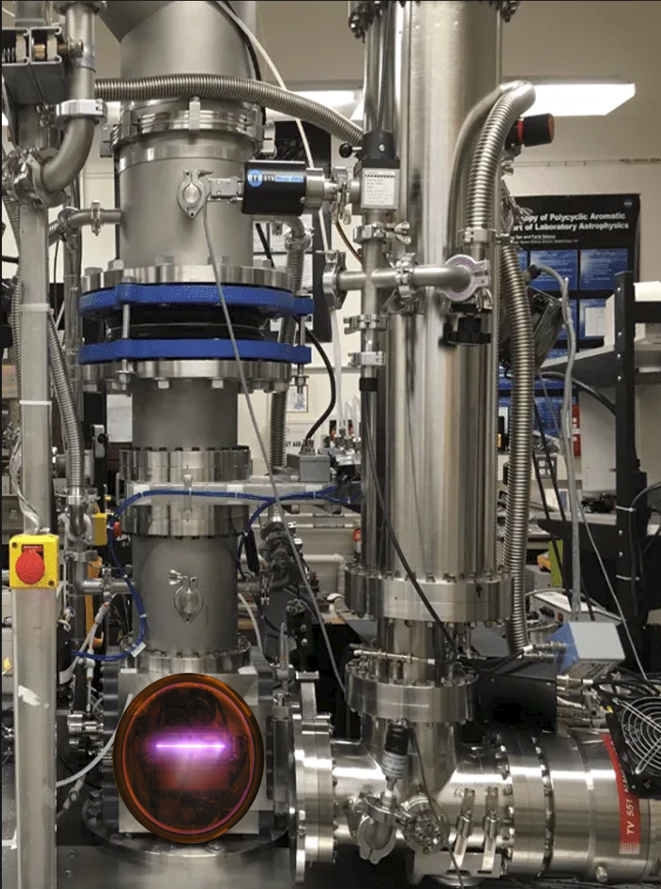
Motivated by the need to understand which gas-phase precursor molecules enables the ultimate formation of solid coloring agents, and to characterize the chemical, physical and morphological properties of these solid chromophores, we therefore propose to build on the work of Carlson et al. (2016) and synthesize new chromophore analogs in the laboratory using the NASA Ames’ COsmic SImulation Chamber (COSmIC, see Figure 1).

Figure 1. NASA Ames’ COSmIC experimental setup.

COSmIC is composed of a vacuum chamber coupled with a pulsed discharge nozzle (PDN). In the PDN, a plasma discharge is generated in the stream of a pulsed supersonic jet-cooled gas expansion (Salama et al., 2017). In the study presented here, we have used COSmIC to produce two different Jupiter chromophore analogs (or Jupiter tholins) from plasma chemistry in Ar:NH3:CH4 (95.5:1:3.5) and Ar:NH3:C2H2 (98:1:1) gas mixtures. In COSmIC, solid particles are produced in the form of grains and carried in the accelerated gas expansion before being jet-deposited onto substrates placed 5 cm downstream of the electrodes. During deposition, the grains stack up and produce a deposit hundreds of nanometers thick.

In this presentation, we will show the morphology and size distribution of the grains that have been analyzed by scanning electron microscopy. We will also present the real and imaginary parts of the complex refractive index (respectively, n and k) of the two Jupiter tholin samples, which have been determined using the Optical Constants Facility (OCF) consisting of a reflectance microscope (0.2-1.7 µm) and a FTIR spectrometer (0.6-200 µm). Additionally, we will present initial radiative transfer model results applying the new chromophore analogs’ optical constants to models of Jupiter’s atmosphere and compare them to models using the Carlson et al. (2016) chromophore.

Acknowledgements: L.J., E.S.O., C.L.R., D.H.W and F.S. acknowledge the NASA SMD PSD ISFM program.

References

West, R. A., et al. (2004) Jupiter: The Planet, Satellites and Magnetospheres, Cambridge Planetary Science, pp. 79-104.

Sánchez-Lavega, A., et al. (2024) Geophysical Research Letters 51:12.

Simon-Miller, A. A., et al. (2001) Icarus 149.1:94-106.

Lewis, J. S. and Prinn, R. G. (1970) Science 169:472-473.

Sill, G. T. (1976) IAU Colloq. 30: Jupiter: Studies of the Interior, Atmosphere, Magnetosphere and Satellites, pp. 372-383.

Loeffler, M. J., et al. (2016) Icarus 271:265-268.

Loeffler, M. J. and Hudson, R. L. (2018) Icarus 302:418-425 .

Prinn, R. G. and Lewis, J. S. (1975) Science 190:4211, pp. 274-276.

Prinn, R. G. and Owen, T. (1976) IAU Colloq. 30: Jupiter: Studies of the Interior, Atmosp here, Magnetosphere and Satellites, pp. 319-371.

Noy, N., et al. (1981) Journal of Geophysical Research:Oceans 86:C12, pp. 11985-11988.

Ferris, J. P. and Ishikawa, Y. (1988) Journal of the American Chemical Society 110:13, pp. 4306-4312.

Carlson, R. W., et al. (2016) Icarus 274:106-115.

Sromovsky, L. A., et al. (2017) Icarus 291:232-244.

Baines, K. H., et al. (2019) Icarus 330:217-229.

Braude, A. S., et al. (2020) Icarus 338:113589.

Dahl, E. K., et al. (2021) The Planetary Science Journal 2.1:16.

Salama, F., et al. (2017) Proceedings of the International Astronomical Union 13.S332:364-369.

How to cite: Jovanovic, L., Sciamma-O'Brien, E., Drant, T., Dahl, E., Braude, A., Ricketts, C., Wooden, D., Baines, K., and Salama, F.: Optical constants of laboratory-generated analogs of the red chromophores in Jupiter’s atmosphere, EPSC-DPS Joint Meeting 2025, Helsinki, Finland, 7–13 Sep 2025, EPSC-DPS2025-1347, https://doi.org/10.5194/epsc-dps2025-1347, 2025.

17:54–18:06
|
EPSC-DPS2025-1798
|
On-site presentation
Kathleen A. Alden, Joanna V. Egan, Alexander D. James, Mark D. Tarn, John M.C. Plane, and Benjamin J. Murray

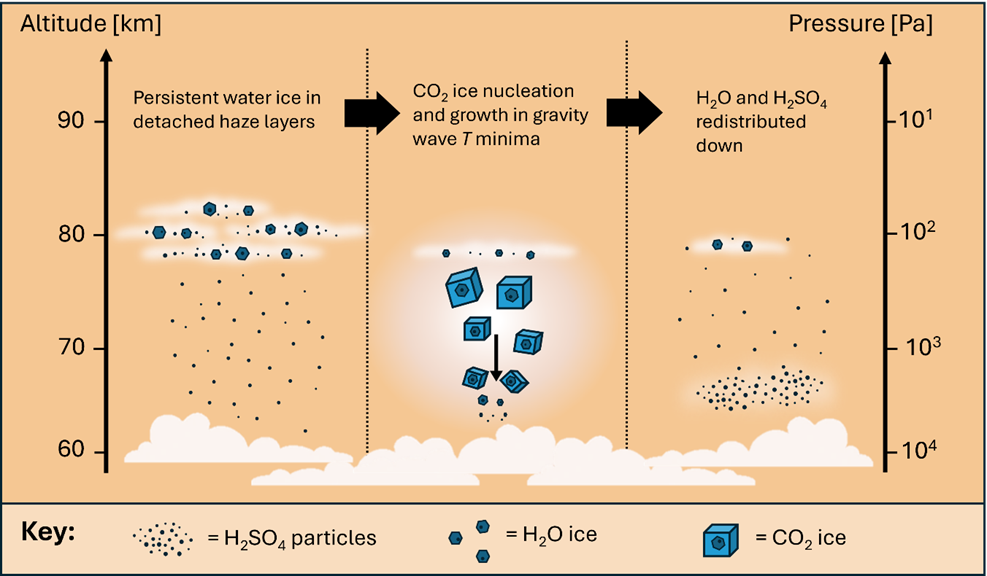
The upper haze region of Venus’ atmosphere (~70-90 km) has been shown to experience cold pockets that may give rise to ice clouds that form from the freezing of sulphuric acid droplets (Turco et al., 1983) On Earth cirrus cloud often form through the hygroscopic growth of aquoue aerosol, but temperatures in Venus’ upper haze region regularly drop well below those of the coldest cirrus clouds on earth (~185 K). However, freezing of sulphuric acid droplets under conditions relevant for Venus’ upper haze region have not been experimentally investigated.  Here, we describe our work using new laboratory freezing measurements in combination with the Solar Occultation in the InfraRed SOIR retrievals to better understand the atmospheric conditions around 80 km and determine if these conditions are suitable for the crystallisation of water and CO2 ice.

First, we experimentally explored the homogeneous nucleation of H2O ice in sulphuric acid solutions using a liquid nitrogen-cooled cryo-microscope setup, where droplet emulsions (oil/surfactant mix and H2SO4 solution with droplets of around 10 to 100 µm) are created using a microfluidic device. With this setup, we were able to extend the results from previous studies to lower temperatures and higher sulphuric acid concentrations (Bertram et al., 1996; Koop et al., 1998). We observed crystallisation down to 154 K, but this crystallisation was increasingly restricted by slow crystal nucleation and growth rates at lower temperatures. Crystallisation was not observed below 154 K, consistent with the formation of ultra-viscous or glassy solutions. To further explore the possibility of water ice cloud formation on Venus, we also examined the retrievals of temperature, water vapour mixing ratio and pressure from the Solar Occultation in the InfraRed (SOIR) instrument onboard the Venus Express orbiter (Mahieux et al., 2023). Using this data, we were able to calculate the expected sulphuric acid concentrations using the parameterisation from Tabazadeh et al. (1997), indicating that, in about 30% of the SOIR profiles, H2O ice nucleates homogeneously in liquid aqueous H2SO4 droplets or heterogeneously on glassy aqueous H2SO4 droplets. Using an average particle number density of 0.5 cm-3, which was previously reported by Luginin et al. (2018), we would expect an average size of ~1 µm ice crystals to form in the upper haze layer of Venus. 

Around 36% of the SOIR profiles reveal that these altitudes experience temperature extremes which low enough (< 140 K) that the atmosphere is stable with respect to crystalline CO2 particles. A 1D model was developed to investigate the influence of gravity waves, the formation of crystalline CO2 and the impact on the upper haze region of the atmosphere. Our 1D model showed that under these conditions, crystals will grow rapidly in the cold phase of a wave to sizes large enough for precipitation downwards to the underlying warm phase where the CO2 sublimates. Therefore, the formation of crystalline CO2 particles creates a mechanism for the redistribution of sulphuric acid particles and water to lower levels in the atmosphere.

Overall, we conclude that cirrus-like water ice clouds likely form and persist in large parts of the upper haze layer on Venus. Due to the variable nature of conditions in this region of the Venusian atmosphere, temperatures will sometimes fall well below 140 K, resulting in the rapid precipitation of CO2 particles. This will likely create a mechanism for the downward transfer of sulphuric acid, water and other materials to the warmer regions of the atmosphere.

Figure 1. The hypothesised mechanism of how temperature variations impact cloud formation and the redistribution of atmospheric constituents. We propose that persistent water ice clouds may be a common feature of the upper haze layer, and these ice crystals may provide the surface on which CO2 ice nucleates in temperature minima driven by gravity waves. The rapid growth and sedimentation of cubic CO2 ice particles would then redistribute H2SO4 particles downwards to the warmer regions of the Venusian atmosphere.


References:

Bertram, A. K., Patterson, D. D., & Sloan, J. J. (1996). Mechanisms and temperatures for the freezing of sulfuric acid aerosols measured by FTIR extinction spectroscopy. The Journal of Physical Chemistry, 100(6), 2376–2383. https://doi.org/10.1021/jp952551v

Koop, T., Ng, H. P., Molina, L. T., & Molina, M. J. (1998). A new optical technique to study aerosol phase transitions: The nucleation of ice from H2SO4 aerosols. The Journal of Physical Chemistry A, 102(45), 8924–8931. https://doi.org/10.1021/jp9828078

Luginin, M., Fedorova, A., Belyaev, D., Montmessin, F., Korablev, O., & Bertaux, J.-L. (2018). Scale heights and detached haze layers in the mesosphere of Venus from SPICAV IR data. Icarus, 311, 87–104. https://doi.org/10.1016/j.icarus.2018.03.018

Mahieux, A., Robert, S., Piccialli, A., Trompet, L., & Vandaele, A. C. (2023). The SOIR/Venus Express species concentration and temperature database: CO2, CO, H2O, HDO, H35Cl, H37Cl, HF individual and mean profiles. Icarus, 405, 115713. https://doi.org/10.1016/j.icarus.2023.115713

Tabazadeh, A., Toon, O. B., Clegg, S. L., & Hamill, P. (1997). A new parameterization of H2SO4/H2O aerosol composition: Atmospheric implications. Geophysical Research Letters, 24(15), 1931–1934. https://doi.org/10.1029/97GL01879

Turco, R. P., Toon, O. B., Whitten, R. C., & Keesee, R. G. (1983). Venus: Mesospheric hazes of ice, dust, and acid aerosols. Icarus, 53(1), 18–25. https://doi.org/10.1016/0019-1035(83)90017-9

How to cite: Alden, K. A., Egan, J. V., James, A. D., Tarn, M. D., Plane, J. M. C., and Murray, B. J.: The Formation of Cirrus-Like Water and Carbon Dioxide Ice Clouds in Venus’ Upper Haze Layer, EPSC-DPS Joint Meeting 2025, Helsinki, Finland, 7–13 Sep 2025, EPSC-DPS2025-1798, https://doi.org/10.5194/epsc-dps2025-1798, 2025.

18:06–18:18
|
EPSC-DPS2025-1113
|
On-site presentation
Ashwin Braude, Marek Slipski, Sumedha Gupta, Nicholas Schneider, Armin Kleinboehl, Franck Montmessin, Sonal Jain, Roger Yelle, and Justin Deighan

JOINT OBSERVATIONS OF MESOSPHERIC AEROSOLS ON MARS FROM MAVEN/IUVS AND MRO/MCS

Ashwin S. Braude1, Marek Slipski1, Sumedha Gupta2, Nicholas M. Schneider2, Armin Kleinböhl1, Franck Montmessin3, Sonal Jain2, Roger V. Yelle4 and Justin Deighan2


1Jet Propulsion Laboratory, California Institute of Technology, Pasadena, CA, USA (ashwin.s.braude@jpl.nasa.gov)

2Laboratory for Atmospheric and Space Physics, University of Colorado Boulder, Boulder, CO, USA

3Laboratoire Atmosphères, Milieux, Observations Spatiales (LATMOS), UVSQ Université Paris-Saclay, Sorbonne Université, CNRS, Paris, France

4Lunar and Planetary Laboratory, University of Arizona, Tucson, AZ, USA


Introduction: Aerosols in the Martian mesosphere (40 – 100 km altitude), consisting of dust, water ice and CO2 ice, act as tracers of both the water cycle and atmospheric dynamics [1,2,3], and are generated by the complex interplay of dust lofting with local perturbations in temperature and atmospheric circulation driven by zonal planetary waves (e.g. [4,5,6,7]). Although well-studied by various instruments on board Mars Express (e.g. [8,9,10,11]) and the ExoMars Trace Gas Orbiter (e.g. [12,13,14,15]), these instruments are unable to simultaneously probe the zonal and vertical structure of these layers for a given season and local time. This makes it difficult to distinguish mesospheric aerosol features driven by transient atmospheric instabilities from more persistent and predictable climatological phenomena.

 Since 2015, the Mars Atmosphere and Volatile EvolutioN (MAVEN) probe’s Imaging UltraViolet Spectrometer (IUVS) has conducted multiple targeted stellar occultations in close geographical and temporal proximity to limb observations made by the Mars Climate Sounder (MCS) instrument onboard the Mars Reconnaissance Orbiter (MRO). In this talk, we will present a climatology of these joint observations, identifying a) to what extent we detect mesospheric aerosol features that are consistent across both datasets and b) the lifetimes of these features. Our results will then be used to identify regional climatologies in aerosol features that can be distinguished from aerosol features generated by transient weather events.

Data: MCS joint observations began in March of 2015 and continued through January of 2022, corresponding to ~40 campaigns that targeted at least 1 IUVS occultation set each. We have available 140 MCS profiles that occurred within 60 minutes, and are within 10° of latitude, 15° of longitude, and 30 minutes of local time, of a single IUVS occultation.

IUVS and MCS are both sensitive to the vertical structure of both aerosols and temperature, while the longitudinal sampling of these observations at fixed latitudes and local times allows for zonal variations in aerosol structure to be extracted. From IUVS stellar occultation measurements [16], we can retrieve vertical profiles of two independent quantities: aerosol opacity up to ~110 km altitude, and an ’Ångström coefficient’ [8,17] loosely correlated with particle size (with non-zero values indicating a submicron particle population). However, aerosol particle composition is difficult to determine with great accuracy. Conversely, MCS limb observations can easily distinguish vertical profiles of dust and water ice (in units of extinction coefficient, km-1), but have little sensitivity to particle size or to aerosol opacity above approximately 60 km altitude. These measurements therefore complement each other.

Preliminary Results: Detections of detached aerosol layers below 60 km in IUVS data generally map well onto water ice cloud layers in joint MCS observations, with large densities of joint water ice cloud detections at equatorial and northern latitudes during the dusty season. Conversely, aerosol features at the lowest altitudes to which IUVS is sensitive mostly correlate with increases in dust opacity detected by MCS. The main exception is during winter and early spring at southern high latitudes, where detached aerosol layers are often retrieved by IUVS at approximately 50 km altitude but entirely absent from corresponding MCS data (with an example shown in Figure 1), even though they should be easily resolvable by both datasets.

Figure 1: Aerosol opacity and Ångström coefficient profiles retrieved from IUVS stellar occultations compared with dust and water ice extinction profiles retrieved from the closest three MCS observations. (top) in this observation, obtained in Southern winter at 63S latitude, IUVS observes a detached aerosol layer centred around 45 km altitude for which MCS failed to detect either a dust or a water ice layer, (bottom) in this observation, obtained in the northern tropics close to the autumn equinox, two detached layers are observed by IUVS at 40 km and 52 km altitude that are clearly determined to be water ice clouds by MCS.

As with [8,18] we also often observe regions of Ångström coefficient greater than 0 directly above either the level of detectable dust in MCS observations or just above water ice cloud layers, indicating layers of smaller aerosol particles – most likely dust - located just above the haze-tops and water ice clouds detected by MCS, and often undetected by MCS. However, we find as with [11] that this pattern is neither consistent nor usually correlated with the presence or absence of water ice clouds, and appears to be highly longitude-dependent.


Acknowledgments: This work was carried out at the Jet Propulsion Laboratory California Institute of Technology under a contract with NASA. We recognize support for this project from NASA grant 23-MDAP23-0060.


References: [1] Bony et al. (2015), Nat. Geosci., 8, 261–268. [2] Guzewich et al. (2016), Icarus, 278, 100–118. [3] Gronoff et al. (2020), J. Geophys. Res. Space Phys., 125, e27639. [4] Banfield et al. (2000), J. Geophys. Res., 105, 9521–9538. [5] Banfield et al. (2003), Icarus, 161, 319–345. [6] Lee et al. (2009), J. Geophys. Res. Planets, 114, E03005. [7] Guzewich et al. (2012), J. Geophys. Res. Planets, 117. [8] Montmessin et al. (2006), J. Geophys. Res., 111, e09S09. [9] Montmessin et al. (2007), J. Geophys. Res., 112, e11S90. [10] Määttänen et al. (2010), Icarus, 209, 452–469. [11] Määttänen et al. (2013), Icarus, 223, 892–941. [12] Liuzzi et al. (2020), J. Geophys Res, Planets, 125, e2019JE006250. [13] Luginin et al. (2020), J. Geophys. Res., 125, e2020JE006419. [14] Stcherbinine et al. (2020), J. Geophys. Res. Planets, 125, e2019JE006300. [15] Stcherbinine et al. (2022), J. Geophys. Res., 127, e2022JE007502. [16] Gröller et al (2018), J. Geophys. Res. Planets, 123, pp. 1449–1483. [17] O’Neill and Royer (1993), Appl. Opt., 32, 1642–1645. [18] Rannou et al. (2006), J. Geophys. Res. Planets, 111, e09S10.

How to cite: Braude, A., Slipski, M., Gupta, S., Schneider, N., Kleinboehl, A., Montmessin, F., Jain, S., Yelle, R., and Deighan, J.: Joint Observations of Mesospheric Aerosols on Mars from MAVEN/IUVS and MRO/MCS, EPSC-DPS Joint Meeting 2025, Helsinki, Finland, 7–13 Sep 2025, EPSC-DPS2025-1113, https://doi.org/10.5194/epsc-dps2025-1113, 2025.

18:18–18:30
|
EPSC-DPS2025-1551
|
ECP
|
On-site presentation
Miguel Ángel Gamonal García-Galán, Miguel Ángel López-Valverde, Adrián Brines, Aurelièn Stolzenbach, Ashimananda Modak, Francisco González-Galindo, Bernd Funke, José Juan López-Moreno, Julio Rodríguez-Gómez, Rosario Sanz-Mesa, Frank Daerden, Bojan Ristic, Giancarlo Belucci, Manish Patel, and Ian Thomas

On Mars, the most common types of atmospheric aerosols are composed of mineral dust and/or water ice. They have large effects on Martian climate, such as the absorption of solar radiation, altering the radiative balance of the planet, and they are key to atmospheric dynamics and circulation. In the case of dust, it can act as a base to form water ice or CO2 ice clouds, and it can affect observations from both orbiting satellites and rovers on ground, especially at the dusty season around perihelion.


The instrument Nadir and Occultation for Mars Discovery (NOMAD) onboard the ExoMars/Trace Gas Orbiter (ExoMars/TGO) is a suite of three spectrometers which has been observing the Martian atmosphere routinely since April 2018. Using data from its solar occultation channel (SO), we combine several sets of diffraction orders, or wavelengths to retrieve the aerosol properties and distribution during that period with a very fine resolution in the vertical from the ground up to the thermosphere. Our retrieval approach consists in three main steps. First, we perform a "cleaning" of the NOMAD observations, provided as transmittance spectra at the tangent altitudes, using an in-house pre-processing algorithm developed at IAA/CSIC. This is intended to eliminate residual imperfections in the calibrated transmittances, such as spectral shifts and continuum curvatures. Second, the cleaned spectra are used to retrieve the aerosol extinction vertical profiles following a global fit approach. This is performed with a retrieval program (RCP) together with a radiative transfer model (KOPRA) which has been well tested in Earth's atmospheric remote sounding. Finally, we implement a fitting algorithm to compare the retrieved extinctions, coming as spectral ratios of the retrieved extinctions, with the extinction ratios simulated using a Lorenz-Mie code by Mishchenko et. al., 2002. The aerosol properties inferred are the size distribution, which is described by an effective radius and its effective variance, nature (mineral dust and water ice proportions), mass of the particles and number density, as well as their vertical distribution and time variability.


In this talk we will discuss the results obtained by analyzing more than three full Martian Years. This is a significant extension of a previous first analysis by our team (Stolzenbach et. al, 2023 a,b), focused on the 1st year of NOMAD data. We have also improved a couple of aspects from the previous work. First, the wavelength coverage has been extended so that we are able to retrieve the aerosol information using any order combination, making us able to cover the SO spectral range as widely as possible, as well as exploiting the wavelengths where the aerosol nature can be better determined. Second, we have developed a new methodology to describe the uncertainties of our retrievals by computing the mean of the transmittances from two distinct regions inside the diffraction order.

We will describe the major results obtained on the global distribution and properties of the aerosols, analyzing latitudinal and seasonal trends during the time range studied.


The NOMAD experiment is led by the Royal Belgian Institute for Space Aeronomy (IASB-BIRA) with co-PI teams from Spain (IAA-CSIC), Italy (INAF-IAPS) and the United Kingdom (Open University). This project acknowledges funding by: the Belgian Science Policy Office (BELSPO) with the financial and contractual coordination by the ESA Prodex Office (PEA 4000103401, 4000121493, 4000140753, 4000140863); by the Spanish Ministry of Science and Innovation (MCIU) and European funds (grants PGC2018-101836-B-I00 and ESP2017-87143-R; MINECO/FEDER), from the Severo Ochoa (CEX2021-001131-S) and from MCIN/AEI/10.13039/501100011033 (grants PID2022-137579NB-I00, RTI2018-100920-J-I00 and PID2022-141216NB-I00); by the UK Space Agency (grants ST/V002295/1, ST/V005332/1, ST/X006549/1, ST/Y000234/1 and ST/R003025/1); and by the Italian Space Agency (grant 2018-2-HH.0). This work was supported by the Belgian Fonds de la Recherche Scientifique – FNRS (grant 30442502; ET_HOME). US investigators were supported by the National Aeronautics and Space Administration. Canadian investigators were supported by the Canadian Space Agency."

How to cite: Gamonal García-Galán, M. Á., López-Valverde, M. Á., Brines, A., Stolzenbach, A., Modak, A., González-Galindo, F., Funke, B., López-Moreno, J. J., Rodríguez-Gómez, J., Sanz-Mesa, R., Daerden, F., Ristic, B., Belucci, G., Patel, M., and Thomas, I.: Martian atmospheric aerosol latitudinal and seasonal analysis over 3 full MYs from Nomad/TGO solar occultation observations, EPSC-DPS Joint Meeting 2025, Helsinki, Finland, 7–13 Sep 2025, EPSC-DPS2025-1551, https://doi.org/10.5194/epsc-dps2025-1551, 2025.

Posters: Tue, 9 Sep, 18:00–19:30 | Lämpiö foyer

Display time: Tue, 9 Sep, 08:30–19:30
L29
|
EPSC-DPS2025-453
|
ECP
|
On-site presentation
Soma Ubukata, Hiroki Karyu, Hiromu Nakagawa, Shungo Koyama, Rikuto Minamikawa, Takeshi Kuroda, Naoki Terada, and Masao Gen

Heterogeneous reactions involving cloud particles are known to influence the chemical balance of planetary atmospheres. Understanding these interactions is especially important for Venus, where cloud particle chemistry likely plays a significant role in shaping the observed vertical distribution of sulfur dioxide (SO2). Observations show that the concentration of SO2 decreases by three orders of magnitude from the bottom to the top of the cloud layers. However, this SO2 depletion cannot be explained by gas-phase chemistry alone, suggesting a missing SO2 sink within the cloud layers. A potential mechanism for SO2 depletion is the reactive uptake of SO2 by cloud droplets, which is a well-documented process in Earth’s atmosphere, particularly in the presence of oxidants. However, it is highly uncertain whether the reactive uptake mechanism can contribute significantly to SO2 depletion in the cloud layers of Venus because the solubility of SO2 in sulfuric acid (H2SO4) is extremely low. This unaccounted-for pathway necessitates experimental validation under Venus-analogous conditions.

Here, we performed laboratory experiments to examine the uptake of SO2 by a single H2SO4 droplet of ~10 µm in the presence of nitrogen dioxide (NO2) as an oxidant for SO2 oxidation. A single sulfuric acid droplet was levitated using an electrodynamic balance (EDB), a device that uses electric fields to levitate a charged particle in mid-air. The droplet was levitated at ambient temperature (~298 K) and pressure (1 atm), conditions approximately corresponding to an altitude of 50-55 km on Venus. The radius of the droplet was determined by analyzing the Mie scattering spectrum of white light scattered by the droplet, allowing precise quantification of size growth due to reactive uptake.

We find that the size growth of the H2SO4 droplet occurs only when both SO2 and NO2 are present, indicating SO2 oxidation by NO2 within the droplet. The growth rate increases with NO2 concentration, and the reactive uptake coefficient of SO2, γ, is parameterized by the number density of NO2 (cm-3), nNO2, as log10 γ = 0.572 × log10 nNO2 - 15.03 . Numerical simulations suggest that γ = 10-7 is required to reproduce the observed SO2 concentration at the top of the cloud layer. Our results underscore that the reactive uptake of SO2 by droplets may play an important role in SO2 depletion in the Venusian cloud layers, warranting future observations of oxidants in the Venusian atmosphere.

How to cite: Ubukata, S., Karyu, H., Nakagawa, H., Koyama, S., Minamikawa, R., Kuroda, T., Terada, N., and Gen, M.: Reactive uptake of SO2 in H2SO4 droplets under Venus-analogous conditions: Laboratory study using a single particle levitation method, EPSC-DPS Joint Meeting 2025, Helsinki, Finland, 7–13 Sep 2025, EPSC-DPS2025-453, https://doi.org/10.5194/epsc-dps2025-453, 2025.

L30
|
EPSC-DPS2025-1899
|
ECP
|
On-site presentation
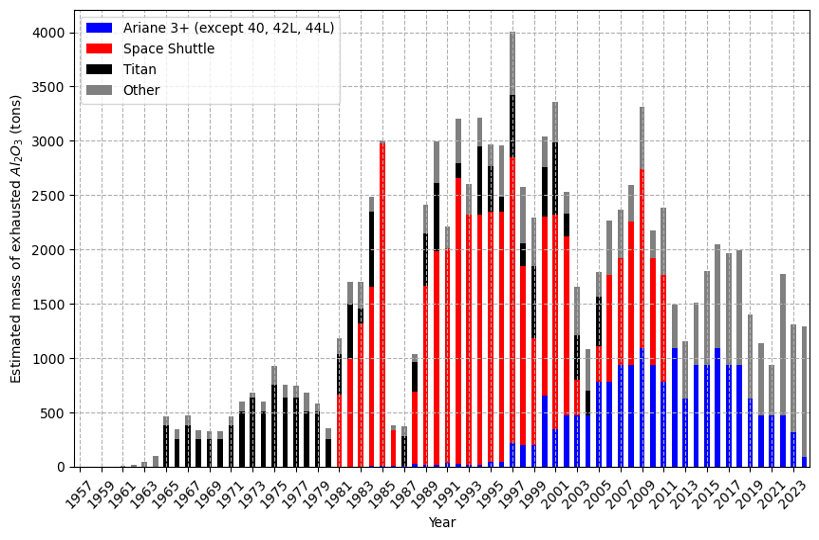
Quentin Taupin, Jérémie Lasue, Anni Määttänen, and Michael Zolensky

Motivation

The injection of materials into the Earth's atmosphere has both a natural and an anthropogenic component. Natural solid aerosols that reach the stratosphere can come from Earth—like ash from volcanic eruptions and biomass fires, pollens, spores, etc. —or from space, such as interplanetary dust, asteroids and comets. Anthropogenic stratospheric solid aerosols exclusively come from space activities, including rocket launches (alumina and black-carbon during propellant combustion) and the re-entry of space objects (rocket bodies, payloads and associated debris) into the atmosphere. Since 2000, the number of rocket launches has increased by a factor of 3 and the number of satellites launched into orbit has increased by a factor of 30 (Lasue et al., 2024). Over the same period, the mass of alumina ejected by Solid Rocket Motors is estimated to have decreased by a factor 2 without accounting for black-carbon emissions (Fig. 1). At the same time, the total mass re-entered into the atmosphere from payloads (excluding manned space flight capsules), rocket bodies, boosters and their debris has increased by more than a factor 2 (Fig. 2). Space debris accounts for only 1% of the total mass re-entered into the atmosphere, while payloads and rocket bodies (and upper stages) account for 7% and 9% respectively. Most of the re-entered mass (83%) comes from boosters and core stages in suborbital flight. Overall, an average of 3.4 kt/year of anthropogenic materials enters Earth’s atmosphere. Whereas the estimated total re-entered mass from cosmic particles ranges between 8.4 and 33.4 kt/year (Schulz et al., 2021, Fig. 1 and Tab. A.7).

Figure 1 – Annual estimated exhausted alumina mass from Solid Rocket Motors assuming a primary emission index of 0.328 and no afterburning effects (Barker et al., 2024).

Figure 2 - Annual re-entered dry mass of space objects since 1957, excluding the human spaceflight re-entry vehicles. Only boosters and core stages re-enter in suborbital flight.

Analysis of stratospheric materials

In 1981, the NASA Cosmic Dust Program was created to collect and study cosmic dust particles in the stratosphere between 18-20 km over the US with campaigns running till present. The NASA WB-57 and ER-2 aircraft collect these particles on silicone oil covered plates at a sampling altitude of about 20km. Then, particles are manually selected from the plates and rinsed in the lab. Shape, size, luster, color and transparency of the particles are characterized under optical and Scanning Electron Microscopes (SEM). Their elemental composition is measured by Energy Dispersive X-ray Spectroscopy (EDS). Based on these data, the particles are tentatively classified into 4 groups:

  • Cosmic (C): from asteroids and comets;
  • Terrestrial Contaminant Natural (TCN): from stratospheric injection of ash from volcanic eruptions and biomass fires, pollens, spores, etc.
  • Terrestrial Contaminant Artificial (TCA): from re-entry of space objects such as satellites, rocket bodies, and space debris;
  • Aluminium Oxide Sphere (AOS): mostly from Solid Rocket Motors exhaust.

5070 particles were selected, analysed, curated and the corresponding data was published in the NASA Cosmic Dust Catalogs, covering the period 1981-2020. The population of TCA in these catalogs increased in the last 10 years although not many AOS were observed after the end of the Space Shuttle Program in 2011 (Fig. 3).  In order to facilitate the micromanipulation and analysis of the particles collected on the silicone oil plates, the submicron-sized particles are not usually selected. This means that most of the analysed and published particles in the catalogs were larger than 5 microns (Fig. 4) whereas if all particles in the silicone oil were analysed, smaller particles would be found (Zolensky et al., 1985, Fig. 3).

Figure 3 - Proportion of particle types per year of collection (Lasue et al., LPSC 2024).

Figure 4 – Violin plot showing the size distribution of the 4 NASA types of all published particles collected over 1981-2020. The percentage of each particle type in the total population is given in brackets.


Classifications based on elemental composition

Between 1981 and 2020, EDS spectrometers with different performances and set-up were used. We developed a digitalization and pre-processing of the EDS spectra to allow intercomparison between different catalogs. We explored these digitized spectra with multivariate analysis techniques (Principal Component Analysis) and generated non-linear 2D projections of these multidimensional scatter plots. EDS spectra of natural minerals and pure elements were added as references to help in visualizing particles of similar composition (Fig. 5). Finally, an automated clustering helped to identify new compositional groups of particles. Hence, we can relate these compositional groups to the origin of the particles (Fig. 6). For example, using the ~1000 particles published in Catalog 18, we can separate volcanic ash (similar to Rhyolite glass) and S-rich volcanic ash, chondritic particles and particles coming from differentiated asteroids, from paints (Cd-rich), from electronics (Cu-rich), satellite structures (Al-rich with other metals) and alumina. These new clusters are consistent with the NASA manual classification (Fig. 5 and Fig. 6).

Figure 5 - Non-linear two-dimensional projection (Sammon’s map) of the elemental composition of all particles from NASA Cosmic Dust Catalog 18. Each circle represents one EDS spectrum and particle sizes can be visualized by the circle size. Some minerals formulas are indicated in square brackets.

Figure 6 - Sammon's map of all particles from NASA Cosmic Dust Catalog 18 with labelled possible origins. The different colors indicate the different compositional clusters.


Perspectives

In the future, we will extend this work to all ~ 5000 stratospheric particles published in all NASA Cosmic Dust Catalogs in order to constrain their origin. Furthermore, stratospheric particle fluxes and densities will be estimated using the flight information records, collector surfaces and selection processes. These results will provide insights into the size distribution of stratospheric solid aerosols at these sampling altitudes and latitudes. Finally, complementary analyses of older and more recent samples curated at NASA’s Johnson Space Center in Houston will be performed using cutting-edge EDS spectroscopy that can detect and quantify lighter elements including carbon and oxygen. Additional Raman spectroscopy can be used to assess mineralogy, help to interpret the origin of particles.

How to cite: Taupin, Q., Lasue, J., Määttänen, A., and Zolensky, M.: Constraining the origins of terrestrial stratospheric solid aerosols over the 1981-2020 period, EPSC-DPS Joint Meeting 2025, Helsinki, Finland, 7–13 Sep 2025, EPSC-DPS2025-1899, https://doi.org/10.5194/epsc-dps2025-1899, 2025.

L31
|
EPSC-DPS2025-295
|
On-site presentation
Daniela Tirsch, Jorge Hernández-Bernal, Agustín Sánchez- Lavega, Pedro Machado, Francisco Brasil, Ashwathy Nair, and Mariana Da Silva Encarnacao

Thanks to a long-term atmospheric monitoring campaign, the High Resolution Stereo Camera (HRSC) onboard Mars Express provides an exceptionally detailed view of atmospheric phenomena on Mars. These observations have been compiled into a comprehensive database - the HRSC Cloud Atlas [1, 2] - which offers in-depth information on the types, distributions, characteristics, and morphologies of various clouds and storm systems across different Martian seasons. Covering data from 2017 to the present, this catalog provides fundamental knowledge about when and where specific cloud and storm types occur on Mars. This in turn allows conclusions on the underlying atmospheric conditions and surface-atmosphere interactions, as each of these phenomena forms under specific boundary conditions constrained by factors such as temperature, pressure, dust and aerosol content, circulation patterns, seasonal cycle, topography, and altitude [e.g., 3, 4, 5].

We will present a comprehensive overview of the cloud type classes identified in our study, the classification scheme developed for their categorization, and detailed close-up views to illustrate the remarkable variability and visual elegance of Martian clouds. Due to space and time constraints, this presentation focuses exclusively on cloud phenomena.

Our analysis reveals that cloud types on Mars are significantly more diverse than previously reported in studies based on lower-resolution imaging instruments [e.g., 3, 6, 7], which nonetheless serve as the foundation of our classification scheme. The higher resolution of HRSC has allowed us to refine and extend existing classification systems, propose updated definitions, and introduce previously unidentified cloud types.

One such discovery is a new class of Elongated Dust Clouds (EDCs) - enigmatic features that occur during a narrow seasonal window and within a specific southern latitude band. While they resemble trough clouds likely formed by katabatic jumps [8], EDCs appear farther from the South Pole and are not always associated with topographic troughs. Another notable finding is that the Aphelion Cloud Belt (ACB, [e.g., 2, 8]), does not only contain diffuse cirrus-type clouds, also forms as gravity wave fields as well as structured cloud street fields made up of small cumulus cloud cells arranged in linear or grid-like patterns - features previously observed only at high northern latitudes. Furthermore, it was possible to observe the daily cycle of the Arsia Mons Elongated Cloud (AMEC, [10]) in high resolution and at multiple local solar times, allowing us to visualize its development phases in great visual detail.


Fig. 1: Selection of close-up example images of cloud types identified in HRSC data.


References:

[1] Tirsch, D., Machado, P., Brasil, F., Hernández-Bernal, J., Sánchez-Lavega, A., Carter, J., Montmessin, F., Hauber, E., Matz, K.-D., Nair, A., 2024, Clouds and Storms as seen by HRSC - A catalogue of atmospheric phenomena on Mars, European Planetary Science Congress, Berlin, Germany, EPSC2024-2044.

[2] HRSC team site; data products node: https://hrscteam.dlr.de/public/data.php

[3] Clancy, R.T., Montmessin, F., Benson, J., Daerden, F., Colaprete, A., Wolff, M.J., 2017. Mars Clouds, in: Haberle, R.M., Clancy, R.T., Forget, F., Smith, M.D., Zurek, R.W. (Eds.), The Atmosphere and Climate of Mars. Cambridge University Press, Cambridge, pp. 76-105.

[4] Cantor, B., Malin, M., Edgett, K.S., 2002. Multiyear Mars Orbiter Camera (MOC) observations of repeated Martian weather phenomena during the northern summer season. Journal of Geophysical Research: Planets 107, 3-1-3-8,https://doi.org/10.1029/2001JE001588.

[5] Sánchez-Lavega, A., del Río-Gaztelurrutia, T., Spiga, A., Hernández-Bernal, J., Larsen, E., Tirsch, D., Cardesin-Moinelo, A., Machado, P., 2024. Dynamical Phenomena in the Martian Atmosphere Through Mars Express Imaging. Space Science Reviews 220, 16,10.1007/s11214-024-01047-4.

[6] French, R.G., Gierasch, P.J., Popp, B.D., Yerdon, R.J., 1981. Global patterns in cloud forms on Mars. Icarus 45, 468-493,https://doi.org/10.1016/0019-1035(81)90047-6.

[7] Wang, H., Ingersoll, A.P., 2002. Martian clouds observed by Mars Global Surveyor Mars Orbiter Camera. Journal of Geophysical Research 107, 8-1-8-16,https://doi.org/10.1029/2001JE001815.

[8] Smith, I.B., Holt, J.W., Spiga, A., Howard, A.D., Parker, G., 2013. The spiral troughs of Mars as cyclic steps. Journal of Geophysical Research (Planets) 118, 1835-1857

[9] Pearl, J.C., Smith, M.D., Conrath, B.J., Bandfield, J.L., Christensen, P.R., 2001. Observations of Martian ice clouds by the Mars Global Surveyor Thermal Emission Spectrometer: The first Martian year. Journal of Geophysical Research: Planets 106, 12325-12338,https://doi.org/10.1029/1999JE001233.

[10] Hernández-Bernal, J., Sánchez-Lavega, A., del Río-Gaztelurrutia, T., Ravanis, E., Cardesín-Moinelo, A., Connour, K., Tirsch, D., Ordóñez-Etxeberria, I., Gondet, B., Wood, S., Titov, D., Schneider, N.M., Hueso, R., Jaumann, R., Hauber, E., 2021. An Extremely Elongated Cloud Over Arsia Mons Volcano on Mars: I. Life Cycle. Journal of Geophysical Research: Planets 126, e06517,doi: 10.1029/2020je006517.


How to cite: Tirsch, D., Hernández-Bernal, J., Sánchez- Lavega, A., Machado, P., Brasil, F., Nair, A., and Da Silva Encarnacao, M.: Cloud Morphologies on Mars: A Closer Look through the HRSC Cloud Atlas, EPSC-DPS Joint Meeting 2025, Helsinki, Finland, 7–13 Sep 2025, EPSC-DPS2025-295, https://doi.org/10.5194/epsc-dps2025-295, 2025.

L32
|
EPSC-DPS2025-657
|
ECP
|
On-site presentation
Alex Innanen, Livio Tornabene, Conor Hayes, and John Moores

The Mars Science Laboratory (MSL) has been observing clouds around Gale Crater since its landing in 2012 (MY 31). While MSL takes a number of different cloud observations, the Zenith and Suprahorizon Movies (ZM & SHM) are notable for being captured since nearly the start of the mission at all times of year and throughout the sunlit hours. These observations have been used to characterize the clouds’ variability, behaviour, altitudes and various scattering properties including opacity [E.g. 1,2,3,4]. Cloud opacities over Gale show very little interannual or diurnal variability, especially during the Aphelion Cloud Belt (ACB) season, a repeated yearly period of increased water-ice cloud formation around Mars aphelion [4].

MSL-derived cloud opacities have been compared with water-ice cloud opacity retrievals from MARCI on board the Mars Reconnaissance Orbiter (MRO) and EXI on board the Emirates Mars Mission [4]. However, both instruments have very large fields of view, and MRO’s sun-synchronous orbit means that it only captures images at the same time of day. Our goal is to derive opacities from another orbital dataset using cloud images from the Colour and Stereo Surface Imaging System (CaSSIS) and examine and compare cloud properties at Gale Crater.

CaSSIS is the main imaging system of the ExoMars Trace Gas Orbiter (TGO). It takes colour-infrared images from an altitude of ~400 km at a resolution of ~4 m/px using four broadband filters spanning 400-1100 nm. The images may be up to ~9.5 km wide and ~50 km long [5]. As TGO is not in a sun-synchronous orbit, it is able to capture images at various times of day and a wider range of incidence and phase angles. Its high resolution enables us to easily determine the size and spacing of the cloud features we observe from the ground with MSL. From the spacings for these features, an altitude may be inferred, something we attempt to constrain from the ground with MSL [2].

Figure 1: Temporal distribution of MSL cloud movies and CaSSIS images acquired over Gale Crater. Note that not all observations contain clouds.

We are examining the nearly 75 images taken by CaSSIS over Gale Crater for the presence of clouds. From these images we can derive the cloud opacities and compare these values with those previously derived from surface observations by MSL [4]. We are also interested in comparing images taken both from the surface and from orbit at near the same time. Additionally, as the ACB season is the best time of year to reliably capture cloud images, we intend to image the Gale Crater area with CaSSIS in hopes of coordinating with MSL cloud movies.


[1] J. E. Moores et al., “Atmospheric movies acquired at the Mars Science Laboratory landing site: Cloud morphology, frequency and significance to the Gale Crater water cycle and Phoenix mission results,” Advances in Space Research, vol. 55, no. 9, pp. 2217–2238, 2015, doi: 10.1016/j.asr.2015.02.007.

[2] C. L. Campbell et al., “Estimating the altitudes of Martian water-ice clouds above the Mars Science Laboratory rover landing site,” Planetary and Space Science, vol. 182, p. 104785, Mar. 2020, doi: 10.1016/j.pss.2019.104785.

[3] A. C. Innanen, C. W. Hayes, B. E. Koch Nichol, and J. E. Moores, “Four Mars Years of ACB Phase Function Observations from the Mars Science Laboratory Show Low Interannual and Diurnal Variability and Suggest Irregular Water–ice Crystal Geometry,” Icarus, vol. 429, p. 116437, Mar. 2025, doi: 10.1016/j.icarus.2024.116437.

[4] C. W. Hayes, J. L. Kloos, A. C. Innanen, C. L. Campbell, H. M. Sapers, and J. E. Moores, “Five Mars Years of Cloud Observations at Gale Crater: Opacities, Variability, and Ice Crystal Habits,” Planet. Sci. J., vol. 5, no. 2, p. 51, Feb. 2024, doi: 10.3847/PSJ/ad2202.

[5] N. Thomas et al., “The Colour and Stereo Surface Imaging System (CaSSIS) for the ExoMars Trace Gas Orbiter,” Space Sci Rev, vol. 212, no. 3, pp. 1897–1944, Nov. 2017, doi: 10.1007/s11214-017-0421-1.

How to cite: Innanen, A., Tornabene, L., Hayes, C., and Moores, J.: Examining Cloud Properties at Gale Crater with MSL and TGO/CaSSIS, EPSC-DPS Joint Meeting 2025, Helsinki, Finland, 7–13 Sep 2025, EPSC-DPS2025-657, https://doi.org/10.5194/epsc-dps2025-657, 2025.

L33
|
EPSC-DPS2025-1085
|
On-site presentation
Improving cloud microphysical parametrizations for ultra-hot Jupiter TOI-1431b
(withdrawn)
Julia Cottingham, Emeline Fromont, Thaddeus Komacek, Peter Gao, and Diana Powell
L34
|
EPSC-DPS2025-904
|
On-site presentation
Zoé Perrin, Thomas Drant, Enrique Garcia-Caurel, Jean-Blaise Brubach, Nathalie Ruscassier, Thomas Gautier, Ella Sciamma-O’Brien, Ludovic Vettier, Audrey Chatain, Olivier Guaitella, and Nathalie Carrasco

Introduction:

In the atmosphere of Saturn's largest satellite, Titan, the solid particles in suspension (photochemistry organic aerosols) play an important role notably to the attenuation of the solar spectrum by absorption and scattering. To constrain these interactions, the optical properties of Titan’s atmospheric aerosols, refractive index n and extinction coefficient k were recovered from observations [1, 2, 3, 4]. The refractive indices database has been expanded using solid analogs of Titan's aerosols produced and analyzed in laboratory [5, 6, 7]. The experimental data are generally consistent with the optical properties derived from Titan’s aerosols, including the contribution to the extinction and albedo of Saturn's moon [5, 7, 8]. However, comparisons of vibrational modes in the mid-infrared (MIR) suggest a difference in composition between laboratory analogs and Titan’s aerosols [9, 10]. These discrepancies in the refractive indices of solids can originate from their morphological and chemical properties. Indeed, numerous experimental studies have revealed the variability in the morphology and chemical composition of solid analogs formed in simulations of Titan's atmospheric chemistry.

Aim and Methods:

The PAMPRE dusty radio-frequency (RF) plasma experiment is used to simulate Titan's atmospheric chemistry up to the formation of solid analogs to Titan aerosols [11]. This reactor enables to produce two morphologies of solid analogs: films deposited on substrates commonly used for optical studies, and quasi-spherical powders. For fixed experimental conditions, the analysis of the chemical composition between analog films and analog powders shows variations, particularly in the N/C ratio of the solid compounds detected [12]. Here, with well-known experimental conditions of PAMPRE reactor, we produced film and powder analogs and recovered their optical properties in the MIR spectral range, to observe the potential effects of their morphological and chemical differences.

For optical analysis, powder analogs are compressed (pellets). Compared to films deposited on substrates, pellets potentially have other morphological aspects such as porosity, that may impact optical measurements. These morphological aspects are constrained and taken into account in the optical processing of the pellets. To recover refractive index n and extinction coefficient k of solid analogs, two types of optical analyses were performed: reflectance measurements from 2 to 12.5 μm by Mueller ellipsometry, and transmittance measurements from 2.5 to 20 μm by spectroscopy. From the reflectance and transmittance measurements, the refractive indices n-k were derived using Lorentz formalism and the single-subtraction Kramers-Kronig iterative model (SSKK), respectively.

Results:

On the MIR spectral range, we observe the difference in optical properties between compressed powders (pellets) and films, both analogs to Titan's atmospheric aerosols. A significant increase in the MIR absorption properties of the pellets compared to the films are observed, in particular the signatures of (hetero-)aromatic and amine features. This more intense absorption of nitrogen chemical groups in analog powders (pellets) correlates with chemical analyses of similar analogs in [12], which observed a higher N/C ratio in the solid compounds of the powders than in the films. We also observe that the reflective power of the pellet analogs is not only affected by the refractive index n but also significantly by the porosity. These new results provide further constraints on the influence of physico-chemical properties on the optical characteristics of solid aerosol analogs.

References:

[1] Lavvas, P., Yelle, R. V. & Griffith, C. A. 2010, Icarus 210, 832–842

[2] Vinatier, S. et al., 2012, Icarus 219, 5–12

[3] Seignovert, B., Rannou, P., Lavvas, P., Cours, T. & West, R. A. 2017, Icarus 292, 13–21

[4] Rannou, P., Coutelier, M., Rey, M. & Vinatier, S. 2022, A&A 666, A140

[5] Khare, B.N., Sagan, C., Arakawa, E.T., et al. 1984, Icarus, 60, 127-137

[6] Imanaka, H., Cruikshank, D.P., Khare, B.N., McKay, C.P. 2012, Icarus, 218, 247–261

[7] Sciamma-O’Brien, E., Roush, T. L., Rannou, P., Dubois, D. & Salama, F. 2023, Planet. Sci. J. 4, 121

[8] He, C., Hörst, S.M., Radke, M., Yant, M. 2022, Planetary Science Journal, 3

[9] Gautier, T. et al. 2012, Icarus 221, 320–327

[10] Brassé, C., Muñoz, O., Coll, P., Raulin, F. 2015, Planetary and Space Science, 109-110, 159–174

[11] Szopa, C., Cernogora, G., Boufendi, L., Correia, J. J. & Coll, P. 2006, Planetary and Space Science, 54, 394–404

[12] Carrasco, N., Jomard, F., Vigneron, J., Etcheberry, A., Cernogora, G. 2016, Planetary and Space Science, 128, 52–57

How to cite: Perrin, Z., Drant, T., Garcia-Caurel, E., Brubach, J.-B., Ruscassier, N., Gautier, T., Sciamma-O’Brien, E., Vettier, L., Chatain, A., Guaitella, O., and Carrasco, N.: Influence of chemical and morphological properties on the mid-infrared refractive indices of Titan aerosol analogs, EPSC-DPS Joint Meeting 2025, Helsinki, Finland, 7–13 Sep 2025, EPSC-DPS2025-904, https://doi.org/10.5194/epsc-dps2025-904, 2025.

L35
|
EPSC-DPS2025-1248
|
ECP
|
On-site presentation
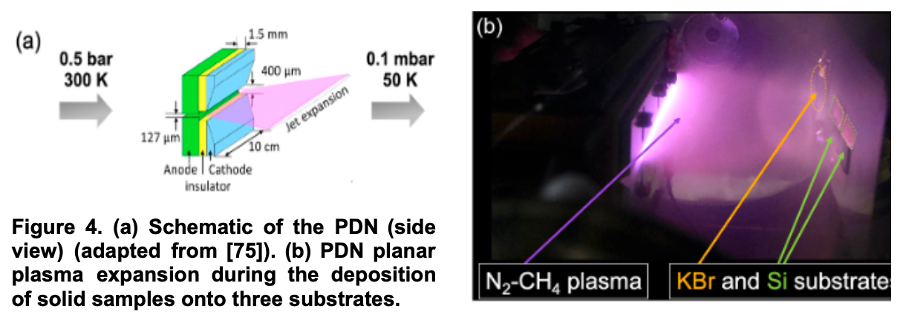
David Dubois, Laura Iraci, Erika Barth, Sandrine Vinatier, Farid Salama, and Ella Sciamma-O'Brien

1.     Introduction

The Cassini Composite Infrared Spectrometer (CIRS) revealed the presence of a benzene (C6H6) ice cloud in Titan's autumn south polar stratosphere, following the northern spring equinox in August 2009. This event increased the mixing ratio of benzene and raised the cloud top near 280 km with an equivalent radius upper limit of ~1.5 μm for pure C6H6 ice particles[1]. Previously, we investigated the size and number of C6H6 cloud particles as a function of altitude in the southern polar atmosphere using the Community Aerosol and Radiation Model for Atmospheres (CARMA)[2] based on new experimental values of the benzene vapor pressures that we measured for Titan-relevant temperatures using the NASA Ames Atmospheric Chemistry Laboratory (ACL)[3,4]. We present here recent experimental work focused on measuring for the first time, with ACL, the critical saturation (Scrit) of pure C6H6 ice at low temperature (138-157 K) deposited onto Titan aerosol analogs (or tholins) produced in the NASA Ames COsmic SImulation Chamber. Previously, no data was available for the Scrit of C6H6, and a value of 1.35 was considered in microphysics models and estimated from previous laboratory measurements of methane, ethane, and butane[2]. These new measurements and the impact they have on microphysical modeling on cloud nucleation in Titan’s atmosphere demonstrate the importance of laboratory experiments and synergy with models for the interpretation of observational data.

1. Methods

Titan tholins were first produced in COSmIC by plasma chemistry in a jet-cooled (150 K) expansion of N2:CH4 (95:5) gas[5]. Tholins were deposited for 10 hours on a silicon substrate to produce a ~800-nm layer of material, then collected in a glove box in an inert atmosphere to minimize air exposure. The tholin sample was then placed in the ACL chamber, in the path of the IR beam (Figure 2) of the ACL infrared spectrometer, placed under vacuum (P < 6 x 10⁻⁸ Torr) and then cooled slowly (0.5 K min-1). Once the target temperature was reached, C6H6 vapor was introduced into the chamber, while monitoring the C6H6 vibrational modes and peak area growth rates between 500–7000 cm-1 (1.4–20 μm). Once conditions reached a saturation ratio Scrit ~ 0.95, cooling further proceeded until bulk solid ice was detected. This entire process was then repeated for different temperatures, enabling Scrit measurements for nucleation of C6H6 between 138–157 K.

Figure 1. (a) Schematic side view of the COSmIC pulsed discharge nozzle used to generate a plasma discharge in the stream of a supersonic jet expansion. (b) Photograph of the planar plasma expansion during the deposition of solid samples onto substrates.

Figure 2. Schematic diagram (not to scale) of the ACL experimental apparatus used for benzene ice nucleation and growth studies (adapted from [2]). Pressure is measured with a capacitance manometer (P1) and an ion gauge (P2). The inset shows a top view of the sample holder with the positions of the two K-type thermocouple gauges (red dots) used for temperature measurements. The ice sample forms on either or both sides of the silicon substrate/tholin sample (grey), which is in the path of the IR beam. Infrared transmission spectra are collected with an external DTGS detector.


3. Results

Our new measurements for benzene nucleation conducted on bare silicon and Titan tholin show a clear influence of tholins on the C6H6 nucleation (Figure 3), with much lower Scrit values for the tholin sample (black) than on the blank silicon substrate used as a reference (red). Additionally, our nucleation measurements on both the tholin sample and Si substrates over the 138–157 K temperature range allow us to derive a temperature dependence to Scrit, which increases with decreasing temperature. These lower Scrit values obtained on the tholin sample are lower by a factor of ~2-3, which indicates that a lower degree of supersaturation is necessary for nucleation of C6H6 to proceed on the Titan tholin than on the bare silicon substrate. Thus, Titan tholins favor the condensation and nucleation of C6H6. We will discuss the experimental and microphysical implications of these new measurements on the number density and size distribution of cloud particles formed, and implications for the benzene cloud seen at Titan's south pole.

Figure 3. Scrit values for C6H6 measured between 138–157 K on a bare silicon substrate and on a laboratory-produced Titan tholin sample.


Acknowledgements

Funding for this project is provided through NASA CDAP.

References

[1] Vinatier et al. 2018, Icarus, 310, 89-104.
[2] Barth, E. L. 2020, Atmosphere, 11(10), 1064.

[3] Iraci, L. T. et al. 2010, Icarus, 210, 985–991.

[4] Dubois et al. 2021, Planet. Sci. J. 2, 121.

[5] Sciamma-O’Brien, E. et al. 2023, The Planetary Science Journal, 4(7), 121.

How to cite: Dubois, D., Iraci, L., Barth, E., Vinatier, S., Salama, F., and Sciamma-O'Brien, E.: Laboratory Measurements of Critical Saturation of Benzene Ice onto Titan Tholins: Application to the Microphysics of Titan’s South Polar Benzene Cloud, EPSC-DPS Joint Meeting 2025, Helsinki, Finland, 7–13 Sep 2025, EPSC-DPS2025-1248, https://doi.org/10.5194/epsc-dps2025-1248, 2025.

L36
|
EPSC-DPS2025-1191
|
On-site presentation
Erika L. Barth, Laura T. Iraci, David Dubois, Farid Salama, Sandrine Vinatier, and Ella Sciamma-O'Brien

The seasonal enhancement of benzene (C6H6) in Titan’s south polar stratosphere coupled with thermal cooling in the 350-500 km altitude range resulted in cloud formation in that region. A benzene ice cloud with a top near 280 km and an equivalent radius upper limit of ~1.5 mm for pure benzene ice particles was detected by the Cassini Composite Infrared Spectrometer (CIRS) [1]. We have been investigating the microphysical properties of this cloud through a collaboration between laboratory work and microphysical modeling by (i) measuring the saturation vapor pressure [2, 3] and critical saturation for nucleation for temperatures relevant to Titan’s stratosphere using the NASA Ames Atmospheric Chemistry Laboratory (ACL) and COsmic SImulation Chamber (COSmIC) and (ii) incorporating these values in the Community Aerosol and Radiation Model for Atmospheres (CARMA, [4]).


CARMA simulates the microphysical evolution of aerosol particles in a column of atmosphere, and includes the processes of vertical transport, coagulation, nucleation, condensation, and evaporation. For nucleation, we follow the classical theory for heterogeneous nucleation by vapor deposition, which requires a knowledge of the critical saturation ratio. In [2], no data was available for the critical saturation (Scrit) for benzene ice nucleation, so we considered a value of 1.35, approximated from previous laboratory measurements of methane, ethane, and butane. We have now measured Scrit for benzene ice at Titan-relevant temperatures (135 – 170 K). Measurements for benzene nucleation onto lab-produced tholin particles indicate Scrit is significantly higher than our initial estimate, ranging ~3-14. Additionally, our nucleation measurements over a range of temperatures allow us to derive a temperature dependence to Scrit, which increases with decreasing temperature.


In CARMA, the critical saturation is converted to the contact parameter in order to calculate the nucleation rate for the formation of benzene cloud particles. For a flat substrate as used in the laboratory environment,

                 fc = ¼*(2 + m)*(1-m)2

 where m is the contact parameter, calculated by solving the nucleation rate equation for a rate, J=1, at the critical saturation and temperature:

The nucleation rate, J, is a function of the energy of germ formation, DFg, which is related to the degree of saturation through the germ radius, ag. The other terms shown are particle radius r, nucleation prefactor K, Boltzmann’s constant k, surface energy s, molecular weight M, gas constant R, and particle density r.  As Scrit decreases towards unity, m increases towards unity and the energy required for nucleation is minimized. Figure 1 shows the critical saturation measurements converted to contact parameters for use in the CARMA nucleation calculations.

Figure 1. Contact parameter values calculated from lab measurements of critical saturation as a function of temperature for C6H6 nucleation onto tholin (black points and error bars). A linear fit, including the error, was calculated in order to model nucleation with a temperature-dependent contact parameter. The dashed green line shows our previous estimate for contact parameter used in [2].

The higher Scrit values for benzene nucleation onto lab-produced tholin translate to a higher degree of supersaturation for nucleation of benzene to proceed in Titan’s stratosphere as compared to our previous estimate [2]. Microphysical modeling has shown that increasing Scrit by a factor of 5 translates to about a 20 km drop in the cloud top height. Additionally, when we consider the temperature dependence to the critical saturation (and hence the contact parameter) the range of altitudes over which nucleation occurs becomes a more significant factor in determining the cloud top altitude.  This is indicated by the cloud top levels shown in Figure 2. The solid lines show the highest, lowest, and linear fit to the data in Fig. 1. The lowest cloud top is seen using the linear fit because the altitude where nucleation begins is at a colder temperature than shown in the measurements. All of our lab measurements show that benzene nucleation in Titan’s atmosphere is less efficient than we modeled it in our previous work ([2], dashed curve).

Figure 2. C6H6 number density profiles for a variety of contact parameters. The solid lines show our new lab measurements of benzene nucleation onto tholin, including the temperature-dependent fit, a constant value at the highest measured Scrit, and a constant value at the lowest measured Scrit. The dashed line is the profile using our previous estimate [2].

We will present microphysical modeling results showing the effects of these higher Scrit values on the number density and size distribution of cloud particles formed, and implications for the benzene cloud seen at Titan’s south pole. Nucleation is a significant factor in the height of the cloud top – the lower cloud tops modeled here may be an indirect indication of the presence of co-condensation which would alter the saturation vapor pressure and critical saturation of the mixture, allowing for cloud formation at 280 km at the south pole.


Funding for this project is provided through NASA CDAP.


[1] Vinatier et al. 2018, Icarus, 310, 89-104. [2] Dubois et al. 2021, Planet. Sci. J. 2, 121. [3] Hudson et al. 2022, PSJ, 3:120, 6pp. [4] Barth 2020, Atmosphere, 11(10), 1064.

How to cite: Barth, E. L., Iraci, L. T., Dubois, D., Salama, F., Vinatier, S., and Sciamma-O'Brien, E.: Applying Lab-Measured Critical Saturation Values for Benzene Nucleation onto Tholin to the Study of the Microphysics of Titan’s South Polar Benzene Cloud, EPSC-DPS Joint Meeting 2025, Helsinki, Finland, 7–13 Sep 2025, EPSC-DPS2025-1191, https://doi.org/10.5194/epsc-dps2025-1191, 2025.

L37
|
EPSC-DPS2025-1243
|
On-site presentation
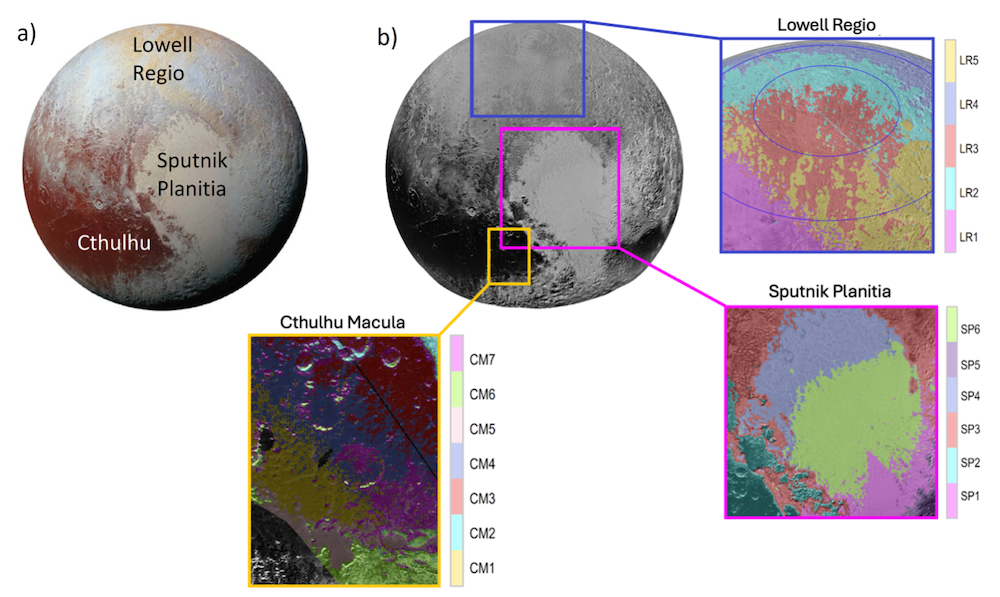
Ella Sciamma-O'Brien, Jason C. Cook, Al Emran, Cristina M. Dalle Ore, Diane H. Wooden, Ted L. Roush, Tanguy Bertrand, Lora Jovanovic, Thomas Drant, Claire L. Ricketts, and Farid Salama

Introduction:  The flyby of Pluto by the New Horizons mission unveiled a world with surprisingly diverse surface compositions and colors as well as an extensive atmospheric haze. In the enhanced color images returned by the Multispectral Visible Imaging Camera (MVIC), Pluto’s surface appears covered with a range of brown to yellow- and red-brown hues (cf. Fig. 1a). The main ices identified on Pluto’s surface (N2, CH4, CO, H2O, CH3OH) are all colorless at visible wavelengths in their pure form. The observed surface colors therefore indicate the presence of one or more colored components mixed in or superimposed on the ices. 

In Pluto’s atmosphere, the CH4 mixing ratio has been observed to vary with altitude (from 0.3% < 350 km to 5% at ~700 km in 2015) and is predicted to vary from 0.01% to 5% over annual or astronomical timescales. The CO atmospheric mixing ratio (0.05% in 2015) is not expected to vary much over time. Haze particles resulting from the photolysis and radiolysis of gaseous N2, CH4, and CO in Pluto’s atmosphere are expected to settle and accumulate onto the surface and could thus darken the surface and contaminate the ices.

Here we present the results of an interdisciplinary investigation combining experimental, modeling and observation research efforts to assess the contribution of Pluto’s atmospheric haze particles to the dark materials present on various regions across Pluto’s surface, in order to reach a better understanding of the processes that result in the surprising diversity of colors and spectral features observed by New Horizons. We focused our study on three main regions of interest that are covered with dark materials of very different colors and spectral features: Lowell Regio (yellow), Sputnik Planitia (pale orange), and Cthulhu Macula (red) (cf. Fig. 1a).

Figure 1. (a) Enhanced colored MVIC image of Pluto showing the different colors of the regions of interest for this study. (b) LOng-Range Reconnaissance Imager (LORRI) and MVIC global basemap of Pluto showing the location of the MVIC and LEISA datasets used in this study for the three regions of interest (image credit: NASA/JHUAPL/SwRI). Insets show, for each region, the distribution of the surface compositional units derived using the clustering technique.


Method: This project was divided into four main tasks:

(1) A Global Circulation Modeling (GCM) task where numerical global circulation climate simulations were used to determine the variations in Pluto’s atmospheric composition over seasonal and astronomical timescales as well as at different altitudes, in order to guide experiments.

(2) An experimental task where laboratory analogs of Pluto’s atmospheric aerosols (or tholins) were produced from gas phase plasma chemistry at low temperature with the NASA Ames COsmic SImulation Chamber (COSmIC) from various N2:CH4:CO gas mixtures representative of the expected variations in Pluto’s atmospheric composition with seasons and epochs, as determined by GCM. The complex refractive indices (optical constants) of these Pluto tholins were then determined from spectroscopic measurements conducted with the NASA Ames Optical Constants Facility (OCF).

(3) An observational task were observational data returned by the New Horizons MVIC and LEISA (Linear Etalon Imaging Spectral Array) instruments were processed using an unsupervised machine-learning clustering tool to segregate sub-regions of Pluto’s surface into clusters based on their spectral signature, hence mapping the distribution of surface composition in the three regions of interest (cf. Fig. 1b).

(4) A reflectance modeling task where the optical constants of Pluto tholins of different compositions were used along with those of relevant ices (N2, CH4, H2O…) as input parameters in a reflectance model to analyze the processed New Horizons observational data and investigate the contribution of atmospheric aerosols to the composition of the three regions of interest.


Results: 

(1) Using Pluto GCM, we determined three atmospheric mixing ratios representative of different altitudes, seasons, or epochs and used those to define the N2:CH4:CO gas mixtures we used in our experiments: 94.95:5:0.05, 98.95:1:0.05, and 99.90:0.05:0.05.

(2) We produced three Pluto tholins in the COSmIC facility from the GCM-defined N2:CH4:CO gas mixtures and determined their complex refractive indices from 0.4 up to 2.5 µm (cf. Fig. 2). To assess the effect of CO on the optical properties, we also produced a Titan tholin from N2:CH4 (95:5) and determine its optical constants.

Figure 2. Real (n) and imaginary (k) parts of the complex refractive index for the COSmIC Pluto and Titan tholins.

(3) We analyzed the LEISA and MVIC data using the principal component reduced Gaussian mixture model (PC-GMM), which is an unsupervised machine learning clustering technique. Our analysis of the three regions resulted in the classification of Cthulhu Macula into seven spectral clusters, Sputnik Planitia into six spectral clusters, and Lowell Regio into five spectral clusters (cf. Fig. 1b).

(4) For each of the three regions of interest, synthetic reflectance spectra of mixed materials were generated using optical constants of various ices and of tholins of different compositions (cf. Fig. 2) as inputs to a Hapke spectral reflectance model. They were then compared to the spectra resulting from the clustering of MVIC and LESIA data to determine what combination of organic refractory materials and ices resulted in the best fit.

We will present more detail on the experimental work, observational analysis efforts, and our findings from the reflectance modeling of the different clusters for each of the three regions of interest, which allowed us to assess the climatic context and epochs of formation for the dark materials observed in each region.


Acknowledgments: The authors acknowledge the support of the NASA SMD ROSES NFDAP (NNH20ZDA001N) program and NASA SMD PSD ISFM.

How to cite: Sciamma-O'Brien, E., Cook, J. C., Emran, A., Dalle Ore, C. M., Wooden, D. H., Roush, T. L., Bertrand, T., Jovanovic, L., Drant, T., Ricketts, C. L., and Salama, F.: A Multidisciplinary Investigation of the Origins of Pluto’s Dark Surface Materials, EPSC-DPS Joint Meeting 2025, Helsinki, Finland, 7–13 Sep 2025, EPSC-DPS2025-1243, https://doi.org/10.5194/epsc-dps2025-1243, 2025.

L38
|
EPSC-DPS2025-204
|
ECP
|
On-site presentation
Bridging Chemistry and Technology: The Dual Role of PAHs in Exoplanetary Atmospheres 
(withdrawn after no-show)
Dwaipayan Dubey, Karan Molaverdikhani, and Barbara Ercolano
L39
|
EPSC-DPS2025-1094
|
ECP
|
On-site presentation
Lily Robinthal, Tyler D. Robinson, Tommi Koskinen, Franck Montemessin, and Guillaume Petzold

Introduction: As we enter the next chapter in our characterization of exoplanet atmospheres with state-of-the-art telescopes such as the James Webb Space Telescope, the efficacy of our atmospheric retrieval pipelines is more important than ever. At present, these models share a major challenge: the parameterizations of aerosols such as clouds, dusts, and hazes. Aerosols are ubiquitous in the atmospheres of both Solar System bodies and exoplanets, but, by necessity, must be heavily simplified in exoplanet inference models. Understanding the impact of these aerosols on atmospheric spectra is key to deriving accurate compositional information from exoplanet atmospheric retrievals. Fortunately, we have the opportunity to use pre-existing Solar System observations to validate and improve exoplanet-focused approaches to representing aerosol structures. We derive aerosol profiles from occultation data of Solar System worlds with known atmospheric composition, such as Mars and Titan. These profiles provide an opportunity for ground-truth verification of exoplanet atmospheric characterization tools and allow us to improve our retrieval pipelines. 

We will be presenting aerosol profiles derived from occultation observations of Mars and Titan, as well as comparisons of these with parameterizations of aerosols in various exoplanet atmospheric retrieval models. We aim to understand if simplified model representations produce results that resemble real clouds and hazes and, if not, where we can improve, as well as determine what impact these simplifications have on retrievals.

Methods: This work involves two major stages. The first is to use the large collection of pre-existing Solar System occultation observations to create an empirically-driven database of aerosol structures. In the second stage, we  will use this ground truth to explore parameterizations of aerosols in exoplanet atmospheres and validate approaches to representing clouds/hazes in models.

For the first stage, our highest priorities are Mars and Titan, and we began with Mars. The Mars Atmosphere and Volatile Evolution (MAVEN) mission's Imaging Ultraviolet Spectrograph (IUVS) has taken 1719 occultation observations of Mars. The data are readily available in the Planetary Data System (PDS) in a derived format, which provides the aerosol optical depths at 1000 nm. There have been 48 occultation campaigns since the beginning of the mission, with campaigns occurring approximately every two months and each campaign consisting of order 10-100 individual occultation observations.

Concurrent with our analysis of the MAVEN IUVS data, we have also begun to explore occultation observations of Titan from Cassini’s UVIS instrument. Additionally, we are compiling exoplanet cloud parameterizations from different atmospheric retrieval pipelines which we will compare to our aerosol profiles.

World

Mission

Instrument

Band m)

Resolution

Date Range

No.

Venus

Venus Exp.

SPICAV-SOIR

2.3 – 4.2

0.2 cm−1

2007 – 2013

337

Earth

SCISAT -1

ACE-FTS

2 – 100

0.0025 cm−1

2004 –

10k+

Mars

MAVEN

IUVS

0.18 – 0.34

400 (λ/∆λ)

2015–

1719

Mars

TGO

NOMAD

0.2 – 4.3

> 0.15 cm−1

2018 –

10k+

Saturn

Cassini

VIMS-IR

0.85 – 5.1

16.6 nm

2005 – 2017

172

Saturn

Cassini

UVIS

0.11 – 0.19

0.28 nm

2006 – 2016

101

Titan

Cassini

VIMS-IR

0.85 – 5.1

16.6 nm

2004 – 2016

38

Titan

Cassini

UVIS

0.11 – 0.19

0.28 nm

2006 – 2016

15

Pluto

New Hor.

Alice

0.052 – 0.19

0.3–0.6 nm

2015

2

Table 1: A selection of the mission data being considered in this work.

Results: We have derived slant aerosol profiles for 45 Maven IUVS occultation campaigns, two of which are shown below.

Figure 1: Aerosol profiles from MAVEN’s campaign 24, taken from 9/12/2018-9/13/2018 (left) and 30, taken from 11/11/2019-11/12/2019 (right).

These plots extend to an altitude of 90 km, corresponding to the MUV range of the IUVS instrument. Aerosol extinction above this altitude, corresponding to the FUV range of the instrument, is unable to be confidently distinguished from the CO2 signal, so we have not included this range. The data become noisy around 60 km due to the transition from the MUV channel to the FUV channel. These profiles show a consistent structure of  higher optical depths at low altitudes, in accordance with opacity due to dust at low altitudes on Mars.

Future Work: Our next step will be to construct aerosol profiles for Titan with Cassini’s UVIS occultation observations. We will investigate aerosol parameterizations in a variety of exoplanet models and retrieval pipelines to compare to the Martian aerosol profiles as well as those we derive for Titan. We will then continue compiling aerosol profiles using occultation data of Venus, Earth, Saturn and Pluto to expand our catalog of ground-truth calibrations. We will subsequently compare these to the exoplanet parameterizations, with the ultimate goal of improving the efficacy of retrieval pipelines and deriving more accurate atmospheric composition information from transit observations of exoplanet atmospheres.

How to cite: Robinthal, L., Robinson, T. D., Koskinen, T., Montemessin, F., and Petzold, G.: Clearing the Air: Solar System Bodies as Windows into the Impact of Aerosols on Exoplanet Atmospheric Retrievals, EPSC-DPS Joint Meeting 2025, Helsinki, Finland, 7–13 Sep 2025, EPSC-DPS2025-1094, https://doi.org/10.5194/epsc-dps2025-1094, 2025.

L40
|
EPSC-DPS2025-365
|
Virtual presentation
Challenges in Cloud Estimation for Hot-Jupiter Atmospheric Retrievals
(withdrawn)
Sushuang Ma, Arianna Saba, Ahmed Faris Al-Refaie, Giovanna Tinetti, Sergei N. Yurchenko, Jonathan Tennyson, and Cesare Cecchi-Pestellini
L41
|
EPSC-DPS2025-420
|
ECP
|
On-site presentation
Emeline Fromont, Thaddeus Komacek, Peter Gao, Hayley Beltz, Arjun Savel, Isaac Malsky, Diana Powell, Eliza Kempton, and Xianyu Tan

Hot and ultra-hot Jupiters are currently the best observational targets to study the effects of clouds on exoplanet atmospheres. Observations have reported westward optical phase curve offsets, weak spectral features, and nightside temperatures remaining constant with increasing stellar flux, which may together be explained by the presence of exoplanetary clouds. Although there are many models that simulate the 3D structure and circulation of hot/ultra-hot Jupiters and many microphysical models describing the formation of clouds, very few models exist that couple these two approaches. This gap, along with recent JWST observations unmatched by models, suggests a need for more accurate models to track the formation of clouds as well as their radiative feedback on atmospheric circulation and dynamics. In this work, we couple two models to better understand how atmospheric dynamics and cloud microphysics in hot Jupiter atmospheres affect each other and the observable properties of such planets in the context of JWST data. We run cloudless 3D general circulation model (GCM) simulations using the SPARC/MITgcm for WASP-43b and WASP-121b, two hot/ultra-hot Jupiters that already have high-quality data from HST and recent JWST observations. We then feed the temperature-pressure profile outputs from the GCM simulations into 1D CARMA, which models the microphysics of mineral clouds in hot and ultra-hot Jupiter atmospheres. Finally, we use our coupled circulation and cloud formation results to calculate synthetic spectra with a ray-striking radiative transfer code and compare our results to emission and transmission observations of WASP-43b and WASP-121b. We find that various cloud species, including corundum, forsterite, and iron, form everywhere on WASP-43b and on the nightside and west limb of WASP-121b, perhaps explaining the most recent phase curve observations of these planets. We discuss implications for the interpretation of JWST/MIRI and JWST/NIRSpec observations of WASP-43b and WASP-121b respectively, with implications for the broader planetary population.

How to cite: Fromont, E., Komacek, T., Gao, P., Beltz, H., Savel, A., Malsky, I., Powell, D., Kempton, E., and Tan, X.: Revealing patchy clouds on WASP-43b and WASP-121b through coupled microphysical and hydrodynamical models, EPSC-DPS Joint Meeting 2025, Helsinki, Finland, 7–13 Sep 2025, EPSC-DPS2025-420, https://doi.org/10.5194/epsc-dps2025-420, 2025.

L42
|
EPSC-DPS2025-1037
|
ECP
|
On-site presentation
Atmospheric Heat Transport and Reflected Light in the Ultra-hot Jupiter WASP-121b using a NIRISS/SOSS Phase Curve
(withdrawn)
Jared Splinter, Nicolas Cowan, Louis-Philippe Coulombe, Robert Frazier, Emily Rauscher, Lisa Dang, Michael Radica, Romain Allart, Stefan Pelletier, Vigneshwaran Krishnamurthy, Ryan MacDonald, David Lafreniere, Doug Johnstone, Caroline Piaulet, Lisa Kaltenegger, Loic Albert, Jake Taylor, and Jake Turner
L43
|
EPSC-DPS2025-534
|
On-site presentation
Olga Muñoz, Elisa Frattin, Julia Martikainen, Francisco J García-Izquierdo, Maria Passas-Varo, Daniel Guirado, Fernando Moreno, Juan Carlos Gómez-Martín, Zuri Gray, and Hester Volten

The characterization of dust particles in the Solar System is a fundamental component of planetary science. These particles are present in a variety of environments, including the atmospheres of planets and satellites, comets, or covering the surfaces of planets, moons, and asteroids. The ever-growing number of new exoplanetary systems show that the Solar System is just a particular case in our galaxy. Through the scattering and absorption of stellar radiation, dust particles significantly influence the radiative balance of the corresponding atmosphere. However, their net radiative effect remains one of the major sources of uncertainty in atmospheric modeling. This uncertainty largely stems from a lack of understanding of how stellar radiation is scattered by a cloud of realistic dust particles i.e.  the lack of accurate scattering properties for dust and cloud particles. While modeling these properties is straightforward for homogeneous spheres, it becomes highly complex when dealing with irregularly shaped dust particles.  Hence, the importance of laboratory astrophysics and in particular the characterization of cosmic dust optical properties for proper interpretation of astronomical observations.

Over the last years, the IAA Cosmic Dust Laboratory (IAA-CODULAB) (Muñoz et al., 2011) has generated a substantial collection of high-quality experimental scattering matrices for clouds of randomly oriented cosmic dust analogues. Measurements are conducted at three wavelengths (448 nm, 520 nm, and 640 nm), spanning a wide scattering angle range from 3° to 177°. These datasets are available in digital format through the Granada-Amsterdam Light Scattering Database (scattering.iaa.es) (Muñoz et al., 2025). The database includes the full set of measured scattering matrices along with comprehensive metadata describing the scattering samples, and guidance on how to interpret and utilize the data effectively. The samples presented in the database comprise a wide range of sizes (sub-micron up to mm-sized grains), shapes and compositions. We have recently added the diffuse reflectance spectra of some of our powder samples and, from these spectra, obtained the corresponding refractive indices (200 nm–2000 nm) (Martikainen et al 2023).  In this presentation, we will provide an overview of the database and illustrate its application through examples demonstrating how the experimental data can be used to interpret astronomical observations.

REFERENCES

  • Muñoz, O.; Moreno, F.; Guirado, D.; Ramos, J. L. ; Volten, H. ; Hovenier, J. W. The IAA cosmic dust laboratory: Experimental scattering matrices of clay particles. Icarus, Volume 211, Issue 1, p. 894-900, 2011.
  • Muñoz, O. Frattin, E.; Martikainen, J. ; Guirado, D. ; Passas-Varo, M. ; Escobar-Cerezo, J. ; García-Izquierdo, F. J. ; Gómez-Martín, J. C. ; Gray, Z. ; Jardiel, T. ; Moreno, F. ; Ocaña, A. J. ; Peiteado, M. ; Gallego-Calvente, A. T. ; Volten, H. Update Granada–Amsterdam Light Scattering Database. JQSRT, 331, id.109252, 2025
  • Martikainen, J.; Muñoz, O.; Jardiel, T.; Gómez Martín, JC; Peiteado, M; Willame,Y; Penttilä, A; Muinonen, K.; Wurm, G.; Becker, T. Optical Constants of Martian Dust Analogs at UV-Visible-Near-infrared Wavelengths. ApJ Suppl. Series, 268 (2), id.47, 2003

How to cite: Muñoz, O., Frattin, E., Martikainen, J., García-Izquierdo, F. J., Passas-Varo, M., Guirado, D., Moreno, F., Gómez-Martín, J. C., Gray, Z., and Volten, H.: The Granada-Amsterdam Light Scattering Database: Experimental optical properties of cosmic dust analogue samples. , EPSC-DPS Joint Meeting 2025, Helsinki, Finland, 7–13 Sep 2025, EPSC-DPS2025-534, https://doi.org/10.5194/epsc-dps2025-534, 2025.