
 1,2,
1,2,- 1Lowell Observatory, Flagstaff, United States of America (jhanley@lowell.edu)
- 2Northern Arizona University, Flagstaff, United States of America
We have observed the Galilean moons to determine their surface composition, any differences with longitude, and whether there are any temporal changes. One of the primary components we are trying to understand is the presence of salts. Salts play an important role in habitability because they can affect the stability of liquid water. Chlorine salts lower the freezing point of water significantly, while sulfate salts create a milder environment. For Europa, most of the “non-icy” spectra from NIMS are very similar to each other and have been suggested to be composed of heavily hydrated sulfate salts (McCord et al, 1999). However, Ligier et al., 2016 and King et al., 2022 observed Europa with VLT/SINFONI and SPHERE, respectively, and utilized recent NIR laboratory spectra (Hanley et al., 2014) to model spectral features, finding that Mg-bearing chlorinated species provide better spectral fits than sulfates in some areas. Additionally, studies suggest that magnesium is originally brought to the surface as magnesium chloride (Brown and Hand, 2013), and NaCl has been detected on the surface (Trumbo et al., 2019). The correlation with lineae and darker units suggests an endogenic origin for these salts.
Any detection of chlorine salts at the surface would further constrain theories that the dark surface material might in fact be emplaced by movement of the ice sheet and possible subsurface ocean interaction and/or cryovolcanism, rather than implantation from Io’s torus, as could be the case for sulfates. This is especially strengthened by observations of plumes on Europa. Identifying the primary constituent of Europa’s ocean salts would lead to greater understanding of the ocean temperature and the thickness of the ice shell. The composition of the ocean puts limits on the habitability of ocean worlds.
We have observed Europa, Io, Ganymede, Callisto and Titan with Lowell’s 4.3 m Discovery Telescope (LDT) with the NIHTS and EXPRES instruments. The Near-Infrared High-Throughput Spectrograph (NIHTS) is a low-resolution (R ~ 200) near-infrared (NIR) spectrograph, covering 0.86 - 2.4 µm. The EXtreme PREcision Spectrometer (EXPRES) observations measure the visible spectrum from ~0.35 - 0.85 µm at a resolution of R ~ 137,500. A unique setup of EXPRES is that it is simultaneously connected to a Solar telescope which observes the Sun daily. Thus we are able to correct for actual Solar features in our spectra. The observations are disk-averaged, and those of Europa and Titan are centered around six different longitude bins to enable us to look for longitudinal differences. We also have access to telescope time every semester, so we will be able to monitor for any temporal variations. The wavelength regions covered by our instruments cover the necessary wavelengths for previous chlorine salt identifications. This work allows for monitoring of any temporal changes in Europa’s surface composition, especially if plumes are depositing new material.
Initial analysis of the NIHTS data for Europa shows water ice/hydration features in the NIR at 1.25, 1.5, 1.65, 2.0 and 2.4 µm. The 1.65 µm water ice band can be used to determine the temperature of the ice, while the others can be compared to literature spectra to determine composition. Preliminary analysis of the EXPRES data centered around 310° longitude do not show salt color centers, as expected, but do show a red slope at lower wavelengths (0.4 – 0.55 µm) followed by a slight blue slope from 0.55 – 0.8 µm. We do see transient molecular oxygen features on Ganymede as well (Figure 1). We will present these observations, as well as those to be collected in June 2025, along with analysis at various longitudes for both NIHTS and EXPRES, for all the Galilean Moons. These ongoing observations will be useful to the upcoming JUICE and Clipper missions to monitor the surface compositions over time.
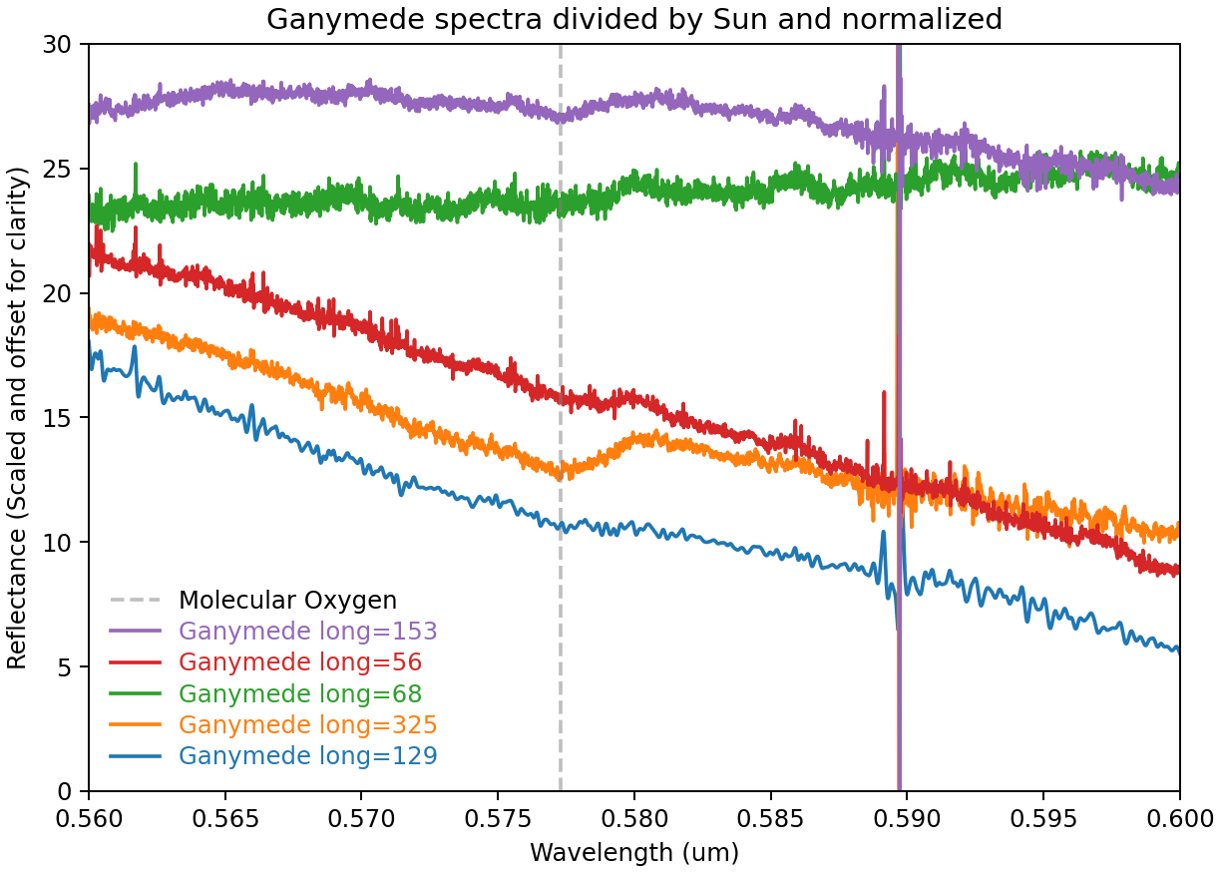
Figure 1: Visible Spectra of Ganymede from EXPRES. All data are disk-averaged, centered on the labelled longitude. Spectra have been normalized and offset for clarity. Dashed line represents the 0.5773 µm molecular oxygen feature.
References: Brown, M. E., and K. P. Hand. The Astronomical Journal 145.4 (2013): 110. Hanley, J., et al. Journal of Geophysical Research: Planets 119.11 (2014): 2370-2377. Ligier, N., et al. The Astronomical Journal 151.6 (2016): 163. King, O, L. N. Fletcher, and N. Ligier. The Planetary Science Journal 3.3 (2022): 72. McCord, T. B., et al. Journal of Geophysical Research: Planets 104.E5 (1999): 11827-11851. Trumbo, S. K., M. E. Brown, K. P. Hand. Science advances 5.6 (2019): eaaw7123.
How to cite: Hanley, J., Thieberger, C., and Grundy, W.: Ground-based Observing of the Galilean Moons in the Vis-NIR: Long-Term Monitoring and Detection of Transient Features, EPSC-DPS Joint Meeting 2025, Helsinki, Finland, 7–12 Sep 2025, EPSC-DPS2025-1246, https://doi.org/10.5194/epsc-dps2025-1246, 2025.


