Multiple terms: term1 term2
red apples
returns results with all terms like:
Fructose levels in red and green apples
Precise match in quotes: "term1 term2"
"red apples"
returns results matching exactly like:
Anthocyanin biosynthesis in red apples
Exclude a term with -: term1 -term2
apples -red
returns results containing apples but not red:
Malic acid in green apples
hits for "" in
Network problems
Server timeout
Invalid search term
Too many requests
Empty search term
OPS2
In preparation for the arrival of these missions to the Jupiter system, this session invites contributions from across the planetary science community, with the goal of fostering collaborations that will advance our understanding of topics relevant to the Galilean moons and maximize the scientific return of the missions. This session welcomes presentations concerning laboratory experiments, numerical modeling, terrestrial analog studies, and Earth-based observations (such as those from JWST, ALMA, or HISAKI), as well as analyses of past or ongoing mission data and comparative investigations of icy moons across systems. Topics of interest include the surface geology and composition of the icy Galilean moons, their interior structures and subsurface ocean dynamics, their interactions with Jupiter’s magnetosphere, surface weathering processes, and the formation, structure, and composition of their exospheres. The detection and characterization of potential Europa plumes is also highly relevant.
Additionally, we welcome discussions on the recent Juice Moon-Earth flyby and the Europa Clipper Mars flyby, examining how these events inform upcoming observations at Jupiter. The session will also provide a platform to explore mission objectives, instrumentation, recent developments, and the potential for Juice-Clipper synergistic science, as described by the recent Juice-Clipper Steering Committee report.
Session assets
The JUpiter ICy moons Explorer (JUICE) is the first European Space Agency’s large-class mission of the Cosmic Vision 2015-2025 program. It was launched in April 2023 and is on its way to Jupiter where it will arrive in July 2031, after ca 8 years of cruise.
JUICE aims to explore the conditions that could have led to habitable environments on Jupiter’s icy moons: Europa, Callisto, and Ganymede. Hosting 10 instruments, 1 investigation and 1 radiation monitor, the spacecraft will characterize the structure and environment of the Galilean moons, the Jupiter magnetosphere and atmosphere as well as the various couplings processes at play in this complex planetary system.
Ganymede, the largest moon in the Solar System, is the mission's primary focus due to its potential as a natural laboratory for studying icy worlds and water-worlds. Its role within the Galilean satellite system, along with its unique magnetic and plasma interactions with Jupiter, further elevates its importance.
The nominal mission phase is divided in two phases: a touring part of more than 3 years with 62 equatorial and inclined orbits around Jupiter as well as 36 flybys of the Galilean moons. Late in 2034, the spacecraft will then enter in orbit around Ganymede. Its orbit will initially be elliptical for 5 months, followed by more than 4-month quasi circular orbit at a 500 km altitude and a final 30-day 200 km circular orbit phase.
This presentation will cover the mission's key science objectives, the status of the spacecraft and its new baseline trajectory, the recent Venus Gravity assist, and the upcoming plans for the cruise phase.
How to cite: Vallat, C., Witasse, O., and Altobelli, N. and the JUICE Science Working Team: The ESA’s JUpiter ICy moons Explorer (JUICE) mission updates and future plans, EPSC-DPS Joint Meeting 2025, Helsinki, Finland, 7–13 Sep 2025, EPSC-DPS2025-1976, https://doi.org/10.5194/epsc-dps2025-1976, 2025.
JUICE is the first Large-class mission selected under ESA’s Cosmic Vision 2015-2025 programme. It was launched on 14 April 2023 and is now en route to the Jovian system. Its primary goal is to characterise the conditions that may have given rise to habitable environments on Jupiter’s icy moons, with particular emphasis on Europa, Callisto, and Ganymede. In parallel, JUICE will conduct a multidisciplinary investigation of the Jupiter system as an archetype for gas giants.
To meet these science objectives, the spacecraft carries ten state-of-the-art instruments designed for both remote-sensing and in-situ measurements of Jupiter, its moons, and their shared environment. During the cruise phase, prior to Jupiter arrival in July 2031, each instrument must complete all commissioning and calibration activities to ensure maximum science return from the beginning of the nominal mission.
Opportunities for calibration are limited to week-long payload checkouts performed twice per year and to periods surrounding gravity-assist manoeuvres. These special windows are the first-ever combined Lunar-Earth Gravity Assist in August 2024, followed by Earth fly-bys in 2026 and 2029. An additional about 3-month interval during the cruise phase to Jupiter may also be available for in-situ calibrations in the solar wind.
This contribution outlines the strategy, schedule, and timeline for these critical cruise-phase science operations.
How to cite: Costa, M., Vallat, C., Esquej, P., Andres, R., Valles, R., Belgacem, I., Capuccio, P., Kotsiaros, S., Vervelidou, F., Altobelli, N., and Escalante, A.: JUICE Science Operations during the Cruise Phase, EPSC-DPS Joint Meeting 2025, Helsinki, Finland, 7–13 Sep 2025, EPSC-DPS2025-1981, https://doi.org/10.5194/epsc-dps2025-1981, 2025.
NASA’s Europa Clipper and ESA’s Jupiter Icy Moons Explorer (JUICE) missions are each currently bound to explore the Jupiter system during overlapping time periods in the early 2030s. Europa Clipper is scheduled to arrive in orbit around Jupiter in April 2030, followed by JUICE’s arrival in July 2031. While each mission was designed to pursue its own set of independently compelling science objectives, the temporal and spatial proximity of these two well-instrumented spacecraft presents an unprecedented opportunity to perform coordinated or complementary scientific observations across the Jovian system. The scientific return from such joint activities has the potential to exceed significantly the sum of each mission’s individual efforts.
Recognizing this potential, a JUICE–Clipper Steering Committee (JCSC) was formed jointly by the two mission teams to identify and evaluate possible synergistic science opportunities. This committee includes members from both missions, and it has drawn on science team input from multiple joint workshops, as well as the Science Traceability Matrix developed for the earlier Europa Jupiter System Mission (EJSM) study. The JCSC recently provided a set of recommendations to the two mission teams, describing science themes and observation strategies that could benefit from joint implementation. The recommendations for the orbital (tour) period include time-dependent and space-dependent coordinated measurements of Europa, Ganymede, Callisto, Io, Jupiter’s magnetosphere and atmosphere, the ring system, and small satellites.
The next step is for each mission to consider which of the proposed activities may be realistically implementable within the scope of its mission constraints. Within the Europa Clipper project, which currently focuses on Europa science only, a structured internal assessment is currently underway to evaluate which synergistic science opportunities could potentially align with the mission’s priorities, resources, and operational design.
The Europa Clipper mission, launched in October 2024, is guided by the mission's goal of assessing the habitability of Europa. The mission’s three science objectives are to characterize the ice shell and subsurface structure, characterize the composition and chemistry of the surface and exosphere, and elucidate geological activity and recent surface processes; cross-cutting these is to search for and characterize current activity such as plumes and thermal anomalies. The spacecraft will conduct nearly 50 flybys of Europa at altitudes as low as 25 km over a four-year nominal tour, while also executing opportunistic flybys of Ganymede and Callisto. Europa Clipper carries a sophisticated suite of nine science instruments—spanning imaging, spectroscopy, magnetometry, radar sounding, dust analysis, and mass spectrometry—as well as gravity and radio science supported by the telecommunications system.
Because the mission is complex and constrained by the high-radiation environment of Jupiter, the incorporation of new science activities, even those of high potential value, must be approached with careful evaluation of resource and cost feasibility. Accordingly, Europa Clipper’s internal response to the JCSC recommendations is being developed through a collaborative, phased process led by the Project Scientist.
In the first phase of this process, each of Europa Clipper’s ten Investigation Teams was asked to review the JCSC’s Orbital Report and provide instrument-specific assessments of the scientific value, technical feasibility, and operational implications of the proposed joint observations, and to identify any additional key opportunities that may warrant consideration. These assessments addressed instrument-specific observation opportunities and constraints.
In the second phase, Europa Clipper’s three Objective-based Thematic Working Groups (Interior, Composition, and Geology) were tasked with synthesizing the instrument-level inputs and identifying which opportunities offer the most compelling science return, considering associated constraints. This cross-disciplinary analysis ensures that the evaluation is anchored in integrated science value.
This process also includes coordination with Europa Clipper’s Mission System team, to evaluate the technical and operational feasibility of candidate observations. The Mission System team is advising on resource availability and limitations in areas such as power, spacecraft pointing and slewing capabilities, BDS (bulk data storage) capacity, and downlink availability. Because Europa Clipper operates in a radiation-intense environment and executes carefully choreographed flybys, even small changes to the mission plan could have significant impacts on spacecraft operations, science acquisition, and data return. As such, potential synergistic activities must be thoroughly vetted to ensure they do not compromise the mission’s primary objective or over-extend mission resources.
With this mission-internal assessment, the Project Scientist and Deputy Project Scientists—working in consultation with the JCSC Facilitator—will prepare a recommended package of synergistic observations that Europa Clipper may be able to support. This recommendation will be presented to the full Science Team for discussion and refinement, ensuring that it reflects both broad consensus and careful prioritization. The final recommended set of activities will be shaped by two overarching criteria: (1) scientific significance in the context of Europa Clipper’s science objectives and capabilities, and (2) simplicity and realism of implementation within the mission’s resource envelope.
By the time of the joint EPSC/DPS 2025 meeting, this process is expected to be substantially complete. At the EPSC/DPS 2025 meeting, we will present the results of Europa Clipper’s internal evaluation, including a summary of which synergistic science opportunities have been prioritized for potential implementation. We will also describe the science and operations constraints considered in the decision-making framework, and the next steps that may follow.
This presentation aims to inform the planetary science community of Europa Clipper’s strategy for evaluating and potentially implementing cross-mission science opportunities. It is intended to support transparency and demonstrate the mission’s commitment to maximizing scientific return while preserving its primary goal and the integrity of its three science objectives. This work complements the separate report of the JUICE–Europa Clipper Steering Committee. We note that at present, no formal agreements or commitments exist between NASA and ESA regarding the implementation of joint science activities.
Government support acknowledged. Writing assisted by ChatGPT 4o.
How to cite: Pappalardo, R., Korth, H., Burratti, B., and Choukroun, M.: Assessing Europa Clipper’s Response to JUICE–Clipper Synergistic Science Opportunities in the Jupiter System, EPSC-DPS Joint Meeting 2025, Helsinki, Finland, 7–13 Sep 2025, EPSC-DPS2025-1147, https://doi.org/10.5194/epsc-dps2025-1147, 2025.
Europa Clipper was launched on October 14, 2024 to implement NASA’s first detailed exploration of an ocean world. Europa almost certainly contains a global subsurface ocean where a potentially habitable environment could have persisted for millions if not billions of years. The nominal tour of 4.27 years includes about 50 flybys of Europa, some as close as 25 km. The underlying theme of the mission is to search for the building blocks of life that could provide the foundation for a habitable environment. With the likely existence of other ocean worlds in the Solar System, including Titan, Enceladus, Ganymede, Ceres, and potentially many more in other solar systems, the detailed exploration of Europa takes on prime importance.
The main objectives of the mission are to characterize the ice shell and any subsurface water, including their heterogeneity, ocean properties, and the nature of surface–ice–ocean interactions; understand the habitability of Europa’s ocean through composition and chemistry; and understand the formation of surface features, including sites of recent or current activity, and characterize high science interest localities. A final cross-cutting objective is to search for current activity.
The mission’s objectives will be addressed with an advanced suite of complementary instruments. The remote sensing payload consists of the Europa Ultraviolet Spectrograph (Europa-UVS), Europa Imaging System (EIS), Mapping Imaging Spectrometer for Europa (MISE), Europa Thermal Imaging System (E-THEMIS), and Radar for Europa Assessment and Sounding: Ocean to Near-surface (REASON). The in-situ instruments are the Europa Clipper Magnetometer (ECM), Plasma Instrument for Magnetic Sounding (PIMS), SUrface Dust Analyzer (SUDA), and MAss Spectrometer for Planetary EXploration (MASPEX). Gravity and Radio Science (G/RS) will be achieved using the spacecraft's telecommunication system, and valuable scientific data of the radiation environment will be collected by the engineering sensors comprising the Radiation Monitor (RadMon). All instruments will be operating together, with the remote sensing instruments pointed to nadir and the in-situ instruments pointing in the ram direction. With a total ionizing dose of 2.97 Mrads, one of the challenges of the missions is to protect the instruments’ electronics from damaging radiation. The main mitigation tactic was to encase most of the electronics in a metal vault. Another operational mitigation is to orbit Jupiter rather than Europa, and swoop into the more dangerous environment of high energy particles at Europa only for encounters.
The cruise period is about five and a half years, providing a long period to check out and calibrate the instruments, as well as to optimize the science planning process for the tour. Initial checkouts and activities have been successful, with minor problems corrected. The interplanetary trajectory includes two gravity assists: one at Mars, which occurred on March 1, 2025, and another at Earth, which will occur on December 3, 2026. The Mars flyby provided an opportunity for key calibrations for E-THEMIS; an end-to-end test of REASON; and checkouts of all the telecommunication components necessary for the G/RS experiment. Although all data are not on the ground as of early May, the indications are that these activities were successful. More activities are being planned for the Earth-flyby. Jupiter Orbit Insertion occurs on April 11, 2030, with an initial flyby of Ganymede on October 30, 2030. The first flyby of Europa will occur on March 7, 2031 with a closest approach of just over 200 km.
During most of the period of the Europa Clipper mission, the European Space Agency (ESA) will be operating the highly complementary Jupiter Icy Moons Explorer (JUICE) mission. JUICE will focus on Callisto, Ganymede, and fields and particles in the vicinity of Jupiter. Although only two flybys of Europa will occur as part of the mission, one will happen almost simultaneously with one of Europa Clipper’s flybys. These coordinated flybys will offer an unprecedented opportunity to understand the Jovian system at a very large spatial scale. The two science teams have begun informal collaborations to consider synergistic science opportunities during this key period, as well as during cruise and approach.
Following the success of the efforts established by other missions, the Europa Clipper science team includes a ground-based astronomical observers support group. The purpose of this group is to provide follow-up for transient events; to offer greater temporal and spatial context; and to obtain wavelengths and viewing geometrics not observed by Europa Clipper.
The Europa Clipper team has published articles on the mission, instruments, and engineering systems in an open-access topical collection of the journal Space Science Reviews. The team has begun science observation planning for both nadir and non-nadir periods of the nominal tour to sketch out a Strategic Science Planning Guide, which details the science observation strategy. This presentation will provide any late updates, particularly those involving the recent gravity assist at Mars.
Government support acknowledged.
How to cite: Buratti, B. and the Europa Clipper Science Team: Europa Clipper: An Overview of the Mission, EPSC-DPS Joint Meeting 2025, Helsinki, Finland, 7–13 Sep 2025, EPSC-DPS2025-1031, https://doi.org/10.5194/epsc-dps2025-1031, 2025.
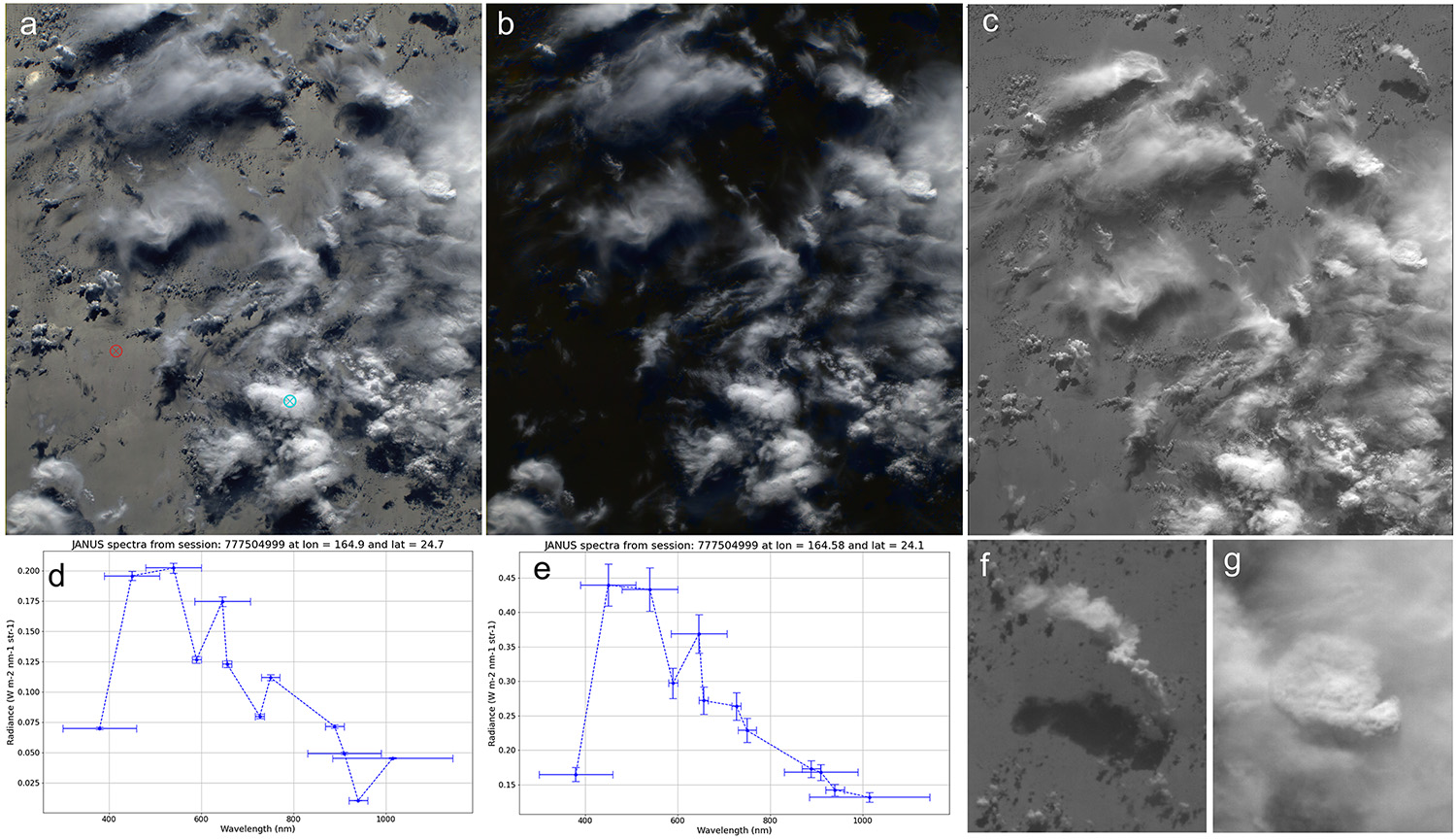
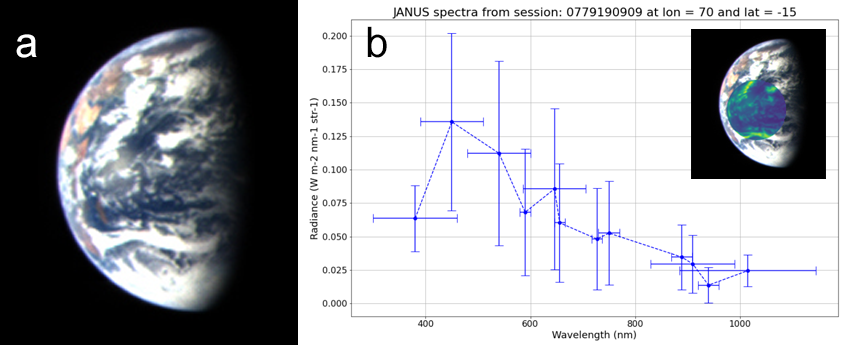
Introduction The JANUS (Jovis, Amorum ac Natorum Undique Scrutator) imaging system [1], onboard ESA’s JUICE mission, had the unique opportunity to observe both Moon and Earth during the Lunar-Earth Gravity Assist (LEGA) maneuver on August 19–20, 2024. This flyby represented the first opportunity to operate JANUS under conditions like those expected in the Jovian system. The JANUS telescope, a modified Ritchey-Chrétien design with a 103.6 mm aperture and 467 mm focal length, uses a Teledyne-e2v CMOS detector and 13 filters spanning 340–1080 nm. During LEGA, the instrument observed the Moon’s dayside, capturing imagery across a wide latitudinal and longitudinal track. Observational planning considered operational constraints, such as filter switching times, data volume limits, and rapid spacecraft motion. The collected data supported performance verification, calibration refinement, and validation of data processing tools, effectively preparing JANUS for its forthcoming scientific operations in the Jovian system. In addition, such a flyby enables us to conduct unique scientific investigations of the Moon thanks to high-resolution and multifilter images acquired.
JANUS Observation of the Moon During the Moon flyby, due to operational constraints, JANUS was switched on 1 hour before the beginning of image acquisition. To ensure thermal stability at the time of observation, the S/C survival heaters were used to bring the telescope to the optimal temperature. Imaging began shortly before crossing the lunar terminator and continued beyond limb crossing to capture stray light. Observations covered latitudes 17°S–16°N and longitudes 107°E–7°W, encompassing prominent lunar features such as the LaPérouse and Langrenus craters, Mare Fecunditatis, Sinus Asperitatis, and the southern portion of Mare Tranquillitatis. Initial imaging used the panchromatic filter with lossless compression, followed by multi-filter sequences (4 to 13 filters) under varying solar incidence angles (90° to 29°), enabling detailed coverage and performance assessment. Among the regions observed by JANUS, our investigation focuses on two specific areas, detailed below.
Langrenus crater: Langrenus is a prominent lunar impact crater located at approximately 8°S, 61°E, on the eastern boundary of Mare Fecunditatis. Measuring ~132 km in diameter and ~2.7 km in depth, it exhibits a well-preserved, terraced rim and steep inner walls, characteristic of complex craters. A central peak structure rises ~1 km above the crater floor, indicative for gravity-driven crater modification. During the LEGA flyby, the JANUS camera acquired high-resolution imagery of Langrenus (~20 m/pixel) using four distinct filters: Blue (450/60 nm), Red (646/60 nm), NIR1 (910/80 nm), and NIR2 (1015/130 nm), as shown in Fig.1. These data support both morphological and spectrophotometric analyses of the crater. A detailed geological map is in preparation to distinguish the geomorphological and structural units across the crater. Langrenus also serves as a stratigraphic window into the adjacent titanium-rich mare basalts. A Digital Terrain Model (DTM) derived from the combination of JANUS imagery and other lunar dataset will enable refined topographic analysis. Complementary spectral analysis is underway to identify the presence of mafic minerals such as olivine and pyroxenes. As illustrated in Fig. 1, the derived RGB composite reveals bluish regions consistent with pyroxene-bearing material, offering valuable insights into the compositional diversity of the site.
Mare Fecunditatis Area: We are conducting a detailed analysis of the boundary between Mare Fecunditatis and Mare Tranquillitatis, focusing on the transition zone between the lunar maria and adjacent highlands. This region was imaged by the JANUS instrument at spatial resolutions ranging from 30 to 60 m/pixel, using various filter sequences. The observations reveal a variety of geological features, including wrinkle ridges, small impact craters, and rounded volcanic domes.
As illustrated in Fig. 2, a representative segment of the Mare Fecunditatis–highland boundary was imaged using five JANUS filters (Violet 380/80 nm, Blue 450/60 nm, Red 646/60 nm, NIR1 910/80 nm, and NIR2 1015/130 nm). From these data, both standard RGB and Clementine-like RGB composites were generated (e.g., R=750/430, G=750/1015, B=430/750). The resulting imagery demonstrates strong consistency with previous mission datasets while offering enhanced spatial resolution for improved geological interpretation.
Ongoing spectral analysis will further investigate compositional variations across the mare–highland interface, with the goal of identifying localized mineralogical concentrations and enhancing our understanding of lunar crustal evolution.
Discussion and future works
The JANUS imaging system, as demonstrated during its observation of the Moon during the LEGA maneuver, has proven its capability to capture high-resolution, multi-filter imagery under conditions similar to those expected in the Jovian system. The ability to observe lunar features across a broad latitudinal and longitudinal range provides a comprehensive dataset for both performance verification and scientific investigations. Detailed analyses of the Langrenus crater and the Mare Fecunditatis region highlight the potential for understanding lunar geological processes, especially in terms of compositional and structural variations. Fresh highlands materials are blue, fresh mare materials are yellowish, and mature mare soils are purplish or reddish. Fresh crater rims appear cyan and due to its color fresher and mature basalt units can be distinguished to their yellowish and reddish color (Fig.2) partly showing sharp geological boundaries. In the next future, we will advance the investigation of JANUS observations and integrate with other lunar datasets, such as topographic and spectral data, will allow for an enhanced interpretation of the lunar surface, enabling insights into the history and evolution of both impact and volcanic processes.
Acknowledgement: JANUS has been funded by the respective Space Agencies: ASI (lead funding agency), DLR, Spanish Research Ministry and the UK Space Agency. Main hardware-provider Companies and Institutes are Leonardo SpA (Prime Industry), DLR-Berlin, CSIC-IAA and Sener. PI and Italian team members acknowledge ASI support in the frame of ASI-INAF agreement n. 2023-6-HH.0. We gratefully acknowledge funding from National Institute of Astrophysics through the INAF - Mini Grant RSN3 RIFTS project (d.d. 5/2022). Part of this work was carried out at the Jet Propulsion Laboratory, California Institute of Technology, under contract with NASA
References [1] Palumbo, P., et al., 2025, SSR. [3] Grasset, O., et al., (2013). PSS, 78, 1-21.
How to cite: Lucchetti, A., Massironi, M., and Gwinner, K. and the JANUS Team: High-Resolution Morphological and Spectrophotometric Analysis of the Moon Using JANUS Observations from the LEGA Flyby, EPSC-DPS Joint Meeting 2025, Helsinki, Finland, 7–13 Sep 2025, EPSC-DPS2025-311, https://doi.org/10.5194/epsc-dps2025-311, 2025.
Please decide on your access
Please use the buttons below to download the supplementary material or to visit the external website where the presentation is linked. Regarding the external link, please note that Copernicus Meetings cannot accept any liability for the content and the website you will visit.
Forward to presentation link
You are going to open an external link to the presentation as indicated by the authors. Copernicus Meetings cannot accept any liability for the content and the website you will visit.
We are sorry, but presentations are only available for users who registered for the conference. Thank you.
Introduction:
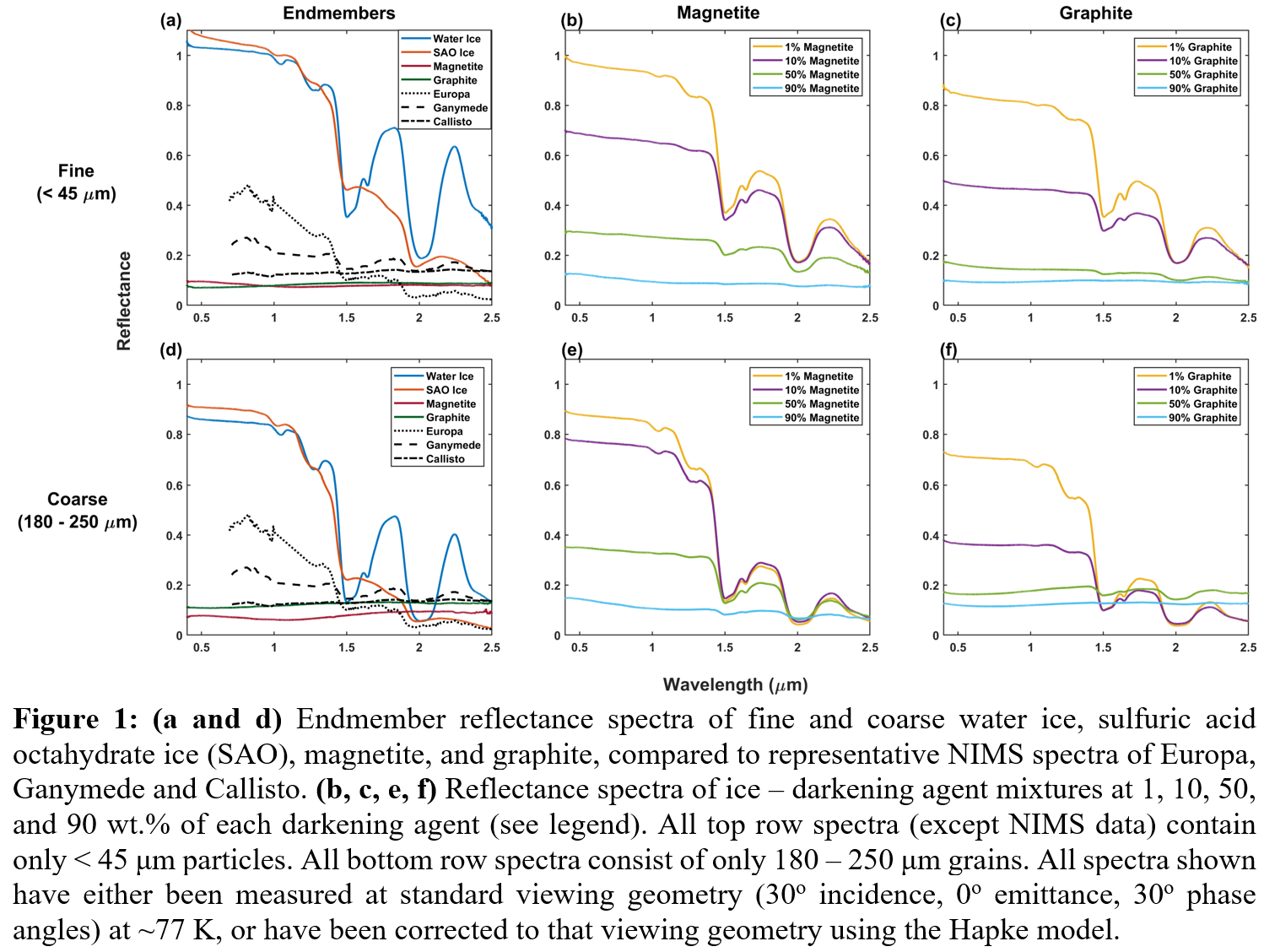
The icy Galilean moons, Europa, Ganymede, and Callisto, have surfaces with visible to near-infrared (VNIR) reflectances that are darker than expected for ices composed of water, acids, and salts. (see Figure 1a, 1d). Past investigations of these moons suggest neutral darkening agents (low reflectance and spectrally featureless materials) may be present. Common darkening agents include Fe- or C-bearing minerals, such as magnetite and graphite, which can be delivered through micrometeorite bombardment, radiolysis of surface species, or endogenic activity [1-3]
Darkening agent abundances are reportedly <20%, ~50%, and ~90% for Europa [4], Ganymede [5,6] and Callisto [7], respectively; however, large uncertainties are present in these estimates. These moons’ surfaces are likely intimately mixed due to space weathering and potential endogenic activity. A few wt.% darkening agent when intimately mixed with bright materials can drastically reduce the overall mixture’s reflectance [8]. Previous darkening agent abundances [4-7] are influenced by more than physically present species. They are sensitive to particle size effects and act as free variables for unknown surface materials. Due to this, our understanding of these moons’ surfaces and therefore the processes happening on and within them may be inaccurate.
This study seeks to provide constraints for magnetite and graphite as darkening agents in mixtures of water and hydrated sulfuric acid ices. The VNIR reflectance spectra of these mixtures are compared to those collected by the Galileo’s Near Infrared Mapping Spectrometer (NIMS) to determine rough abundances needed to achieve sufficient darkening. We additionally compare laboratory measurements with modeled spectra computed via radiative transfer theory [9] to further investigate model limitations.

Results:
VNIR reflectance spectra for mixtures of sulfuric acid octahydrate ("SAO") ice, water ice, and graphite or magnetite are shown in Figure 1 (b, c, e, f). For each darkening agent, two particle size groups are investigated, fine (<45 μm) and coarse (180 – 250 μm), to probe effects due to particle size variations. Each mixture set investigates darkening agents at 1, 10, 50, and 90 wt.%. Water and SAO ices comprise the remainder of these mixtures equally.
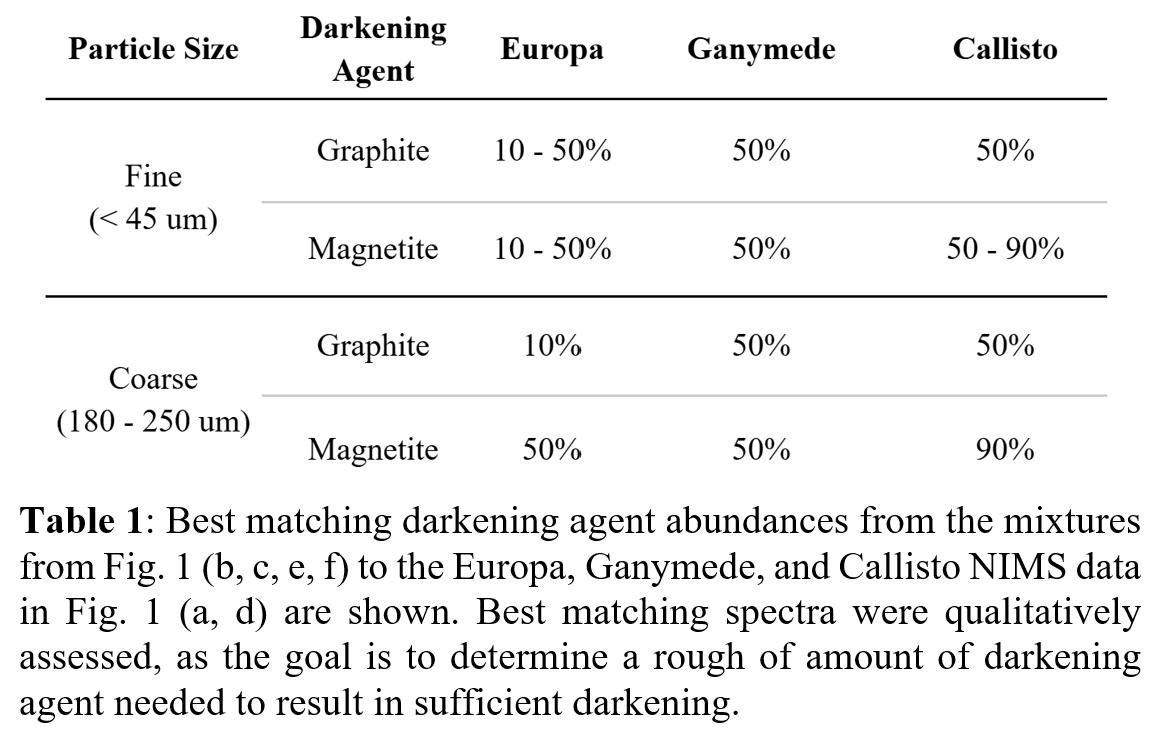
The fine and coarse darkening agent mixtures suggest a few wt.% darkening agents may not cause drastic overall darkening. Darkening by graphite is more efficient than magnetite at similar abundances, with total saturation being achieved at ~50% graphite compared to 90% magnetite. These mixtures are compared to the NIMS reflectance spectra shown in Fig. 1a, 1d to determine rough abundance estimates for the amount needed to match NIMS spectra (see Table 1, which displays the best matching abundance value).
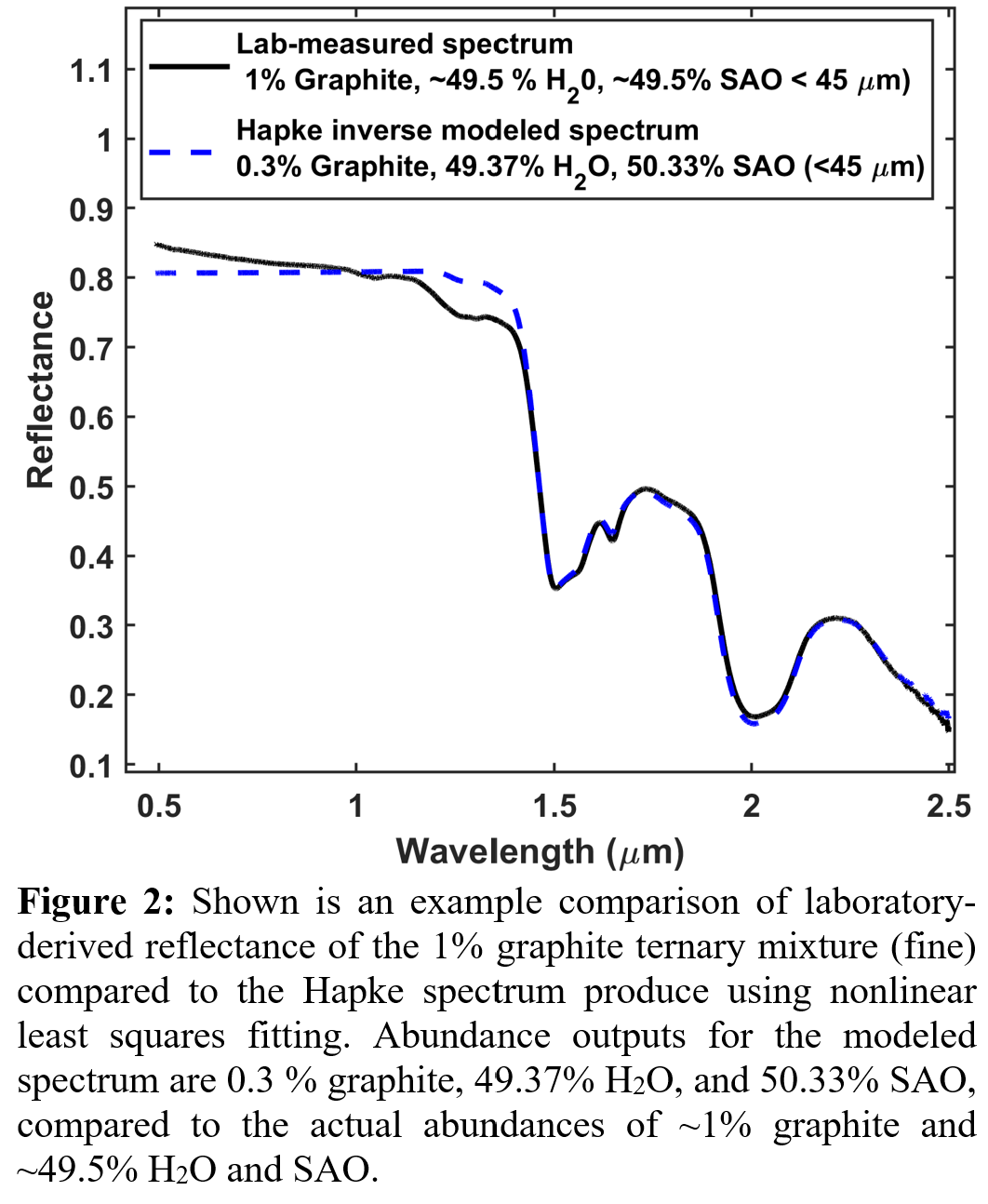
Hapke radiative transfer modeling [9] was used to produce spectra of each mixture to investigate model accuracy and limitations. Figure 2 shows a comparison of the 1 wt.% fine graphite mixture to a modeled spectrum produced by a nonlinear least square fitting algorithm to the Hapke reflectance equation. The best-fitting model spectrum used 0.3% graphite (45 μm), 49.37% water (36 μm), and 50.33% sulfuric acid octahydrate (45 μm).

Discussion:
Definitive statements about upper and lower limits of darkening agents through comparisons between NIMS data and lab mixtures (Table 1) are difficult to make. The surfaces of these bodies are undoubtedly more complex than simple three-component mixtures. However, we can still draw rough conclusions based on darkening agent abundances that give similar reflectance levels, despite not being able to match features perfectly.
Europa’s spectrum is closest to the 10 and 50 wt.% graphite and magnetite mixtures at fine and coarse particle sizes. For graphite, 10 wt.% is within previous darkening agent abundance estimates, but 50 wt.% of either graphite or magnetite is much higher than any reported darkening agent abundance. Ganymede’s spectra fall within expected ranges, suggesting that the darkening agent on Ganymede may be graphite, magnetite, both, or a similar material. At fine and coarse sizes, 50 wt.% magnetite is close to a lower limit of needed darkening agent abundance, as the Ganymede spectrum is darker by ~0.05. However, 90 wt.% graphite may serve as an upper limit, as the 90 wt.% mixture is darker than the Ganymede spectrum. An upper limit for magnetite or graphite of either particle size may be near 90 wt.% for Callisto.
Mixture results additionally highlight the overall plausibility of some darkening agents. For example, fine and coarse magnetite abundances need to be near 90 wt.% to match Callisto’s surface in some regions. Our mixtures may be spectrally similar to the Callisto spectrum; however, this is likely not representative of Callisto’s actual surface composition. The main avenue by which magnetite, or any Fe-rich material, can be delivered to Callisto’s surface is through (micro)meteorite impacts. A significant flux of Fe-rich impactors needed to have been present near Callisto to provide this amount. Graphite or C-bearing materials are more feasible. They can be delivered via (micro)meteorite bombardment, produced through radiolytic breakdown of surface C materials like CO2, or may also be sourced endogenically like on Europa, where CO2 signatures are linked to chaos terrain [10].

Laboratory mixtures were compared against Hapke modeled spectra to probe model limitations, especially in mixtures of very bright and very dark materials. More work needs to be done, but Figure 2 suggests the Hapke model struggles to reproduce visible wavelengths when the reflectance of bright materials is near unity. Figure 1 disagrees with the longstanding notion that a few wt.% dark materials can significantly darken bright materials when mixed. The agreement between Hapke-derived abundance with the actual abundances used in each mixture suggest this idea may not be true when the materials being mixed are at opposite reflectance extrema.
References:
[1] Strazzulla, G., et al., (2023). Earth Moon Planets 127, 2. [2] Carlson, R. W., et al., (1999) Science 286, 97-99. [3] Carlson, R. W., et al. (2002) Icarus 157, 456-463. [4] Dalton III, J. B., et al. (2013) Pl and Sp. Sci 77, 45-63. [5] Ligier, N., et al. (2019). Icarus 333, 496-515. [6] Tosi, F., et al. (2023) Nature Ast. 8, 82-93. [7] Ligier, N., et al. (2019). EPSC 13, 492-2. [8] Clark, C. (1982) Icarus 49, 244-257. [9] Hapke, B. (1981) JGR: Solid Earth 86, B4, 3039-3054. [10] Trumbo, S., et al., (2023) Science 381, 1308-1311.
How to cite: Hayes, T. and Li, S.: Constraining possible darkening agents on the surfaces of the icy Galilean moons, EPSC-DPS Joint Meeting 2025, Helsinki, Finland, 7–13 Sep 2025, EPSC-DPS2025-1097, https://doi.org/10.5194/epsc-dps2025-1097, 2025.
Background
Sodium chloride (NaCl), the most common salt on Earth, has been detected at several icy worlds that could be habitable in the present day, including Europa [1], Enceladus [2], Ganymede [3] and Ceres [4], providing evidence that salty liquid water from their interiors has been delivered to their surfaces. Areas that have experienced the emplacement of subsurface fluids through mechanisms such as plumes could contain a record of recently exposed ocean material and thus provide information on ocean chemistry and potential habitability. Identifying such regions will be a major priority for upcoming missions such as ESA’s JUpiter ICy moons Explorer (JUICE) and NASA’s Europa Clipper.
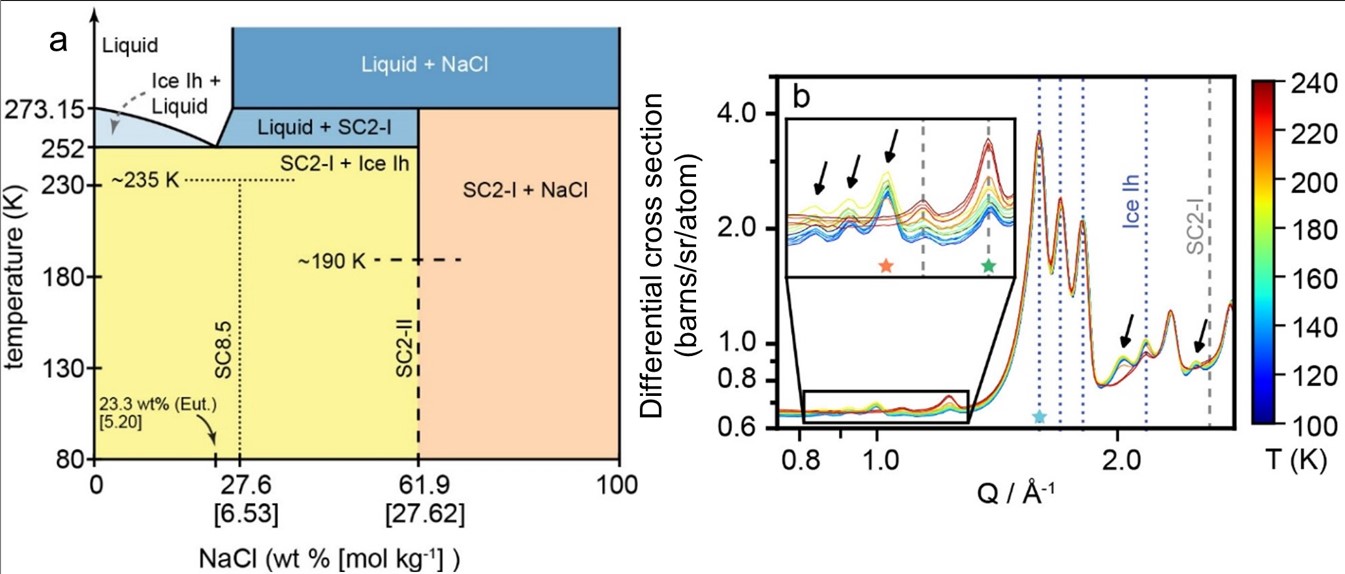
Here, we report the discovery of a metastable NaCl dihydrate formed through rapid freezing of a NaCl solution at ambient pressure (Fig. 1) [5]. This new NaCl hydrate expands on the recently identified NaCl hydrates formed in high-pressure experiments [6], and together with these reveals a rich phase behaviour in the low temperature Na-Cl-H2O system that had been overlooked for over 200 years. Using synchrotron X-ray and neutron powder diffraction, we show that the metastable form transforms irreversibly to the stable hydrate hydrohalite above 190 K, exothermically releasing 3.47 kJ mol-1 of latent heat. Additionally, we used Raman and near-infrared (NIR) reflectance spectroscopy to show experimentally that the solid phase composition of NaCl-bearing ices varies as a function of fluid cooling rate, promising a means of reconstructing the formation history of NaCl-bearing icy world surface materials from remote measurements of their composition.
Methods
NaCl solutions were frozen from room temperature to liquid nitrogen (LN2) temperature (~77 K) using multiple techniques that allowed us to probe a wide range of cooling rates spanning < 1 K min-1 to > 107 K min-1. Neutron and X-ray diffraction (XRD) were carried out at ISIS Neutron and Muon Source and Diamond Light Source, UK, respectively. We exploited the diagnostic Raman signatures of the stable and metastable hydrates [5] to identify the cooling rates required for their formation, and how these varied with NaCl concentration. NIR spectra were recorded at wavelengths between 1.0 and 2.5 micron from powdered samples at 77 K.

Figure 1. (a) Updated phase diagram of the low-temperature NaCl-H2O system incorporating phase behavior of high-pressure hydrate 2NaCl·17H2O (SC8.5 [6]) and proposed metastable dihydrate (SC2-II, this study, [5]). Dashed lines indicate observed metastable transition temperatures to hydrohalite (SC2-I) and ice Ih. (b) Neutron diffraction patterns for a flash frozen sample that has been heated. Bragg peaks for the new NaCl hydrate are marked with arrows, while Bragg peaks for hydrohalite (SC2-I) and ice Ih are marked with dashed lines (reproduced from [5]).
Results and Discussion
Our findings contribute to a new recognition of overlooked structural diversity and phase behavior complexity in the low-temperature NaCl-H2O system. We found that the newly discovered hydrate is a dihydrate structurally related to hydrohalite, with a proposed crystal structure comprising a 3 × 1 × 3 supercell of the hydrohalite unit cell. Because the metastable hydrate forms from liquid solutions at low pressures, it could feasibly form directly through cooling of ocean water at the surface or within the shallow ice shells of icy worlds and remain stable unless warmed above ~190 K. At active icy worlds such as Enceladus and Europa, rapid cooling of fluids could be achieved in various geological scenarios including plumes and chaos formation.
We found that the phase composition of NaCl-bearing ice is dependent on the cooling rate, indicating that compositional properties of NaCl-rich ices can act as a record of thermal history. At rates below ~90 K min-1, only the stable hydrohalite was produced. The metastable phase formed in distinct cooling rate regimes either in combination with hydrohalite, or as the sole NaCl phase. In addition, we used XRD to confirm that vitreous glass forms at the fastest rates, a phenomenon which has been proposed by previous studies [7,8]. Finally, we show that the new hydrate possesses near-infrared spectral features that are distinct from hydrohalite and thus could be used to identify it with existing or future remote sensing observations.
Our data show that in such regions distinguishing between different NaCl phase assemblages holds great promise in reconstructing the formational cooling rate of salty surface materials. Connecting surface composition to ice shell processes is a next major frontier in understanding the geology of icy worlds, a challenge that can be addressed by combining laboratory insights with new observations from upcoming planetary missions including NASA’s Europa Clipper and ESA’s JUICE.
References
[1] S.K. Trumbo et al. (2019). Sci. Adv., 5, eaaw7123
[2] F. Postberg et al., (2009). Nature, 459, 1098–1101
[3] F. Tosi et al., (2024). Nat. Astron., 8, 82–93
[4] M.C. De Sanctis et al., (2020) Nat. Astron. 4, 786–793
[5] R.E. Hamp et al. (2024). J. Phys. Chem. Lett. 15(50), 12301–12308
[6] Journaux et al., (2023). PNAS, 120 (9) e2217125120
[7] M.G. Fox-Powell & C.R. Cousins, (2021). J. Geophys. Res. Planets, 126, e2020JE006628
[8] F. Klenner et al. (2025) Planet. Sci. J. 6 (65)
How to cite: Hamp, R., Salzmann, C., Fawdon, P., Amato, Z., Beaumont, M., Chinnery, H., Henry, P., Headen, T., Perera, L., Thompson, S., and Fox-Powell, M.: Metastable hydrate of sodium chloride: A new mineralogical indicator of rapid freezing of brines at icy worlds, EPSC-DPS Joint Meeting 2025, Helsinki, Finland, 7–13 Sep 2025, EPSC-DPS2025-1413, https://doi.org/10.5194/epsc-dps2025-1413, 2025.
The icy moons of Jupiter and Saturn, such as Europa, Ganymede, Callisto, and Enceladus, are expected to host saltwater oceans beneath their icy crusts, raising the intriguing possibility of habitability in these water-rich environments. The distribution and compositions of salts, both dissolved in the oceans and present in solid form as hydrates, are key factors in shaping the internal structures and evolutionary pathways of these icy worlds. Constraining the compositions of salts and salt hydrates detected on icy moon surfaces provides critical insights into the geochemistry of the subsurface oceans and interior processes.1 Salt-water interactions under the high-pressure, low-temperature conditions characteristic of icy moon interiors give rise to a diverse range of hydrated salt structures that are not always accessible through temperature variations alone.2 However, relatively few experimental studies have investigated the combined effects of pressure and temperature on these systems.
Here we characterise the binary salt-water systems of NaCl,2 KCl, MgCl2, and CaCl2 under high-pressure, low-temperature conditions (0–2 GPa; 300–150 K) using in situ single-crystal synchrotron X-ray diffraction experiments to constrain the mineralogy of the chloride salts in icy moon interiors. This structural work, along with planned spectroscopic measurements, will help establish a foundation for identifying high-pressure salt hydrates that have been transported from the internal hydrosphere to the surface.
1. Dalton, J. B. et al. Chemical Composition of Icy Satellite Surfaces. Space Sci Rev 153, 113–154 (2010).
2. Journaux, B. et al. On the identification of hyperhydrated sodium chloride hydrates, stable at icy moon conditions. PNAS 120, e2217125120 (2023).
How to cite: Collings, I., Journaux, B., Pakhomova, A., Boffa Ballaran, T., and Kurnosov, A.: Salt hydrate mineralogy at the conditions of icy moon interiors and surfaces, EPSC-DPS Joint Meeting 2025, Helsinki, Finland, 7–13 Sep 2025, EPSC-DPS2025-915, https://doi.org/10.5194/epsc-dps2025-915, 2025.
Introduction: On the surface of Jupiter's icy moons Europa and Ganymede, non-water ice materials are mixed with water ice at different proportions. Hydrated minerals can mimic the 1.5 and 2.0 μm water ice absorption bands. In particular, the presence of hydrated magnesium sulfate, such as hexahydrite (MgSO4∙6H2O), was first suggested on the surface of these icy bodies based on Galileo/NIMS data, which could be a remnant of past extrusion of liquid water from an ocean below [1]. Although other compounds, particularly chloride salts, have subsequently been proposed to explain spectral signatures observed by NIMS, the key interest for future close exploration is to understand whether these non-water ice materials are distinguishable in mixtures with water ice, and whether they are of exogenic or endogenic origins. Characterizing such minerals under environmental conditions similar to those found on the icy moons' surfaces is therefore crucial, especially considering the link between the presence of hydrated salts on Solar System bodies and geological processes that occurred in the presence of liquid water, with potential implications for the establishment of a habitable environment.
This work is also important to support the future observations of the MAJIS (Moons and Jupiter Imaging Spectrometer) instrument [2,3] onboard the ESA JUICE mission. Although similar work on hexahydrite was carried out previously [4,5,6], the MAJIS spectral sampling, which is 3.6 nm from 0.50 to 2.35 μm and 6.5 nm from 2.25 to 5.54 μm, motivates performing new laboratory measurements at higher spectral resolution.
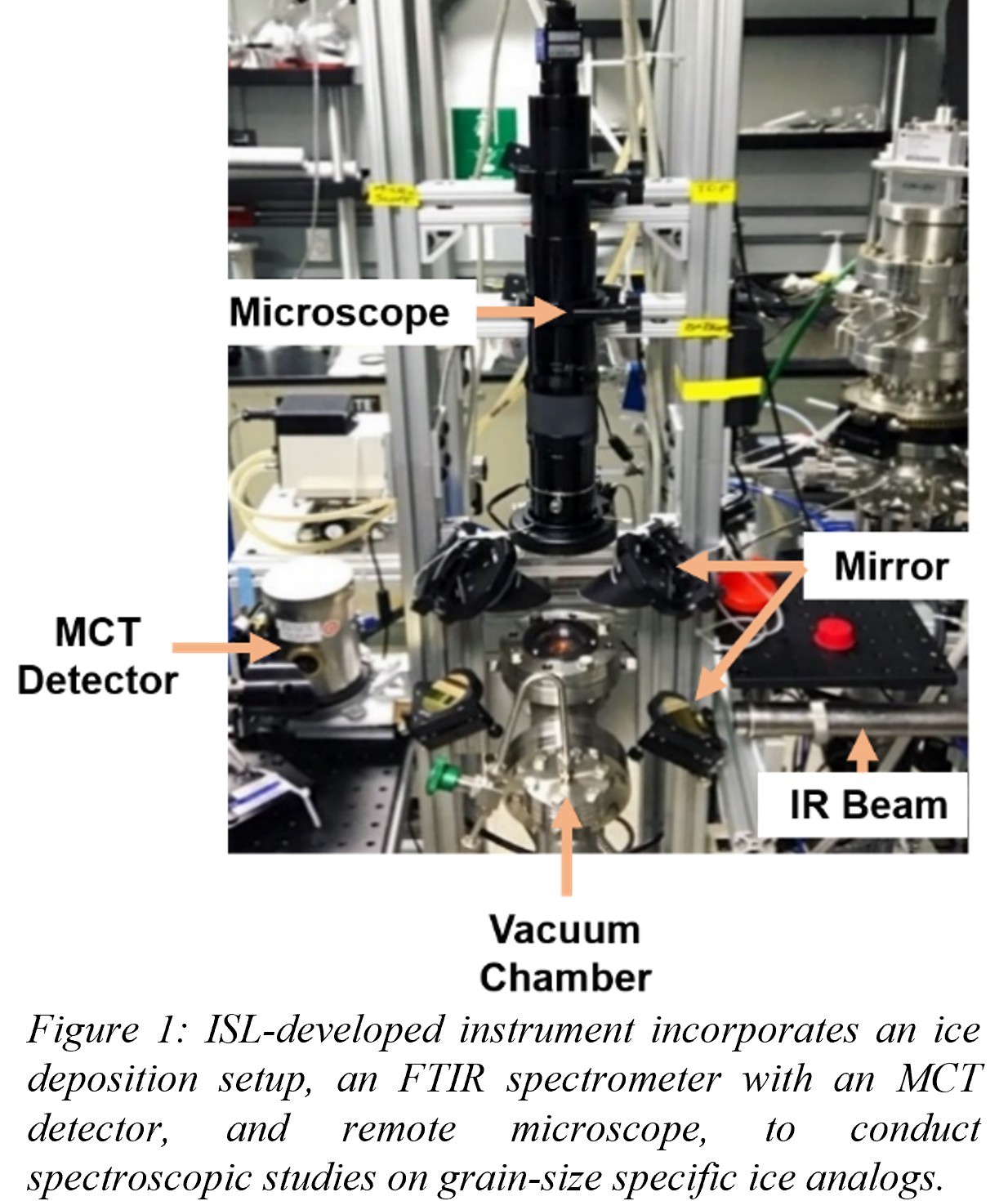
Experimental procedure and results: For this objective, we prepared powders of hexahydrite at different grain sizes, ranging from 50 to 500 μm, to study the variation of the spectral features in the infrared and visible spectral ranges depending on the environmental conditions. The set of measures described in this abstract was performed as a deeper investigation following the measures taken with a different setup, CAPSULA [7]. We acquire both the reflectance and the visible image of the sample with a microscope coupled with an FTIR spectrometer and equipped with a cryogenic cell [Figure 1] that contains the sample in a controlled environment, which can go down to a pressure of 10-4 mbar, and a temperature of 40 K. Different grain sizes of the sample were put inside the cryogenic cell thanks to a custom sample holder which allows the acquisition of different grain sizes during one single data taking [Figure 2], and brought to a pressure of 10-4 mbar while acquiring spectra during the process. The reflectance spectra and the computed spectral parameters show that there is more than one critical pressure at which the sample starts to change part of its lattice structure. Moreover, different grain sizes respond differently to the pressure variation, as shown in Figures 3 and 4.
Figure 1: Experimental setup composed of a cryogenic cell that allows a controlled environment where we put the sample, and a microscope coupled with an FTIR spectrometer that enables both the acquisition of the spectral radiance and the visible image of the samples.
Figure 2: Custom sample holder placed inside the cryogenic cell. It contains 4 different grain sizes of hexahydrite.
Figure 3: Infrared reflectance spectra of different grain sizes of hexahydrite powder at room pressure and room temperature.
Figure 4: Close-up of the 2 microns water diagnostic absorption band in the continuum-removed reflectance spectra of a hexahydrite powder with a grain size between 50 and 75 microns at different pressures and room temperature. The sample shows a first spectral variation at around 100 mbar and a second one between 5 and 10-1 mbar.
Conclusions: The results shown here may constrain the correlation between the spectral features of this kind of material, planetary analogs for the icy satellites, and their physical properties. One of the most interesting aspects we came across is a change in the lattice structure of this sample, which seems incompatible in its crystalline and hydrated form (hexahydrite) at the extremely low pressure on the surface of the icy moons, that is, in the range 10-8 -10-12 mbar. In the laboratory, the process of amorphization and dehydration with vacuum occurs in a timescale of tens ofminutes at room temperature. Therefore, if hexahydrite was present on these bodies, it should be continuously replenishedor ephemeral, and this may sustain the subsurface liquid water as a possible source. On thesurface of Europa and Ganymede, this type of hydrated salt could eventually bepreserved thanks to some mechanism that involves the rapid emplacement in simultaneoussurface conditions of low temperatures and ultra-high vacuum. In this regard, a deeper laboratory investigation is required.
These results are extremely important to avoid any ambiguity in the determination of the surface composition of the icy moons of Jupiter once the data MAJIS will acquire is available, and could also allow some constraints on what could be present underneath the surface.
References:
[1] T.B. McCord et al., Icarus, 209, 639-650 (2010)
[2] G. Piccioni et al., IEEE 5th International Workshop on Metrology for AeroSpace, 318-323 (2019)
[3] F. Poulet et al., Space Sci Rev, 27, 220 (2024)
[4] T.B. McCord et al., JGR, 104, 11827-11851 (1999)
[5] J.B. Dalton et al., Icarus, 177, 472-490 (2005)
[6] S. DeAngelis et al., Icarus, 281, 444-458 (2017)
[7] De Angelis S. et al. (IN PRESS) Mem. S.A.It., 75, 282.
Acknowledgements: This work has been developed under the ASI-INAF agreement n. 2023-6-HH.0. This work is supported by EU and Regione Campania with FESR 2007/2013 O.O.2.1
How to cite: Furnari, F., Piccioni, G., Rubino, S., Stefani, S., De Angelis, S., Tosi, F., Carli, C., Ferrari, M., and La Francesca, E.: Spectroscopic measures of hydrated sulfate as a relevant planetary analogue for Jupiter’s icy moons, EPSC-DPS Joint Meeting 2025, Helsinki, Finland, 7–13 Sep 2025, EPSC-DPS2025-654, https://doi.org/10.5194/epsc-dps2025-654, 2025.
Introduction: There is a growing consensus that ocean-derived impurities, and particularly salts, play a key role in the geophysical evolution and habitability of planetary ice shells [1]. This is bolstered by several observations including 1) the association of endogenic material with geologically young surface features, 2) the ability of salts to depress the freezing temperature and extend the longevity of liquids within planetary ices, 3) the critical role salts play in governing the material properties, biogeochemistry, and habitability of salt-rich ice, and 4) the fundamental role small melt fractions and impurity levels play in the analogous terrestrial mantle-lithosphere system [2]. As the primary medium for the transport and expression of observable signatures from underlying oceans these impurity enriched ices provide a geological record of subsurface ocean properties and processes.
Given these geophysical and astrobiological implications, there has been a recent effort to constrain the material entrainment rates occurring at ice-ocean and ice-brine interfaces [3]. Bred from multiphase models of analogous terrestrial systems (sea ice, magma chamber dynamics, solidifying metal alloys), these investigations have produced parameterizations linking interface conditions to material entrainment rates and resultant ice properties [2-3]. Moreover, they have been validated against salinity profiles and material entrainment rates observed in natural and laboratory grown sea ice cores [3]. That said, it is likely that the ocean compositions of other ocean worlds in the solar system may differ from that of the Earth. If this is the case, it bodes the question, are all salts species entrained at an equal rate? Recent research suggests that ion fractionation, the preferential entrainment/rejection of salt species into/out of the forming ice, could be prevalent under ice-ocean world thermodynamic conditions [4]. If so, ionic speciation within planetary ices may not be directly representative of the progenitor fluid reservoir from whence they came.
While there exist extensive ionic composition measurements for ice cores derived from our own NaCl-dominated ocean, investigations of ion fractionation in natural ices have been inconclusive and even contradictory [4-5], and there currently exists a dearth of empirical data related to the ionic composition of ices formed from alternate ocean chemistries [2]. As such, there remains a large gap in our understanding of the entrainment rates of various salt species in ices formed from planetary relevant brines. Moreover, contemporary models of ice-brine systems that include the physics needed to describe ion fractionation (e.g., multispecies ion diffusion, salt precipitation) [6] are in desperate need of empirical measurements to assess their accuracy.
These are potentially critical processes operating within the ice shells of ocean worlds, controlling their geochemistry, geophysics, and habitability [4]. As such, a well constrained dataset of salt entrainment rates in compositionally diverse ices is needed to improve our understanding of the physics governing these high-priority systems and benchmark evolving predictive models of planetary ice-brine systems to guarantee their accuracy and optimize their utility for upcoming missions (e.g., Europa Clipper, Dragonfly).
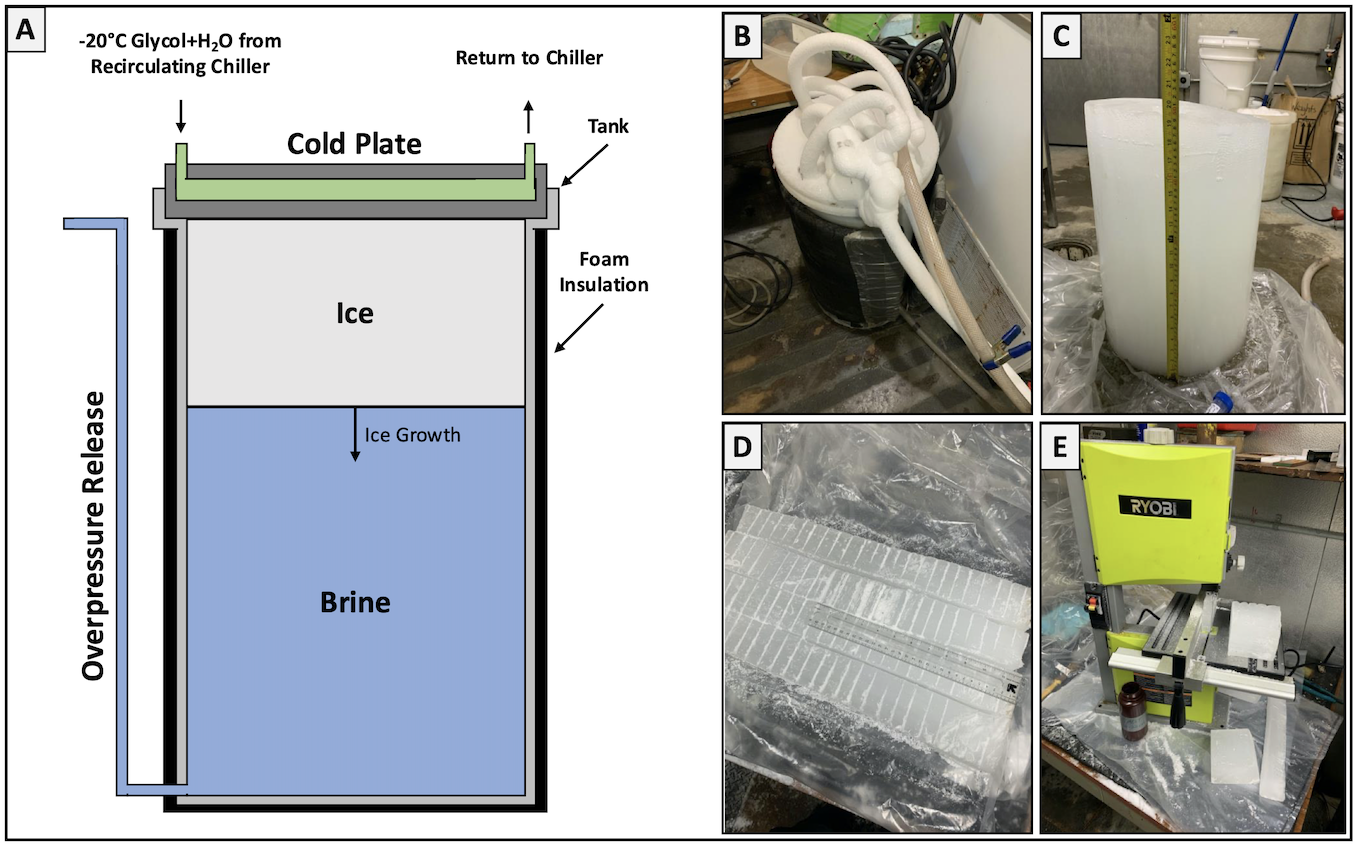
Methods: To bridge this knowledge gap, we have carried out novel top-down ice growth experiments (Figure 1) and established a database of physical, thermal, chemical, and material properties of compositionally diverse saline ices grown from putative ice-ocean world ocean compositions (NaCl, MgSO4, and Na2CO3 dominated). Leveraging the ionic composition and temperature profiles of these ices alongside the equilibrium geochemistry software PHREEQC, we additionally simulate their mineralogical assemblages and interstitial brine properties (e.g., water activity, ionic concentration) – key characteristics when assessing aqueous environment habitability [7].

Figure 1 – Ice growth apparatus and vertical sectioning for ionic composition/fractionation analysis.
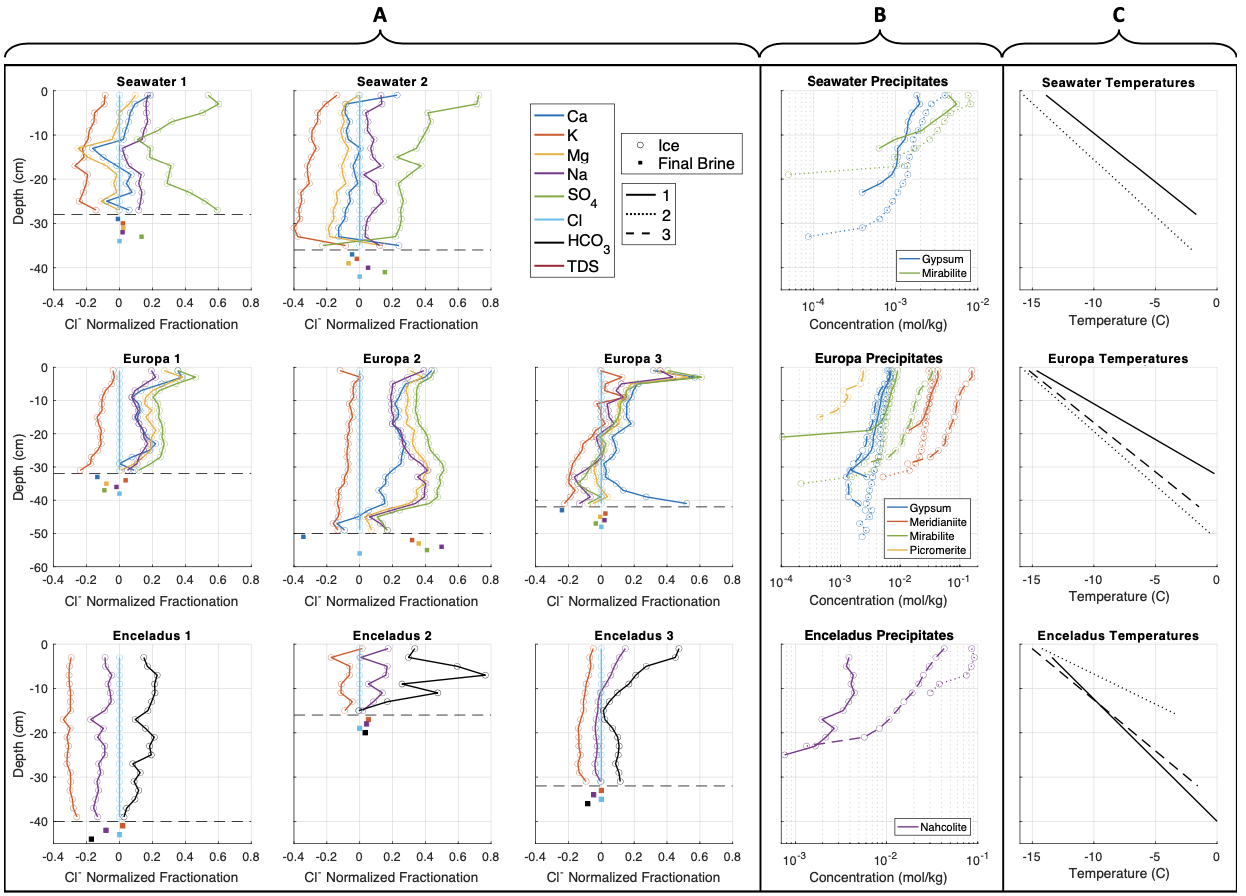
Results: Here we present ionic composition and fractionation profiles of these ices, as well as their associated hydrate minerology and liquid phase properties (e.g., Figure 2). We describe the novel physics that govern the diverse evolution of these complex multiphase systems, such as multispecies ion diffusion and thermochemically dependent precipitation pathways. We show that:
- Ion fractionation signals are present in all of our analog ice samples.
- Depletions and amplifications in relative ion abundance, compared to the source fluid, range from -40% to +77%.
- The level of fractionation is dependent on both the thermal and chemical conditions under which the ice forms.
- The simulated precipitate mineralogical assemblages throughout the ice columns are consistent with the fractionation signals.
- The observed amplifications and depletions of relative ion concentrations (compared to the parent underlying fluid) are consistent with the processes of hydrate precipitation and multispecies diffusion, respectively.
- The ionic composition of saline ices are not necessarily a reflection of the relative ion abundances of the fluid from whence they formed – i.e., all salts are not entrained at an equal rate.
We discuss the important implications these results have for our understanding of ice-ocean world geophysics, habitability, and mission science interpretation.

Figure 2 – Ion fractionation profiles in analog ice cores (A). Amplifications relative to Cl- correlate with precipitated minerals, while depletions are associated with amplified diffusion rates. Simulated mineralogical assemblages (B) using in situ temperatures (C) agree with observed fractionation signals.
Conclusions: Through novel laboratory measurements we demonstrate that ion fractionation in planetary ices is likely a prevalent process, capable of generating heterogeneous and compositionally diverse ices – even from the same parent fluid. The resultant geochemical complexity of these ices directly correlates to associated variations in ice material properties (e.g., melting points, strengths, viscosity, porosity, etc.) that will significantly impact the geophysical processes and habitability of planetary ice shells. As high-priority planetary science and astrobiology targets for current and upcoming missions constraining the chemical and thermophysical properties of planetary ices and their relationships to the characteristics of their underlying oceans will be imperative for constraining predictive models of these environments and maximizing the science return from observational datasets.
References: [1] Vance S. D. (2021) JGR: Planets, 126.1. [2] Buffo J. J. et al. (2023) JGR: Planets, 128.3. [3] Buffo J. J. et al. (2020) JGR: Planets, 125.10. [4] Wolfenbarger N. S. et al. (2022) Astrobiology, 22.8, 937-961. [5] Maus S. et la., (2011) AoG, 52.57. [6] Meyer et al., (2024), AbSciCon, 412.03. [7] Wolfenbarger N. S. et al., (2022) GRL, 49.22.
How to cite: Buffo, J., Fox-Powell, M., Murdza, A., Tomlinson, T., Schultz, A., Barton, T., Gurd, C., McEwen, A., Wolfenbarger, N., Chivers, C., Schmidt, B., and Meyer, C.: As Above, Not So Below: Ion Fractionation in Planetary Analog Ices, EPSC-DPS Joint Meeting 2025, Helsinki, Finland, 7–13 Sep 2025, EPSC-DPS2025-823, https://doi.org/10.5194/epsc-dps2025-823, 2025.
Background
Europa's icy surface is exposed to low pressures and subject to intense radiation, resulting in complex processes such as sublimation and radiolytic modification that influence its spectral properties. Interpreting reflectance spectra from future missions like Europa Clipper and JUICE requires understanding how salts in Europa’s surface ice evolve under such conditions. Specifically, the formation and stability of hydrated salts such as hydrohalite (NaCl·2H₂O) are of great interest.
Methods
Granular icy analogs containing NaCl, MgSO₄, and MgCl₂ were produced by flash-freezing brine droplets with 5 wt% salt content. These samples were put in a vacuum chamber, simulating the surface evolution at low pressures and temperatures over hundreds of hours. A novel application of a thermopile sensor, with a custom sensor mount and calibration algorithm, allowed direct surface temperature measurement (160–185 K), enabling us to scale laboratory sublimation timescales to equivalent durations under Europa conditions. Reflectance spectra were acquired in the 400–2500 nm range using a hyperspectral imaging system. In a separate set of experiments, NaCl analogs were irradiated with 2 keV electrons to simulate Europa’s radiation environment and study the stability of observed spectral features.
Results
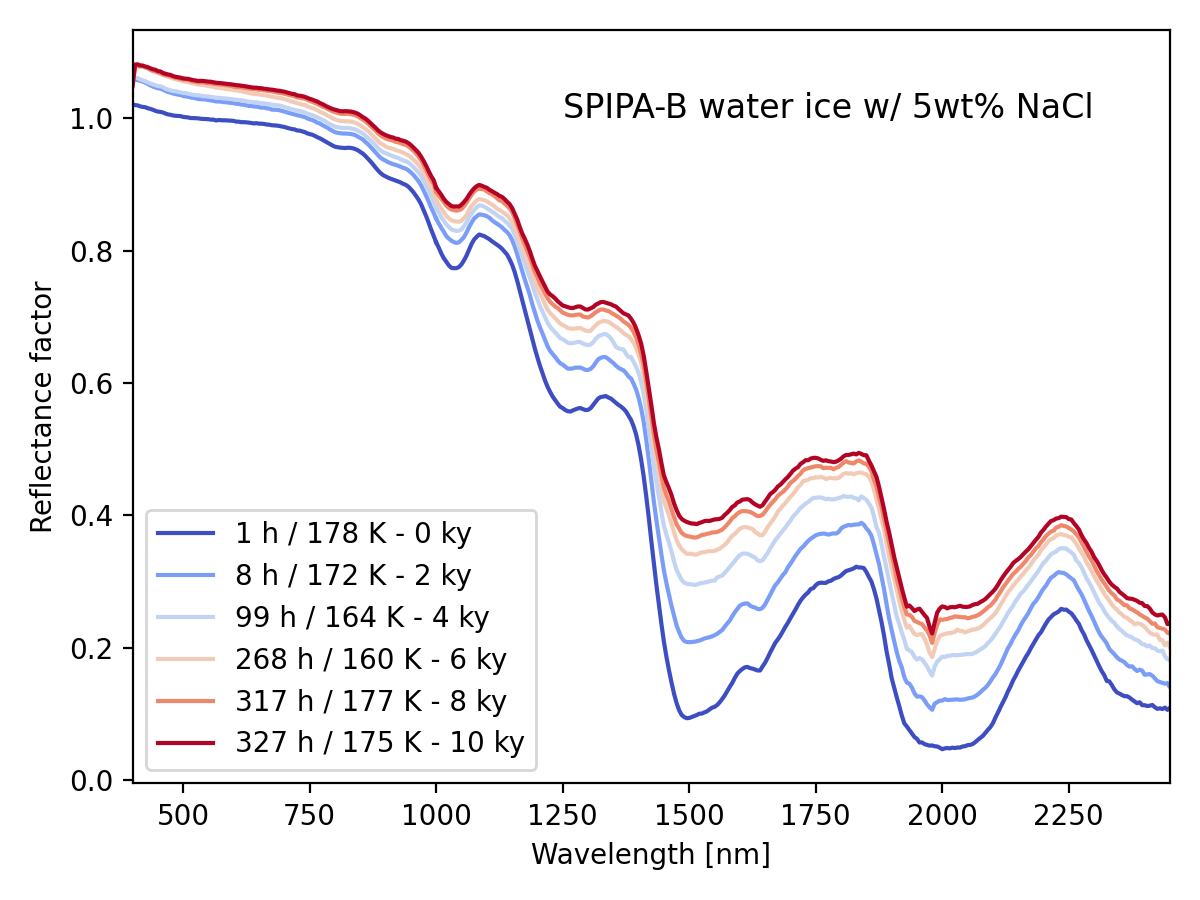
Sublimation caused notable changes in the reflectance spectra of all analog samples over hundreds of hours, which can be scaled to Europa-equivalent timescales of less than 10’000 years. The broad water absorption bands around 1.5 µm and 2.0 µm became shallower over time, and the overall reflectance increased, indicating the formation of optically dominant salt crusts on the surface due to water loss. The equivalent geometric albedo of all samples increased by more than 10% during sublimation, implying a substantial change in the surface's thermal properties.
In the NaCl-containing samples, a distinct narrow absorption band emerged at 1.98 µm, consistent with the formation of hydrohalite (NaCl·2H₂O) during sublimation, as can be seen in Figure 1. In contrast, samples containing MgSO₄ and MgCl₂ did not show narrow hydration bands during sublimation. However, changes in the shape of the 2 µm band were observed, with a slight skew in the MgSO₄ sample and a strong asymmetry in the MgCl₂ sample, both toward shorter wavelengths.
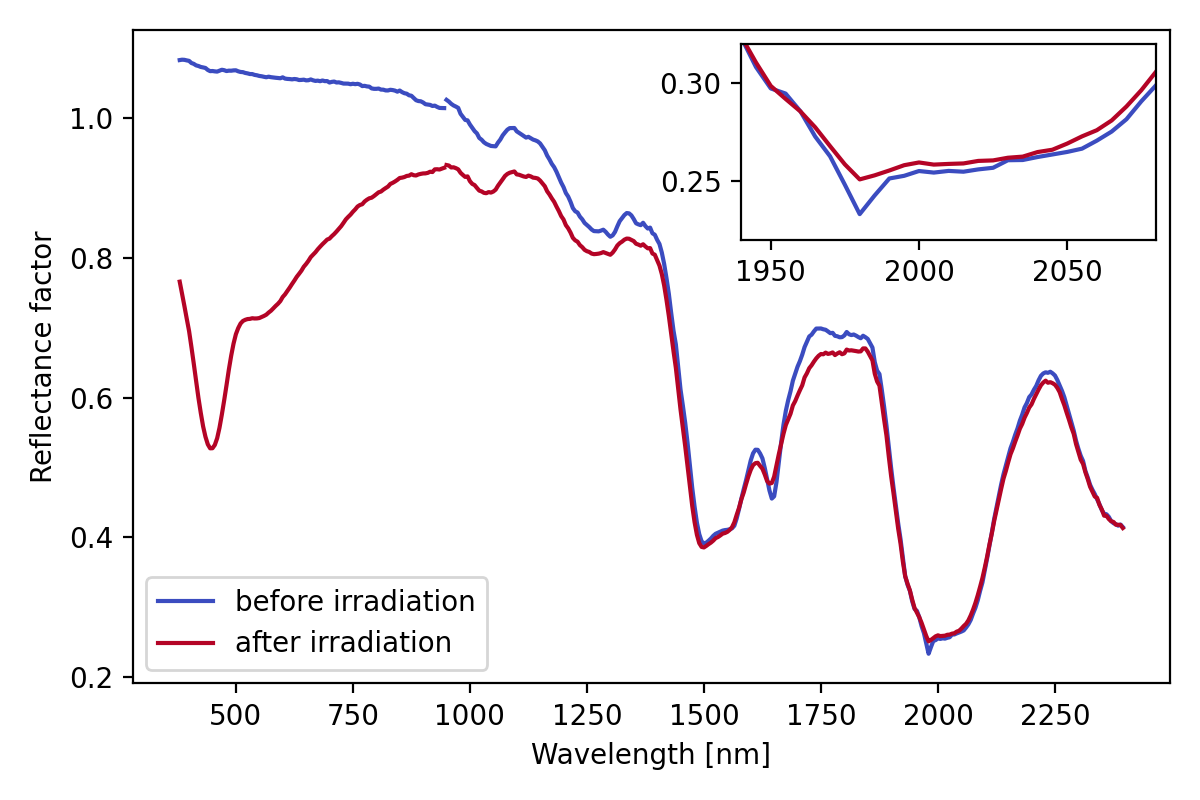
To investigate the stability of the hydrohalite feature, the NaCl samples were exposed to 2 keV electron irradiation at a total dose of 3.4 × 10¹⁶ electrons / cm². The 1.98 µm feature was significantly diminished after irradiation, corresponding to just a few years of surface exposure on Europa (see Figure 2). This shows a rapid dehydration of hydrohalite under electron bombardment.
These spectral and physical changes highlight the importance of accounting for sublimation and radiation effects when interpreting Europa’s surface composition from remote sensing data.
The presented data is publicly available under the DOI’s 10.26302/SSHADE/EXPERIMENT_RO_20240312_001 and 10.26302/SSHADE/EXPERIMENT_RO_20240701_000.
Conclusions
Our results demonstrate that sublimation alters the reflectance spectra of salty ice on Europa over short geological timescales. Sublimation processes must be accounted for in spectral interpretations to avoid overestimating bulk salt abundances. The formation of hydrohalite during sublimation and its rapid destruction under irradiation implies it is unlikely to be stable under typical conditions on Europa’s surface. If hydrohalite is present on the surface, it is either freshly exposed material (<10 years) or sustained by thermal anomalies (>145 K). Thus, any detection of hydrohalite in future observations would strongly indicate recent surface activity.

Figure 1: Sublimation of a grainy ice analog containing 5 wt% NaCl. The relative laboratory time and the measured surface temperature for all spectra are shown in the legend. The estimated timescales in the unit of 1000 years (ky), when the sublimation kinetics are scaled to Europa’s equatorial conditions, are given after the dash.

Figure 2: The reflectance spectra of a grainy ice analog with 5 wt% NaCl. The two lines show the reflectance before and after irradiation with 2 keV for 10 min with a current of 10 µA. The irradiation leads to the formation of color centers in the Vis and reduces the depth of the absorption band at 1.98 µm.
How to cite: Ottersberg, R., Pommerol, A., Stöckli, L. L., Obersnel, L., Galli, A., Murk, A., Wurz, P., and Thomas, N.: Evolution of Granular Salty Ice Analogs for Europa: Sublimation and Irradiation, EPSC-DPS Joint Meeting 2025, Helsinki, Finland, 7–13 Sep 2025, EPSC-DPS2025-529, https://doi.org/10.5194/epsc-dps2025-529, 2025.
Introduction: The non-ice materials on the surface of Europa provide insight into its geologic history, the exogenous processes that affect its surface, and by extension the composition of its subcrustal ocean. Europa has been known to be covered by water ice and other (non-ice) materials, both trace and in abundance. Here we report on the use of spectroscopy at visible wavelengths to help constrain the composition of the non-ice material(s) on Europa’s surface. The visible to near infrared brightness and color of salts are affected by energetic particle radiation [e.g. 1,2].
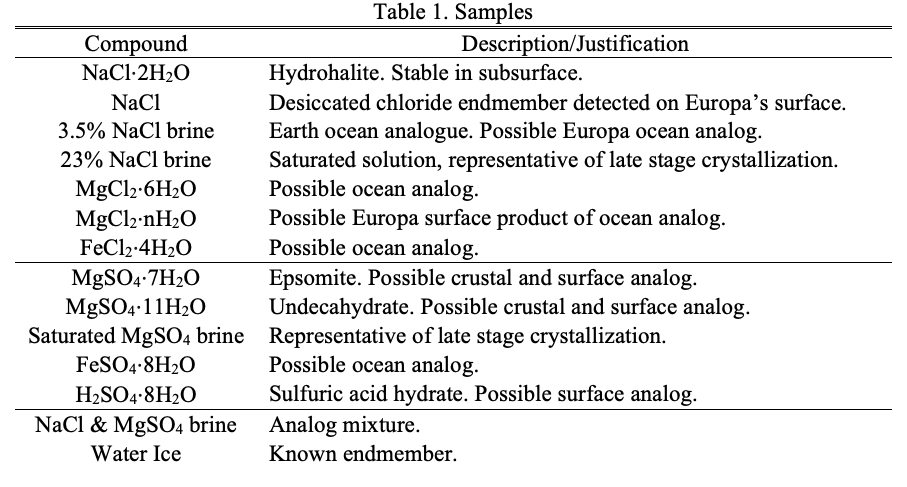
Methods: Fourteen different materials investigated potentially representative of Europa’s surface, frozen subsurface and ocean compositions were investigated. They include halides and sulfates of Na, Mg, and Fe as well sulfuric acid octahydrate and water ice (Table 1). Visible and infrared reflectance spectra from ~ 400 to ~ 2500 nm or 8000nm were obtained of the materials in pellet form before and after irradiation using the LabSPEC facility at the John Hopkins Applied Physics Laboratory. All samples were in the form of pellets, pressed from powdered samples. Cryogenic temperature (~ 100K) was maintained for any material not thermally stable at room temperature. However, grain size was unconstrained.
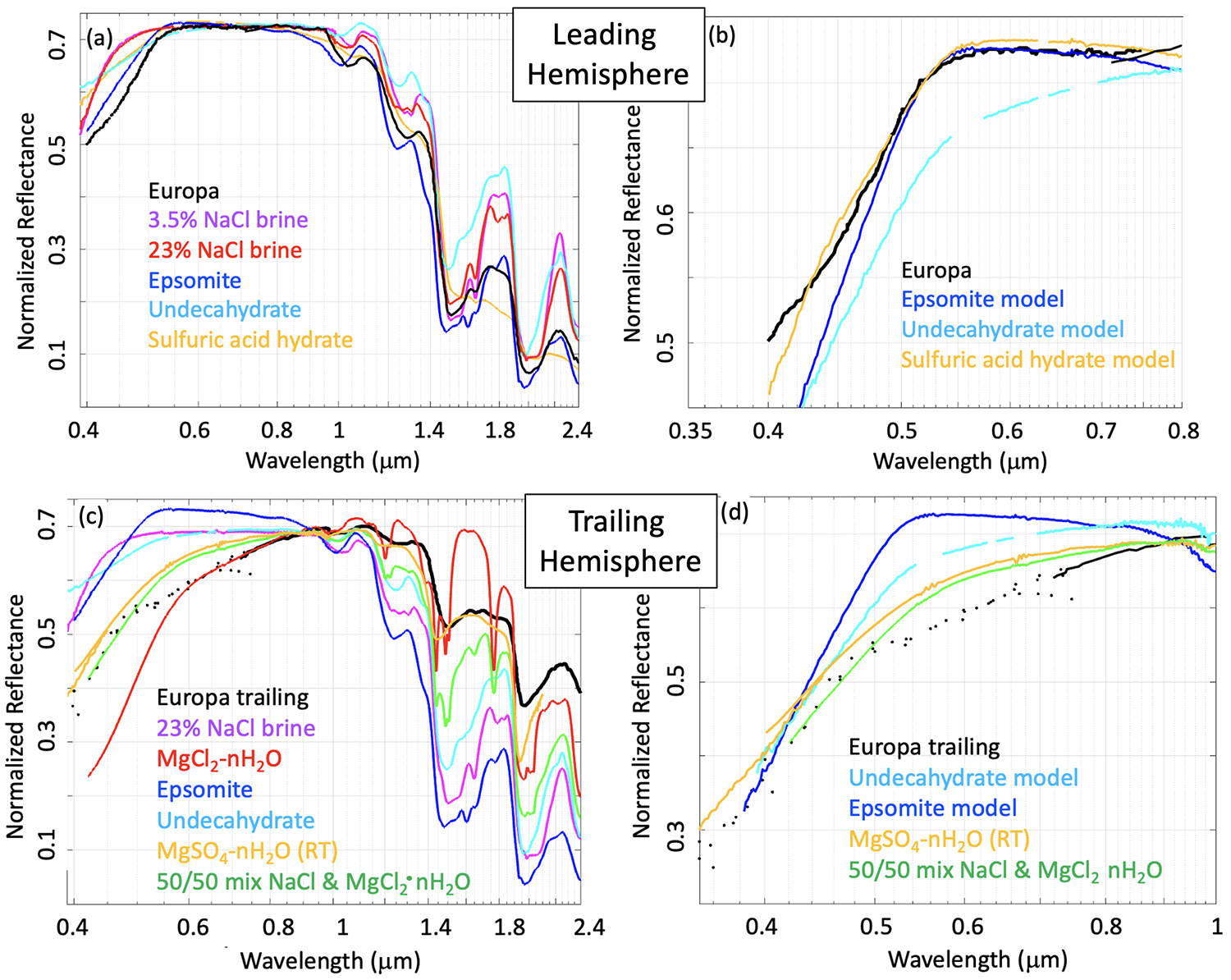
Results and Conclusions: We have found that the visible spectrum of each material was altered by electron irradiation while the infrared was largely not affected. The materials investigated included cryogenic brines, salts, and hydrates. For NaCl brines, the discoloration in visible and near infrared is sensitive to even small amounts of NaCl being present. We confirm the 460-nm absorption band observed on the leading hemisphere of Europa is indicative of desiccated NaCl, and is not representative of either hydrohalite nor its frozen cryogenic brine. The color of Europa’s leading hemisphere is more consistent with either or both hydrated sulfuric acid or magnesium sulfates (Figure 1a,b) . Other chlorides, such as variants of MgCl2 are not present in abundance. A small amount of brine may also be present to account for the ~ 15% of NaCl being necessary to produce the observed depth of the color center. The color of the trailing hemisphere is also consistent with magnesium sulfates but the extensive irradiation and effects on the spectra of these and other potential surface materials has not been adequately simulated in the laboratory at relevant fluxes to confirm this (Figure 1c,d). MgSO4 is likely a precipitate from the ocean and not a radiolytic product and it is possible that radiolytic hydrated sulfuric acid could have formed from the degradation of the sulfate. Thus, the interior ocean appears to contain sulfates as well as chlorides, with the magnesium sulfates potentially preferentially concentrating in the crust.
Additional laboratory work, as well as higher spatial resolution spectral mapping of Europa’s surface are needed to better constrain Europa’s surface composition. Further irradiation of cryogenic samples, especially with ions for altering the physical structure, will be necessary for refining a spectral match to Europa’s surface, especially in the infrared. We emphasize that the spectral identification of a component responsible for coloring the surface of Europa must also not be inconsistent with spectral features in the infrared and also that infrared spectra of relevant materials need to account for the spectral effects of damaging ion irradiation. For instance, subtle features, such as near 1350 nm may or may not persist under ion irradiation. Also, other types of materials need to be considered that also darken and redden in the visible, such as nano-phase metallic iron [e.g. 3], which may be a component of meteoritic contamination.
Figure 1. The VNIR spectrum of Europa’s leading hemisphere (a & b) are best matched by magnesium sulfate epsomite, magnesium undecahydrate, and hydrated sulfuric acid. The infrared is best matched by the NaCl brines, because that portion of the spectrum of the disk-integrated leading hemisphere is dominated by water-ice. It is also likely the match of sulfuric acid hydrate would improve with different sample preparations and smaller grain sizes. The trailing hemisphere (c & d) is best matched by hydrated magnesium sulfate but also a mixture of NaCl and partially hydrated MgCl2. However, MgCl2•nH2O significantly mismatches in the shortwave. An additional material absorbing at 0.6 mm continues to be needed.

Acknowledgements: This work was supported primarily by the Solar Systems Working Grant # 80NSSC20K1044 with some support also provided through the Europa Clipper MISE Contract to APL.
References: [1] Hand, K. P., & Carlson, R. W. 2015, GRL, 42; [2] Hibbitts, C. A., Stockstill-Cahill, K., Wing, B., & Paranicas, C. 2019, Icar, 326; [3] Clark, R. N., Cruikshank, D. P., Jaumann, R., et al. 2012, Icar, 218, 2.
How to cite: Hibbitts, C., Stockstill-Cahill, K., Lloyd, E., Gloesener, E., Choukroun, M., Paranicas, C., and Clark, R.: Inferring Europa Surface Composition through Visible – Infrared Spectra of keV Electron-Irradiated Cryogenic Salts and Hydrates, EPSC-DPS Joint Meeting 2025, Helsinki, Finland, 7–13 Sep 2025, EPSC-DPS2025-962, https://doi.org/10.5194/epsc-dps2025-962, 2025.
- Context. The constant flux of energetic particles reaching the surface of the Jovian Moons, in particular Europa[1], can process and destroy the potential organic species that could be found on their surface. Endogenic organics could be a window into the composition of the subsurface ocean, therefore it is critical to understand the result of their alteration to interpret the future measurements of the Europa Clipper [2] and JUICE [3] missions.
- Goals. This study was performed to determine the diversity of volatile organic products that can be obtained by irradiating methanol in conditions relevant to Europa’s surface Methanol is the simplest of alcohols, widely present in early solar system materials, and tentatively detected in another ocean world, Enceladus [4]. Its radiation chemistry is well studied but primarily in colder conditions, more relevant to small bodies of the early solar system (e.g., [5]).
- Experimental methods.
We grew pure CH3OH ices, ~5 µm thick on a copper sample holder connected to a closed cycle Helium cryostat inside a vacuum chamber. Their growth and evolution was monitored using a FTIR (Fourier-Transform Infrared) Spectrometer in the Mid-Infrared range. We then irradiated them with 10 keV electrons.
The experiments were performed at three different temperatures relevant to Europa’s surface (50 K, 80 K and 130 K), and at three different fluences: 2.12·1015 e−/cm2, 6.36·1015 e−/cm2 and 1.27·1016 e−/cm2. This last value corresponds to an exposition lasting from ~100 days to ~400 years on Europa, depending on the area of the surface [6]. After the irradiation was completed, the sample was brought back to room temperature and the resulting volatiles were transferred into a GCMS (Gas Chromatographer−Mass Spectrometer)[7], allowing for separation and unambiguous identification of volatile organic compounds that could otherwise not be detected with FTIR spectroscopy.
- Results. Post-irradiation FTIR spectra allows the identification of several common products of methanol radiation chemistry: CO2, CO, CH4, ethylene glycol and formaldehyde [7]. GCMS analysis of the volatile products shows great chemical diversity (22 species identified). These compounds include aldehydes, ketones, ethers, esters, alcohols, alkenes and some heterocycles, in different abundances depending on dose and temperature. The quantity and diversity of products differ from previous results obtained with UV irradiation[5], suggesting different branching ratios of radicals resulting from electron irradiation such as the predominance of •OCH3. The products of this experiments show that radiation processing of even simple organics could complicate the assessment of the interior conditions of Europa. As an example, the propylene/propanol ratio we obtain could, in a proposed framework based on geochemical modelling of hydrothermal fluids [8], wrongly be interpreted as evidence for high temperature hydrothermalism.
- Acknowledgements. This work was supported by CNES, focused on the JUICE mission. This work was also supported by the Programme National de Planétologie (PNP) of CNRS-INSU cofunded by CNES. We acknowledge support from CNRS Ingéniérie as part of the DERCI Programme (European Research and International Cooperation Directorate). We acknowledge support from the French government under the France 2030 investment plan, as part of the Initiative d'Excellence d'Aix-Marseille Université—A*MIDEX AMX-21-PEP-032. This research is part of the project ROC-ICE and has benefited from funding provided by l'Agence Nationale de la Recherche (ANR) under the Generic Call for Proposals 2024
[1] C. Paranicas, J. Cooper, H. Garrett, R. Johnson, and S. Sturner, “Europa’s Radiation Environment and Its Effects on the Surface,” Europa, Jan. 2009.
[2] S. M. Howell and R. T. Pappalardo, “NASA’s Europa Clipper—a mission to a potentially habitable ocean world,” Nat Commun, vol. 11, no. 1, Art. no. 1, Mar. 2020, doi: 10.1038/s41467-020-15160-9.
[3] O. Grasset et al., “JUpiter ICy moons Explorer (JUICE): An ESA mission to orbit Ganymede and to characterise the Jupiter system,” Planetary and Space Science, vol. 78, pp. 1–21, Apr. 2013, doi: 10.1016/j.pss.2012.12.002.
[4] R. Hodyss et al., “Methanol on Enceladus,” Geophysical Research Letters, vol. 36, no. 17, 2009, doi: 10.1029/2009GL039336.
[5] L. I. Tenelanda-Osorio, A. Bouquet, T. Javelle, O. Mousis, F. Duvernay, and G. Danger, “Effect of the UV dose on the formation of complex organic molecules in astrophysical ices: irradiation of methanol ices at 20 K and 80 K,” Monthly Notices of the Royal Astronomical Society, vol. 515, no. 4, pp. 5009–5017, Oct. 2022, doi: 10.1093/mnras/stac1932.
[6] P. Addison, L. Liuzzo, and S. Simon, “Surface-Plasma Interactions at Europa in Draped Magnetospheric Fields: The Contribution of Energetic Electrons to Energy Deposition and Sputtering,” Journal of Geophysical Research: Space Physics, vol. 128, no. 8, p. e2023JA031734, 2023, doi: 10.1029/2023JA031734.
[7] C. J. Bennett, S.-H. Chen, B.-J. Sun, A. H. H. Chang, and R. I. Kaiser, “Mechanistical Studies on the Irradiation of Methanol in Extraterrestrial Ices,” ApJ, vol. 660, no. 2, p. 1588, May 2007, doi: 10.1086/511296.
[8] K. J. Robinson, H. E. Hartnett, I. R. Gould, and E. L. Shock, “Ethene-ethanol ratios as potential indicators of hydrothermal activity at Enceladus, Europa, and other icy ocean worlds,” Icarus, vol. 406, p. 115765, Dec. 2023, doi: 10.1016/j.icarus.2023.115765.
How to cite: Bouquet, A., Carrasco-Herrera, R., Noble, J., Duvernay, F., and Danger, G.: Volatile organic products resulting from the electron irradiation of methanol ice: Implications for Europa’s surface organics, EPSC-DPS Joint Meeting 2025, Helsinki, Finland, 7–13 Sep 2025, EPSC-DPS2025-1315, https://doi.org/10.5194/epsc-dps2025-1315, 2025.
NIRSpec observations of Europa’s leading hemisphere have revealed that CO2 appears as a spectral doublet centered at 4.25 and 4.27 µm. Given that crystalline CO2 sublimes at 80 K in UHV and Europa’s surface reaches temperatures up to 120 K, the presence of CO2 implies an active source and a stable trapping material—both of which remain unidentified. Characterizing these processes is essential for constraining Europa’s surface chemistry and its interaction with Jupiter’s magnetosphere. Laboratory investigations so far have focused on electron irradiation of carbonic acid, C-bearing minerals, and mixtures of ice and organics, and uncovered multiple CO2 trapping mechanisms, including clathrate formation, physisorption onto minerals such as Ca-montmorillonite, and entrapment within non-ice materials. The idea that carbonate salts could be a plausible source and host material for CO2 has also been discussed, and a tentative 3.9 µm absorption feature characteristic of carbonates has been reported. However, no experimental work has directly examined irradiated carbonates as a CO2 source under conditions relevant to Europa. To address this gap, we irradiated calcite with 10 keV electrons at 50 K, 100 K, and 120 K in a vacuum chamber and monitored spectral changes and gaseous release using FTIR and mass spectroscopy. We found that CO2 is produced during irradiation; it exhibits absorption features consistent with those observed on the Galilean satellites and remains stable at temperatures beyond 100 K. Our work provides the first experimental evidence that carbonates may be a plausible source of CO2 on the Galilean moons.
How to cite: Pandya, A., Chandra, S., and Brown, M. E.: CO2 Production from Cryogenic Irradiation of Calcite, EPSC-DPS Joint Meeting 2025, Helsinki, Finland, 7–13 Sep 2025, EPSC-DPS2025-145, https://doi.org/10.5194/epsc-dps2025-145, 2025.
Observations of the leading side of Europa by NIRSpec aboard the JWST reveal a doublet profile of the absorption attributed to solid CO2, centered at 4.249 and 4.269 µm (Trumbo & Brown 2023; Villanueva et al. 2023). A second absorption at ~2.695 µm is also observed, which is close to the absorption at 2.71 µm of crystalline CO2. At the ultra-high vacuum conditions prevailing over the surface of Europa, the stability of solid CO2 at temperatures exceeding 70 K is intriguing (Bryson et al. (1974)). Therefore, the operation of a trapping mechanism for CO2 is considered despite the similarity of absorptions at 4.269 and 2.695 µm to that of crystalline CO2. Mapping the integrated area of the doublet across the surface conveyed increased abundance of solid CO2 at lower latitudes closer to the equator than at the poles, despite the former being warmer (Trumbo & Brown 2023; Trumbo et al. 2018). Furthermore, increased concentrations are seen at chaos terrains, with Tara Regio having the maximum concentration. All proposed mechanisms for the formation of geologically young chaos terrains involve exchange of material between ice shell and the subsurface ocean (Anderson et al. 1998; Kivelson et al. 2000; Schilling et al. 2007). This forms the basis of CO2 being endogenous, from the ocean.
Substances with carbon in their chemical composition, sourced from the ocean, could be processed by radiolysis and/or chemical reactions at the surface to generate CO2. Alternatively, CO2 could be sourced from the ocean in its native form during the migration of water ice between the ocean and surface. Distinguishing CO2 formed via these pathways given their plausible co-existence, forms another query.
We performed experiments attempting a qualitative replication of the pressure-temperature conditions surrounding CO2 retained in water ice, as the latter migrates from the ocean to the surface. Water ice and frozen NaCl brine containing CO2 were produced which were then ground at liquid N2 temperature. The diffused infrared reflectance spectra of these samples were recorded at 100 K and evacuated conditions. We observe the appearance of a doublet absorption at 4.258 and 4.278 µm and a weak absorption at 2.706 µm, characteristic of clathrate hydrates of CO2 (Oancea et al. 2012). However, these absorptions do not coincide with those observed on Europa. A separate batch of ices produced by flash freezing at temperatures below 90 K also retained CO2. The corresponding absorption also forms a doublet with blue-shifted band centers at 4.251 and 4.272 µm, while the 2.706 µm feature is absent. The doublet absorptions in both batches of ice remain stable up to 150 K for prolonged durations.
Therefore, given the mismatch of the band centers with those observed on Europa and their stability at the pressure – temperature conditions expected on Europa, we conclude that the endogenous CO2 observed at the chaos terrains is not sourced directly from the ocean. It must be the result of transformation of carbon-based materials, sourced from the ocean, driven by radiolysis and/or chemical reactions at the surface.
References
Anderson, J. D., Schubert, G., Jacobson, R. A., et al. 1998, Science, 281, 2019,
doi: 10.1126/science.281.5385.2019
Bryson, C. E. I., Cazcarra, V., & Levenson, L. L. 1974, Journal of Chemical & Engineering Data, 19, 107,
doi: 10.1021/je60061a021
Kivelson, M. G., Khurana, K. K., Russell, C. T., et al. 2000, Science, 289, 1340,
doi: 10.1126/science.289.5483.1340
Oancea, A., Grasset, O., Le Menn, E., et al. 2012, Icarus, 221, 900,
doi: 10.1016/j.icarus.2012.09.020
Schilling, N., Neubauer, F. M., & Saur, J. 2007, Icarus, 192, 41,
doi: 10.1016/j.icarus.2007.06.024
Trumbo, S. K., & Brown, M. E. 2023, Science, 381, 1308,
doi: 10.1126/science.adg4155279
Trumbo, S. K., Brown, M. E., & Butler, B. J. 2018, The Astronomical Journal, 156, 161,
doi: 10.3847/1538-3881/aada87
Villanueva, G. L., Hammel, H. B., Milam, S. N., et al. 2023, Science, 381, 1305
doi: 10.1126/science.adg4270
How to cite: Chandra, S., Denman, W. T. P., and Brown, M. E.: Arrival of CO2 from the ocean to the surface of Europa: A laboratory study, EPSC-DPS Joint Meeting 2025, Helsinki, Finland, 7–13 Sep 2025, EPSC-DPS2025-138, https://doi.org/10.5194/epsc-dps2025-138, 2025.
Please decide on your access
Please use the buttons below to download the supplementary material or to visit the external website where the presentation is linked. Regarding the external link, please note that Copernicus Meetings cannot accept any liability for the content and the website you will visit.
Forward to presentation link
You are going to open an external link to the presentation as indicated by the authors. Copernicus Meetings cannot accept any liability for the content and the website you will visit.
We are sorry, but presentations are only available for users who registered for the conference. Thank you.
The Galileo mission first detected CO2 on Europa over 25 years ago [1, 2], and it remains the only known carbon-bearing species on the satellite. Since this discovery, the origin and physical state of the CO2 have been important questions key to understanding any potential relationship between the CO2 and Europa’s subsurface chemistry. Specifically, the source of the CO2 could be endogenic (possibly from the subsurface ocean), exogenic, or radiolytically produced from endogenic or exogenic carbon-bearing surface materials. In addition, pure CO2 ice is highly unstable at Europa’s surface temperatures, so the CO2 must be trapped within other, so-far-unidentified surface materials [1,2,3].
Recently, a single Cycle 1 JWST NIRSPec observation of Europa’s leading hemisphere provided new detail of Europa’s CO2 by 1) resolving the 2.7 μm ν1+ν3 combination band for the first time, 2) revealing that the ν3 fundamental asymmetric stretch band near 4.26 μm exhibits a double-peaked minimum, and 3) finding an association with the large-scale chaos region Tara Regio [4,5]. This observation provided new clues to uncovering the still-unknown trapping mechanism(s) and host material(s) of the CO2, and suggested that the CO2 may have an endogenic origin. However, the observation was limited to the leading hemisphere, which limited the ability to investigate relationships to the widespread geologic terrain and radiation patterns across Europa’s variegated surface.
We present our analysis of the first full surface observations of Europa’s CO2 with JWST NIRSpec. We investigate how the CO2 band strengths and positions correspond to Europa’s geology, compositional components, and surface bombardment patterns. We find that all three CO2 features are widespread (Figure 1) and that the CO2 is enhanced in chaos regions on the leading, sub-Jovian, and anti-Jovian hemispheres (Figure 2). Conversely, the CO2 is depleted on the trailing hemisphere, which may be related to particle bombardment from Jupiter’s magnetosphere. We will discuss how these global JWST observations constrain the origin of Europa’s CO2, as well as its physical state, correlation with other species, and relationship to radiolytic processes.
Figure 1: The total band area of the ν3 asymmetric stretch feature across Europa’s surface, with regions of disrupted surface terrain outlined in black [6]. The CO2 correlates with the disrupted terrain on all but the trailing hemisphere, where CO2 appears substantially depleted and could reflect the effects of particle bombardment from Jupiter’s magnetosphere. The correlation with the disrupted terrain on the rest of the surface suggests that the CO2 reflects an endogenic carbon source.
Figure 2: Example spectra of the 2.7 μm ν1+v3 fundamental band and double-peaked ν3 fundamental asymmetric stretch bands of disrupted surface terrain on each of Europa’s hemispheres. While all of the CO2 signatures are widespread, their depths and shapes vary across the surface, providing clues to the mechanisms underlying the stability of the CO2.
[1] McCord, T. B., Hansen, G. B., Clark, R. N., et al. 1998, J. Geophys. Res., 103, 8603, doi: 10.1029/98JE00788
[2] Carlson, R. W., Calvin, W. M., Dalton, J. B., et al. 2009, in Europa, ed. R. T. Pappalardo, W. B. McKinnon, & K. K. Khurana, 283
[3] Hibbitts, C. A., & Szanyi, J. 2007, Icarus, 191, 371, doi: 10.1016/j.icarus.2007.04.012
[4] Trumbo, S. K., & Brown, M. E. 2023, Science, 381, 1308, doi: 10.1126/science.adg4155
[5] Villanueva, G. L., Hammel, H. B., Milam, S. N., et al. 2023, Science, 381, 1305, doi: 10.1126/science.adg4270
[6] Leonard, E. J., Patthoff, A. D, Senske, D. A. 2024, USGS, 18, 3513, doi: 10.3133/sim3513
How to cite: Goldberg, C., Trumbo, S., Brown, M., Davis, R., and Loeffler, M.: Investigating the Origin and State of Europa’s CO2 with Global Observations from JWST, EPSC-DPS Joint Meeting 2025, Helsinki, Finland, 7–13 Sep 2025, EPSC-DPS2025-434, https://doi.org/10.5194/epsc-dps2025-434, 2025.
Background:
As though it were frozen in time, Jupiter’s moon Callisto has seemingly done little more than collect and degrade impact craters.1 This contrasts with other big icy moons in the solar system (e.g., Ganymede, Titan, Europa), which bear evidence for either past or present endogenic geologic activity. As such, by virtue of its ancient surface (>4 gyr old2), Callisto serves as a template for understanding how an icy, airless body evolves under the near exclusive control of exogenic processes. At present, the study of H2O ice on Callisto and its sibling moons is motivated by the centrality of ice in feeding surface chemistry and atmospheric processes. For example, H2O is an important precursor molecule in the formation of molecular oxygen, a molecule found in their atmospheres and likely trapped in H2O ice on their surfaces3–8. Additionally, H2O may serve as a host for the highly volatile CO2. Studies of the surface chemistry of the Galilean moons are currently being greatly advanced by JWST. In this work, we present a new global map of Callisto’s 3.1 μm Fresnel peak, as well as updated maps of CO2 and the 4.56 μm feature using a new Valhalla-centered cube.
Methods:
We used the JWST NIRSpec instrument as part of General Observer (GO) program 2060, which observed Callisto on 2022 November 15 and 25 (previously reported9) and 2023 September 20 (reported here, Camarca et al in prep). The 2023 September 20 observation is centered on the Valhalla impact basin. The G395H grating was used in all three observations, spanning 2.85–5.35 μm with an average R ∼ 2700. In this work, we mapped the distribution of both solid-phase and gaseous-phase CO2 at 4.25 μm. We also report band areas of the 3.1 μm H2O ice Fresnel peak, and band depths of the 4.56 μm absorption feature.
Major Findings:
Water Ice: We find that there is a dichotomy between the leading and trailing hemispheres regarding how the strength of the Fresnel peak is distributed on Callisto (Fig 1). On the leading hemisphere, the Fresnel peak correlates well with geologic features (i.e., impacts). We find that Valhalla, Asgard, as well as the region near Lofn/Heimdall bear elevated Fresnel peak band areas, consistent with their higher albedos and ice content as measured by Galileo NIMS1,10. By contrast, the ability of the Fresnel peak to track geology is erased on the trailing hemisphere, and instead exhibits a bull’s eye pattern with lower band areas at low latitudes, similar to what is found on Ganymede 11. We speculate that the Fresnel peak band areas may be suppressed on Callisto’s trailing hemisphere by the exogenic Jovian particle environment, or possibly because H2O ice is feeding the creation of radiolytically produced CO2.
CO2: On the leading hemisphere of Callisto, we find that a region near the Lofn/Heimdall impact terrain is one of Callisto’s most CO2 rich regions (Fig 2). This region is geologically significant on Callisto as the Lofn impact potentially excavated materials from a subsurface slushy/liquid zone12. We also report a new detection of a patchy CO2 atmosphere on the Valhalla-centered observation in which the peak column densities do not match the location of deepest solid-phase band depths near Lofn/Heimdall.
4.56 μm Feature: We find that consistent with past work, the band depths of the 4.56 μm feature are stronger on Callisto’s leading hemisphere than the trailing, including the new Valhalla-centered observation. Additionally, there is evidence for depletion of this feature in center of the Valhalla impact basin.


[1] Moore, J. (2004) In Jupiter: The Planet, Satellites and Magnetosphere, pp. 397–427. Cambridge University Press, Cambridge. [2] Zahnle, K. (1998) Icarus 136, 202–222. [3] Johnson, R. E. (1997) ApJ 480, L79. [4] de Kleer, K. (2023) Planet. Sci. J. 4, 37. [5] Cunningham, N. J. (2015) Icarus 254, 178–189. [6] Spencer and Calvin (2002). AJ 124 [7] Trumbo, S. K. (2021) Planet. Sci. J. 2, 139. [8] Oza, A. V. (2024) Icarus 411, 115944. [9] Cartwright, R. J. (2024) Planet. Sci. J. 5, 60. [10] Hibbitts, C. A. (2000) J. Geophys. Res. 105, 22541–22557. [11] Bockelée-Morvan, D. (2024) A&A 681, A27. [12] Greeley, R. (2001) J. Geophys. Res. 106, 3261–3273.
How to cite: Camarca, M., de Kleer, K., Cartwright, R., Villanueva, G., Holler, B., Hand, K., Glein, C., and Roth, L.: CO2-rich terrain on Callisto’s leading hemisphere and a global dichotomy in Callisto’s H2O ice as seen with JWST, EPSC-DPS Joint Meeting 2025, Helsinki, Finland, 7–13 Sep 2025, EPSC-DPS2025-1046, https://doi.org/10.5194/epsc-dps2025-1046, 2025.
JWST observations of Europa's leading hemisphere show excess CO2 over chaos terrains [1, 2] where the subsurface ocean is likely to have breached the ice shell. Analysis of the 3.5-µm hydrogen peroxide (H2O2) absorption band reveals elevated amounts of H2O2 in these chaos regions. Peroxide abundance scales with CO2 abundance, presenting a strong pixel-level linear correlation, particularly with the υ3 CO2 feature at 4.27 mm (Figure 1).
New laboratory experiments [3] motivated by these observations show that trace inclusions of CO2 can substantially inflate the radiolytic peroxide yield, more so than in pure water ice. We considered various mechanisms by which CO2 boosts H2O2 synthesis and developed an analytical model to quantify the dependence of peroxide enhancement on CO2 abundance [3]. These experiments support the hypothesis that endogenic CO2 may amplify H2O2 synthesis in the Tara and Powys Regiones when processed by Jupiter's magnetospheric particles. We combine the CO2-enhanced H2O2 yields with the energy dose delivered by the magnetospheric particles onto the leading hemisphere [4, 5] to generate a peroxide distribution map to compare with the observed distribution. Our results highlight the intricate interplay of Europa’s interior ocean, geologic activity, and precipitating radiation in shaping surface chemistry, boosting the synthesis of molecules vital for habitability.

Figure 1: Exploring correlations between Europa’s peroxide and CO2 absorption. Integrated H2O2 band area against each of the three CO2 band areas. Grey data points are individual pixel values, while red points are binned data. The red lines are linear fits to these binned datasets. The strongest linear correlation, quantified by Pearson’s correlation coefficient, occurs between the peroxide and the 4.27 µm CO₂ absorptions.
The rapid transport of peroxide to the subsurface ocean via brine-percolated conduits [6] has strong implications for Europa's habitability. The mixing of these oxidants with reduced seawater, derived from geochemical cycling through the porous seafloor, could generate ‘redox potential’, supplying chemical energy that putative life forms may utilize to sustain metabolism, cellular maintenance, and reproduction [7]. These JWST observations combined with laboratory measurements set the stage for detailed mapping of CO2 (via its 2.7 and ~ 4.2 - 4.3 µm absorptions), H2O2 (via its 3.5 µm absorption) and possibly CHO organics with MISE (Europa Clipper) and MAJIS (Juice) at finer spatial scales to advance our understanding of Europa’s surface and subsurface composition and chemistry.
References:
[1] Villanueva, G. L., et al. 2023, Science, 381, 1305. [2] Trumbo, S. K., & Brown, M. E., 2023, Science, 381, 1308. [3] Mamo, B. et al., 2025, Planetary Science Journal, submitted. [4] Nordheim, T. A., et al., 2022, Planetary Science Journal, 3, 5. [5] Nordheim, T. A., 2018, Nat. Astro., 2, 673-679. [6] Hesse, M.A., et al., 2022, Geophysical Research Letters, 49, 5. [7] Hand, K., et al., 2007, Astrobiology, 7, 1006-1022.
How to cite: Raut, U., Protopapa, S., Mamo, B. D., Teolis, B. D., Erwin, T., Cartwright, R. J., Nordheim, T. A., Kammer, J. A., Retherford, K. D., and Villanueva, G.: Ocean-sourced CO2 inflates radiolytic H2O2 at Europa’s Chaos, EPSC-DPS Joint Meeting 2025, Helsinki, Finland, 7–13 Sep 2025, EPSC-DPS2025-423, https://doi.org/10.5194/epsc-dps2025-423, 2025.
Spectroscopic investigations of Europa’s geologically young, disrupted surface have so far provided our best observational window into the potential composition of its internal ocean. However, a substantial lack of high-quality reflectance spectra beyond 2.5 μm has stymied progress towards constraining the composition of mysterious hydrated materials revealed decades ago by the Galileo mission, understanding the sulfur radiolysis that is expected to pervade the heavily irradiated trailing hemisphere, and searching for critical trace species (e.g., organics)—all of which would inform both the chemistry of the subsurface and the highly altering effects of Europa’s unique irradiation environment. JWST NIRSpec presents the singular opportunity to observe Europa across the entirety of its largely unexplored 2.5–5 μm range at a unique combination of spectral resolution, sensitivity, and spatial resolution, which complements the capabilities of the upcoming Europa Clipper and Juice missions. We present JWST Cycle 2 and 3 NIRSpec observations of Europa (programs 4023 and 9230), which add to the single leading-hemisphere observation from Cycle 1 to provide both the first high-quality, global spectral dataset of Europa’s surface across the entire ~1.7–5.3 μm range and two epochs of observations beyond 2.9 μm. We will discuss how these data reveal the most spectrally detailed view to date of Europa’s chemically distinct trailing hemisphere and enable us to shed new light on endogenic, radiolytic, and temporal processes affecting Europa’s surface chemistry.
How to cite: Trumbo, S., Brown, M., Davis, R., and Loeffler, M.: Comprehensive Coverage of Europa’s Heterogeneous Surface with JWST NIRSpec, EPSC-DPS Joint Meeting 2025, Helsinki, Finland, 7–13 Sep 2025, EPSC-DPS2025-426, https://doi.org/10.5194/epsc-dps2025-426, 2025.
We have observed the Galilean moons to determine their surface composition, any differences with longitude, and whether there are any temporal changes. One of the primary components we are trying to understand is the presence of salts. Salts play an important role in habitability because they can affect the stability of liquid water. Chlorine salts lower the freezing point of water significantly, while sulfate salts create a milder environment. For Europa, most of the “non-icy” spectra from NIMS are very similar to each other and have been suggested to be composed of heavily hydrated sulfate salts (McCord et al, 1999). However, Ligier et al., 2016 and King et al., 2022 observed Europa with VLT/SINFONI and SPHERE, respectively, and utilized recent NIR laboratory spectra (Hanley et al., 2014) to model spectral features, finding that Mg-bearing chlorinated species provide better spectral fits than sulfates in some areas. Additionally, studies suggest that magnesium is originally brought to the surface as magnesium chloride (Brown and Hand, 2013), and NaCl has been detected on the surface (Trumbo et al., 2019). The correlation with lineae and darker units suggests an endogenic origin for these salts.
Any detection of chlorine salts at the surface would further constrain theories that the dark surface material might in fact be emplaced by movement of the ice sheet and possible subsurface ocean interaction and/or cryovolcanism, rather than implantation from Io’s torus, as could be the case for sulfates. This is especially strengthened by observations of plumes on Europa. Identifying the primary constituent of Europa’s ocean salts would lead to greater understanding of the ocean temperature and the thickness of the ice shell. The composition of the ocean puts limits on the habitability of ocean worlds.
We have observed Europa, Io, Ganymede, Callisto and Titan with Lowell’s 4.3 m Discovery Telescope (LDT) with the NIHTS and EXPRES instruments. The Near-Infrared High-Throughput Spectrograph (NIHTS) is a low-resolution (R ~ 200) near-infrared (NIR) spectrograph, covering 0.86 - 2.4 µm. The EXtreme PREcision Spectrometer (EXPRES) observations measure the visible spectrum from ~0.35 - 0.85 µm at a resolution of R ~ 137,500. A unique setup of EXPRES is that it is simultaneously connected to a Solar telescope which observes the Sun daily. Thus we are able to correct for actual Solar features in our spectra. The observations are disk-averaged, and those of Europa and Titan are centered around six different longitude bins to enable us to look for longitudinal differences. We also have access to telescope time every semester, so we will be able to monitor for any temporal variations. The wavelength regions covered by our instruments cover the necessary wavelengths for previous chlorine salt identifications. This work allows for monitoring of any temporal changes in Europa’s surface composition, especially if plumes are depositing new material.
Initial analysis of the NIHTS data for Europa shows water ice/hydration features in the NIR at 1.25, 1.5, 1.65, 2.0 and 2.4 µm. The 1.65 µm water ice band can be used to determine the temperature of the ice, while the others can be compared to literature spectra to determine composition. Preliminary analysis of the EXPRES data centered around 310° longitude do not show salt color centers, as expected, but do show a red slope at lower wavelengths (0.4 – 0.55 µm) followed by a slight blue slope from 0.55 – 0.8 µm. We do see transient molecular oxygen features on Ganymede as well (Figure 1). We will present these observations, as well as those to be collected in June 2025, along with analysis at various longitudes for both NIHTS and EXPRES, for all the Galilean Moons. These ongoing observations will be useful to the upcoming JUICE and Clipper missions to monitor the surface compositions over time.

Figure 1: Visible Spectra of Ganymede from EXPRES. All data are disk-averaged, centered on the labelled longitude. Spectra have been normalized and offset for clarity. Dashed line represents the 0.5773 µm molecular oxygen feature.
References: Brown, M. E., and K. P. Hand. The Astronomical Journal 145.4 (2013): 110. Hanley, J., et al. Journal of Geophysical Research: Planets 119.11 (2014): 2370-2377. Ligier, N., et al. The Astronomical Journal 151.6 (2016): 163. King, O, L. N. Fletcher, and N. Ligier. The Planetary Science Journal 3.3 (2022): 72. McCord, T. B., et al. Journal of Geophysical Research: Planets 104.E5 (1999): 11827-11851. Trumbo, S. K., M. E. Brown, K. P. Hand. Science advances 5.6 (2019): eaaw7123.
How to cite: Hanley, J., Thieberger, C., and Grundy, W.: Ground-based Observing of the Galilean Moons in the Vis-NIR: Long-Term Monitoring and Detection of Transient Features, EPSC-DPS Joint Meeting 2025, Helsinki, Finland, 7–13 Sep 2025, EPSC-DPS2025-1246, https://doi.org/10.5194/epsc-dps2025-1246, 2025.
Europa’s tenuous atmosphere remains poorly constrained to this day. It is primarily composed of O2 with a concentration of H2O near the subsolar point when the trailing hemisphere is illuminated and surrounded by an extended neutral cloud with an abundance of H2. One of the main tools used to study this atmosphere has been the Hubble Space Telescope (HST), as it covers many important wavelength ranges that are essential for atmospheric research. NASA’s Europa Clipper mission is scheduled to arrive at the system in the upcoming decade, and will enhance our understanding of Europa. This dissertation focused on 3 main objectives working toward further understanding the atmosphere and preparing for the upcoming mission. The first objective was to establish a stellar occultation quality algorithm to ensure that Europa Clipper’s Ultraviolet Spectrograph (UVS) will achieve its optimal science goals. The second objective was to analyze Europa’s optical aurora using HST visible spectrograph images during times when Europa is in Jupiter’s shadow. The final objective was to characterize and constrain H2 and other trace species at Europa by using a large number of HST UV spectrograph images to compile a spectrum with a high Signal-to-Noise Ratio (SNR).
Objective 1
Ultraviolet spectroscopy is a powerful method to study planetary surface composition through reflectance measurements, and atmospheric composition through stellar/solar occultations, transits of other planetary bodies, and direct imaging of airglow and auroral emissions. The present generation of UVS instruments on board ESA’s Jupiter Icy Moons Explorer (JUICE) and NASA’s Europa Clipper missions will perform such measurements of Jupiter and its moons in the early 2030s. This work presents a compilation of a detailed UV stellar catalog, named Catalog of Ultraviolet Bright Stars (CUBS). This catalog is composed of targets with high stellar flux (O,B,A types) in the 50–210 nm wavelength range with applications relevant to planetary spectroscopy. These applications include (1) planning and simulating occultations, including calibration measurements; (2) modeling starlight illumination of dark, nightside planetary surfaces primarily lit by the sky; and (3) studying the origin of diffuse Galactic UV light as mapped by existing data sets from Juno-UVS and others. CUBS includes observations from the International Ultraviolet Explorer (IUE) and additional information from the SIMBAD database. We have constructed model spectra at 0.1 nm resolution for almost 90,000 targets using interpolated Kurucz models (which have a resolution of 1 nm) and, when available, IUE spectra. CUBS also includes robust checks for agreement between the Kurucz models and the IUE data, with validation using Juno-UVS comparisons. Our catalog can also be used to identify the best candidates for stellar occultation observations with applications for any UV instrument. We report on our methods for producing CUBS and discuss plans for its implementation during ongoing and upcoming planetary missions.
Objective 2
We analyzed HST Space Telescope Imaging Spectrograph (STIS) observations of Europa’s optical aurora, yielding further insight into the composition of its tenuous atmosphere and its time-variable interaction with Jupiter’s magnetospheric plasma. We obtained these observations of auroral emissions while Europa was in solar eclipse behind Jupiter to avoid reflected sunlight as a background signal and source of noise. The focus of this study are the oxygen 630.0 nm and 636.4 nm emission line brightness profiles across the disk in order to constrain O2 abundances. Analyses of time-varying brightness ratios across different regions of Europa were compared with previous auroral studies in the ultraviolet (e.g., Roth et al. 2016) and in the visible (de Kleer and Brown 2018; 2019). We find a loose correlation with auroral brightness and relative distance from Jupiter’s plasma sheet crossing. We find that the auroral brightness diminishes with longer eclipse durations, suggesting a possible partial collapse of Europa’s atmosphere when in eclipse is worthy of further investigation.
Objective 3
We used the UV auroral emissions of Europa to investigate the composition of the atmosphere including O and H, as well as searching for trace species such as S, C, and Cl. HST observations of Europa’s UV aurora, including the STIS data used in this study, have led to some important findings about the moon including evidence for plumes. These emission observations have also been essential in constraining the abundances of O2, H2O, and H at Europa. Since 1999, repeat observations of Europa in the far-UV using STIS have amounted to a large total integration time on the target. By compiling all the observed spectra, we can increase the SNR and place new constraints on species that are not yet detected, such as S, Cl, and H2. To extract the spectrum, we start by subtracting the detector dark and sky background signals for the entire STIS image in each dataset. We then isolate the rows in the image that correspond to Europa’s disk and the immediate surrounding environment. Combining the spectra of each row, we then subtract the contribution from surface reflected sunlight in the non-eclipse observations (when Europa is not in Jupiter’s shadow) to arrive at a final extracted auroral spectrum. All spectra across all datasets are then combined to one total spectrum that we use for our constraints. We also divide the spectra into regions of different hemispheres and orbital geometries on Europa. We report on our findings of the derived species abundance limits in Europa’s atmosphere.
How to cite: Velez, M., Retherford, K., Hue, V., Becker, T., Kammer, J., Roth, L., and Molyneux, P.: Investigating Europa’s Atmosphere: Hubble Space Telescope Analysis and Europa-UVS Stellar Occultation Preparations, EPSC-DPS Joint Meeting 2025, Helsinki, Finland, 7–13 Sep 2025, EPSC-DPS2025-1199, https://doi.org/10.5194/epsc-dps2025-1199, 2025.
Jupiter moon Europa possesses a tenuous atmosphere, constantly replenished from weathering of the icy surface (McGrath et al. 2009, Johnson et al. 2009). The atmosphere is likely dominated by molecular oxygen (O2) near the surface and hydrogen (H2) at higher altitudes (e.g., Smyth & Marconi 2006). Surface ice sublimation can be a source for H2O molecules in the atmosphere, in particular in the warmest subsolar region. Further water group species in the atmosphere like OH, O and H are produced by dissociation of the primary molecular atmosphere and possibly also directly through radiolysis of the ice.
While molecular hydrogen (H2) has not been detected yet with remote sensing observations, a widely extended atomic hydrogen (H) exosphere was measured through attenuation at the Lyman-α line (1216 Å) in HST/STIS observations of Europa in transit of Jupiter (Roth et al. 2017). A comparison with HST observations of Ganymede in and out of transit (Roth et al. 2023) suggests that the H exosphere at Europa might actually be denser than derived from the transit observations.
We have analyzed a set of Hubble Space Telescope images of Europa's ultraviolet emissions (out of transit) taken in October 1999 and on 21 occasions between 2012 and 2020. The hydrogen Lyman-α emission (1216 Å) in the data confirms the presence of an extended H corona around Europa (Figure 1), with similar densities at all orbital longitudes. The inferred densities are about 10 times higher than the previously inferred values. We find that the H exosphere signal observed by HST is extinct by the geocorona whenever Europa had a relatively low radial velocity to Earth and thus the Doppler shift of the source signal was small. The transition in the observed exosphere brightness from low Doppler shift (attenuated) to high Doppler shift (unattenuated) allows us to constrain the temperature of H in Europa's exosphere. The derived value of T_H = 1500 (+/- 800) K is the first constraint on atmospheric temperature at Europa. We discuss implications from this temperature about the production of H in the exosphere.
Finally, we compare the Lyman-α surface reflectance to previous results to further constrain the reflectance inversion from the visible to the far-UV.
Figure 1: Lyman-α emission profile along detector y axis of HST/STIS, revealing contributions from the background (green), the H exosphere (blue) and surface reflections (red).
Johnson, R. E., et al. "Composition and detection of Europa’s sputter-induced atmosphere." Europa 21 (2009): 507-528.
McGrath, M. A., C. J. Hansen, and A. R. Hendrix. "Observations of Europa’s tenuous atmosphere." Europa (2009): 485-505.
Roth, Lorenz, et al. "Detection of a hydrogen corona in HST Lyα images of Europa in transit of Jupiter." The Astronomical Journal153.2 (2017): 67.
Roth, Lorenz, et al. "Probing Ganymede’s atmosphere with HST Lyα images in transit of Jupiter." The Planetary Science Journal4.1 (2023): 12.
Smyth, William H., and Max L. Marconi. "Europa's atmosphere, gas tori, and magnetospheric implications." Icarus 181.2 (2006): 510-526.
How to cite: Roth, L., Retherford, K., Saur, J., Strobel, D., Ivchenko, N., Joshi, S., Paganini, L., Becker, T., Grodent, D., and Blöcker, A.: HST Lyman-α observations of Europa from 1999 to 2020: Constraints on the H exosphere , EPSC-DPS Joint Meeting 2025, Helsinki, Finland, 7–13 Sep 2025, EPSC-DPS2025-1333, https://doi.org/10.5194/epsc-dps2025-1333, 2025.
Please decide on your access
Please use the buttons below to download the supplementary material or to visit the external website where the presentation is linked. Regarding the external link, please note that Copernicus Meetings cannot accept any liability for the content and the website you will visit.
Forward to presentation link
You are going to open an external link to the presentation as indicated by the authors. Copernicus Meetings cannot accept any liability for the content and the website you will visit.
We are sorry, but presentations are only available for users who registered for the conference. Thank you.
When an icy surface, like Europa, is irradiated by energetic particles, surface material can be removed via sputtering and contribute to exospheres and/or potentially complicate the detection of plumes. While magnetospheric ions are important drivers of sputtering processes on icy surfaces, we recently determined that magnetospheric electrons are also significant contributors [1, 2]. While the majority of our laboratory measurements have been on fresh H2O-ices, we have also observed that the irradiation history of the sample can cause a significant (up to a factor of six) increase in the measured total mass sputtering yield [3]. This enhancement is also observed in ion-irradiated samples, where the enhancement is hypothesized to be due to the build-up and release of O2 [4, 5], however the mechanism for the enhancement appears to be different in our electron-irradiated ices. Here, we present our most recent laboratory results investigating how the radiolytic history of an ice can affect electron-induced sputtering yields under a variety of laboratory conditions (temperature, energy, fluence, etc.). These results will have implications for the icy Galilean, Saturnian, and Uranian moons, as they are constantly bombarded by electrons (and ions) of various energies and experience temperature variations. Understanding how sputtering yields change with ice history is critical to accurately predicting exosphere production and magnetospheric pick-up, as well as distinguishing between H2O ejected from the surface via sputtering or potential plumes.
[1] Davis, M. R., Meier, R. M., Cooper, J. F., & Loeffler, M. J. (2021). The contribution of electrons to the sputter-produced O2 exosphere on Europa. The Astrophysical Journal Letters, 908(2), L53.
[2] Carmack, R. A., & Loeffler, M. J. (2024). Energy and Temperature Dependencies for Electron-induced Sputtering from H2O Ice: Implications for the Icy Galilean Moons. The Planetary Science Journal, 5(6), 146.
[3] Meier, R. M., & Loeffler, M. J. (2020). Sputtering of water ice by keV electrons at 60 K. Surface Science, 691, 121509.
[4] Teolis, B. D., Vidal, R. A., Shi, J., & Baragiola, R. A. (2005). Mechanisms of O2 sputtering from water ice by keV ions. Physical Review B—Condensed Matter and Materials Physics, 72(24), 245422.
[5] Teolis, B. D., Shi, J., & Baragiola, R. A. (2009). Formation, trapping, and ejection of radiolytic O2 from ion-irradiated water ice studied by sputter depth profiling. The Journal of chemical physics, 130(13).
How to cite: Carmack, R., Davis, M. R., and Loeffler, M.: How the Radiolytic History of H2O-ice affects electron-induced sputtering: implications for Europa’s exosphere and potential plumes, EPSC-DPS Joint Meeting 2025, Helsinki, Finland, 7–13 Sep 2025, EPSC-DPS2025-174, https://doi.org/10.5194/epsc-dps2025-174, 2025.
Water ice in the Solar System is predominantly observed in two forms: amorphous or crystalline [1,2]. Spectroscopic measurements, particularly the absorption bands from about 1.5 to 3 µm, enable the determination of water ice structure. On Jovian satellites such as Europa and Ganymede, a majority of crystalline water ice with a superficial amorphous layer has been observed [3]. While an amorphous water ice layer is detected across the entire leading hemisphere of Europa [4], amorphous layers on Ganymede are primarily found on the polar caps [5,6]. Ganymede's magnetic field shields its equatorial regions from charged particle bombardment, resulting in higher irradiation at the poles [7,8]. Therefore, these amorphous water ice layers are likely produced by the amorphization of crystalline water ice due to charged particles coming from the Jovian magnetosphere. To better model the distribution between amorphous and crystalline water ice on Jovian satellite surfaces, a thorough understanding of the water ice amorphization process is essential. However, the kinetics of amorphization is poorly constrained in the literature, with variations observed between low- and high-energy ion irradiation (0,1-100 MeV) [9,10]. Most previous experiments were conducted at temperatures below 90 K with light ions, temperatures too low to be applied to the surfaces of Galilean satellites (see the review [9]).
In this study, we investigate the kinetics of water ice amorphization at temperatures between 90 and 120 K, typical of Jovian satellites. New irradiation experiments were conducted at GANIL (Grand Accélérateur National d’Ions Lourds, Caen), where water ice films were irradiated with Mg, O and S ions at energies around 100 keV. These ions have significant nuclear stopping powers, allowing us to explore a different energy loss regime compared to previous studies [11,12,13]. During irradiation, the temporal evolution of the amorphous fraction was monitored using infrared spectra. The amorphization fraction follows an exponential behavior either as a function of the dose (controlled by the K parameter, i.e. the dose for which it reaches 63.2 % of its maximal value during the experiment) or as a function of the fluence (controlled by the compact amorphization cross-section σam). We show that the K parameter depends not only on temperature but also on flux and ion energy, and it is not correlated with stopping powers. However, we found that the compact amorphization cross-section σam is very well correlated with the electronic stopping power Se [Fig.1], but not with the nuclear stopping power Sn. Expressions linking σam and Se were determined at 90, 100 and 110 K, enabling the estimation of the amorphous fraction based solely on the electronic stopping power of the ions. The correlation between σam and Se is discussed using the thermal spike model [14], which estimates the temperature reached within the track radius induced by ion irradiation in materials. This model has been developed to simulate the effects of swift heavy ions on insulators and metals at room temperature. Here, it successfully reproduces the linear correlation between σam and Se observed in the experimental data, thereby confirming that amorphization results from water ice melting and quenching along the ion track. However, the model does not explain the temperature dependence of the amorphization cross-section by varying the energy transfer from excited electrons to phonons, suggesting that it is most likely controlled by recrystallization or even thermal agitation.
In parallel, we develop a numerical model to determine the distribution between crystalline and amorphous water ice on Ganymede. As part of this work, doses received at Ganymede’s surface have been estimated [Fig.2]. Our experiments have shown that the electronic stopping power of the incident energetic particles controls the amorphization of water ice, rather than the dose. Our model will be refined with the new experimental data to provide more accurate numerical simulations of the evolution of water ice on Ganymede.
Fig. 1: Water ice amorphization cross-section σam as a function of electronic stopping power Se, derived from fitting the amorphous fraction as a function of fluence. Power regressions with their associated uncertainties are included.
Fig. 2: Doses delivered by ions at Ganymede’s surface as a function of depth, computed for different regions. A dynamic surface was considered, taking sputtering into account.
[1] Jenniskens et al. (1998), Solar System Ices 227, 139-155
[2] Mastrapa et al. (2013), Astrophysics and Space Science Library 356, 371-408
[3] Hansen and McCord (2004), Journal of Geophysical Research 109, E01012
[4] Ligier et al. (2016), The Astronomical Journal 151, 163
[5] Ligier et al. (2019), Icarus 333, 496-515
[6] Bockelée-Morvan et al. (2024), Astronomy and Astrophysics 681, A27
[7] Kivelson et al. (1996), Nature 384, 537-541
[8] Poppe et a. (2018), Journal of Geophysical Research 123, 389-391
[9] Fama et al. (2010), Icarus 207, 314-319
[10] Dartois et al. (2015), Nuclear Inst. and Methods in Physics Research, B 365, 472-476
[11] Strazzulla et al. (1992), Europhysics Letters 18, 517-522
[12] Leto and Baratta (2003), Astronomy and Astrophysics 397, 7-13
[13] Leto et al. (2005), Memorie della Società Astronomica Italiana Supplement 6, 57
[14] Toulemonde et al. (1993), Radiation Effects and Defects in Solids 126, 201-206
How to cite: Moingeon, A., Quirico, E., Poch, O., Faure, M., Boduch, P., Domaracka, A., Rothard, H., Bockelée-Morvan, D., Fouchet, T., Leblanc, F., Lellouch, E., Schmitt, B., and Zakharov, V.: Ion irradiation of crystalline water ice: investigation of amorphization kinetics and application to Ganymede, EPSC-DPS Joint Meeting 2025, Helsinki, Finland, 7–13 Sep 2025, EPSC-DPS2025-168, https://doi.org/10.5194/epsc-dps2025-168, 2025.
The abundance of icy materials on or near the surface of planetary bodies in the outer solar system dictates the need for lab measurements of ice properties at relevant environmental conditions – to unravel their age, evolution, and surface physics/chemistry. Deposition of ice on the surface could occur due to a variety of surface-subsurface exchange processes, and once emplaced, it can undergo phase transitions, changes in grain size and other physical properties (e.g., 1-3). While water ice spectral properties have been extensively studied in the past (4), and absorption coefficients of relatively warm ice have been published, we need insights (at lab scale) into formation/transport mechanisms of surface icy materials, and evolution with time via active surface processes.

NIR Spectroscopy: New infrastructure was custom-built (Fig. 1) to produce “thick” (~2 mm) pristine water ice samples and collect reflectance spectra in the near infrared (NIR) wavelength range, with grain-size ranging from 25-212 μm (under ultrahigh vacuum) at temperatures of 10-170 K (with annealing) for direct comparison to spectra of Solar System objects. Samples display spectral signatures of water ice, both crystalline and amorphous based on temperature and formation protocols and demonstrate the theorized evolution of absorption band features due to variations in sample thickness, grain size, and thermal cycling (Fig. 2). To demonstrate the efficacy of this new dataset for surface characterization, we determine bulk crystallinity of Europa’s leading hemisphere, and the environmental conditions required to meet current age estimates.
Calculation of 1.65/1.5 μm Integrated Band Area Ratios (B): 𝐵 was calculated for our ice samples as the ratio of integrated area of the 1.65 μm and 1.5 μm region. New laboratory end members for pure amorphous (Bamorph = 0.0166) and crystalline ice (Bcryst = 0.0529) were calculated using transmission and reflection spectroscopy.

Crystallinity: The amount of crystalline water ice compared to total abundance of both crystalline and amorphous ice phases, is referred to here as ‘‘crystallinity’’ (C) of a surface, defined by equation:
C = (𝐵𝐺𝐵𝑂 - 𝐵𝑎𝑚𝑜𝑟𝑝ℎ) / (𝐵𝑐𝑟𝑦𝑠𝑡 - 𝐵𝑎𝑚𝑜𝑟𝑝ℎ)
where BGBO is calculated for ground-based observations (GBO). Crystallinity captures the balance between crystallization and amorphization due to several processes operating on timescales of a few hours to millions of years [5]. Thus, our understanding of the environmental history of icy bodies (with limited observations) can be enhanced by constraining this crystallinity. Current crystallinity estimates of Europa’s leading hemisphere range from ~27 to 95% [6]. Using our new end members with 3 full-disk, spectroscopic GBO’s of Europa’s leading hemisphere, allows us to re-interpret its crystallinity, increasing from previously estimated 27-36% (using transmission spectra) to equal proportions as a full disk average of 46-52% (reflection spectra) - similar to [7] and global estimates of Ganymede. The discrepancies in measured crystallinities can be assigned to differences in methods of acquiring reflectance spectra from a real planetary surface and previous lab transmission spectra from thin films of water ice, grain sizes and thermal history contributing B values. The reflection spectroscopy technique with “thick” ice samples employed in this work should offer a more accurate comparison to planetary surface observations, with thicknesses far beyond 50 μm, and consistency with spectral mixing results increases our confidence. Spatial variations in crystallinity are expected due to changes in particle flux and thermal history with location, and due to other temporal resurfacing processes.

Age Ruler: Over the past three decades, there have been several estimates of Europa’s surface age, with [8] estimating a best-fit average age of ~30-70 Ma and [9] estimating ~40-90 Ma. We can deploy an alternate approach here with the calculated bulk crystallinity, using an age equation established by [10], based on measured rate of ice phase transformation in environmental conditions:
1-C = Φ Amax (1- exp [-kFt / N])
Any determination of age requires tight constraints on surface conditions, which are captured in equation inputs, derived either from the methodology of [6], or from recent literature. [11] used this equation to determine the approximate ages of 2 craters on Saturn's moon Rhea. We have similarly computed an age ruler for Europa's leading hemisphere. The age range of ~ 40 Ma to 90 Ma can be obtained for our range of surface crystallinity values under a surface temperature of 110 K, and ~low particle flux (7.92 x 106 cm-2 s-1).
Ongoing Work on Jovian System: Bulk crystallinity and age estimate techniques presented here provide first order approximations and constraints on surface conditions and evolution of ice. These techniques are immediately applicable to other icy moons in the Jovian system and will enable new discoveries with increased science return of past missions and support ongoing missions to Jovian moons such as Europa. Building on this work, we are performing calculations of spatial variation in the rate of water ice amorphization and thermal annealing in Europa’s radiation environment. We compare the rates of these two competing processes and identify a steady state condition for (location dependent) crystallinity on Europa. Overall, a broad global pattern of amorphous versus crystalline ice on both hemispheres will be established for Europa, and reported on here.
Acknowledgments: A part of the work presented here was carried out at the Jet Propulsion Laboratory, California Institute of Technology under a contract with NASA. VS and ARR acknowledge funding from NASA PSIE, and MSG acknowledges funding from NASA SSW and DDAP programs. We also thank Jodi Berdis for contributions to crystallinity calculations.
References: [1] Kouchi, A. et al. (1994) Astronomy and Astrophysics 290, 1009–1018. [2] Cooper, J.F. et al. (2001) Icarus 149, 133-159. [3] Porter, S. B., S. Desch, J. C. Cook (2010) Icarus 208, 492-498. [4] Clark, R. N. (1980a). JGR Solid Earth 86(B4): 3087-3096. [5] Singh, V. (2021) ProQuest. [6] Berdis, J. et al. (2020) Icarus 341, 113660. [7] Ligier, N. et al. (2016) The Astronomical Journal 151(6):163. [8] Zahnle et al. (2008) Icarus 194:660-674. [9] Bierhaus, E.B. et al. (2009) in: Europa, p. 161. [10] Fama, M. et al. (2010) Icarus 207(1), 314-219. [11] Dalle Ore, C.M. et al. (2015) Icarus 261, 80-90.
How to cite: Singh, V., Gudipati, M., and Rhoden, A.: Crystallinity and Age Ruler for the Jovian System: Using 1.65/1.5 μm bands as indicators of Surface Crystallinity and Evaluating the role of Sample Thickness, Grain Size and Thermal History , EPSC-DPS Joint Meeting 2025, Helsinki, Finland, 7–13 Sep 2025, EPSC-DPS2025-373, https://doi.org/10.5194/epsc-dps2025-373, 2025.
Intro:
Europa’s surface ice exists in a dynamic equilibrium between thermally driven crystallization and radiation-induced amorphization. While thermal crystallization transforms amorphous ice into crystalline phases, energetic particles and UV photons disrupt the lattice, amorphizing the ice. Spectroscopic studies (Hansen & McCord 2004; Ligier et al. 2016) suggest that there exist a vertical crystallinity gradient, with amorphous ice dominating the surface of Europa and crystalline ice emerging around the 1 mm depth. However, the interplay of these processes across Europa’s diverse thermal and radiation environments remains poorly quantified.
Numerical modeling offers a powerful tool to simulate the complex competition between thermal crystallization and radiation-induced amorphization on Europa. Berdis et al. (2020) initiated this approach by modeling the interaction between ion radiations and thermal crystallization, assuming a fixed average temperature for Europa's surface. Here, we present the first depth-resolved estimates of Europa’s crystallinity using a coupled multiphysics surface model (MSM), Lunalcy (Mergny & Schmidt 2024a) that integrates all temperature fluctuations, to map subsurface crystallinity with depth across Europa and identify its evolution over time.
Methods
- Thermal Crystallization
The crystallization process is modeled using the Johnson-Mehl-Avrami-Kolmogorov (Avrami) equation, which describes the kinetics of crystallization. The crystalline fraction, θ(t), after a relaxation time t, is given by:
θ(t)=1−exp(−(t/τ)^n)
where n is the Avrami constant, and τ is the characteristic crystallization time. The crystallization timescale, τ, is highly temperature-dependent and is computed using parameters from Kouchi et al. (1994) and Schmitt et al. (1989). To account for diurnal temperature variations, we discretize the Avrami equation, allowing for the computation of crystallization rates coupled with a thermal solver.
- Radiation-Induced Amorphization
Radiation-induced amorphization is modeled by considering the accumulation of radiation energy per molecule over time, known as the dose, D. The amorphization of the crystalline fraction is given by:
θ(t)=exp(−k(T)D(t))
where k(T) is the amorphization factor, dependent on temperature and radiation type. We derive k(T) for ions, electrons, and UV photons using experimental data and fits from various studies (Strazzulla et al. 1992; Loeffler et al. 2020).
The dose rates for different particles are derived from literature (Cooper 2001; Paranicas et al. 2009; Pavlov et al. 2018) and interpolated to obtain dose rates at all depths. The UV-induced dose is computed using the solar flux received at Europa's surface, considering the UV absorption cross-section of water ice. The dose at depth is obtained using Beer-Lambert's law, accounting for the absorption of UV radiation in the shallow layers. The dose rates for electrons and protons are shown in Figure 1.

Figure 1: Particle dose rates as a function of depth on Europa, derived from literature. The combined dose rate (line) is computed by taking the maximum of interpolated values from the three datasets.
- Coupled Simulations
The LunaIcy model integrates these competing processes into a uni-dimensional block of ice, iteratively computing the crystallinity changes corresponding to the current temperature and radiation flux. The model is run over a range of parameters, simulating the evolution of Europa's icy surface crystallinity under various conditions for 100,000 years.
Results
The simulations reveal a complex interplay between thermal crystallization and radiation-induced amorphization, resulting in depth-dependent crystallinity profiles.
At high latitudes and albedo, the surface remains predominantly amorphous due to low temperatures and high radiation doses. While at low latitudes and albedo, thermal crystallization dominates, leading to a mostly crystalline profile.
Regions of particular interest are those where a balanced competition between crystallization and amorphization occurs, typically at mid-latitudes. These regions show a crystallization increase near the 1 mm depth, aligning with spectroscopic observations (Hansen & McCord 2004).
By interpolating the simulation results, we generate a crystallinity map of Europa, shown in Figure 2. This map reveals a transition from amorphous ice at the poles to fully crystalline ice at the equator, with a mixture of both at mid-latitudes.

Figure 2: (Top Left) Average crystalline fraction heatmap for depths <1 mm computed on Europa for a uniform flux of particles as a function of albedo and latitude. (Bottom) Interpolation of the averaged crystalline fraction heatmap to the albedo map of Europa.
The simulations also uncover periodic variations in crystallinity profiles due to seasonal and geological fluctuations in solar flux. Seasonal variations are particularly pronounced at mid-latitudes, with crystallinity fluctuations reaching up to 35%. These variations could be observed by upcoming missions such as Europa Clipper and JUICE, providing valuable insights into Europa's surface dynamics.
Conclusion
This study presents a novel approach to understanding Europa's surface dynamics by using a coupled multiphysics surface model (MSM), LunaIcy. By simulating both thermal crystallization and radiation-induced amorphization, we have produced the first depth-resolved, latitude-dependent simulations of Europa's crystallinity.
Our results align with existing spectroscopic observations and highlight transitions from amorphous ice at the poles to crystalline ice at the equator, with mixed phases at mid-latitudes. The crystallinity map generated from our simulations serves as a valuable tool for guiding future observations and improving surface interpretation from remote-sensing.
Remarkably, the simulations of these competing processes have revealed periodic variations in the crystallinity profiles. Seasonal variations have the highest amplitudes in mid-latitude regions, reaching crystallinity fluctuations of up 35%. Upcoming missions like Europa Clipper and JUICE could potentially observe these seasonal variations during their operational lifetimes.
Finally, we proposed the observation of key regions on Europa during upcoming missions Europa Clipper and JUICE to validate or refine our model.
References
Mergny, C., et al. (2025). Article related to this abstract, Icarus, in revision
Berdis, J. R., et al. (2020). Icarus, 341, 113660.
Cooper, J. (2001). Icarus, 149, 133.
Hansen, G. B., & McCord, T. B. (2004). Journal of Geophysical Research: Planets, 109.
Kouchi, A., et al. (1994). Astronomy and Astrophysics, 290, 1009.
Ligier, N., et al. (2016). The Astronomical Journal, 151, 163.
Strazzulla, G., et al. (1992). Europhysics Letters (EPL), 18, 517.
How to cite: Mergny, C. and Schmidt, F.: Crystalline or Amorphous Ice on Europa? Simulating the Competition Between Surface Processes, EPSC-DPS Joint Meeting 2025, Helsinki, Finland, 7–13 Sep 2025, EPSC-DPS2025-327, https://doi.org/10.5194/epsc-dps2025-327, 2025.
Temperature is a fundamental quantity that drives diverse processes on the surfaces and in the interiors of planetary bodies. Conversely, measurements of surface temperatures and thermophysical properties can reveal records of both endogenic and exogenic processes. For example, surface temperatures on icy satellites may be elevated due to localized heat flow anomalies (“hot spots”) at the sources of plumes. Hot spots on Europa are expected to persist for thousands of years after the cessation of any plume activity [1]. On a global scale, interactions with the Jovian magnetosphere may cause thermophysical variations on Europa like those observed on the saturnian satellites Tethys and Dione [2, 3]. Thus, understanding Europa’s geological evolution depends on accurate knowledge of surface and subsurface temperatures.
The NASA Europa Clipper mission will carry the Europa Thermal Emission Imaging System (E-THEMIS), a multi-band infrared radiometer, which will measure surface temperatures globally at kilometer scales and locally at decameter scales [4]. In addition to E-THEMIS, other Clipper investigations will rely upon accurate knowledge of Europa’s surface and subsurface temperatures. For example, temperature is a critical parameter in modeling radar signal propagation (i.e., REASON on Clipper and its counterpart, RIME on JUICE), as well as plasma interactions with the ice shell (e.g., the PIMS instrument on Clipper). Currently, thermophysical models lack key capabilities needed to enable this important science.
We are developing an advanced 3D ray-tracing thermophysical model for Europa that will support achieving Europa Clipper’s interdisciplinary science goals. The model is designed to simulate effects known or expected to influence thermal infrared measurements, such as topography, albedo variations, and thermophysical properties varying at sub-km scales. Jupiter eclipses are included, as are reflected solar and emitted infrared radiation from Jupiter. We use the global Bond albedo map of Europa from [5], interpolated to match the mesh resolution. Our model implements advanced computational features, such as hardware-accelerated ray tracing using Intel Embree, SIMD/AVX-512 vectorization, and multiprocessing. Benchmark tests indicate speeds ~104 times faster than earlier versions of the model without these features. Global models with ~1 km spatial resolution (107 triangular mesh elements) can be run over a complete 3.55-day Europa diurnal cycle on a 24-core Intel Xeon workstation in < 10 minutes. This computational efficiency enables rapid exploration of the model parameter space, which will be needed to fit the E-THEMIS data by constraining thermophysical properties (e.g., thermal inertia, regolith thickness, porosity, heat flow).
Preliminary model results (Figs. 1 & 2) demonstrate the capabilities of the model and highlight several important results: 1) Europa’s maximum surface temperatures are strongly influenced by albedo variations, 2) Peak temperatures on the sub-Jovian hemisphere drop by up to ~30 K during eclipses, and 3) The polar regions remain colder than ~90 K regardless of albedo or thermal inertia variations. Dark lineaments (i.e., the double-ridges) are among the more prominent features in the thermal maps, indicating possible feedback, which could lead to thermal segregation of dark non-ice materials [6]. Our model results also indicate that granular deposits of plume particles surrounding inactive vents may also be detectable due to their anomalous thermal emission. We will present these and other results, highlighting the possible thermophysical variations E-THEMIS and other instruments on Europa Clipper may detect.
Figure 1: Perspective view of modeled surface temperatures on Europa’s trailing hemisphere for a global thermal simulation with ~10 km/pixel resolution. The color scale ranges from 83 to 152 K. Pwyll crater (88.6°E, 25.2°S) and its ejecta are visible at the lower left in this view, which highlights the effects of albedo on surface temperatures: the brighter ejecta regions reach maximum temperatures of ~115 K, compared to ~135 K for the lower-albedo background terrain.
Figure 2: Example diurnal surface temperature curve for the sub-Jupiter point. The ~20 K dip near local noontime is due to the solar eclipse by Jupiter, which occurs every orbit at a similar local time on the sub-Jovian hemisphere.
References:
[1] Abramov, O., Rathbun, J. A., Schmidt, B. E., & Spencer, J. R. (2013). Detectability of thermal signatures associated with active formation of ‘chaos terrain’on Europa. Earth and Planetary Science Letters, 384, 37-41.
[2] Howett, C. J. A., Spencer, J. R., Hurford, T., Verbiscer, A., & Segura, M. (2012). PacMan returns: An electron-generated thermal anomaly on Tethys. Icarus, 221(2), 1084-1088.
[3] Schaible, M. J., Johnson, R. E., Zhigilei, L. V., & Piqueux, S. (2017). High energy electron sintering of icy regoliths: Formation of the PacMan thermal anomalies on the icy Saturnian moons. Icarus, 285, 211-223.
[4] Christensen, P. R., Spencer, J. R., Mehall, G. L., Patel, M., Anwar, S., Brick, M., ... & Rathbun, J. A. (2024). The Europa Thermal Emission Imaging System (E-THEMIS) investigation for the Europa Clipper Mission. Space Science Reviews, 220(4), 38.
[5] Mergny, C., Schmidt, F., Andrieu, F., & Belgacem, I. (2025). A Bond albedo map of Europa. Astronomy & Astrophysics, 693, L21.
[6] Sorli, K., & Hayne, P. (2023). Thermal Segregation as a Mechanism for Darkening Ridge Troughs on Europa. In AAS/Division for Planetary Sciences Meeting Abstracts# 55 (Vol. 55, No. 8, pp. 210-03).
How to cite: Hayne, P. and Sorli, K.: Simulating Europa’s Surface Properties with an Advanced 3D Thermophysical Model , EPSC-DPS Joint Meeting 2025, Helsinki, Finland, 7–13 Sep 2025, EPSC-DPS2025-835, https://doi.org/10.5194/epsc-dps2025-835, 2025.
Please decide on your access
Please use the buttons below to download the supplementary material or to visit the external website where the presentation is linked. Regarding the external link, please note that Copernicus Meetings cannot accept any liability for the content and the website you will visit.
Forward to presentation link
You are going to open an external link to the presentation as indicated by the authors. Copernicus Meetings cannot accept any liability for the content and the website you will visit.
We are sorry, but presentations are only available for users who registered for the conference. Thank you.
We describe physical processes affecting the formation, trapping, and outgassing of molecular oxygen (O2)at Europa and Ganymede. Following Voyager measurements of their ambient plasmas, laboratory data indicated that the observed ions were supplied by and would in turn impact and sputter their surfaces (Lanzerotti et al 1978), decomposing the ice (Brown et al 1982) and producing thin O2 atmospheres (Johnson et al 1982). More than a decade later Europa’s ambient O2 was inferred from observations of the O aurora (Hall et al 1995,1998) and condensed O2 bands at 5773 & 6275 Å were observed in Ganymede’s icy surface (Spencer et al 1995; Calvin et al. 1996). More than another decade later, the O2 atmosphere was shown to have a dusk/dawn enhancement (Roth et al. 2016; Leblanc et al. 2017; Oza et al. 2019), confirmed by Juno data (Addison et al. 2024). Although the incident plasma produces these observables, processes within the surface are still not well understood. Here we note that incident plasma produces a non-equilibrium defect density in the surface grains. Subsequent diffusion leads to the formation of voids and molecular products, some of which are volatile (Johnson and Quickenden 1997). Although some volatiles are released into their atmospheres, others are trapped at defects or in voids forming gas bubbles, which might be delivered to their subsurface oceans. Here we discuss how trapping competes with annealing of the radiation damage. We describe differences observed at Europa and Ganymede and roughly determine the trend with latitude of O2 bands on Ganymede’s trailing hemisphere (Trumbo et al. 2021). This understanding is used to discuss the importance of condensed and adsorbed O2 as atmospheric sources, accounting for dusk/dawn enhancements and temporal variability reported in condensed O2 band depths. Since plasma and thermal annealing timescales affect the observed O2 variability on all of the icy moons, understanding the critical physical processes of O2 can help determine the evolution of other detected oxidants often suggested to be related to geologic activity and venting.
How to cite: Oza, A., Johnson, R., Schmidt, C., and Calvin, W.: Spatial and Temporal Variability of Surface Oxidants at Europa and Ganymede, EPSC-DPS Joint Meeting 2025, Helsinki, Finland, 7–13 Sep 2025, EPSC-DPS2025-1758, https://doi.org/10.5194/epsc-dps2025-1758, 2025.
The subsurface oceans of icy moons in our Solar System, such as Jupiter’s moon Europa and Saturn’s moon Enceladus, are prime targets in the search for extraterrestrial life. At Enceladus’ south pole, ice grains of ocean water are ejected into space in a plume and can be detected by instruments on flyby missions [1,2]. The Cosmic Dust Analyzer (CDA) [3], an impact ionization mass spectrometer on the Cassini spacecraft, analyzed the composition of ejected ice grains and thereby the ocean, that is moderately salty [1], alkaline [2,4,5] and contains organic compounds [6,7]. Although less is currently known about the conditions in the subsurface of Europa, this will soon change when it is investigated by the Europa Clipper and JUICE missions in the next decade [8, 9]. Europa Clipper is equipped with a next generation impact ionization mass spectrometer, the SUrface Dust Analyser (SUDA), to analyze the composition of ice grains ejected from the moon’s surface or interior [10]. Interpretation of CDA data was aided by an analogue laboratory experiment that employs the Laser Induced Liquid Beam Ion Desorption (LILBID) technique and simulates impact ionization with laser desorption [11]. LILBID can also predict the detectability of molecular biosignatures enclosed in ice grains for future mass spectrometers, such as SUDA [12-15].
Potential extraterrestrial microorganisms adapted to one site within the oceans of the icy moons may be exposed to adverse environmental conditions when dispersed to different locations, which could induce sporulation in putative spore-forming microorganisms [16]. At the interface of the ocean and rocky core of the icy moons, hydrothermally heated seawater (e.g., >90°C for Enceladus [17]) mixes with the cold ocean generating temperature gradients. Under similar conditions on Earth, spore-forming bacteria have been isolated from warm hydrothermal vent environments that form endospores to withstand temperature fluctuations [18]. The resilient endospores of such bacteria can disperse widely to cold waters and survive over long timescales [19]. The lower end of transport times within the ocean of Enceladus has recently been estimated to range from hours to weeks [20]. These or longer time scales are consistent with sporulation times of common spore formers on Earth, such as Bacillus subtilis [21]. Spores are highly resistant to environmental stressors [22] and have been found to survive exposure to surface conditions of Enceladus and Europa including severe radiation [23]. This renders them promising targets for the analysis of surface material by Europa Clipper's SUDA or lander missions, such as ESA’s planned L4 mission [24].
We analyzed the molecular biosignatures of B. subtilis spores and vegetative cells in a water matrix with the LILBID technique to determine their detectability in ice grains by impact ionization mass spectrometers.
We found that biosignatures of B. subtilis spores (1.80 mg/mL) and vegetative cells (4.77 mg/mL) would be detectable in the ice grains. Mass spectral features of the biological material included mass peaks of various amino acids and small organic compounds that, while not necessarily a biotic identifier on their own, can indicate the presence of life if detected in combination. For spores specifically, the amino acids arginine in cation spectra and glutamic acid in anion spectra were readily detectable at low concentrations. Dipicolinic acid (DPA) also yielded characteristic mass peaks and fragments of the compound could be identified in both cation and anion mass spectra of the spores. This would be a unique identifier for sporulation, since DPA is a characteristic component of various bacterial spores but absent in vegetative cells [25]. The analogue spectra are collected in a database [26] that will aid interpretation of mass spectra obtained on future space missions.
We show that future impact ionization mass spectrometers, such as Europa Clipper’s SUDA, would be able not just to identify characteristic biomolecules derived from B. subtilis spores and vegetative cells, but could specify their differing biosignatures. Our work highlights the value of impact ionization mass spectrometers in the exploration of icy worlds and the predictive capabilities of the LILBID technique for future space missions to Europa or Enceladus, like the recently announced L4 mission by ESA [23] or a New Frontiers mission by NASA [27].
[1] Postberg, F. et al. (2009). Nature 459(7250), 1098-1101.
[2] Postberg, F. et al. (2011). Nature 474(7353), 620-622.
[3] Srama, R., et al. (2004). Space Sci Rev 114, 465–518.
[4] Glein, C. R. et al. (2018). In Enceladus and the Icy Moons of Saturn, p. 39.
[5] Postberg, F. et al. (2023). Nature 618, 489-493.
[6] Postberg, F. et al. (2018). Nature 558(7711), 564-568.
[7] Khawaja, N. et al. (2019). MNRAS 489(4), 5231-5243.
[8] Howell, S.M. & Pappalardo, R.T (2020). Nat Commun 11, 1311.
[9] Grasset, O. et al. (2013). Planet Space Sci 78, 1-12.
[10] Kempf, S. et al. (2025). Space Sci Rev 221, 10.
[11] Klenner, F. et al. (2019). Rapid Commun Mass Spectrom 33(22), 1751-1760.
[12] Klenner, F. et al. (2020a). Astrobiology 20(2), 179-189.
[13] Klenner, F. et al. (2020b). Astrobiology 20(10), 1168-1184.
[14] Dannenmann, M. et al. (2023). Astrobiology 23(1), 60-75.
[15] Klenner, F. et al. (2024). Sci Adv 10(12), eadl0849.
[16] Piggot, P. J., & Hilbert, D. W. (2004). Curr Opin Microbiol 7(6), 579-586.
[17] Hsu, H.-W. et al. (2015). Nature 519(7542), 207- 210.
[18] Elsgaard, L., & Prieur, D. (2011). J Gt Lakes Res 37(1), 203-206.
[19] De Rezende, J. R. et al. (2013). The ISME journal, 7(1), 72-84.
[20] Bouffard, M. et al. (2025) Nat Astron (2025).
[21] Driks, A. (2002). Cell Mol Life Sci 59, 389–391.
[22] Setlow, P. (2016). In The bacterial spore: from molecules to systems, 201-215.
[23] Vincent, L.N. et al., (2024). Commun Earth Environ 5, 688.
[24] Martins, Z. et al., Report of the Expert Committee for the Large-class mission in ESA’s Voyage 2050 plan.
[25] Perry, J.J. & Foster J.W. (1955) J Bacteriol 69, 337.
[26] Klenner, F. et al. (2022). Earth Space Sci 9, e2022EA002313.
[27] NASA Planetary Science and Astrobiology Decadal Survey 2023-2032.
How to cite: Dannenmann, M., Toy, Ö., Ackley, M., Napoleoni, M., Olsson-Francis, K., and Postberg, F.: Detecting biosignatures of B. subtilis spores in ice grains ejected from icy moons, EPSC-DPS Joint Meeting 2025, Helsinki, Finland, 7–13 Sep 2025, EPSC-DPS2025-827, https://doi.org/10.5194/epsc-dps2025-827, 2025.
Introduction. Europa, i.e., one of Jupiter's Icy Moons is a fundamental target of interest in the search for life in the solar system. The presence of a tidally heated liquid ocean beneath the moon’s icy shell is the main characteristic that makes it a strong candidate for hosting life [1-2]. In addition to this, the presence of a liquid water ocean in contact with a geothermally active subsurface, e.g., hydrothermal vents, which allows for chemical reactions and thermodynamic disequilibria, is what makes this body of exobiological interest [3]. Other icy moons, such as Ganymede for the Jovian system and Saturn’s moon Enceladus have shown to harbour liquid oceans which could be of exobiological interest [4]. Europa is the primary target of the Europa Clipper mission (NASA – 5- 6) and will also be observed via the JUICE probe (ESA – 7), with the possibility of joint observations from the two spacecraft. Before arriving at the Jovian system, it is of paramount importance to investigate which forms of life could be expected to survive and thrive under Europa’s pressure and temperature conditions, both at the bottom of the ocean and on the moon’s surface, as well as to identify possible biosignatures and assess their detectability by remote-sensing instruments onboard the two probes. Previous studies have already worked on spectral characterisation of isolated bacterial strains such as sulphur-metabolising bacteria, radiation-resistant Deinococcus spp. and Echerichia coli exposed to Europa-like temperature and pressure[8]. Recent works have focused on investigating the adaptability and survivability of microbial communities at pressures compatible with Europa’s depth, below the icy shell [9]. In particular, this work will use desert cyanobacteria [10 and references within] focusing on extremotolerant strains capable of using infra-red light to drive oxygenic photosynthesis. Thanks to the specific characteristics of those microbes they can be exposed to extreme conditions similar to the ones of Europa’s surface in terms of cryogenic temperature, pressure, and mineralogical composition to investigate their possible survivability and adaptability.These studies cope with the end goal to produce biomolecule’s spectroscopic data to compare with remote observations.
Materials and Methods. Different desert cyanobacteria strains from the genus Chroococcidiopsis spp. will be used for this experiment. These photosynthetic bacteria are able to establish both hypolithic (under the rocks) and endolithic (within the rocks) communities, which can survive extreme conditions such as water scarcity and temperature fluctuations, making them prime candidates for exobiological investigations. Their resistance has already been tested under simulated Mars conditions in low Earth orbit [11-12] and in several ground-based laboratory experiments testing their different properties (e.g.: radioresistance, limits of photosynthetic behaviour - [13-14]). In the present study, the biological material, e.g.dried-up/isolated bacteria and rehydrated/mixed bacteria within icy brines, will be exposed to cryogenic temperatures and low pressure in order to assess their metabolic activity upon exposure to Europa-like conditions. The biological material and brine’s evolution will be then followed in-situ via infrared spectroscopy using a Bruker Hyperion FTIR microscope coupled to a cryo-cell (Figure 1).
Figure 1. Cryo-cell coupled to the FTIR microscope.
Perspective. This project is currently a work-in-progress. The in-situ spectroscopic monitoring of the system is expected to produce data on the metabolic activities of the microorganisms and identify possible indicators of their vitality. Such data shall be then compared with currently available remote sensed data of Europa’s surface and future data from the MAJIS instrument [15-16] onboard JUICE. A more general comparison with spectral data from other icy moons of exobiological interest would be considered. One of the last goals of the experiment is to evaluate which biomolecules, e.g., carotenoids-like molecules, and microbes are able to survive in Europa-like conditions to create a potential model able to explain the presence and the composition of the famous “Red Stripes” on Europa’s surface. Understanding the resistance of photosynthetic cyanobacteria on icy moons can also be fundamental for the identification of potential biosignature in extremely cold environments and more in general in ice covered celestial bodies of astrobiological interest.
Acknowledgement. This work is supported by the EU and Regione Campania with FESR 2007/2013 O.O.2.1. SR is supported by the ASI-INAF agreement n.2023-6-HH.0 (Resp.: G. Piccioni).
References. [1] Belton, M. J. S. et al. Science 274, 377–385 (1996). [2] Smith, B. A. et al. Science 206, 927–950 (1979). [3] Pappalardo, R. T. et al. J. Geophys. Res. 104, 24015–24055 (1999). [4] Sagan, C. Space Sci Rev 11, 827–866 (1971). [5] Pappalardo, R. T. et al. Space Sci. Rev. 220, (2024). [6] Phillips, C. B. & Pappalardo, R. T. Eos (Washington DC) 95, 165–167 (2014). [7] Grasset, O. et al. Planet. Space Sci. 78, 1–21 (2013). [8] Dalton, J. B. (2001). [9] del Moral Jiménez, 2023. [10] Billi, D., Baqué, M., Verseux, C., Rothschild, L. & de Vera, J.-P. Desert Cyanobacteria: Potential for space and earth applications. in Adaption of Microbial Life to Environmental Extremes 133–146 (Springer International Publishing, Cham, 2017). [11] de Vera, J.-P. et al. Planet. Space Sci. 74, 103–110 (2012). [12] Baqué, M. et al. Orig. Life Evol. Biosph. 43, 377–389 (2013). [13] Di Stefano, G. et al. Life (Basel) 15, 622 (2025). [14] Billi, D. et al. Applied and Environmental Microbiology 66, 1489–1492 (2000). [15] Poulet F. et al. 2024. Space Sci Rev 220. [16] Piccioni G. et al. 2019. IEEE. pp. 318–323.
How to cite: Rubino, S., Tonietti, L., Furnari, F., Stefani, S., Piccioni, G., Tosi, F., Di Stefano, G., Billi, D., and Rotundi, A.: Infrared spectra of cyanobacteria and brine mixtures: a planetary analogue for life on Europa, EPSC-DPS Joint Meeting 2025, Helsinki, Finland, 7–13 Sep 2025, EPSC-DPS2025-537, https://doi.org/10.5194/epsc-dps2025-537, 2025.
Ocean worlds have become a major focus of interest in exobiology and planetary science due to their internal structure and dynamics [1]. Among them, Europa is one of the most promising candidates for the search for life in the Solar System. Its very young surface suggests intense tectonic activity and the existence of a subsurface liquid water ocean in direct contact with a rocky core allows strong water-rock interactions and efficient heat and mass transfer, which is a key ingredient for habitability.
Europa’s subsurface ocean likely contains salts, mainly NaCl and/or MgSO4 [2,3], inherited either from its differentiation phase and/or from water-rock interactions. Recent observations from multiple space missions also confirm the presence of salts at its surface [2,3,4]. While they might also originate from the exterior environment, their coincidence with geological structures rather suggest an internal origin. This work investigates the hypothesis that these salts may originate from the ocean and be transported to the surface by tectonic extension of the ice shell. The thickness of Europa's ice layer may vary considerably in time (~3-70km) due to gravitational interaction with neighboring moons Io and Ganymede [5]. When the ice layer is thinner, the ocean-ice boundary is highly tidally deformed, leading to fractures. Salty water can infiltrate the ice and recrystallize, enriching the ice with salts. When the ice layer thickens, deformations of the interface are smaller, limiting the infiltration of salts from the underlying ocean. However, salts that have previously been trapped in the ice can be transported through the shell by convection or tectonic processes. The oscillating thickness of Europa’s ice shell leads to global contraction or extension of the surface. The extension process may cause rifting [6], which facilitates mass exchanges between the ocean and the surface. To investigate how the combination of extension process and convection affects the heat and mass transfer, we solve the thermo-chemical convection equations in a 2D Cartesian model of Europa’s ice shell, using a finite element method and the advection of Lagrangian tracers. Preliminary results from two scenarios are shown in Figs.1 and 2, where a thin layer of salty ice (containing 10% and 15% MgSO4, respectively) is set in the upper part of the ice shell and for an extension velocity of 10km/Myr. The figures show viscosity (top) and density (bottom) fields at three different time steps. In both cases the rift due to the extension process is clearly visible in the viscosity fields. For 10% MgSO4 (Fig.1), the salts are easily transported upwards and spread along the rift at the surface. The presence of the salts within the band at the end of this run is interestingly similar to the distribution of salts on Europa’s surface. For 15% MgSO4 (Fig.2), the higher density causes only a fraction of the salts to reach the surface, while the rest collapses downward.

Fig1. Snapshots of the viscosity (top) and density (bottom) fields. 1-km-thick layer of salty ice containing 10% MgSO4, in the upper part of the ice shell.

Fig2. Snapshots of the viscosity (top) and density (bottom) fields. 2-km-thick layer of salty ice containing 15% MgSO4, in the middle part of the ice shell.
In addition to salts, which have a major effect on the overall dynamics, a recent study also suggests the existence of clathrate reservoirs at the ice-ocean boundary [7], trapping volatiles such as CO2 or CH4. Due to their material properties, which are significantly different from those of ice, the presence of clathrates at the base of the ice shell has no less important effect on the ice dynamics. Following outgassing episodes of the clathrate reservoirs, volatiles may be transported by convection through the ice and concentrate near the surface. Fig.3 shows clathrates rising to the surface, creating localized topography (middle panel), before spreading around the rift. This could explain the CO2 detected on the surface of Europa, which seems to have an internal origin [8].

Fig3. Snapshots of the viscosity (top) and density (bottom) fields. 1-km-thick layer of methane clathrates at the base of the ice shell.
Taken together, the results highlight how salts and clathrates affect the overall dynamics of the ice shell. The aim of this work is to determine the efficiency of mass exchanges between the ocean and the surface. Characterizing these processes is also necessary to understand Europa's surface features better.
References:
[1] F. Nimmo and R. T. Pappalardo (2016), J. Geophys. Res. Planets, 121, 1378–1399
[2] M. Y. Zolotov and E. L. Shock (2001), J. Geophys. Res., 106, 32815-32827
[3] S. K. Trumbo et al. (2022), Planet. Sci. J., 3, 27
[4] T. B. McCord et al. (2002), J. Geophys. Res., 107, 112
[5] H. Hussmann and T. Spohn (2004), Icarus, 171, 391-410
[6] S. M. Howell and R. T. Pappalardo (2018), Geophys. Res. Lett., 45, 4701-4709
[7] G. Tobie et al. (2006), Nature, 440, 61-64
[8] S. K. Trumbo and M. E. Brown (2023), Science, 381, 1308-1311
How to cite: Lebec, L., Kihoulou, M., and Čadek, O.: Exchanges of salts and volatiles in Europa’s hydrosphere, EPSC-DPS Joint Meeting 2025, Helsinki, Finland, 7–13 Sep 2025, EPSC-DPS2025-262, https://doi.org/10.5194/epsc-dps2025-262, 2025.
Introduction
Ganymede holds a complex geological history with an ocean sandwiched between high-pressure ice layers [1], enhancing its potential for habitability. Consequently, Ganymede has become the primary target of ESA's JUICE mission [2]. The surface of Ganymede is 35% covered by old, low-albedo terrain known as dark terrain, with the remaining characterized by younger, higher-albedo terrain called light terrain [3]. These terrains are dominated by impact craters, each exhibiting distinctive morphology and ejecta patterns (Fig. 1). Studying these impact craters and their ejecta patterns will help to understand the vertical stratigraphy of Ganymede's crust at a local scale and the properties of its dark and light ices.
Data and Methodology
We used the global mosaic from [4] to identify craters with ejecta blankets (Fig. 2). This study focuses on craters with dark ejecta on dark terrain (e.g., Antum), dark ejecta on light terrain (e.g., Kittu), and craters with a dark halo surrounded by bright ejecta (e.g., Nergal). We employed two models to analyze crater formation and excavation depth:
- Maxwell Z-Model: This analytical model examines the excavation flow field during cratering, focusing on near-surface explosion calculations. According to [5], the maximum depth of excavation (De) and transient cavity diameter (Dt) relate to the Z value:
De = (1/2 Dt) (Z-2 )(Z-1) (1-Z) (Z-2)
Where, De is the maximum depth of excavation
Dt is the diameter of the transient crater cavity.
Z=4 is considered in icy targets [6].
- iSALE-2D: iSALE, a multi-rheology, multi-material code based on the SALE hydrocode (e.g., [7]), handles both multi-material and Newtonian fluids and considers porosity, damage, dilatancy. It analyzes material flow and structural collapse under gravity, offering a robust method to recreate and analyze events from projectile impact to crater formation. By incorporating projectile characteristics and ice target properties, iSALE investigates how different sequences of stratigraphic layers interact with impactors (Table 1).
|
Parameter |
Light Ice |
Dark Ice |
|
Cohesion (yield strength at zero pressure) (Yi0) |
10 MPa |
10 MPa |
|
Damaged cohesion (Yd0) |
0.2 MPa |
0.5 MPa |
|
Limiting strength at high pressure for intact material (Yim) |
0.11 GPa |
0.11 GPa |
|
Limiting strength at high pressure for damaged material (Ydm) |
0.11 GPa |
0.11 GPa |
|
Coefficient of internal friction (μi) |
2 |
2 |
|
Damaged coefficient of friction (μd) |
0.6 |
0.6 |
|
Thermal softening parameter (ξ) |
1.2 |
1.2 |
Table 1: Summary of the input parameters for the strength model of target (dark ice and light ice).
Results
- Antum: Antum, 15 km in diameter, resides on dark terrain, with maximum excavation depth of about 2.3 km when Z = 4 (Fig. 3). Its geological features include floor and rim, along with extensive dark rays [6]. Numerical simulations indicate materials are excavated from depths less than 5 km (Fig. 4).
- Kittu: Kittu, 15 km diameter crater located on light terrain (Fig. 4), has also a maximum excavation depth of approximately 2.3 km (Fig. 3). Its main geological features include central peak, bright rim and floor, continuous bright ejecta, and discontinuous dark ejecta [6]. Numerical simulations indicate materials are excavated from depths less than 5 km (Fig. 5).
- Nergal: Nergal is a 9 km diameter crater situated on light terrain. It has maximum excavation depth of approximately 1.4 km (Fig. 3). The geological features include central peak, rim, and floor, with halo of dark material surrounded by lighter material [6]. Numerical simulations indicate materials are excavated from depths less than 4 km (Fig. 6).
Discussion
Numerical simulations confirm that on Antum, dark ejecta originates from the dark terrain itself (Fig. 4). Simulations on Kittu and Nergal demonstrate the existence of stratigraphic sequence with multiple layers: dark and light terrain layers, excavated from depths less than 5 km (Figs. 5 and 6). The impact crater formation approach from the Z-model [6] aligns well with these simulations. Our study also indicates that dark material exhibits higher cohesion than light ice. However, iSALE has limitations, such as its consideration of only vertical impacts, homogeneous surfaces without topography, and the absence of strain localization in the target material. The numerical simulations show that a nested, two-fold ejecta curtain develops by ice-phase change upon pressure release from the shocked state. This twofold ejecta curtain supports the formation of double layer ejecta blanket.
Figure 1: (a) Antum and (b) Mir: craters with dark ejecta on dark terrain. (c) Kittu: crater with dark ejecta on light terrain. (d) Nergal and (e) Khensu: craters with a circular halo of dark ejecta surrounded by bright ejecta. (f) Tammuz: crater with half of the crater floor and ejecta are bright and another half are dark. (g) Melkart: crater with bright ejecta located at the boundary between light and dark terrain. (h) Osiris: bright ray crater.
Figure 2: Global mosaic showing the distribution of different craters. The red-colored ones are those we studied in detail: Antum, Kittu, and Nergal.
Figure 3: Schematic illustration of subsurface layer configurations explaining different ejecta patterns [6]. a) Craters in dark terrain with dark ejecta blanket (Antum); b) Craters in light terrain with dark ejecta blanket (Kittu); c) Craters with dark halo surrounded by bright ejecta (Nergal).
Figure 4 Antum:
Figure 5 Kittu:
Figure 6 Nergal:
(a) The target and projectile before impact. (b) transient cavity formation, and shock waves propagation. (c) shock waves lead to further vaporization of the growing transient cavity. (d) development of voids leads to the formation of nested-crater cavity. (e) nested cavity enlarges and detachment of the layers from the target surface. (f) Final crater look
References:
- [1] Clark, R. N., et al., The science of solar system ices, 3-46, 2013. [2] Grasset, O., et al., Planetary and Space Science, 78, 1-21, 2013. [3] Pappalardo, R. T., et al., Jupiter, 363–396, Cambridge University Press, 2004. [4] Kersten, E., et al., EPSC2022-450, 2022. [5] Maxwell, D. E. Impact and explosion cratering, 1003–1008, Pergamon Press, 1977. [6] Baby, N. R., et al., ESS, 11, e2024EA003541, 2024. [7] Amsden, A., et al., Los Alamos National Laboratories Report, LA-8095, 101, 1980.
How to cite: Baby, N. R., Karagoz, O., Das, R., Kenkmann, T., Stephan, K., Wagner, R. J., and Hauber, E.: Ray and Halo Impact Crater Formation on Ganymede: Probing Crustal Properties via Z-model and Numerical Simulations , EPSC-DPS Joint Meeting 2025, Helsinki, Finland, 7–13 Sep 2025, EPSC-DPS2025-1264, https://doi.org/10.5194/epsc-dps2025-1264, 2025.
The icy crust of Ganymede, Jupiter’s largest moon, preserves evidence of complex interactions among impact, tectonic, and chemical processes. Antum Crater, a 25-km dark-rayed feature located in Marius Regio, offers a valuable case study to investigate these dynamics. By integrating Galileo and Voyager geological mapping, spectral analysis from the Near Infrared Mapping Spectrometer (NIMS), and iSALE2D impact simulations, this study reconstructs Antum’s formation and explores its implications for Ganymede’s subsurface volatile inventory.
Geological mapping based on a 359 m/pixel global mosaic identifies three distinct albedo-defined facies within the Antum crater region. The oldest terrain is densely fractured, while the crater’s ejecta display progressively darker albedo with distance, indicating stratigraphic differences or compositional gradients. A revised crater rim diameter of 25 km—significantly larger than previous estimates of 15 km based on the inner dark rim—and an asymmetric ejecta pattern suggest a south-southeast to north-northwest impact trajectory. This directional asymmetry is consistent with the redistribution of dark-rayed material enriched in non-ice components.
Spectral analysis of NIMS data (~2 km/pixel) reveals distinct compositional regimes. The crater floor shows strong 1.5–2.0 µm water ice absorption bands and coarser grain sizes (1–3 mm), indicative of relatively pristine subsurface ice, likely shielded from surface irradiation by Ganymede’s magnetic field. In contrast, the dark ejecta exhibit weaker ice bands, redder spectral slopes, and finer grains, along with diagnostic features of hydrated salts—hydrohalite, bloedite —as well as complexed CO₂ and hydrated sulfuric acid. Nonlinear spectral unmixing using a Hapke model confirms that CO₂ is embedded in a water ice matrix and resolves residual features consistent with up to 20% carbonaceous chondrite material. Hydrated phases dominate the spectral signal, suggesting excavation of volatile-rich subsurface strata.
Impact modeling with iSALE2D constrains Antum’s formation to a collision with a 600–750 m ice projectile (ρ = 910 kg/m³) at a velocity of 20–10 km/s. The resulting 25-km crater and its shallow depth-to-diameter ratio (~0.10) are consistent with formation in a low-cohesion ice shell (~10 kPa). Simulations indicate that steeper thermal gradients (5–15 K/km) can inhibit central peak formation, in agreement with Antum’s observed morphology. Ejecta trajectories from the model align with the spatial distribution of spectrally distinct materials, indicating excavation from compositionally heterogeneous subsurface layers—likely a mix of ancient hydrated non-ice material and impact-redistributed salts.
Antum’s ejecta rays overprint older, concentric structural rings and interact with the adjacent grooved terrain of Tiamat Sulcus, suggesting that the impact may have modified local stress fields. Bright, patchy deposits within the ejecta blanket could represent transient frost from volatile sublimation. The detection of hydrated sulfuric acid in distal regions further supports the presence of pre-impact radiolytic processing of surface or near-surface sulfur compounds by Jovian magnetospheric ions.
Together, these findings point to Antum Crater as a key site where impact processes have mobilized and exposed subsurface brines and radiation-shielded volatiles. The crater serves as a natural excavation into Ganymede’s interior, revealing the interplay between surface and subsurface geochemistry. This interpretation will be directly testable with data from ESA’s JUICE mission: JANUS imaging will resolve fine-scale ejecta stratigraphy and monitor frost dynamics; MAJIS hyperspectral imaging (0.5–5.1 µm) will map hydrated salts and organics at sub-100 m resolution; and RIME radar soundings, guided by JANUS- and GALA-derived topography, will probe for subsurface liquid or frozen brine reservoirs.
The Antum case highlights the value of impact craters as probes of icy moon interiors and demonstrates how impact-driven resurfacing connects surface chemistry with subsurface processes. The approach developed here is broadly applicable to other ocean worlds where similar processes may govern volatile cycling and habitability.
Acknowledgements: The authors acknowledge support from the ASI-INAF grant n. 2023-6-HH.0 (CUP F83C23000070005) “Missione JUICE - Attività dei team scientifici dei Payload per Lancio, commissioning, operazioni e analisi dati” (2023-ongoing), and from the INAF Mainstream project “Ganimede dal 2D al 3D: Un approccio multidisciplinare in preparazione a JUICE” (2019-2022).
How to cite: Tosi, F., Colaiuta, F., Galluzzi, V., Martellato, E., Zambon, F., Palumbo, P., Piccioni, G., and Stephan, K.: Impact-driven Resurfacing at Antum Crater (Ganymede), EPSC-DPS Joint Meeting 2025, Helsinki, Finland, 7–13 Sep 2025, EPSC-DPS2025-1322, https://doi.org/10.5194/epsc-dps2025-1322, 2025.
Introduction: The differentiation state of a planetary body affects evolution and thermal structure, but the differentiation state of Callisto remains unclear. Our understanding of Callisto relies on data retrieved from NASA’s Galileo mission, which measured the moment of inertia (MOI) under an assumption of hydostaticity [1]. Models of Callisto’s internal structure with this inferred MOI were used to suggest a partially differentiated interior without full ice/rock separation [1]. Other works, however, argued that an undifferentiated Callisto is improbable because partial differentiation would lead to a runaway differentiation process [2].
Interior structures that could explain the inferred high MOI value include: (1) a partially differentiated interior, (2) nonhydrostatic components on a differentiated Callisto, and (3) an undifferentiated outer shell overlying a fully differentiated interior, which we focus on here. An undifferentiated shell could result from a differentiated interior with full ice/rock separation but a melting front that does not reach the shallow subsurface (Fig. 1) and has been proposed for Uranian moons [3]. The undifferentiated shell would be a dense mixture of ice and rock, which would lead to a high MOI value with a more differentiated interior. Although this undifferentiated outer shell would have a negative density gradient, foundering of the shell is unlikely to occur [4].
Here, we investigate the evolution of Callisto’s surface assuming an undifferentiated outer shell overlying a pure-ice mantle. The undifferentiated shell would behave as a high-density, high-viscosity layer, and the pure-ice mantle would act as a low-density, low-viscosity layer, analogous to ice tectonics on Ceres [5]. Topography and density differences would cause differential stresses that could drive upward deformation. Ice tectonic deformation would uplift the crater floor and may be another pathway to the shallow, anomalous craters observed by [6] that has been suggested to be the result of viscous relaxation [7].
Methods: We simulate the evolution of topography on Callisto assuming an undifferentiated shell using the finite element method (FEM). We simulate an undifferentiated ice-rock layer (50% ice, 50% silicates [2]) on top of a pure ice layer. The interfaces between layers are flat, and the initial topography of the crater is taken from [7], which extrapolated depth-diameter ratios of smaller complex craters (<26 km diameter) on Callisto. Both layers deform as viscoelastic materials with non-Newtonian rheologies (grain boundary sliding and dislocation creep) [8]. The thermal profile is calculated for surface temperatures of 125 K and 110 K, with a constant heat flux of 15 mW/m2 [7].
We vary the undifferentiated layer thickness (5–25 km) for multiple crater diameters (10–100 km). As ice tectonics will uplift crater floors, we measure the time it takes for craters to reach current depths from a deeper initial depth to test if an undifferentiated shell could cause the shallow, observed craters [6].
Results: We found that craters ≥40 km in diameter in all undifferentiated shell thickness values deform to their currently observed states in <108 yrs at equatorial surface temperatures (Fig. 2). Craters ≤20 km in diameter experience little deformation in 2 Gyrs. We also tested mid-latitude surface temperatures and found craters ≥60 km in diameter achieve their observed depths in <1 Gyr (Fig. 2).
In simulations where deformation is highly favored (large craters, thin shells), our simulations begin to produce broad topographic domes at the center of the craters (Fig. 3). These domes are shallow and comprise most of the crater floor.
Discussion: Our simulations predict shallow Callisto craters that are consistent with observed crater depths in some of the model parameter space. Our smallest craters (≤20 km in diameter) do not deform even under the most favorable conditions. The shallow, anomalous crater transition diameter is ~26 km on Callisto [6], so the smallest craters begin the simulation with depths consistent with observations. Our current results show only the 40 km diameter craters at colder surface temperatures are unable to reproduce observations after 2 Gyrs. Future work that implements porosity into the undifferentiated shell will increase thermal conductivity and may help drive further deformation.
The domes produced in some of our simulations are different than central pit/domes found in many craters across Ganymede and Callisto [6]. Such central pit/domes are laterally smaller with steeper slopes. The domes produced in our simulations are morphologically distinct from these and would be more difficult to observe with low resolution data due to the shallow slopes. High resolution images of Doh craters reveal domes that may be consistent with our model predictions and an undifferentiated outer shell (Fig. 3).
Conclusions: We use viscoelastic FEM simulations to investigate how topography on Callisto would evolve in an undifferentiated outer shell. We found that ice tectonics from a pure ice layer underneath an undifferentiated ice shell can reproduce observed crater depth-diameter ratios (Fig. 2). Scenarios that favor deformation may produce subtle, broad topographic domes in craters, which may require high resolution data to observe (e.g., Doh crater, Fig. 3). The abundance or lack of these broad domes on Callisto can provide a test for the JUICE mission to rule out or favor an undifferentiated shell on Callisto.
References: [1] Anderson et al., Nature 387, 264–266 (1997). [2] Mueller & McKinnon, Icarus 76, 437–464 (1988). [3] Castillo-Rogez et al., JGR: Planets 128 (2023). [4] Miyazaki & Stevenson, PSJ 5, 192 (2024). [5] Bland et al., Nat. Geo 12, 797–801 (2019). [6] Schenk, Nature 417, 419–421 (2002). [7] Bland & Bray, Icarus 408, 115811 (2024). [8] Durham et al., JGR Planets 102, 16293–16302 (1997).

Figure 1: Left, a fully differentiated interior with an undifferentiated shell. Right, a partially differentiated core without full separation of ice and rock.

Figure 2: Shallowing time vs undifferentiated shell thicknesses for different crater sizes. Left, surface temperature of 125 K. Right, surface temperature of 110 K.

Figure 3: a) Doh crater (~60 km diameter). b) arial view of 60 km diameter simulated crater (20 km thick undifferentiated shell) with the two rings denoting the rim and floor. Color shows upward deformation. c) profile of the simulated crater showing the undifferentiated and pure ice.
How to cite: Pamerleau, I. and Sori, M.: Insights into Callisto’s interior: shallow craters and broad domes as a test for JUICE. , EPSC-DPS Joint Meeting 2025, Helsinki, Finland, 7–13 Sep 2025, EPSC-DPS2025-933, https://doi.org/10.5194/epsc-dps2025-933, 2025.
Please decide on your access
Please use the buttons below to download the supplementary material or to visit the external website where the presentation is linked. Regarding the external link, please note that Copernicus Meetings cannot accept any liability for the content and the website you will visit.
Forward to presentation link
You are going to open an external link to the presentation as indicated by the authors. Copernicus Meetings cannot accept any liability for the content and the website you will visit.
We are sorry, but presentations are only available for users who registered for the conference. Thank you.
The Galilean moons exhibit a radial gradient in bulk density that decreases with increasing distance from Jupiter, reflecting a corresponding increase in their ice-to-rock ratios. The origin of this compositional gradient remains a matter of debate. Competing hypotheses attribute it either to primordial conditions within Jupiter's circumplanetary disk or to divergent evolutionary pathways. In the latter framework, Io and Europa may have experienced substantial volatile loss early in their history, possibly driven by the formation of transient atmospheres and surface oceans that were subsequently lost through atmospheric escape processes facilitated by their relatively low surface gravities (Bierson & Nimmo 2020; Bierson et al. 2023).
To explain Europa's preserved ice content, one hypothesis is that its subsurface ocean formed later in its evolution as a result of metamorphic dehydration of accreted hydrous silicates. Fluids released during this process could have migrated upward, leading to the formation of an ice shell. However, this scenario raises a critical question: if Io also accreted hydrous minerals, what mechanism allowed it to completely lose its volatiles while Europa retained a significant fraction?
To explore this divergence, we model the early thermal evolution of both satellites, incorporating surface and internal temperature profiles as well as hydrodynamic escape processes to quantify potential volatile losses. We consider a range of formation scenarios, paying particular attention to the controversial existence of a primordial ocean on Io and the plausibility of Europa's ocean-ice shell system being formed solely by silicate dehydration.
How to cite: Bennacer, Y., Mousis, O., and Hue, V.: Constraints on Primordial Hydrosphere Development in Io and Europa from Interior Thermal Models, EPSC-DPS Joint Meeting 2025, Helsinki, Finland, 7–13 Sep 2025, EPSC-DPS2025-672, https://doi.org/10.5194/epsc-dps2025-672, 2025.
Volcanic activity at Europa’s seafloor is a key question in assessing the habitability of its subsurface ocean. The conditions required for seafloor hydrothermalism are largely governed by the heat flux from the underlying silicate mantle, driven by both radiogenic and tidal heating. The orbital resonance between Io, Europa, and Ganymede maintains non-zero orbital eccentricities and forces periodic tidal deformation. On Io, this results in extreme tidal heating and intense volcanism. Although tidal heating in Europa’s mantle is expected to be weaker due to its greater distance from Jupiter, Běhounková et al. [1] showed that it could still sustain partial melting in the mantle over tens to hundreds of millions of years, particularly during phases of elevated eccentricity. Given the likely inefficiency of melt extraction through Europa’s thick lithosphere [2, 3], melt produced during these periods may accumulate at depth. Such accumulation modifies the mantle’s viscoelastic properties and can in turn enhance tidal dissipation, which could lead to a positive feedback loop similar to the processes inferred for Io [4].
In this context, our study evaluates how melt accumulation in Europa’s rocky mantle affects tidal heat production with depth, tidal heat flow pattern and phase lag. We build on an existing viscoelastic tidal model developed for Io’s partially molten interior [4], adapting it to Europa’s structure following the 3D predictions of Běhounková et al. [1]. We show that, whatever the partially molten layer thickness, melt accumulation increases tidal heat production and even exceed radiogenic heating for certain conditions. Additionally, melt accumulation significantly alters the spatial distribution of seafloor tidal heating. In particular, melt fractions exceeding 20% within a ∼100 km thick layer can lead to localized heat fluxes greater than 100 mW/m². Finally, according to our results, phase lag measurements with a precision of 0.1°–0.2°, which could not be achieved by Europa Clipper, would be necessary to provide critical insights into Europa’s mantle rheology. The potential presence of such melt accumulations may be, however, tested by future measurements by Europa Clipper and JUICE from the combined analysis of gravimetric, altimetric and magnetic data, which might reveal long-wavelength anomalies which could be confronted to our model predictions.
[1] Běhounková et al., GRL, 48(3), e2020GL090077 (2021), [2] Bland and Elder, GRL, 49(5), e2021GL096939 (2022), [3] Green et al, Nature Astronomy (2025), [4] Kervazo et al., A&A, 650, A72 (2021).
How to cite: Kervazo, M., Běhounková, M., Tobie, G., Choblet, G., and Dumoulin, C.: Impact of melt accumulation on tidal heat production in Europa’s rocky mantle, EPSC-DPS Joint Meeting 2025, Helsinki, Finland, 7–13 Sep 2025, EPSC-DPS2025-745, https://doi.org/10.5194/epsc-dps2025-745, 2025.
Introduction
Understanding the internal structure and composition of icy bodies in the Solar System is a central objective in planetary science, offering insights into their formation, thermal evolution, and potential habitability. However, this understanding is limited by a lack of direct observations, due to their distance from Earth and the fact that most data come from orbit. While missions like Voyager, Galileo, and Juno have greatly advanced our knowledge of Jupiter and its moons, major questions—such as the detailed nature of subsurface oceans and internal structures—remain unsolved. Upcoming missions like JUICE and Europa Clipper aim to reduce these uncertainties by measuring the tidal deformation and refining models of interior composition and structure [1–3].
Our work models the internal structures of Europa and Ganymede using a Bayesian framework to explore the range of possible configurations. We map the posterior probability distribution based on observed satellite parameters and thermodynamic properties [4–6]. We analysed how structural outcomes are influenced by variations in factors such as salt composition and concentration, and we examined correlations between key internal parameters. Our analysis also includes expected measurements of the Love number, which express gravitational changes due to tidal deformation.
Model
The internal density, pressure, and temperature profiles of the satellites are calculated numerically based on known structural parameters. Each satellite is assumed to be fully differentiated into three layers: a hydrosphere, silicate mantle, and iron core. From this, we derive observable quantities such as total mass (M), moment of inertia (MOI), radius (Rsurf), and Love numbers k2 and h2, using a library based on [7, 8].
To explore interior structures that fit observed values (M, MOI, Rsurf) and their uncertainties, we use statistical inversion with the Markov chain Monte Carlo method using the emcee sampler [9]. We test various combinations of constraints, including known k2 values and ocean salinity ranges, and study how these affect parameter estimates and correlations.
Results
An illustration of results for Europa with fixed ocean salinity is shown in Figure 1. The surface heat flux is poorly constrained and exhibits an almost uniform probability distribution over the allowed range. As expected, surface heat flux influences the temperature at the ice Ih/water interface, and we observe an almost linear decrease of the ice shell thickness with increasing temperature at ice Ih/water interface. Similarly, Love numbers k2 and h2 are strongly correlated with the ice shell thickness. In the deeper interior, we observe a trade-off between mantle radius, mantle density, and core radius, reflecting the limited ability to independently constrain these parameters.
Interestingly, the h2/k2 ratio suppresses the influence of the hydrosphere and increases its correlation with the deeper interior structure. Furthermore, when k2 is included among the observed parameters, anticipating future measurements, the parameter ranges within the 3σ confidence interval decrease significantly for the ice shell thickness, temperature at the ice Ih/ocean interface, h2, and the h2/k2 ratio. The lower bound of the surface heat flux is also slightly more constrained. Moreover, we observe an even stronger correlation between the h2/k2 ratio and the deeper interior layers.
In contrast, when the salt concentration in the ocean is treated as a free parameter, the concentration unsurprisingly follows a nearly uniform distribution over the allowed range. However, we find a strong anti-correlation between the concentration and the h2/k2 ratio, while the correlation between h2/k2 and the deeper interior is reduced.
The results for Ganymede are illustrated in Figure 2. The parameter dependencies and trade-offs follow similar trends to those observed for Europa. When examining the probability distributions of Love numbers, two different solutions occur. Lower values correspond to the case without a subsurface ocean present, while higher values are associated with models that include an ocean within the hydrosphere.
Additionally, the correlation between the h2/k2 ratio and mantle/core properties is weakened, with increased sensitivity density of high-pressure ice layers.
Summary
We investigated the internal structure of icy bodies, focusing on Europa and Ganymede, by fitting constraints on mass, radius, and MOI while considering variations in ocean salt concentration and incorporating a prospective constraint on Love number k2. Our results reveal several parameter trade-offs in both moons. For Europa, including the value of k2 among observables strengthens the correlation between the h2/k2 ratio and parameters of mantle and core. In contrast, for Ganymede, the h2/k2 ratio appears to be more sensitive to the density of high-pressure ices. In the future, we aim to incorporate magnetic induction data into the analysis, particularly for Ganymede, to further constrain its interior.
References
[1] Cappuccio et al. Planetary and Space Science, 187 (2020), 104902.
[2] Cappuccio et al. The Planetary Science Journal 3.8 (2022), p. 199.
[3] Mazarico et al. Space Science Reviews 219.4, (2023), 30.
[4] Choukroun and Grasset. The Journal of Chemical Physics 133 (2010), p. 144502.
[5] McDougall and Barker. SCOR/IAPSO WG 127 (2011), pp. 1–28.
[6] Journaux et al. Journal of Geophysical Research: Planets 125 (2020). e2019JE006176.
[7] Sabadini and Vermeersen. Global Dynamics of the Earth: Applications of Normal Mode Relaxation Theory to Solid-Earth Geophysics. 2004.
[8] Walterová et al. Is there a semi-molten layer at the base of the lunar mantle? [software]. Version v1.0.0. 2023.
[9] Foreman-Mackey et al. Publications of the Astronomical Society of the Pacific 125 (2013), pp. 306–312.


How to cite: Košíková, T. and Běhounková, M.: Statistical Modelling of Europa and Ganymede structure: The Role of Love Numbers and Ocean Composition, EPSC-DPS Joint Meeting 2025, Helsinki, Finland, 7–13 Sep 2025, EPSC-DPS2025-889, https://doi.org/10.5194/epsc-dps2025-889, 2025.
Icy worlds are abundant in the solar system. Several of these are known to possess subsurface liquid water oceans beneath their ice shells, several more potentially have oceans today or had them in the past, and others have always been frozen. The energy required to sustain liquid water in outer solar system moons can come from tidal dissipation in their interiors. Subsurface oceans can be sustained over geologic timescales through orbital resonances that maintain the eccentricity and obliquity necessary to maintain the tidal heating (e.g., [1-2]).
Resonances are not constant through time, and orbital evolution can cause moons to pass through several over their histories. The changing orbits lead to a variety of interesting thermal interiors, but one key feature is robustness against freezing. Resonances can drive strong dissipation in the ocean layer itself, once it becomes extremely thin (< 1 km) [3–4]. A thickening ice shell may place the ocean into a state that prevents complete freezing. By keeping the ice shell mechanically decoupled from the rocky layers, the ability of the ice shell to deform in response to tidal forces is preserved [5–6] and tidal heating in the solid portion can continue, albeit at a reduced rate. Should the ocean freeze entirely, the deformation of the ice will be sharply restricted by the much more rigid rocky interior and tidal heating will plummet.
Here, we explore methods by which icy worlds could escape from a frozen state, and how new habitable regions might form in the solar system. We focus on two well-known ocean worlds, Enceladus and Europa, along with two candidate ocean worlds, Callisto and Mimas [2,7–8]. These four worlds have been chosen to span wide ranges in key physical characteristics such as radius, hydrosphere thickness, interior structure (Figure 1), and prevalence of surface impacts.
The tidal dissipation rate is a strong function of the eccentricity [9], and dissipation tends to circularize the orbit in the absence of a resonance to maintain it. A completely frozen satellite is much less dissipative than one with an ocean, and can sustain a high eccentricity over much longer timescales, allowing heat to build up. If the basal heat flux and tidal dissipation exceeds the heat lost from the surface, then melting is initiated. Moreover, tidal migration is a notable feature of the Jupiter and Saturn systems [10] and eccentricities of satellites may have been different in the past (e.g., [11]). Here, we identify the eccentricities required to initiate ocean formation in an initially frozen state. As an initial condition, we assume a fully frozen Europa. In Figure 2, we show a series of “stability envelopes,” which plot the heat flux at the ice-rock interface as a function of ice temperature and orbital eccentricity (which control tidal heating). The initial condition is a stable, frozen Europa with a basal temperature of 150K and a heat flux of 1.5 W m-3 (top). If the orbital eccentricity increases, tidal heating raises the temperature, even if the ice shell is fully frozen and coupled to the silicate layer beneath. At e= 0.003, the ice shell is still stable and grounded at a basal temperature of 150 K. If e continues to increase to 0.004, a grounded ice shell is incompatible with the basal heat flux.
Once the ice shell begins to melt, the shell thickness is no longer constant, and is a free parameter. Instead, the basal temperature is constant and controls the shell thickness. In Figure 3, we show a “zipper,” which plots the basal heat flux as a function of orbital eccentricity and the shell thickness. For e = 0.004 and 6 mW m-2 basal flux, we find that a 57-km thick shell that is stable.
While this can be achieved under moderate conditions for larger satellites such as Europa, the eccentricity must be relatively high at Mimas for this to occur. In fact, the present-day eccentricity of 0.02 is nearly the upper limit for Mimas to avoid a large melting event. Raising the eccentricity to 0.03 would result in completing melting of Mimas’ ice shell; rapid dissipation and damping of the eccentricity would be needed to prevent this. Similar results are observed for Enceladus. The basal heat flux must have been higher in the past to produce the subsurface ocean, but is inconsistent with the present-day eccentricity is inconsistent with melting, implying the ice shell is thickening today.
The above results assume a purely conductive ice shell. Sufficiently warm and thick ice shells may be able to convect, and have a significant feedback between heat production and removal. The lower viscosity of a warm convective ice shell promotes stronger tidal heating. This low viscosity also increases the vigor of convection, which can remove the heat more quickly. Ongoing models of convection in the ice shells of these moons will quantify the relative effects of viscosity on heat production and removal, to refine the equilibrium shell thicknesses expected.
References: [1] Peale, S.J. et al., 1979, Science 203, 892–894. [2] Rhoden, A.R. and Walker, M.E. (2022), Icarus 376, 114872. [3] Tyler R.H. (2008), Nature 456, 770–772. [4] Matsuyama, I. et al., (2018), Icarus 312, 208–230. [5] Roberts, J.H. and Nimmo, F. (2008), Icarus 194, 675–689. [6] Tobie, G. et al. (2008), Icarus 196, 642–652. [7] Rhoden, A.R. et al. (2017), JGR 122, 400–410. [8] Rhoden, A.R. (2023), AREPS 51, 367-387. [9] Segatz, M., et al. (1988) Icarus 75, 187–206. [10] Fuller, J. et al., (2016), MNRAS 458, 3867–3879. [11] Hussmann and Spohn, 2004, Icarus 171, 391–410.
How to cite: Roberts, J., Walker, M., and Rhoden, A.: Melty Shells: Thermal Evolution of Ice Shells on Ocean Worlds , EPSC-DPS Joint Meeting 2025, Helsinki, Finland, 7–13 Sep 2025, EPSC-DPS2025-1084, https://doi.org/10.5194/epsc-dps2025-1084, 2025.
Introduction
Together with the ice shell thickness, grain size due to its effect on viscosity is perhaps the most crucial parameter determining the heat transfer regime inside the outer shells of icy moons. Grain growth rates derived from laboratory experiments and terrestrial ice sheets rather differ and strongly depend on the concentration of impurities (1, 2, 3), therefore grain size in the environment of icy moons is still highly uncertain. Most of published models still consider the grain size as a free parameter, yet a few studies have investigated the thermal convection coupled with dynamic recrystallization (4, 5, 6). Here, using the latest description of this process (3), we explore two possible mechanisms for onset of convection. Starting from a conductive temperature profile, we impose either (i) variations of the heat flux coming from the ocean (without any artificial perturbation of the temperature field), or (ii) temperature and melt distribution mimicking an impact (7).
Method
We developed a numerical model of thermal convection in the ice shell with phase transition, melt transport and grain size evolution. In our model, implemented in the finite-element library FEniCS (8), the bottom boundary represents a phase transition between water and ice, and its shape is governed by the flow in the ice shell and by the jump in the heat flux across the ice-water interface. The melt, carried by Lagrangian markers, affects the density and viscosity of the ice, acting as a Rayleigh-Taylor instability (two-phase flow is neglected). The rheology is nonlinear due to the feedback between the stress, the viscosity and the grain size (3, 9), therefore the Stokes problem is solved iteratively. Due to the short time scales of grain size growth and reduction, we evaluate a steady-state value of a grain size in every iteration.
Results
To assess the role of oceanic heat flux in the onset of convection, we performed a parametric study combining the ice shell thickness with the oceanic heat flux anomaly amplitude and width relative to ice shell thickness, see Fig. 1. The ice shell melts above the heat flux peak and depending on the amplitude of the resulting ice-water topography, the stresses might be sufficient to reduce grain size enough to ignite convection. In absence of other mechanisms limiting the grain growth (impurities, tidal stress, global stress due to shell thickening), Fig. 1 shows that convection is triggered only for shells at least 100 km thick and only for rather high heat flux variations (200%). However, once the convection starts, it spreads laterally with speed ca 75 km/Myr. The convective stress keeps the grain size between 1.8 and 3.5 mm, preventing transition back into the conduction regime by grain growth, as similarly reported by ref. (4).

Figure 1. Onset of convection triggered by oceanic heat flux anomaly. Initial shell thickness 100 km, grain growth law from ref. (2) assuming ice with small bubbles. Left: Heat transfer regime diagram for various shell thicknesses and oceanic heat flux anomaly parameters. Right: Shapshots of temperature and grain size.
Due to the vastness of parameter space for the impact scenario, we only performed several simulations varying the shell thickness (30 – 100 km) and the impactor radius (6 – 10 km), identifying four possible regimes. First, for a thick ice shell, the convection does not start since the thermal anomaly rapidly vanishes already in the cold lid. Second, with larger thermal anomaly, but with a thin ice shell, only transient convection occurs. Finally, there is a regime in between, with a long-term convection (> tens of Myr) which might either spread (similarly to Fig. 1) or stay localized beneath the impact site (see Fig. 2). In the latter case, the convection is rather sluggish, generating stress large enough to sustain the grain size, yet insufficient to spread laterally.

Figure 2. Impact simulation resulting in an isolated, long-term convection. Initial shell thickness is 50 km, grain growth law from ref. (3) combining laboratory and GRIP data. Left: grain size. Right: temperature (contours) with melt fraction (field).
Conclusions
Oceanic heat flux anomaly can trigger convection only if it is strong (> 200% of average heat flux) and short-wavelength compared to the shell thickness. Such anomalies in the oceanic heat flux are rather unlikely for large moons such as Titan or Ganymede, but might be expected for Enceladus (10). For Enceladus, however, thin ice shell (< 35 km (11)) and lower gravity might be the main limiting factors. Impact heating can trigger convection only if the thermal anomaly reaches the ductile layer and the shell is sufficiently thick. Collapsing melt, if present, provides a further impulse favoring the onset of convection. Our results therefore suggest that global convection in the outer shells of icy moons might be scarcer than previously thought. To investigate the scenarios presented above more thoroughly, we will include pinning effect of impurities (1) and use iSALE 2D (12) to compute realistic post-impact state.
Acknowledgments
This research is supported by Agence Nationale de la Recherche ANR-2020-CE49-0010, Czech Science Foundation project 25-16801S, Charles University project SVV 260825 and CNES through the preparation of the Juice and Europa Clipper missions.
References
1. Durand et al. (2006), JGR: Sol. Ea., 111, F01015.
2. Azuma et al. (2012), JSG, 42, 184–193.
3. Behn et al. (2021), Cryosphere, 15, 4589–4605.
4. Barr and McKinnon (2007), JGR: Planets, 112, E02012.
5. Rozel et al. (2014), JGR: Planets, 119, 416–439.
6. Mitri (2023), Icarus, 403, 115648.
7. Monteux et al. (2014), Icarus, 237, 377–387.
8. Logg et al. (2012), The FEniCS Book, Springer–Verlag
9. Goldsby and Kohlstedt (2001), JGR: Sol. Ea. 106, 11017–11030.
10. Choblet et al. (2017), Nat Astron 1, 841–847.
11. Čadek et al. (2016), GRL, 43, 5653–5660.
12. Gareth et al. (2016), iSALE-Dellen manual, Figshare.
How to cite: Kihoulou, M., Choblet, G., Tobie, G., Kalousová, K., and Čadek, O.: Grain size evolution and heat transfer regime in the shells of icy moons , EPSC-DPS Joint Meeting 2025, Helsinki, Finland, 7–13 Sep 2025, EPSC-DPS2025-1519, https://doi.org/10.5194/epsc-dps2025-1519, 2025.
Introduction
Understanding the internal structure of Ganymede and the ongoing processes in its interior is critical for assessing its formation, evolution and the potential habitability of its subsurface ocean. While the observations of Ganymede’s auroral oval oscillations confirmed the presence of a salty, electrically conductive ocean1, the structure of the hydrosphere remains unconstrained2. The Juice mission will provide unique constraints on Ganymede’s hydrosphere by determining the tidal Love numbers, which are sensitive to the ice shell thickness and its mechanical properties3, but also to the composition and dynamics of ocean4,5,6.
In this study, we present a new 3D numerical tool, Oceanus, developed for calculating the Love numbers of realistic planetary interiors. Oceanus considers previously neglected physical effects, namely the compressibility, inertial and the Coriolis forces in the ocean. Our aim is to predict the Love numbers of Ganymede that Juice is expected to measure. This study consists of two parts: we first quantify the effects of compressibility and the dynamical flow in the ocean due to eccentricity tides. We then investigate the tidal perturbations due to moon-moon interactions4 and the resulting ocean’s response.
3D modeling of the ice-ocean dynamic response using Oceanus
Oceanus computes the tidal response of a planetary body by solving the 3D linearized Navier-Stokes equations in time domain. Unlike previous models that are used to compute the tidal response, Oceanus accounts for compressibility and tidal flow in liquid layers. It provides complete information about the tidally induced gravity signals, predicting the degree 2 Love number separately for orders 0 and 2 (e.g., k20 and k22 )4,6. For eccentricity tides, Love numbers remain constant during a tidal cycle, while for moon–moon tides, they vary in time and are expressed as the sum of a time-averaged component and an oscillatory part. The Love numbers for moon-moon tides differ from those in frequency domain.
We describe the interior of Ganymede with five layers: a solid ice Ih shell, a viscous liquid ocean, a solid high-pressure ice, a solid mantle, and a liquid core. The interior profiles are defined by two parameters: the ice shell thickness b (in the range of 10—152 km), and the ocean composition C. We consider three compositions corresponding to the NaCl solution of 0 wt.%, 5.8 wt.% and 11.7 wt.% . For each case, the reference density, bulk modulus, and shear modulus profiles are computed consistently from the pressure-temperature conditions using the SeaFreeze thermodynamic representation7. The mantle and core densities are fixed to 3500 and 8000 kg/m3, respectively, and their radii are set to match Ganymede’s observed mass and moment of inertia. Both the silicate mantle and the iron core are assumed to be incompressible and the tidal flow in the core is neglected. The solid layers are assumed to behave as an elastic or Maxwell viscoelastic body and the ocean is treated as a Newtonian fluid with a viscosity of 100 Pa s.
Response to eccentricity tides
Our results show that the compressible Love numbers of Ganymede range from 0.41 to 0.58 depending on the hydrosphere's structure. The value of k2 increases with decreasing ice shell thickness and increasing salt concentration. The difference in the Love numbers between the incompressible and compressible models ranges from 2% to 6% (Figure 1). For a given Love number, the estimated ice shell thickness can differ by 20 to 30 km between compressible and incompressible models. For thick oceans (>10 km, b<145km), the tidal flow in the ocean leads to a decoupling between the order 0 and 2 Love numbers by up to 7%. For thin oceans (d<10 km, b>150km), this difference increases to 10%.

Response to moon-moon tides
We consider the tidal interaction with Io and Europa. The time-averaged Love number differs by 2% from the Love number obtained from the eccentricity tides for both thin and thick ocean cases (Figure 2b). While the average response is similar, the behavior of the oscillatory part depends on the ocean thickness. For thin oceans, k2 shows high-frequency oscillations and its instantaneous value can vary by nearly 10%, whereas for thick oceans, the oscillations are dampened, and the deviations are about 2-3% (Figure 2a). Our results indicate that the response to the moon-moon tides are smaller than what was previously anticipated8, but remains detectable by 3GM experiment.

Conclusions
Depending on the ocean concentration of NaCl and the ice shell thickness, we predict the Love numbers of Ganymede to vary from 0.41 to 0.58. Our computations show that using incompressible models can lead to errors of up to 30 km in the estimated ice shell thickness. While the dynamics of a thin ocean (d<10 km) significantly alters the gravitational signal, the effects of the tidal flow in thicker oceans are weaker, but larger than the expected accuracy of Juice/3GM experiment9. The expected accuracy is 0.01% on the time-averaged k29, while in most of our simulated cases k20 and k22 differ by a few percent, and up to 10% for thin ocean. In response to moon-moon tides, k2 can vary during a tidal cycle by 2% for thick oceans and up to 10% for thin oceans, while its time-averaged value remains close to the Love number for eccentricity tides.
Acknowledgments
This project is supported by ANR-2020-CE49-0010, from CNES for the preparation of the Juice mission, Charles University project SVV 260825, and the Czech Science Foundation project No. 25-16801S.
References
[1] Saur et al., 2015, JGR: Spa. Sci. 120, 1715–1737
[2] Vance et al., 2018, JGR.: Planets 123, 180-205
[3] Kamata et al., 2016, JGR.: Planets 121, 1362–1375
[4] Hay et al., 2022, JGR: Planets 127, e2021JE007064
[5] Aygün & Čadek, 2024, GRL 51, e2023GL107869
[6] Aygün & Čadek, 2025, Icarus 436, 116567
[7] Journaux et al., 2020, JGR: Planets 125, e2019JE006176
[8] De Marchi et al. 2022, Icarus 386, 115150
[9] Cappuccio et al. 2020, Plane. & Spa. Sci. 187, 104902
How to cite: Aygün, B., Tabie, G., Choblet, G., Čadek, O., and Hay, H.: The tidal response of Ganymede with a realistic compressible dynamic ocean, EPSC-DPS Joint Meeting 2025, Helsinki, Finland, 7–13 Sep 2025, EPSC-DPS2025-1684, https://doi.org/10.5194/epsc-dps2025-1684, 2025.
Europa’s subsurface ocean is thought to host a variety of local and global heterogeneities, possibly including stratification and latitudinal and zonal flows. All of these would affect the distribution of salts throughout the ocean, creating asymmetries in ocean conductivity and potentially affecting the magnetic induction response of the ocean to Jupiter’s magnetic field. Separating out the effects of these structures on the induced response will form a key part of future investigations using data from the Europa Clipper and JUICE missions.
We explore the effects on the magnetic induction response of a variety of proposed ocean structures and features within a parameter space consistent with likely prevailing conditions within the moon. The response is characterised for the most significant periods and harmonics of the inducing field. This work helps to create a modelled baseline for constraining subsurface conditions and decoupling the effects of conductivity and ocean size on the induced response.
How to cite: Rogan, P., Saur, J., and Grayver, A.: The Induction Response of a Dynamic, Heterogeneous Europan Ocean, EPSC-DPS Joint Meeting 2025, Helsinki, Finland, 7–13 Sep 2025, EPSC-DPS2025-1480, https://doi.org/10.5194/epsc-dps2025-1480, 2025.
Introduction: The main reservoirs of liquid water in the Solar System are hidden below the icy surfaces of several moons of the gaseous giants, namely Jupiter and Saturn. None of these Icy Moons (as they are called) are found in the astronomical habitable zone, the zone of a planetary system where liquid water is possible on the surface of a body. However, tidal heating produced by the gaseous giants and internal heating due to radioactive decay in the silicate mantle allow the presence of liquid water oceans in the subsurface that could host the necessary conditions for life to emerge and persist [1,2].
Although these moons are directly accessible by space missions, today’s technology only gives us access to their surfaces, leaving the oceans hidden beneath the icy crust. For several of these worlds, the icy crust appears to be active today (or has been in the past), connecting the ocean to the surface and making orbiter observations even more interesting for understanding the internal oceans. Among these ocean worlds, Jupiter’s icy moons will soon be visited by two orbiters, ESA/ASI JUICE and NASA Europa Clipper. From this perspective, the dynamics of the internal oceans of such satellites have been investigated to better understand water-ice interaction and the possible surface-subsurface connection.
Methods: Icy moons’ oceans are known to be heated from below, facilitating natural, or Rayleigh-Bénard, convection that could transport enough heat to let the overlaying icy crust undergo phase changes. In this perspective, we explored the (expectedly turbulent) convective dynamics of a portion of the hidden ocean. In this work, we considered a Newtonian fluid layer, set in a 3D box with thickness D and horizontal sides 2πD. Periodic boundary conditions were used along the horizontal axes at x=0, 2πD and y=0, 2πD, while boundary conditions on temperature, salinity, and velocity along the vertical were defined at z=0, z=D. Considering icy moons, at the top of the ocean, a fixed temperature at the ice melting value was considered to maintain the water-ice interface in equilibrium, while at the bottom of the ocean, a fixed heat flux was imposed. Gravity is aligned with the vertical direction, and it points opposite to the z-axis. The model includes rotation that can be set in any direction in the y-z plane. As a first step, for simplicity, the fluid was treated under the Boussinesq approximation, which means that only small density changes were considered so that the equation of state became independent of pressure. In our simulations, only large-scale flows were represented, without resolving the small-scale turbulent motions, which were thus represented in terms of constant eddy viscosity and diffusivity; that is, the kinematic viscosity and the thermal diffusivity were considered as “eddy” quantities. Simulations have been performed with a CFD code [3,4] that solves a system of coupled equations for momentum and temperature in the Boussinesq approximation.
Results: Water-ice interactions were investigated by solving a proper equation that describes the interface between the ocean and the overlaying icy crust, which in non-dimensional units is:
where is the averaged thickness of the ice shell, while H’ is a small perturbation to this average thickness. A and B are constants that depend on the parameters of each moon, such as the internal heat flux, the ocean depth, sea water density, etc. The typical values for these two constants are A~10−5 and B~ - 1, hence, the evolution of the ice is 10−5 times slower than that of the ocean.
The equation was numerically solved in two dimensions using the temperature gradient derived from the ocean convection simulations. For Ganymede, the main target of the ESA/ASI JUICE mission, the results indicate that in 10 million years, ocean convection could melt the ice shell (taken to be about 70 km thick, on average [5]) by about 6% (Figure 1). Such topographic variations could be validated in the future by the ESA/ASI-JUICE mission. To better understand the spatial variations of the water-ice interface topography, three-dimensional simulations were performed. In addition, by introducing rotation, it was possible to investigate the effects of convection at different latitudes. Taking horizontal sections of the water-ice interface at the poles, mid-latitudes, and the equator, it was seen that the greatest melting effect is registered at the equator. After 158 years, the maximum melting reaches 0.2 m clustered in a hot spot of about 100 km.
Figure 1: Vertical section of Ganymede’s water-ice interface after 10 million years of ongoing ocean convection.
Figure 2: Horizontal section of Ganymede’s water-ice interface after about 158 years of ongoing ocean convection.
These results could support upcoming missions looking for surface-subsurface connection “hot-spots” on icy satellites.
References:
[1] Vance S. D. et al. (2014). Ganymede’s internal structure including thermodynamics of magnesium sulfate oceans in contact with ice. Planetary and Space Science, Vol. 96, Iss. 06. https://doi.org/10.1016/j.pss.2014.03.011
[2] Vance S. D. et al. (2018). Geophysical investigations of habitability in ice-covered ocean worlds. J. Geophys. Res. Planets 123, 180–205. https://doi.org/10.1002/2017JE005341
[3] Von Hardenberg J. (2008). Large-scale patterns in Rayleigh–Bénard convection, Physics Letters A, Vol. 372, Iss. 13. https://doi.org/10.1016/j.physleta.2007.10.099
[4] Novi L. et al. (2019). Rapidly rotating Rayleigh-Bénard convection with a tilted axis, Physical Review Vol 99, Iss. 5. https://link.aps.org/doi/10.1103/PhysRevE.99.053116
[5] Soderlund, K. M. (2019). Ocean dynamics of outer solar system satellites. Geophysical Research Letters, 46, 8700–8710. https://doi.org/10.1029/2018GL081880
Additional Information: This work is part of the JUICE Phase E project, and it was funded by ASI under agreement n. 2023-6-HH.0, CUP F83C23000070005.
How to cite: Pagnoscin, S., von Hardenberg, J., Brucato, J. R., and Provenzale, A.: Water-Ice Interactions Driven by Ocean Convection in Jupiter’s Icy Moons, EPSC-DPS Joint Meeting 2025, Helsinki, Finland, 7–13 Sep 2025, EPSC-DPS2025-362, https://doi.org/10.5194/epsc-dps2025-362, 2025.
The dynamical regime that prevails in sub-surface oceans of icy moons is thought to control the
pattern of heat transfer in the oceans and possibly the topography of the ice layer above. However, if the heat flux across the seafloor is heterogeneous, its pattern may strongly affect the dynamics and the heat transfer in the ocean. Here we use numerical simulations of rotating convection in a thin spherical shell to explore the potential impact of heterogeneous inner boundary heat flux on the fluid dynamics and heat transfer in the thin liquid layer of icy moons. We prescribed synthetic large-scale heat flux patterns on the inner boundary corresponding to either polar or equatorial heating. Our results indicate that large-scale heating heterogeneity at the bottom of the ocean can strongly control the convection and heat transfer patterns in thin spherical shells, even for mild levels of heterogeneity amplitude. In practice, this means that an inner boundary heterogeneity can force polar or equatorial cooling at the top of the ocean, regardless of the ocean dynamics with homogeneous inner boundary conditions. Consequently, observed topographies at the surfaces of icy moons might not be deterministic of the competition between rotation and inertia in the sub-surface oceans and may provide constraints on large-scale heat flux anomalies emanating from the seafloor.
How to cite: Terra-Nova, F., Amit, H., Choblet, G., Bouffard, M., Tobie, G., and Cadek, O.: Bottom control on heat transfer in thin spherical shells: Application to ice-covered ocean worlds, EPSC-DPS Joint Meeting 2025, Helsinki, Finland, 7–13 Sep 2025, EPSC-DPS2025-1277, https://doi.org/10.5194/epsc-dps2025-1277, 2025.
Please decide on your access
Please use the buttons below to download the supplementary material or to visit the external website where the presentation is linked. Regarding the external link, please note that Copernicus Meetings cannot accept any liability for the content and the website you will visit.
Forward to presentation link
You are going to open an external link to the presentation as indicated by the authors. Copernicus Meetings cannot accept any liability for the content and the website you will visit.
We are sorry, but presentations are only available for users who registered for the conference. Thank you.
The Galilean moons of Jupiter have been of great interest over the past years and are the targets of the JUICE and Europa Clipper missions. Europa is an ocean world that may potentially be suitable for hosting life, while Io is the most volcanically active world of the solar system. Despite their apparent differences, Europa and Io are believed to have accreted in a similar environment in the circumjovian disk [1]. In addition, their thermo-chemical evolutions are modulated by the nature of the accreted materials [2], and tidal heating forces induced by Jupiter and the Laplace resonance. Thus, determining the interior structure, chemical composition and thermal evolution of Europa and Io is crucial to understanding the origin and the history of the Jovian system as a whole. Previous studies attempted to conciliate the internal structure of Io and Europa with their chemical composition in order to constrain the origin of the accreted materials. The relatively low density of their rocky interior suggested that Europa and Io may be depleted in iron relative to the solar compositions and that iron-poor ordinary chondrites may be the most suitable accretionary materials [3], [4], [5]. More recent studies however preferred volatile-poor carbonaceous chondrites for Europa [6], which highlights the lack of consensus. However, these studies do not simultaneously consider Io and Europa while the comparison between the two bodies is necessary to better assess their chemical composition and origin. Organic matter has been proposed to be incorporated in large amounts in the interior of large icy moons like Ganymede and Titan [7], [8]. Organic matter may also constitute a significant amount of Europa’s interior [9].
In this study, the internal structure and chemical composition of Europa and Io are constrained through a joint analysis. The method relies on a Monte-Carlo Markov Chains inversion scheme fitting the mass and moment of inertia of the two bodies [10], [11]. Using state-of-the-art equations of states for the densities of the metallic core, silicate mantle, and integration of the internal structure, elemental ratios Fe/Si & Mg/Si are computed and compared to that of chondrites. Two endmembers are used for the numerical modelling, with a carbon-free interior and another with a mantle incorporating a mass fraction of graphite. Different temperature profiles are also tested to take into account uncertainties on the present thermal-state of the two bodies. In the carbon-free scenario, the results show that only the elemental ratios of iron-poor L/LL chondrites are reached for both Europa and Io, which is consistent with the conclusions of the aforementioned studies. These chondrites are, however, almost water-free and thus cannot explain the hydrosphere of Europa on their own. With the addition of several weight% of graphite in the silicate mantle, elemental ratios of iron- volatile-rich carbonaceous chondrites, whose compositions are close to the solar photosphere, are reached. In the case of Io, the amount of graphite is systematically higher than the bulk carbon content of carbonaceous chondrites for any temperature profile. For Europa, while the water content is systematically lower, the amount of graphite is strongly anti-correlated to the thickness of the hydrosphere. This suggests that Europa and Io have accreted from materials enriched in refractory organic compounds and reduced in water relative to carbonaceous chondrites. This favors an accretion scenario where ice and organic rich pebbles are delivered from the outer solar system and are progressively ablated the more they move towards Jupiter, explaining the volatile gradient observed in the Galilean satellites [1], [12]. The results further support the idea that carbon under the form of organic matter is a major component in the bulk composition of outer solar system objects and may have strongly affected the chemistry of Europa’s ocean.
References
[1] Estrada, P.R. et al. Formation of Jupiter and conditions for accretion of the Galilean satellites. In: Pappalardo, R.T., McKinnon, W.B., Khurana, K. (eds.) Europa, pp. 27–58. University of Arizona Press, Tucson, AZ (2009)
[2] Hussmann, H. and Spohn, T. (2004). Thermal-orbital evolution of io and Europa. Icarus, 171(2):391–410.
[3] Sohl et al. (2002). Implications from Galileo observations on the interior structure and chemistry of the Galilean satellites. Icarus, 157:104-119.
[4] Kuskov, O. L. and Kronrod, V. A. (2001). Core sizes and internal structure of Earth’s and Jupiter's satellites. Icarus, 151(2):204–227.
[5] Kuskov, O. and Kronrod, V. (2005). Internal structure of Europa and Callisto. Icarus, 177(2):550–569.
[6] Petricca, F. et al. (2025). Partial differentiation of Europa and implications for the origin of materials in the Jupiter system. Nature Astronomy, pages 1–11. doi: https://doi.org/10.1038/s41550-024-02469-4
[7] Néri, A. et al. (2020). A carbonaceous chondrite and cometary origin for icy moons of Jupiter and Saturn. Earth and Planetary Science Letters, 530:115920. doi: https://doi.org/10.1016/j.epsl.2019.115920
[8] Reynard, B. and Sotin, C. (2023). Carbon-rich icy moons and dwarf planets. Earth and Planetary Science Letters, 612:118172. doi: https://doi.org/10.1016/j.epsl.2023.118172
[9] Becker, T. et al. (2024). Exploring the composition of Europa with the upcoming Europa Clipper mission. Space Science Reviews, 220(5):49. doi: https://doi.org/10.1007/s11214-024-01069-y
[10] Anderson, J. et al. (1998). Europa’s differentiated internal structure: Inferences from four Galileo encounters. Science, 281(5385):2019–2022.
[11] Casajus, L. et al. (2021). Updated europa gravity field and interior structure from a reanalysis of Galileo tracking data. Icarus, 358:114187. doi: https://doi.org/10.1016/j.icarus.2020.114187
[12] Mousis, O. et al. (2023). Early stages of Galilean moon formation in a water-depleted environment. The Astrophysical journal letters, 944(2):L37. doi: https://doi.org/10.3847/2041-8213/acb5a4
Acknowledgments
This study has been co-funded by the European Union (ERC, PROMISES, project #101054470). Views and opinions expressed are however those of the author(s) only and do not necessarily reflect those of the European Union or the European Research Council. Neither the European Union nor the granting authority can be held responsible for them.
How to cite: André, V., Tobie, G., Běhounková, M., Kervazo, M., Reynard, B., and Sotin, C.: Role of carbon in the interior structure of Jupiter’s moons Europa and Io, EPSC-DPS Joint Meeting 2025, Helsinki, Finland, 7–13 Sep 2025, EPSC-DPS2025-94, https://doi.org/10.5194/epsc-dps2025-94, 2025.
The formation of subsurface oceans in icy moons is a key process shaping their internal structure, thermal evolution, and potential habitability. These oceans typically emerge during the early stages of internal differentiation, when water released by ice melting begins to segregate and creates porosity within an initially homogeneous matrix of ices, silicates, and metals. The onset of this critical transition depends on the intensity and timing of radiogenic heating associated with the decay of U, Th and K, which is controled by their initial abundance, the body's size, the accretion history. The present-day structure and composition of subsurface oceans are largely conditioned by the duration of the differentiation phase, and by the ongoing mobilization of salts and potential organic compounds from the surrounding layers.
This study describes the numerical approach developed to model the multiphase evolution of initially undifferentiated icy cores. The initial structure is made of two solid phases: the refractory component made of silicates, iron bearing minerals and carbon rich molecules, and a solid ice phase. As the interior heats up, a fraction of the ice melts leading to compaction of the solid phases and migration of the liquid phase towards the ocean. The model self-consistently tracks the co-evolution of solid and liquid phases by solving coupled conservation equations for mass, momentum and energy in a multi-phase framework. This allows us to compute the evolution of porosity, melt migration and matrix compaction in a self-consistent way. It incorporates a wide range of flexible input parameters spanning structural dimensions, initial phase distributions, thermal properties, rheology, physical processes, and heating conditions. This approach allows us to identify key regimes and transitions in the path to differentiation, including the timing and extent of internal melting, the redistribution of fluids, and the emergence of layered structures. We investigate a range of evolutionary scenarios relevant to icy satellites, from small moons experiencing intense early heating due to rapid accretion and impact-driven melting, to larger bodies with slower, pebble-like accretion and significant internal heating.
Preliminary results suggest that the core of large icy moons could differentiate into a hydrosphere and a refractory core in a few tens to a few hundreds of millions of years (Figure 1). However, we need to include two complexities that are not yet implemented: the pressure dependence of the ice melting temperature and the presence of high-pressure ices at the interface between the core and the hydrosphere. Such studies will provide context for the interpretation of missions such as JUICE and Europa Clipper, and for a better understanding of ocean worlds evolution throughout the Solar System.
Figure 1: Typical evolution of phases distribution and temperature profile of a Ganymede-like moon.
How to cite: Pinceloup, M., Bouffard, M., Choblet, G., Labrosse, S., and Sotin, C.: Subsurface ocean formation in icy moons: exploring the timing and the diversity of differentiation pathways, EPSC-DPS Joint Meeting 2025, Helsinki, Finland, 7–13 Sep 2025, EPSC-DPS2025-360, https://doi.org/10.5194/epsc-dps2025-360, 2025.
Europa, one of Jupiter's Galilean moons and a primary target of the upcoming JUICE and Europa Clipper missions, is one of the most promising candidates for habitability in the Solar System, largely due to the presence of a subsurface ocean. However, Europa's origin and evolution remain poorly constrained, particularly with respect to the volatile inventory of its hydrosphere. A key aspect of Europa-shared with Saturn's moon Enceladus-is the potential for water-rock interactions between the subsurface ocean and the underlying rocky mantle. These interactions likely influence both the current chemical composition and physical properties of the ocean and are thought to have shaped its long-term evolution. In addition, the composition of the primordial atmosphere in contact with the ocean shortly after accretion is also expected to have significantly influenced the chemistry and pH of the ocean.
This study models the chemical evolution of Europa's hydrosphere during accretion, assuming that it was formed by the delivery of ice-rich planetesimals and solids. As Europa accumulates mass through accretion of surrounding material and bombardment by impactors, both its size and the volume of its hydrosphere increase. The surface temperature is calculated from a combination of impact heating and thermal input from the circumjovian disk. Rocky and icy impactors striking the liquid surface result in rock precipitation into the ocean, which is treated as a Stokes flow. At each time step, we compute the composition of the primordial atmosphere and the evolving ocean, taking into account water-rock interactions with volatile-rich water. We also consider the ongoing interactions between the ocean and the underlying rocky mantle, which progressively incorporates precipitated material and changes its water content over time. Chemical equilibria associated with water-rock interactions are calculated using PHREEQC, while atmosphere-ocean exchange is modeled following the framework of Amsler Moulanier et al. (2025)
Our results provide a comprehensive view of the evolving chemical composition of Europa's ocean throughout the accretion phase. In particular, we highlight the key role of water-rock interactions and the composition of the primordial atmosphere in controlling the chemical evolution of the ocean, including fundamental properties such as pH and salinity.
How to cite: Amsler Moulanier, A., Mousis, O., Sekine, Y., Bennacer, Y., and Kadoya, S.: On the chemical evolution of Europa’s hydrosphere during the accretion phase, EPSC-DPS Joint Meeting 2025, Helsinki, Finland, 7–13 Sep 2025, EPSC-DPS2025-478, https://doi.org/10.5194/epsc-dps2025-478, 2025.
In the coming decade, the JUICE and Europa Clipper spacecraft will both visit Jupiter’s Galilean satellites, a joint exploration in great part motivated by the presence of subsurface oceans on Europa, Ganymede, and possibly Callisto. A key aspect of our investigation of these moons as potential extraterrestrial habitats is the long-term thermal-orbital evolution of the Galilean system. Our present knowledge of these moons is mostly based on the findings of the Galileo mission, among which the discovery of the aforementioned subsurface oceans. Earth-based astrometric observations, on the other hand, have brought constraints on the current evolution of the Laplace resonance between the three innermost Galilean moons (Io, Europa, and Ganymede) (Lainey et al., 2009).
However, the origin and history of the Laplace resonance, and the dynamical evolution of the system in general, still remain poorly constrained. The moons’ surfaces bear witness of past changes in the system’s orbital configuration (Greenberg, 2010), possibly hinting at periods of enhanced tidal heating due to increased eccentricity. Such episodes could be accompanied by a thinning of the ice shell and growth of the ocean layer, and a possible melting of the rocky mantle (Behounkova et al., 2021). However, the level of magmatic activity at the seafloor and its potential expression at the surface should strongly depend on the duration and periodicity of these periods of increased eccentricity. They are intrinsically linked to the system’s orbital resonance history and, as such, evidence the strong coupling between the evolution of the moons’ orbits and interiors.
While extensive orbital and thermal evolution studies of the Galilean satellites have been separately conducted, coupled thermal-orbital analyses remain limited in number and scope (Showman et al., 1997; Hussmann and Spohn, 2004; Bland et al., 2009). To work towards a coherent reconstruction of the system’s evolution, we therefore propose to couple a N-body dynamical model with existing, state-of-the-art interior models to consistently account for the intricate feedback between the moons’ orbits, tidal heating, and thermal evolution of the moons’ interiors.
As a first step towards such a consistent solution, we will exploit our N-body dynamical model to investigate the moons’ recent orbital history and specifically investigate potential periods of enhanced eccentricities over the last few hundreds million years. As the thermal evolution takes place over significantly longer timescales, averaged orbital configurations can be fed to interior modelling tools to continuously update tidal parameters throughout the orbital propagation. We aim to both place constraints on past tidal heating episodes and identify families of possible orbital evolution scenarios, eventually benefiting the interpretation of JUICE and Europa Clipper’s unprecedented characterisation of the present-day Galilean system.
References
Běhounková, M., et al. "Tidally induced magmatic pulses on the oceanic floor of Jupiter's moon Europa." Geophysical Research Letters 48.3 (2021): e2020GL090077.
Bland, M.T., Showman, A.P., and Tobie, G. "The production of Ganymede's magnetic field." Icarus 198.2 (2008): 384-399.
Greenberg, R. "The icy Jovian satellites after the Galileo mission." Reports on Progress in Physics 73.3 (2010): 036801.
Hussmann, H., and Spohn, T. "Thermal-orbital evolution of Io and Europa." Icarus 171.2 (2004): 391-410.
Lainey, V., et al. "Strong tidal dissipation in Io and Jupiter from astrometric observations." Nature 459.7249 (2009): 957-959.
Showman, A.P., Stevenson, D.J., and Malhotra, R. "Coupled orbital and thermal evolution of Ganymede." Icarus 129.2 (1997): 367-383.
How to cite: Fayolle, S., Lainey, V., and Tobie, G.: Towards a consistent thermal-orbital model for the Galilean satellites, EPSC-DPS Joint Meeting 2025, Helsinki, Finland, 7–13 Sep 2025, EPSC-DPS2025-501, https://doi.org/10.5194/epsc-dps2025-501, 2025.
The presence of carbonaceous material is inferred on the surfaces of numerous outer Solar System bodies, including the Galilean moons. Furthermore, the densities and moments of inertia of icy moons and dwarf planets suggest that such material may also be incorporated into their refractory cores. This carbonaceous component likely originated as complex organic molecules (COMs), possibly formed when the moons' building blocks - pebbles and icy grains - resided in the protosolar nebula. Laboratory experiments have shown that COMs can be formed by thermal processing or UV irradiation of icy grains under nebular conditions.
A leading scenario is that the Galilean moons formed in a circumplanetary disk that remained too cold to vaporize the solids inherited from the protosolar nebula. In this context, the thermodynamic conditions within the protosolar nebula are the primary factors controlling the composition of the moons' precursors. The goal of this study is to characterize the nebular conditions that allowed the formation and subsequent delivery of COMs to the Galilean moon-forming region under this cold disk scenario.
To this end, we have developed a two-dimensional Lagrangian model to simulate the transport of grains and dust particles during the evolution of the protosolar nebula. This approach allows us to compute the cumulative interstellar UV flux received by the particles as they migrate through the disk.
Using this particle tracking model, we analyze the UV flux and thermal history experienced by the grains. By comparing these values with laboratory derived thresholds for COM formation from NH3:CO2 ices, we identify the spatial and temporal windows in the disk where COM synthesis is possible. Finally, we assess whether the newly formed nitrogen-bearing COMs could have been transported to the Jovian region and ultimately incorporated into the building blocks of the Galilean moons.
How to cite: Benest Couzinou, T., Amsler Moulanier, A., and Mousis, O.: The Voyage of Complex Organic Matter: From the Protosolar Nebula to the Galilean Moons, EPSC-DPS Joint Meeting 2025, Helsinki, Finland, 7–13 Sep 2025, EPSC-DPS2025-520, https://doi.org/10.5194/epsc-dps2025-520, 2025.
This study investigates the formation of complex organic molecules (COMs) in Jupiter’s circumplanetary disk (CPD) during its early, warm phases. This disk served as the formation environment for its major moons—Europa, Ganymede, and Callisto—which are believed to harbor subsurface oceans beneath their icy crusts. Understanding the chemical evolution of these moons is essential for assessing their potential habitability. While several studies have explored the role of COMs in the context of the protoplanetary disk (PPD), direct evidence of their presence on the Galilean moons remains elusive, with detections to date limited to other icy bodies such as Enceladus. COMs, composed of carbon, hydrogen, oxygen, and potentially nitrogen, are fundamental constituents of planetary chemistry and have been observed in comets and star-forming regions. Laboratory experiments have shown that these molecules can form in icy environments through processes such as UV irradiation and thermal processing.
This study shifts the focus to COM formation in a hot CPD, where elevated temperatures influence chemical pathways, providing a dynamic environment for molecular evolution. The work employs simulations of particle trajectories within the CPD, accounting for various particle sizes and release epochs throughout the disk’s evolution. These simulations track the transport of particles released from different regions and examine how thermal processing in specific zones of the CPD transforms simple ices—particularly NH₃:CO₂ mixtures—into complex organic molecules. A key result is that thermal processing, rather than photochemical reactions, is the dominant mechanism driving COM formation in this environment. This transformation occurs before significant irradiation takes place, suggesting that thermally driven processes prevail in the early stages of CPD evolution.
In summary, this study offers new insights into the thermal and dynamical conditions within Jupiter’s CPD and their impact on the chemical development of its forming moons. By demonstrating that thermal processing is the principal pathway for COM formation, the research contributes to our understanding of how the Galilean moons—and potentially other icy satellites—may have acquired their complex chemical inventories. These findings have broader implications for evaluating the origins of life and the habitability of similar bodies in other planetary systems.
How to cite: Mousis, O., Pétetin, C., Benest Couzinou, T., and Schneeberger, A.: Formation and Survival of Complex Organic Matter in a Warm Jovian Circumplanetary Disk, EPSC-DPS Joint Meeting 2025, Helsinki, Finland, 7–13 Sep 2025, EPSC-DPS2025-524, https://doi.org/10.5194/epsc-dps2025-524, 2025.
Launched on 14 October 2024, the Europa Clipper mission represents a pivotal endeavor in planetary exploration, aimed specifically at studying the habitability of Jupiter’s moon Europa. During its cruise phase, the spacecraft will conduct gravity assist maneuvers at both Mars and Earth before arriving in the Jovian system in 2030, where it is scheduled to perform a series of 49 flybys of Europa, along with additional encounters with Ganymede and Callisto. These gravity assists are instrumental in refining the spacecraft’s trajectory and optimizing the calibration of some of its scientific instruments prior to the primary mission phase, underscoring the importance of the cruise period as a preparatory stage for the core observational efforts.
The Mars gravity assist on 1 March 2025 provided an opportunity to calibrate and test three Europa Clipper investigations. First, the Europa Thermal Emission Imaging System (E-THEMIS) thermal instrument acquired data on Mars as a well characterized source, to test an algorithm that corrects a nonlinearity in one of the instrument’s wavelength bands. These observations occurred one day prior to closest approach and near in time when the same region was measured by the THEMIS instrument on Mars Odyssey, which is heritage for E-THEMIS. Second, the Radar for Europa Assessment and Sounding: Ocean to Near-surface (REASON) ice-penetrating radar performed its first comprehensive end-to-end test by operating at closest approach. Due to technical limitations and flow of the flight system integration process, it was not possible to complete such test prior to launch. As a reference for comparison, the Shallow Radar (SHARAD) sounder on the Mars Reconnaissance Orbiter (MRO), which is heritage for REASON, obtained data of the same area 20 minutes later. Finally, the Gravity and Radio Science (G/RS) team tested flyby procedures and processes using the open-loop receivers of the Deep Space Network (DSN). At the time of writing of this abstract, the E-THEMIS and REASON data have not been received due to limitation in the bandwidth of the spacecraft communication. The data are anticipated to be transmitted to ground by June 2025.
The Earth gravity assist will occur on 3 December 2026. This encounter will enable the one and only absolute calibration of the Europa Clipper Magnetometer (ECM) post launch by flying through Earth’s well-characterized magnetic environment. Existing space assets near Earth will also allow for cross-calibration of the Plasma Instrument for Magnetic Sounding (PIMS) through comparison of observed charged particles populations, which are difficult to faithfully reproduce in a laboratory environment prior to launch. Additional instrument operations are presently under discussion. While these observations are not critical to the functioning of the payload, the Earth encounter offers a unique opportunity for the mission operations team to test simultaneous operation of multiple instrument and flight system components in preparation for the primary mission.
Finally, throughout the cruise phase, the mission’s scientific instruments must be exercised periodically to verify functionality and for calibrations purposes. For select instruments, notably ECM and PIMS, these operations enable the collection of complementary data of their heliospheric and magnetospheric environment as the spacecraft transitions through varying interplanetary conditions. The coordination of the Europa Clipper mission with the European Space Agency’s Jupiter Icy Moons Explorer (JUICE) has further created unique opportunities for joint interactive science during the joint cruise phase and beyond. Such collaboration could potentially enhance our understanding of broader dynamics in the solar wind and within the Jovian system while employing complementary observational strategies.
Collectively, the planned and already executed activities during the cruise phase of the Europa Clipper mission will set the stage for detailed analysis upon arrival in the Jovian system, ultimately enhancing our understanding of one of the solar system’s foremost candidates for habitability. At Europa, the anticipated scientific observations will include characterizing the ice shell and subsurface ocean properties, determining the surface and atmospheric composition, and understanding the formation of geological features at the surface. A well-working and fully calibrated payload is a prerequisite for achieving these science objectives and the mission’s overarching goal to investigate Europa’s habitability.
How to cite: Korth, H., Pappalardo, R., and Buratti, B.: Activities and Observations during the Europa Clipper Cruise Phase, EPSC-DPS Joint Meeting 2025, Helsinki, Finland, 7–13 Sep 2025, EPSC-DPS2025-885, https://doi.org/10.5194/epsc-dps2025-885, 2025.
JUICE (JUpiter ICy moons Explorer) was launched in April 2023 and will arrive at the Jupiter system in July 2031 [1, 2] after a tour that includes various gravitational assist maneuvers with the Earth, the Moon, and Venus. The first of these maneuvers was a Lunar and Earth Gravitational Assist (LEGA) that was run on August 19-20 2024, and provided an opportunity to test JUICE instruments’ performance in a real operational scenario. JANUS (Jovis, Amorum ac Natorum Undique Scrutator) [3] is the camera system on board JUICE. The instrument obtains images in the 340-1080 nm wavelength range with 13 filters in a filter wheel, and it uses a CMOS detector with 2000x1504 pixels with an angular resolution of 15 microrad/pixel.
JANUS imaged the Earth over 30 min. at a closest distance of 8,408 km obtaining sequences of single and multi-filter images. The set of observations started with a night-side inbound over the north of the Mozambique Channel with an elongated strip of observations that ended over the day-side over the Pacific Ocean. JANUS obtained night-side observations of Earth’s airglow and city lights from low population areas with some illumination of Earth’s surface provided by the Moon (Fig. 1). Observations at the terminator included dawn observations of Luzon in the Philippines (Fig. 2), followed by multi-filter images of meteorological systems over the Pacific Ocean with tangent illumination. Later morning observations of tropical convective clouds show elongated shadows that provide a means to measure cloud altitudes from the geometry of the shadows over the ocean. Observations in the 940 nm wavelength are sensitive to water absorption in the atmosphere and are also indicative of cloud altitude (Fig. 3). Images of the ocean in the green filter showed features compatible with internal waves.
Many of these observations are analogs to the observations of Jupiter’s atmosphere that JANUS will acquire. Earth’s airglow observations are akin to observations of the auroral oval in Jupiter. City lights of different intensity can be compared with expected observations of lightning on Jupiter, and water and multi-filter observations of tropical clouds with their projected shadows serve us to prepare for studies of relative cloud altitude determination on Jupiter’s atmosphere. Consecutive observations of cloud fields separated by a few minutes will be examined to develop image stacking and image correlation comparisons to improve image quality. These observations also allow us to quantify their potential for wind retrievals from image correlation algorithms. Weakly contrasted features in the ocean will be presented and compared with wave features on Jupiter. Finally, a full portrait of the Earth and the Moon was obtained days later after LEGA at a distance of about 5.6 million km at a phase angle of 70º in all filters (Fig. 4). The sequence includes exotic views of the Earth-Moon system in Ha and Na filters. Spectral trends over JANUS’ filter bandwidths of different locations on Earth will be presented. The performance of the JANUS camera will be compared to hyperspectral data acquired by the EnMAP satellite mission [4, 5] close to the time of the JUICE flyby and to data from the PRISMA mission [6].
Figures

Figure 1: Limb and night-side images of the Earth. (a) Night-side observation of Earth’s limb with airglow, stars and city lights from Madagascar. Clouds are illuminated by moonlight. (b) Clouds and city lights from Nom Pen in Cambodia. (c) Day-side limb view of the Earth.

Figure 2: JANUS panchromatic observation of Luzon Island in the Philippines before dawn. (a) Full frame image of 2000x1500 pixels. North is up and East is to the right. (b) Incidence angle from 91.5º (right) to 93.5º (left). (c) Fuga island north of Luzon. The mean emission angle and incidence angles of this region is 91.8º and 1.8º respectively. Saturated pixels correspond to elevated clouds over the island. The image was obtained at a distance of 9,334km and the pixel size is about 140m.

Figure 3: Multi-filter images of the Pacific Ocean. (a) RGB color composite. The color of the ocean is affected by sunglint. (b) Observation in the CMT_Strong JANUS filter at 940 nm. This filter is highly sensitive to absorption from atmospheric water and only elevated clouds are visible in the image. (c) Observation in the violet filter with the lowest contrast between clouds and ocean. (d) Spectral trends from JANUS filters for the ocean (red circle in a). (e) Spectral trends from JANUS filters from a convective cloud (blue circle in a). (f) and (g) Zoom over elevated clouds and shadows from panel (c).

Figure 4: Multi-filter images of the Earth. (a) RGB color composite of the Earth from a distance of 5.645 million km. (b) Spectral trend over the Indian Ocean with effects from clouds and sunglint.
References: [1] Grasset et al. JUpiter ICy moons Explorer (JUICE): An ESA mission to orbit Ganymede and to characterise the Jupiter system. Planetary and Space Science, 78 (2013). [2] Witasse et al. The JUpiter ICy moons Explorer (JUICE) mission: status report, science objectives, plans for the cruise phase, collaboration with Europa Clipper. AGU Fall Meeting 2023, (2023). [3] Palumbo et al. The JANUS (Jovis Amorum ac Natorum Undique Scrutator) VIS-NIR Multi-Band Imager for the JUICE Mission. Space Science Reviews, 221 (2025). [4] Chabrillat, S. et al. (2024), The EnMAP spaceborne imaging spectroscopy mission: Initial scientific results two years after launch. Remote Sensing of Environment, 315, 114379. doi: 10.1016/j.rse.2024.114379. [5] Storch, T. et al. (2023) The EnMAP imaging spectroscopy mission towards operations. Remote Sensing of Environment, 294, 113632. doi: 10.1016/j.rse.2023.113632ISSN 0034-4257. [6] Vangi et al. (2021) The New Hyperspectral Satellite PRISMA: Imagery for Forest Types Discrimination, Sensors 2021, 21, 1182; https://doi.org/10.3390/s21041182.
Acknowledgments: JANUS has been funded by the respective Space Agencies: ASI (lead funding agency), DLR, Spanish Research Ministry and the UK Space Agency. Main hardware-provider Companies and Institutes are Leonardo SpA (Prime Industry), DLR-Berlin, CSIC-IAA and Sener. PI and Italian team members acknowledge ASI support in the frame of ASI-INAF agreement n. 2023-6-HH.0.
How to cite: Hueso, R., Palumbo, P., Portyankina, G., Lara, L. M., Tubiana, C., Lucchetti, A., Penasa, L., Stephan, K., Antuñano, A., Roatsch, T., Aboudan, A., Agostini, L., Kersten, E., Matz, K.-D., Politti, R., Trauthan, F., Zinzi, A., Patel, M., Junichi, H., and Simon, A. and the JANUS Team: From Earth to Jupiter: JANUS observations of Earth in preparation of the Jupiter’s atmosphere investigation, EPSC-DPS Joint Meeting 2025, Helsinki, Finland, 7–13 Sep 2025, EPSC-DPS2025-553, https://doi.org/10.5194/epsc-dps2025-553, 2025.
Compostion models of icy bodies require the incorporation of important volume of carbonaceous organic matter (COM) in their rocky cores to account for their density and moment of inertia[1], as measured by the Cassini and Galileo missions. In these models, the effects of temperature and pressure on COM were either simplified or neglected due to the lack of experimental data. To address this, we conducted experiments to constrain the evolution of COM composition and density at elevated temperatures and pressures within the range of icy moons core conditions (up to ~7 GPa and 1300 K in Ganymede’s core). Type III kerogens were used as analogs for COM to quantify this transformation.
The ambient-temperature compressibility of kerogens was measured using diamond anvil cell experiments while the evolution of COM chemistry and density with temperature and time was described by adapting a kinetic model previously developed for coals[2]. Kinetic model parameters[3] were adjusted to account for the chemical composition and physical properties (density, vitrinite reflectance) of experimental samples heated between 473 and 723 K for durations ranging from seconds to hundreds of days under various pressures (0.2–2.5 GPa). The density of COM as a function of time, temperature, and pressure was determined by combining compressibility data with the kinetic model.
The kinetic model adjusted to experimental data on coals provides a good fit to experimentally determined chemical variations of IOM and IOM analogs (Miller). This suggests that type III kerogens are indeed valid analogs to describe the density and composition of meteoritic IOM submitted to metamorphism in icy bodies. The kinetic model was implemented in thermo-chemical evolution models to describe the composition and density evolution of COM in the refractory cores of icy bodies.
At astronomical timescales (>100 Myrs), COM density undergoes a rapid variation from ~1350 kg/m³ 300 K to values close to that of graphite (~2250 kg/m³) at 600 K according to the present kinetic model. Additionally, the kinetic model predicts the nature and proportions of released volatiles (H₂O, CO₂, and CH₄). Reactions between core material and volatiles produced during COM transformation have been investigated, and are taken into account in the thermal evolution model. Applications to Titan and Ganymede suggest that the amount of COM required to match gravitational constraints is higher than previously estimated, potentially reaching 40 wt% for Titan and 25% for Ganymede, based on the newly determined density values. Future gravity measurements by the JUICE and Europa Clipper missions will allow testing and refining the present reference composition models.
Acknowledgements: This work was supported by Institut National des Sciences de l'Univers through Programme National de Planétologie, by the Agence Nationale de la Recherche (ANR, project OSSO BUCO, ANR-23-CE49-0003) and by the European Union (ERC, PROMISES, project #101054470). Views and opinions expressed are, however, those of the authors only and do not necessarily reflect those of the European Union or the European Research Council. Neither the European Union nor the granting authority can be held responsible for them.
[1] Reynard, B., & Sotin, C. (2023). Carbon-rich icy moons and dwarf planets. Earth and Planetary Science Letters, 612, 118172.
[2] Burnham, A. K. Kinetic models of vitrinite, kerogen, and bitumen reflectance. Organic Geochemistry 131, 50-59 (2019). https://doi.org/https://doi.org/10.1016/j.orggeochem.2019.03.007
[3] Braun, R. L., & Burnham, A. K. (1987). Analysis of chemical reaction kinetics using a distribution of activation energies and simpler models. Energy & Fuels, 1(2), 153-161.
How to cite: Delarue, C., Reynard, B., Sotin, C., Clémentine, F., Hervé, C., Gilles, M., Giorgia, C., and Ferreiro Mählmann, R.: Carbon-rich interiors of Ganymede and Titan: application of a kinetic model of carbonaceous organic matter transformation, EPSC-DPS Joint Meeting 2025, Helsinki, Finland, 7–13 Sep 2025, EPSC-DPS2025-646, https://doi.org/10.5194/epsc-dps2025-646, 2025.
1. Introduction
Perhaps one of the most fascinating ice-covered moons in our solar system is the Galilean satellite Europa. The successful launch of Europa Clipper has motivated the re-evaluation of our current knowledge of the Jovian moon -- specifically thermal measurements of the moon's surface, which may contain information about recent geologic activity. After the discovery of active plumes on Enceladus [1], similar phenomena were searched for on Europa [2]. While evidence of surface alteration -- such as troughs, ridges, chaos terrain, and the lack of prevalent craters -- indicate ongoing activity and a relatively young surface [3], the presence of plumes is still being debated.
While no endogenic thermal anomalies have yet been observed on Europa's surface [4], we re-assess the thermal IR data from Galileo Orbiter's photopolarimeter-radiometer instrument (PPR) [5]. We perform a thermal analysis of the surface properties of Europa, including mapping the thermal inertia and albedo similar to what was done by Rathbun et al. [4], with a goal of extending thermal surface mapping beyond the previous 20% surface coverage. We also perform a sensitivity study of PPR in hotspot detection by determining the minimum detectable hotspot temperature across the surface of the moon and compare our results to previous work.
2. Data Analysis
We use 29 PPR radiometry datasets taken during various orbits ranging from November 1996 to November 1999. Both narrow band and open filters were used, with a total wavelength range of 0.3-110 μm. We divide the surface into 3°x3° longitude/latitude grid cells and determine each cell's temperature at a given local time to produce diurnal temperature curves. To determine the thermal inertia and albedo, we fit a thermophysical model to each cell's diurnal curve using the Thermophysical Body Model Simulation Script (TEMPEST) [6] as our modelling tool. The best-fit diurnal curve is chosen by minimizing the reduced chi-squared of the model fit, while all data with χred2 <1 is considered an adequate fit.
We choose three synthetic hotspot areas -- 50, 100, 200 km2 -- to represent the possible size range of hotspots based on average sizes of lenticulae [7]. We increase the hotspot temperature by 1 K until the integrated radiance across the PPR filter of the synthetic blackbody exceeds 2σ of the original observation's radiance. The result provides a map of the minimum temperature a hotspot of a given size would need in order to be detected by PPR.
3. Results
3.1 Albedo & Thermal Inertia
We calculate the bolometric albedo and thermal inertia for 38% of the surface of Europa (Fig. 1). Our fitting criteria requires at least three data points forming a diurnal curve, with at least one point 45 degrees from noon. These are more relaxed constraints when compared to Rathbun et al. [4], which, alongside the use of more PPR datasets, allows for the increase in surface coverage. This however leads to higher margins of error in our results, which must be taken in account: nearly half of our fits for thermal inertia do not have a constrained upper bound. Nevertheless, these results provide a broad estimate in the possible thermophysical properties of previously unmapped regions.
We notice lower albedo and thermal inertia in darker regions near the equator, which coincides well with chaos terrain when compared to geological maps [8]. This may provide a physical explanation for variations in albedo and thermal inertia, as opposed to those caused by endogenic emission. Because of this, no thermal anomalies can be verified as of yet based solely on thermal PPR data, which agrees with previous studies [4], [9]. We aim to perform a more detailed comparison between thermophysical properties and geological regions in future work.
Figure 1. Albedo and thermal inertia maps. Base map from Becker et al. [10].
3.2 Minimum Hotspot Temperature
Minimum detectable hotspot temperatures for 50 and 200 km2 hotspots are displayed in Fig. 2, alongside their respective probability density histograms. The mean for a 200 km2 hotspot is 185.89±44.84 K, and 290.86±116.59 K for a 50 km2 hotspot. To illustrate agreement in analysis methods, we compare our results to similar work by Rathbun et al. [4] in Fig. 3 for a 100 km2 hotspot, plotting only the 15 datasets used in their work. For a 100 km2 hotspot, the minimum hotspot temperature detectable by PPR has a mean and standard deviation of 228.98±69.53 K.
These results provide a visualization of the extent of surface coverage of PPR. Regions in Figs. 2 & 3 with lower hotspot detection thresholds indicate higher resolution nighttime observations, while regions with only daytime or low resolution observations require higher hotspot temperatures to be detected. This highlights areas that would benefit from priority observations from future missions due to their lack of sufficient coverage.
Figure 2. Minimum detectable hotspot temperature for 50 km2 (top) and 200 km2 (bottom) hotspots. Histograms for each are plotted to the right.
Figure 3. Minimum detectable hotspot temperature for a 100 km2 hotspot compared to Rathbun et al. (2010) [4] (lower).
References
[1] Porco, C. C. et al. Science 311, 1393–1401 (2006).
[2] Roth, L. et al. Science 343. Publisher: American Association for the Advancement of Science, 171–174 (Jan. 2014).
[3] Pappalardo, R. T. et al. JGR 104, 24015–24056 (Oct. 1999).
[4] Rathbun, J. A. et al. en. Icarus 210, 763–769 (Dec. 2010).
[5] Russell, E. E. et al. en. Space Sci Rev 60, 531–563 (May 1992).
[6] Lyster, D. et al. Europlanet Science Congress 2024, Berlin, Germany, 8–13 Sep 2024, EPSC2024-1121.
[7] Greeley, R. et al. JGR: Planets 105, 22559–22578 (2000).
[8] Leonard, E. J. et al. Global geologic map of Europa English. Report 3513 (Reston, VA, 2024), 18.
[9] Spencer, J. R. et al. en. Science 284, 1514–1516 (May 1999).
[10] Becker, T. et al. Europa Voyager-Galileo SSI Global Mosaic 500m, USGS Astrogeology Science Center (Jan. 2010).
How to cite: Howes, S. and Howett, C.: Thermal Surface Measurements of Europa using Galileo PPR: Searching for Temperature Anomalies, EPSC-DPS Joint Meeting 2025, Helsinki, Finland, 7–13 Sep 2025, EPSC-DPS2025-601, https://doi.org/10.5194/epsc-dps2025-601, 2025.
Europa and Ceres are among the main ocean worlds considered by ESA and NASA as astrobiological targets [1]. Past space missions such as Galileo and Dawn [2, 3], and more recently telescope observations (e.g., [4]), are uncovering evidence for the existence of interior salty oceans and/or extensive aqueous reservoirs, which act as a source of cryomagmatic activity. Among other substances, NaCl and MgSO4 have been suggested as important cryomagmas constituents (e.g., [5, 6]). Depending on the cryomagma source and eruption style, cryomagma may be released either explosively or more slowly through progressive ascent and flow at the surface [7]. The final mineral associations will depend on the ascent cryomagma from the interior and on the cooling rate once exposed at the cold space. Once at the surface, the environmental change to ultra-low pressure (in airless worlds), change in temperature and radiation, which can vary spatially, will make the final mineral associations continue to evolve over time.
In the present study, we investigate the Infrared and Raman characteristics of frozen cryolava analogues, considering fast or slow cooling rate and post-eruption sublimation processes. Our main goal is to generate new spectroscopic databases to help with the interpretation of data from space missions; including those of the coming JUICE and Europa Clipper missions. Here we report the behavior of NaCl and MgSO4 frozen brines, both in low (≤ 5 wt.%) and eutectic concentrations, under low pressure conditions (10-5 bar) and at changing temperature (80 - 200 K). Different preparation method (with different cooling rates), resulting in different grain size distribution (>100 microns, ~ 40 microns, and ~ 25 microns). The samples have been then monitored by macro-NIR (1-5 microns) and micro-Raman spectroscopy, with the objective of associating a NIR spectrum at a resolution similar to flight instruments with a detailed mineralogical evolution. For NaCl icy samples, we showed the Infrared and Raman spectral signatures of hydrohalite significantly vary depending on the preparation methods and after a sublimation cycle, while for MgSO4 icy samples, much less variability is observed. For NaCl icy samples, we identified new absorption features in the 2.5-5 microns range, which was not investigated by previous studies [8, 9, 10]. The combination of both techniques has allowed us to potentially detect metastable glass and crystalline phases (e.g., [11, 12]), monitor alteration/amorphization processes, and address the effect of salts on ice grain size decrease after partial sublimation.
ACKNOWLEDGEMENTS
The authors acknowledge support from the Marie Curie Postdoctoral Fellowship program (HORIZON-MSCA-2022-PF-01), grant nº 101105979 - SECRECY.
REFERENCES
[1] Hendrix et al., 2019, Astrobiology, 19, 1-27; [2] Kivelson et al., 2000, Science, 289, 1340-1343; [3] Ermakov et al., 2017, J. Geophys. Res. Planets, 122, 2267-2293; [4] Villanueva et al., 2023, Science, 381, 1305-1308; [5] McCord et al., 1998, Science, 280, 1242-1245; [6] Trumbo et al., 2019, Sci. Adv., 5, eaaw7123; [7] Fagents et al., 2022, In Comparative Planetology, Planetary Volcanism across the Solar System, 1, 161-234; [8] Dalton et al., 2012, J. Geophys. Res., 117, E03003; [9] Hanley et al., 2014, J. Geophys. Res. Planets, 119, 2370-2377; [10] Cerubini et al., 2022, Plan. Space Sci., 211, 105391; [11] Johnson and Vu, 2022, Planet. Sci. J., 3, 151; [12] Hamp et al., 2024, J. Phys. Chem. Lett., 15, 12301-12308.
How to cite: Munoz-Iglesias, V., Tobie, G., Jabaud, B., Le Menn, E., and Bollengier, O.: Near-Infrared Reflectance (NIR)/Raman combined-spectra of NaCl and MgSO4 brines at airless ocean worlds surface conditions, EPSC-DPS Joint Meeting 2025, Helsinki, Finland, 7–13 Sep 2025, EPSC-DPS2025-610, https://doi.org/10.5194/epsc-dps2025-610, 2025.
The ESA’s JUICE and the NASA’s Europa Clipper spacecrafts will jointly operate in orbit around Jupiter. This will start in 2031 when JUICE is inserted into the Jovian system, and end in 2034 when it is inserted into a Ganymede orbit.
The science payload of both missions includes a radar sounder operating at around 9 MHz’s. The Radar for Icy Moons Exploration (RIME) on JUICE and the Radar for Europa Assessment and Sounding: Ocean to Near-surface (REASON) on Europa Clipper. If RIME and REASON transmit and listen to each other, plasma between the two spacecrafts could be detected and measured from this induced distortion affecting the radar signals. This type of joint measurement has been recommended by the Juice-Clipper Steering Committee supported by ESA and NASA. We report on two opportunities where such a joint measurement could be achieved at the Europa’s ionosphere. On July 16, 2032, Europa Clipper will flyby Europa first, and then, less than four hours later JUICE will follow. The two probes will be as close as 50,000 km from each other. Europa is in the line of sight of JUICE and Clipper for about three-quarters of an hour after the first flyby and for other three-quarters of an hour before the second one. This means there are two opportunities to see the Europa’s ionosphere.
The purpose of this poster is to evaluate the feasibility of active bistatic measurement, whereby RIME transmits and REASON receives the radar signal after propagation throughout the Europa ionosphere. Radar signal delay and dispersion are modelled, taking into account signal propagation between the two probes and geometry using Spice and Europa's ionosphere model. The study explores the potential for measuring ionospheric parameters using delayed and distorted signals.
A pure passive mode is also evaluated using a radar that measures Jovian emissions after propagation throughout the ionosphere. At the same time, a second radar measures an undistorted reference.
How to cite: Herique, A., Kofman, W., Grima, C., Zine, S., Rogez, Y., and Blankenship, D.: Probing Europa Ionosphere during Juice/Clipper joint operations in July 2034 with RIME / REASON bistatic measurement? , EPSC-DPS Joint Meeting 2025, Helsinki, Finland, 7–13 Sep 2025, EPSC-DPS2025-754, https://doi.org/10.5194/epsc-dps2025-754, 2025.
Despite being comparable in size and mass, the largest moons in the Solar System—Jupiter’s moons Ganymede and Callisto, and Saturn’s moon Titan—exhibit contrasting surface characteristics and varying degrees of internal differentiation, suggesting distinct geological evolution paths. Characterizing their interior structure and thermal state is crucial for understanding the origin, evolution, and potential habitability of their subsurface oceans. Future geophysical measurements, including tidal monitoring and magnetic induction from the upcoming JUICE and Dragonfly missions (Van Hoolst et al., 2024; Charnay et al., 2022), will be essential for determining the structure of their hydrospheres and constraining their thermal state and degree of differentiation.
The hydrosphere structure is modeled using the SeaFreeze Python library (Journaux et al., 2020), which provides thermodynamic and elastic properties of water and various ice polymorphs over a wide range of temperatures and pressures. The library also includes similar properties for aqueous NaCl solutions. When integrating the mass, pressure, and temperature equations throughout the hydrosphere, we obtain the necessary properties at each depth using data from this Python package.
In our models, the outer ice shell consists primarily of pure ice I and includes an upper crust with different thermodynamic properties (reduced strength and low conductivity). Depending on its thickness and the assumed viscosity values, the shell may be either fully conductive or partially convective. To determine the appropriate temperature profile and the relative proportions of conductive and convective layers, we apply scaling laws from Dumoulin et al. (1999), Deschamps and Sotin (2000), and Tobie et al. (2003). The main parameters in our ice shell models are the total shell thickness, the crust thickness and the reference viscosity at the melting point. The adopted surface temperature, thermal conductivity, and ocean composition also influence the ice shell thermal structure.
The ocean is modeled as an aqueous NaCl solution with varying concentrations, and its thermodynamic properties at each pressure and temperature are determined using the SeaFreeze package. The NaCl concentration influences the ice–water phase transition, as well as the ocean’s density and electrical conductivity. The ocean is assumed to follow an adiabatic temperature profile, while the underlying high-pressure ice layer is modeled using various thermal structure scenarios. The possibility of using implementing ocean induction constraints such as Jia et al. (2025) in our hydrosphere models is also discussed.
The interiors of the moons are modeled with either two or three distinct layers. For Ganymede, the interior consists of a silicate mantle and a liquid iron core, with or without a solid inner core. For Titan and Callisto, we assume an outer hydrated silicate mantle (characterized by low density) and a denser inner rocky core. The presence of a significant fraction of carbon in the form of graphite is also considered. For each hydrosphere model, we explore all combinations of radii and densities for the interior layers that produce moments of inertia consistent with observational constraints. Density within each layer increases with depth according to the Adams–Williamson equation. For each adopted model, we also vary the elastic moduli and viscosity of the interior layers.
When computing tidal deformation, it is crucial to properly account for anelasticity. In this work, we adopt Andrade rheology, following the approach described by Amorim and Gudkova (2025). The tidal Love numbers for each model are computed using an algorithm similar to that of Amorim and Gudkova (2024), but with some improvements regarding the governing equations and boundary conditions.
For each moon, we generate tens of thousands of interior structure models by varying all relevant parameters that describe their hydrosphere and deep interior. We compute the tidal Love numbers k2 and h2, which characterize the gravitational potential perturbation and surface displacement caused by tidal forces, respectively, along with their associated phase lags. In particular, we investigate the influence of the ice shell thickness, ocean properties, and the thermal state of both the ice I and high-pressure ice layers on the amplitude and phase lag of the Love numbers. We also assess how these quantities may be constrained by future observations from the JUICE and Dragonfly missions.
How to cite: Oliveira Amorim, D., Tobie, G., Choblet, G., and Bove, L.: Interior structure models and tidal Love numbers of Ganymede, Callisto and Titan: A prospective study for JUICE and Dragonfly, EPSC-DPS Joint Meeting 2025, Helsinki, Finland, 7–13 Sep 2025, EPSC-DPS2025-656, https://doi.org/10.5194/epsc-dps2025-656, 2025.
Gravity data from the Galileo mission suggest that Callisto has a partially differentiated interior, in contrast to the globally molten state of Ganymede. This dichotomy poses unique challenges to theories of the formation and evolution of the Galilean moons. During their formation, both moons were exposed to multiple heating mechanisms, including tidal dissipation, radiogenic heating from short-lived isotopes, impact-driven accretional heating, and thermal input from the circumplanetary disk.
In this study, we investigate the range of accretion conditions that could produce Callisto's incomplete differentiation while allowing Ganymede to undergo global melting. Our analysis focuses on key parameters such as the timing of accretion onset, its duration, and the impactor size distribution.
We find that the divergent internal structures of Ganymede and Callisto can arise under similar formation conditions, assuming an identical impactor size distribution and composition in the Jovian circumplanetary disk. Our results indicate that both satellites accreted gradually over periods longer than 2 million years, with accretion stopping at least 5.5 million years after the formation of calcium-aluminum-rich inclusions in the protosolar nebula. Our model also shows that Callisto can remain undifferentiated despite the accretion of a substantial influx of kilometer-sized impactors, while still allowing for the full differentiation of Ganymede.

Figure 1. Final states of Callisto and Ganymede as functions of accretion parameters tstart, τacc, and α which are respectively the timing of accretion onset, the duration of accretion, and the impactor size distribution. The white region indicates where Ganymede undergoes melting, while Callisto remains undifferentiated. From left to right, the panels display increasing values of α, ranging from 3 to 5, with a total of 100 simulations per panel.
How to cite: Bennacer, Y., Mousis, O., Monnereau, M., Hue, V., and Schneeberger, A.: Formation Conditions Leading to an Unmelted Callisto and a Differentiated Ganymede , EPSC-DPS Joint Meeting 2025, Helsinki, Finland, 7–13 Sep 2025, EPSC-DPS2025-777, https://doi.org/10.5194/epsc-dps2025-777, 2025.
Understanding the internal structure of icy moons is essential to assess their potential habitability. Ganymede, the largest moon in the Solar System, is the only one known to have its own magnetic field [1] and likely harbors a subsurface ocean [2, 3], making it a prime target for future exploration such as ESA’s Juice mission. Constraining its internal structure is essential to assess its potential habitability.
Different observables (e.g., gravity, magnetic induction, tidal response, and libration) provide insight into the moon’s interior structure. While each observable is sensitive to different interior parameters, previous studies have typically considered them independently [2, 4, 5, 6]. This often results in degeneracies between interior parameters. To tackle this, we propose a joint inversion of interior properties.
To this end, we perform a global sensitivity analysis to understand how different observations relate to interior parameters, followed by a Bayesian inversion to combine these datasets into a single probabilistic model. This framework is adaptable to other icy moons and can be expanded to include new data types.
Sensitivity Analysis
In this work, we consider a five-layer spherical model of Ganymede’s interior, consisting of a metallic core, a silicate mantle, a high-pressure ice, a liquid salty ocean and an ice shell, all consistent with the moon’s mass and moment of inertia. The magnetic induction response is calculated following [7], the tidal response is computed using LOVE3D [8], and the libration response is based on [9].
To identify which parameters most influence each observable, we first vary each parameter independently. This confirms well-known behaviors. For instance, magnetic induction is most sensitive to ocean thickness and conductivity, tidal displacement to the ice shell's thickness and rigidity, and libration amplitude to shell rigidity. While informative, this single-parameter approach does not capture the non-uniqueness of the problem. To address this, we conduct a Monte Carlo analysis with 150k samples in which we vary all parameters simultaneously. We analyze the results using correlation coefficients to identify key dependencies between interior parameters and observables, and two-dimensional histograms to visualize the most relevant trends (see Figure 1).

Figure 1: Matrix of correlation coefficients and major trends in Ganymede's responses.
The Monte Carlo analysis confirms the same trends as the previous one, but makes parameter degeneracies evident. In particular, the interplay between shell thickness, ocean density, and shear modulus makes it challenging to constrain all three parameters simultaneously using tidal observations alone. However, other observables may help resolve these ambiguities, such as libration data for the shell's shear modulus and magnetic measurements for ocean composition, highlighting the need for a joint inversion approach.
These insights help to prioritize the most informative measurements and to define the most influential model parameters, which will be the focus of the inversion process.
Bayesian Inversion
The sensitivity analysis evidences the advantage of using multiple observations to estimate interior parameters. In a second step, we plan to perform a Bayesian inversion to estimate the uncertainties to which relevant interior parameters can be recovered using Juice observations [10]. This approach builds on recent Bayesian methods used for Europa [11, 12, 13] and extends them to incorporate a broader range of observations.
With the Bayesian inversion, we hope to provide a unified framework that can be used to most efficiently exploit Juice data and reveal the structure of Ganymede’s interior.
Bibliography
[1] O. Grasset, M. K. Dougherty, A. Coustenis, E. J. Bunce, C. Erd, D. Titov, M. Blanc, A. Coates, P. Drossart, L. N. Fletcher and others, "JUpiter ICy moons Explorer (JUICE): An ESA mission to orbit Ganymede and to characterise the Jupiter system," Planetary and Space Science, vol. 78, p. 1–21, 2013.
[2] M. G. Kivelson, K. K. Khurana and M. Volwerk, "The Permanent and Inductive Magnetic Moments of Ganymede," Icarus, vol. 157, p. 507–522, June 2002.
[3] S. Vance, M. Bouffard, M. Choukroun and C. Sotin, "Ganymede's internal structure including thermodynamics of magnesium sulfate oceans in contact with ice," Planetary and Space Science, vol. 96, pp. 62-70, 2014.
[4] S. Kamata, J. Kimura, K. Matsumoto, F. Nimmo, K. Kuramoto and N. Namiki, "Tidal deformation of Ganymede: Sensitivity of Love numbers on the interior structure," Journal of Geophysical Research: Planets, vol. 121, p. 1362–1375, 2016.
[5] F. Sohl, T. Spohn, D. Breuer and K. Nagel, "Implications from Galileo observations on the interior structure and chemistry of the Galilean satellites," Icarus, vol. 157, p. 104–119, 2002.
[6] G. Schubert, J. D. Anderson, T. Spohn and W. B. McKinnon, "Interior composition, structure and dynamics of the Galilean satellites," Jupiter: The planet, satellites and magnetosphere, vol. 1, p. 281–306, 2004.
[7] S. D. Vance, M. J. Styczinski, B. G. Bills, C. J. Cochrane, K. M. Soderlund, N. Gómez-Pérez and C. Paty, "Magnetic induction responses of Jupiter's ocean moons including effects from adiabatic convection," Journal of Geophysical Research: Planets, vol. 126, p. e2020JE006418, 2021.
[8] M. Rovira-Navarro, I. Matsuyama and A. Berne, "A Spectral Method to Compute the Tides of Laterally Heterogeneous Bodies," The Planetary Science Journal, vol. 5, p. 129, May 2024.
[9] T. Van Hoolst, R.-M. Baland and A. Trinh, "On the librations and tides of large icy satellites," Icarus, vol. 226, p. 299–315, 2013.
[10] P. Gregory, Bayesian logical data analysis for the physical sciences: A comparative approach with Mathematica® support, Cambridge University Press, 2005.
[11] F. Petricca, A. Genova, J. C. Castillo-Rogez, M. J. Styczinski, C. J. Cochrane and S. D. Vance, "Characterization of icy moon hydrospheres through joint inversion of gravity and magnetic field measurements," Geophysical Research Letters, vol. 50, p. e2023GL104016, 2023.
[12] J. B. Biersteker, B. P. Weiss, C. J. Cochrane, C. D. K. Harris, X. Jia, K. K. Khurana, J. Liu, N. Murphy and C. A. Raymond, "Revealing the interior structure of icy moons with a Bayesian approach to magnetic induction measurements," The Planetary Science Journal, vol. 4, p. 62, 2023.
[13] I. Matsuyama and A. Trinh, "Gravity constraints on the interior structure of Europa," March 2020.
How to cite: Marzolini, A. and Rovira-Navarro, M.: Characterizing Ganymede’s Interior with Gravity, Tidal, Rotation and Magnetic Observations, EPSC-DPS Joint Meeting 2025, Helsinki, Finland, 7–13 Sep 2025, EPSC-DPS2025-804, https://doi.org/10.5194/epsc-dps2025-804, 2025.
How to cite: Mosimann, T., Vorburger, A., and Schlarmann, L.: DSMC Modelling of Gaseous Plumes in Europa’s Icy Vents, EPSC-DPS Joint Meeting 2025, Helsinki, Finland, 7–13 Sep 2025, EPSC-DPS2025-899, https://doi.org/10.5194/epsc-dps2025-899, 2025.
The gravitational field of a planetary body is a direct manifestation of its internal mass distribution, and the ability to decompose this signal into contributions from individual internal layers is crucial for accurate interior characterization. This is particularly relevant for icy moons, where the internal structure is thought to consist of a dense, rocky core overlain by a hydrosphere composed of a subsurface ocean and icy shells. Due to this layered configuration, large-scale gravitational anomalies are typically attributed to the deeper rocky components, while finer-scale features are often linked to the upper hydrosphere and ice shell. Through the expansion of the gravitational potential into spherical harmonics [1], the field can be interpreted as a combination of spatial frequencies, making it analysable to signal processing techniques. In this framework, the gravitational field can be viewed as a two-dimensional oscillatory signal distributed over the spherical surface of the planetary body. However, traditional signal decomposition tools, such as Fourier or wavelet transforms, are often inadequate for non-stationary, non-linear signals on spherical domains, which is where our proposed approach comes into play.
In this work, we present a novel mathematical tool called Spherical Iterative Filtering (SIF), designed specifically for the decomposition of non-stationary signals defined on spherical surfaces. The method extends the well-established Iterative Filtering (IF) algorithm, originally developed for one-dimensional time series [2], into the spherical domain. IF works by iteratively removing local averages to isolate intrinsic mode functions (IMFs), each representing a dominant oscillatory mode in the signal. Its value has been demonstrated across various disciplines [3], and its performance has been significantly enhanced via the Fast Iterative Filtering (FIF) approach, which can be guaranteed a priori convergent and whose acceleration is obtained via the so called Fast Fourier Transform [4]. SIF generalizes this decomposition strategy to spherical data, yielding what we term Intrinsic Mode Surfaces (IMSs). Unlike other techniques, SIF does not require any a priori assumptions or predefined basis functions, allowing it to adaptively separate components while preserving the inherent non-stationary characteristics of the data. This algorithm has also addressed the convergence properties of the method on the sphere in discrete settings, by leveraging the Generalized Locally Toeplitz (GLT) matrix theory, laying a solid theoretical foundation for its application in planetary sciences [5].
As a case study, we apply SIF to simulated gravimetric data of Ganymede, Jupiter’s largest moon and a prime target of ESA’s upcoming JUICE mission. This mission is expected to return high-resolution gravitational data that will be critical for probing Ganymede’s internal structure. Using an interior model of Ganymede based on current knowledge [6], we apply SIF to decompose the moon’s synthetic gravitational field and demonstrate its ability to separate contributions from the rocky core and the overlying hydrosphere. Remarkably, this decomposition is achieved in a blind fashion without any external constraints or prior information about the internal layers. Although the results presented here are based on simulated data and are subject to uncertainty, they provide a strong proof of concept. The outputs from SIF can serve as a first-order tool to constrain parameter spaces for more computationally intensive inverse methods, offering a valuable pre-processing step in planetary gravity inversion pipelines.
In summary, Spherical Iterative Filtering emerges as a powerful and flexible tool for the analysis of gravitational signals on planetary bodies, particularly those with complex, layered interiors like Ganymede. Its ability to decompose spherical, non-stationary signals in a fully data-driven way, with minimal assumptions, makes it a strong candidate for future geophysical applications in icy moon exploration and beyond.
Acknowledgements:
E.S.M. and G.M. acknowledge support from the Italian Space Agency (project 2023-6-HH.0). This research has been conducted within the framework of the Italian national inter-university PhD programme in Space Science and Technology.
References:
[1] M. A. Wieczorek, ‘Gravity and Topography of the Terrestrial Planets’, in Treatise on Geophysics, Elsevier, 2015.
[2] L. Lin, Y. Wang, and H. Zhou. Iterative filtering as an alternative algorithm for empirical mode decomposition. Adv. in Adap. Data An., 2009, 1.04, 543-560.
[3] G. Barbarino, A. Cicone. Conjectures on spectral properties of ALIF algorithm. Linear Algebra and its Applications, 2022, 647, 127-152.
[4] A. Cicone, H. Zhou. Numerical Analysis for Iterative Filtering with New Efficient Implementations Based on FFT. Num. Math., 2021, 147 (1),1-28.
[5] G. Barbarino, R. Cavassi, A. Cicone. Extension and convergence analysis of Iterative Filtering to spherical data. Lin. Alg. and its Applications, 2024.
[6] D. M. Fabrizio et al., ‘Observability of Ganymede’s gravity anomalies related to surface features by the 3GM experiment onboard ESA’s JUpiter ICy moons Explorer (JUICE) mission’, Icarus, 2021.
How to cite: Santero Mormile, E. and Mitri, G.: New Mathematical Tool For Icy Moon Exploration: Spherical Iterative Filtering For Gravimetric Data And The Study Case Of Ganymede , EPSC-DPS Joint Meeting 2025, Helsinki, Finland, 7–13 Sep 2025, EPSC-DPS2025-1360, https://doi.org/10.5194/epsc-dps2025-1360, 2025.
Jupiter's icy moon Europa is currently seen as the most habitable world closest to Earth. Data from the space mission Galileo supported the presence of a global subsurface water ocean in direct contact with a rocky mantle, implying possible rock-water processes similar to those occurring on Earth's ocean floor, which is teeming with life. Although Juno can provide occasional glimpses of the Galilean satellites, close-up observations are not expected until the arrival of Europa Clipper and JUICE in the Jovian system. In the meantime, radar astronomy can help expand our understanding of this intriguing ocean world.
There are ongoing efforts to determine Europa's obliquity from radar echoes observed with the Goldstone Solar System Radar and the Green Bank Telescope [1]. In this contribution, we will present our latest models for icy moon obliquity and nutations, and demonstrate the need for precise modelling of elastic deformation in the ice shell. We will also investigate possible resonant amplification of the obliquity due to ocean dynamics.
This work is financially supported by the Belgian Science Policy Office (BELSPO) through the BRAIN.be-2.0 programme.
[1] Margot J.-L., Spin states of Europa and Ganymede, European Geosciences Union General Assembly 2025
How to cite: Trinh, A., Baland, R.-M., Van Hoolst, T., Yseboodt, M., and Margot, J.-L.: Can Europa's obliquity help probe its interior structure?, EPSC-DPS Joint Meeting 2025, Helsinki, Finland, 7–13 Sep 2025, EPSC-DPS2025-1704, https://doi.org/10.5194/epsc-dps2025-1704, 2025.
Introduction. Reconstructions of offset features on the surface of Europa demonstrate that it has been modified by lateral motions along narrow boundaries, and indicate the existence in the past of convergent plate boundaries that accommodated several kilometers – to several tens of kilometers – of motion [5, 2]. If convergent boundaries existed, then this suggests that subduction of icy plates may have occurred in Europa’s past. Here, we build on the work of previous modeling studies to examine the constraints on icy plate subduction within the ice shell of Europa. We follow previous efforts by using a 1D “subduction model” to simulate the thermal and density evolution of a subducting ice plate along a predefined path [4, 3]. We use the output of the subduction model to evaluate the forces resisting and driving subduction to determine if subduction is favorable for a given set of simulation parameters [3]. The new contribution of our work is in our methods for evaluating the resisting forces. In particular, we use laboratory measurements of the frictional and failure properties of ice to evaluate the force required to bend the subducting plate. This provides a more accurate estimate compared to assuming that the subducting slab has a viscous rheology [3]. As a result, we find that subduction is much more favorable.
Model Geometry. Figure 1 shows the geometry of the subduction model [4, 3]. An essential assumption is that the ice shell (of total thickness Hshell) is divided into an upper, cold conductive layer of thickness H and a lower, warmer convective layer of thickness Hshell −H. We assume that a section of the conductive layer ("the slab") is subducting into the convective layer along a predefined path. In this model the warm, convective layer must be present for the possibility of subduction due to the force of slab pull to exist. We assume that the temperature of the surface of the shell is Ts and that the entire convecting layer has a temperature Tb . Finally, we assume that the slab has a salt content fsalt (volume %) relative to the surrounding ice, and assume ρsalt = 1444 kg/m3 , appropriate for natron [4].
Figure 1. Europa subduction model geometry, after [4]. The dashed, black line shows the centerline of the slab. The dashed, red line indicates the plate interface, where Fshear exists.
Methods. We simulate heat flow and porous compaction in the slab by considering a one-dimensional column of the slab. We assume that this column moves through the defined slab geometry at a rate vplate along the s-axis (Figure 1). We terminate simulations when the bottom surface of the slab encounters the bottom edge of the ice shell. We use the same set of governing equations used by Refs. [3] and [4] to solve for temperature and porosity in the column.
To determine if subduction is favorable, we evaluate the same driving and resisting forces considered by [3]:
Fdrive = Fslab + Fridge , Fresist = Fshear + Fbend ,
where Fslab is the force due to density contrasts between the slab and the surrounding ice (i.e. buoyancy); Fridge is the ridge push force; Fshear is due to the shear resistance along the subducting slab boundary (defined by the red, dashed line in Figure 1); and Fbend is the force needed to bend the slab into its subduction geometry. If Fdrive > Fresist then subduction is favorable. We evaluate Fbend by assuming that stresses within the slab cannot exceed those determined by a laboratory defined failure envelope, or yield surface. We determine the failure envelope using temperature dependent data on the frictional properties of ice [6] and its ductile creep behavior [1]. This reduces Fbend by 1 – 2 orders of magnitude compared to assuming that the stresses in the slab are governed by a viscous rheology [3]; thus Fshear is the primary force that resists subduction, and Fbend is of secondary importance. We use a similar method to evaluate Fshear . At low temperatures we assume that Fshear is dominated by the frictional resistance along the slab boundary, while at higher temperatures the shear resistance in dominated by ductile processes.
Figure 2. Values of Fdrive /Fresist for Hshell = 20 km, vplate = 4 mm/yr and different slab thicknesses and salt contents. Each dot represents an individual simulation. The black line shows the Fdrive /Fresist = 1 boundary.
Results. We conducted a parameter analysis over a range of slab thicknesses and salt contents, and find that subduction can be favorable for plausible values of these parameters. Figure 2 shows values of Fdrive /Fresist for 180 individual simulations with Hshell = 20 km and different values of H and fsalt . As the slab thickness increases, the plate interface becomes longer, resulting in larger Fshear . Thus, very large salt content is needed to achieve Fdrive > Fresist for thicker slabs. Figure 3 shows the Fdrive = Fresist boundaries for five different values of Hshell . Larger values of Hshell are more favorable for subduction because Fslab increases with the length of slab that is contained within the shell; longer slabs exert larger slab pull forces. Overall, our results indicate that subduction of icy plates is favored by: (1) a high salt contrast between the slab and surrounding ice; (2) a thin conductive layer; and (3) a thick convective layer.
Figure 3. Contours of Fdrive /Fresist = 1 for different ice shell thickness (Hshell ) indicated by the red numbers, in kilometers. Subduction is favorable at pairs of (H, fsalt ) values above the black line for each value of Hshell . Each line was determined from a set of 180 simulations as shown in Figure 2.
References
[1] Behn et al. (2021), Cryosphere, 15(9):4589–4605, doi:10.5194/tc-15-4589-2021.
[2] Collins et al (2022), JGR, 127(11), doi:https://doi.org/10.1029/2022JE007492.
[3] Howell &Pappalardo (2019), Icarus, 322:69–79, doi:https://doi.org/10.1016/j.icarus.2019.01.011.
[4] Johnson et al. (2017), JGR, 122(12):2765–2778, doi:https://doi.org/10.1002/2017JE005370.
[5] Kattenhorn & Prockter (2014), Nature Geoscience, 7(10):762–767, doi:https://doi.org/10.1038/ngeo2245.
[6] Zaman et al. (2024), JGR, 129(3):e2023JE008,215, doi:https://doi.org/10.1029/2023JE008215.
How to cite: Skarbek, R., McCarthy, C., Rhoden, A., Singh, V., and Zaman, M.: Using Laboratory Constraints to Evaluate the Possibility of Subduction in the Ice Shell of Europa, EPSC-DPS Joint Meeting 2025, Helsinki, Finland, 7–13 Sep 2025, EPSC-DPS2025-1811, https://doi.org/10.5194/epsc-dps2025-1811, 2025.
The Europa Clipper mission launched on 14 October 2024, and includes the Europa Ultraviolet Spectrograph (Europa-UVS) instrument. Europa-UVS’s science goals are focused on Europa habitability goals, specifically: 1) Search for and characterize the vapor composition of any plumes; and 2) Enable mapping of atmospheric vertical structure and composition. Initial low-voltage turn on and launch latch deployments for the telescope aperture doors occurred successfully in mid-December 2024, with nominal performance. In January 2025 the one-time deployable microchannel plate (MCP) detector door was successfully opened in preparation for a full set of high-voltage operations and a “first-light” spectral image acquistion to verify the full in-flight operability. However before the sequence of high-voltage test commands could be completed, the fires near the Jet Propulsion Lab and general Los Angeles area interrupted the commanding efforts while the JPL campus was evacuated. Subsequent completion of the high-voltage testing awaited the completion of Clipper’s Mars flyby and a return to suitable round-trip light travel time for communications, and is instead occurring the week of this abstract submission in May 2025. We will report the status of this commissioning and describe the performance of the instrument relative to pre-launch expectations. Plans ahead for subsequent calibrations, cruise activities, and preparation for Jupiter tour phase will also be reported. We’ll discuss how Europa-UVS’s extreme-UV to far-UV (55-206 nm) observational techniques to investigate aurora and airglow imaging, stellar and solar occultation, Jupiter transit, and surface reflectance related to the overall habitability goals for the Europa Clipper mission. Coordination with its sister instrument on the JUICE mission, JUICE-UVS, offers additional opportunities for advancing the science goals for each mission.
How to cite: Retherford, K., Greathouse, T., Davis, M., Ferrell, S., Versteeg, M., Becker, T., Giles, R., Trantham, B., Gladstone, R., Freeman, M., Kammer, J., McGrath, M., Brooks, S., Raut, U., Mamo, B., Hendrix, A., Hue, V., Johnson, E. A., Molyneux, P., and Persson, K. and the Europa-UVS Team: Europa-UVS Commissioning and In-Flight Calibration Results and Plans Ahead with Europa Clipper, EPSC-DPS Joint Meeting 2025, Helsinki, Finland, 7–13 Sep 2025, EPSC-DPS2025-1818, https://doi.org/10.5194/epsc-dps2025-1818, 2025.
Introduction
ESA’s JUpiter Icy Moons Explorer (JUICE) mission was launched on April 14th, 2023 and is now on its way to Jupiter and its icy moons, arriving in 2031. After a Jupiter Touring phase of about 3.3 years, JUICE will change its orbiting body, starting the Ganymede orbit phase in November 2034. The goal of JUICE is to characterize the giant gas planet and its three large moons – Ganymede, Europa and Callisto using observations from a variety of remote sensing, geophysical and in-situ instruments.
All science and facility instrument data acquired from the JUICE launch to its end of operations, including the Near Earth Commissioning Phase (NECP) and the Cruise Phase, including the planetary flybys, are planned to be archived in ESA’s Planetary Science Archive (PSA) allowing the long-term preservation of an exceptional data set. The high-level plans of each science team for archive data generation are captured in the Science Data Generation, Validation and Archiving Plan, a living document modified as the mission evolves and authored by instrument teams and the JUICE Science Operations Centre (SOC).
Archiving Approach and organization
The JUICE approach to data archiving follows closely that of the ExoMars Trace Gas Orbiter (TGO) and BepiColombo missions. The data are processed after each ground-station (downlink) pass and archived following the PDS4 standard. The calibrated data are sent by the instrument teams to the PSA. All data will be subject to a 6-month proprietary period before being made public. In addition to following the NASA PDS rules, the data also adhere to PSA cross-mission rules recorded in the PSA PDS4 Archiving Guide (a living document used by all new ESA missions archiving data in the PSA). In practice, the PSA allows for the addition of cross-mission attributes which are not included in the PDS4 core model. In summary, the JUICE products to be archived in the PSA are validated against the PDS, the PSA and the JUICE dictionaries, where the latter capture additional rules related to the mission itself.
Additionally, the archive follows the PSA PDS4 structure by having a single bundle per instrument containing collections organised by data type (e.g., document, geometry, data), with science data collections being further subdivided by processing level (e.g., data_raw, data_calibrated, data_derived, …).
JUICE Archive Status
The JUICE Archive is already providing auxiliary data (spacecraft monitoring data) to the community, while defining and archiving the data acquired by the JUICE facility instruments: the JUICE Monitoring Camera (JMC), the RADiation–hard Electron Monitor (RADEM), the High Accuracy Accelerometer (HAA) and the Navigation Camera (NavCam). Since the Lunar-Earth Gravity Assist (LEGA) in August 2024, the non-peer reviewed JMC images are publicly available in the PSA (https://psa.esa.int/). The other facility instrument data are also planned to become public, after successfully passing their archive peer review. RADEM raw data will be the next in line to become publicly available to the scientific community.
Simultaneously, iterations between the JUICE Archive Scientists and the Instrument Teams are taking place to define the data products details (data and meta-data content, data structure, product names, etc…) for several JUICE science instruments. The public release of the science instrument (raw and calibrated levels) data (acquired during the cruise phase) in the PSA is planned for mid 2029.
How to cite: Oliveira, J. S., Cornet, T., Bentley, M. S., Vallat, C., Witasse, O., and Altobelli, N.: Archiving JUICE data in the European Space Agency (ESA) Planetary Sciences Archive (PSA), EPSC-DPS Joint Meeting 2025, Helsinki, Finland, 7–13 Sep 2025, EPSC-DPS2025-1822, https://doi.org/10.5194/epsc-dps2025-1822, 2025.
Jupiter’s moon Europa is one of the prime targets for planetary exploration due to its high astrobiological potential. Slightly smaller than Earth’s moon, Europa harbors a liquid water ocean beneath an ice shell. The thickness of Europa’s ice shell is poorly constrained and values of less than 1 km to up to 90 km have been suggested in previous studies that investigated shell thickness via a combination of thermal, impact, and mechanical models [2,3]. Low thickness values were derived from mechanical models, which can generally only estimate the thickness of the brittle layer. Thermal and impact models can consider the entire ice shell and estimates using such models suggest the higher thickness end-member values.
Ice-penetrating radars on NASA’s Europa-CLIPPER (REASON, [4]) and ESA’s JUICE (RIME, [5]) missions aim to determine the thickness of Europa's ice shell. Recent studies have suggested that constraints on the thickness of Europa’s ice shell can be obtained through the detection of eutectic interfaces, defined as the depth where brine becomes thermodynamically stable in the ice shell [6]. In fact, previous studies have shown that the detection of eutectic horizons within an ice shell is likely easier than detecting the ice-ocean interface, given their shallower depths and therefore lower total signal attenuation [7,8,9]. The depth of the eutectic interfaces depends on the thermal state of the ice shell, which is closely linked to the ice shell viscosity and large-scale dynamics [7]. As suggested by previous authors [6,7], detection of eutectic interfaces therefore represents a promising strategy to constrain the thermophysical properties of the ice shell through characterization of its convective pattern.
In this study we use the geodynamic code GAIA-v2 [1] to investigate the ice shell dynamics on Europa. GAIA-v2 is a finite volume fluid flow solver. It numerically solves the conservation equations of mass, linear momentum, and thermal energy in order to determine the thermal state and fluid flow within the interior or planetary bodies. The code was originally developed to model solid-state convection in the interior of rocky bodies [10,11,12], but was recently adapted to treat large-scale dynamics in the ice shell of moons in the outer solar system [13,14].
We vary the ice shell thickness and ice shell viscosity that largely affect the convection pattern and in particular the number of hot upwellings and cold downwellings that can develop. In our models, we use a 2D cylindrical geometry. While free-slip is implemented as a condition on all boundaries, the top layer naturally arrives at a no-slip boundary condition due to the strong temperature-dependent viscosity (which follows an Arrhenius law). We choose a reference value for the viscosity at the ice-ocean interface and vary this over several orders of magnitude between the different models. We set the surface temperature to the temperature at the equator of Europa (110 K), and the temperature at the base of our model to the melting temperature of water-ice at the respective pressure. In our simulations, we only include diffusion creep as a deformation mechanism and vary the reference viscosity over several orders of magnitude.
Figure 1: End-member Zoltov and Shock eutectic interfaces (237 K) for simulations with 20 km ice shell (left) and 60 km (right), varying reference viscosity by color. The dashed line represents the average eutectic depth (km) for the given eutectic interface.Once a simulation has reached a statistical (quasi-)steady state, we determine the eutectic pattern by identifying the depths of the eutectic temperature. We treat this sequence of eutectic depths as a signal (Figure 1) and identify key characteristics of the interface like the number and location of upwellings and downwellings (peaks and troughs), average eutectic depth, and dominant signal frequency. The number of local maxima and minima are used in conjunction with the dominant frequency to estimate the global number of convective cells in the ice shell. Once these key characteristics are determined, we use them to develop scaling laws to key geodynamic parameters.
Figure 2: Ice shell thickness (D, km) plotted against average eutectic depth (km) for each simulation, for each eutectic temperature. A consistent positive relationship holds between Ice shell thickness and average eutectic depth for all simulations and the two colder eutectic temperatures. The eutectic temperature for MgSO4 is so close to the pressure-dependent solidus of water ice (ice-ocean interface temperature) that the average eutectic temperature will consistently be equivalent to ice shell depth.
While our preliminary results have struggled to demonstrate consistent relationships between global convective cell count and viscosity, they do show a close relation between the average eutectic depth and the total ice shell depth (Figure 2). By increasing the number and complexity of our simulations, we aim to fully develop these initial scaling laws which relate the convection structure with the viscosity and thickness of Europa’s ice shell. This will provide a framework that will help to interpret the detection of eutectic interfaces in future radar measurements in the context of large-scale dynamics of the deep ice shell. In future work, we will evaluate the ability to reconstructure patterns of the ice shell by using sparse radar echoes by analyzing cases of melt detection on terrestrial glaciers, and create a more realistic signal resolution based on terrestrial and non-terrestrial sounding studies.
References:
[1] Hüttig et al., 2013, PEPI. [2] Billings and Kattenhorn et al., 2005, Icarus. [3] Vilella et al., 2020, JGR:Planets. [4] Blankenship et al., 2024, Nature. [5] Bruzzone et al., 2013, IEEE:IGARSS. [6] Schroeder et al., 2024, GRL. [7] Kalousova et al., 2017, JGR:Planets. [8] Soucek et al., 2023, GRL. [9] Byrne et al., 2024, JGR:Planets. [10] Laneuville et al., 2013, JGR:Planets. [11] Tosi et al., 2013 JGR:Planets. [12] Plesa et al., 2016, GRL. [13] Rückriemen-Bez et al., 2023, Galilean Moons Workshop. [14] Plesa at al., 2023, Galilean Moons Workshop.
How to cite: Byrne, W., Plesa, A.-C., Wolfenbarger, N., Hussmann, H., Schroeder, D., and Steinbrügge, G.: Leveraging Eutectic Interfaces in Geodynamic models of Europa’s Ice shell to constrain Physical Parameters, EPSC-DPS Joint Meeting 2025, Helsinki, Finland, 7–13 Sep 2025, EPSC-DPS2025-1952, https://doi.org/10.5194/epsc-dps2025-1952, 2025.
ESA’s JUice ICy moons Explorer is an ambitious planetary mission currently bound to the Jovian system. Juice’s arrival at Jupiter is planned for July 2031 [1]. The mission’s main science objective is to study the potential habitability of Jupiter’s icy moons – Europa, Ganymede and Callisto and characterize the broader Jovian system to understand the conditions past and present that allowed these worlds to be [2,3,4,5].
The mission can be split in two main parts: an orbital tour of about three years around Jupiter with multiple flybys of Europa, Ganymede and Callisto and an orbital phase around Ganymede starting around end of 2035 [6].
At this point in the cruise, the planning efforts are focused on the complex multiple target tour phase. Juice’s science ground segment teams – ESA’s Science Operations Center (SOC), the Science Working Team and the Project Scientist – have been developing a science planning strategy to address best the numerous science objectives for different disciplines (e.g. surface science, Jupiter atmosphere, magnetospheric science) within the limited resources of the spacecraft so far from the Earth and Sun.
The foundation of the science planning concept for the Jupiter tour is the segmentation of the trajectory [7]. Based on the Cassini heritage, this activity relies on the analysis of all science opportunities along the tour to subsequently support the decision on selecting a prime scientific objective that will get priority in terms of resources (data volume, power and pointing) for a specific time window (a.k.a segment).
To prepare for nominal science planning, the SOC has been leading yearly detailed scenario planning exercises to plan detailed timelines down to observation and resource analysis level. These exercises have been instrumental in developing the ground segment systems, increasing the understanding of the different instrument objectives and constraints and identify opportunities for joint science campaigns.
In this presentation, we want to describe this approach, break down the different operational challenges we are facing and the tools and strategies we are developing to address them.
References: [1] Grasset et al. (2013) PSS, [2] Tosi et al. (2024) SSR, [3] Van Hoolst et al. (2024) SSR, [4] Fletcher et al. (2024) SSR, [5] Masters et al. (2025) SSR, [6] Boutonnet et al. (2024) SSR, [7] Vallat et al. (2022), EPSC.
How to cite: Belgacem, I., Vallat, C., Costa, M., Witasse, O., Altobelli, N., Cappuccio, P., Esquej, P., Kotsiaros, S., Vervelidou, F., Andres, R., and Valles, R.: Science Operations Planning concept for ESA’s Juice mission , EPSC-DPS Joint Meeting 2025, Helsinki, Finland, 7–13 Sep 2025, EPSC-DPS2025-1978, https://doi.org/10.5194/epsc-dps2025-1978, 2025.
Introduction: The icy Galilean satellites of Jupiter, Europa, Ganymede and Callisto will be the targets of intense study by orbiting spacecraft in the near future: NASA’s Europa Clipper (planned insertion into Jupiter orbit on April 11, 2030 [1]), and ESA’s JUICE (Jupiter orbit and Ganymede orbit insertion 2031 and 2034, respectively [2]). Examining the crater distributions on a planetary body is a general method to infer its geologic evolution. The sparsely cratered, tectonically intensely deformed and comparably young surface of Europa [3] provides a strong contrast to the surfaces of Ganymede [4][5] and Callisto [6] with vast expanses of dark, densely cratered plains most likely dating back to a distant past. Since no surface material from these bodies is available todate, absolute surface ages can only be derived from impact chronology models. In this study we focus on Ganymede featuring dark, densely cratered plains and bright, less cratered tectonized units, using various impact chronology models, including a recently updated model [7][8][9].
Methodology: For geologic mapping and crater counts in mapped geologic units, we follow the guidelines by [10] and use the crater statistics analysis tool craterstats developed and described in [11][12]. Crater size-frequency distributions (abbreviated as CSFDs) are plotted in three types of diagrams: (a) cumulative, (b) differential, or (c) relative distribution [10]. In this study we prefer the cumulative form, representing the logarithm of the cumulative crater frequency larger than, or equal to, a given crater diameter (Ncum(>D)) plotted against the logarithm of crater diameters in (given in kilometers).
Potential Impactors: The impact craters on the Galilean satellites may have been formed by the following types of bodies: (1) Main Belt Asteroids (MBAs) [7], (2) Comets [8][13], or (3) planetocentric debris (e.g., [13]). Since CSFDs in the ideal case represent the SFD of the impactors which created the craters, the potential impactor family can be inferred from the shape of measured CSFDs (e.g., [14]). Ideal case means: (a) preexisting craters are not superposed by newly formed craters to reach an equilibrium CSFD (or saturation), or (b) an existing CSFD has not been changed by geologic resurfacing (e.g., [14]). Therefore, similarities in the shape of CSFDs measured on different bodies indicate the same impactor family which bombarded these surfaces, while different shapes of CSFDs on different surfaces imply a different projectile family.
Chronology Models and Derived Surface Ages of Ganymede: Impact chronology models are based on the impact rates of members of a potential projectile family. For most planets and satellites in the outer Solar System, the consensus is that cometary bodies from the Kuiper Belt, specifically short-period ecliptic or Jupiter-family comets (ECs or JFCs) are the dominant source of impactors [8][9]. Nearly isotropic or long-period comets (NICs) from the Oort cloud and MBAs are practically negligible, the latter at least at present and in the recent past [8]. Several groups of investigators found CSFDs measured on the Galilean satellites to be distinct from those found on inner Solar System bodies, confirming mainly ECs (JFCs) from the Kuiper Belt (e.g., [8]). An alternative view was presented by G. Neukum and colleagues [7] who found strong similarities between CSFDs on the Galilean satellites and the Earth’s moon instead and concluded MBAs as major impactor source, hence a family of collisionally evolved impactors. This view has been intensely debated and put into doubt (e.g., [13]). However, W. Bottke and colleagues [15] recently discussed a collisional evolution of Kuiper Belt Objects, which supports similarities between the shape of CSFDs from impacts of ECs as well as of MBAs, with a different impactor source, however [15] (see also discussion in [16]). Based on EC (or JFC) impacts, a Jupiter-family comet chronology model (JCM) was derived by K. Zahnle and colleagues [8] with a more or less constant cratering rate back to ~4 Gyr. In this model chronology, Ganymede’s dark cratered plains (as well as those on Callisto) are older than ~4 Gyr (e.g., [4]). A comprehensive study of the stratigraphy and ages of the tectonically deformed light units on Ganymede by N. R. Baby and colleagues [16] showed that the light terrain unit ages range from ~0.7 Gyr to 4 Gyr and higher, indicating a tectonically active Ganymede for most of its geologic history. The chronology model by G. Neukum and colleagues [7] based on mainly MBA impacts and a lunar-like model chronology (lunar-derived model, LDM) provides a completely different view of Ganymede’s history: the formation of the light units and the tectonically active period was comparably short, on the order of 3.6 – 4 Gyr [16]. Based on the preferential impacts of JFCs, updated impact probabilities for the Galilean satellites (and other outer Solar System bodies) and their time dependence were recently derived by D. Nesvorný and colleagues [9]. In this study, we will discuss how these findings applied to existing CSFD measurements (e.g., [16]) will affect the interpretation of the tectonic evolution of Ganymede.
Summary and Outlook: All existing impact chronology models for bodies in the outer Solar System have high degrees of uncertainty, especially for the first 1-2 Gyr of their geologic histories, and also for the cratering rates (e.g., [8]). Improvements in modeling collisional evolution of impactor families and improving the census of the potential impactor CSFDs by astronomical observations are necessary until Europa Clipper and JUICE reach the Jovian system. The surface age issue, however, can only be solved in the future by a lander capable of carrying out radiometric measurements of surface materials.
How to cite: Wagner, R., Stephan, K., Kenkmann, T., Baby, N. R., Roatsch, T., Kersten, E., and Palumbo, P.: Surface Ages of the Galilean Satellites of Jupiter: the Case of Ganymede, EPSC-DPS Joint Meeting 2025, Helsinki, Finland, 7–13 Sep 2025, EPSC-DPS2025-2086, https://doi.org/10.5194/epsc-dps2025-2086, 2025.
The JUpiter ICy moons Explorer (JUICE) is an ESA mission to investigate the Jovian system, with a primary focus on the potential habitability of subsurface oceans on Europa, Ganymede, and Callisto. Launched on 14 April 2023, JUICE will arrive at Jupiter in July 2031, when it will commence a comprehensive science phase, including multiple flybys of the icy moons and a 9-month orbital phase around Ganymede, partially conducted in a low-altitude (500–200 km) polar orbit.
The 3GM experiment (Gravity and Geophysics of Jupiter and the Galilean Moons) will employ precise radiometric tracking to determine the moons’ ephemerides, gravity fields, and tidal responses. For Callisto, 23 flybys will enable the reconstruction of its global gravity field up to approximately degree and order 7 and will support the estimation of gravity variations associated with eccentricity-driven tidal effects [1]. These gravity measurements are critical for detecting the presence of a subsurface ocean and for constraining the internal structure of the moon.
Callisto’s gravity field can be decomposed in spherical harmonics [2], which offer a global representation but are less effective when coverage is sparse or uneven, as is the case with flybys. In contrast, Slepian functions offer improved spatial localization and are better suited for capturing regional gravity anomalies [3].
The Slepian function approach presents therefore some advantages over conventional methods using spherical harmonics. It enables high-resolution spatial estimation of gravity fields in localized regions, even when observational data are limited. This method has proven effective in the Juno mission, where Slepian functions were used to represent the spatially confined gravity signal induced by the Great Red Spot's winds [4] and to resolve the short-scale latitudinal gravity structure of Jupiter [5].
We conducted numerical simulations incorporating all planned Callisto flybys and the associated tracking schedule, which includes three 6-hour tracking windows centered at –12, 0, and +12 hours relative to closest approach. Simulated range and range-rate observables were analyzed to compare gravity anomaly reconstructions based on spherical harmonics alone and in combination with Slepian functions. This analysis aims to identify the optimal approach for accurately modeling Callisto’s gravity field under realistic mission conditions.
References
[1] Cappuccio, Paolo & Di Benedetto, Mauro & Durante, Daniele & Iess, Luciano. (2022). Callisto and Europa Gravity Measurements from JUICE 3GM Experiment Simulation. The Planetary Science Journal. 3. 199. 10.3847/PSJ/ac83c4.
[2] Kaula, W.M., Theory of Satellite Geodesy, Blaisdell Publishing Company, Waltham Massachuset,1966.
[3] Slepian, David. “Some Comments on Fourier Analysis, Uncertainty and Modeling.” SIAM Review, vol. 25, no. 3, 1983, pp. 379–93. JSTOR, http://www.jstor.org/stable/2029386. Accessed 24 June 2024.
[4] Galanti, E., Kaspi, Y., Simons, F. J., Durante, D., Parisi, M., & Bolton, S. J. (2019). Determining the Depth of Jupiter's Great Red Spot with Juno: A Slepian Approach. Astrophysical Journal Letters, 874(2), Article 24. https://doi.org/10.3847/2041-8213/ab10864
[5] Parisi, Marzia & Galanti, Eli & Folkner, William & Kaspi, Yohai & Buccino, Dustin. (2020). Resolving the Latitudinal Short¿Scale Gravity Field of Jupiter Using Slepian Functions. Journal of Geophysical Research: Planets. 125. 10.1029/2020JE006416.
How to cite: De Filippis, U., Cappuccio, P., Di Benedetto, M., Durante, D., and Iess, L.: Combining Spherical Harmonics and Slepian Functions for Callisto’s Gravity Field Analysis, EPSC-DPS Joint Meeting 2025, Helsinki, Finland, 7–13 Sep 2025, EPSC-DPS2025-1983, https://doi.org/10.5194/epsc-dps2025-1983, 2025.
Ganymede, the largest and most massive satellite in the solar system, has been extensively explored by past missions, including Voyager 1 and 2, and, more recently, Galileo. These missions revealed remarkable geological and geophysical features, highlighting the need for further investigation [1;2]. The ESA-led JUpiter ICy moons Explorer (JUICE), launched in April 2023, aims to conduct detailed observations of Ganymede from orbit, with a particular focus on its past and/or recent cryovolcanic and tectonic activity, as well as potential exchanges between the surface, subsurface, and possibly an internal ocean [e.g., 3].Voyager imaging suggested that light material areas on Ganymede might represent resurfaced dark terrain due to cryovolcanic flows [2]. Additionally, small, isolated depressions known as paterae have been proposed as potential cryovolcanic source vents resembling calderas [5]. [6] classified these "potential cryovolcanic regions" as key observation targets for JUICE, incorporating 20 out of 30 previously mapped paterae and other candidate regions identified in Voyager and Galileo data [7]. More recently, JunoCam provided close-up images of Ganymede, revealing previously unrecognized paterae [8]. Their small size suggests localized cryovolcanic activity, making it crucial to investigate whether their formation consistently aligns with tectonic boundaries. The high-resolution imaging capabilities of JUICE's JANUS camera, are expected to resolve long-standing questions about cryovolcanism on Ganymede and the origins of its complex geological features. Here, we present a spectral analysis of high-resolution paterae images captured by Galileo NIMS, along with geomorphological comparisons to analogous features on other planetary bodies. These insights will aid in refining our understanding of cryovolcanic processes and their implications for Ganymede’s evolution and potential habitability.
[1] Kalousova et al. (2025). Structure and Evolution of Ganymede’s Hydrosphere. In: Ganymede. Cambridge Planetary Science. Cambridge University Press, 181-196. [2] Ahrens et al. (2025). Physical Chemistry and Thermal Properties of Ices at Ganymede. In: Ganymede. Cambridge Planetary Science. Cambridge University Press, 165-180. [3] Tosi et al. (2024). Space Science Reviews, 220, 59. [4] Parmentier et al. (1982). Nature, 295, 290-293. [5] Spaun et al. (2001). LPSC, 32. [6] Stephan et al. (2021). PSS, 105324. [7] Collins et al. (2013). USGS, 3237, 4. [8] Ravine et al. (2022). GRL, 49, 23.
How to cite: Solomonidou, A., Stephan, K., Coustenis, A., Ntinos, C., Malaska, M., Valenti, M., Lopes, R., Witasse, O., Tosi, F., and Mitri, G.: From Voyager and Galileo to JUICE: Investigating Potential Cryovolcanic Regions on Ganymede, EPSC-DPS Joint Meeting 2025, Helsinki, Finland, 7–13 Sep 2025, EPSC-DPS2025-23, https://doi.org/10.5194/epsc-dps2025-23, 2025.
Titan has an ionosphere with complex variations caused by both solar radiation and its interaction with Saturn's magnetospheric plasma. Previous studies have examined Titan’s electron density using methods such as radio occultation and in situ measurements. However, additional observations are needed to better capture the spatial variability of the electron density—including its dependence on local time, latitude, and magnetic conditions—and to improve our understanding of the overall structure of Titan’s ionosphere.
In Yasuda et al. (2024), we developed a new method to estimate ionospheric electron densities using planetary auroral radio emissions. This technique was first applied to Galileo PWS data to study the ionospheres of Ganymede and Callisto, two Jovian moons with thin neutral atmospheres.
To extend this method using radio emissions from other planets or to adapt it for moons with dense atmospheres, we applied it to Cassini RPWS data to derive Titan's ionospheric electron density. We focused on the Titan 15 flyby and applied our method to obtain the electron density profile of Titan’s ionosphere. As a result, we confirmed that the method remains effective in this new configuration and successfully derived electron density profiles at several locations around Titan.
In addition, we used the polarization data from RPWS to identify the direction of the radio source. The polarization sense (right- or left-handed circular) clearly indicates whether the source was in the northern or southern hemisphere of Saturn. This allowed us to narrow down the possible radio source locations during the occultation. Our results demonstrate that polarization measurements are useful not only for identifying the origin of radio emissions but also for improving the accuracy of ionospheric measurements.
This approach has direct relevance to upcoming radio observations by the JUICE mission and is expected to support the characterization of the ionospheres of Jupiter’s icy moons in the 2030s. Cassini RPWS observations provide the closest available analog to JUICE RPWI data. Like RPWS, JUICE RPWI is equipped with three orthogonal electric antennas for detailed polarization measurements. This similarity makes RPWS data valuable for developing and validating analysis methods for JUICE. Our study suggests that applying this method to future JUICE data can yield new insights into the ionospheres of moons like Ganymede and Callisto, especially when combined with polarization measurements. We will present our analysis of the Titan 15 flyby and discuss how this approach can support future JUICE observations.
How to cite: Yasuda, R., Misawa, H., Cecconi, B., Kimura, T., Louis, C., Grosset, L., Kasaba, Y., Tsuchiya, F., Gautier, T., Kato, T., and Sakai, S.: Ray Tracing for Titan’s Ionospheric Occultation of Saturn Radio Emissions: Implications for JUICE Mission, EPSC-DPS Joint Meeting 2025, Helsinki, Finland, 7–13 Sep 2025, EPSC-DPS2025-90, https://doi.org/10.5194/epsc-dps2025-90, 2025.
The Particle Environment Package (PEP) onboard ESA’s Jupiter Icy Moons Explorer (JUICE) provides particle measurements to address three overarching science questions:
- How does Jupiter’s co-rotating magnetosphere interact with Ganymede, Callisto, Europa, and Io?
- How do internal and solar wind drivers generate energetic, time-variable, and multi-scale phenomena in Jupiter’s steadily rotating giant magnetosphere?
- What are the structure and composition of the icy moons’ exospheres, and how do they respond to external conditions?
PEP measures positive and negative ions, electrons, exospheric neutral gas, thermal plasma, and energetic neutral atoms (ENAs) across all domains of the Jupiter system—covering nine decades of energy, from < 0.001 eV to > 1 MeV, with full angular coverage.
The six PEP sensors are:
- Jovian Plasma Dynamics and Composition Analyzer (JDC)
- Jovian Electrons and Ions Analyzer (JEI)
- Jovian Energetic Electrons (JoEE)
- Jovian Energetic Neutrals and Ions Sensors (JENI)
- Jovian Neutrals Analyzer (JNA)
- Neutral Gas and Ion Mass Spectrometer (NIM)
These sensors are grouped into two subsystems:
- PEP-Lo: JDC, JEI, JNA, NIM (covering low energies up to tens of keV)
- PEP-Hi: JENI, JoEE (covering up to 1 MeV)
For the first time at Jupiter, PEP combines magnetospheric ENA imaging with in-situ measurements, enabling remote sensing of the Europa and Io tori via ENAs. Using low-energy ENAs produced by particle–surface interactions, PEP investigates space weathering of the icy moons caused by particle precipitation.
PEP directly samples the exospheres of Europa, Ganymede, and Callisto with unprecedented mass resolution (>700).
PEP-Hi (JENI and JoEE), JEI, and JDC are fully commissioned and collected excellent data during the Moon–Earth flyby on 19–20 August 2024.
This presentation overviews the status of the package, collected data so far, sensor performance, and science operations in the Jovian system and during the cruise phase.
How to cite: Barabash, S., Brandt, P., Wurz, P., Clark, G., Fränz, M., Mitchel, D., Shimoyama, M., Vorburger, A., Wieser, M., Roussos, E., and Stenberg Wiesewr, G. and the PEP Team: Particle Environment Package (PEP) for the Juice Mission: Current Status, EPSC-DPS Joint Meeting 2025, Helsinki, Finland, 7–13 Sep 2025, EPSC-DPS2025-818, https://doi.org/10.5194/epsc-dps2025-818, 2025.
Modelling the origin of Jupiter’s Galilean moons remains a significant challenge. While it is widely accepted that the moons formed within a circumplanetary disk (CPD) that surrounded Jupiter during the final stages of its formation, the physical properties and composition of this disk remain poorly constrained in theoretical models.
An approach to deduce the CPD’s properties and composition is by using the bulk composition of the Galilean moons as a reference to infer compositional trends within the disk. A notable example is the gradient in water content with distance from Jupiter: from the completely dry Io to a 1:1 water-to-rock ratio on Ganymede and Callisto. This gradient strongly suggests that the CPD exhibited a corresponding water abundance gradient during its formation. With the JUICE and Europa Clipper missions currently cruising to the Jovian system, the next decade will provide an unprecedented opportunity to study Europa, Ganymede, and Callisto, providing new constraints for CPD models based on improved understanding of the moons' bulk compositions.
In this context, we have previously developed a 2-dimensional model of the circumplanetary disk, which highlighted the existence and of self-shadowing within the CPD. We demonstrated that regions within the shadow are up to 100 K cooler than their surroundings, allowing for the formation of potential cold traps in which volatile ices could accumulate. This process would bring ice closer to Jupiter on timescales of up to 30-50 kyr. However, this phenomenon had not been tested with a volatile transport model, as previous studies had focused only on simple iceline location analysis.
To address this, we employed a volatile transport model to simulate the evolution of volatiles within the midplane of the CPD. The results show that the enrichment in H2O, CO2, and NH3 remains close to unity, without the peaks at iceline locations commonly observed in protoplanetary disk models. Additionally, the model reveals that self-shadowing creates cold traps, with ice surrounded by vapor around 150 kyr into CPD evolution. These cold traps lead to volatile enrichments between 2 and 3 times the initial values in regions near 10 RJ. However, since the disk is already heavily depleted at this stage, the surface density of volatiles has dropped by a factor of a thousand compared to the initial condition.
Thus, we demonstrate that cold traps influence the radial distribution of volatiles in the Jovian circumplanetary disk, which could affect the composition of the building blocks of the Galilean moons. However, due to the transient nature of these cold traps and their effectiveness only when the disk is heavily depleted, their impact on the composition of a moon that forms within the cold trap region centred around 10 RJ may be limited
Figure 1: Abundance enrichment of H2O, CO2 and NH3 in the circumplanetary disk midplane (from top to bottom) compared to, their initial abundances, at 50, 150 and 200 kyr (from left to right) after the jovian circumplanetary disk formation.
How to cite: Schneeberger, A., Bennacer, Y., and Mousis, O.: Impact of self-shadowing on the Jovian Circumplanetary disk volatile ices distribution, EPSC-DPS Joint Meeting 2025, Helsinki, Finland, 7–13 Sep 2025, EPSC-DPS2025-611, https://doi.org/10.5194/epsc-dps2025-611, 2025.
Callisto is the most distant of the four Galilean moons, orbiting at around 26.3 Jovian radii from its planet. Composed of equal parts rock and ice, the moon has a tenuous atmosphere composed mainly of O2 [Cunningham et al., 2015] and CO2 [Carlson, 1999], as well as an ionosphere characterized by densities of up to 104 cm−3 [Kliore et al., 2002]. The moon’s environment interacts with the Jovian magnetosphere (surface erosion, Alfvén wings, etc.), whose physical characteristics vary greatly during its orbit, with a wide excursion in magnetic latitude. Due to a time-varying magnetic environment, electromagnetic induction occurs at Callisto in its ionosphere [Hartkorn & Saur, 2017], but also in a potential subsurface liquid ocean, as it was observed by NASA’s Galileo mission during flybys of the moon [Zimmer et al., 2000; Cochrane et al., 2025].
While the JUICE mission plans to carry out several flybys of Callisto, the interaction between the moon and Jupiter’s magnetosphere remains poorly understood. Simulations describing the neutral and ionized environments of the Jovian satellite must therefore be set up. The Larmor radii of freshly generated pick-up ions of O2+ and CO2+ being larger than the moon radius, a kinetic approach for the ion dynamic is more appropriate than a fluid model and is enable to capture asymmetries in Callisto’s plasma interaction. Therefore, these simulations use the LatHyS hybrid multi-species parallel 3D model [Modolo et al., 2016; 2018] developed to describe planetary plasma environments. This model has already been used to simulate the interaction between Galilean moons and the Jovian magnetosphere : Ganymede [Leclercq, 2015] and Europa [Baskevitch et al., 2025].
We will present our latest simulation results and compare them with Galileo in-situ observations, in particular with the C23 flyby (closest approach at 1052 km) which was the closest one to the center of the Jovian current sheet.
How to cite: Le Liboux, T., Modolo, R., André, N., and Leblanc, F.: Modeling the interactions between Callisto’s neutral and ionized environments and the Jovian magnetosphere, EPSC-DPS Joint Meeting 2025, Helsinki, Finland, 7–13 Sep 2025, EPSC-DPS2025-1570, https://doi.org/10.5194/epsc-dps2025-1570, 2025.
Introduction:
Volatile material, released from planetary surfaces, provides fundamental information to understand the past and ongoing processes related to the formation and evolution of planetary bodies. The emission of volatiles opens a window on the composition of planetary interiors and allows the search for biologically relevant molecules.
An important role in the study of volatile release is played by the evidence of plume emissions from icy satellites, as those observed on Enceladus [1-9] and possibly Europa [10,11]. These plumes outgas from surface fractures [1,2] and are primarily composed of water vapor and icy grains, organics, salts and other gases [9]. The origin of such cryovolcanic activity is strongly thought to be the salty subsurface ocean beneath the icy crust of such moons [12].
In this work, we simulate the plume emission through a Smoothed Particle Hydrodynamics (SPH) numerical model considering the Enceladus case, a well-studied phenomenon thanks to models and the Cassini-Huygens mission measurements.
Methods:
We simulate a plume on Enceladus outgassing from a surface fracture through a SPH [13-15] model. It is a Lagrangian (mesh-free) method, where volume elements and a statistical approach are used to follow spatial and temporal variations of physical quantities. The model integrates the hydrodynamics equations for the evolution of density, velocity, and thermo-kinetic energy. We also model phase transitions from water vapor to single-sized icy grains and their possible sublimation, considering the dynamical viscous coupling between the two components. We include interactions with boundaries (fracture walls and Enceladus surface), the heating effect of the solar radiation on released particles, Enceladus’ gravity, and Saturn’s tidal field. The mentioned processes are important since they can alter the thermal and dynamical behavior of the volatile material [16, 17].
We start by considering an amount of saturated water vapor at the triple point that can outgas from a single rectangular fracture with a section of 200 m2 [3] and 5 km deep, located at Enceladus' South Pole. We explore the role of icy-grain size (1 μm and 100 μm) in shaping the properties of the plume.
Results:
Within the fracture, the initial reservoir of vapor can efficiently form icy grains that rapidly dominate the plume content. After emission, the solar radiation favors the sublimation of part of the icy grains to vapor that can rapidly expand in all directions, while the remaining icy grains are less widespread. Simulations assuming a large grain size (100 μm) show a more collimated ice component, due to the weaker viscous coupling with the vapor as compared to the small grain size (1 μm) case, where the coupling is more important. The obtained average velocity of the plume is of the same order of magnitude as the observed one, namely hundreds of m/s [5], with the vapor faster than icy grains. The mass loss from the surface fracture increases in a few seconds and reaches values compatible with the expected ones [8].
The assumptions of a fixed amount of material causes an overall decrease in the mass loss with time, and the density perturbations inside the fracture associated with the phase transition treatment produce a superimposed short-term temporal variability (Figure 1).
Figure 1: Mass loss from the surface fracture for the simulation with 1-micron-sized icy grains
The thermal conduction with the cold Enceladus’ surface is efficient and favors the deposition of surface ice, with a symmetrical distribution around the fracture. This allows the evaluation of the deposition rate as a function of the distance from the emitting region (Figure 2). The obtained values are consistent with those reported in the literature [4].
Figure 2: Ice deposition rate at different times as a function of the projected radial distance from the emitting region, for the simulation with 1-micron-sized icy grains.
Conclusions and perspectives:
Our simulations produce results consistent with literature knowledge regarding Enceladus plumes, validating our implementation of physical processes in the SPH method. This opens the possibility to explore the release of volatiles from different planetary objects through our approach. In such a view, we are further refining the model, mainly for phase transitions and boundary interactions for which we can take advantage of Eulerian models for surface and subsurface thermophysical characterization [18, 19]. Moreover, the presence of a dusty component with a size distribution is important for several targets. In particular, for application to cometary activity as well as to characterize the evolution of a small object post-impact plume over the Moon’s surface. Similarly, this model is applicable to the sublimation of surface ice and the release of gas-ice-dust mixtures due to drilling-induced activities, planned for missions to the Moon and Mars.
Finally, the presented model is suitable for Europa's case. It can provide a tool to interpret and plan the future possible plume observations by JUICE and Europa Clipper missions.
References:
[1] Hansen et al. 2006, Science 311, 1422.
[2] Waite et al. 2006, Science 311, 1419.
[3] Schmidt et al. 2008, Nature, 451, 685.
[4] Kempf et al. 2010, Icarus, 206, 446-457.
[5] Dong et al. 2011, J. Geophys. Res., 116.
[6] Ingersoll & Ewald 2011, Icarus, 216, 492.
[7] Yeoh et al. 2017, Icarus, 281, 357.
[8] Teolis et al 2017, Astrobiology, 17, 9.
[9] Postberg et al. 2018, Nature, 558, 564.
[10] Roth et al. 2014, Science, 343, 171.
[11] Sparks et al. 2016, ApJ, 829, 121.
[12] Spencer & Nimmo 2013, Annu. Rev. Earth Planet. Sci. 41, 693.
[13] Gingold & Monaghan 1977, MNRAS, 181, 375.
[14] Lucy 1977, AJ, 82, 1013.
[15] Monaghan 2005, Rep. Prog. Phys. 68, 1703.
[16] M. Teodori et al. 2025, Icarus, under-review.
[17] M. Teodori et al. 2024, EPSC2024-55.
[18] M. Formisano et al. 2018, J. Geophys. Res., 123, 2445.
[19] M. Formisano et al. 2024, PSS, 251, 105969.
Acknowledgments: This work was partially supported by ISSI within the project “Thermophysical Characterization of Ice-Rich Areas on the Surface of Specific Planetary Bodies: Conditions for the Formation of a Transient Exosphere”.
How to cite: Teodori, M., Maggioni, L., Magni, G., Formisano, M., De Sanctis, M. C., Altieri, F., D'Aversa, E., and Ciarniello, M.: Simulations of Enceladus’ plumes with a Smoothed Particle Hydrodynamics model, EPSC-DPS Joint Meeting 2025, Helsinki, Finland, 7–13 Sep 2025, EPSC-DPS2025-308, https://doi.org/10.5194/epsc-dps2025-308, 2025.
Simulations of oceanic convection in icy moons often consider the ice-ocean interface to be a perfectly smooth surface. We know from studies of sea ice and ice-ocean interfaces on Earth that this is quite far from reality. Recently, there has been a recent resurgence of research on the effects of topography on flows in a rotating frame. We perform simulations of rotating convection in a periodic box with a flat bottom. A sinusoidal topography is imposed on the top with a given wavelength and amplitude. We choose a rotation rate (Ekman number) and thermal driving (Rayleigh number) and examine the effect of the scale and amplitude of topography by quantifying the mean heat flux (or Nusselt number). We observe that as the scale of topography is changed to shorter wavelengths, the mean heat flux increases. We vary our parameters (Ekman and Rayleigh numbers) and quantify this increase across a few different parameters. Potential applications to icy moons are discussed.
How to cite: Barik, A. and Favier, B.: Influence of topography on rotating convection, EPSC-DPS Joint Meeting 2025, Helsinki, Finland, 7–13 Sep 2025, EPSC-DPS2025-1157, https://doi.org/10.5194/epsc-dps2025-1157, 2025.
Introduction
Ganymede, the largest moon in the solar system, has an icy crust that covers a large ocean underneath. Its surface is subdivided into Dark Terrain (DT) and Light Terrain (LT). The low-albedo DT forms about one-third of Ganymede´s surface and is roughly 4 Gya old (e.g., Schenk et al. 2004; Baby et al. 2023). The younger LT, that covers two-thirds of the surface, fills the gaps between DT and provides evidence of extension of the crust (Steinbrügge et al. 2025). Both DT and LT are fragmented. Resurfacing of Ganymede has been taken place by tectonic processes and cryovolcanism. Here we present a statistical analysis of fragmentation of the DT and LT that may shed light on the rheological properties, fragmentation mode and crustal thickness of Ganymede´s icy crust.
Methods
We used Ganymede´s global remote sensing mosaic published by Kresten et al. (2022). This mosaic is composed of Voyager, Galileo, and Juno imageries with different resolutions, ranging from <1km/pxl to 5km/pxl (Kresten et al. 2021). Collins et al. (2013) mapped the blocks of DT and LT as polygones, available in a GIS format. We used this data set and analyzed the size-frequency distribution of these blocks, separated for LT and DT. There are many small polygones, and fewer large ones, and this relationship is visualized by plotting the number of blocks larger than a given size against the area itself on a log-log scale. Using cumulative fragment area-frequency diagrams we fitted power-laws with an exponent -b, if the distributions follow linear regressions in the double logarithmic space. A power law distribution indicates a scale-invariant behavior.

Fig. 1 Fragment size - frequency distribution of DT blocks
Results
Figure 1 shows the cumulative area-frequency distribution of DT blocks separated for the different resolutions. The negative power law slopes range between b = 0.58 and 0.75. The power law fits are robust over 2-3 orders of magnitude. To smaller block sizes a deviation from the power-law regression occurs. This cut-off is slightly affected by resolution and occurs at a threshold block size of around 3000-6000 square kilometers.

Fig. 2 Fragment size - frequency distribution of LT blocks.
The fragment size-frequency distribution of LT blocks is distinctly different from that of the DT (Fig. 2). Resolution only slightly affects the critical cut-off area, where a deviation from a power law exists. However, this cut-off is poorly defined as the slope changes gradationally and it starts at larger areas. The negative power law exponent b ranges between 1.6-1.85 for different resolutions. If all data are combined the area frequency distribution of LT blocks can be better described by an exponential function.
Discussion
The distinctly different fragment size distributions of DT and LT blocks may indicate different rheological properties of both terrain types. This means that the terrains are mechanically different as a whole and imply that the dark ice is not only a near-surface feature. The DT show a lower number of fragments in all size classes. Although these terrains are older than the LT, they are less fragmented. This suggests that they are mechanically stronger than the LT. Due to their higher strength, the deformation is localized in the area of the LT. But why should the DT have a higher strength than the LT? The concentration of dust and non-ice particles in the DT may inhibits grain growth of ice crystals, so that the DT may contain smaller grain sizes. Zhang et al. (2024) showed that the strength of ice increases with a decrease in grain size.
We also discuss whether the critical cut-off size of fragments from the power-law distribution may provide information on the thickness of the icy crust. The idea behind this is that the crustal thickness should not exceed the length of the short side of an ice fragment, otherwise there is a risk of toppling of the ice block in an extensional setting (if the block is not stabilized by adjacent blocks). Based on this simplified approach, crustal thicknesses should range between 50-130 km, which is in the range of published data (Schubert et al. 2004). Interestingly, this would imply that the thickness of the DT should be less than that of the LT.
We will compare the fragment size distributions of LT and DT with those of crushed shelf ice in Antarctica and Greenland, both showing scale invariance over many orders of magnitude (Weiss, 2001). Even the 52 lithospheric plates on Earth have a robust fractal structure and obey a power law distribution (Sornette & Pisarenko 2003).
References
Baby, N. R., et al. (2023). Stratigraphy, Crater Size–Frequency Distribution, and Chronology of Selected Areas of Ganymede’s Light and Dark Terrains. The Planetary Science Journal, 4(9), 162. https://doi.org/10.3847/PSJ/acebed
Collins, G. C., et al. (2013). Global Geologic Map of Ganymede, p. 3237 US Department of the Interior, US Geological Survey.
Kersten, E., et al. (2022) Updated Ganymede Mosaic from Juno Perijove 34 Images EPSC 2022-450, Granada, Spain. September 18–23., https://doi.org/10.5194/epsc2022-450.
Kersten, E. et al. (2021). Controlled Global Ganymede Mosaic from Voyager and Galileo Images. Planetary and Space Science 206: 105310.
Schenk, P. M., et al. (2004). Ages and interiors: the cratering record of the Galilean satellites. In: Bagenal, F., Dowling, T. E., McKinnon, W. B. (Eds.), Jupiter. The planet, satellites, and magnetosphere. Cambridge Univ. Press, Cambridge, pp. 427–456.
Sornette, D. and Pisarenko, V. (2003). Fractal Plate Tectonics. Geophysical Research Letters, 30, 1105, doi:10.1029/2002GL015043
Steinbrügge, G., et al. (2025) Tidal Deformation and tidal evolution of Ganymede. In Volwerk, M., et al. (eds.) Ganymede, 46-58, Cambridge University Press.
Weiss, J. (2001) Fracture and fragmentation of ice: a fractal analysis of scale invariance. Engineering Fracture Mechanics 68, 1975-2012.
Zhang, Y., et al. (2024). Effect of grain size on the uniaxial compressive strength of ice forming with different wind speeds in a cold laboratory. Water 16, 2049.https://doi.org/10.3390/w16142049.
How to cite: Kenkmann, T., Baby, N., Karagoz, O., Stephan, K., Hauber, E., and Wagner, R.: Statistical analysis of fragmentation of the Dark and Light Terrain on Ganymede and possible implications, EPSC-DPS Joint Meeting 2025, Helsinki, Finland, 7–13 Sep 2025, EPSC-DPS2025-954, https://doi.org/10.5194/epsc-dps2025-954, 2025.
Introduction
Current orbits of moon systems are the result of billion-year evolution, which is mainly driven by tidal forces acting between satellites and their host planet. Past studies of moons' orbital history are based on classic tidal equilibrium models, which assumed constant values of tidal quality factors Q between 104 and 106 for giant planets (Goldreich and Soter 1966). From the resulting secular trend of moons' distance from their host planet, researchers predicted past resonance crossings and captures between moons. Analyzing the dynamical effects of resonances, they tried to explain observed orbital eccentricities and inclinations, and also geophysical features, like past resurfacing events.
However, recent studies and measurements suggest that tidal dissipation within gas giant planets is much higher than previously thought (Fuller et al. 2016, Lainey et al. 2020). As consequence, moons of giant planets could move away from their host planet more rapidly, including outer moons like Callisto and Titan. This new paradigm provides new directions for the reconstruction of the orbital history of natural satellites, and more generally of the co-evolution of moons and planets. More precisely, a fast migration of moons changes their expected orbital expansion, allowing different resonances to have played a fundamental role in shaping the moon systems of Jupiter, Saturn and Uranus. Moreover, as moons' orbital dynamics is coupled with the rotational dynamics of their host planet, a fast migration of moons affects the evolution of planet's obliquity as well.
In this context, we aim at revisiting the history of moon systems in the solar system.
Methods
We investigate orbital evolution of moon systems assuming high tidal dissipation scenarios. More precisely, we assume different values of the planet's quality factor Q for different moons (frequency dependence), considering also values between 1 and 103, a range outside classic tidal theories (see Downey et al. 2020, Lainey et al. 2020 and Nimmo 2023 for low Q values in the Jupiter, Saturn and Uranus systems, respectively). Since low values of parameters Q cannot be sustained for the whole history, they must start from large values and then decrease during the evolution (Fuller et al. 2016). From the resulting orbital expansion, we can search for crossings of resonances between satellites, focusing on most significant ones and on differences with classic moons' evolution scenarios. Through numerical simulations of specific resonance crossings, we explore the dynamical effects on the orbits and assess whether such evolution is compatible with the current configuration of the moon systems.
Furthermore, for studying the effect of the fast orbital migration on their host planets, we simulate the moons evolution over billion years. From the total orbital expansion of moons, we compute the change of the precession frequency of the host planet's spin axis and we check whether the planet encountered spin-orbit resonances during its evolution. Capture in such resonances makes the obliquity increase, possibly explaining the observed tilt of giant planets in the solar system. Through numerical simulations, we try then to reconstruct the evolution of planets' spin axes.
Results
In the Saturn system, the fast migration of some moons seems confirmed by observations, including Titan (Lainey et al. 2020), and the whole orbital evolution of the system has been recently reviewed in light of new tidal theories (Cuk et al. 2024).
In the Jupiter system, when assuming a fast migration of the moon Callisto, it follows that the outer moon should have encountered the 2:1 resonance with Ganymede, which is already involved in the Laplace resonance with Io and Europa. We show that if Callisto crossed the resonance, all four Galilean satellites could have been temporarily trapped in a four-body resonant chain. This evolution could account for the observed past resurfacing of Ganymede, even in a scenario where the Laplace resonance is primordial (Lari et al. 2023).
In the Uranus system, if we consider a fast migration of Ariel, we show that a past 2:1 resonance crossing between Ariel and Umbriel is almost certain, although past studies tried to avoid it. The capture in this strong resonance would explain past resurfacing of Ariel. However, it is not clear whether it would have been possible for the moons to exit the resonance once captured; the involvement of other satellites of the system could provide a dynamical tool for breaking the resonance.
Finally, when considering the fast and long migration of moons, the tilting history of giant planets greatly change with respect to previously proposed scenarios. Because of moons migration, the planets' spin-axis precession frequencies tend to increase, pushing giant planets into spin-orbit resonances. This way, it is possible to explain the spin axis tilts of Jupiter and Saturn (Saillenfest et al. 2020, 2021) and to bring also key advances into explaining the extreme axis tilt of Uranus (Saillenfest et al. 2022). Evolution through spin-orbit resonances provides a smooth increase of the obliquity, without the need of catastrophic events like giant impacts.
In the end, a fast migration of moons offers a compelling opportunity to explain current configuration of moon systems and address some open questions of the solar system.
References
Cuk et al. (2024), Space Science Reviews 220, 20.
Downey et al. (2020), Monthly Notices of the Royal Astronomy Society 499, 40-51.
Fuller et al. (2016), Monthly Notices of the Royal Astronomy Society 458, 3867-3879.
Goldreich and Soter (1966), Icarus 5, 375-389.
Lainey et al. (2020), Nature Astronomy 4, 1053-1058.
Lari et al. (2023), Monthly Notices of the Royal Astronomy 518, 3023-3035.
Nimmo (2023), The Planetary Science Journal 4, 241.
Saillenfest et al. (2020), Astronomy and Astrophysics 640, A11.
Saillenfest et al. (2021), Nature Astronomy 5, 345-349.
Saillenfest et al. (2022), Astronomy and Astrophysics 668, A108.
How to cite: Lari, G. and Saillenfest, M.: Fast orbital migration of moons and implications in the solar system, EPSC-DPS Joint Meeting 2025, Helsinki, Finland, 7–13 Sep 2025, EPSC-DPS2025-222, https://doi.org/10.5194/epsc-dps2025-222, 2025.
The JUICE (Jupiter Icy Moons Explorer) mission is the first Large (L-class) mission selected for the European Space Agency (ESA) Cosmic Vision 2015-2025 program. Its main goal is the exploration of the Jupiter system and the investigation of its icy Galilean satellites Europa, Ganymede and Callisto [Grasset et al. (2013)]. JUICE has been successfully launched on 14 April 2023 from Europe’s Spaceport in Kourou, French Guiana, on an Ariane 5 launcher and, after its 8 years journey throughout the inner Solar System, it will reach the Jupiter system in July 2031. During its nominal science phase, JUICE will spend many months orbiting around Jupiter, performing fly-bys of Europa, Ganymede and Callisto, and finally conducting an orbital tour of Ganymede. JUICE carries 10 state-of-the-art instruments, comprising the most powerful remote sensing, geophysical and in situ payload suite ever flown to the outer Solar System. Among those, JANUS (Jovis Amorum ac Natorum Undique Scrutator) is the scientific optical camera system [Palumbo et al. (2025)]. Its design has been optimised, according to JANUS’ scientific requirements, for observations of a wide range of targets, from Jupiter’s atmosphere, to solid satellite surfaces and their exospheres, rings, and transient phenomena like lightning.
JANUS is a modified Ritchey-Chrétien telescope with a nominal focal length of 467 mm, an effective entrance pupil diameter of 103.6 mm, a FoV of 1.72° x 1.29° and a 2000x1504 pixel CMOS sensor with a pixel dimension of 7 µm. In addition, a filter wheel with 13 filters allows JANUS to acquire multi-spectral images in the 340-1080 nm wavelength range. This camera provides images of the targets with a scale of 7.5 m/pixel at a distance of 500 km. Such characteristics will allow to observe the surfaces of the icy satellites with a spatial resolution ranging from 400 m to 3 m for Europa, Ganymede and Callisto. In addition, Jupiter and other targets, e.g. Io, small moons and rings, will be observed with a resolution from few km to tens of km.
The achievement of mission and instrument science goals during the science phase is strictly related to the resources available to each instrument. A series of science planning exercises, led by ESA and involving all JUICE instruments, are taking place during the cruise phase. Starting from individual instrument timelines, sets of observations that are fulfilling specific scientific objectives, under ESA's coordination, a harmonization process integrates proposed observations from various payloads into a unified mission timeline.
ORB17 was the chosen mission segment for the fourth planning exercise and a very challenging one: it is a multi-target scenario over a Medium-Term-Planning (MTP) time scale. MTP time scales of several weeks will be typical during the JUICE science phase at Jupiter, and in that sense this exercise was a huge step forward in developing and testing realistic planning sequences, compared to the more focused planning intervals of past exercises. ORB17 is a highly representative orbit from the 3rd Phase of the JUICE mission, during which the inclination of the spacecraft orbit gradually increases to >30° with the help of multiple Callisto flybys. Phase-3 orbits thus offer repeated opportunities to observe the polar regions of the planet during perijoves, offer a top-down perspective on the rings and the Europa and Io torus, and allow for repeated close observations of Callisto. Specifically, ORB17 planning covered a three-week period (2032-12-18 to 2033-01-08), and included the Callisto flyby 16C9 at a low altitude on the leading hemisphere of the moon and a perijove at high south latitudes.
ORB17 planning was successful: Callisto’s surface at the flyby and Jupiter’s atmosphere during perijove could get sufficient observation time. Even more important was that the observation time was accumulated while also finding common or shared pointing strategies with several instruments during perijove and during most of the Callisto flyby period (JANUS, MAJIS, SWI, UVS, PEP-Lo, PEP-Hi, RIME). Common strategies and resolutions will likely propagate as planning templates in follow up exercises, maximizing the efficiency of science planning for JANUS and JUICE overall. An effort will have to be put on optimizing conflicting periods, especially during closest approach of moon flybys, which present most of the challenges for incorporating all instrument pointing requirements and resource allocation.
Here we present the JANUS perspective of the ORB17 planning, with a view to the actions that shall be taken in the future to ensure that all science goals will be reached in the science phase.
Acknowledgements: JANUS has been funded by the respective Space Agencies: ASI (lead funding agency), DLR, Spanish Research Ministry and the UK Space Agency. Main hardware-provider Companies and Institutes are Leonardo SpA (Prime Industry), DLR-Berlin, CSIC-IAA and Sener. PI and Italian team members acknowledge ASI support in the frame of ASI-INAF agreement n. 2023-6-HH.0.
References: Grasset, O. et al. JUpiter ICy moons Explorer (JUICE): An ESA mission to orbit Ganymede and to characterise the Jupiter system. Planetary and Space Science, 78, 1-21 (2013). Palumbo, P. et al., The JANUS (Jovis Amorum ac Natorum Undique Scrutator) VISNIR multi-band imager for the JUICE mission. Space Science Reviews, 221, 32 (2025).
How to cite: Tubiana, C., Penasa, L., Hueso, R., Lucchetti, A., Aye, M., Gwinner, K., Aboudan, A., Agostini, L., Kersten, E., Matz, K.-D., Politi, R., Trauthan, F., Zinzi, A., Palumbo, P., Portyankina, G., Roatsch, T., Lara, L. M., and Patel, M. R. and the JANUS team: Science planning activities in preparation of JUICE's science phase. The JANUS perspective, EPSC-DPS Joint Meeting 2025, Helsinki, Finland, 7–13 Sep 2025, EPSC-DPS2025-1014, https://doi.org/10.5194/epsc-dps2025-1014, 2025.
Please decide on your access
Please use the buttons below to download the supplementary material or to visit the external website where the presentation is linked. Regarding the external link, please note that Copernicus Meetings cannot accept any liability for the content and the website you will visit.
Forward to presentation link
You are going to open an external link to the presentation as indicated by the authors. Copernicus Meetings cannot accept any liability for the content and the website you will visit.
We are sorry, but presentations are only available for users who registered for the conference. Thank you.
Please decide on your access
Please use the buttons below to download the supplementary material or to visit the external website where the presentation is linked. Regarding the external link, please note that Copernicus Meetings cannot accept any liability for the content and the website you will visit.
Forward to session asset
You are going to open an external link to the asset as indicated by the session. Copernicus Meetings cannot accept any liability for the content and the website you will visit.
We are sorry, but presentations are only available for users who registered for the conference. Thank you.