
 1,2,1,4,1,1
- 1NASA Ames Research Center, Moffett Field, CA, USA (david.f.dubois@nasa.gov)
- 2Bay Area Environmental Research Institute, Moffett Field, CA, USA
- 3Southwest Research Institute, Boulder, CO, USA
- 4LIRA, Observatoire de Paris, Université PSL, CNRS, Sorbonne Université, Université Paris Cité, 5 place Jules Janssen, 92195 Meudon, France
1. Introduction
The Cassini Composite Infrared Spectrometer (CIRS) revealed the presence of a benzene (C6H6) ice cloud in Titan's autumn south polar stratosphere, following the northern spring equinox in August 2009. This event increased the mixing ratio of benzene and raised the cloud top near 280 km with an equivalent radius upper limit of ~1.5 μm for pure C6H6 ice particles[1]. Previously, we investigated the size and number of C6H6 cloud particles as a function of altitude in the southern polar atmosphere using the Community Aerosol and Radiation Model for Atmospheres (CARMA)[2] based on new experimental values of the benzene vapor pressures that we measured for Titan-relevant temperatures using the NASA Ames Atmospheric Chemistry Laboratory (ACL)[3,4]. We present here recent experimental work focused on measuring for the first time, with ACL, the critical saturation (Scrit) of pure C6H6 ice at low temperature (138-157 K) deposited onto Titan aerosol analogs (or tholins) produced in the NASA Ames COsmic SImulation Chamber. Previously, no data was available for the Scrit of C6H6, and a value of 1.35 was considered in microphysics models and estimated from previous laboratory measurements of methane, ethane, and butane[2]. These new measurements and the impact they have on microphysical modeling on cloud nucleation in Titan’s atmosphere demonstrate the importance of laboratory experiments and synergy with models for the interpretation of observational data.
1. Methods
Titan tholins were first produced in COSmIC by plasma chemistry in a jet-cooled (150 K) expansion of N2:CH4 (95:5) gas[5]. Tholins were deposited for 10 hours on a silicon substrate to produce a ~800-nm layer of material, then collected in a glove box in an inert atmosphere to minimize air exposure. The tholin sample was then placed in the ACL chamber, in the path of the IR beam (Figure 2) of the ACL infrared spectrometer, placed under vacuum (P < 6 x 10⁻⁸ Torr) and then cooled slowly (0.5 K min-1). Once the target temperature was reached, C6H6 vapor was introduced into the chamber, while monitoring the C6H6 vibrational modes and peak area growth rates between 500–7000 cm-1 (1.4–20 μm). Once conditions reached a saturation ratio Scrit ~ 0.95, cooling further proceeded until bulk solid ice was detected. This entire process was then repeated for different temperatures, enabling Scrit measurements for nucleation of C6H6 between 138–157 K.
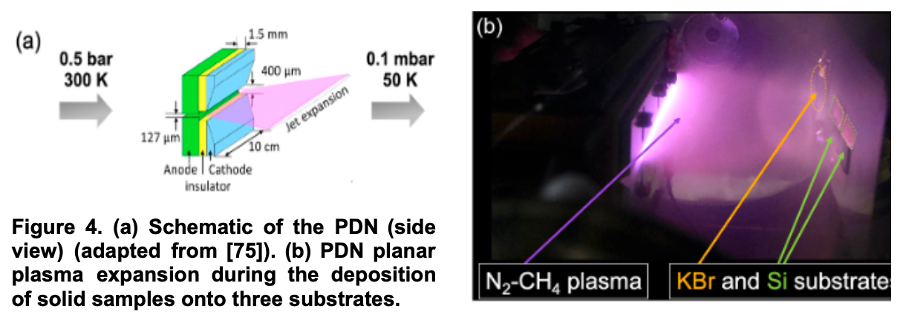
Figure 1. (a) Schematic side view of the COSmIC pulsed discharge nozzle used to generate a plasma discharge in the stream of a supersonic jet expansion. (b) Photograph of the planar plasma expansion during the deposition of solid samples onto substrates.
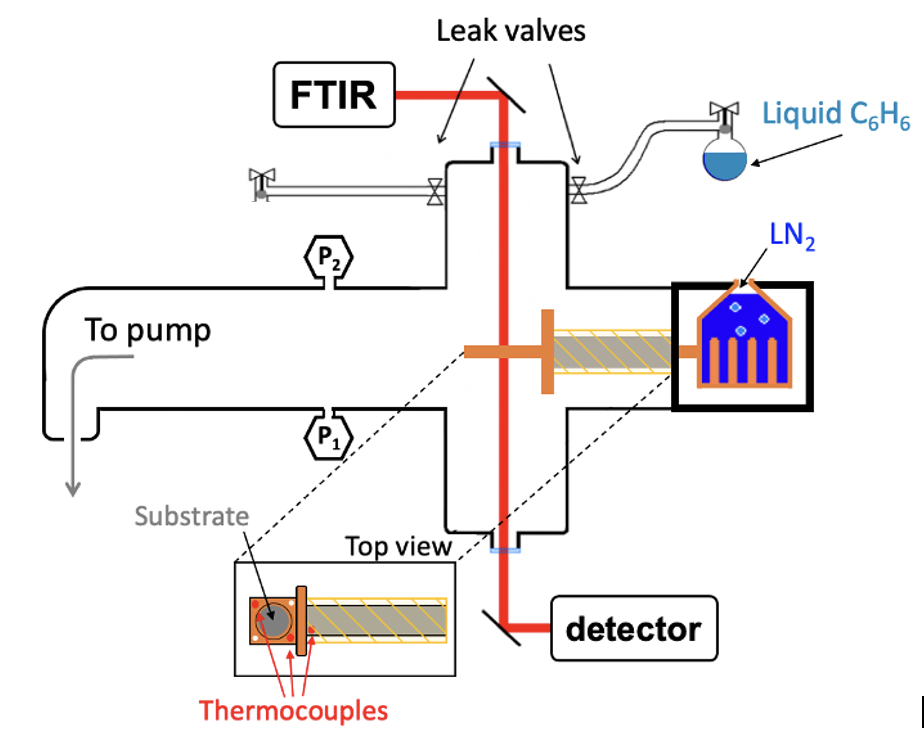
Figure 2. Schematic diagram (not to scale) of the ACL experimental apparatus used for benzene ice nucleation and growth studies (adapted from [2]). Pressure is measured with a capacitance manometer (P1) and an ion gauge (P2). The inset shows a top view of the sample holder with the positions of the two K-type thermocouple gauges (red dots) used for temperature measurements. The ice sample forms on either or both sides of the silicon substrate/tholin sample (grey), which is in the path of the IR beam. Infrared transmission spectra are collected with an external DTGS detector.
3. Results
Our new measurements for benzene nucleation conducted on bare silicon and Titan tholin show a clear influence of tholins on the C6H6 nucleation (Figure 3), with much lower Scrit values for the tholin sample (black) than on the blank silicon substrate used as a reference (red). Additionally, our nucleation measurements on both the tholin sample and Si substrates over the 138–157 K temperature range allow us to derive a temperature dependence to Scrit, which increases with decreasing temperature. These lower Scrit values obtained on the tholin sample are lower by a factor of ~2-3, which indicates that a lower degree of supersaturation is necessary for nucleation of C6H6 to proceed on the Titan tholin than on the bare silicon substrate. Thus, Titan tholins favor the condensation and nucleation of C6H6. We will discuss the experimental and microphysical implications of these new measurements on the number density and size distribution of cloud particles formed, and implications for the benzene cloud seen at Titan's south pole.

Figure 3. Scrit values for C6H6 measured between 138–157 K on a bare silicon substrate and on a laboratory-produced Titan tholin sample.
Acknowledgements
Funding for this project is provided through NASA CDAP.
References
[1] Vinatier et al. 2018, Icarus, 310, 89-104.
[2] Barth, E. L. 2020, Atmosphere, 11(10), 1064.
[3] Iraci, L. T. et al. 2010, Icarus, 210, 985–991.
[4] Dubois et al. 2021, Planet. Sci. J. 2, 121.
[5] Sciamma-O’Brien, E. et al. 2023, The Planetary Science Journal, 4(7), 121.
How to cite: Dubois, D., Iraci, L., Barth, E., Vinatier, S., Salama, F., and Sciamma-O'Brien, E.: Laboratory Measurements of Critical Saturation of Benzene Ice onto Titan Tholins: Application to the Microphysics of Titan’s South Polar Benzene Cloud, EPSC-DPS Joint Meeting 2025, Helsinki, Finland, 7–12 Sep 2025, EPSC-DPS2025-1248, https://doi.org/10.5194/epsc-dps2025-1248, 2025.


