
 1,1,3,
- 1Johns Hopkins Applied Physics Laboratory, United States of America (tom.nordheim@jhuapl.edu)
- 2NASA Goddard Space Flight Center, United States of America
- 3University of California, Berkeley, United States of America
In 1989, Voyager 2 carried out the first, and thus far only, in-situ exploration of the Neptune system. This included a distant flyby of Neptune’s only major moon Triton – a large icy moon that may possibly be a captured Kuiper Belt Object. Based on radio occultation measurements during the flyby, Triton was found to have an intense ionosphere with peak electron densities on the order of 104 cm-3 [1]. This was surprising, as Neptune’s orbital location at 30 AU from the Sun means that the flux of ionizing solar UV photons is relatively low. It was therefore suggested that magnetospheric electron precipitation may be an important, and possibly dominant, energy input to Triton’s ionosphere [2], [3], [4]. However, subsequent modelling efforts were never able to fully explain the structure of Triton’s ionosphere from either solar photoionization or magnetospheric electron input [5], [6]. The question of what drives Triton’s intense ionosphere therefore remains unresolved.
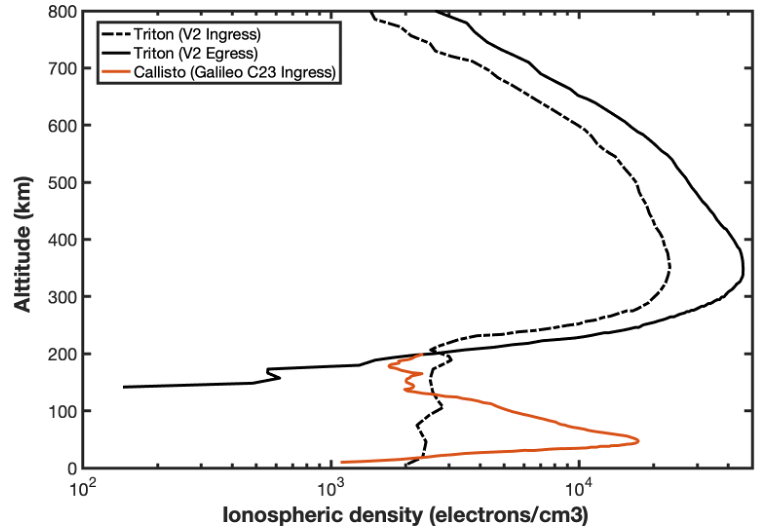
Figure 1: Ionospheric densities at Triton as measured by Voyager 2 [1] during ingress (dashed black line) and egress (solid black line) compared to the most intense ionosphere measured by Galileo at Jupiter’s moon Callisto [7].
An important factor in determing the role of magnetospheric electron precipitation at Triton is our knowledge of Neptune’s magnetosphere and the “seed population” of magnetospheric electrons upstream of the moon. Most studies in the literature have considered either mono-energetic beams of electrons incident at the top of Triton’s atmosphere or a “best-guess” electron spectrum based on early analyses of the Voyager 2 magnetospheric measurements. An example of the most commonly used “best-guess” magnetospheric electron spectrum [5] is shown below in Figure 2.
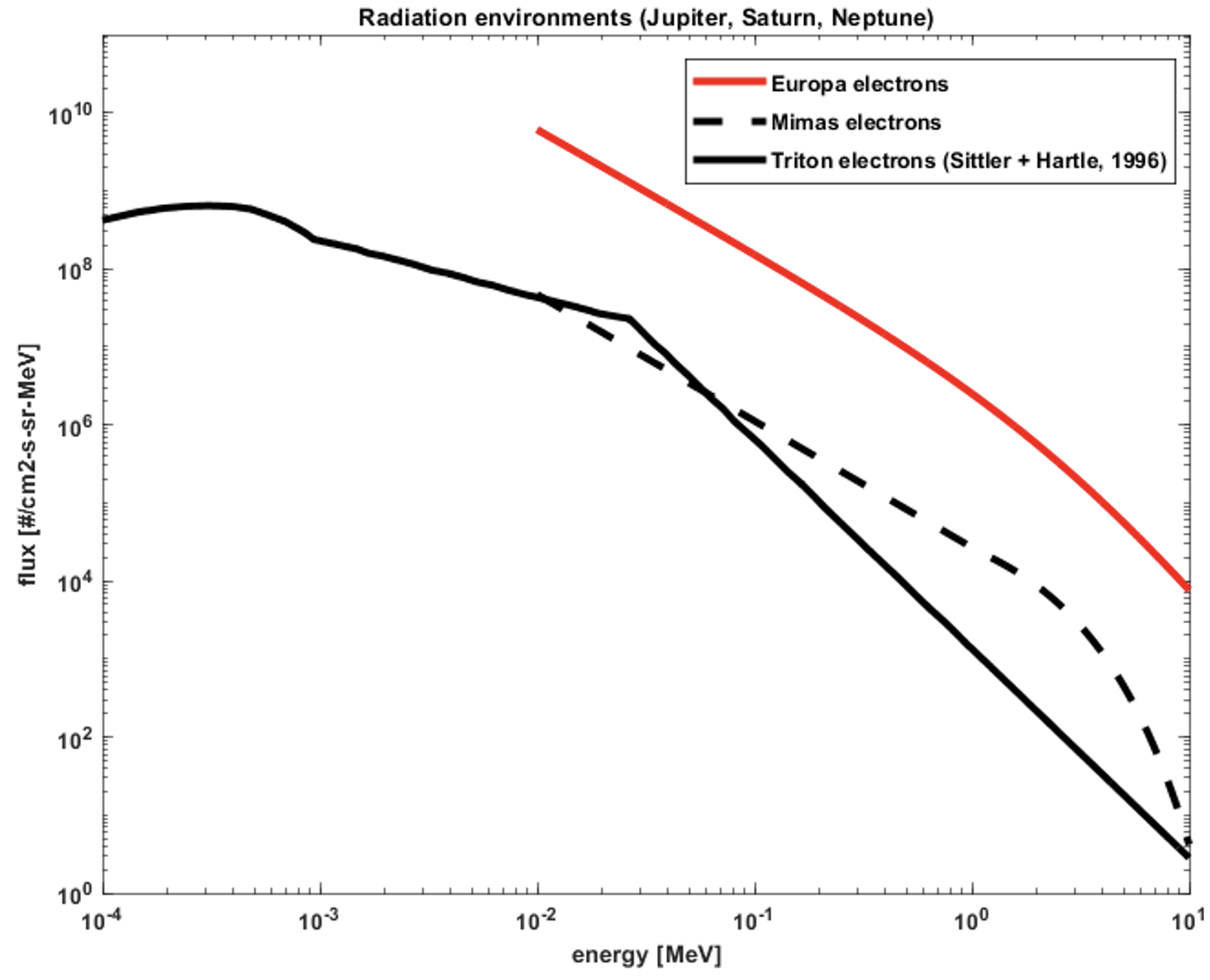
Figure 2: Representative magnetospheric electron environment at Triton based on the “best guess” estimate by [5] compared to similar magnetospheric environments at Jupiter and Saturn.
Here, we revisit the question of the dominant energy input to Triton’s ionosphere using new models and analysis techniques that were not available at the time of the Voyager 2 Neptune encounter. This includes re-analyses of data from the Voyager 2 Plasma Science (PLS) and Low Energy Charged Particle (LECP) instruments near Triton’s location in Neptune’s magnetosphere, and charged particle transport modelling to simulate the resulting energy deposition and primary ionization rate due magnetospheric elctrons incident at the top of Triton’s atmosphere.
References:
[1] Tyler G. L., et al. (1989) Science, 246, 4936,1466–1473. [2] Strobel, D. F. et al. (1990) Geophys Res Lett, 17, 10, 1661–1664. [3] Majeed, T., et al. (1990) Geophys Res Lett, 17, 10, 1721–1724. [4] Yung, Y. L. and Lyons, J. R. (1990) Geophys Res Lett, 17, 10, 1717–1720. [5] Sittler, E. C. and Hartle, R. E. (1996) J Geophys Res, 101, A5, 10863–10876. [6] Krasnopolsky, V. A. and Cruikshank, D. P. (1995) J Geophys Res, 100, E10, 21271. [7] Kliore, A. J. et al. (2002) J Geophys Res Space Phys, 107, A11, 1–7.
How to cite: Nordheim, T., Luspay-Kuti, A., Grayson, R., Kollmann, P., Mandt, K., Liuzzo, L., and Vervack, R.: Triton’s mysteriously intense ionosphere: Updates on magnetospheric charged particle fluxes and atmospheric energy deposition, EPSC-DPS Joint Meeting 2025, Helsinki, Finland, 7–12 Sep 2025, EPSC-DPS2025-1281, https://doi.org/10.5194/epsc-dps2025-1281, 2025.


