
 1,2,3,1,3,2
- 1Groupe de Spectrométrie Moléculaire et Atmosphérique (GSMA), Université de Reims Champagne-Ardenne, CNRS, 51687 Reims cedex, France (bruno.debatz@obspm.fr)
- 2Laboratoire de Météorologie Dynamique (LMD/IPSL), Sorbonne Université, ENS, PSL Research University, Ecole Polytechnique, IP Paris, CNRS, 4 Place Jussieu, 75252 Paris Cedex 05, France
- 3LIRA, Observatoire de Paris, Université PSL, CNRS, Sorbonne Université, Université Paris Cité, 5 place Jules Janssen, 92195 Meudon, France
Introduction:
Titan's atmosphere features intricate chemical and meteorological dynamics, particularly the seasonal development of polar stratospheric clouds, which were extensively studied by the Cassini mission. These clouds were initially observed during the northern winter, completely covering the North Polar Region between 2004 and 2012 [1]. As Titan transitioned into northern spring, the northern cloud dissipated, and a similar cloud emerged over the South Pole from 2012 until the mission concluded in 2017 [2, 3, 4].
Spectroscopic analyses have revealed that these clouds are composed of various ices, including hydrocarbons such as C6H6, as well as nitriles like HCN [5, 2, 6].
Nevertheless, the full seasonal behavior of these polar clouds and the relationship between their northern and southern occurrences remain poorly understood. Key questions persist: What processes lead to their formation? How do their structure and composition evolve? Are the northern and southern clouds manifestations of a single overarching system? Is there an asymmetry between them? And what becomes of the condensed chemical species?
Results & Discussion:
To address these questions, we employ a microphysical cloud model that simulates key processes—nucleation, condensation, and sublimation—for six primary species involved in Titan’s cloud dynamics: CH4, C2H2, C2H6, C6H6, HCN, and HC3N. This model is integrated with the Titan Planetary Climate Model (Titan PCM) [7, 8], which provides atmospheric constraints and simulates three-dimensional transport and mixing.
Our simulations indicate that Titan's polar clouds begin forming in early autumn at altitudes around 330 km, confined within the polar vortex, triggered by pronounced stratospheric cooling and a buildup of trace gases driven by the planet's general circulation (Figure 1). During autumn and winter, the clouds undergo significant evolution in altitude, extent, and composition. Enhanced atmospheric subsidence during late autumn causes the cloud layer to descend to below 160 km and spread horizontally to about 59° latitude. By late winter, the cloud reaches a final development phase before fully dissipating roughly four years after the spring equinox, driven by warming in the stratosphere and depletion of condensable species in the polar region.
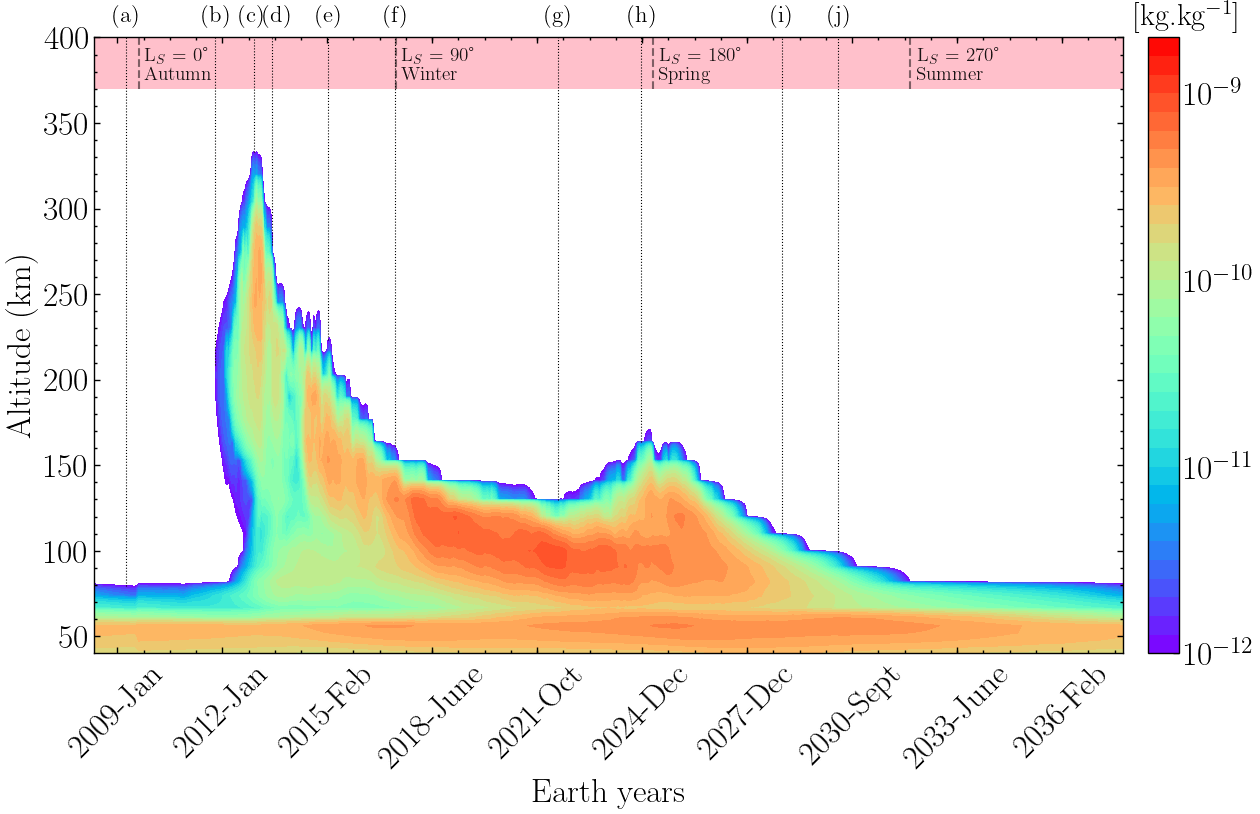
Figure 1. Vertical evolution of the mass mixing ratio of ices at Titan’s South Pole (> 60°S) in the Titan PCM. Vertical lines correspond to key phases in the polar cloud’s evolution.
While these clouds facilitate the formation of ices in Titan’s lower atmosphere, their surface precipitation rates remain minimal compared to that of methane. Due to their high-altitude origin, most of the cloud particles re-evaporate before reaching the surface.
We will present Titan’s polar cloud cycle, the observed variations in altitude and composition between early autumn and late winter, as well as the connection between the clouds observed in the northern and southern hemispheres.
References: [1] Le Mouélic et al (2012) Planet. Space Sci., 60, 1. [2] de Kok et al (2014) Nature, 514, 7520. [3] West et al (2016) Icarus, 270. [4] Le Mouélic et al (2018) Icarus, 311. [5] Griffith et al (2006) Science, 313, 5793. [6] Vinatier et al (2018) Icarus, 310. [7] de Batz de Trenquelléon et al (2025a) Planet. Sci. J., 6, 4. [8] de Batz de Trenquelléon et al (2025b) Planet. Sci. J., 6, 4.
How to cite: de Batz de Trenquelléon, B., Rannou, P., Vinatier, S., and Lebonnois, S.: Complex Seasonal Cycle of Titan's Polar Clouds, EPSC-DPS Joint Meeting 2025, Helsinki, Finland, 7–12 Sep 2025, EPSC-DPS2025-1312, https://doi.org/10.5194/epsc-dps2025-1312, 2025.


