
 1,2,3,1,4,
- 1INAF-OAPD Astronomical Observatory of Padova, Italy, (tonoian.susanna@gmail.com)
- 2Università di Bologna, Centro Interdipartimentale di Ricerca Industriale - CIRI Aerospaziale - Aerospace, Bologna, Italy
- 3Scuola Galileiana di Studi Superiori, Padova, Italy
- 4Dipartimento di Geoscienze, Università di Padova, Italy
- 5Johns Hopkins University Applied Physics Laboratory, Laurel, USA
Introduction
Ariel, one of Uranus’ icy satellites, has been known since the 19th century, with most of our current knowledge about its surface coming from the Voyager 2 flyby. Despite the limited number of images acquired during the mission, they remain the primary source of information onUranus’s icy moons. When combined with data from more recent observations, such as those from the James Webb Space Telescope (JWST), they contribute to our understanding of the evolution of icy bodies by shedding light on both surface and subsurface processes.
Ariel's surface exhibits extensive resurfacing [1] and it is primarily composed of CO₂ and CO ices, and possibly NH-bearing species [2]. It is also considered as a candidate ocean world, potentially harboring a subsurface ocean [3]. The portion of Ariel’s terrain recorded by Voyager 2 has been mapped and classified into geological units based on both absolute and relative stratigraphic ages. Specifically, the Crater Plains unit is the oldest one with an estimated absolute age of approximately 1.3 – 0.6/+2.0 Ga [4] with a more tectonized region being 0.8 -0.5/+1.8 Ga, while three younger units have been identified through relative dating with no absolute modeled age.
Given the diversity of surface features,such as medial grooves, fault scarps, grabens, deep troughs, and ridges [5], conducted a detailed structural analysis is essential.This work aims to investigate the structural relationships among these features and explore their potential connection to Ariel’s subsurface.
Data and Methods
For this study we used processed mosaics from Voyager 2 ISS images along with a digital elevation model (DEM) [1], both with a spatial resolution of 1 km. Building on previous mapping efforts [5] we are conducting additional mapping of structural features using QGIS software to perform the structural analysis. From this mapping, we derive statistical properties, such as feature orientation and lengths. To identify orientation patterns, we generate rose diagrams for different feature groups using the Line Direction Histogram plugin [6].
In addition, we analysed the DEM using VRGS software to investigate dip and dip direction trends via the Tensor Analysis inbuilt tool [7].
Discussion and future work
The preliminary resulting orientation distribution of structural features, as shown in Figure 1, will provide insights into the stress field behavior of Ariel’s surface. In the future, we will finalize the mapping deriving all the statistical properties of the analyzed surface features. Such investigation will help in reconstructing the influence of global processes such as tidal stress and contraction, as well as local processes associated with cryovolcanism and diapiric upwelling [8], [9]. Additionally, it will offer indirect evidence about Ariel’s interior, including possible subsurface ocean presence and internal layers differentiation.
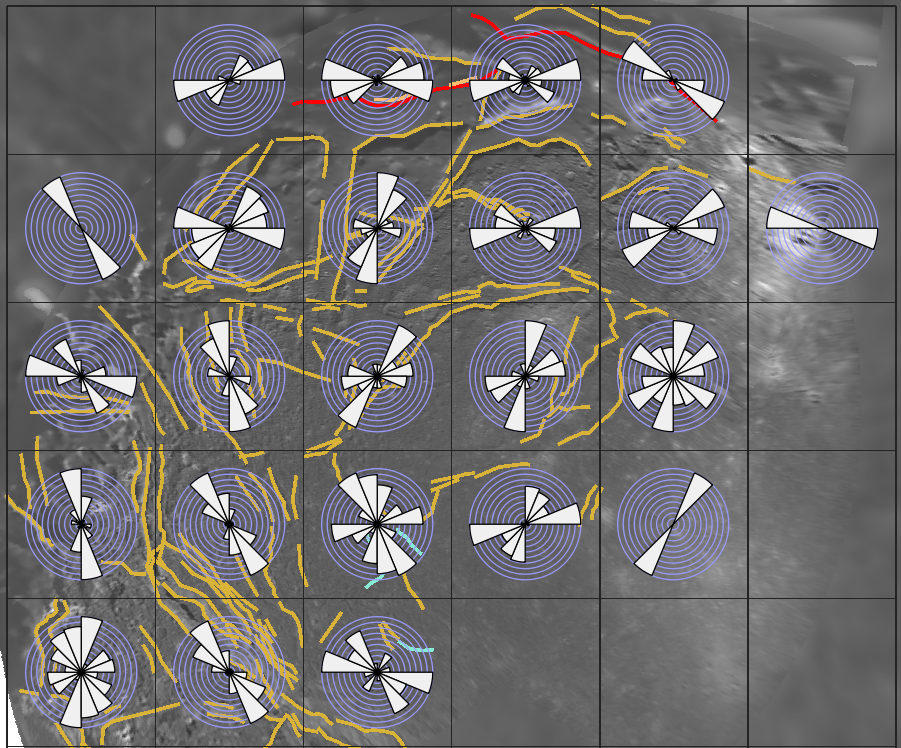
Figure 1. An example of the Rose diagrams with an applied grid of 300 km.
Indeed, to further investigate the icy crust, we will also apply fractal clustering methods to determine the possible thickness of icy fractured medium [10].
Acknowledgements: This activity has been developed under the ASI/UniBo-CIRI agreement n. 2024-5-HH.0.
References: [1] Schenk & Moore (2020) R. Soc. A 378. [2] Cartwright et al. (2024) ApJ Lett, 970, L29. [3] Castillo-Rogez et al. (2023) JGR Planets, 128, 1. [4] Kirchoff et al. (2022) Planet. Sci. J., 3, 2. [5] Beddingfield et al. (2025) Planet. Sci. J., 6, 2. [6] Tveite (2025) QGIS, Line direction histogram. [7] VRGeoscience Limited (2003) VRGS. [8] Barr & Hammond (2015) Phys. Earth Planet. Inter., 249, 18–27. [9] Beddingfield & Cartwright (2021) Icarus, 367, 114583. [10] Lucchetti et al. (2021) Planet. Space Sci., 195, 10514.
How to cite: Tonoian, S., Lucchetti, A., Massironi, M., Beddingfield, C. B., Penasa, L., Pajola, M., and Rossi, C.: Surface investigation of Ariel’s structural features, EPSC-DPS Joint Meeting 2025, Helsinki, Finland, 7–12 Sep 2025, EPSC-DPS2025-1554, https://doi.org/10.5194/epsc-dps2025-1554, 2025.


