
 1
1- 1Université Côte d'Azur, Observatoire de la Côte d'Azur, CNRS, Laboratoire Lagrange, Nice, France (nishil.mehta@oca.eu)
- 2Université Côte d'Azur, Observatoire de la Côte d'Azur, CNRS, Laboratoire Lagrange, Nice, France (vivien.parmentier@oca.eu)
Clouds play a crucial role in shaping the atmospheres of exoplanets, influencing their albedo, heat distribution, and spectrum. While most past studies focused on hot and ultra-hot planets, JWST now allows an in-depth characterisation of warm objects, where the interactions between cloud, circulation, and radiative transfer are yet to be studied in detail.
In this study, we integrate physically motivated, radiatively active, tracer-based clouds in General Circulation Models (GCM) (ADAM, former SPARC) to analyze the atmosphere of WASP-80b, a warm Jupiter orbiting an M-dwarf star. This planet, with an equilibrium temperature of ~800 K, is analogous to warm sub-Neptunes, making it a crucial target for understanding sub-Neptune atmospheres. We take advantage of the high-quality dataset from JWST obtained through the MANATEE GTO collaboration, allowing us to jointly interpret both high-quality panchromatic emission and absorption spectra ranging from 2.5 to 12 microns with the outputs from a GCM. We provide an in-depth characterisation of the planet’s atmospheric dynamics and possible cloud distribution. By comparing our models to the data, we constrain the likelihood of different expected cloud species, such as silicate, sulfide, or chloride clouds, on this planet.
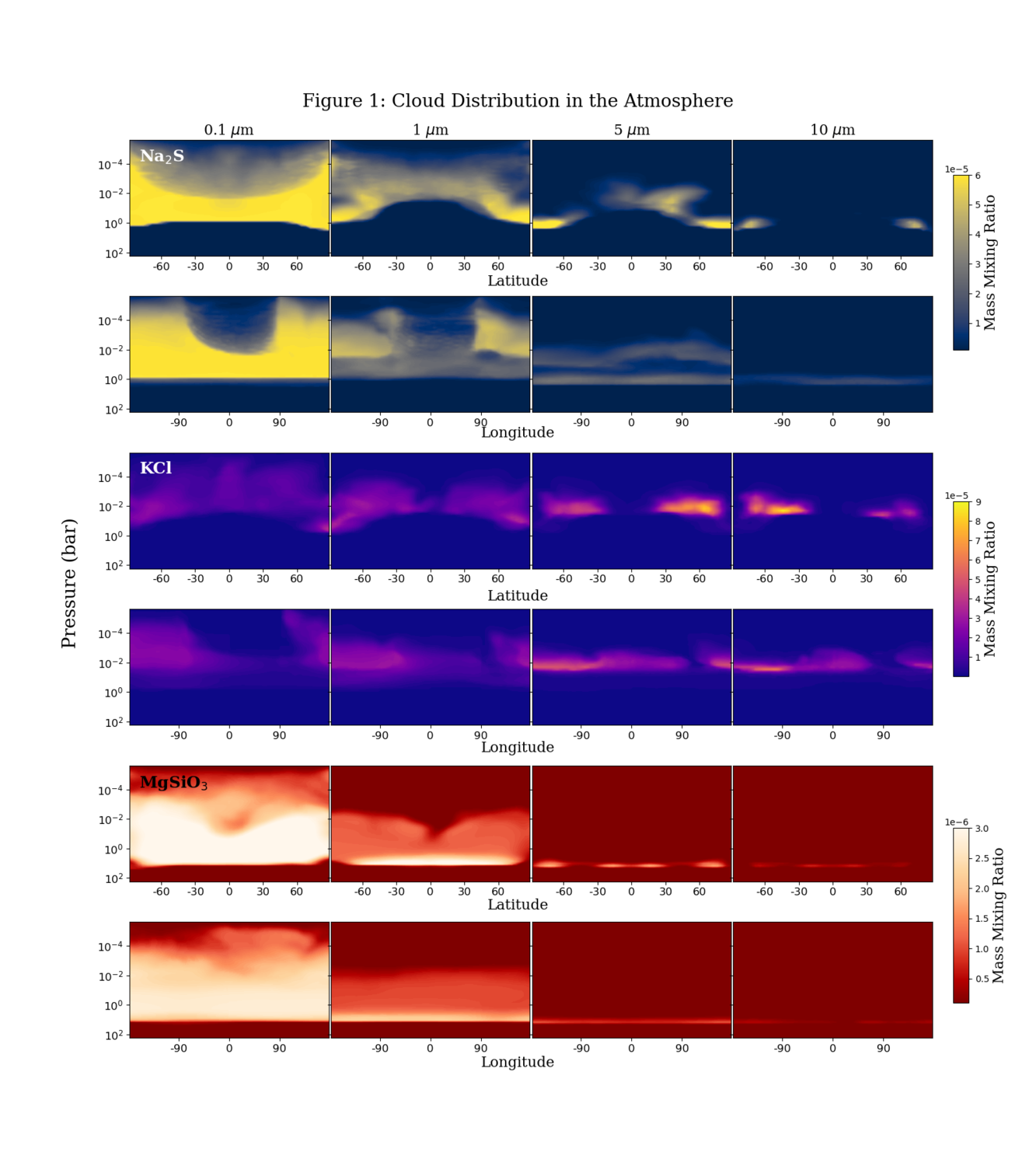
Figure 1 shows the zonal mean averaged over latitudes and longitudes of the mass mixing ratio distribution of the cloud particles in the atmosphere. The region around 0° latitude (Row: 1, 3, 5) is the region around the equator averaged over all longitudes. The region around 0° longitude (Row: 2, 4, 6) is the dayside region averaged over all latitudes.
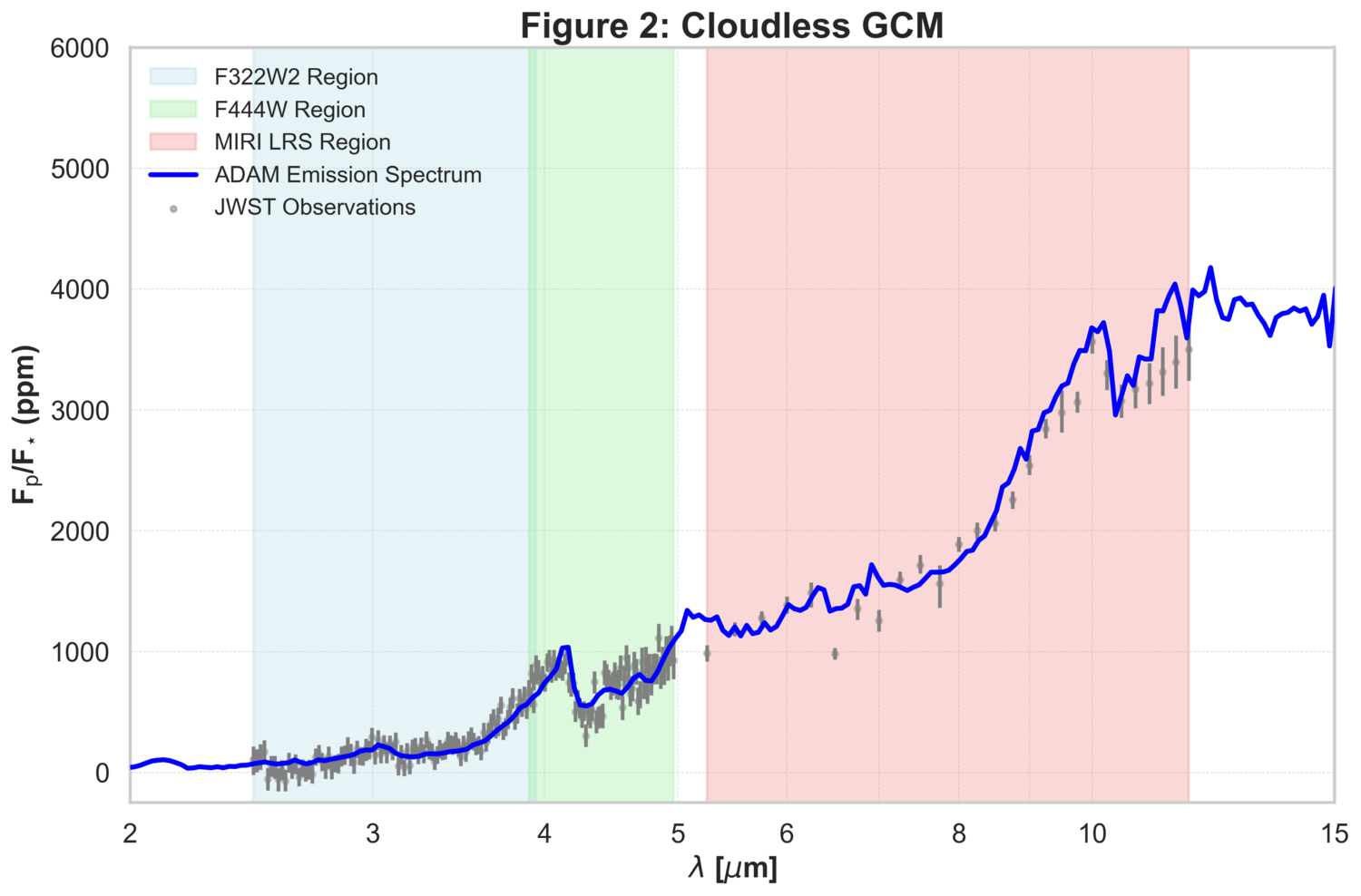
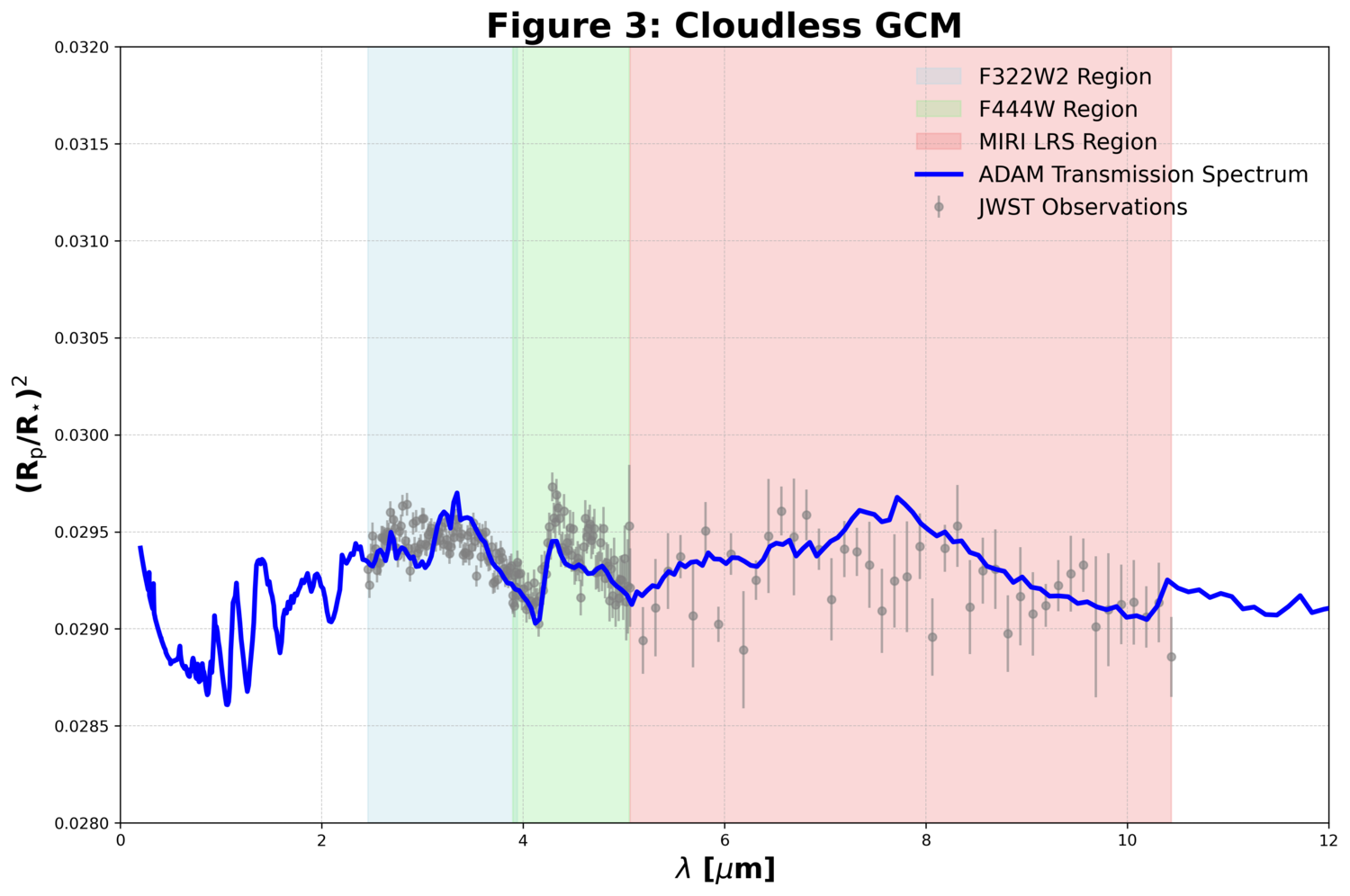
Figure 2: Emission Spectrum from ADAM-GCM plotted over the JWST observations from the MANATEE-GTO program, with the colored regions indicating the instruments. Figure 3: Transmission Spectrum from ADAM-GCM plotted over the JWST observations from the MANATEE-GTO program, with the colored regions indicating the instruments.
While both emission and transmission spectra are very well fitted by cloudless GCMs (Figures 2 and 3), the data also appear compatible with small KCl cloud particles, but Na2S condensates can be ruled out due to the strength of their radiative feedback.
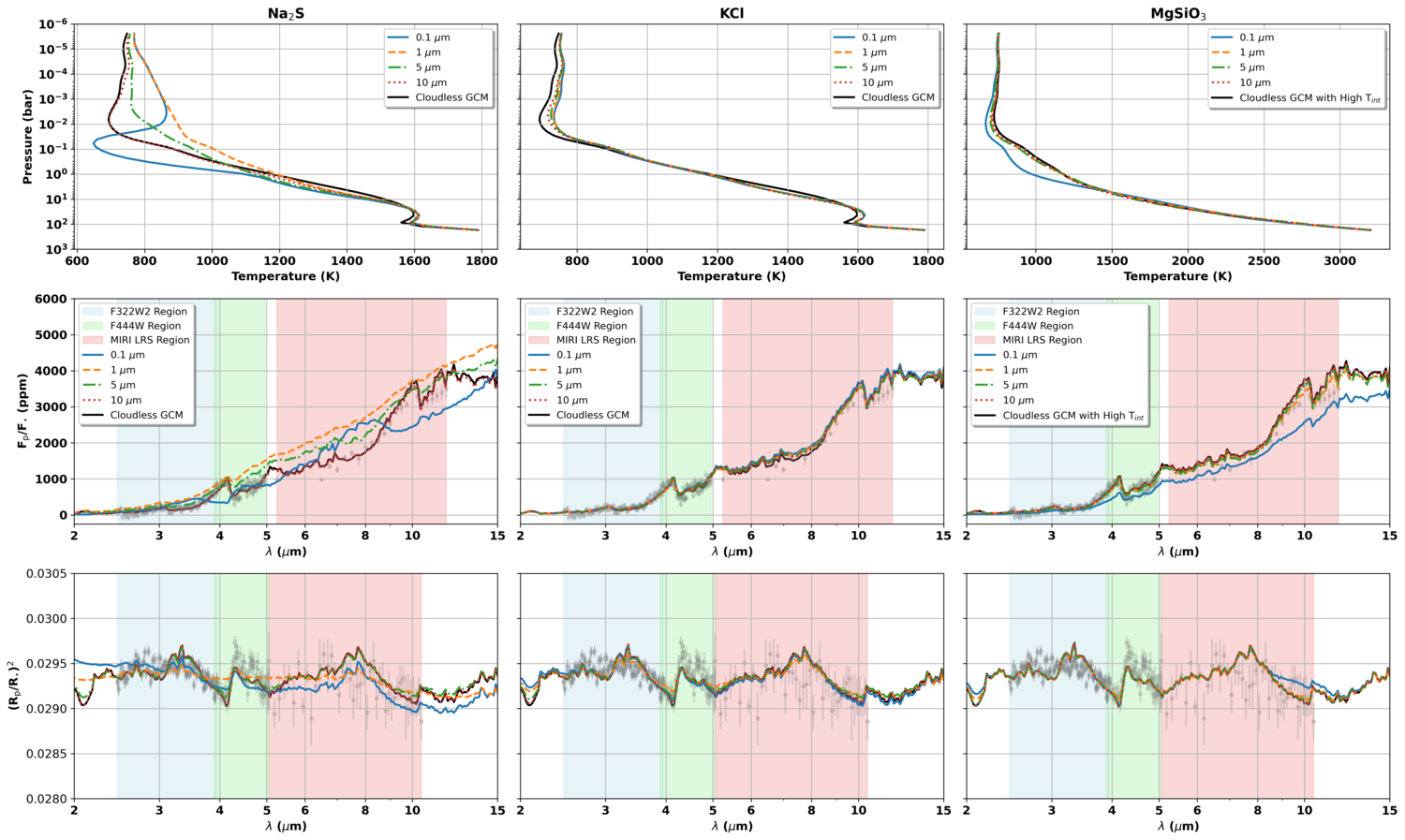
Figure 4 shows the dayside average temperature-pressure profiles (Row 1) and the corresponding emission (Row 2) and transmission spectra (Row 3) for different clouds and particle sizes.
This showcases the unique insights that can be obtained from global modeling of exoplanet atmospheres. Our results point towards a homogeneous atmosphere with minimal temperature contrast between the day and night sides, suggesting efficient heat redistribution. Additionally, the relatively low abundance of CH4 points to active atmospheric chemistry and the possibility of a high internal heat flux, which can lead to quenching of CH4 in the atmosphere.
This work not only provides a comprehensive framework for interpreting JWST observations but also enhances the capabilities of GCMs in characterizing the global atmospheres of exoplanets in the JWST era.
How to cite: Mehta, N. and Parmentier, V.: Combining JWST data and General Circulation Models for a 3D study of the clouds on warm Jupiter WASP-80b, EPSC-DPS Joint Meeting 2025, Helsinki, Finland, 7–12 Sep 2025, EPSC-DPS2025-1597, https://doi.org/10.5194/epsc-dps2025-1597, 2025.


