
 1,2,2
1,2,2- 1Laboratoire de Météorologie Dynamique / Institut Pierre-Simon Laplace (LMD/IPSL), Centre National de la Recherche Scientifique (CNRS), Sorbonne Université, 4 place Jussieu, Tour 45-55 3e étage, 75252 Paris, France.
- 2Laboratoire Atmosphères Observations Spatiales/Institut Pierre-Simon Laplace (LATMOS/IPSL), Université Paris-Saclay, Université de Versailles Saint-Quentin-en-Yvelines (UVSQ), Sorbonne Université, Centre National de la Recherche Scientifique (CNRS), Guyan
Titan is the largest moon of Saturn, with a radius around 2575 km, and it is surrounded by a thick atmosphere composed of nitrogen, methane, and many other organic compounds. The temperature and pressure profiles on Titan enable the condensation of several gases in the atmosphere, including methane, forming clouds. Here we focus on the methane clouds.
Titan has been observed up close during the Cassini mission, between 2004 and 2017. Some of the methane clouds observed then seem convective (see Figure 1 for an example). We want to reproduce these clouds in a numerical model, to try to answer some of these questions:
- what are the conditions that enable convective methane clouds on Titan? (temperature, methane concentration, global scale influence, topography, ...)
- do we form shallow convection? deep convection?
- how does convection organize itself on Titan?
- what is the size of the cloud particles?
- how do the scales of the convective systems on Titan and on Earth relate?
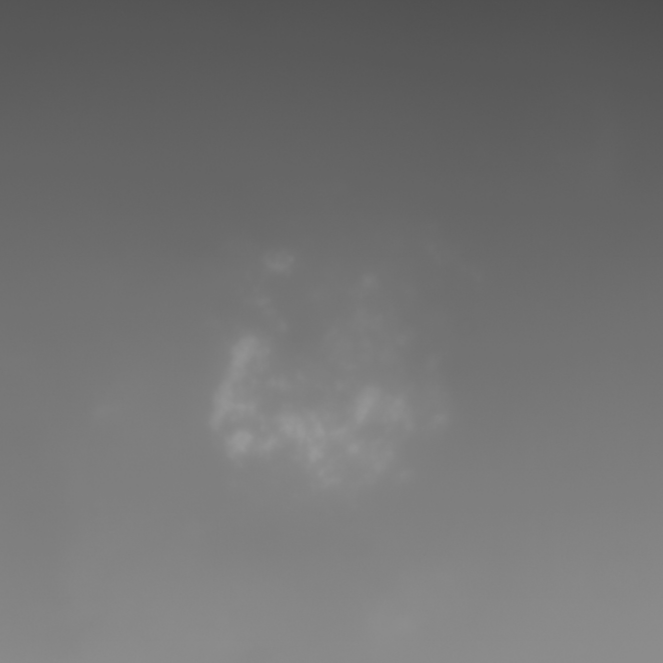
Figure 1 : Tropospheric methane clouds over the south pole of Titan, July 2004 (Cassini/ISS, infrared filters). The cloud diameter is around 500 km.
To tackle these questions, we need a mesoscale model of Titan's atmosphere, i.e. a local model (approximately above a 100 km zone). The current Titan mesoscale model used at LMD couples the physics of the Titan-PCM model (Trenquelléon et al. 2025a) with the dynamics of the WRF model (a weather forecasting model also used for Earth previsions), see for instance Lefevre, Bonnefoy, and Spiga 2024. In our study, we include the new microphysics modules (i.e. the aerosols and clouds modules, described in Trenquelléon et al. 2025b) and use the last version of WRF (WRF-V4). The microphysics schemes we use enable to study the formation of cloud particles, and their size distribution. We use a horizontal resolution of a few kilometers: this enables us to resolve the clouds, i.e. to consider each grid cell to be either completely a cloud or completely clear, without subcell cloud parameterization. Such a model is called a cloud resolving model. For Titan, several cloud resolving models have been developped (Hueso and Sánchez-Lavega 2006, Barth and Rafkin 2010), based on other dynamical cores and physical schemes.
Our first test cases are a "warm bubble" and a "cold bubble", over a very small domain (40x40 km, the top of the model is 30 km high). Such simulations are useful to check the behavior of the model. We obtain respectivelly a rising and a falling air parcel, with for each case methane condensation (when the air reaches colder atmospheric layers for the warm bubble case, and due to low temperatures in the bubble for the cold bubble case).
Our next steps will be to perform more testing (e.g. abundant methane zone). Then, we will study the different formation mechanisms for clouds (in particular convective clouds): solar heating, topographic clouds, methane accumulation due to the global circulation, lake evaporation, ... We will try to explore the parallels and discrepancies between Earth's water convective clouds and Titan's methane convective clouds.
References
Barth, Erika L. and Scot C. R. Rafkin (Apr. 1, 2010). “Convective cloud heights as a diagnostic for methane environment on Titan”. In: Icarus. Cassini at Saturn 206.2, pp. 467–484. issn: 0019-1035. doi: 10.1016/j.icarus.2009.01.032. url: https://www.sciencedirect.com/science/article/pii/S0019103509000591
Hueso, R. and A. Sánchez-Lavega (July 2006). “Methane storms on Saturn’s moon Titan”. In: Nature 442.7101. Number: 7101 Publisher: Nature Publishing Group, pp. 428–431. issn: 1476-4687. doi: 10.1038/nature04933. url: https://www.nature.com/articles/nature04933
Lefevre, Maxence, Léa Bonnefoy, and Aymeric Spiga (July 3, 2024). Mesoscale Modelling of Titan’s Shangri-La region. doi: 10.5194/epsc2024-408. url: https://meetingorganizer.copernicus.org/EPSC2024/EPSC2024-408.html
Trenquelléon, Bruno de Batz de et al. (Mar. 31, 2025a). “The New Titan Planetary Climate Model. I. Seasonal Variations of the Thermal Structure and Circulation in the Stratosphere”. In: The Planetary Science Journal 6.4. Publisher: IOP Publishing, p. 78. issn: 2632-3338. doi: 10.3847/PSJ/adbbe7. url: https://iopscience.iop.org/article/10.3847/PSJ/adbbe7/meta
Trenquelléon, Bruno de Batz de et al. (Mar. 31, 2025b). “The New Titan Planetary Climate Model. II. Titan’s Haze and Cloud Cycles”. In: The Planetary Science Journal 6.4. Publisher: IOP Publishing, p. 79. issn: 2632-3338. doi: 10.3847/PSJ/adbb6c. url: https://iopscience.iop.org/article/10.3847/PSJ/adbb6c/meta
How to cite: Moisan, E., Spiga, A., and Chatain, A.: Developping a new cloud resolving model for Titan’s methane clouds, EPSC-DPS Joint Meeting 2025, Helsinki, Finland, 7–12 Sep 2025, EPSC-DPS2025-1616, https://doi.org/10.5194/epsc-dps2025-1616, 2025.


