
 1,1,
1,1,- 1Department of Meteorology, University of Reading, Reading, RG6 6ET, UK
- 2Department of Physics, Imperial College London, London, SW7 2BW, UK
Almost all the known ocean-bearing moons of our solar system orbit within the magnetosphere of their host planet. Given these oceans are expected to contain salt, any fluid flow therein will constitute a moving conductor within the ambient magnetic field, permitting ‘motional induction’, a mechanism where the deflection of moving ions and resulting electrical shorting gives rise to secondary magnetic fields. At Earth, the motionally-induced magnetic signature of the ocean tides has been successfully extracted from magnetometer data obtained at satellite altitude. The signature of Earth’s time-mean ocean circulation is yet to be detected at altitude but has been modelled numerically and extensively. In contrast, motional induction at icy moons has received little attention and, in the case of Enceladus, has not been explored.
At Enceladus, ocean salinity has been demonstrated as a fundamental control upon the stratification and time-mean ocean circulation, uncertainty in which leading to orders of magnitude of uncertainty in the bottom-to-top transit timescale of particulates from the ocean depths to the south polar plumes (Ames et al., 2025). Considering this, we set out to explore whether motional induction within Enceladus could be large enough to be detectable and, if so, whether it could be used to constrain the ocean salinity and, by extension, timescales of transport within the ocean.
To this end, we conduct fully global, 3D simulations of Enceladus’ ocean circulation using a general circulation model (MITgcm) at varying ocean salinity. The model is non-hydrostatic, and accounts for geothermal heating, non-linearity in the equation of state for water density, as well as variation in the pressure-dependant freezing temperature at the ocean top. Simulated time-mean ocean flow and conductivity fields are then inserted into GEMMIE (https://gitlab.com/m.kruglyakov/gemmie), a global 3D electromagnetic solver, to obtain the ocean induced magnetic field (OIMF) at Enceladus’ ice surface.
Our results show that different salinity oceans generate different magnetic signatures. For example, the polarity of the dipole in the radial OIMF component reverses at low vs high salinity (see figure 1). The OIMF is dominated by the meridional (north-south) and radial ocean flows, with weak contributions from zonal (east-west) flows owing to the near perfect alignment of Saturn’s rotation and magnetic dipole axis. We find 3D variability of the flow field to be important. Longitudinal variation in the ocean flows permit higher order components of the OIMF that can significantly raise the magnitude of the induced signature. However, we find that the magnitude of Enceladus’ OIMF is very likely beyond the detection capability of modern fluxgate magnetometers located on its ice surface, especially where the assumed ocean salinity is low. Reasons for a weaker OIMF at Enceladus vs Earth include a much weaker (~ two orders of magnitude) ambient magnetic field, a more sluggish ocean circulation and a weaker ocean conductivity (owing to lower temperatures). Our results provide a first estimate of the ocean induced magnetic field at Enceladus and inform future developments in the field.
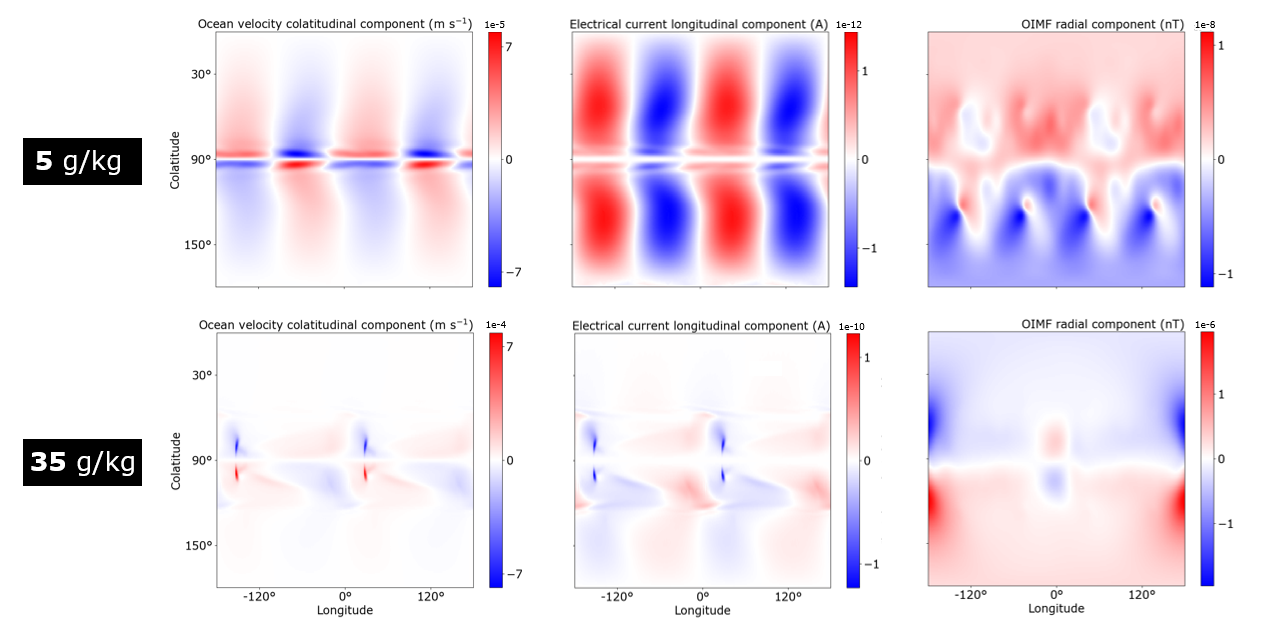
Fig.1 Left: Simulated colatitudinal ocean flow velocity (m/s), here shown at the ocean top. Centre: Longitudinal component of the electrical current (amperes; also a function of the radial ocean flows) at the ocean top. Right: Radial component of the ocean induced magnetic field (nT; OIMF) at Enceladus’ ice surface. Solutions are shown at 5 (top) and 35 (bottom) g/kg ocean mean salinity. Note colour bars are saturated throughout.
References:
Ames, F., Ferreira, D., Czaja, A., Masters, A., 2025. Ocean stratification impedes particulate transport to the plumes of Enceladus. Communications: Earth and Environment. DOI 10.1038/s43247-025-02036-3
How to cite: Ames, F., Ferreira, D., Czaja, A., and Masters, A.: Simulating the motional induction of 3D time-mean ocean flows within Enceladus, EPSC-DPS Joint Meeting 2025, Helsinki, Finland, 7–12 Sep 2025, EPSC-DPS2025-1885, https://doi.org/10.5194/epsc-dps2025-1885, 2025.


