
 ,,
,,- Mechanical and Aerospace Engineering Department, Sapienza University of Rome. Via Eudossiana 18, Roma, 00184, Italy.
Introduction: One of the most compelling discoveries in planetary science is the potential existence of habitable subsurface oceans within icy moons. Among these, Saturn's moon Enceladus stands out due to its remarkable geological activity, characterized by the continuous venting of water vapor, ice particles, and organic compounds from its south polar region [1]. Cassini's comprehensive suite of measurements, including gravity data, confirmed the existence of a global subsurface ocean [2]. Accurately modeling the internal structure of Enceladus is crucial for assessing its habitability. Geophysical parameters, such as total mass and moment of inertia (MoI), are effective at constraining the total thickness of the hydrosphere, but they provide limited information on the separate contributions of the ice shell and the underlying liquid ocean. In contrast, measurements of physical librations in longitude are particularly sensitive to the internal structure of the hydrosphere, as they are influenced by the degree of mechanical decoupling provided by the liquid layer and the rigidity of the overlying ice shell. By combining mass and the moment of inertia measurements with libration amplitude estimate, a Bayesian inference approach enables tighter constraints on the deep interior and hydrosphere properties. This study presents an internal structure framework based on the Markov Chain Monte Carlo (MCMC) method that is well-suited for the estimation of Enceladus’ interior properties with rigorously quantified uncertainties by exploring the parameter space.
Methods: The mass, MoI and libration amplitude provide constraints that are integrated into a Bayesian inference framework, which is used to infer the internal properties of the investigated body. In particular, we implemented a MCMC algorithm to invert interior models by varying the free parameters associated with the structure of an icy moon. In accordance with the methodologies employed and tested in previous studies [3-4], our approach considers the body to be a multi-layered structure with free parameters of layer size, density, and rheology. These parameters are iteratively refined within the MCMC framework using the Metropolis–Hastings algorithm, which generates a diverse set of interior models. To ensure robust mapping of the parameter space, 20 independent chains are employed, each generating approximately 50,000 accepted models. Following the convergence of all chains, probability distributions for each parameter are derived, yielding constraints on the likely internal structure that are consistent with the observed geophysical data.
Enceladus Interior Model Inversion: The internal structure of Enceladus is constrained using a combination of geophysical parameters derived from Cassini mission data. The mass of Enceladus, determined from radio science data, is 1.08022 ± 0.00108 × 10²⁰ kg [5], while the normalized MoI is estimated at 0.335 ± 0.002 [6]. These parameters place fundamental constraints on the total thickness of the hydrosphere, while remaining insensitive to the separate contributions of the ice shell and the subsurface ocean [6]. Physical librations, however, offer a crucial complementary constraint, as it is highly sensitive to the thickness and mechanical properties of the ice shell. The libration amplitude of Enceladus was determined from optical tracking of surface features by the Cassini spacecraft, revealing a physical libration of 0.120 ± 0.007°, which corresponds to an equatorial displacement of approximately 530 ± 30 m [7].
In this work, we implement the elastic libration model [8], which accounts for the gravitational torques acting on both the periodic and static tidal bulges and includes the complex gravitational interactions between the individual layers of the icy moon arising from their mutual misalignment and the pressure forces exerted by the liquid ocean on the surrounding solid layers. The model captures the contributions from both the direct external gravitational torque and the internal gravitational coupling between layers, as well as the pressure feedback from the ocean.
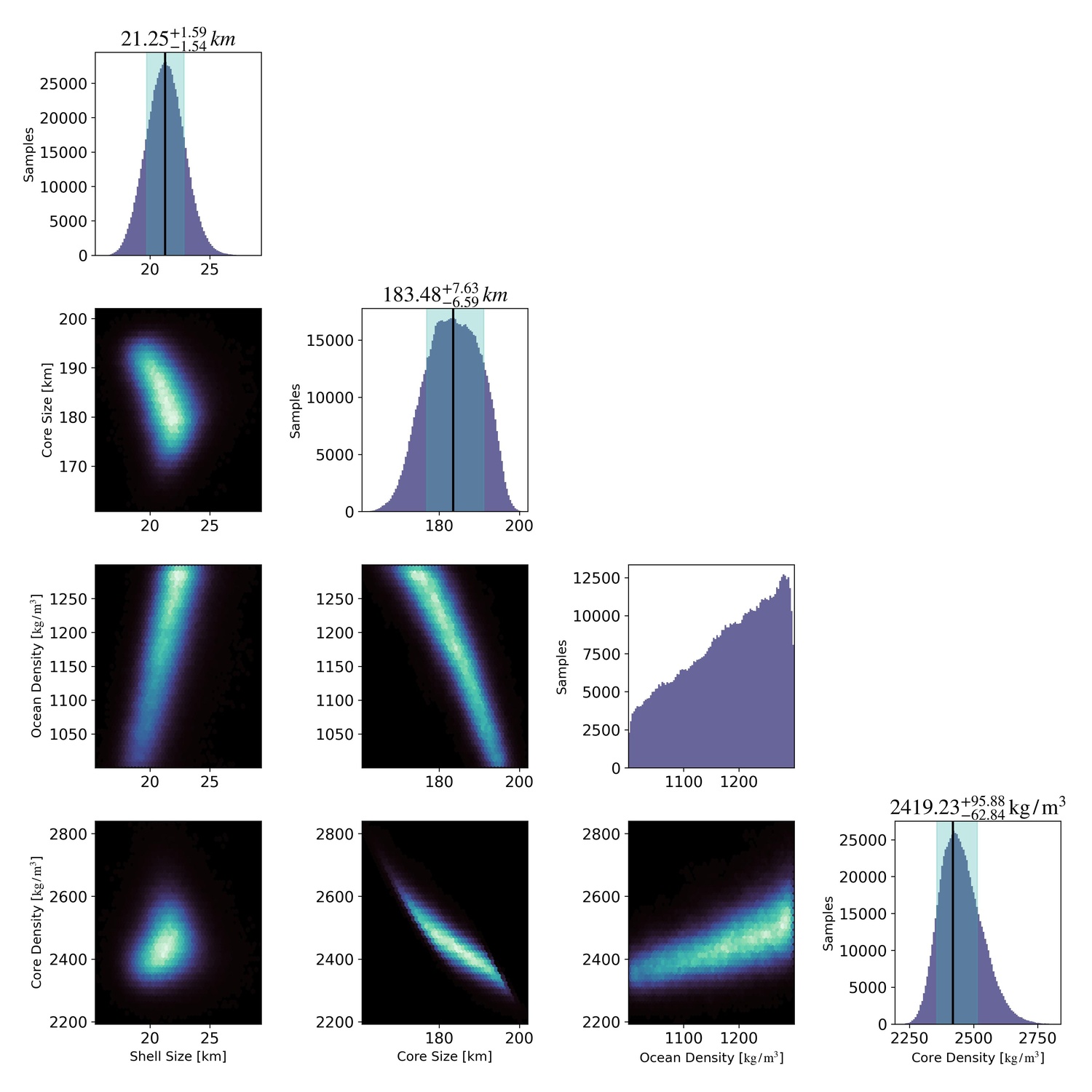
The moon is modeled with a three-layer structure comprising a rocky core, a subsurface ocean, and an ice shell. The thicknesses of the core and ice shell were treated as free parameters, while the ocean thickness was determined based on Enceladus’ known radius. The free parameters included the densities of the core and ocean, while the ice shell density was fixed at 917 kg m-3. The viscosities and shear moduli of the shell and core were included as free parameters. Within the MCMC framework, each proposed interior model starts from a simplified spherical approximation, characterized by an average radius and the densities of each layer. The hydrostatic shapes of the internal interfaces are then computed assuming hydrostatic equilibrium, calculating the polar and equatorial eccentricities of each layer using a fourth-order formulation [9].
The results suggest that incorporating libration amplitude can significantly improve the characterization of the internal differentiation withing Enceladus' hydrosphere, providing an estimate of the ice shell thickness with an uncertainty of approximately 1.5 km around a mean value of 21 km, consistent with previous studies.
Summary: The application of MCMC inversion with libration constraint offers a powerful approach to precisely determine the ice shell thickness of Enceladus, achieving a constraint accuracy of approximately 1.5 km. This framework can be readily adapted to other icy moons, providing a valuable tool for probing the internal structures of ocean worlds throughout the solar system.
References:
[1] Glein et al. (2015) GeCoA, 162, 202. [2] Iess et al. (2014), Sci, 344, 78. [3] Genova A. et al (2019) GRL 46(7), 3625–3633. [4] Petricca et al. (2023) GRL, 50, e2023GL104016. [5] Hemingway et al. (2018) in Enceladus and the Icy Moons of Saturn, Univ. Ariz. Press, 57. [6] Genova et al. (2024) PSJ, 5(2), 40. [7] Thomas et al. (2016) Icarus, 264: 37-47. [8] Van Hoolst et al. (2013) Icarus, 2013, 226.1: 299-315. [9] Tricarico (2014) ApJ, 782(2), 99.
How to cite: Ciambellini, M., Genova, A., Gargiulo, A. M., and Boccacci, G.: Constraining Enceladus' interior structure by using libration measurement in a Bayesian framework, EPSC-DPS Joint Meeting 2025, Helsinki, Finland, 7–13 Sep 2025, EPSC-DPS2025-1889, https://doi.org/10.5194/epsc-dps2025-1889, 2025.


