
 1,1,3
1,1,3- 1NASA Jet Propulsion Laboratory, California Institute of Technology, La Cañada Flintridge, CA
- 2Department of Mechanical and Aerospace Engineering, California State University, Long Beach, CA
- 3NASA Goddard Space Flight Center, Greenbelt, CA
Jupiter’s atmospheric circulation is dominated by strong zonal jets that occupy much of the equatorial and temperate regions up to about ±60˚ in latitude. They play an important role in shaping the tropospheric weather dynamics, and facilitate the zonal mixing of trace species and aerosols. The zonal winds of these jets have been the focus of many observational programs, as they provide a significant constraint on the atmospheric energy budget. Observations of the temporal and spatial variations of these zonal winds can help inform general circulation models (GCMs) that aim to simulate the interplay of instabilities that facilitate or inhibit these zonal flows.
Space-based observation efforts such as the Outer Planetary Atmospheres Legacy (OPAL) program have used data from the Hubble Space Telescope to constrain zonal flows on Jupiter (Simon et al., 2015), along with the other outer planets in the Solar System. Zonal wind estimates have also been derived from the Voyager and Cassini flybys, shedding light on the details of eddy-mean flow interactions that feed the atmospheric jets. Although spacecraft and HST observations benefit from having a consistently advantageous viewing geometry, ground-based observations provide significant support to these programs. For example, observations made using the TEXES instrument on the Gemini North Telescope have also been used to constrain stratospheric thermal and dynamic changes during Jupiter’s equatorial oscillations (Benmahi et al., 2021).
Here, we showcase Jupiter’s zonal wind profiles derived using long-term ground-based observations in the 5-µm spectral window using the SpeX instrument on the NASA Infrared Telescope Facility (IRTF). We demonstrate the use of an anti-cloud tracking technique, providing a novel methodology in constraining the dynamics of atmospheric motions. Although the IRTF data lacks the spatial resolution that can be achieved via the Gemini-based TEXES or space-based observations, our observational study encapsulates the entirety of the Jovian year as seen in the 5-µm spectral window.
We employ the methodology developed by Johnson et al. (2018) to constrain the zonal wind field via 1D image correlation and demonstrate the efficacy of their “sliding window” technique as applied to infrared datasets (Figure 1). We estimate the correlation errors using the methodology outlined by Asay-Davis et al. (2008).
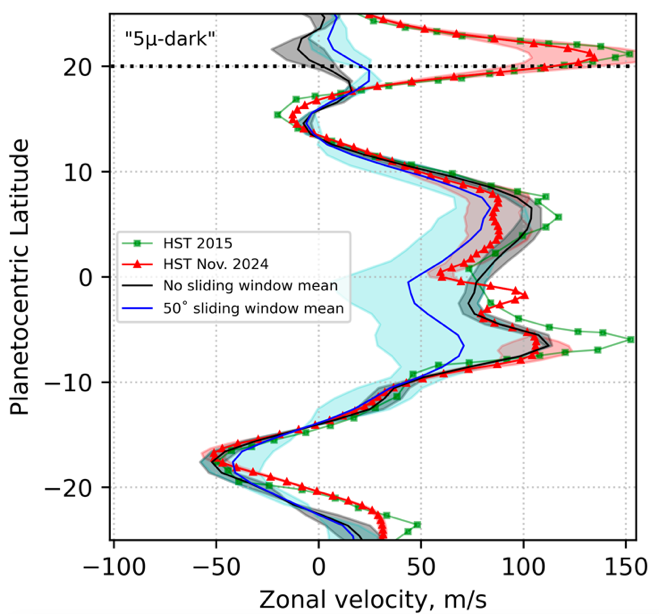
Figure 1 Jupiter zonal winds as derived using the NASA IRTF dataset for the 2024 observation cycle. The HST datasets are provided by the OPAL team. The blue and black lines are the results of our anti-cloud tracking technique applied to 5µ observations of Jupiter.
Our results demonstrate that when using 5-µm images, an anti-cloud tracking approach allows for wind field estimates that are consistent with the derived zonal flows from space-based observations. This allows us to constrain long-term behavior of the zonal jets, which include years that precede the inchoation of the OPAL observation campaign.
Reference:
- Asay-Davis, X. S., Marcus, P. S., Wong, M. H., and de Pater, I., “Changes in Jupiter’s zonal velocity between 1979 and 2008”, Icarus, vol. 211, no. 2, pp. 1215–1232, 2011.
- Benmahi, B., “Mapping the zonal winds of Jupiter's stratospheric equatorial oscillation”, Astronomy and Astrophysics, vol. 652, Art. no. A125, 2021.
- Johnson, P. E., Morales-Juberías, R., Simon, A., Gaulme, P., Wong, M. H., and Cosentino, R. G., “Longitudinal variability in Jupiter's zonal winds derived from multi-wavelength HST observations”, Planetary and Space Science, vol. 155, pp. 2–11, 2018.
- Simon, A. A., Wong, M. H., and Orton, G. S., “First Results from the Hubble OPAL Program: Jupiter in 2015”, The Astrophysical Journal, vol. 812, no. 1, Art. no. 55, IOP, 2015.
How to cite: Hyder, A., Orton, G., Sinclair, J., Kurinna, Y., and Simon, A.: Deriving Jupiter's Zonal Winds using an Anti-Cloud Tracking Method – Long-term Trends in 5 µm Observations from the NASA IRTF, EPSC-DPS Joint Meeting 2025, Helsinki, Finland, 7–12 Sep 2025, EPSC-DPS2025-1909, https://doi.org/10.5194/epsc-dps2025-1909, 2025.


