OPS8 | Jupiter's and Saturn's Atmospheres

OPS8

Jupiter's and Saturn's Atmospheres
Convener: Arrate Antunano | Co-conveners: Shawn Brueshaber, Thibault Cavalié, Emma Dahl, Thierry Fouchet, R Giles, Sandrine Guerlet, Glenn Orton, Amy Simon
Orals FRI-OB3
| Fri, 12 Sep, 11:00–12:30 (EEST)
 
Room Uranus (Helsinki Hall)
Orals FRI-OB4
| Fri, 12 Sep, 14:00–16:00 (EEST)
 
Room Uranus (Helsinki Hall)
Posters THU-POS
| Attendance Thu, 11 Sep, 18:00–19:30 (EEST) | Display Thu, 11 Sep, 08:30–19:30
 
Lämpiö foyer, L31–47
Fri, 11:00
Fri, 14:00
Thu, 18:00
The gas giants Jupiter and Saturn have complex atmospheres where jet streams, convective storms and variable weather patterns interact at multiple spatial and temporal scales and where complex variations in density and composition driven by solar radiation, particle interactions and the energetic auroras occur.

Analyzing these atmospheric variations, as well as the properties of the clouds and hazes that cover both planets, enable to investigate the fundamental mechanisms governing gas giant atmospheres, including the overall atmospheric circulation, how energy is distributed in these atmospheres, what is the vertical structure of the clouds, how large is the role of convection, how the upper atmosphere and ionosphere affect the chemistry and dynamics of the lower atmosphere and troposphere, what is the interior structure of the gas giant planets, etc. In addition, comparative studies of these planets contribute to advancing our knowledge of the behavior of exoplanetary atmospheres and serve to establish links with scenarios of formation and evolution of gas giant atmospheres.

This session welcomes papers concerning the current state of the atmospheres of the gas giant planets, Jupiter and Saturn, with special emphasis on observations (from recent and ongoing planetary missions and from the ground), dynamics, chemistry, vertical structure, clouds and hazes, auroras and modelling. Abstracts concerning the interior of these planets or discussing new research on past missions such as Cassini, ongoing missions like Juno, future observations from missions such as JUICE, and ground-based and space-based facilities are also welcome.

Session assets

Orals FRI-OB3: Fri, 12 Sep, 11:00–12:30 | Room Uranus (Helsinki Hall)

Chairpersons: Arrate Antunano, Shawn Brueshaber, Glenn Orton
11:00–11:15
|
EPSC-DPS2025-1054
|
solicited
|
On-site presentation
Michael H. Wong, Fabiano A. Oyafuso, Masafumi Imai, Ivana Kolmašová, Shinji Mizumoto, Steven M. Levin, Ramanakumar Sankar, Amy A. Simon, Shawn Brueshaber, Glenn S. Orton, Sushil K. Atreya, Cheng Li, and Scott J. Bolton

Overview

Jovian lightning has been investigated by every spacecraft mission that visited Jupiter prior to Juno. Lightning is valued because it traces locations with active moist convection, presumably rooted in the water cloud layer. Occurrence rates of lightning are not spatially uniform, with increased activity in cyclonic belts as compared to anticyclonic zones.

The Juno spacecraft has detected lightning signals in UV (Giles et al. 2020), optical (Becker et al. 2020), and radio bandpasses (Kolmasova et al. 2018, Brown et al. 2018). We focus here on data from the Microwave Radiometer instrument (Janssen et al. 2017), which detects pulses at 600 MHz frequency (or 50 cm wavelength). Lightning is detected in the MWR dataset as pulses of anomaly high brightness temperature, spanning one (or sometimes more than one) integration period of 0.1 seconds. The actual lightning pulses are probably not temporally resolved by MWR, since Juno Waves detects dispersed pulses and whistlers implying source signal durations of 0.5 to 12 milliseconds (Imai et al. 2020, Kolmasova et al. 2023).


Stealth superstorms

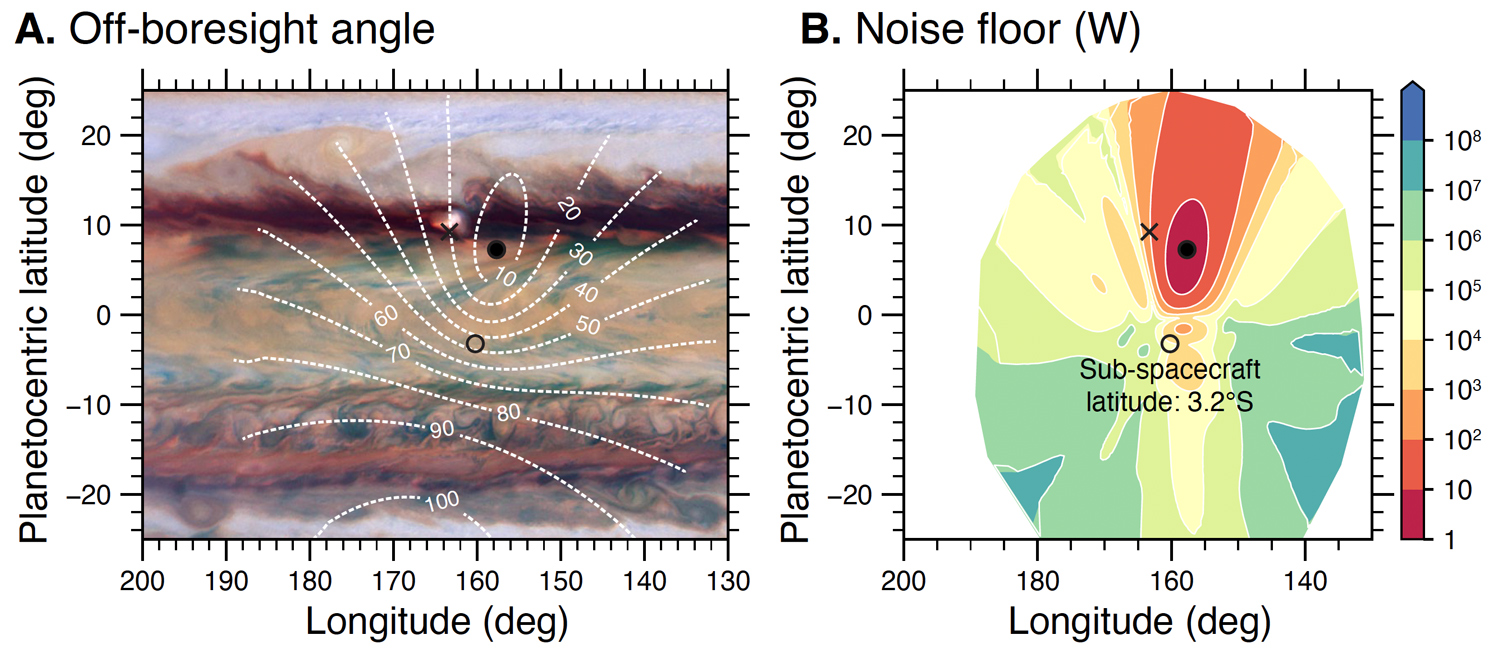
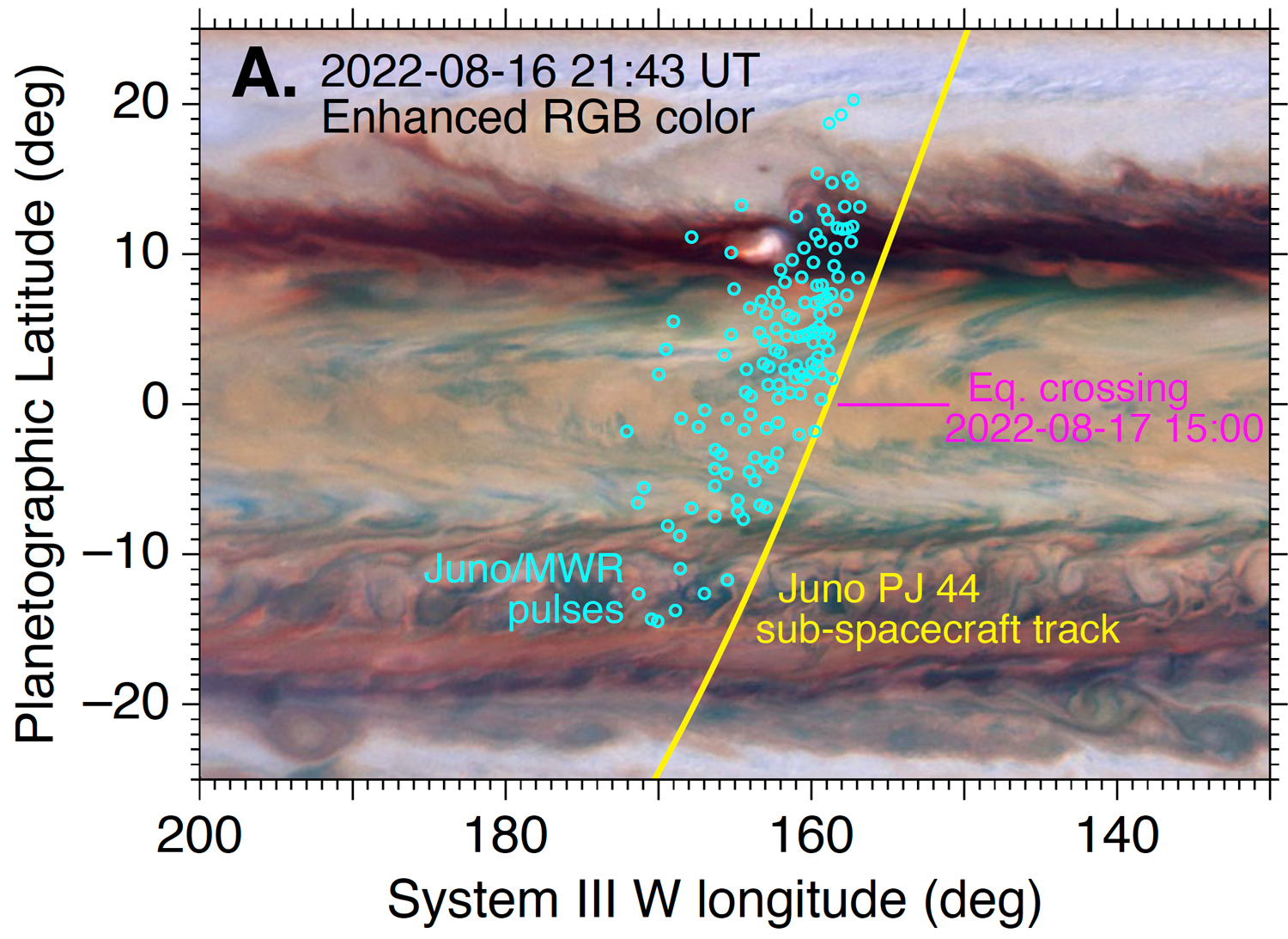
In 2021, convective activity in the North Equatorial Belt (NEB) ceased, according to visible imaging. Over a period of several months, convection gradually began to recover, in form of "stealth superstorms" that took place at a single active longitude (Rogers et al. 2022, Wong et al. 2023, Brueshaber et al. 2025). Between September 2021 and December 2022, Juno passed over this active longitude and detected stealth superstorm activity (including pulses with MWR) on four occasions (perijoves 38, 39, 44, and 47). Figure 2 shows an HST map of a storm on PJ 44, with the (shifted) Juno spacecraft track and MWR boresight pointings at the time of lightning pulse detections. But the MWR beam is 21 degrees full width at half maximum, and signal can be detected at larger angles (just with greater attenuation). So we hypothesize that the source of the lightning was the stealth superstorm at 9.5 degrees N planetocentric latitude rather than the boresight locations.

Figure 2


Juno/MWR beam/gain/sensitivity

We can use lightning signals with a known source to determine the source power of the signal, rather than only the detected power for unlocated sources. Figure 4(A) shows the MWR pointing for a single lightning detection, with contours indicating the off-boresight angle. The source power noise floor for this particular detection is shown in panel B, where the source noise floor is a function of both the off-boresight angle (and thus the antenna gain), plus the range from Jupiter's atmosphere to Juno. Using similar pointing information for all of the detections, we were able to measure the lightning source power distribution for stealth superstorms on perijoves 38, 39, 44, and 47.

Figure 4


Comparing Jupiter and Earth Lightning power

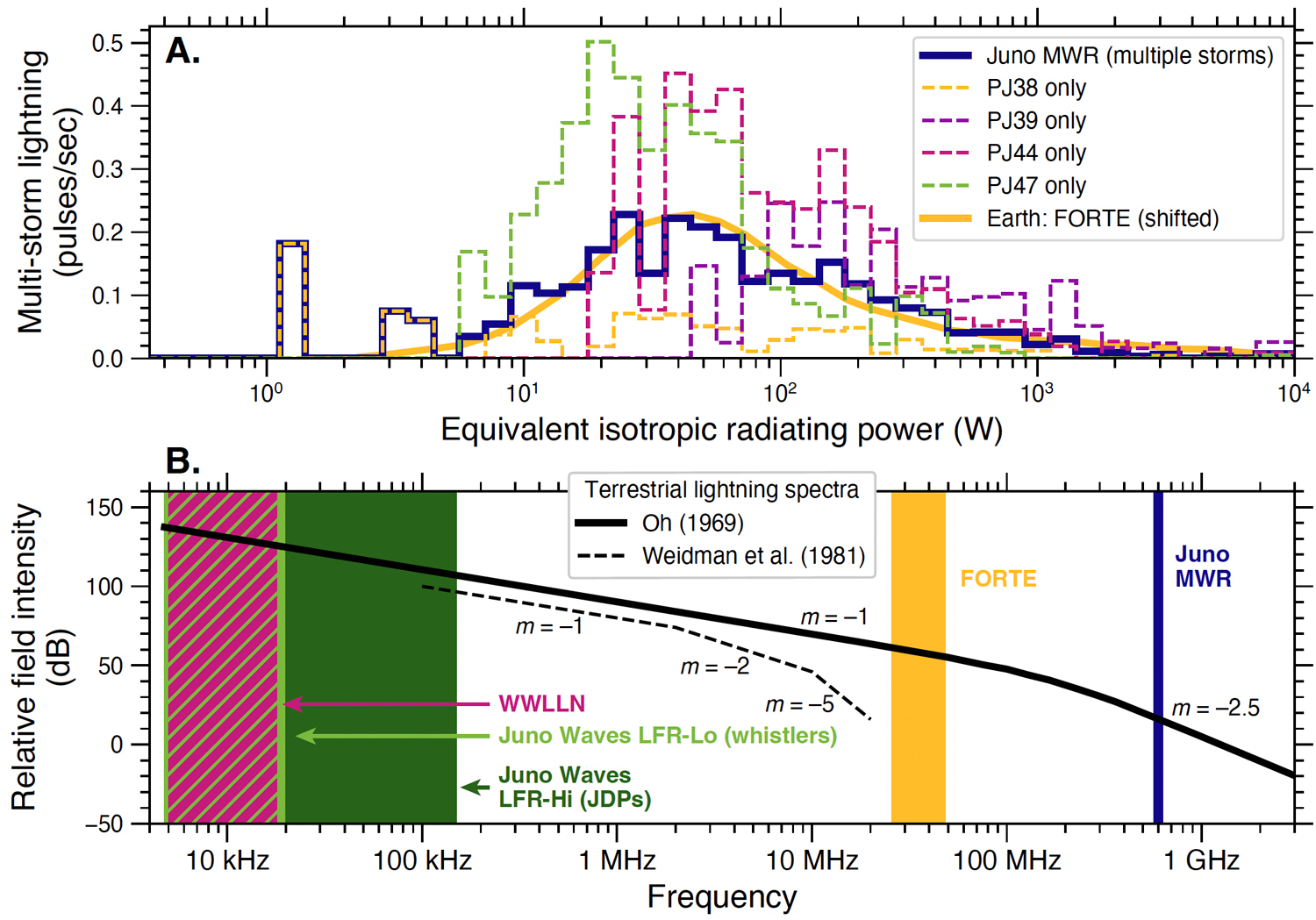
To analyze the distribution of pulse power levels, we combined data from the four perijoves into the combined distribution shown as a blue curve in Fig. 12(A). For comparison, a shifted terrestrial lightning distribution from the FORTE satellite (Jacobson 2003) is shown in gold. In both cases, the distribution has a clear peak and shows that the median and mode of the power distribution falls within the detection range of MWR and FORTE. For the MWR data, we argue that the peaked distribution (resembling a log-normal distribution) is evidence that MWR detects typical Jovian lightning signals, rather than Jovian superbolts that are at least 1000 times stronger than the mode of the distribution. This follows from the superbolt definition of Holzworth et al. (2019) for terrestrial WWLLN lightning data in the 5-18 kHz frequency range, where superbolts had energies greater than 1 MJ, compared to a mean of about 1 kJ.

Figure 12


Comparing absolute source power between terrestrial and Jovian radio signals is challenging, partly because the relevant measurements are in very different bandpasses (Fig. 12(B)). Various power-law spectral energy distributions can be used to relate signals in terrestrial data at different frequencies, as shown for Oh (1969) and Weidman et al. (1981). If we use these spectra to extrapolate lightning modal power from WWLLN and FORTE to the 600-MHz frequency of MWR, we find that Jovian lightning is likely to be in the range of 1 to 100 times more powerful than terrestrial lightning.


Conclusions: key points

  • Clustering breaks the power/location degeneracy to reveal the source power distribution of lightning signals
  • Juno MWR measured an event rate of about 3 integrated pulses/sec at 600 MHz in four isolated storms
  • The lightning power distribution peaks inside the MWR sensitivity range, favoring typical lightning activity (not superbolt outliers)


References

  • Becker et al. 2020 - DOI: 10.1038/s41586-020-2532-1
  • Brown et al. 2018 - DOI: 10.1038/s41586-018-0156-5
  • Brueshaber et al. 2025 - DOI: 10.1016/j.icarus.2025.116465
  • Giles et al. 2020 - DOI: 10.1029/2020JE006659
  • Holzworth et al. 2019 - DOI: 10.1029/2019JD030975
  • Imai et al. 2020 - DOI: 10.1029/2020GL088397
  • Jacobson 2003 - DOI: 10.1029/2003JD003936
  • Janssen et al. 2017 - DOI: 10.1007/s11214-017-0349-5
  • Kolmasova et al. 2018 - DOI: 10.1038/s41550-018-0442-z
  • Kolmasova et al. 2023 - DOI: 10.1038/s41467-023-38351-6
  • Oh 1969 - DOI: 10.1109/TEMC.1969.303024
  • Rogers et al. 2022 - DOI: 10.5194/epsc2022-17
  • Weidman et al. 1981 - DOI: 10.1029/GL008i008p00931
  • Wong et al. 2023 - DOI: 10.3390/rs15030702

How to cite: Wong, M. H., Oyafuso, F. A., Imai, M., Kolmašová, I., Mizumoto, S., Levin, S. M., Sankar, R., Simon, A. A., Brueshaber, S., Orton, G. S., Atreya, S. K., Li, C., and Bolton, S. J.: Radio pulse power distribution of lightning in Jupiter's 2021-2022 stealth superstorms, EPSC-DPS Joint Meeting 2025, Helsinki, Finland, 7–13 Sep 2025, EPSC-DPS2025-1054, https://doi.org/10.5194/epsc-dps2025-1054, 2025.

11:15–11:30
|
EPSC-DPS2025-625
|
ECP
|
On-site presentation
Nimrod Gavriel and Yohai Kaspi

The poles of Jupiter are hidden from the view of Earth-orbiting and solar-plane satellites. In 2016, the arrival of the Juno spacecraft into a pole-to-pole orbit around Jupiter provided the first direct images of the Jovian poles, revealing a unique meteorological phenomenon. Each pole features a symmetrical arrangement of cyclones, with radii of ~5,000 km and wind speeds reaching 100 m/s. These formations comprise one polar cyclone at each pole and a surrounding ring of circumpolar cyclones, with eight cyclones in the north and five in the south. Today, more than 7 years after Juno's arrival, these two polar vortex-"crystals" have proven stable, maintaining their numbers and, on average, their latitudes and relative positions. 

The balance holding the cyclones in place is explained in the first part of this research. This balance is between a natural tendency of cyclones to propagate poleward, known as "β-drift," and a similar effect that stems from an interaction between multiple cyclones, causing a rejection between them. Evaluating these components using the observed properties of the cyclones exposes a band of equilibrium at latitude ~84°, matching their observed latitude, and accounts for the different number of cyclones between the north and south poles occupying that band. In addition, we demonstrate that this equilibrium cannot form on Saturn, which, although dynamically similar to Jupiter, only has a single polar cyclone at each pole. 

Analyzing the location of the cyclones throughout the Juno mission, 2 motion patterns become apparent. These patterns are presented and explained mechanistically in the second part of this research. The first is a coherent oscillatory motion of the cyclones around their mean positions, with an amplitude of ~400 km and periods of ~12 months. We find that perturbations from the balance responsible for the cyclones' mean positions can account for their radial accelerations leading to these circular motion patterns, as illustrated in the observations and in a toy model. The second motion pattern is a general westward drift of all cyclones, with southern cyclones drifting on average 7° per year and northern cyclones 3°. By analyzing the group of cyclones from a center-of-mass perspective and thus eliminating the mutual interactions between them, we find that their center of mass only feels the β-drift, which is expected to lead to a westward motion. This analysis, supported by measurements and modeling, accounts for the different drift rates between the poles.

Lastly, we explore the vertical structure of these polar cyclones. By analyzing the westward drift in a single-layer Shallow-Water model, we constrain the deformation radius of the cyclones to fit the observations, where we find that deeper cyclones result in a stronger β-drift. We use this estimation of the deformation radius to explore the vertical modes of Jupiter’s polar upper atmosphere by solving the eigenfunction problem between the 2D and 3D quasi-geostrophic models. This analysis explores and predicts the vertical structure of the polar cyclones and lays a framework for interpreting the forthcoming Microwave Radiometer (MWR) measurements expected for the north pole of Jupiter.

This work provides a unified perspective on the dynamics of Jupiter’s polar cyclones, revealing the physical principles that govern their stability, motion, and vertical structure. By linking observed cloud-level motions to deeper atmospheric dynamics, our findings offer a foundation for interpreting future MWR data from Juno. This research enhances our broader understanding of cyclonic behavior in giant planet atmospheres and sets the stage for further explorations of similar phenomena on other planetary bodies.

How to cite: Gavriel, N. and Kaspi, Y.: The Dynamics of Jupiter’s Polar Cyclones, EPSC-DPS Joint Meeting 2025, Helsinki, Finland, 7–13 Sep 2025, EPSC-DPS2025-625, https://doi.org/10.5194/epsc-dps2025-625, 2025.

11:30–11:42
|
EPSC-DPS2025-361
|
On-site presentation
Agustin Sanchez-Lavega, José Félix Rojas, Peio Iñurrigarro, Alberto Mendi-Martos, Jon Legarreta, Ricardo Hueso, Amy Simon, Michael Wong, and Liming Li

Jupiter’s zonal wind system has its most intense jet centred at latitude 23.5° N where peak velocities reach 140 to 180 ms-1. One of the most spectacular planetary-scale disturbances takes place on it, changing a bright whitish band of clouds into a dark belt, known as the North Temperate Belt (NTB), with the convective outbreaks and their effects in the belt being named the NTB Disturbance (NTBD). The disturbance begins with the rapid eruption of typically 1 to 3 “plumes”, bright clouds of convective origin that, after a rapid initial expansion, generate a turbulent wake formed by a turmoil of eddies and filaments that encircles the planet. We have studied the reported cases starting in 1970 and ending with the last two most recent NTBD eruptions in August-September 2020 and January-February 2025. Our analysis shows the existence of a cycle between plume outbreaks with a mean period of 4.64 years (range 3.84 to 4.87 years) for the 10 outbreaks observed between years 1970 and 2025. Interestingly, there was a large period of ~17 years (from the end of 1990 to early 2007) without eruptions (we call the “NTBD desert”). During this period, the NTB was a dark belt, populated with large and long-lived anticyclones. Other key properties of the plumes, such as their zonal velocity, initial meridional migration and zonal acceleration, and their spatial distribution and cadence, are also analyzed using ground-based and Hubble Space Telescope observations.

How to cite: Sanchez-Lavega, A., Rojas, J. F., Iñurrigarro, P., Mendi-Martos, A., Legarreta, J., Hueso, R., Simon, A., Wong, M., and Li, L.: The cycles and dynamical properties of convective outbreaks in Jupiter’s highest speed jet from a 55-year study , EPSC-DPS Joint Meeting 2025, Helsinki, Finland, 7–13 Sep 2025, EPSC-DPS2025-361, https://doi.org/10.5194/epsc-dps2025-361, 2025.

11:42–11:54
|
EPSC-DPS2025-782
|
ECP
|
On-site presentation
Mikel Sanchez Arregui, Arrate Antuñano, Ricardo Hueso, and Agustín Sanchez Lavega

Regardless of the differences among Earth, Jupiter and Saturn, several resembling phenomena occur in the atmospheres of these planets. One of the most striking is the oscillation in temperature and winds that occurs in their equatorial stratospheres on multi-year time-scales [1-3]. Decades of observations of Jupiter in the thermal IR, have shown that Jupiter’s Equatorial Stratosphere present an oscillation in temperatures between the North and South Equatorial Belts at pressure levels of 0.1-40 mbar. The vertical extension of this Jupiter Equatorial Stratospheric Oscillation (JESO) is not well determined, since retrieving temperatures above or below those levels becomes more difficult. Existing observations also suggest that the stratospheric oscillation might be affected by large convective outbreaks developing in the troposphere outside the equator and disrupting its stability [4]. The JESO is unrelated to seasons, with a variable period of 3.9-5.7 years, and numerical simulations indicate that gravity waves propagating from the troposphere are a key element of the stratospheric oscillations [5-6]. The oscillation in Saturn’s equatorial atmosphere, however, is likely related to seasonal effects with 15-year period [7].


The Cassini mission obtained observations of Saturn that showed the presence of a narrow equatorial jet located at the stratospheric hazes [8]. Recent observations of Jupiter, made by the James Webb Space Telescope (JWST), discovered an intense narrow equatorial jet located at the lower stratosphere (50-200 mbar) that has been suggested to be a deep counterpart of the JESO phenomena [9]. Additionally, recent studies in thermal infrared observations suggested that JESO might extend down to 300 mbar [10-11], thus linking the troposphere and stratosphere activity. This occurs precisely at the equator, a region where Coriolis forces vanish, complicating the usual relation between temperatures and winds that governs most dynamical aspects of the atmosphere in rapidly rotating planets.


Here we use observations taken by the Hubble Space Telescope (HST) between 2015 and 2024 at the strong methane absorption band at 890nm (FQ889N) to analyse potential temporal variations of the zonal winds and reflectivity at the equatorial latitudes. These images probe the elevated hazes at the upper troposphere (200-300 mbar), just below the narrow-elevated jet observed by JWST [9]. We present an analysis of the zonal winds over time, comparing these new winds in the methane band with previous results from Cassini [12] and JWST [9]. We investigate the potential variability of the equatorial jets in the upper troposphere and its possible relation to the lowest levels of the JESO. We also characterize the evolution of the equatorial hazes’ brightness over the same time period, which enables us to search for common trends and periodic activity. The results of this multi-year study will be presented with the goal to better understand the troposphere-stratosphere connection.


References: [1] Baldwin, et al., Reviews of Geophysics , 39, 179-229 (2001). [2] Leovy, C., et al. Nature 354, 380–382 (1991). [3] Fouchet, et al. Nature, 452, 200-202 (2008). [4] Antuñano, A, et al. Nat Astron 5, 71–77 (2021). [5] Cosentino, R. G., et al. (2017). Journal of Geophysical Research: Planets, 122, 2719–2744. [6] Cosentino, et al. The Planetary Science Journal. 1. 63 (2020). [7] Guerlet et al., Geophys. Res. Lett. 38, L09201 (2011). [8] García-Melendo et al.,
Geophys. Res. Lett., 37, L22204 (2010). [9] Hueso, R., et al. Nat Astron 7, 1454–1462 (2023). [10] Orton, G. S et al., Nature Astronomy, 7 , 190-197 (2023). [11] Antuñano, A., et al., Journal of Geophysical Research: Planets, 128 (12) (2023). [12] Porco, C.C., et al., 2003: Science, 299, 1541-1547, doi:10.1126/science.1079462.

How to cite: Sanchez Arregui, M., Antuñano, A., Hueso, R., and Sanchez Lavega, A.: A long-term study of Jupiter's equatorial atmosphere at the upper troposphere-lower stratosphere, EPSC-DPS Joint Meeting 2025, Helsinki, Finland, 7–13 Sep 2025, EPSC-DPS2025-782, https://doi.org/10.5194/epsc-dps2025-782, 2025.

11:54–12:06
|
EPSC-DPS2025-573
|
On-site presentation
Maria Smirnova, Eli Galanti, Andrea Caruso, Leigh N. Fletcher, Dustin R. Buccino, Luis Gomez Casajus, William B. Hubbard, Glenn S. Orton, Marzia Parisi, Ryan S. Park, Marco Zannoni, Paul G. Steffes, Steven M. Levin, Scott J. Bolton, Paolo Tortora, and Yohai Kaspi

The shallow layers of Jupiter’s atmosphere, the only region accessible to in-situ measurements, offer critical insights into the planet’s deeper structure. Radio occultation experiments are a powerful tool for investigating these layers, revealing detailed information about their thermal structure and composition. Beginning in July 2023, Juno’s extended mission carried out a series of radio occultations - the first since the Voyager era - to probe the neutral atmosphere of Jupiter down to approximately ±0.5 bar. By analyzing the refraction of radio signals as they pass through the atmosphere and comparing the results with ground-based observations, these experiments generate precise vertical profiles of key atmospheric parameters, particularly in the stratosphere
and upper troposphere.

Juno uses a coherent two-way radio link with multiple frequencies, requiring the application of ray-tracing techniques to model the propagation of uplink and downlink signals through the atmosphere. This approach enables the retrieval of pressure-temperature profiles, offering new insights into the thermal and dynamical structure of Jupiter’s atmosphere. Comparisons with contemporary ground-based measurements, as well as historical mid-infrared data from Voyager’s IRIS and Cassini’s CIRS instruments, highlight the value of these profiles in understanding atmospheric variability and circulation across different latitudes.

Since August 2024, Juno’s radio occultations have focused on Jupiter’s northern polar stratospheric vortex, a region (above ~65°N) known for its particularly low temperatures and distinct dynamical behavior. While the cold polar vortex has been detected in mid-infrared ground-based observations from VISIR and TEXES, Juno’s radio occultations offer the first opportunity to directly probe its thermal structure in detail. In this presentation, we share results from the first two years of Juno’s radio occultation campaign, highlighting pressuretemperature profiles across multiple latitudes and longitudes. These profiles help characterize the vertical extent, temperature gradients, and broader dynamical context of the polar vortex. In addition, we show how these thermal profiles can be used to quantify the jet velocity of the stratospheric vortex, providing new constraints on its intensity and latitudinal structure within Jupiter’s polar circulation.

How to cite: Smirnova, M., Galanti, E., Caruso, A., Fletcher, L. N., Buccino, D. R., Gomez Casajus, L., Hubbard, W. B., Orton, G. S., Parisi, M., Park, R. S., Zannoni, M., Steffes, P. G., Levin, S. M., Bolton, S. J., Tortora, P., and Kaspi, Y.: Analysis of Jupiter's Atmosphere Using Juno's Radio Occultations, EPSC-DPS Joint Meeting 2025, Helsinki, Finland, 7–13 Sep 2025, EPSC-DPS2025-573, https://doi.org/10.5194/epsc-dps2025-573, 2025.

12:06–12:18
|
EPSC-DPS2025-560
|
ECP
|
On-site presentation
José Ribeiro, Pedro Machado, Santiago Pérez-Hoyos, Asier Anguiano-Arteaga, and Patrick Irwin

The nature of the red colouration of Jupiter’s belts and some of its major anticyclones is still debated to this day. Sromovsky et al. (2017) proposed the existence of an “universal chromophore” by fitting Cassini/VIMS-V observations. Baines et al. (2019) concluded that this chromophore should be located in a thin layer above the ammonia clouds, giving rise to the so called “Crème Brûlée” model. Both of these works had as a basis the red compound that formed through the reaction of photolyzed ammonia with acetylene as obtained in the laboratory by Carlson et al. (2016).

However,  both Pérez-Hoyos et al. (2020) and Braude et al. (2020) found that a less blue and more vertically extended chromophore layer would fit better their HST/ WFC3 North Temperate Belt disturbance observations for the former and latitudinal swath from MUSE/VLT observations for the later, without fully discarding the possible existence of an “universal chromophore”. Recently, analysis of HST/WFC3 images of Jupiter’s Great Red Spot, its surroundings, and, Oval BA by Anguiano-Arteaga et al. (2021,2023) suggest the presence of two distinct colouring aerosols. The first being similar to the “universal chromophore” and the second one being a new UV-absorbing species below the main chromophore layer at tropospheric levels. This highlights the uncertainties on the vertical distribution of aerosols, their properties and their variability.

To address this uncertainty, we used new Jupiter spectra obtained with CARMENES (The Calar Alto High-Resolution search for M dwarfs with Exoearths with Near-infrared and optical Échelle Spectrographs) in 2019. This instrument consists of two separated spectrographs with spectral resolutions R = 80,000-100,000, covering the wavelength ranges of 0.52 to 0.96 μm and of 0.96 to 1.71 μm. The original purpose of these observations was to measure winds through the Doppler velocimetry method. We used a downgraded resolution version (R = 173-570) so the observations match the available spectral data for methane, as this resolution is enough for constraining aerosol properties. Due to the original nature of the observations, no calibration star was recorded. In order to achieve flux calibration, we used  2017 observations of Saturn with CARMENES. We employed Saturn’s B ring to obtain the response function of the instrument, since no other sources of calibration are available at the desired resolution or epoch.

We used the reflectivity (I/F) spectrum obtained with Cassini/VIMS (Cuzzi et al., 2009) at phase angles less than 3º. We applied the response function to the centre of disc spectrum of Saturn and compared the obtained reflectivity spectrum with results from Clark and McCord (1979) and Mendikoa, et al. (2017). Lastly, we applied the flux calibration to the Jupiter observations and compared them results from Mendikoa, et al., (2017) and Irwin et al. (2018) (Figure 1). All calibrations agree within 10% with MUSE calibration.

We were able to perform a Minnaert Limb-darkening approximation and produce 2 synthetic spectra (zenith angle = 0º/61.45º) for five distinct sample areas (EZ (Figure 2), SEB, NEB, transition region from EZ to SEB, and from NEB to NTrZ). We performed retrievals using the same a priori atmospheric parameterization as presented in Braude et al. (2020), Pérez-Hoyos et al. (2020) and Anguiano-Arteaga et al. (2021), comparing the retrieved results of each in order to constrain the uncertainties in the Jovian aerosol scheme. To achieve this, we used the NEMESIS (Nonlinear Optimal Estimator for MultivariatE Spectral analySIS) radiative transfer suite (Irwin et al., 2008). We present here the results of this analysis.

Figure 1: Comparison of centre of disk Jupiter spectrum after flux calibration with EZ spectrum from Irwin et al. (2018) and 0º latitude spectrum from Mendikoa et al. (2017).

Figure 2: Observation spectra compared to the obtained synthetic spectra after retrieving the atmospheric parameters for the EZ using Braude et al. (2020) model. Top row corresponds to nadir (incidence and emission angle = 0º) and bottom row to limb (incidence and emission angle = 61.45º). 

Figure 3: Comparison between the a priori aerosol vertical profiles and the retrieved profiles for every region for the model from Braude et al. (2020).


References:

  • Carlson, R. W., et al. (2016). Chromophores from photolyzed ammonia reacting with acetylene: Application to Jupiter's Great Red Spot. Icarus, 274, 106–115.
  • Sromovsky, L. A., et al. (2017). A possibly universal red chromophore for modeling color variations on Jupiter. Icarus, 291, 232–244.
  • Baines, K. H., et al. (2019). The visual spectrum of Jupiter's Great Red Spot accurately modelled with aerosols produced by photolyzed ammonia reacting with acetylene. Icarus, 330, 217–229.
  • Pérez-Hoyos, S., et al. (2020). Color and aerosol changes in Jupiter after a North temperate belt disturbance. Icarus, 132, 114021.
  • Braude, A. S., et al. (2020). Colour and tropospheric cloud structure of Jupiter from MUSE/VLT: Retrieving a universal chromophore. Icarus, 338, 113589.
  • Anguiano-Arteaga, A., et al. (2021). Vertical Distribution of Aerosols and Hazes Over Jupiter's Great Red Spot and Its Surroundings in 2016 From HST/WFC3 Imaging. Journal of Geophysical Research: Planets, 126, e2021JE006996.
  • Anguiano-Arteaga, A., et al. (2023). Temporal variations in vertical cloud structure of Jupiter's Great Red Spot, its surroundings and Oval BA from HST/WFC3 imaging. Journal of Geophysical Research: Planets, 128, e2022JE007427.
  • Karkoschka, E. (1994). Spectrophotometry of the Jovian Planets and Titan at 300- to 1000-nm Wavelength: The Methane Spectrum. Icarus, 111, 1, 174–192.
  • Irwin, P., et al. (2008). The NEMESIS planetary atmosphere radiative transfer and retrieval tool. J. Quant. Spectrosc. Radiat. Transf., 109, 1136–1150.
  • Rodgers CD. (2000). Inverse methods for atmospheric sounding: theory and practice. Singapore: World Scientific.
  • Cuzzi, J., et al., 2009. Ring Particle Composition and Size Distribution. Springer Netherlands, Dordrecht. pp. 459–509.
  • Clark, R.N., McCord, T.B., 1979. Jupiter and Saturn: Near-infrared spectral albedos. Icarus 40, 180–188.
  • Mendikoa, I., et al., 2017. Temporal and spatial variations of the absolute reflectivity of Jupiter and Saturn from 0.38 to 1.7 𝜇m with planetcam-upv/ehu. A&A 607, A72.
  • Irwin, P.G., et al., 2018. Analysis of gaseous ammonia (NH3) absorption in the visible spectrum of Jupiter. Icarus 302, 426–436

How to cite: Ribeiro, J., Machado, P., Pérez-Hoyos, S., Anguiano-Arteaga, A., and Irwin, P.: Jovian chromophore and upper hazes from CARMENES spectra, EPSC-DPS Joint Meeting 2025, Helsinki, Finland, 7–13 Sep 2025, EPSC-DPS2025-560, https://doi.org/10.5194/epsc-dps2025-560, 2025.

12:18–12:30
|
EPSC-DPS2025-565
|
ECP
|
On-site presentation
Asier Anguiano-Arteaga, Santiago Perez-Hoyos, and Agustin Sanchez-Lavega

The composition and formation mechanisms of the compounds responsible for the reddish colouration of Jupiter’s Great Red Spot (GRS) – the so-called chromophores – remain unknown. In recent years, the laboratory-produced chromophore proposed by Carlson et al. (2016) has been shown to satisfactorily reproduce the observed visible spectra not only of the GRS but also of various regions across Jupiter’s disk, with little to no modification (Sromovsky et al., 2017; Baines et al., 2019; Pérez-Hoyos et al., 2020; Braude et al., 2020; Dahl et al., 2021; Fry & Sromovsky, 2023). More recently, Anguiano-Arteaga et al. (2021, 2023) independently retrieved a dominant chromophore agent in the GRS (Figure 1) via radiative transfer modelling of long-term HST/WFC3 observations (225–900 nm), which showed reasonable spectral agreement with the Carlson candidate. The retrieved chromophore particle sizes and column densities were found to be broadly consistent with those reported in earlier GRS studies (e.g., Baines et al., 2019; Braude et al., 2020).

Here, we present results from microphysical modelling of the GRS upper atmosphere (pressures < 1 bar), applying constraints on chromophore mass and particle size derived by Anguiano-Arteaga et al. (2021, 2023). Our simulations, based on the model by Toon et al. (1988), explore the vertical evolution of particle size and distribution (see Figure 2) due to sedimentation, eddy diffusion, and coagulation - following a methodology similar to that of Toledo et al. (2019, 2020) for Uranus and Neptune. These results allow us to constrain the chromophore mass production rates required to maintain a stable, long-lived chromophore layer at the expected levels. This study provides new insights into the origin and persistence of the GRS red colouration.

Figure 1. Illustrative layout of the cloud and haze structure within the Great Red Spot, as retrieved by Anguiano-Arteaga et al. (2023)

Figure 2. Simulated evolution of particle size and vertical distribution in the upper atmosphere of the Great Red Spot, as calculated using the microphysical model described in Toon et al. (1988).

References:

  • Anguiano-Arteaga, A, Pérez-Hoyos, S., Sánchez-Lavega, A., Sanz-Requena, J.F. & Irwin, P.G.J. (2021). Vertical distribution of aerosols and hazes over Jupiter's Great Red Spot and its surroundings in 2016 from HST/WFC3 imaging. J. Geophys. Res. Planets, 126, e2021JE006996.

  • Anguiano-Arteaga, A., et al. (2023). Temporal variations in vertical cloud structure of Jupiter's Great Red Spot, its surroundings and Oval BA from HST/WFC3 imaging. J. Geophys. Res. Planets, 128, e2022JE007427.

  • Baines, K.H., Sromovsky, L.A., Carlson, R.W., Momary, T. W. & Fry, P.M. (2019). The visual spectrum of Jupiter’s Great Red Spot accurately modeled with aerosols produced by photolyzed ammonia reacting with acetylene. Icarus, 330, 217-229.

  • Braude, A.S., Irwin, P.G.J., Orton, G.S., & Fletcher, L.N. (2020). Colour and tropospheric cloud structure of Jupiter from MUSE/VLT: Retrieving a universal chromophore. Icarus, 338, 113589.

  • Carlson, R.W., Baines, K.H., Anderson, M.S., Filacchione, G., & Simon, A.A. (2016). Chromophores from photolyzed ammonia reacting with acetylene: Application to Jupiter’s Great Red Spot. Icarus, 274, 106-115.

  • Dahl, E. K., Chanover, N.J., Orton, G.S., Baines, K.H., … Irwin, P.G.J. (2021). Vertical Structure and Color of Jovian Latitudinal Cloud Bands during the Juno Era. Planet. Sci. J. 2, 16

  • Fry, P. M., Sromovsky, L.A. (2023). Investigating temporal changes in Jupiter’s aerosol structure with rotationally-averaged 2015–2020 HST WFC3 images. Icarus, 389, 115224.

  • Pérez-Hoyos, S., Sánchez-Lavega, A., Sanz-Requena, J.F., Barrado-Izagirre, N., Carrión-González, O., Anguiano-Arteaga, A., Irwin, P.G.J., & Braude A. S. (2020). Color and aerosol changes in Jupiter after a North Temperate Belt disturbance. Icarus, 132, 114021.

  • Sromovsky, L.A., Baines, K.H., Fry, P.M., & Carlson, R.W. (2017). A possibly universal red chromophore for modeling color variations on Jupiter. Icarus, 291, 232-244.

  • Toledo, D., Irwin, P. G. J., Rannou, P., Teanby, N. A., Simon, A. A., Wong, M. H., & Orton, G. S. (2019). Constraints on Uranus’s haze structure, formation and transport. Icarus, 333, 1–11.

  • Toledo, D., Irwin, P. G. J., Rannou, P., Fletcher, L. N., Teanby, N. A., Wong, M. H., & Orton, G. S. (2020). Constraints on Neptune’s haze structure and formation from VLT observations in the H-band. Icarus, 350, 113808.

  • Toon, O. B., Turco, R. P., Westphal, D., Malone, R., & Liu, M. S. (1988). A multidimensional model for aerosols - Description of computational analogs. Journal of Atmospheric Sciences, 45, 2123–2143.

How to cite: Anguiano-Arteaga, A., Perez-Hoyos, S., and Sanchez-Lavega, A.: Formation Constraints on Jupiter’s Great Red Spot chromophore from Microphysical Modelling, EPSC-DPS Joint Meeting 2025, Helsinki, Finland, 7–13 Sep 2025, EPSC-DPS2025-565, https://doi.org/10.5194/epsc-dps2025-565, 2025.

Orals FRI-OB4: Fri, 12 Sep, 14:00–16:00 | Room Uranus (Helsinki Hall)

Chairpersons: Sandrine Guerlet, Thibault Cavalié
14:00–14:12
|
EPSC-DPS2025-1019
|
On-site presentation
Peter L. Read, Arrate Antunano, Hadrien Bobas, Greg Colyer, Shanshan Ding, Teresa del Río Gaztelurrutia, Agustin Sanchez-Lavega, and Roland Young

Recent analyses of wind measurements obtained from tracking cloud motions in spacecraft images of Jupiter and Saturn[1,2] indicate that nonlinear scale-to-scale transfers of kinetic energy act from small to large scales over a wide range of length scales, much as anticipated for 2D or geostrophic turbulence paradigms. At the smallest resolvable scales, however, there is evidence in observations of a forward (downscale) transfer, at least at low and middle latitudes on Jupiter, much like in the Earth’s atmosphere. Moreover, the upscale transfers at the largest spatial scales are evidently dominated by spectrally non-local, highly anisotropic eddy-zonal interactions associated with the generation of intense zonal jets and equatorial super-rotation by direct eddy-zonal flow exchanges. Most analyses to date have emphasised the global mean interactions for both planets, thereby focusing on the spatially homogeneous and isotropic components of the turbulence. Here we present some new analyses of spectral energy transfers on both Jupiter and Saturn that resolve variations in latitude[cf 3], thereby shedding new light on non-homogeneous aspects of jovian turbulent interactions. The results indicate significant variability and inhomogeneity between different locations, with a clear distinction between the tropics, the extratropical middle latitudes and the polar regions. We discuss these in light of other observations and models of gas giant circulation and related laboratory experimental analogues.

[1] Antu˜nano, A., del Río-Gaztelurrutia, T., Sánchez-Lavega, A., & Hueso, R. (2015) Dynamics of Saturn’s polar regions. J. Geophys. Res.: Planets, 120 , 155–176. doi:10.1002/2014JE004709
[2] Read, P. L., Antu˜nano, A., Cabanes, S., Colyer, G., del Río-Gaztelurrutia, T., Sánchez-Lavega, A. (2022). Energy exchanges in Saturn’s polar regions from
Cassini observations: Eddy-zonal flow interactions. J. Geophys. Res., 127 , e2021JE006973. https://doi.org/10.1029/2021JE006973
[3] Chemke, R., & Kaspi, Y. (2015). The latitudinal dependence of atmospheric jet scales and macroturbulent energy cascades. J. Atmos. Sci., 72 , 3891–3907. doi: 10.1175/JAS-D-15-0007.1

How to cite: Read, P. L., Antunano, A., Bobas, H., Colyer, G., Ding, S., del Río Gaztelurrutia, T., Sanchez-Lavega, A., and Young, R.: Characterising turbulent cascades and zonal jet formation processes from observations of cloud level winds on Jupiter and Saturn, EPSC-DPS Joint Meeting 2025, Helsinki, Finland, 7–13 Sep 2025, EPSC-DPS2025-1019, https://doi.org/10.5194/epsc-dps2025-1019, 2025.

14:12–14:24
|
EPSC-DPS2025-1106
|
Virtual presentation
Ramanakumar Sankar, Michael Wong, and Csaba Palotai

Moist convection plays a key role in Jupiter’s energy and mass transport [1, 2], yet its distribution and nature remain poorly understood due to conflicting observations from various space- and ground-based instruments. Juno MWR data reveal equatorial enrichment of water and ammonia [3, 4], suggesting strong upwelling, while lightning observations show minimal activity near the equator and increased activity toward the poles [5]. These discrepancies have led to competing theories involving the presence of strong deep wind shear [6], circulation cells [7, 8], and mixed-phase cloud formation [9]. Disentangling these requires detailed knowledge of Jupiter’s deep atmospheric structure (such as the deep wind and thermal structure and the spatial distribution of condensing species), which is challenging to obtain via remote sensing alone.

In this work, we aim to address these degenerate results by simulating the jovian atmosphere using the Explicit Planetary hybrid-Isentropic Coordinate (EPIC, [10]) model. We use the new convective parameterization alongside the existing cloud microphysics scheme [11, 12] to model the convection across the planet. We vary the deep atmospheric wind shear and the water abundance to test how these parameters affect the nature and strength of convection in our model. Using these models, we investigate and compare the spatial distribution of convection in our models with those observed by both the Juno MWR and lightning data. 

Our results (Figure 1) show that the locations of strong convection are driven by the presence of a “moisture front” [13], whereby the advection of moisture-rich air into a drier region results in an increase in convective potential, which leads to convection. This has been observed along meso-scale (or larger) convective storms [14] and is consistent with observations of strong convection tied to locations to steep volatile gradients. Increasing the deep wind shear increases the eddy mixing across the gradient through the generation of baroclinic instabilities.

Figure 1: Integrated water cloud density (left) and water vapor mixing ratio at 4 bars (right) along with the associated wind field at 4 bar and the water vapor convergence in red, at day 110 into the model. Note how both the turbulence and the meridional volatile gradient increases with wind shear (parameterized by m in our model), increasing the strength of convection in the atmosphere. Increased convection results in thicker and denser clouds in the zone (northern half of the region).

Here, we will present our results from varying the deep wind shear and the water abundance. We will derive constraints on the degenerate properties by comparing our modeled atmosphere to the observed data, and present possible theories to reconcile the contrasting observed nature of convection.

References

[1] Gierasch, P. J. et al. Nature, 403, 628-630. 2000

[2] Showman, A. P. Journal of the Atmospheric Sciences, 64, 3132. 2007

[3] Li, C. et al. Nature Astronomy, 4, 609-616. 2020

[4] Moeckel, C. et al. Planetary Science Journal, 4, 25. 2023

[5] Brown, S. et al. Nature, 558, 87-90. 2018

[6] Fletcher, L. N. et al. Journal of Geophysical Research (Planets), 126,e06858. 2021

[7] Duer, K. et al. Geophysics Research Letters, 48, e95651. 2021

[8] Fletcher, L. N. et al. Space Science Reviews, 216, 30. 2020

[9] Guillot, T. et al. Journal of Geophysical Research (Planets), 125, e06403. 2020

[10] Dowling, T. E. et al. Icarus, 182, 259-273. 2006

[11] Palotai, C. et al. Icarus, 194, 303-326. 2008

[12] Sankar, R. et al. Icarus, 380, 114973. 2022

[13] Sankar, R. et al. Planetary Science Journal, in press. 2025

[14] Brueshaber, S. R. et al. Icarus, 432, 116465. 2025

How to cite: Sankar, R., Wong, M., and Palotai, C.: Dynamical sources of jovian moist convection, EPSC-DPS Joint Meeting 2025, Helsinki, Finland, 7–13 Sep 2025, EPSC-DPS2025-1106, https://doi.org/10.5194/epsc-dps2025-1106, 2025.

14:24–14:36
|
EPSC-DPS2025-1907
|
On-site presentation
Ali Hyder, Glenn Orton, Cheng Li, Nancy Chanover, and Gordon Bjoraker

The Jovian deep water abundance is an important quantity in planetary formation theories that serves as a proxy for Jupiter’s evolution during the early Solar System. The in-situ measurement of this quantity made by the Galileo probe showed that Jupiter’s atmosphere was significantly depleted in oxygen than previously expected (Seiff et al., 1996). However, it is believed that the measurement was made in a Jovian “hot spot” (Orton et al., 1998), which is a region where there is a lack of water clouds (Wong et al., 2004). As a result, the Galileo probe’s measurement of ~0.3x Solar oxygen enrichment has remained contested. Subsequent estimates of the water content made using the Microwave Radiometer (MWR) instrument on-board the Juno spacecraft, particularly in the equatorial region of the planet showed that the planet is enriched in oxygen (Li et al., 2024)., in contrast to the subsolar enrichment obtained by its predecessor spacecraft.

Measurements of disequilibrium chemical species, such as carbon monoxide (CO), phosphine (PH3), and germane (GeH4) have been tied to Jupiter’s deep water abundance as they serve as tracers for the compositional make-up of the deeper troposphere (e.g., Wang et al., 2015, 2016). Conventionally, 1D chemical-diffusion models have been employed to simulate the behavior of these trace chemical species in hydrogen-rich atmospheres to constrain the deep water abundance using tropospheric measurements. However, such models are limited in their treatment of the atmosphere as all dynamical behavior is assumed to be constrained via the eddy mixing coefficient, Kzz (Zhang & Showman, 2018).

Here, we present the results of our hydrodynamical cloud-resolving model with simplified thermochemistry to showcase the effects of hydrodynamical and microphysical processes on the abundances of these disequilibrium trace species (Hyder et al., 2025). Using updated chemical timescales, we demonstrate that a deep water abundance of ~2.5x Solar is needed to match the CO observations made near the lifting condensation level. We also find that PH3 and GeH4 can be used to place upper bounds on the water content, limiting it to a range of 2.5-5.0x Solar. Our results show that this coupled approach can explain the observations made by the Juno MWR instrument near the equatorial region, supporting the case for a supersolar abundance oxygen in the Jovian troposphere.


References:

  • Seiff, A., “Structure of the Atmosphere of Jupiter: Galileo Probe Measurements”, Science, vol. 272, no. 5263, pp. 844–845, 1996.
  • Orton, G. S., et al. “Characteristics of the Galileo probe entry site from Earth-based remote sensing observations”, Journal of Geophysical Research, vol. 103, no. E10, pp. 22791–22814, 1998.
  • Wong, M. H., Mahaffy, P. R., Atreya, S. K., Niemann, H. B., and Owen, T. C., “Updated Galileo probe mass spectrometer measurements of carbon, oxygen, nitrogen, and sulfur on Jupiter”, Icarus, vol. 171, no. 1, pp. 153–170, 2004.
  • Li, C., “Super-adiabatic temperature gradient at Jupiter's equatorial zone and implications for the water abundance”, Icarus, vol. 414, Art. no. 116028, 2024.
  • Wang, D., Gierasch, P. J., Lunine, J. I., and Mousis, O., “New insights on Jupiter's deep water abundance from disequilibrium species”, Icarus, vol. 250, pp. 154–164, 2015.
  • Wang, D., Lunine, J. I., and Mousis, O., “Modeling the disequilibrium species for Jupiter and Saturn: Implications for Juno and Saturn entry probe”, Icarus, vol. 276, pp. 21–38, 2016.
  • Zhang, X. and Showman, A. P., “Global-mean Vertical Tracer Mixing in Planetary Atmospheres. I. Theory and Fast-rotating Planets”, The Astrophysical Journal, vol. 866, no. 1, Art. no. 1, IOP, 2018.
  • Hyder, A., Li, C., Chanover, N., and Bjoraker, G., “A supersolar oxygen abundance supported by hydrodynamic modelling of Jupiter's atmosphere”, Nature Astronomy, vol. 9, pp. 211–220, 2025.

How to cite: Hyder, A., Orton, G., Li, C., Chanover, N., and Bjoraker, G.: Hydrodynamical and Chemical Modeling of Jupiter's Atmosphere – Updates on the Deep Water Abundance, EPSC-DPS Joint Meeting 2025, Helsinki, Finland, 7–13 Sep 2025, EPSC-DPS2025-1907, https://doi.org/10.5194/epsc-dps2025-1907, 2025.

14:36–14:48
|
EPSC-DPS2025-699
|
ECP
|
On-site presentation
Keren Duer-Milner, Louis Siebenaler, and Yamila Miguel

Recent measurements from the Juno spacecraft have revived interest in the possible existence of a radiative zone within Jupiter's atmosphere. If such a layer exists, it would create a stably stratified region, estimated to extend up to 2000 km, challenging the traditional view of a predominantly convective envelope associated with the planet’s zonal jet streams, which penetrate approximately 3000 km. In this study, we explore the potential effects of this radiative zone on Jupiter’s jet stream properties and gravity field. Combining gravity measurement constraints with numerical simulations of a shallow atmospheric model representative of Jupiter, we investigate the dynamical implications of a radiative layer. Our analysis evaluates how the presence of this zone could alter atmospheric dynamics, offering new insights into the planet’s internal structure and questioning the hypothesis of a fully convective dynamical layer. Additionally, through gravity data analysis, we assess whether the existence of such a radiative zone is feasible within Jovian conditions. These findings highlight the importance of considering layered atmospheric models in planetary data interpretation. Moreover, the presence of a radiative zone could be a common feature in other planetary systems and exoplanets, underscoring the need for further research into planetary atmospheres and interiors and their broader implications for planetary science.

How to cite: Duer-Milner, K., Siebenaler, L., and Miguel, Y.: Implications of a Radiative Zone on Jupiter’s Gravity Field and Atmospheric Dynamics, EPSC-DPS Joint Meeting 2025, Helsinki, Finland, 7–13 Sep 2025, EPSC-DPS2025-699, https://doi.org/10.5194/epsc-dps2025-699, 2025.

14:48–15:00
|
EPSC-DPS2025-512
|
ECP
|
On-site presentation
Deborah Bardet, Thierry Fouchet, Thibault Cavalié, Raphaël Moreno, Emmanuel Lellouch, Bilal Benmahi, and Sandrine Guerlet

In giant planet atmospheres, carbon monoxide (CO) can originate either from internal sources, such as thermochemical processes, or from external sources, such as meteorite impacts.

Preliminary retrieval results of the latitudinal variation of CO abundance in Saturn's stratosphere (at 0.001 bar) observed with ALMA. Here, the apriori CO profile was constant for a volume mixing ratio of 10-8.

A dual origin of CO has already been inferred on Jupiter through infrared spectroscopy [1], and on Neptune via submillimeter spectroscopy [2,3]. For both planets, these studies concluded that stratospheric CO primarily originated from external sources, namely large cometary impacts—the most recent being the collision of comet Shoemaker-Levy 9 (SL9) with Jupiter in 1994 [4–8], along with an internal source. In contrast, the origin of CO in Saturn's atmosphere remains uncertain. Observations of the vertical distribution of CO in Saturn’s atmosphere are consistent with a cometary source approximately 220 years ago [9–11], although an internal origin cannot be ruled out, particularly given the potential influence of H₂O photochemistry on the vertical CO profile. The specific contribution of material infalling from the rings, both in the equatorial and mid-latitude regions remain also to be estimated.

Observed on May 25, 2018 using ALMA (project 2017.1.00636.S), maps of HCN (5-4) and CO (3-2) lines have been obtained with a combination of seven pointings of the main array in configuration C43.2, complemented by three pointings of the ACA to mosaic the full disk of the planet. Together with the HCN line, the CO line observed by ALMA is detected at the limb of the planet only, from the equator up to the south and north polar regions, with a latitudinal resolution about 2°, and both were initially used to provide the first absolute wind measurements in Saturn's stratosphere [12]. These analyses have revealed variations in the width of the CO line across the entire limb, suggesting that information on the vertical distribution of Saturn’s CO is accessible—potentially shedding light on its external or internal origin. Here, we will present the retrieved CO stratospheric abundances from 25°S to the northern polar regions resulting from different initial condition setups (preliminary results with an apriori CO profile as constant for a volume mixing ratio of 10-8 are shown in the figure, and at the observation date, Saturn southern hemisphere was masked by its rings). We test the sensibility of the retrieved abundances to the CO prior and temperature profiles. We will also discuss the retrieved abundances in the context of the ring material infalling from the rings detected in situ by Cassini [13,14], and compare our results with photochemical model calculations taking into account ring material influx in Saturn’s neutral and ionized atmosphere [15].


[1] Bézard et al. (2022, Icarus 159, 95–111)

[2] Lellouch et al. (2005, A&A 430, L37–L40)

[3] Hesman et al. (2007, Icarus 186, 342–353)

[4] Lellouch et al. (1995, Nature 373, 592–595)

[5] Lellouch et al. (1997, Planet. Space Sci. 45, 1203–1212)

[6] Moreno et al. (2003, Planet. Space Sci. doi:10.1016/S0032-0633(03)00072-2)

[7] Griffith et al. (2004, Icarus)

[8] Lellouch et al. (2006, Icarus doi:10.1016/j.icarus.2006.05.018.

[9] Cavalié et al. (2009, Icarus 203, 531–540)

[10] Cavalié et al. (2008, A&A 484, 555–561)

[11] Cavalié et al. (2010, A&A 510, A88)

[12] Benmahi et al. (2022, A&A 666, A117)

[13] Moore et al. (2018, Geophysical Research Letters, Volume 45, Issue 18, pp. 9398-9407)

[14] Waite et al. (2018, Science, Volume 362, Issue 6410, id.aat2382)

[15] Moses et al. (2023, Icarus, Volume 391, article id. 115328)

How to cite: Bardet, D., Fouchet, T., Cavalié, T., Moreno, R., Lellouch, E., Benmahi, B., and Guerlet, S.: Saturn’s stratospheric carbon monoxide abundance observed with ALMA, EPSC-DPS Joint Meeting 2025, Helsinki, Finland, 7–13 Sep 2025, EPSC-DPS2025-512, https://doi.org/10.5194/epsc-dps2025-512, 2025.

15:00–15:12
|
EPSC-DPS2025-248
|
ECP
|
On-site presentation
Camille Lefour, Thibault Cavalié, Raphael Moreno, Emmanuel Lellouch, Thierry Fouchet, and Paul Hartogh

The composition and isotopic ratios in different bodies of the solar system are important tracers of their formation and of the primordial composition and physical/chemical conditions of the protoplanetary disk. Numerous measures have been performed these past 50 years in meteorites (Meibom et al. 2007), comets (Rousselot et al. 2014), and in giant planets atmospheres (Owen and Encrenaz 2003 and many others). They show a variety of values compared to the solar ones (Marty et al. 2011). Measuring the abundances and the isotopic ratios in the giant planets is of prime interest as they should reflect the initial composition of the solar nebula and the properties of the disk from which they were formed (Marboeuf et al. 2018).

One way to assess this is to look at the 12C/13C and 15N/14N isotopic ratios. The relative abondance of 15N in N-bearing species is a strong indicator of the formation processes of the giant planets, because it gives hints on the abundances of N2 and NH3, the two major N-bearing species in the solar system. The 15N/14N ratio from NH3 in Jupiter’s and Saturn’s atmospheres was found to be close to solar (Fouchet et al. 2000, Fletcher et al. 2014), implying that the main contributor of primordial N in the two planets atmospheres was N2 which is expected to present a low 15N enrichment in the solar nebula (Fletcher et al. 2014). The 12C/13C ratio in hydrocarbons is also close to solar in the giant planets’ atmospheres (Niemann et al. 1998, Orton et al. 1992, Combes et al. 1979 and others).

However, the atmospheres of the giant planets are subject to drastic changes as they constantly interact with their surroundings. A major example was in July 1994 with the comet Shoemaker-Levy 9 (SL9) impacts in Jupiter’s atmosphere, which led to altered atmospheric composition and anomalous isotopic ratios (Matthews et al. 2002). New molecules previously undetected were brought/produced in Jupiter’s stratosphere, presumably by shock-induced chemistry (Zahnle et al. 1995), such as HCN (Marten et al. 1995). Matthews et al. 2002 found that the post-impact 12C/13C and 14N/15N isotopic ratios in HCN were super-terrestrial, respectively with a mean increase factor of 3 and 10, probably indicating an unusual cometary composition depleted in 13C and 15N.

In this paper, we present new derivations of the 12C/13C and 15N/14N isotopic ratios in Jupiter’s atmosphere from HCN observations. We used the Atacama Large Millimeter/submillimeter Array (ALMA) observations of Jupiter at two lines of two HCN isotopes, H13CN at 345.34 GHz and HC15N at 344.20 GHz. This dataset is part of project 2016.1.01235.S that was taken in March 22, 2017, i.e., almost 23 years after SL9 impacts. With a radiative transfer code, we derive the vertical abundance profiles of the two isotopes and we give new estimates of the 12C/13C and 15N/14N isotopic ratios in the stratosphere of Jupiter using the vertical profile of HCN derived in Cavalié et al. (2023). We compare our new derivations 1) with the intriguing post-SL9 values of Matthews et al. (2002) to confirm their findings or to trace any evolution of the isotopic ratios 23 years after SL9 impacts; and 2) more generally with the last 50 years observations of the atmosphere of Jupiter and of other solar system objects to better understand isotopic ratios in the giant planets.


References:

Cavalié et al. 2023, Nature Astronomy, Volume 7, p. 1048-1055

Combes et al. 1979, Icarus, Volume 39, Issue 1, p. 1-27

Fletcher et al. 2014, Icarus, Volume 238, p. 170-190

Fouchet et al. 2000, Icarus, Volume 143, Issue 2, pp. 223-243

Marboeuf et al. 2018, Monthly Notices of the Royal Astronomical Society, Volume 475, Issue 2, p.2355-2362

Marten et al. 1995, Geophysical Research Letters, Volume 22, Issue 12, p. 1589-1592

Matthews et al. 2002, The Astrophysical Journal, Volume 580, Issue 1, pp. 598-605

Meibom et al. 2007, The Astrophysical Journal, Volume 656, Issue 1, pp. L33-L36

Niemann et al. 1998, Journal of Geophysical Research, Volume 103, Issue E10, p. 22831-22846

Orton et al. 1992, Icarus, Volume 100, Issue 2, p. 541-555

Owen and Encrenaz 2003, Space Science Reviews, v. 106, Issue 1, p. 121-138

Rousselot et al. 2014, The Astrophysical Journal Letters, Volume 780, Issue 2, article id. L17, 5 pp.

Zahnle et al. 1995, Geophysical Research Letters, Volume 22, Issue 12, p. 1593-1596

How to cite: Lefour, C., Cavalié, T., Moreno, R., Lellouch, E., Fouchet, T., and Hartogh, P.: A new derivation of the 12C/13C and 15N/14N isotopic ratios in the stratosphere of Jupiter revealed by ALMA, EPSC-DPS Joint Meeting 2025, Helsinki, Finland, 7–13 Sep 2025, EPSC-DPS2025-248, https://doi.org/10.5194/epsc-dps2025-248, 2025.

15:12–15:24
|
EPSC-DPS2025-751
|
Virtual presentation
James O'Donoghue, Luke Moore, Henrik Melin, Mathew Owens, Omakshi Agiwal, and Tom Stallard

Saturn's upper atmosphere is dominated by two main processes: the planetary aurora, which encircle the polar regions, and the influx of material from the rings, known as "ring rain." To observe the upper atmosphere, we measure the spectral emission lines of the major ionospheric ion H₃⁺, which are observable from Earth through key atmospheric windows using large infrared telescopes. Over the last few decades, these ion emissions have been used to determine the ion's temperature and density, mainly within the auroral region where emissions are brightest. In prior work on Saturn's aurora, we found that the southern aurora was warmer than the northern near equinox in 2011, likely due to magnetic field asymmetries, and that auroral power/density/temperature in general is modulated by Saturn's `planetary period oscillation' phenomenon. In previous work on Saturn's ring rain, we estimated the ring mass influx to the planet to be on the order of 432-2870 kg/second, which, if constant, would result in the rings demise within hundreds of millions of years. In the several years that followed these Saturn upper atmosphere results, the planets auroral and global temperature appeared to fall by approximately 100 Kelvin for presently unknown reasons, preventing our ability to probe the region, as the signal to noise ratio fell too low.

Here, we will present new results from a new observing campaign with the Keck telescope in late 2024, using the upgraded NIRSPEC instrument. Saturn’s upper atmosphere appears to have warmed again to the point that we are now able to detect H₃⁺ emission from not only the auroral region, but the mid-latitude region in which ring rain falls, allowing us to study both. This talk will discuss our new results on temperature variability in the auroral region in both hemispheres simultaneously and add a new derivation of the ring rain influx. 

How to cite: O'Donoghue, J., Moore, L., Melin, H., Owens, M., Agiwal, O., and Stallard, T.: Saturn's upper atmosphere: auroras and 'ring rain' using new H3+ observations with Keck, EPSC-DPS Joint Meeting 2025, Helsinki, Finland, 7–13 Sep 2025, EPSC-DPS2025-751, https://doi.org/10.5194/epsc-dps2025-751, 2025.

15:24–15:36
|
EPSC-DPS2025-1083
|
ECP
|
On-site presentation
Peio Iñurrigarro, Alexander S. Medvedev, and Ingo C. F. Müller-Wodarg

Several types of atmospheric waves can be found in the atmospheres of the Solar System planets. They are an important atmospheric phenomenon because they can modify the mean structure of the atmosphere and affect the general circulation [1]. Gravity waves are a common type of atmospheric wave. They can have different origins and cover a large range of spatial scales. Gravity waves are able to transport energy and momentum through different atmospheric layers, thus indicating the great importance of understanding their effects on the atmospheric dynamics.

Observations of temperatures of the Giant Planets have shown that their upper atmospheres (thermospheres) are hundreds of Kelvins hotter than would be expected from solar heating alone [2]. The existing numerical models have had difficulties to reproduce the observed temperature structures, particularly at mid and low latitudes. It has been long thought that waves propagating vertically from below play an important role in shaping the thermal structure of thermospheres. One of the mechanisms proposed to heat thermospheres is the heating produced by dissipating waves [3, 4], but this effect seems to be at least a factor of two lower than needed on Saturn [2]. Another mechanism is the weakening of the intense high-latitude westward jets, thereby allowing the meridional transport of energy trapped in the polar regions [5, 6]. Recently, the detection of gravity waves in Saturn's thermosphere has been reported using data from Cassini INMS and UVIS occultation data [5, 6, 7].

The Saturn Thermosphere-Ionosphere Model (STIM) is a 3D general circulation model used to study the dynamics, energy balance and gas structure of Saturn's upper atmosphere under the external influences of solar radiation and magnetospheric forcing [8, 9]. The model couples dynamically and chemically the thermosphere and the ionosphere, including the drag produced by the collisions between ions and neutral species, and Joule heating. In this work we show high resolution numerical simulations of Saturn's upper atmosphere performed using the STIM model to explore the effects of gravity waves in the circulation of Saturn's thermosphere. We force the bottom of the model (near 3 Pa) to explore the propagation of waves resolved by the model through the thermosphere, their characteristics and impact on the circulation. We also explore the effects of smaller scale gravity waves by adapting the gravity wave drag parameterization of [10] to Saturn.


References:

[1] Vallis. Atmospheric and Ocean Fluid Dynamics. Cambridge University Press, Cambridge, UK, 2006.

[2] Strobel et al. Saturn's Variable Thermosphere. Saturn in the 21st Century. Cambridge University Press, Cambridge, UK, 2019.

[3] Young et al. Gravity waves in Jupiter's thermosphere. Science, 276, 1997.

[4] O’Donoghue et al. Heating of Jupiter's upper atmosphere above the Great Red Spot. Nature, 536, 2016.

[5] Müller-Wodarg et al. Atmospheric Waves and Their Possible Effect on the Thermal Structure of Saturn's Thermosphere. Geophysical Research Letters, 46, 2019.

[6] Brown et al. Evidence for gravity waves in the thermosphere of Saturn and implications for global circulation. Geophysical Research Letters, 49, 2022.

[7] Brown et al. A pole-to-pole pressure-temperature map of Saturn's thermosphere from Cassini Grand Finale data. Nature Astronomy, 4, 2020.

[8] Müller-Wodarg et al. A global circulation model of Saturn's thermosphere. Icarus, 180, 2006.

[9] Müller-Wodarg et al. Magnetosphere-atmosphere coupling at Saturn: 1 – Response of thermosphere and ionosphere to steady state polar forcing. Icarus, 221, 2012.

[10] Yiğit et al. Parameterization of the effects of vertically propagating gravity waves for thermosphere general circulation models: Sensitivity study. Journal of Geophysical Research, 113, 2008.

How to cite: Iñurrigarro, P., Medvedev, A. S., and Müller-Wodarg, I. C. F.: Simulations of gravity waves in Saturn's thermosphere., EPSC-DPS Joint Meeting 2025, Helsinki, Finland, 7–13 Sep 2025, EPSC-DPS2025-1083, https://doi.org/10.5194/epsc-dps2025-1083, 2025.

15:36–15:48
|
EPSC-DPS2025-1146
|
On-site presentation
Jupiter’s auroral stratosphere as revealed by IRTF-TEXES spectroscopy
(withdrawn)
James Sinclair, Glenn Orton, Thomas Greathouse, Rohini Giles, Conor Nixon, Vincent Hue, Leigh Fletcher, and Patrick Irwin
15:48–16:00
|
EPSC-DPS2025-1421
|
On-site presentation
Ingo Müller-Wodarg, Peio Iñurrigarro, Luke Moore, Tommi Koskinen, and Alexander Medvedev

The primary source of heating in the upper atmospheres (thermospheres) of giant planets has been subject of long debate. The conundrum (or 'energy crisis') consists in  observed thermosphere temperatures at low and mid latitudes exceeding values expected from solar heating by several hundred Kelvins (Yelle and Miller, 2004), suggesting the presence of another energy source. Several theories have been proposed to explain the high temperatures, from heating by upward propagating gravity or acoustic waves  (Young et al., 1997; Matcheva et al., 1999; Schubert et al., 2003) to heating of auroral regions by magnetosphere-atmosphere coupling (Yelle and Miller, 2004; Mueller-Wodarg et al., 2019). While the latter provides sufficient energy, the problem became one of global energy redistribution. On a rapidly rotating planet, Coriolis forces act to 'trap' auroral energy in the polar regions, heating up the poles but leaving the equator cold (Smith et al., 2007; 2009; Mueller-Wodarg et al., 2019). On Saturn, the redistribution of energy from pole to equator was achieved by invoking zonal Rayleigh drag, possibly related to atmospheric waves (Mueller-Wodarg et al., 2019). Using a new General Circulation Model of Jupiter, we reproduce well the observed low and mid latitude thermosphere temperatures without the need to invoke Rayleigh drag. We identify for the first time the role played by a planet's magnetic field in affecting the global energy redistribution in thermospheres.

How to cite: Müller-Wodarg, I., Iñurrigarro, P., Moore, L., Koskinen, T., and Medvedev, A.: Temperatures of Jupiter's and Saturn's Upper Atmospheres: The role of the Planetary Magnetic Field, EPSC-DPS Joint Meeting 2025, Helsinki, Finland, 7–13 Sep 2025, EPSC-DPS2025-1421, https://doi.org/10.5194/epsc-dps2025-1421, 2025.

Posters: Thu, 11 Sep, 18:00–19:30 | Lämpiö foyer

Display time: Thu, 11 Sep, 08:30–19:30
L31
|
EPSC-DPS2025-6
|
On-site presentation
Chuxin Chen

The persistence and symmetry of cyclones about the poles of Jupiter are unknown.  In present investigation, inspired by the cyclones in the South Pole of the Earth, we propose a mechanism which gives an explanation about this problem. The negative temperature gradient with respect to latitude may play an important role here. This temperature gradient is induced by solar radiation, because of the small axial inclination of Jupiter. Our numerical simulations suggest that the cyclones in the polar regions of Jupiter may be modulated or controlled by the radially directional Rayleigh-Taylor instability driven by the centrifugal force and the negative temperature gradient along the latitude.

How to cite: Chen, C.: Are cyclones in Jupiter’s polar regions modulated by the radially directional Rayleigh-Taylor instability?, EPSC-DPS Joint Meeting 2025, Helsinki, Finland, 7–13 Sep 2025, EPSC-DPS2025-6, https://doi.org/10.5194/epsc-dps2025-6, 2025.

L32
|
EPSC-DPS2025-711
|
ECP
|
On-site presentation
Shawn Brueshaber, Isabel Williams, John H. Rogers, Gerald Eichstadt, Glenn Orton, Candice Hansen, Leigh N. Fletcher, and Scott Bolton

Juno continues to observe the evolution of Jupiter’s circumpolar cyclones (CPCs) with JunoCam, JIRAM camera/spectrometer, and the Microwave Radiometer. The CPCs have distinctive cloud features, and unique characteristics that, at least in visible and infrared wavelengths, broadly classify into two morphological forms, “filled,” and “chaotic” as in Tabataba-Vakili et al. 2020. We call the chaotic form “spiral” (Fig. 1).

 As revealed by JunoCam, the filled CPCs typically appear with large, visibly bright features on the periphery, similar in appearance to a circular saw blade. Just inward, a nearly uniform darker region appears, occasionally displaying small hole-like openings, appearing bright at 5 μm. These darker regions (e.g., Fig. 1 left, CPC #3 & Fig. 2 left) are probably a result of flat, generally non-convective stratiform clouds. The overall appearance of the periphery and just inward is reminiscent of shear-like instability in the flow, distorting the flow into the “blade-like” shapes. Anticyclonic circulation has been witnessed in the center of several filled CPCs. Lightning has also been observed by JunoCam in one of the blade-like cloud features during PJ 31, and we occasionally observe thin, bright curvilinear cloud features and clusters of bright clouds with shadows indicating vertical structure.

The spiral CPCs (Fig. 3), including the central, north polar cyclone have a different morphology than the filled cyclones, appearing as flocculent and tightly wrapped series of alternatively bright and darker spirals. Interestingly, CPC #2 has partially transformed from a chaotic morphology into a filled morphology, similar perhaps to how oval cyclones and barges in the low latitudes can sometimes transform into folded-filamentary cyclones (e.g., Clyde’s Spot; Hueso et al. 2022). Microwave radiometry strongly suggest that the north polar cyclone (NPC) is a third class of polar cyclone that morphologically appears as a spiral type but has a different vertical brightness temperature structure than possessed by any of the CPCs.

This work documents the cloud-top structure of Jupiter’s polar cyclones, their changes, and their positions, which extends the results in Tabataba-Vakili et al. 2020.  High resolution modeling seeking to understand the dynamical mechanisms driving the distinct morphologies will require detailed observational “ground-truths,” which this work provides.

How to cite: Brueshaber, S., Williams, I., Rogers, J. H., Eichstadt, G., Orton, G., Hansen, C., Fletcher, L. N., and Bolton, S.: Morphological and Positional Changes in Jupiter's Northern Polar Cyclones, EPSC-DPS Joint Meeting 2025, Helsinki, Finland, 7–13 Sep 2025, EPSC-DPS2025-711, https://doi.org/10.5194/epsc-dps2025-711, 2025.

L33
|
EPSC-DPS2025-1221
|
ECP
|
On-site presentation
Ting-Juan Liao and Andrew Ingersoll

Juno spacecraft observed persistent polygonal patterns of large cyclones at both the north and south poles [1]. These patterns have been studied by plasma physics, but they are the first of their kind on a planet. Siegelman used a one-layer quasi-geostrophic (QG) model with initial turbulence to study the formation of vortex crystals [2]. Li used a one-layer shallow water (SW) model with initial large-scale vortices to demonstrate the importance of vortex shielding [3]. Chen et al. used the SW equations starting with initial turbulence to study the vertical structure of the layer. [4] However, these simulations all began with an initial disturbance and did not include continuous forcing balanced by dissipation, which is closer to the real situation on Jupiter. We intend to use a QG model at the pole of a rotating planet to study the evolution of vortices under the influence of forcing and dissipation. An important parameter of the models is the radius of deformation ), where g is the gravitational acceleration, h is the thickness of the weather layer,  is the fractional density difference between the weather layer and the deep abyssal layer below, and  is the planetary rotation. To get vortex crystals, the models starting with initial turbulence require large values of , implying stable stratification and a thick weather layer penetrating down into the abyssal layer. Whether this requirement applies when the flow is continuously forced and balanced by dissipation is an important result of this study.


[1] Adriani, A., A. Mura, G. Orton, et al., Clusters of cyclones encircling Jupiter’s poles. Nature 555, 216–219. https://doi.org/10.1038/nature25491 (2018).

[2] Siegelman, L., W.R. Young, A.P. Ingersoll, Polar vortex crystals: Emergence and structure, Proc. Natl. Acad. Sci. U.S.A. 119 (17) e2120486119, https://doi.org/10.1073/pnas.2120486119(2022).

[3] Li, C., A.P. Ingersoll, A.P. Klipfel, H. Brettle, Modeling the stability of polygonal patterns of vortices at the poles of Jupiter as revealed by the Juno spacecraft, Proc. Natl. Acad. Sci. U.S.A. 117 (39) 24082-24087, https://doi.org/10.1073/pnas.2008440117(2020).

[4] Chen, S., A. P. Ingersoll, and C. Li, Vortex crystals at Jupiter’s poles: Emergence controlled by initial small-scale turbulence. Icarus 429 (2025): 116438.

How to cite: Liao, T.-J. and Ingersoll, A.: Polar vortex crystals on Jupiter: Simulating Jupiter’s atmosphere using a Quasi-Geostrophic model, EPSC-DPS Joint Meeting 2025, Helsinki, Finland, 7–13 Sep 2025, EPSC-DPS2025-1221, https://doi.org/10.5194/epsc-dps2025-1221, 2025.

L34
|
EPSC-DPS2025-289
|
On-site presentation
Sandrine Guerlet, Jérémy Leconte, Déborah Bardet, Noé Clément, Gwenaël Milcareck, Arthur Le Saux, Aymeric Spiga, and Ehouarn Millour

Jupiter’s iconic banded cloud structure correlates approximately with alternating eastward and westward zonal jets located at the edges of the “zones” and “belts”, from the tropics to 70° latitude. At higher latitudes, the mean zonal flow is weak and many cyclones and anticyclones are observed, well studied thanks to the Juno spacecraft [1]. At the equator, the flow is characterized by an eastward (super-rotating) jet, reaching 100 m/s.

Zonal jets are thought to emerge through an inverse energy cascade, from small to large scales, owing to the turbulent nature of Jupiter’s atmosphere combined to its rapid rotation period [2]. However, the nature and depth of the small-scale forcing and the precise processes shaping these jets remain debated.

Although these jets extend rather deep (3000 km, or 4% of the planet’s radius [3]), evidence of inverse energy cascade has been reported at cloud level [4], suggesting that eddy forcing at meteorological scales could be an important driver for the jets.

Such jets are indeed well reproduced in shallow water models and emerge from baroclinic instabilities at scales of typically one to a few degrees in latitude x longitude, or a few thousand km [2], while it has also been suggested that convective activity at much smaller scales (20 – 100 km) can also play and important role in energy injection [5,6]. The role of moist convection (both at large scale and through small-scale storms) on large-scale circulation is also poorly known. In any case, simulating these jets with a Global Climate Model (GCM) is a numerical challenge and the resulting circulation is highly dependent on the model set-ups [eg., 7].


We are developing a GCM tuned to Jupiter’s atmosphere that solves the Navier-Stockes equations on an icosahedral grid [8], coupled to several physics “packages” including radiative transfer [9]. Radiative heating and cooling rates are computed with a correlated-k model that includes opacity by methane, ammonia, ethane, acetylene and water, along with H2-H2 and H2-He collision-induced absorption. Several radiatively active cloud and aerosols layers are included, whose optical depth vertical profile are set fixed during the simulation. An internal heat flux is included, that is either set fixed (at 7.5 W/m2) or increases with latitude. At the bottom of our model, we can either impose a Rayleigh drag (except near the equator, similarly to [7]) with a given characteristic timescale, or set a free-slip condition.


Previous work in our group investigated the impact of employing a sub-grid scale parametrization for small-scale convection, called the thermal plume model, compared to a dry case, on the mean zonal flow [10]. Here we performed additional Jupiter simulations without the thermal plume model but with dry and moist convective adjustments that instantaneously mix enthalpy. Compared to the work by [10], we have extended the model down to 20 bars (instead of 10 bars) and up to 0.1 mbar (instead of 20 mbars), with 96 vertical layers, and have included water vapour in the correlated-k tables. Simulations are performed at a horizontal resolution equivalent to 0.5° in latitude x longitude and the water specific concentration at depth is set to 0.02 kg/kg, which corresponds to 3 times the solar abundance.

In this work, we investigate several factors shaping Jupiter’s zonal jets (their number, width, intensity) by varying the intensity of the bottom drag or even suppress it (free-slip condition) and by testing the influence of setting the internal heat flux constant or increasing with latitude. In these different simulations, three to four prograde jets per hemisphere emerge, while the flow is retrograde at the equator (see an example fig. 1).

Figure 1: Instantaneous zonal wind at 1 bar obtained after 3 years, for a simulation with a bottom drag (except at latitudes < 16°) and with an internal heat flux varying between 6 W/m2 at the equator to 10.5 W/m2 at the poles.

We plan to complete these preliminary results with other simulations run without moist convection, and with a non-instantaneous moist adjustment, and will discuss the dominant mechanisms shaping the atmospheric flow in our Jupiter GCM simulations by characterizing eddy-to-mean flow interactions in each experiment.


References:

[1] Mura, A. et al. (2022), Journal of Geophysical Research (Planets), 127, e07241.

[2] Read, P. L., Young, R. M. B. & Kennedy, D. (2020), Geoscience Letters, 7, 10.

[3] Kaspi, Y. et al. (2023), Nature Astronomy, 7, 1463.

[4] Galperin, B. et al. (2014), Icarus, 229, 295.

[5] Ingersoll, A. P. et al. (2000), Nature, 403, 630.

[6] Siegelman, L. et al. (2022), Nature Physics, 18, 357.

[7] Liu, J., & Schneider, T. (2015), Journal of the Atmospheric Sciences, 72, 389.

[8] Dubos, T. et al. (2015), Geoscientific Model Development, 8, 3131.

[9] Guerlet, S. et al. (2020), Icarus, 351, 113935.

[10] Boissinot, A. et al. (2024), Astronomy & Astrophysics, 687, A274.


How to cite: Guerlet, S., Leconte, J., Bardet, D., Clément, N., Milcareck, G., Le Saux, A., Spiga, A., and Millour, E.: Global Climate Model simulations of Jupiter’s atmospheric circulation: assessing the influence of different boundary conditions and forcings, EPSC-DPS Joint Meeting 2025, Helsinki, Finland, 7–13 Sep 2025, EPSC-DPS2025-289, https://doi.org/10.5194/epsc-dps2025-289, 2025.

L35
|
EPSC-DPS2025-45
|
On-site presentation
John Rogers, Candice Hansen, Gerald Eichstädt, Glenn Orton, Tom Momary, Shinji Mizumoto, Gianluigi Adamoli, Rob Bullen, Grischa Hahn, Michel Jacquesson, Hans-Joerg Mettig, Marco Vedovato, and Björn Jónsson

Outbreaks of activity on the eastward jet stream on the south edge of the North Temperate Belt (NTBs jet) are spectacular, infrequent phenomena, which include the brightest and fastest-moving spots that Jupiter ever displays.  These are believed to be tall plumes driven by moist convection in the water cloud layer below the visible clouds, where the jet is faster than at the cloud tops (‘super-fast’) [refs.1&2].  Currently they occur every 4 to 5 years [ref.3].  The latest outbreak began on 2025 Jan.10, and has been one of the best observed ever.  Here we describe the great plumes and smaller ‘wake-induced plumelets’ as recorded by amateur observers and by JunoCam.  A companion abstract (ODAA4 session) describes the zonal wind profiles and feature drifts as they changed during the cycle.

Because of the high speed of the NTBs jet, maps and charts are plotted in System 1 longitude (L1) unless otherwise stated.  Drift rates (DL1) are given in degrees per day; DL3 = DL1 - 7.364 deg/day.  Latitudes are planetographic.

The three primary plumes:  Plume 1 is shown in Figure 1.  It was extremely bright at all wavelengths, especially the methane absorption band (889 nm).  In Fig.1A, the brightest cloud in the methane band (the head of the plume) was not the brightest in RGB and near-IR continuum, showing that different parts were at different levels.  The second primary plume (only 20º p. plume 1) appeared on Jan.27, and the third (dubbed Plume 5) on Feb.9. 

Early acceleration and latitude shift:  All three plumes first appeared at 24.0-24.6ºN, then drifted south and accelerated within a few days (Fig.2), to remain at 23.3 (±0.3)ºN with sustained speeds of DL1 = -5.0, -5.1, and -4.6 deg/day (u = 160-167 m/s).  The early acceleration could be due to the change in latitude, following a fixed zonal wind profile (see companion abstract).  This behaviour supports the theoretical model [ref.2], in which the plumes were convective storms rising from the super-fast jet in the water-cloud layer, initiated with an arbitrary heat pulse; but modelling required this initial source to be at about 24.5ºN, not at the mature plume latitude.  This is just what we have observed for all three plumes in 2025.  However in 2020, while the three plumes showed a similar early acceleration, we did not find any significant shift in latitude, despite high-quality observations [ref.3].

Plume 1 with lightning:  It is well known that many convective eruptions on Jupiter are thunderstorms, but until now there was no direct proof for these greatest of all plumes.  On Jan.28/29, Juno flew past Jupiter at perijove-69 (PJ69). The outbreak was not in JunoCam’s field of view during the sunlit inbound phase; but a dark-side image revealed two lightning flashes or clusters at 23.2ºN (20.6ºN planetocentric), near the edge of the frame. The brighter of these was on the edge of the head of plume 1 (Fig.4), confirming that the plume is a thunderstorm.

Demise of the plumes:  The plumes always disintegrate within a few days when they catch up with the slower-moving wake of the next plume to the east, and this happened to plume 1 on/about Feb.2 (Fig.3). Thereafter, plumes 2 and 5 persisted at full strength until Feb.25, when they each caught up with the expanding wake of the other and started to fade.  By March 1 only small remnants were left. This suggests that the convection can no longer be sustained where these storms have disrupted the pre-existing vertical atmospheric layering.  Both also decelerated after Feb.25, and moved slightly south, to ~22.7ºN.  This may mean that the surface current was still less than the super-fast speed of the plumes, so as soon as their deep convection was cut off, they began to be advected with the higher-level winds, like small northerly bright spots trailing behind the plumes earlier. Juno's PJ70 occurred on March 2, and JunoCam would have had a fine view of plume 5, but it had just disappeared . So JunoCam obtained an excellent view of the turbulent wake just afterwards (Fig.5).

Wake-induced plumelets:  Bright spots were repeatedly observed near the following (west) end of the wake, which seemed to be weaker versions of the main plumes, therefore designated as plumes 3,4,6,7,8 (e.g. Fig.3).  They were also methane-bright, and accelerated to speeds almost as fast as the main plumes, but only lasted for 3-10 days. Mean drifts were  ~-3.9 to -4.6 deg/day (u ≈ 150-160 m/s), at 23.2 to 24.1ºN.  We suggest that the intense disturbance along the wake of the outbreak, while suppressing the jet speed at cloud-top level, is sensed in the super-fast water layer just beyond the end of the wake and thus triggers short-lived plumes, but these are themselves disrupted as they advance into the wake. These wake-induced plumelets have also been observed in some previous outbreaks and are a newly-recognised feature of these events.  Fig.6 is a sketch of our present model of the outbreak.

In our companion abstract (ODAA4 session), we show that the cloud-top winds never achieved the full speed of the deeper super-fast jet as shown by the plumes and plumelets.  Full details of these studies are in our 2024/25 Report no.5 [ref.4].   Details of the observations are posted in our regular reports on the JunoCam and BAA websites:   https://www.missionjuno.swri.edu/junocam;  https://britastro.org/sections/jupiter.

Acknowledgements:  Some of this research was carried out at the Jet Propulsion Laboratory, California Institute of Technology, under a contract with NASA (80NM0018D0004).

References:

  • Sanchez-Lavega A et 24 al. (2008) Nature 451, 437-440.  Depth of a strong jovian jet from a planetary-scale disturbance driven by storms.
  • Sanchez-Lavega A, Rogers JH, et al.(2017). ‘A planetary-scale disturbance in the most intense Jovian atmospheric jet from JunoCam and ground-based observations.’ GRL 44, 4679–4686.   DOI: 10.1002/2017GL073421
  • Rogers J & Adamoli G (2021): ‘Jupiter in 2020, Report no.9: Final report on northern hemisphere.’  https://britastro.org/section_information_/jupiter-section-overview/jupiter-in-2020/jupiter-in-2020-report-no-9-final-report-on-northern-hemisphere
  • Rogers J et al.(2025).  ‘Jupiter in 2024/25, Report no.5:  The NTBs outbreak.’ https://britastro.org/section_information_/jupiter-section-overview/jupiter-in-2024-25/report-no-5-ntbs-outbreak.

Figure 1:  

Figure 2:  

Figure 3:


Figure 4:  

Figure 5:  

Figure 6:  


How to cite: Rogers, J., Hansen, C., Eichstädt, G., Orton, G., Momary, T., Mizumoto, S., Adamoli, G., Bullen, R., Hahn, G., Jacquesson, M., Mettig, H.-J., Vedovato, M., and Jónsson, B.: Jupiter’s NTBs jet outbreak 2025:  Convective plumes and plumelets, EPSC-DPS Joint Meeting 2025, Helsinki, Finland, 7–13 Sep 2025, EPSC-DPS2025-45, https://doi.org/10.5194/epsc-dps2025-45, 2025.

L36
|
EPSC-DPS2025-143
|
On-site presentation
shenghan ma, Yuming Wang, Tao Li, Quanhao Zhang, Jiajia Liu, and Ruobing Zheng

Understanding Jupiter's zonal winds is crucial for unraveling the dynamics of Jupiter’s atmosphere. Multiple facilities were used to derive zonal winds using various methods. Here, we develop a correlation-based method for the near-infrared data from the Cassini spacecraft to investigate zonal winds at different altitudes. The new method establishes the capability to process the Cassini/VIMS-IR spectral data with a low spatial/temporal resolution and a non-uniform cadence. By applying this method to the episode during 2001, January 15, 9:42 UT – January 16, 3:22 UT, we reveal the zonal winds at three different wavebands and latitudes as well as the wind vertical structure at the equator, showing significant vertical wind shear in the troposphere. The vertical wind shear we derived is weaker than reported in previous studies, highlighting the intricate interactions among multiple dynamical processes in Jupiter's atmosphere and reflecting the complexity of its atmospheric circulation. More observations in the future are essential to explore the underlying mechanisms in Jupiter's atmosphere.

How to cite: ma, S., Wang, Y., Li, T., Zhang, Q., Liu, J., and Zheng, R.: Jovian Zonal Winds Revealed from Cassini/VIMS Observations, EPSC-DPS Joint Meeting 2025, Helsinki, Finland, 7–13 Sep 2025, EPSC-DPS2025-143, https://doi.org/10.5194/epsc-dps2025-143, 2025.

L37
|
EPSC-DPS2025-1909
|
On-site presentation
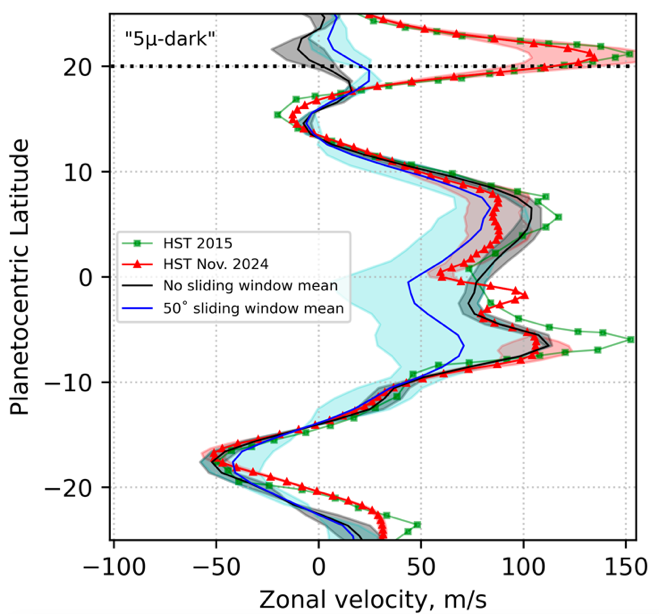
Ali Hyder, Glenn Orton, James Sinclair, Yulia Kurinna, and Amy Simon

Jupiter’s atmospheric circulation is dominated by strong zonal jets that occupy much of the equatorial and temperate regions up to about ±60˚ in latitude. They play an important role in shaping the tropospheric weather dynamics, and facilitate the zonal mixing of trace species and aerosols. The zonal winds of these jets have been the focus of many observational programs, as they provide a significant constraint on the atmospheric energy budget. Observations of the temporal and spatial variations of these zonal winds can help inform general circulation models (GCMs) that aim to simulate the interplay of instabilities that facilitate or inhibit these zonal flows.

Space-based observation efforts such as the Outer Planetary Atmospheres Legacy (OPAL) program have used data from the Hubble Space Telescope to constrain zonal flows on Jupiter (Simon et al., 2015), along with the other outer planets in the Solar System.  Zonal wind estimates have also been derived from the Voyager and Cassini flybys, shedding light on the details of eddy-mean flow interactions that feed the atmospheric jets. Although spacecraft and HST observations benefit from having a consistently advantageous viewing geometry, ground-based observations provide significant support to these programs. For example, observations made using the TEXES instrument on the Gemini North Telescope have also been used to constrain stratospheric thermal and dynamic changes during Jupiter’s equatorial oscillations (Benmahi et al., 2021).

Here, we showcase Jupiter’s zonal wind profiles derived using long-term ground-based observations in the 5-µm spectral window using the SpeX instrument on the NASA Infrared Telescope Facility (IRTF). We demonstrate the use of an anti-cloud tracking technique, providing a novel methodology in constraining the dynamics of atmospheric motions. Although the IRTF data lacks the spatial resolution that can be achieved via the Gemini-based TEXES or space-based observations, our observational study encapsulates the entirety of the Jovian year as seen in the 5-µm spectral window.

We employ the methodology developed by Johnson et al. (2018) to constrain the zonal wind field via 1D image correlation and demonstrate the efficacy of their “sliding window” technique as applied to infrared datasets (Figure 1). We estimate the correlation errors using the methodology outlined by Asay-Davis et al. (2008).


Figure 1 Jupiter zonal winds as derived using the NASA IRTF dataset for the 2024 observation cycle. The HST datasets are provided by the OPAL team. The blue and black lines are the results of our anti-cloud tracking technique applied to 5µ observations of Jupiter.

Our results demonstrate that when using 5-µm images, an anti-cloud tracking approach allows for wind field estimates that are consistent with the derived zonal flows from space-based observations. This allows us to constrain long-term behavior of the zonal jets, which include years that precede the inchoation of the OPAL observation campaign.

Reference:

  • Asay-Davis, X. S., Marcus, P. S., Wong, M. H., and de Pater, I., “Changes in Jupiter’s zonal velocity between 1979 and 2008”, Icarus, vol. 211, no. 2, pp. 1215–1232, 2011.
  • Benmahi, B., “Mapping the zonal winds of Jupiter's stratospheric equatorial oscillation”, Astronomy and Astrophysics, vol. 652, Art. no. A125, 2021.
  • Johnson, P. E., Morales-Juberías, R., Simon, A., Gaulme, P., Wong, M. H., and Cosentino, R. G., “Longitudinal variability in Jupiter's zonal winds derived from multi-wavelength HST observations”, Planetary and Space Science, vol. 155, pp. 2–11, 2018.
  • Simon, A. A., Wong, M. H., and Orton, G. S., “First Results from the Hubble OPAL Program: Jupiter in 2015”, The Astrophysical Journal, vol. 812, no. 1, Art. no. 55, IOP, 2015.

How to cite: Hyder, A., Orton, G., Sinclair, J., Kurinna, Y., and Simon, A.: Deriving Jupiter's Zonal Winds using an Anti-Cloud Tracking Method – Long-term Trends in 5 µm Observations from the NASA IRTF, EPSC-DPS Joint Meeting 2025, Helsinki, Finland, 7–13 Sep 2025, EPSC-DPS2025-1909, https://doi.org/10.5194/epsc-dps2025-1909, 2025.

L38
|
EPSC-DPS2025-914
|
On-site presentation
Iñaki Ordoñez-Etxeberria, Agustín Sánchez-Lavega, Ricardo Hueso, Naiara Barrado, and Arrate Antuñano

We present MeteoJuno, a web-based exploration tool developed for the interactive visualization of processed images from JunoCam, the visible-light camera aboard NASA's Juno mission. Originally designed for public outreach, JunoCam has become a valuable scientific instrument, delivering high-resolution images of Jupiter’s atmosphere—particularly of the planet's polar regions, which had been largely unexplored by previous missions. This work details the complete workflow for image processing and the integration of resulting data products into platforms for both scientific analysis and educational outreach.

JunoCam image processing poses specific challenges due to Juno’s polar orbit, variable illumination, and highly elliptical flybys. To address these, we implemented a specialized workflow combining ISIS3 (for geometric corrections and cartographic projections) and GDAL (for image mosaicking, spectral band merging, and exporting to standard formats). The processed images include full metadata and are available in PNG (for quick visualization) and FITS (the astronomical standard for detailed scientific analysis).

The final products are integrated into two complementary platforms:

  • PVOL (Planetary Virtual Observatory and Laboratory): an international archive combining amateur and professional observations, now enhanced with georeferenced JunoCam images.

  • MeteoJuno: a tool developed by the Pamplona Planetarium that allows users to explore JunoCam imagery projected onto a 3D model of Jupiter. The interface supports globe manipulation, image overlay from multiple perijoves, analysis of geographic coordinates and illumination conditions, and direct download via PVOL.

From a scientific perspective, the processed images have supported key investigations of Jupiter’s atmospheric dynamics. Notable studies include:

  • Great Red Spot (GRS): analysis of its internal dynamics and interactions with incoming anticyclones, revealing fragmentation events, changes in rotation rate, and material shedding.

  • Convective storms and cyclones: tracking features such as Clyde’s Spot, detecting mesoscale wave structures (30–100 km), and creating 3D cloud reconstructions using stereoscopic image pairs.

  • Large-scale disturbances: documentation of jet disruptions and equatorial band instabilities, including localized plumes that trigger widespread atmospheric changes.
  • Polar vortices: long-term tracking of the stable cyclonic rings at Jupiter’s poles and analysis of zonal vorticity and high-latitude jet systems.

Beyond their scientific value, the processed images have been extensively used for educational and outreach purposes. The Pamplona Planetarium employs georeferenced JunoCam mosaics in full-dome projections simulating close flybys of Jupiter, providing immersive public experiences. The accessibility of the data and tools further enables amateur astronomers and educators to engage with planetary science meaningfully.

We conclude that the developed processing pipeline, together with open-access platforms such as PVOL and MeteoJuno, represents an effective and replicable approach for the exploitation of data from planetary missions. This methodology enhances scientific research capabilities while fostering public participation and educational impact, bridging the gap between professional science, citizen engagement, and classroom learning.

How to cite: Ordoñez-Etxeberria, I., Sánchez-Lavega, A., Hueso, R., Barrado, N., and Antuñano, A.: JunoCam Image Processing and Navigation Supported by the MeteoJuno Exploration Tool, EPSC-DPS Joint Meeting 2025, Helsinki, Finland, 7–13 Sep 2025, EPSC-DPS2025-914, https://doi.org/10.5194/epsc-dps2025-914, 2025.

L39
|
EPSC-DPS2025-216
|
ECP
|
On-site presentation
Aida Flix Bellmunt, Agustín Sánchez-Lavega, Ricardo Hueso, Enrique García-Melendo, and Arnau Miró

Saturn’s zonal wind profile at cloud level has been measured at different epochs since the first spacecraft visits from Voyager 1 and 2 in 1980-81 [1-2]. Saturn’s wind measurements available in the literature include zonal wind profiles obtained from HST before Cassini, from 1996 to 2002 [3], Cassini ISS images and VIMS data from 2004 to 2017 [4-6], and zonal wind profiles from Hubble Space Telescope (HST) images in 2015 [7] and 2018-2020 [8]. In most latitudes, there is a very close agreement among those zonal wind profiles. However, the equatorial region, between the planetographic latitudes of 10ºN and 10ºS, presents a complex vertical structure and significant variability [e.g. 7]. In this work, we track and characterize several discrete features in Saturn’s atmosphere and measure the zonal winds along four years from 2021 to 2024. We used ground-based images from amateur observers (available in the PVOL database and similarly to refs. [9-10]) to track individual meteorological systems, and HST images obtained by the OPAL program [8] to obtain zonal wind profiles. The ground-based images have lower spatial resolution than HST, but the tracked features are followed over long timescales, reducing uncertainty in wind speed measurements. HST images in different filters were used to retrieve zonal wind profiles by correlating pairs of images taken one planetary rotation apart. The results in filters F631N and F763M show an intensification and strong variability in the equatorial jet when compared to Cassini measurements. In the methane absorbing bands (FQ727N and FQ889N) we also observed changes with respect to previous measurements. Given Saturn’s yearly illumination cycle due to its tilt and ring shadows, images from 2021 to 2024 provide the first measurements of the southern hemisphere since the end of the Cassini mission.


REFERENCES:

[1] Sromovsky et al. Journal of Geophysical Research (1983). [2] Sánchez-Lavega et al. Saturn’s Zonal Winds at Cloud Level, Icarus (2000). [3] Sánchez-Lavega et al. Nature (2003). [4] García-Melendo et al. Geophys. Res. Lett. (2010). [5] García-Melendo et al. Icarus (2011). [6] Studwell eta l. Geophys. Res. Lett. (2018). [7] Sánchez-Lavega et al. Nature Communications (2016). [8] Simon et al. Planet. Sci. Journal (2021). [9] Sánchez-Lavega et al. Nature Comm. (2019). [10] Hueso et al. Icarus (2020).


How to cite: Flix Bellmunt, A., Sánchez-Lavega, A., Hueso, R., García-Melendo, E., and Miró, A.: Saturn’s atmospheric winds between 2021 and 2024, EPSC-DPS Joint Meeting 2025, Helsinki, Finland, 7–13 Sep 2025, EPSC-DPS2025-216, https://doi.org/10.5194/epsc-dps2025-216, 2025.

L40
|
EPSC-DPS2025-1866
|
ECP
|
On-site presentation
Justin Garland, Jacob L. Gunnarson, Kunio M. Sayanagi, and John W. C. McNabb

We present an analysis of the temporal evolution of the aftermath of Saturn’s 2010-2011 Great Storm using images captured by the Imaging Science Subsystem (ISS) and Visual and Infrared Mapping Spectrometer (VIMS) cameras onboard the Cassini orbiter. The intense cumulus convection in the storm lifted an enormous amount of mass from the water condensation level, estimated to be at a depth of 20 bar, to the upper tropospheric altitudes above 1 bar. Cassini’s remote-sensing instruments detected numerous changes triggered by the storm in the cloud morphology and thermal structure. In particular, we analyzed the vast cloudless latitude band left behind the storm. The formation of this cloudless band is surprising because a cumulus storm transports saturated air upward and forms clouds, while such a clearing is normally associated with subsidence rather than upwelling. Our analysis of the rich Cassini datasets has produced a detailed record of when and where the storm’s cumulus convection released the lifted mass and examines the expansion of the post-storm clearing until the entire latitudinal zone becomes cloudless.


Saturn’s Great Storm of 2010-2011 started on December 5, 2010 as a small spot that appeared extremely bright in reflected sunlight (Sanchez-Lavega et al. 2012, Sayanagi et al. 2013). White clouds rapidly expanded from the spot to cover a wide swath of area between 30°N and 40°N latitude (latitudes in this proposal are planetocentric). By June 2011, the storm clouds engulfed the full-360° longitude; the intense cumulus convection, indicated by the radio-frequency pulses emitted by lightning discharges in the storm, ceased as the storm completed its circumpropagation around the planet (Sayanagi et al. 2013). The storm also disturbed the cloud morphology between 20°N and 30°N latitudes, which acquired a turbulent, billowing appearance similar to that of Jupiter. A cloudless region emerged in May 2011 near the end of the convective phase of the storm; the cloudless area subsequently grew to cover the entire 360° longitude between 30°N and 40°N latitude by January 2012.


We created a detailed record of the temporal evolution of the clouds left behind the storm by measuring the areal expansion of the storm clouds and their motion. Previous studies such as Sanchez-Lavega et al. (2012) and Sayanagi et al. (2013) focused primarily on the bright clouds between 30°N and 40°N latitudes, which are likely the anvil clouds atop the cumulus storm. On Earth, the anvil cloud covers a wider area than the underlying clouds associated with a storm; the underlying clouds form predominantly through horizontal mixing of air parcels in the cumulus upwelling with the environment (Houze, 1993). However, Sayanagi et al. (2018) found that the latitudes affected by the mass lifted by the storm extended to latitudes between 15°N and 45°N, far wider than the storm clouds analyzed by Sayanagi et al. (2013). We produced 12 fully processed Cassini ISS mosaics in the 750-nm filter, which senses sunlight scattered by tropospheric clouds. This sequence of images records the expansion of the storm clouds as an indicator of the mass detrained from the storm. All Cassini ISS images and mosaics will be archived at the PDS Atmospheres Node


We also employed a 2D Correlation Imaging Velocimetry (CIV) cloud tracking method to measure the wind fields to the north of the storm in latitudes between 30°N and 45°N. To the south of the storm between 20°N and 30°N, we employed a 1D CIV to measure the zonal wind speed. The motivation is to detect changes in the zonal mean wind caused by the mass loading through the thermal wind balance. The end products are the two-dimensional wind vector field of the swirling motion to the north of the storm 30°N and 45°N, and zonal-mean wind speeds to the south of the storm 20°N and 30°N that are compared to past measurements by Sayanagi et al. (2013).


We then established a temporal record of the formation and growth of the cloudless area that formed after the storm. The formation of the cloud-free region started in May 2012 near the end of the convective phase of the storm in June 2012. The clearing started near the farthest point in the storm clouds downwind of the cumulus head of the storm, from where the clearing spread upwind. The latitude band transformed over only 1.5 Earth-years between May 2011 and December 2012 from being fully covered by newly injected cloud particles to being nearly free of clouds in all detectable altitudes. Using 15 fully processed mosaics from Cassini VIMS 5-µm images, we established a temporal record of the formation and evolution of the post-storm cloud-free region. The timescale of the cloud clearing is used to estimate the cloud particle settling rate.  The end product is the area occupied by the post-storm cloud-free region as a function of time. All Cassini VIMS images and mosaics will be archived at the PDS Atmospheres Node.

How to cite: Garland, J., Gunnarson, J. L., Sayanagi, K. M., and McNabb, J. W. C.: Temporal Evolution of the Aftermath of Saturn’s 2010-2011 Great Storm through Multi-Spectral Analysis of Cassini ISS and VIMS Images, EPSC-DPS Joint Meeting 2025, Helsinki, Finland, 7–13 Sep 2025, EPSC-DPS2025-1866, https://doi.org/10.5194/epsc-dps2025-1866, 2025.

L41
|
EPSC-DPS2025-67
|
On-site presentation
Thibault Cavalié, Bilal Benmahi, Camille Lefour, Raphael Moreno, Thierry Fouchet, Emmanuel Lellouch, and Frédéric Gueth

Great White Spot events occur every orbital period in Saturn's atmosphere (Sanchez-Lavega et al. 2018). These planetary scale storms perturb the upper tropospheric cloud deck for weeks to months. From December 2010 to June 2011, Saturn underwent its most recent Great White Spot event in its northern hemisphere (Fischer et al. 2011, Sanchez-Lavega et al. 2011, 2012). Cassini and ground-based thermal infrared observations enabled to observe the consequences of the storm above the clouds, in the stratosphere. Two hot vortices were produced above the storm, and after a few months, they merged to create a giant hot vortex that lasted for years. In this vortex, hydrocarbon abundances and temperatures were significantly altered (Fletcher et al. 2011, 2012, Hesman et al. 2012, Moses et al. 2015). Thermal wind balance calculations indicate that stratospheric circulation may have been altered too (Fletcher et al. 2012). 
In this paper, we present mapping observations of CO at 230 GHz in Saturn's stratosphere, obtained with the Atacama Large Millimeter/submillimeter Array (ALMA) in January 2012, when the hot vortex was still active. From the Doppler shifts induced by the winds on the spectral lines, we have derived Saturn's stratospheric winds as a function of latitude. We present the dramatic differences found with more recent observations, including those of Benmahi et al. (2022).


References:
Benmahi et al. 2022. Astronomy and Astrophysics 666, A117
Fischer et al., 2011. Nature 475, 75–77
Fletcher et al. 2011. Science 332, 1413-1417
Fletcher et al. 2012. Icarus 221, 560-586
Hesman et al. 2012. Astrophysical Journal 760, 24
Moses et al. 2015. Icarus 261, 149-168
Sanchez-Lavega et al. 2011. Nature 475, 71-74
Sanchez-Lavega et al. 2012. Icarus 220, 561-576
Sanchez-Lavega et al. 2018. In Saturn in the 21st Century, ed. K. H. Baines, F. M. Flasar, N. Krupp, & T. Stallard, 377–416

How to cite: Cavalié, T., Benmahi, B., Lefour, C., Moreno, R., Fouchet, T., Lellouch, E., and Gueth, F.: Direct stratospheric wind measurements with ALMA during Saturn's 2010-2013 Great Storm, EPSC-DPS Joint Meeting 2025, Helsinki, Finland, 7–13 Sep 2025, EPSC-DPS2025-67, https://doi.org/10.5194/epsc-dps2025-67, 2025.

L42
|
EPSC-DPS2025-1116
|
On-site presentation
Saturn’s Local and Seasonal Aerosol Variations Inferred from Cassini Combined UV, Visual, and Near-IR Observations  
(withdrawn)
James Sinclair, Emma Dahl, Kevin Baines, Tom Momary, Lawrence Sromovsky, Pat Fry, and Patrick Irwin
L43
|
EPSC-DPS2025-796
|
On-site presentation
Jan-Erik Wahlund, Anders Eriksson, Michiko Morooka, Stephan Buchert, Moa Persson, Erik Vigren, Joshua Dreyer, William Kurth, Jack Waite, Jean-Pierre Lebreton, William Farrell, and Ingo Müller-Wodarg

The Cassini observations of Saturn’s ionosphere during the proximal orbits 288-293 in the altitude range 1450 – 4000 km (above 1-bar level) are revisited. A thorough re-analysis is made of all 159 available Langmuir probe sweeps of the Radio & Plasma Wave Science (RPWS) measurements. We relate them to the RPWS plasma wave inferred electron number densities and compare them with the available Ion Neutral Mass Spectrometer (INMS) measurements of the H+and H3+ number densities. Different analysis methods are used by RPWS to provide consistent electron number density values for the whole measured altitude interval. Consistent RPWS electron number density (ne) and INMS positively charged ion number density (ni+) profiles are derived for altitudes above ~2200 km. Below this altitude the inability of INMS to measure ions above 8 amu at the 34 km/s flyby speed lead us to infer the presence of heavy ions (> 8 amu) and a negatively charged ion component, presumably related to infalling material from the D-ring of Saturn with its associated local ion-molecule-aerosol chemistry. This lower altitude region shows a highly time variable layered structure. The Langmuir probe data in this region are strongly affected by secondaries emitted from the spacecraft and sensor surfaces when traversing a molecule-rich atmosphere at 34 km/s. There are clear signatures of secondary electron and ion emissions from the spacecraft and sensor surfaces in the data. In the Langmuir probe sweep analysis, we correct for the effect of such impact-generated products. This gives corrected total ion number densities that can be compared to the INMS ion number densities and the electron number densities. From this analysis the number of negative ions and/or nm-sized aerosol/dust particles can be constrained. A clear ionospheric peak is not identified, not even at the lowest observed altitude of approximately 1450 km. There are clear latitudinal variations and temporal evolving structures, which we infer are representative of the difference in infalling material from different regions of the D-ring. In addition, there are indications of a strong heating source for the ambient electrons that are well above expected thermal equilibrium levels (up to 4000 K). The cause of this heating is unknown but may be linked to collisional deacceleration of infalling ring material. The observational profiles presented here can be used for ionosphere theory/model comparisons in the future.

How to cite: Wahlund, J.-E., Eriksson, A., Morooka, M., Buchert, S., Persson, M., Vigren, E., Dreyer, J., Kurth, W., Waite, J., Lebreton, J.-P., Farrell, W., and Müller-Wodarg, I.: On the equatorial dayside ionosphere of Saturn – In-situ observations give evidence for a dynamic and layered structure in disequilibrium, EPSC-DPS Joint Meeting 2025, Helsinki, Finland, 7–13 Sep 2025, EPSC-DPS2025-796, https://doi.org/10.5194/epsc-dps2025-796, 2025.

L44
|
EPSC-DPS2025-1026
|
ECP
|
On-site presentation
Paula Betriu, Arnau Miró Jané, Enrique García-Melendo, Aida Flix, and Manel Soria

Long-term simulations of planetary vortices and storms are essential for improving our understanding of the atmospheric dynamics on gas giants such as Jupiter and Saturn. These simulations allow investigating the physical mechanisms that govern the lifespan and stability of features like Jupiter’s Great Red Spot (GRS) [1] and Saturn’s giant storms [2]. Furthermore, long-term integration is necessary to reproduce and assess observed morphological changes in key atmospheric features—such as the gradual shrinking or 90-days longitudinal oscillations of the GRS [3, 4]—, recorded over decades by spacecraft missions as well as ground- and space-based telescope observations. By capturing these evolving processes, simulations can test the adequacy of proposed forcing and dissipation mechanisms, assess the role of convective injection [5], and inform planetary circulation models [6], among others.

The objective of this work is to improve current planetary atmospheric models to reproduce relevant scales of motion on Jupiter and Saturn with very small dissipation over time scales of years. In order to understand the atmospheric dynamics of gas giants, we require models capable of reproducing and simulating the processes involved. Specifically, we employ the Shallow Water (SW) equations to reproduce fluid dynamics, focusing on a thin atmospheric layer influenced by rotational effects and zonal winds. Despite their relative simplicity, the SW equations capture essential dynamics that govern atmospheric phenomena like planetary-scale vortices and storms, e.g., Saturn’s Great White Spot [2]. To simulate these phenomena within the model, we introduce a localized Gaussian-shaped pulse perturbation representing a convective source. Model parameters are tuned to optimize agreement between simulated features and observational data from spacecraft instrumentation and telescope observations.

SW equations are typically solved using a semi-discrete approach, where spatial discretization is applied first, followed by time integration. However, both conventional spatial and temporal schemes present limitations that hinder long-term simulations of planetary atmospheres. Large-scale perturbations introduced in the model trigger a dynamical response that involves substantial instabilities, such as gravity waves, which represent a challenge for the numerical methods. To address this, many SW models employ advanced spatial discretization techniques designed to suppress unphysical oscillations. A commonly used approach is the Total Variation Diminishing (TVD) finite volume scheme, which incorporates gradient-based limiters that dynamically switch between lower- and higher-order formulations. While these limiters are effective at managing steep gradients and instabilities, they can also introduce excessive numerical dissipation, which compromises the conservation of the flow properties.

To address these limitations, the objective of this work is twofold: 1) Implementing entropy viscosity algorithms to mitigate numerical dissipation [7]; 2) Adopting higher-order strong stability preserving Runge-Kutta integration schemes to improve temporal integration [8]. On the one side, the entropy viscosity technique dynamically adjusts dissipation based on local flow properties. Specifically, the model spots unstable regions through local entropy-residual analysis, subsequently tackling only those areas where instabilities are detected. Additionally, the formulation also leverages Ducros-type discontinuity sensors [9] to further refine the identification of regions requiring stabilization by distinguishing between compressive (shock-like) and vortical (rotational) structures. The result is an artificial viscosity that enables selective dissipation, preserving fine-scale features in smooth regions while controlling instabilities elsewhere. Furthermore, this artificial viscosity is used to complement gradient-based limiters in TVD schemes, offering a hybrid strategy that enhances stability without significantly compromising accuracy, improving the robustness of SW simulations over long time scales. On the other side, for time integration, we use pseudo-symplectic (Low Storage) Strong Stability Preserving Runge-Kutta methods, which provide a better bounding of the solution while improving energy conservation and long-term stability. These schemes are TVD-implicit and show a significantly larger Region of Absolute Stability (ROS) than commonly used multistep methods such as Adams-Bashforth [8], which makes them particularly suitable for the highly nonlinear flows considered in this study.

We validate our approach using a set of benchmark test cases based on [10], demonstrating its effectiveness in controlling numerical dissipation and its improved accuracy as compared to traditional schemes. Finally, we apply our methodology to simulate long-term atmospheric dynamics associated with Jupiter’s Great Red Spot and Saturn’s Great White Spot, illustrating the model’s capability to reproduce long-term, planetary-scale vortices and storms with high fidelity, i.e., preserving reliable dynamics over extended simulation periods with improved stability.


[1] Sánchez-Lavega, A. et al. Jupiter’s Great Red Spot: Strong interactions with incoming anticyclones in 2019, Journal of Geophysical Research: Planets 126 (2021).

[2] García-Melendo, E. and Sánchez-Lavega, A. Shallow water simulations of Saturn’s giant storms at different latitudes. Icarus 287, 241-260 (2017).

[3] Simon, A., et al. Historical and contemporary trends in the size, drift, and color of Jupiter's Great Red Spot. The Astronomical Journal 155(4), 151 (2018).

[4] Sánchez‐Lavega, A. et al. The Origin of Jupiter’s Great Red Spot. Geophysical Research Letters 51, (2024).

[5] García-Melendo, E., et al. Atmospheric dynamics of Saturn’s 2010 giant storm. Nature Geoscience 6, 525–529 (2013).

[6] Spiga, A., et al. Global climate modeling of Saturn's atmosphere. Part II: Multi-annual high-resolution dynamical simulations. Icarus 335, 113377 (2020).

[7] Guermond, J.-L., et al. Entropy viscosity method for nonlinear conservation laws. Journal of Computational Physics 230, 4248–4267 (2011).

[8] Higueras, I. and Roldán, T. Efficient SSP low-storage Runge–Kutta methods. Journal of Computational and Applied Mathematics 387, 112500 (2021).

[9] Hendrickson, T. R., et al. An Improved Ducros Sensor for the Simulation of Compressible Flows with Shocks. Fluid Dynamics Conference (AIAA, 2018).

[10] Williamson, D. L., et al. A standard test set for numerical approximations to the shallow water equations in spherical geometry. Journal of Computational Physics 102(1), 211-224 (1992).

How to cite: Betriu, P., Miró Jané, A., García-Melendo, E., Flix, A., and Soria, M.: Towards long-term simulations of planetary-scale vortices and storms on Jupiter and Saturn, EPSC-DPS Joint Meeting 2025, Helsinki, Finland, 7–13 Sep 2025, EPSC-DPS2025-1026, https://doi.org/10.5194/epsc-dps2025-1026, 2025.

L45
|
EPSC-DPS2025-1624
|
ECP
|
On-site presentation
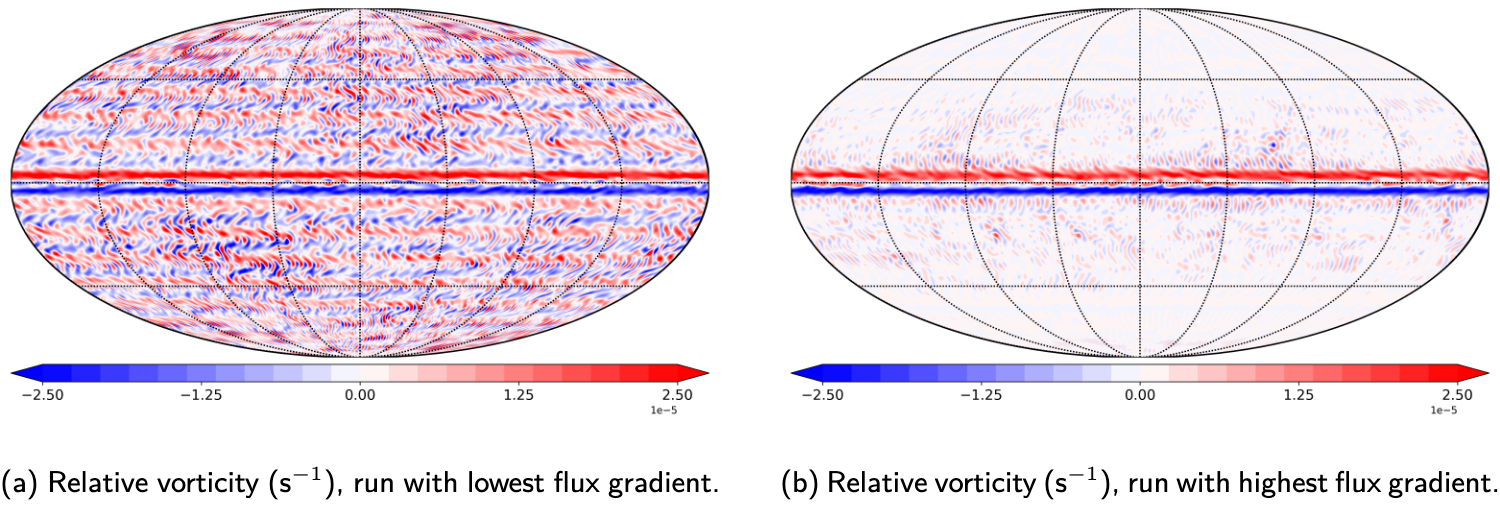
Xinmiao Hu, Peter Read, Roland Young, and Greg Colyer

The atmospheric circulation of Jupiter is shaped by a complex interplay between deep internal processes and cloud-level dynamics. Numerical simulations and observational analyses have suggested that Jupiter’s mid-latitude jets are strongly influenced by baroclinic instability [1], which is governed by the planet’s atmospheric thermal structure. Jupiter emits a substantial intrinsic heat flux originating from its interior. Past modelling efforts [2, 3] have demonstrated that this internal energy plays a key role in shaping large-scale atmospheric dynamics.

Our previous work [4] showed that latitudinal variations in interior heat flux can significantly impact the structure and behaviour of Jupiter’s mid-latitude jets in a General Circulation Model (GCM).  Such an impact is best illustrated by the relative vorticity snapshots from two simulations with the lowest and highest latitudinal flux gradient (see Figure 1). In this study, we present a more detailed analysis linking these jet modifications to changes in the atmospheric thermal structure and, consequently, to the strength and distribution of baroclinic eddy activity. In particular, we use the Lorenz energy cycle framework to diagnose how variations in deep thermal forcing influence baroclinic energy conversion and eddy-mean flow interactions. We further examine the implications for meridional transport and the water cycle within Jupiter’s weather layer.

Additionally, we present a control simulation in which the potential temperature at the model’s lower boundary is forced toward a fixed value (a deep adiabat setup). We compute the equivalent upward heat flux associated with this forcing to place it in the context of previous models that impose constant or latitudinally varying interior heat flux. This allows a direct comparison of how different representations of deep thermal forcing affect upper-atmospheric dynamics.

Finally, we discuss the broader implications of these findings for future weather-layer models of Jupiter and other gas giant planets, especially on the effect of bottom boundary conditions in representing the coupling between deep and observable atmospheric dynamics.


Figure 1: Mollweide projection of the relative vorticity at 1 bar at the end of two simulations.


Reference:
[1] Read, P. L. (2023). The dynamics of Jupiter’s and Saturn’s weather layers: a synthesis after Cassini and Juno. Annual Review of Fluid Mechanics, 56(1), 271–293. https://doi.org/10.1146/annurev-fluid-121021-040058
[2] Liu, J., & Schneider, T. (2011). Convective Generation of Equatorial Superrotation in Planetary Atmospheres. Journal of the Atmospheric Sciences, 68(11), 2742-2756. https://doi.org/10.1175/JAS-D-10-05013.1
[3] Young, R. M. B., Read, P. L., & Wang, Y. (2018). Simulating Jupiter’s weather layer. Part I: Jet spin-up in a dry atmosphere. Icarus, 326, 225–252. https://doi.org/10.1016/j.icarus.2018.12.005
[‌4] Hu, X. and Read, P.: Latitudinal Variation in Internal Heat Flux in Jupiter's Atmosphere: Effect on Weather Layer Dynamics, Europlanet Science Congress 2024, EPSC2024-669, https://doi.org/10.5194/epsc2024-669, 2024.

How to cite: Hu, X., Read, P., Young, R., and Colyer, G.: The Role of Bottom Thermal Forcing on Modulating Baroclinic Instability in a Jupiter GCM, EPSC-DPS Joint Meeting 2025, Helsinki, Finland, 7–13 Sep 2025, EPSC-DPS2025-1624, https://doi.org/10.5194/epsc-dps2025-1624, 2025.

L46
|
EPSC-DPS2025-643
|
ECP
|
On-site presentation
Francesca Vitali, Stefania Stefani, Giuseppe Piccioni, Marcel Snels, Davide Grassi, David Biondi, and Angelo Boccaccini

Introduction: The atmospheres of the gaseous and icy giant planets represent a high-density environment whose composition is generally dominated by H2 and He.

Consequently, the H2 Collision-Induced Absorption (CIA) represents one of the main opacity sources in the near-infrared spectral range between 1 and 5 μm. This is a spectral range widely investigated for Jupiter not only by ground-based instruments, but also from space, presently through the eyes of JIRAM on board JUNO, JWST, and in future also of MAJIS on board JUICE.

Jupiter, in fact, represents an archetype for the giants’ gaseous planets, and the understanding of its magnetosphere, composition, and opacity of its dense and complex atmosphere are all important elements for the most comprehensive view about how the Jupiter system(s) works.

In this work, we performed an experimental study of the H2 CIA in the [3600, 5500] cm-1 spectral range at high resolution, to investigate not only the overall opacity due to the CIA, but also to study the narrow features called interference dips, not taken into account by the existing models.

Experimental setup: The experimental setup employed here is called PASSxS (Planetary Atmosphere Simulation System x Spectroscopy) [1]. It consists of a simulation chamber that contains a Multi-Pass cell coupled with an IR Fourier spectrometer (FTIR) and aligned to reach an optical path of 3.28 m. The chamber can be heated up to 550 K, cooled down to 100 K, and sustain pressures up to 70 bar. The FTIR has a maximum spectral resolution of 0.002 cm-1.

A picture of the setup can be visualized in Figure 1.

Figure 1: Experimental setup, consisting of a Fourier Spectrometer coupled with a simulation chamber (in grey behind the FTIR)

Results and discussion: Binary absorption coefficients due to both the H2-H2 and H2-He collisions in the [3600, 5500] cm-1  spectral range for temperatures going from 120 to 500 K has been recently published in [2]. Superimposed on the CIA absorption, some narrow features have been observed at all the temperatures. These interference dips correspond with a smaller absorption at specific frequencies with respect to the overall CIA band contour.

They have been previously observed in other experimental works [3-7] at temperatures up to 300 K. To study the behavior of those features with density and temperature, we performed measurements of the H2 CIA fundamental band at a resolution of 0.05 cm-1, temperatures from 305 to 499 K, and different pressures.

Figure 2 shows the measured absorption coefficients for three pressures at 399 K.

Figure 2: Experimental absorption coefficients measured at 399 K for three different pressures

The interference dips are well visible on the left side of the main peak of the band.

Furthermore, they are also present around 4161 cm-1, 4500 cm-1, 4700 cm-1, and 4900 cm-1, but the latter three are superimposed on several sharp absorption lines due to the H2 quadrupolar transitions, located approximately in the centre of the dips.  

The phenomenon generating those dips has been previously investigated by Van Kranendonk [8]. They are caused by the interference of induced dipole moments in consecutive collisions and are not reproduced by the existing CIA model simulations.

Van Kranendonk calculated a symmetric theoretical profile to describe their shape as a function of the intracollisional halfwidth δ and the frequency of the dip’s peak νc.

He also predicted a linear behavior of the intracollisional halfwidth with density.

However, Kelley and Bragg [5] observed an asymmetry of the main peak of the dips. Consequently, they used a modified version of Van Kranendonk’s profile by adding a phase α to fit the asymmetric line profiles as shown Equation 1.

Equation 1: Asymmetric profile [5]

We used their profile to fit the Q(1) dip near 4155 cm-1 for all the pressures considered at the investigated temperatures and retrieve the δ parameter.

Figure 3 shows the fit performed over the Q(1) dip measured at 12.7 bar and 399 K.

Figure 3: Q(1) interference dip (black solid line) measured at 399 K and 12.7 bar. The light blue dotted line represents the fit made with the asymmetric profile [4].

The intracollisional halfwidth has been then plotted against the density, finding a linear behavior for all three temperatures considered, 305 K, 399 K, and 499 K, as can be seen in Figure 4, as expected by Van Kranendonk's theory.

Figure 4: Behavior of the intracollisional halfwidth (δ) with density for the three temperatures considered

CIA of H2 plays an important role in investigating Jupiter’s atmosphere, and accurate laboratory measurements along with models are of primary importance to study the chemistry and physical properties of a gas giant atmosphere.

Laboratory data can also potentially provide additional elements, such as the dependence of the interference dips on density, that can extend the retrieval of atmospheric parameters otherwise difficult to access.

References:

[1] M. Snels et al. (2021), AMT 14, 7187–7197,

https://doi.org/10.5194/amt-14-7187-2021.

[2] Vitali F. et al. (2025), JQSRT, Vol. 330, doi: https://doi.org/10.1016/j.jqsrt.2024.109255

[3] J. D. Poll et al (1975), Can. J. Phys., 53, 954

[4] A. R. McKellar et al. (1975), Can. J. Phys., 53, 2060

[5] J. D. Kelley et al. (1984), Phys. Rev. A, 29, 1168

[6] J. P. Bouanich et al. (1990), JQSRT, 44, 4

[7] J. Westberg et al. (2025), Optics Express, 33, 5

[8] Van Kranendonk J. (1968), Canadian Journal of Physics, Vol. 46 N.10,

doi: https://doi.org/10.1139/p68-150

Acknowledgments:  This work has been developed under the ASI-INAF agreement n. 2023-6-HH.0. The upgrade (in progress) of this experimental setup is partially funded by the EMM (Earth Moon Mars) project of PNRR (task 1500-13).


How to cite: Vitali, F., Stefani, S., Piccioni, G., Snels, M., Grassi, D., Biondi, D., and Boccaccini, A.: Experimental study of the interference dips observed on the collision-induced absorption fundamental band of H2: their relevance to planetary atmosphere characterization, EPSC-DPS Joint Meeting 2025, Helsinki, Finland, 7–13 Sep 2025, EPSC-DPS2025-643, https://doi.org/10.5194/epsc-dps2025-643, 2025.

L47
|
EPSC-DPS2025-1657
|
On-site presentation
halima ghorbel

After the explorer probe of the voyager 1 and the voyager 2 missions that flew over Jupiter and Saturn, The Juice mission « Jupiter Icy moons Explorer » was launched by an Ariane 5 rocket on October 2023. It will provide the first observation of the Jupiter’s atmosphere. Indeed, the aerosols and the atmosphere of this planet initially perplexed researchers. Several research studies have focused on Titan aerosols following the Cassini mission. In this way, we built on the legacy of this Titan model to discover the Jupiter science. This research topic is dedicated to the comparative study of aerosols analogue of Titan, which is the second largest Saturn satellite, and aerosols analogue of Jupiter, which is the largest planet of the solar system, to gain a better understanding of the difference between the appearance of organic aerosols in nitrogen and non-nitrogen based atmospheres. For this purpose, in this work, we first synthesized aerosols analogues by experimental means using Cold Plasma, and second then analyzed them by Scanning Electron Microscope (SEM), Infra-Red (IR). The result revealed the presence, possibly, of the different organic molecules and it showed a difference in an average size and a geometric shape between the two planetary analogues.

Keys words:  Aerosols, Planetary Atmosphere, Titan, Jupiter and Plasma

How to cite: ghorbel, H.: Study of organic aerosols formed in cold plasma: experimental simulation of a nitrogen and non-nitrogen based atmosphere., EPSC-DPS Joint Meeting 2025, Helsinki, Finland, 7–13 Sep 2025, EPSC-DPS2025-1657, https://doi.org/10.5194/epsc-dps2025-1657, 2025.