
 1,1,2,
- 1Department of Geophysics, Faculty of Mathematics and Physics, Charles University, Prague, Czech Republic (lebec@karel.troja.mff.cuni.cz)
- 2Nantes Université, Univ Angers, Le Mans Université, CNRS, Laboratoire de Planétologie et Géosciences, LPG UMR 6112, Nantes, France
Ocean worlds have become a major focus of interest in exobiology and planetary science due to their internal structure and dynamics [1]. Among them, Europa is one of the most promising candidates for the search for life in the Solar System. Its very young surface suggests intense tectonic activity and the existence of a subsurface liquid water ocean in direct contact with a rocky core allows strong water-rock interactions and efficient heat and mass transfer, which is a key ingredient for habitability.
Europa’s subsurface ocean likely contains salts, mainly NaCl and/or MgSO4 [2,3], inherited either from its differentiation phase and/or from water-rock interactions. Recent observations from multiple space missions also confirm the presence of salts at its surface [2,3,4]. While they might also originate from the exterior environment, their coincidence with geological structures rather suggest an internal origin. This work investigates the hypothesis that these salts may originate from the ocean and be transported to the surface by tectonic extension of the ice shell. The thickness of Europa's ice layer may vary considerably in time (~3-70km) due to gravitational interaction with neighboring moons Io and Ganymede [5]. When the ice layer is thinner, the ocean-ice boundary is highly tidally deformed, leading to fractures. Salty water can infiltrate the ice and recrystallize, enriching the ice with salts. When the ice layer thickens, deformations of the interface are smaller, limiting the infiltration of salts from the underlying ocean. However, salts that have previously been trapped in the ice can be transported through the shell by convection or tectonic processes. The oscillating thickness of Europa’s ice shell leads to global contraction or extension of the surface. The extension process may cause rifting [6], which facilitates mass exchanges between the ocean and the surface. To investigate how the combination of extension process and convection affects the heat and mass transfer, we solve the thermo-chemical convection equations in a 2D Cartesian model of Europa’s ice shell, using a finite element method and the advection of Lagrangian tracers. Preliminary results from two scenarios are shown in Figs.1 and 2, where a thin layer of salty ice (containing 10% and 15% MgSO4, respectively) is set in the upper part of the ice shell and for an extension velocity of 10km/Myr. The figures show viscosity (top) and density (bottom) fields at three different time steps. In both cases the rift due to the extension process is clearly visible in the viscosity fields. For 10% MgSO4 (Fig.1), the salts are easily transported upwards and spread along the rift at the surface. The presence of the salts within the band at the end of this run is interestingly similar to the distribution of salts on Europa’s surface. For 15% MgSO4 (Fig.2), the higher density causes only a fraction of the salts to reach the surface, while the rest collapses downward.
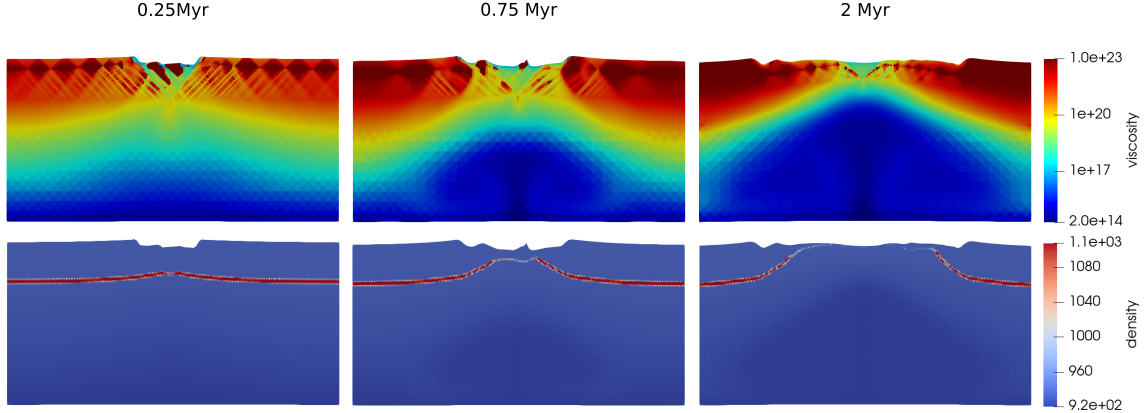
Fig1. Snapshots of the viscosity (top) and density (bottom) fields. 1-km-thick layer of salty ice containing 10% MgSO4, in the upper part of the ice shell.
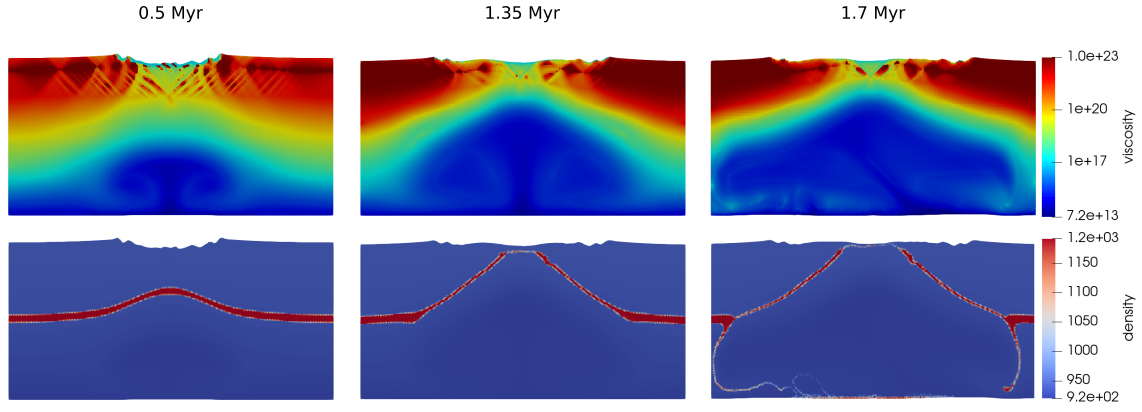
Fig2. Snapshots of the viscosity (top) and density (bottom) fields. 2-km-thick layer of salty ice containing 15% MgSO4, in the middle part of the ice shell.
In addition to salts, which have a major effect on the overall dynamics, a recent study also suggests the existence of clathrate reservoirs at the ice-ocean boundary [7], trapping volatiles such as CO2 or CH4. Due to their material properties, which are significantly different from those of ice, the presence of clathrates at the base of the ice shell has no less important effect on the ice dynamics. Following outgassing episodes of the clathrate reservoirs, volatiles may be transported by convection through the ice and concentrate near the surface. Fig.3 shows clathrates rising to the surface, creating localized topography (middle panel), before spreading around the rift. This could explain the CO2 detected on the surface of Europa, which seems to have an internal origin [8].
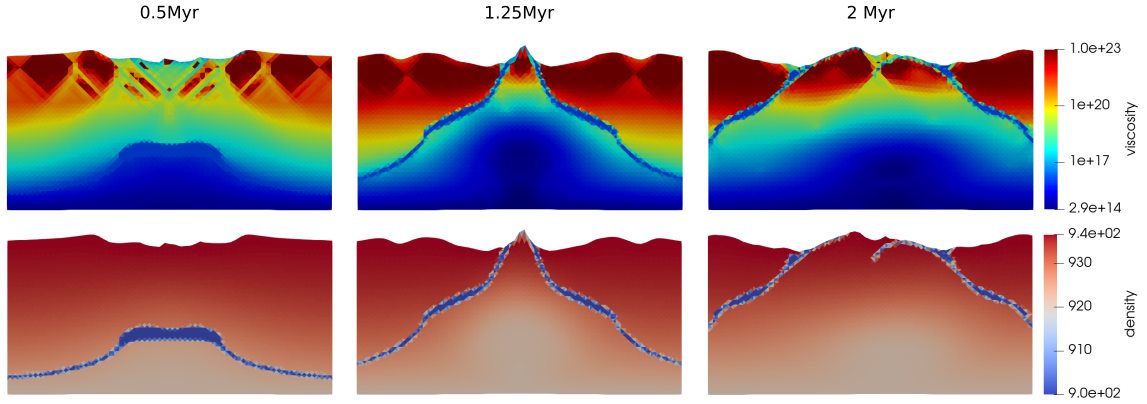
Fig3. Snapshots of the viscosity (top) and density (bottom) fields. 1-km-thick layer of methane clathrates at the base of the ice shell.
Taken together, the results highlight how salts and clathrates affect the overall dynamics of the ice shell. The aim of this work is to determine the efficiency of mass exchanges between the ocean and the surface. Characterizing these processes is also necessary to understand Europa's surface features better.
References:
[1] F. Nimmo and R. T. Pappalardo (2016), J. Geophys. Res. Planets, 121, 1378–1399
[2] M. Y. Zolotov and E. L. Shock (2001), J. Geophys. Res., 106, 32815-32827
[3] S. K. Trumbo et al. (2022), Planet. Sci. J., 3, 27
[4] T. B. McCord et al. (2002), J. Geophys. Res., 107, 112
[5] H. Hussmann and T. Spohn (2004), Icarus, 171, 391-410
[6] S. M. Howell and R. T. Pappalardo (2018), Geophys. Res. Lett., 45, 4701-4709
[7] G. Tobie et al. (2006), Nature, 440, 61-64
[8] S. K. Trumbo and M. E. Brown (2023), Science, 381, 1308-1311
How to cite: Lebec, L., Kihoulou, M., and Čadek, O.: Exchanges of salts and volatiles in Europa’s hydrosphere, EPSC-DPS Joint Meeting 2025, Helsinki, Finland, 7–12 Sep 2025, EPSC-DPS2025-262, https://doi.org/10.5194/epsc-dps2025-262, 2025.


