
 1,22,3
- 1European Space Agency (ESA), European Space Astronomy Center (ESAC), Villanueva de la Cañada, Spain
- 2Université Paris-Saclay, GEOPS, UMR 8148, CNRS, Orsay, France
- 3Institut Universitaire de France (IUF)
Intro:
Europa’s surface ice exists in a dynamic equilibrium between thermally driven crystallization and radiation-induced amorphization. While thermal crystallization transforms amorphous ice into crystalline phases, energetic particles and UV photons disrupt the lattice, amorphizing the ice. Spectroscopic studies (Hansen & McCord 2004; Ligier et al. 2016) suggest that there exist a vertical crystallinity gradient, with amorphous ice dominating the surface of Europa and crystalline ice emerging around the 1 mm depth. However, the interplay of these processes across Europa’s diverse thermal and radiation environments remains poorly quantified.
Numerical modeling offers a powerful tool to simulate the complex competition between thermal crystallization and radiation-induced amorphization on Europa. Berdis et al. (2020) initiated this approach by modeling the interaction between ion radiations and thermal crystallization, assuming a fixed average temperature for Europa's surface. Here, we present the first depth-resolved estimates of Europa’s crystallinity using a coupled multiphysics surface model (MSM), Lunalcy (Mergny & Schmidt 2024a) that integrates all temperature fluctuations, to map subsurface crystallinity with depth across Europa and identify its evolution over time.
Methods
- Thermal Crystallization
The crystallization process is modeled using the Johnson-Mehl-Avrami-Kolmogorov (Avrami) equation, which describes the kinetics of crystallization. The crystalline fraction, θ(t), after a relaxation time t, is given by:
θ(t)=1−exp(−(t/τ)^n)
where n is the Avrami constant, and τ is the characteristic crystallization time. The crystallization timescale, τ, is highly temperature-dependent and is computed using parameters from Kouchi et al. (1994) and Schmitt et al. (1989). To account for diurnal temperature variations, we discretize the Avrami equation, allowing for the computation of crystallization rates coupled with a thermal solver.
- Radiation-Induced Amorphization
Radiation-induced amorphization is modeled by considering the accumulation of radiation energy per molecule over time, known as the dose, D. The amorphization of the crystalline fraction is given by:
θ(t)=exp(−k(T)D(t))
where k(T) is the amorphization factor, dependent on temperature and radiation type. We derive k(T) for ions, electrons, and UV photons using experimental data and fits from various studies (Strazzulla et al. 1992; Loeffler et al. 2020).
The dose rates for different particles are derived from literature (Cooper 2001; Paranicas et al. 2009; Pavlov et al. 2018) and interpolated to obtain dose rates at all depths. The UV-induced dose is computed using the solar flux received at Europa's surface, considering the UV absorption cross-section of water ice. The dose at depth is obtained using Beer-Lambert's law, accounting for the absorption of UV radiation in the shallow layers. The dose rates for electrons and protons are shown in Figure 1.
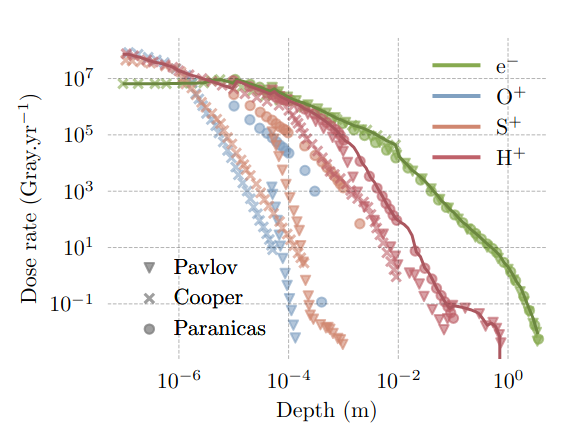
Figure 1: Particle dose rates as a function of depth on Europa, derived from literature. The combined dose rate (line) is computed by taking the maximum of interpolated values from the three datasets.
- Coupled Simulations
The LunaIcy model integrates these competing processes into a uni-dimensional block of ice, iteratively computing the crystallinity changes corresponding to the current temperature and radiation flux. The model is run over a range of parameters, simulating the evolution of Europa's icy surface crystallinity under various conditions for 100,000 years.
Results
The simulations reveal a complex interplay between thermal crystallization and radiation-induced amorphization, resulting in depth-dependent crystallinity profiles.
At high latitudes and albedo, the surface remains predominantly amorphous due to low temperatures and high radiation doses. While at low latitudes and albedo, thermal crystallization dominates, leading to a mostly crystalline profile.
Regions of particular interest are those where a balanced competition between crystallization and amorphization occurs, typically at mid-latitudes. These regions show a crystallization increase near the 1 mm depth, aligning with spectroscopic observations (Hansen & McCord 2004).
By interpolating the simulation results, we generate a crystallinity map of Europa, shown in Figure 2. This map reveals a transition from amorphous ice at the poles to fully crystalline ice at the equator, with a mixture of both at mid-latitudes.
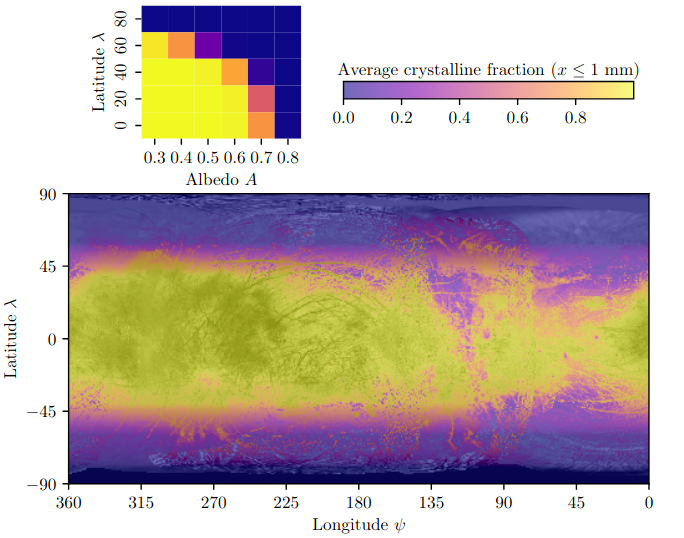
Figure 2: (Top Left) Average crystalline fraction heatmap for depths <1 mm computed on Europa for a uniform flux of particles as a function of albedo and latitude. (Bottom) Interpolation of the averaged crystalline fraction heatmap to the albedo map of Europa.
The simulations also uncover periodic variations in crystallinity profiles due to seasonal and geological fluctuations in solar flux. Seasonal variations are particularly pronounced at mid-latitudes, with crystallinity fluctuations reaching up to 35%. These variations could be observed by upcoming missions such as Europa Clipper and JUICE, providing valuable insights into Europa's surface dynamics.
Conclusion
This study presents a novel approach to understanding Europa's surface dynamics by using a coupled multiphysics surface model (MSM), LunaIcy. By simulating both thermal crystallization and radiation-induced amorphization, we have produced the first depth-resolved, latitude-dependent simulations of Europa's crystallinity.
Our results align with existing spectroscopic observations and highlight transitions from amorphous ice at the poles to crystalline ice at the equator, with mixed phases at mid-latitudes. The crystallinity map generated from our simulations serves as a valuable tool for guiding future observations and improving surface interpretation from remote-sensing.
Remarkably, the simulations of these competing processes have revealed periodic variations in the crystallinity profiles. Seasonal variations have the highest amplitudes in mid-latitude regions, reaching crystallinity fluctuations of up 35%. Upcoming missions like Europa Clipper and JUICE could potentially observe these seasonal variations during their operational lifetimes.
Finally, we proposed the observation of key regions on Europa during upcoming missions Europa Clipper and JUICE to validate or refine our model.
References
Mergny, C., et al. (2025). Article related to this abstract, Icarus, in revision
Berdis, J. R., et al. (2020). Icarus, 341, 113660.
Cooper, J. (2001). Icarus, 149, 133.
Hansen, G. B., & McCord, T. B. (2004). Journal of Geophysical Research: Planets, 109.
Kouchi, A., et al. (1994). Astronomy and Astrophysics, 290, 1009.
Ligier, N., et al. (2016). The Astronomical Journal, 151, 163.
Strazzulla, G., et al. (1992). Europhysics Letters (EPL), 18, 517.
How to cite: Mergny, C. and Schmidt, F.: Crystalline or Amorphous Ice on Europa? Simulating the Competition Between Surface Processes, EPSC-DPS Joint Meeting 2025, Helsinki, Finland, 7–12 Sep 2025, EPSC-DPS2025-327, https://doi.org/10.5194/epsc-dps2025-327, 2025.


