
 2,
2,- 1Southwest Research Institute, 1301 Walnut Street, Suite 400, Boulder, CO, USA (vishaal.singh@swri.org)
- 2Jet Propulsion Laboratory, California Institute of Technology, USA
The abundance of icy materials on or near the surface of planetary bodies in the outer solar system dictates the need for lab measurements of ice properties at relevant environmental conditions – to unravel their age, evolution, and surface physics/chemistry. Deposition of ice on the surface could occur due to a variety of surface-subsurface exchange processes, and once emplaced, it can undergo phase transitions, changes in grain size and other physical properties (e.g., 1-3). While water ice spectral properties have been extensively studied in the past (4), and absorption coefficients of relatively warm ice have been published, we need insights (at lab scale) into formation/transport mechanisms of surface icy materials, and evolution with time via active surface processes.
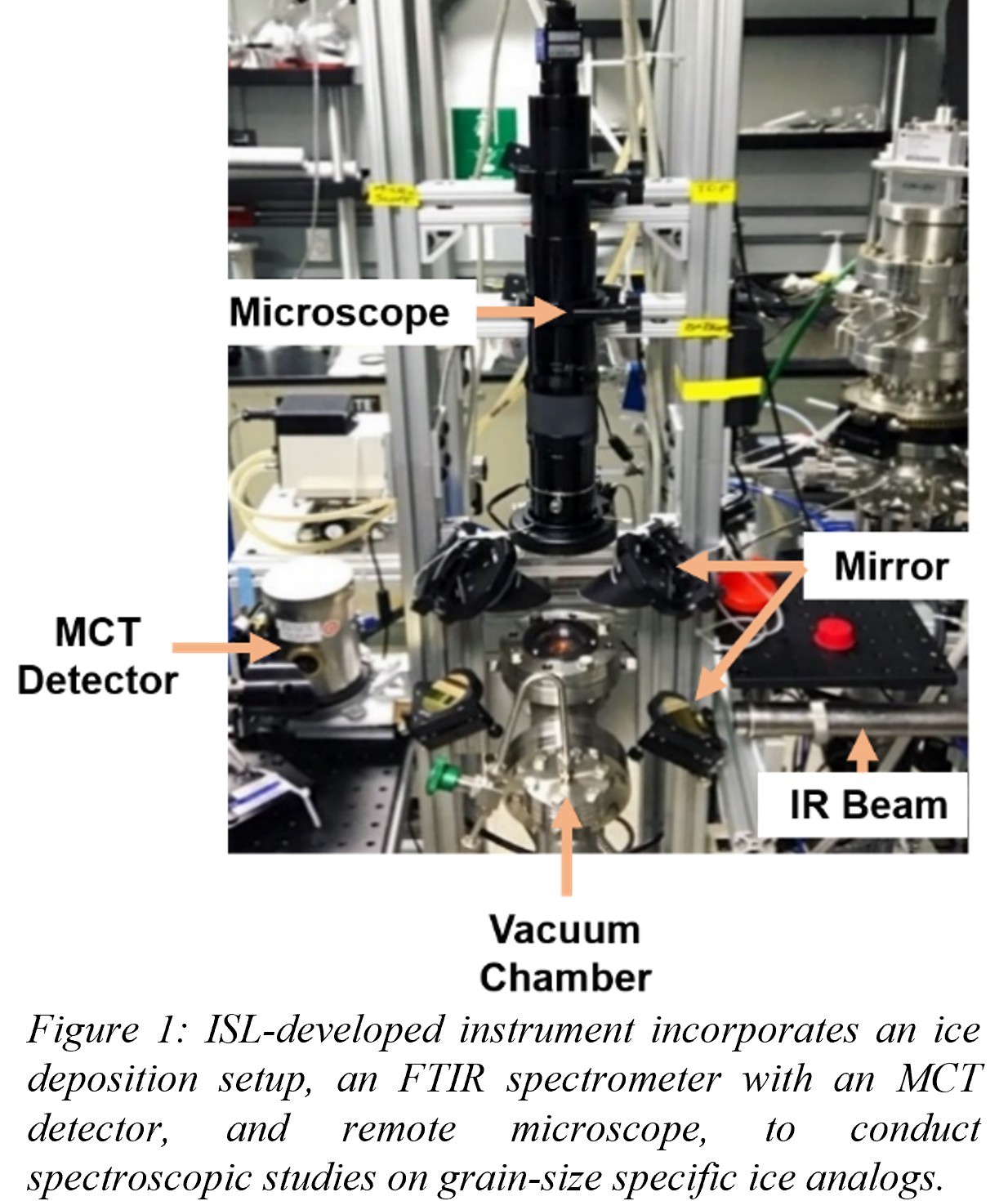
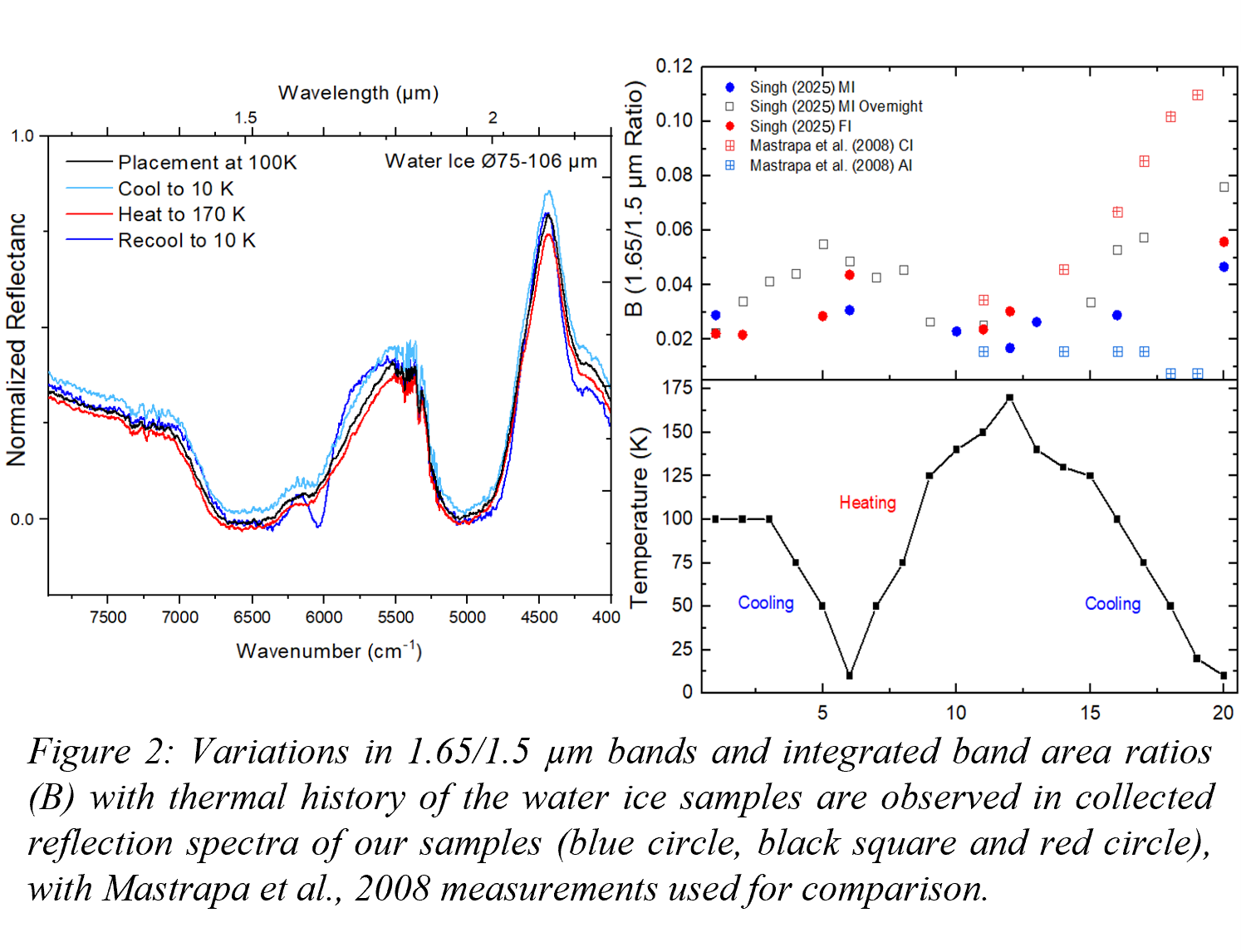
NIR Spectroscopy: New infrastructure was custom-built (Fig. 1) to produce “thick” (~2 mm) pristine water ice samples and collect reflectance spectra in the near infrared (NIR) wavelength range, with grain-size ranging from 25-212 μm (under ultrahigh vacuum) at temperatures of 10-170 K (with annealing) for direct comparison to spectra of Solar System objects. Samples display spectral signatures of water ice, both crystalline and amorphous based on temperature and formation protocols and demonstrate the theorized evolution of absorption band features due to variations in sample thickness, grain size, and thermal cycling (Fig. 2). To demonstrate the efficacy of this new dataset for surface characterization, we determine bulk crystallinity of Europa’s leading hemisphere, and the environmental conditions required to meet current age estimates.
Calculation of 1.65/1.5 μm Integrated Band Area Ratios (B): 𝐵 was calculated for our ice samples as the ratio of integrated area of the 1.65 μm and 1.5 μm region. New laboratory end members for pure amorphous (Bamorph = 0.0166) and crystalline ice (Bcryst = 0.0529) were calculated using transmission and reflection spectroscopy.
Crystallinity: The amount of crystalline water ice compared to total abundance of both crystalline and amorphous ice phases, is referred to here as ‘‘crystallinity’’ (C) of a surface, defined by equation:
C = (𝐵𝐺𝐵𝑂 - 𝐵𝑎𝑚𝑜𝑟𝑝ℎ) / (𝐵𝑐𝑟𝑦𝑠𝑡 - 𝐵𝑎𝑚𝑜𝑟𝑝ℎ)
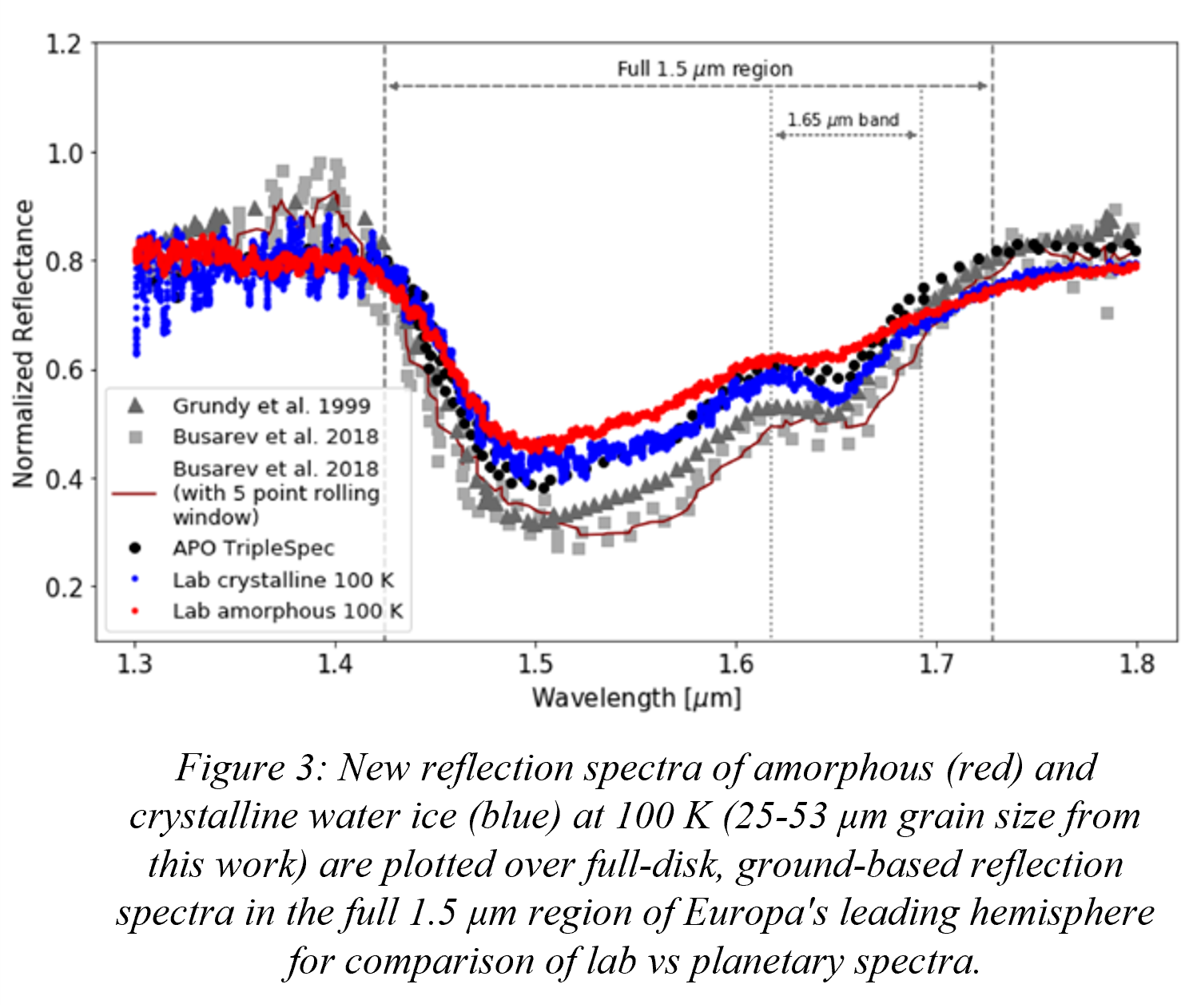
where BGBO is calculated for ground-based observations (GBO). Crystallinity captures the balance between crystallization and amorphization due to several processes operating on timescales of a few hours to millions of years [5]. Thus, our understanding of the environmental history of icy bodies (with limited observations) can be enhanced by constraining this crystallinity. Current crystallinity estimates of Europa’s leading hemisphere range from ~27 to 95% [6]. Using our new end members with 3 full-disk, spectroscopic GBO’s of Europa’s leading hemisphere, allows us to re-interpret its crystallinity, increasing from previously estimated 27-36% (using transmission spectra) to equal proportions as a full disk average of 46-52% (reflection spectra) - similar to [7] and global estimates of Ganymede. The discrepancies in measured crystallinities can be assigned to differences in methods of acquiring reflectance spectra from a real planetary surface and previous lab transmission spectra from thin films of water ice, grain sizes and thermal history contributing B values. The reflection spectroscopy technique with “thick” ice samples employed in this work should offer a more accurate comparison to planetary surface observations, with thicknesses far beyond 50 μm, and consistency with spectral mixing results increases our confidence. Spatial variations in crystallinity are expected due to changes in particle flux and thermal history with location, and due to other temporal resurfacing processes.
Age Ruler: Over the past three decades, there have been several estimates of Europa’s surface age, with [8] estimating a best-fit average age of ~30-70 Ma and [9] estimating ~40-90 Ma. We can deploy an alternate approach here with the calculated bulk crystallinity, using an age equation established by [10], based on measured rate of ice phase transformation in environmental conditions:
1-C = Φ Amax (1- exp [-kFt / N])
Any determination of age requires tight constraints on surface conditions, which are captured in equation inputs, derived either from the methodology of [6], or from recent literature. [11] used this equation to determine the approximate ages of 2 craters on Saturn's moon Rhea. We have similarly computed an age ruler for Europa's leading hemisphere. The age range of ~ 40 Ma to 90 Ma can be obtained for our range of surface crystallinity values under a surface temperature of 110 K, and ~low particle flux (7.92 x 106 cm-2 s-1).
Ongoing Work on Jovian System: Bulk crystallinity and age estimate techniques presented here provide first order approximations and constraints on surface conditions and evolution of ice. These techniques are immediately applicable to other icy moons in the Jovian system and will enable new discoveries with increased science return of past missions and support ongoing missions to Jovian moons such as Europa. Building on this work, we are performing calculations of spatial variation in the rate of water ice amorphization and thermal annealing in Europa’s radiation environment. We compare the rates of these two competing processes and identify a steady state condition for (location dependent) crystallinity on Europa. Overall, a broad global pattern of amorphous versus crystalline ice on both hemispheres will be established for Europa, and reported on here.
Acknowledgments: A part of the work presented here was carried out at the Jet Propulsion Laboratory, California Institute of Technology under a contract with NASA. VS and ARR acknowledge funding from NASA PSIE, and MSG acknowledges funding from NASA SSW and DDAP programs. We also thank Jodi Berdis for contributions to crystallinity calculations.
References: [1] Kouchi, A. et al. (1994) Astronomy and Astrophysics 290, 1009–1018. [2] Cooper, J.F. et al. (2001) Icarus 149, 133-159. [3] Porter, S. B., S. Desch, J. C. Cook (2010) Icarus 208, 492-498. [4] Clark, R. N. (1980a). JGR Solid Earth 86(B4): 3087-3096. [5] Singh, V. (2021) ProQuest. [6] Berdis, J. et al. (2020) Icarus 341, 113660. [7] Ligier, N. et al. (2016) The Astronomical Journal 151(6):163. [8] Zahnle et al. (2008) Icarus 194:660-674. [9] Bierhaus, E.B. et al. (2009) in: Europa, p. 161. [10] Fama, M. et al. (2010) Icarus 207(1), 314-219. [11] Dalle Ore, C.M. et al. (2015) Icarus 261, 80-90.
How to cite: Singh, V., Gudipati, M., and Rhoden, A.: Crystallinity and Age Ruler for the Jovian System: Using 1.65/1.5 μm bands as indicators of Surface Crystallinity and Evaluating the role of Sample Thickness, Grain Size and Thermal History , EPSC-DPS Joint Meeting 2025, Helsinki, Finland, 7–12 Sep 2025, EPSC-DPS2025-373, https://doi.org/10.5194/epsc-dps2025-373, 2025.


