
 2,3,1,1,4
- 1Jet Propulsion Laboratory, California Institute of Technology
- 2Southwest Research Institute
- 3Purdue University
- 4Johns Hopkins University Applied Physics Laboratory
Introduction: Ceres is the only inner Solar System dwarf planet (2.77 AU, 940-km-diameter). There are intriguing parallels between Ceres and two of the large Uranian satellites, located at 19.19 AU: Umbriel (1,169-km-diameter) and Oberon (1,523-km-diameter). All three bodies are mid-sized objects, differentiated into icy shells and rocky interiors, and lack atmospheres or substantial present day tidal heating. The limited coverage and low resolution data of Umbriel and Oberon (~4-5 km/pixel, <40% coverage from Voyager 2) hampers our ability to define and test hypotheses about the origin and evolution of these moons. Because of the similarities between Umbriel, Oberon and Ceres, and because Ceres currently has the highest resolution datasets of any icy body (e.g., 35 m/pixel, ~100% coverage from Dawn), we leverage Dawn data to gain insights into specific surface features on Umbriel and Oberon.
Similar surface features on Ceres, Umbriel and Oberon: The overall morphometry and albedo contrast of the bright deposit in Umbriel’s Wunda crater (131-km-diameter) (Figure a) is reminiscent of the bright salt deposits in Ceres’ Occator crater (92-km-diameter), called faculae (Figure b). Wunda’s bright deposit is interpreted as cold-trapped CO2 ice (Sori+2017) or a cryovolcanic deposit (Plescia1987). Sodium-rich carbonates, organics and phyllosilicates may be present somewhere on Umbriel (Cartwright+2023). Occator’s bright faculae are salt deposits (De Sanctis+2016, Raponi+2019) interpreted to originate from brines that were emplaced from a subsurface impact-induced melt reservoir (Bowling+2019, Quick+2019, Scully+2020), which likely thermally merged with the remnants of an ancient subsurface ocean (Hesse&Castillo-Rogez2019).
We also find that the overall morphometry of an unnamed mountain on Oberon and Ceres’ Ahuna Mons are comparable in limb views (Figures c & d). Oberon’s 11 km high mountain may be the central peak of an impact crater (Smith+1986, Blanco-Rojas+in review), a type of tectonic feature, remnant equatorial ridge, or volcanic construct (Schenk&Moore2020). On Ceres, Ahuna Mons is ~4 km high and interpreted as an extrusive cryovolcanic dome (Ruesch+2016), formed by a slurry of brine and rock particles from the remnant subsurface ocean, sourced near the crust/mantle boundary (Ruesch+2019).
The aforementioned observations lead us to propose two new hypotheses:
- Hypothesis #1: Brines sourced from an impact-induced melt reservoir (which may have been refreshed from a subsurface ocean) formed the bright deposit in Wunda crater on Umbriel.
- Hypothesis #2: A slurry of brine and solids from the subsurface ocean formed the mountain on Oberon as a cryovolcanic dome.
We further explore our hypotheses using presently-available data via image analysis.
Wunda image analysis: We hypothesize that the dark central area in Wunda is a central peak, contributing to the annulus shape of Wunda’s bright deposit. Occator’s faculae are six times brighter than Ceres’ average surface (Schröder+2017). Thus, it is necessary to stretch the images of Occator to enhance detail in both the surroundings and in the faculae. We investigated whether similar stretch variations would enhance detail within, and around, Wunda’s bright deposit. We found that stretching the Umbriel data does not enhance particular areas within Wunda’s bright deposit as it did with the Ceres data. This is likely due to the Dawn Framing Camera (Schröder+2013) having a higher dynamic range and higher bit depth than the Voyager ISS NAC (Smith+1977). Moreover, Dawn’s orbital mission enabled fine-tuning of exposure times to image Occator’s faculae, which was not possible during Voyager 2’s singular flyby of Umbriel. Thus, the Voyager images cannot capture the full brightness variation of the bright Wunda deposit. Given the change in size of Occator’s faculae in images before and after stretching, we assume that the diameter of the Wunda bright material (~80 km) as measured by Smith+1986 is an overestimate.
Oberon image analysis: Ruesch+2016 found that the aspect ratio of Ahuna Mons is 0.24, which is consistent with extrusive volcanic domes on the Earth and Moon (aspect ratios of ~0.2). We measure the aspect ratio of Oberon’s mountain to be 0.25+0.25-0.13, consistent with a cryovolcanic dome. Oberon’s mountain may alternatively be the central peak of an impact crater (Smith+1986). The aspect ratio of central peaks on Ganymede is 0.05 (Bray+2012) and of Aeneas crater on Dione is 0.06 (Moore+2004, Schenk1991), significantly lower than the (cryo)volcanic domes. However, the aspect ratio of the central peak of Herschel crater on Mimas is 0.24 (Moore+2004, Schenk1989). Therefore, further data is needed to discern between the cryovolcanic dome and central peak hypotheses.
Future observations: We define the types of observations a potential future Uranus Orbiter and Probe mission could make to further test our hypotheses. The mission could balance observations of the previously observed <40% portions of Umbriel and Oberon to resolve open questions about the formation of features, with observations of the >60% unobserved portions to better understand the global diversity and distributions of features. We derive that panchromatic images should require a spatial resolution of 1 km/pixel to resolve structure within Wunda’s bright deposit and the summit of Oberon’s mountain, both of which are required to test our hypotheses. The camera should have an appropriate dynamic range and exposure times to successfully image Wunda’s bright deposit. The composition of the bright deposit in Wunda is a key test for identifying its source (cold-trapped CO2 ice or subsurface brines), which we find could be tested with an IR spectrometer with a spectral range of 1-5 μm and spatial resolution of 8 km/pixel. Geophysical data from at least two flybys of Umbriel could test for the presence of a subsurface ocean. A new proposed passive sounding technique using Uranian Kilometric Radio (UKR) emissions could be used for ocean detection at Oberon (Romero-Wolf+2024).
Conclusions: We eagerly anticipate an orbiter in the Uranian system with the capability to test our hypotheses and predictions about the origin of Wunda’s bright deposit on Umbriel and the mountain on Oberon, which would contribute to the overall understanding of the evolution of these moons and their habitability potential (Weber&Leonard2024).
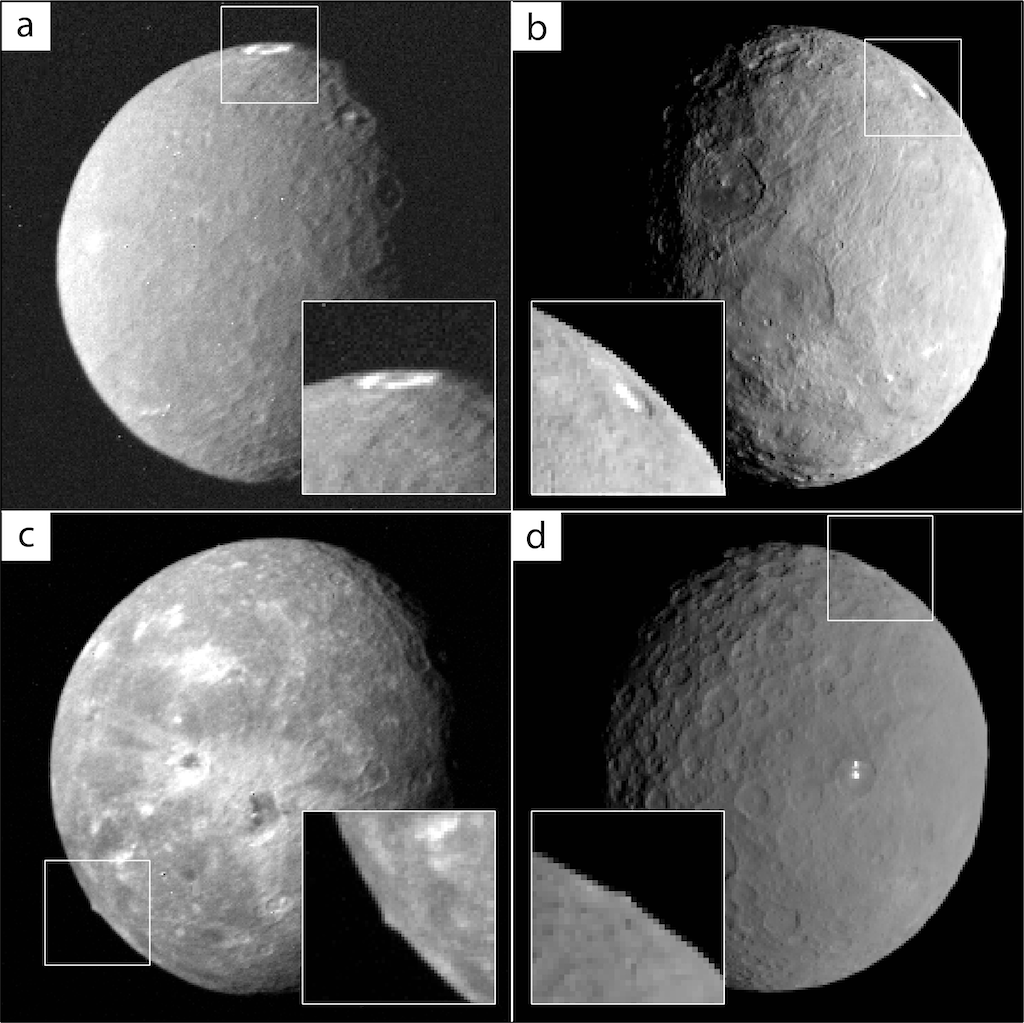
Figure. (a) Bright deposit in Wunda crater, Umbriel, ~4 km/pixel. (b) Faculae in Occator crater, Ceres, ~4 km/pixel. (c) The unnamed mountain on Oberon, ~5 km/pixel. (d) Ahuna Mons on Ceres, ~5 km/pixel.
How to cite: Scully, J., Denton, C. A., Castillo-Rogez, J., Sori, M., Leonard, E., Beddingfield, C., Cartwright, R., Elder, C., Mitchell, K., and Nordheim, T.: Leveraging Ceres to Gain Insights into the Candidate Ocean Worlds of Umbriel and Oberon that Orbit Uranus, EPSC-DPS Joint Meeting 2025, Helsinki, Finland, 7–12 Sep 2025, EPSC-DPS2025-381, https://doi.org/10.5194/epsc-dps2025-381, 2025.


