
 1,2,4,5,
- 1Space Science Division, Southwest Research Institute, San Antonio, TX, 78238, USA (uraut@swri.edu)
- 2University of Texas at San Antonio, Department of Physics and Astronomy, San Antonio, Texas 78249, USA
- 3Solar System Science and Exploration Division, Southwest Research Institute, Boulder, CO, 80302, USA
- 4Purdue University, Department of Earth, Atmospheric and Planetary Sciences, West Lafayette, IN, 47906, USA
- 5Johns Hopkins Applied Physics Laboratory, 11100 John s Hopkins Road, Laurel, MD, 20723, USA
- 6NASA Goddard Flight Center, Greenbelt, MD, 20771, USA
JWST observations of Europa's leading hemisphere show excess CO2 over chaos terrains [1, 2] where the subsurface ocean is likely to have breached the ice shell. Analysis of the 3.5-µm hydrogen peroxide (H2O2) absorption band reveals elevated amounts of H2O2 in these chaos regions. Peroxide abundance scales with CO2 abundance, presenting a strong pixel-level linear correlation, particularly with the υ3 CO2 feature at 4.27 mm (Figure 1).
New laboratory experiments [3] motivated by these observations show that trace inclusions of CO2 can substantially inflate the radiolytic peroxide yield, more so than in pure water ice. We considered various mechanisms by which CO2 boosts H2O2 synthesis and developed an analytical model to quantify the dependence of peroxide enhancement on CO2 abundance [3]. These experiments support the hypothesis that endogenic CO2 may amplify H2O2 synthesis in the Tara and Powys Regiones when processed by Jupiter's magnetospheric particles. We combine the CO2-enhanced H2O2 yields with the energy dose delivered by the magnetospheric particles onto the leading hemisphere [4, 5] to generate a peroxide distribution map to compare with the observed distribution. Our results highlight the intricate interplay of Europa’s interior ocean, geologic activity, and precipitating radiation in shaping surface chemistry, boosting the synthesis of molecules vital for habitability.
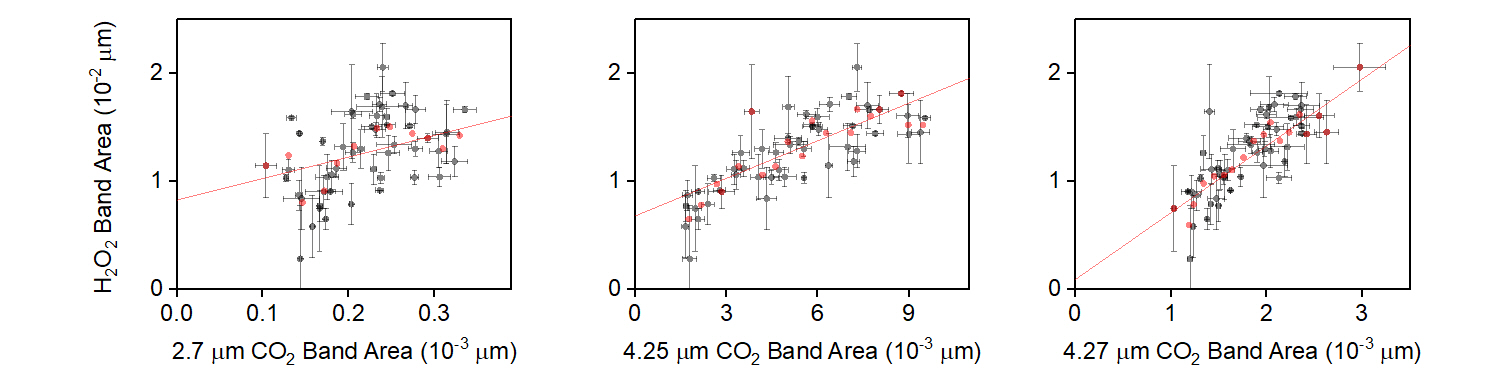
Figure 1: Exploring correlations between Europa’s peroxide and CO2 absorption. Integrated H2O2 band area against each of the three CO2 band areas. Grey data points are individual pixel values, while red points are binned data. The red lines are linear fits to these binned datasets. The strongest linear correlation, quantified by Pearson’s correlation coefficient, occurs between the peroxide and the 4.27 µm CO₂ absorptions.
The rapid transport of peroxide to the subsurface ocean via brine-percolated conduits [6] has strong implications for Europa's habitability. The mixing of these oxidants with reduced seawater, derived from geochemical cycling through the porous seafloor, could generate ‘redox potential’, supplying chemical energy that putative life forms may utilize to sustain metabolism, cellular maintenance, and reproduction [7]. These JWST observations combined with laboratory measurements set the stage for detailed mapping of CO2 (via its 2.7 and ~ 4.2 - 4.3 µm absorptions), H2O2 (via its 3.5 µm absorption) and possibly CHO organics with MISE (Europa Clipper) and MAJIS (Juice) at finer spatial scales to advance our understanding of Europa’s surface and subsurface composition and chemistry.
References:
[1] Villanueva, G. L., et al. 2023, Science, 381, 1305. [2] Trumbo, S. K., & Brown, M. E., 2023, Science, 381, 1308. [3] Mamo, B. et al., 2025, Planetary Science Journal, submitted. [4] Nordheim, T. A., et al., 2022, Planetary Science Journal, 3, 5. [5] Nordheim, T. A., 2018, Nat. Astro., 2, 673-679. [6] Hesse, M.A., et al., 2022, Geophysical Research Letters, 49, 5. [7] Hand, K., et al., 2007, Astrobiology, 7, 1006-1022.
How to cite: Raut, U., Protopapa, S., Mamo, B. D., Teolis, B. D., Erwin, T., Cartwright, R. J., Nordheim, T. A., Kammer, J. A., Retherford, K. D., and Villanueva, G.: Ocean-sourced CO2 inflates radiolytic H2O2 at Europa’s Chaos, EPSC-DPS Joint Meeting 2025, Helsinki, Finland, 7–12 Sep 2025, EPSC-DPS2025-423, https://doi.org/10.5194/epsc-dps2025-423, 2025.


