
 1,1,2,3,1,
- 1University of Zurich, Department of Astrophysics, Zurich, Switzerland
- 2University of Bern, Physics Institute, Space Research and Planetary Sciences, Center for Space and Habitability, Switzerland
- 3Rice University, Department of Earth, Environmental and Planetary Sciences, United States of America
Introduction: The Juno mission has provided the community with accurate measurements of Jupiter’s gravitational field, providing tighter constraints for interior models. Structure models that fit Juno data find that the planet is inhomogeneous in composition and consists of a fuzzy core. Several scenarios for the formation of Jupiter’s fuzzy core were proposed, including the concurrent accretion of heavy elements and H-He gas, core erosion by large-scale or double-diffusive convection and a giant impact that mixed the primordial heavy-element core, distributing the heavy elements beyond the central region. While the possibility of forming Jupiter’s fuzzy core via a giant impact has been studied in prior work [1,2], further investigations of this scenario are required, as each study was limited in several aspects. In this study, we re-asses the giant impact scenario while considering the constraints imposed by using N-body formation simulations, smoothed particle hydrodynamics (SPH) impact simulations with state-of-the-art equations of state and high resolution, and post-impact thermal evolution simulations.
Methods: To assess the expected impact conditions between proto-Jupiter and large embryos, we use an N-body code developed by [3] based on the IAS15 integrator. We simulate the evolution of 10 embryos of the local isolation mass, separated by 5 or 8 mutual Hill radii with different initial inclinations. The simulation uses the gaseous disk model and the growth model of proto-Jupiter from [4] as well as tidal damping of embryos.
We simulate the impacts using an SPH code based on pkdgrav3 [5], derived from the Lagrangian including corrections for variable smoothing length with a kernel that can be sampled with 400 neighbors without suffering from the pairing instability. The code includes improvements for modeling giant impacts such as an interface/free-surface correction and a generalized EOS interface to use state-of-the-art equations of state. The code shows excellent scaling on HPC systems with either CPU based or hybrid CPU/GPU architecture, enabling the use of several billion particles in a simulation.
To simulate Jupiter’s post-impact evolution, we use a modified version of the Modules for Experiments in Stellar Astrophysics code [6]. We use 1D heavy-element fraction profiles extracted from the SPH results and imprint hot, warm and cold temperature profiles. We then evolve all these models for 4.56 Gyr, predicting Jupiter’s current-day composition profiles.
Results: We find that impacts of large embryos on growing Jupiter are unlikely and if an impact happens, it is very likely at an oblique angle, not head-on. This is in stark contrast to the findings of [1] who found that head-on impacts are rather likely to occur during Jupiter’s growth.
We simulate this oblique impact, as well as a head-on and an intermediate impact with SPH to see the effect on the core-envelope structure. The oblique impact does not disrupt the core and even though some impactor material gets mixed into the envelope, most of the mass coalesces onto the core (see Figure 2). In the head-on (see Figure 3) and intermediate impact, the core is fully or partially disrupted, but, in all cases, the heavy elements quickly settle in a massive pure heavy-element core which confirms the findings of [2]. Parts of the heavy elements, especially those originating in the impactor are strongly shock- and compression heated, leading to a very hot core.
The thermal evolution simulations show that when considering reasonable interior temperatures for Jupiter post-impact, giant impacts do not lead to an extended dilute core as inferred by interior models. Convective mixing tends to homogenize the planetary envelope, leaving a distinct compact core (see Figure 4).
Conclusions: We explored the possibility that Jupiter’s fuzzy core is the result of a giant impact. We find that giant impacts on growing Jupiter are unlikely and rather oblique. Such an impact is not able to disturb Jupiter’s core enough to create a fuzzy core. Even in a head-on impact, no fuzzy core remains. If a fuzzy core were formed by a GI, the thermal evolution would quickly result in a homogeneous envelope with a compact core. Jupiter’s fuzzy core has thus not formed via a giant impact. The formation is likely related to Jupiter’s formation history, which also more naturally explains why Saturn also has a fuzzy core.
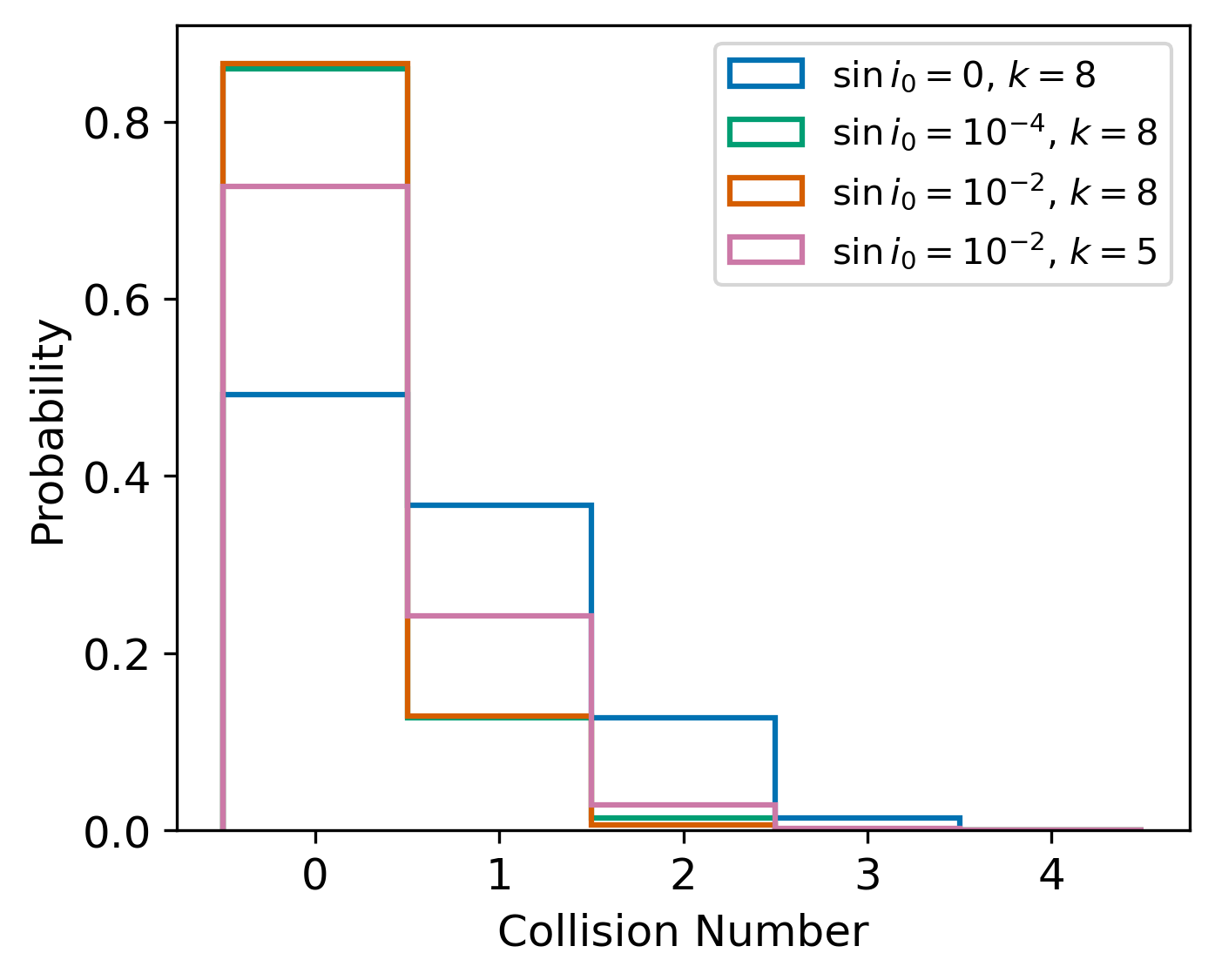
Figure 1: Probability for a collision occurring during Jupiter’s growth.
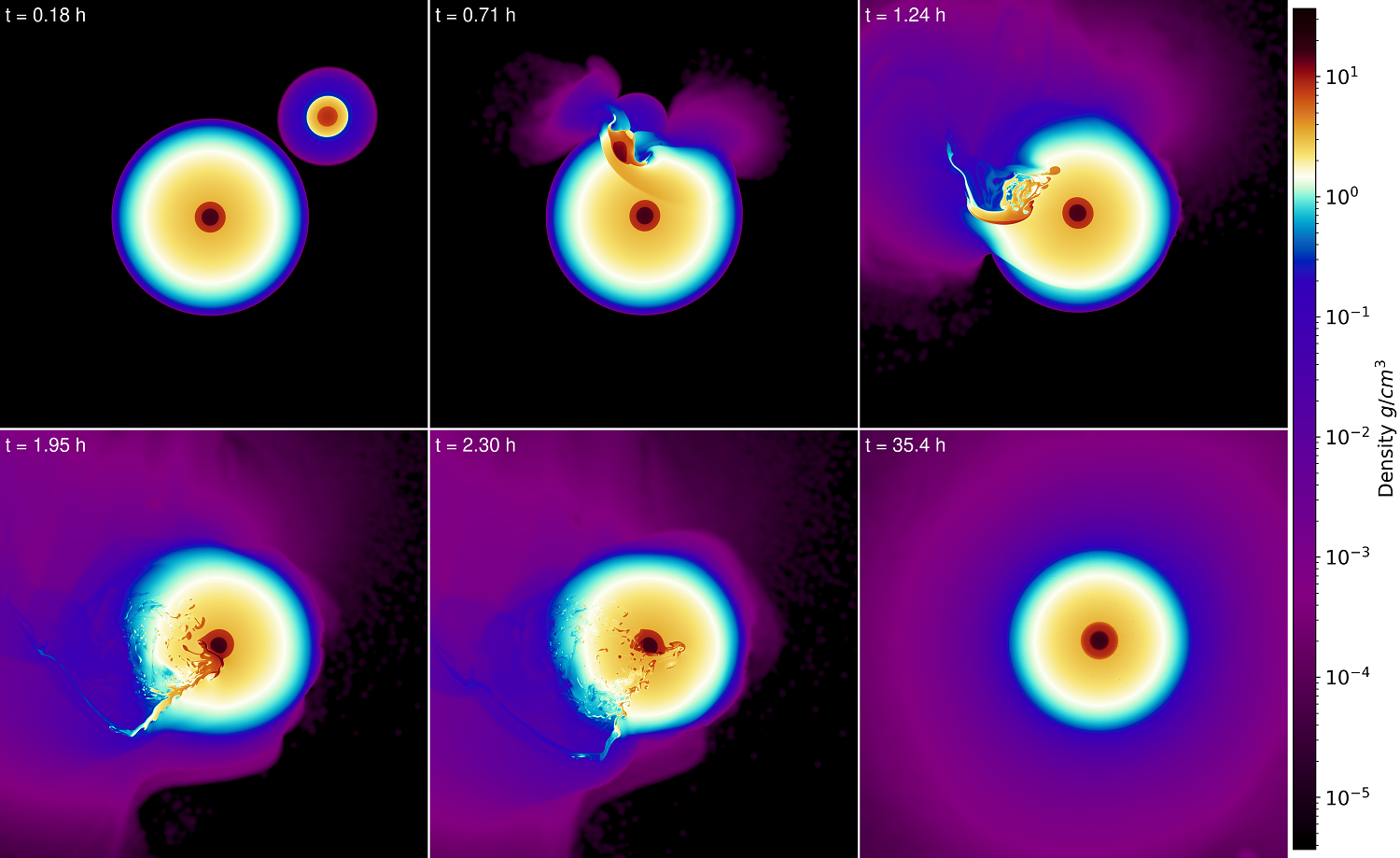
Figure 2: Density slices through the oblique collision with 10^9 particles with sidelength of 50 R⊕.
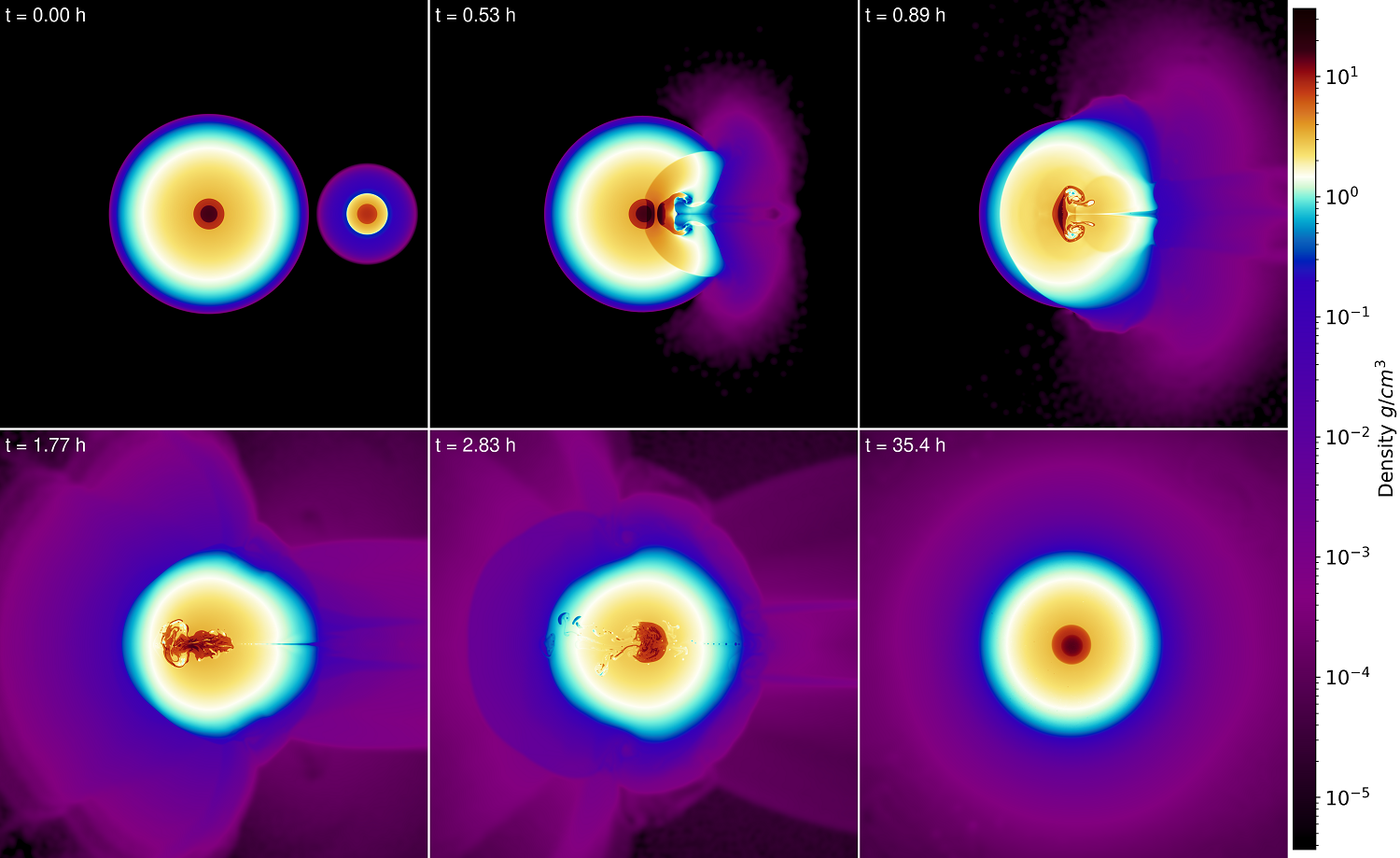
Figure 3: Density slices through the head-on collision with 10^9 particles with sidelength of 50 R⊕.
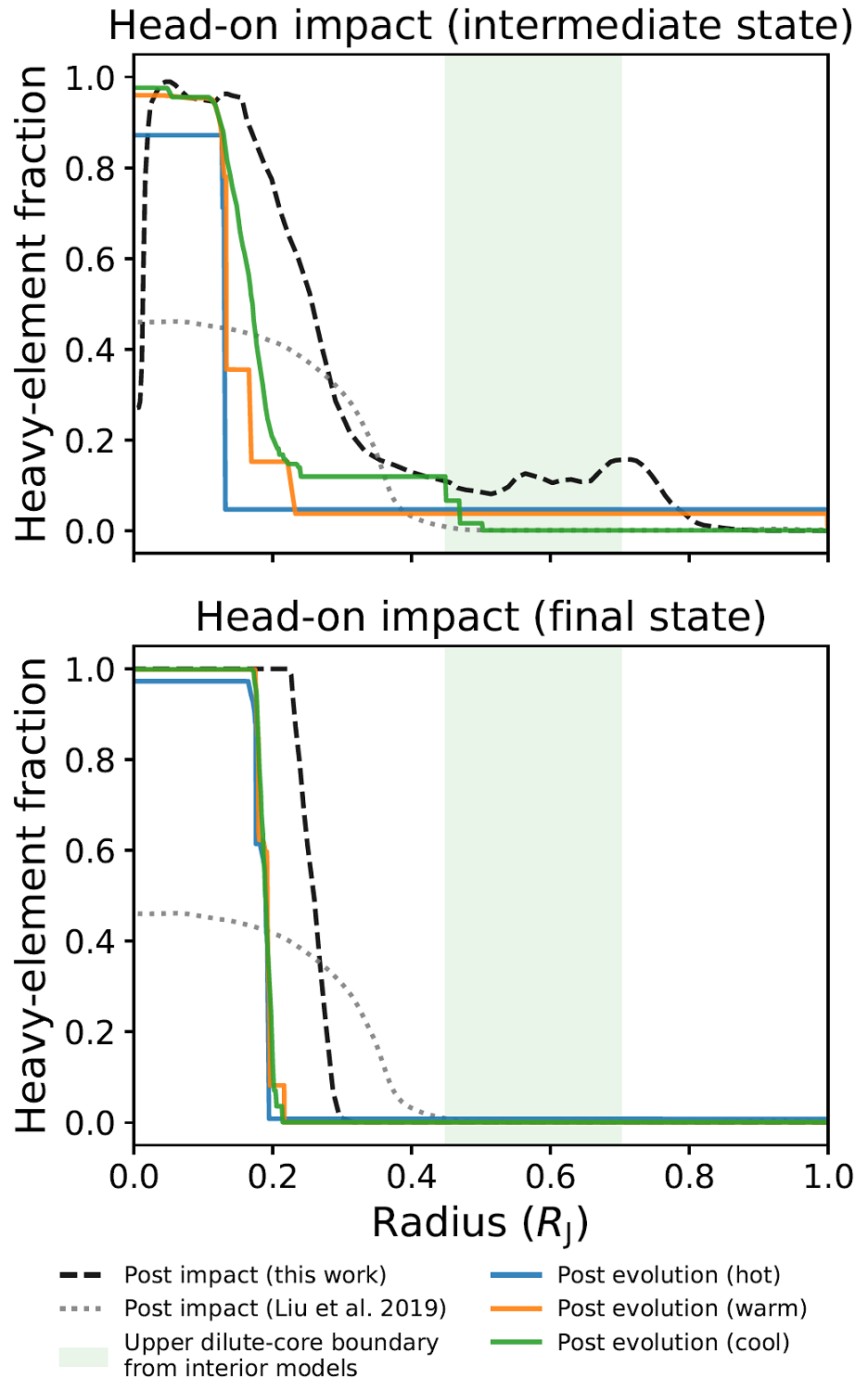
Figure 4: Heavy-element fraction after the impact and after the post-impact evolution.
References:
[1] Liu, S.-F. et al. Nature 572, 355–357 (2019).
[2] Sandnes, T. D., Eke, V. R., Kegerreis, J. A., Massey, R. J. & Teodoro, L. F. A. https://doi.org/10.48550/arXiv.2412.06094 (2024).
[3] Shibata, S. & Helled, R. A&A 689, A26 (2024).
[4] Shibata, S., Helled, R. & Kobayashi, H. Monthly Notices of the Royal Astronomical Society 519, 1713–1731 (2023).
[5] Potter, D., Stadel, J. & Teyssier, R. Comput. Astrophys. 4, 2 (2017).
[6] Müller, S. & Helled, R. ApJ 967, 7 (2024).
How to cite: Meier, T., Reinhardt, C., Shibata, S., Mülller, S., Stadel, J., and Helled, R.: On the origin of Jupiter’s fuzzy core: constraints from N-body, impact, and evolution simulations, EPSC-DPS Joint Meeting 2025, Helsinki, Finland, 7–12 Sep 2025, EPSC-DPS2025-461, https://doi.org/10.5194/epsc-dps2025-461, 2025.


