OPS9 | Giant Planet Interiors, Atmospheres, and Evolution

OPS9

Giant Planet Interiors, Atmospheres, and Evolution
Conveners: Pierre Drossart, Benjamin Idini | Co-conveners: Paula Wulff, Scott Bolton, Cheng Li
Orals THU-OB3
| Thu, 11 Sep, 11:00–12:29 (EEST)
 
Room Mars (Veranda 1)
Posters THU-POS
| Attendance Thu, 11 Sep, 18:00–19:30 (EEST) | Display Thu, 11 Sep, 08:30–19:30
 
Lämpiö foyer, L48–54
Thu, 11:00
Thu, 18:00
The formation and evolution of planets remains a fundamental question with broad implications to the understanding of the structure of the universe and the presence of life beyond Earth. Recent measurements from Juno and Cassini missions have revealed novel fundamental constraints on the interior structure of Jupiter and Saturn and how they relate to atmospheric observations. These new insights are posed to enrich the interpretation of exoplanet atmospheric data and its connection to the bulk composition of exoplanets. Beyond Jupiter and Saturn, the recently proposed Uranus Orbiter and Probe mission has already initiated community efforts to develop new techniques and models to assist the future exploration of ice giant planets. Here we bring together theory and observations capable of advancing our understanding of giant planets in the solar system and beyond. We welcome studies that discuss interiors, formation, evolution, and interior-atmosphere interactions.. Active investigations in this field include ring and Doppler seismology, gravity fields, equations of state, normal mode oscillations, dynamo magnetic fields, core detection and characterization, helium and heavy element bulk composition, formation scenarios, thermal evolution studies, long-living vortices, zonal flows, stable stratification, atmospheric structure, and atmospheric elemental abundances.

Session assets

Orals: Thu, 11 Sep, 11:00–12:30 | Room Mars (Veranda 1)

Chairpersons: Benjamin Idini, Paula Wulff, Scott Bolton
11:00–11:05
11:05–11:17
|
EPSC-DPS2025-243
|
On-site presentation
Glenn Orton, Zhimeng Zhang, Steven Levin, Leigh Fletcher, Fabiano Oyafuso, Cheng Li, Shawn Brueshaber, Michael H. Wong, Thomas Momary, Scott Bolton, Kevin Baines, Emma Dahl, and James Sinclair

       Juno’s Microwave Radiometer (MWR) is providing an unprecedented opportunity to explore the dynamical properties and composition of Jupiter’s atmosphere well below its cloud tops. Jupiter’s atmosphere is arguably the most visibly heterogeneous and time variable in the solar system. Since its arrival on 2016 August 27, the MWR has observed variability in microwave emission at wavelengths between 1.3 and 50 cm, sensing from 0.7 bar to over 100 bars of atmospheric pressure at over 69 close approaches to the atmosphere, known as “perijoves”. There has been a concerted effort to collect contextual information from other Juno instruments, as well as ground- and space-based observations to help interpret the MWR results. The space-based observations have included those from Juno’s own visible camera (JunoCam) and its Jupiter Infrared Auroral Mapper (JIRAM), as well as the Hubble Space Telescope (HST). The ground-based observations have included images and spectra from both professional and citizen-science astronomers.

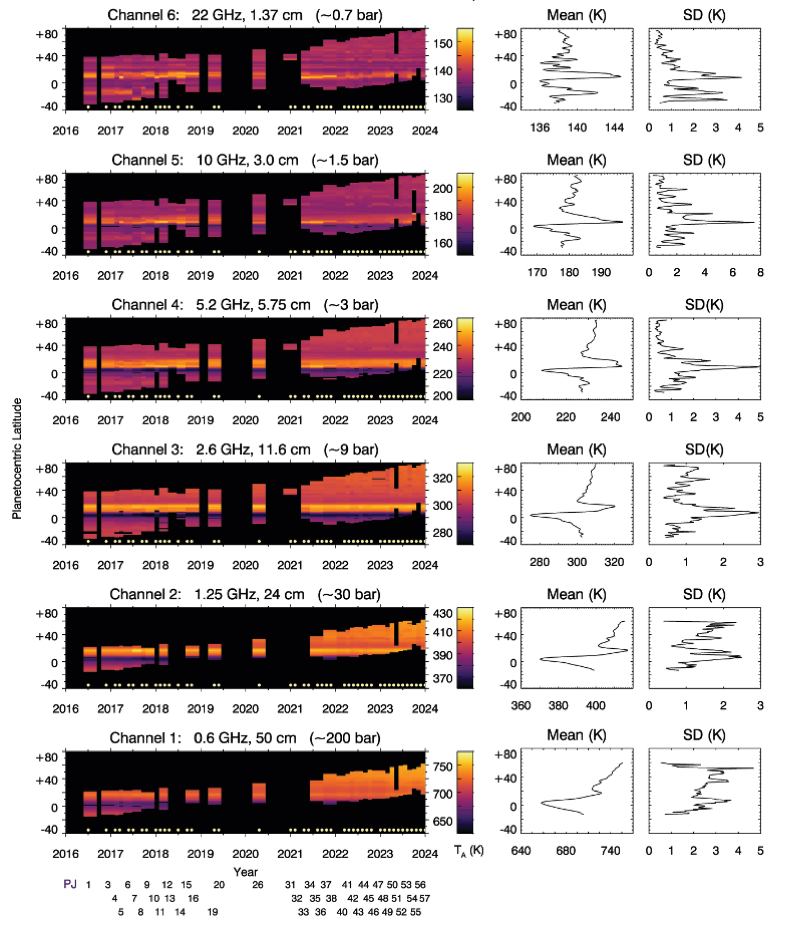
     We report here observations that are constrained to spatial resolutions of 2° in latitude or better, and have been subject to recent improvements in the calibration drift for all MWR’s channels with an improved relative calibration uncertainty of 0.5% or better over the entire mission. These are shown in Figure 1 for the MWR observations covering planetocentric latitudes from 40°S to 80°N. This has allowed us to evaluate zonal-mean temperatures and variability with improved confidence that these are real and not an artifact of receiver drift. The region that shows the greatest variability from a zonal mean is the North Equatorial Belt, (NEB: 12°N-16°N) with a 2% standard deviation from the mean at all levels sensed by the MWR except for the 50-cm channel that senses variability in temperature and ammonia and water composition at pressures in excess of 100 bars of pressure. Among the strongest variability associated with discrete features in the atmosphere is a major upwelling and subsequent clearing of cloud cover in the North Temperate Belt (NTB: 20°N-26°N) in August-September of 2020.  In general, the microwave brightness temperature variability often but not always correlates with visible or near- to mid-infrared variability. In some regions, such as the Equatorial Zone (EZ: 3°S-6°N), substantial variability is detected not only in regions above the level of the water-condensate cloud (~10 bars) but also at great depth (>100 bars). Current work is focusing on identifying where variabilities in the zonal-mean microwave brightness are the result of zonally discrete features in the atmosphere, particularly the NEB. Future work will address observations fulfilling the same spatial resolution requirements but covering higher northern latitudes.


Figure 1. Composite MWR maps of observed zonal-mean antenna temperatures in all channels that cover planetocentric latitudes 40°S to 80°N with 2° meridional resolution, interpolated to a common emission angle of 47°. Maps have been expanded by 0.1 year for visibility. White circles denote the actual date of the measurements, with the responsible perijove indicated at the bottom. Rightmost panels display the zonal-mean temperatures over all perijoves, together with the associated standard deviation. Unfilled spots in the maps correspond to spacecraft attitudes that precluded MWR observations being made at the required spatial resolution. Note that Channels1 and 2 have angular resolutions (“footprints”) twice the size of Channels 3-6; keeping a 2° latitude resolution for those channels thus restricts their coverage relative to Channels 3-6.

How to cite: Orton, G., Zhang, Z., Levin, S., Fletcher, L., Oyafuso, F., Li, C., Brueshaber, S., Wong, M. H., Momary, T., Bolton, S., Baines, K., Dahl, E., and Sinclair, J.: Juno Microwave Radiometer Measurements of the Depths of Spatial and Temporal Variability in Jupiter , EPSC-DPS Joint Meeting 2025, Helsinki, Finland, 7–13 Sep 2025, EPSC-DPS2025-243, https://doi.org/10.5194/epsc-dps2025-243, 2025.

11:17–11:29
|
EPSC-DPS2025-100
|
On-site presentation
Heidi Becker, Martin Brennan, Meghan Florence, Thomas Greathouse, Sushil Atreya, Hunter Waite, Ananyo Bhattacharya, Scott Bolton, and James Alexander

In 2024, the orbital evolution of Juno’s Extended Mission created opportunities for Stellar Reference Unit (SRU) limb observations at high northern latitudes on Jupiter’s night side. The night side measurements were acquired during the period of spacecraft closest approach, from only a few thousand kilometers from the cloud tops. The low-light SRU is a highly sensitive broadband visible wavelength (450-1000 nm) star camera, with a peak sensitivity from ~570-800 nm, that Juno has utilized as a multi-disciplinary science imager. The night side SRU limb imagery provides high-resolution views of the vertical structure of visible wavelength emission layers (and potential photon scattering layers) in Jupiter’s atmosphere between ~100-1300 km above the 1 bar level. Observations made in high northern latitude regions, both inside and outside the auroral region, are compared to those made in the equatorial region. Our presentation will discuss findings and potential interpretations of this unprecedented data set.  

How to cite: Becker, H., Brennan, M., Florence, M., Greathouse, T., Atreya, S., Waite, H., Bhattacharya, A., Bolton, S., and Alexander, J.: Vertical structure of visible wavelength limb emissions on Jupiter’s night side, EPSC-DPS Joint Meeting 2025, Helsinki, Finland, 7–13 Sep 2025, EPSC-DPS2025-100, https://doi.org/10.5194/epsc-dps2025-100, 2025.

11:29–11:41
|
EPSC-DPS2025-526
|
ECP
|
On-site presentation
Keren Duer-Milner, Nimrod Gavriel, Eli Galanti, Eli Tziperman, and Yohai Kaspi

The equatorial jets dominating the dynamics of the Jovian planets  exhibit two distinct types of zonal flows: strongly eastward (superrotation) and strongly westward (subrotation). Existing theories propose different mechanisms for these patterns on gas giants and ice giants, but no single mechanism has successfully explained both. However, the planetary parameters of the four Solar System giant planets suggest that a fundamentally different mechanism is unlikely. In this study, we demonstrate that a convection-driven columnar structure can explain the equatorial jets on all four Jovian planets, framing the problem as a bifurcation phenomenon. Consequently, both superrotation and subrotation emerge as stable branches of the same mechanistic solution. Our analysis of these solutions uncovers similarities in the properties of equatorial waves and the leading-order momentum balance. This study reveals that the underlying dynamics of equatorial jet formation are more universally applicable across the Jovian planets than previously thought, providing a unified explanation for their two distinct zonal wind patterns.

How to cite: Duer-Milner, K., Gavriel, N., Galanti, E., Tziperman, E., and Kaspi, Y.: From Gas to Ice Giants: A Unified Mechanism for Equatorial Jets, EPSC-DPS Joint Meeting 2025, Helsinki, Finland, 7–13 Sep 2025, EPSC-DPS2025-526, https://doi.org/10.5194/epsc-dps2025-526, 2025.

11:41–11:53
|
EPSC-DPS2025-231
|
On-site presentation
Eli Galanti, Maria Smirnova, Maayan Ziv, Matteo Fonsetti, Andrea Caruso, Dustin Buccino, William Hubbard, Burkhard Militzer, Scott Bolton, Tristan Guillot, Ravit Helled, Steven Levin, Marzia Parisi, Ryan Park, Paul Steffes, Paolo Tortora, Paul Withers, Marco Zannoni, and Yohai Kaspi

Jupiter, the fastest-rotating planet in the Solar System, exhibits a pronounced equatorial bulge, with its equatorial radius exceeding the polar radius by approximately 7%. This oblate shape reflects the combined effects of rapid rotation, complex internal structure, and atmospheric winds. Existing estimates of Jupiter's shape, with uncertainties of around 4 km, are based on a single analysis of Voyager and Pioneer radio occultations from nearly five decades ago and do not account for the influence of Jupiter's strong differential rotation. The Juno spacecraft has recently returned numerous high-precision radio-occultation measurements, enabling a more accurate determination. Incorporating the effects of zonal winds, we derive Jupiter's shape with an order-of-magnitude reduction in uncertainty. The results indicate that winds above the visible cloud tops are largely barotropic, showing minimal vertical variation. The updated shape has important implications for interior structure models, supporting a metal-enriched and cooler atmosphere, thereby helping reconcile discrepancies between models, Galileo probe measurements, and Voyager-derived temperatures. The refined radius profile also improves spatial referencing for pressure-dependent observations, offering a more precise context for interpreting Jupiter's atmospheric dynamics.

How to cite: Galanti, E., Smirnova, M., Ziv, M., Fonsetti, M., Caruso, A., Buccino, D., Hubbard, W., Militzer, B., Bolton, S., Guillot, T., Helled, R., Levin, S., Parisi, M., Park, R., Steffes, P., Tortora, P., Withers, P., Zannoni, M., and Kaspi, Y.: The shape of Jupiter redefined by Juno, EPSC-DPS Joint Meeting 2025, Helsinki, Finland, 7–13 Sep 2025, EPSC-DPS2025-231, https://doi.org/10.5194/epsc-dps2025-231, 2025.

11:53–12:05
|
EPSC-DPS2025-452
|
On-site presentation
Hao Cao and Jonathan Aurnou

All four giant planets in our solar system feature planetary-scale magnetic fields and internal heat fluxes that exceed the adiabat. These observations point towards vigorous convection inside the planets, while some stable stratified internal layers have also been suggested. Rotating convective scaling laws can be employed to infer the bulk characteristics of planetary interior dynamics. A recent theoretical study connected the turbulent convection scaling laws across nonrotating, slowly rotating, and rapidly rotating regimes (Aurnou et al. 2020).

Here we apply these scaling laws to the interior dynamics of the four giant planets in the solar system. With the measured heat flow as a critical input parameter, we estimate the characteristic flow speeds and dynamical length-scales within the different giant planet convective zones. These estimations inform us about the importance of rotation on the local dynamics via the local Rossby number. In addition, they can be used to kinematically evaluate the local magnetic field generation efficiency and the importance of Lorentz force via the local magnetic Reynolds number and the local Elsasser number. Our analysis indicates that the local magnetic Reynolds number exhibits a dichotomy between the gas giants and the ice giants. We will discuss how this might contribute to the dipole-multipole dichotomy in their observed magnetic fields.

How to cite: Cao, H. and Aurnou, J.: Giant Planet Interior Dynamics in the Context of Rotating Turbulence Scaling Laws, EPSC-DPS Joint Meeting 2025, Helsinki, Finland, 7–13 Sep 2025, EPSC-DPS2025-452, https://doi.org/10.5194/epsc-dps2025-452, 2025.

12:05–12:17
|
EPSC-DPS2025-1239
|
On-site presentation
Konstantin Batygin and Fred Adams

Jupiter's formation significantly influenced the structure and evolution of our solar system, yet crucial details about its earliest physical state remain uncertain due to the complexity of planet-formation models. Here we will discuss Jupiter's primordial physical state by leveraging the dynamical history of Jupiter’s innermost satellites and the planet’s angular momentum budget. In particular, our analysis indicates that at the time the solar nebula dispersed, Jupiter was 2 to 2.5 times its current size. Furthermore, during this epoch, Jupiter had a magnetic field of at least ~200G, and it was accreting gas through a circumplanetary disk at a rate of about one to two Jupiter masses per million years. These findings support core-accretion models of giant planet formation and offer a critical snapshot of Jupiter's properties at a pivotal stage of the solar system's evolution, providing new insights into the conditions that shaped the largest planet of the sun's planetary album.

How to cite: Batygin, K. and Adams, F.: Determination of Jupiter’s Primordial Radius, Accretion Rate, and Magnetic Field, EPSC-DPS Joint Meeting 2025, Helsinki, Finland, 7–13 Sep 2025, EPSC-DPS2025-1239, https://doi.org/10.5194/epsc-dps2025-1239, 2025.

12:17–12:29
|
EPSC-DPS2025-461
|
ECP
|
On-site presentation
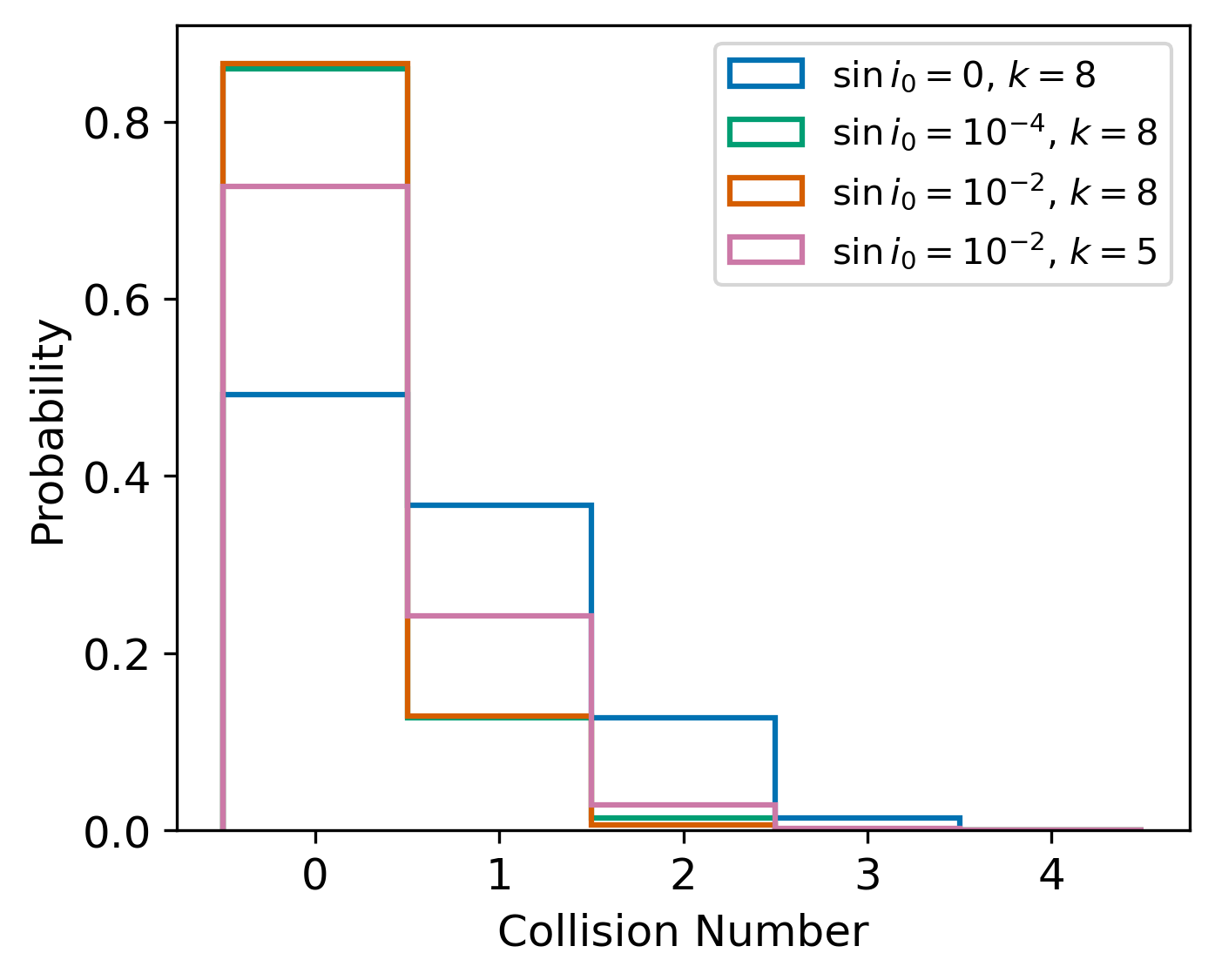
Thomas Meier, Christian Reinhardt, Sho Shibata, Simon Mülller, Joachim Stadel, and Ravit Helled

Introduction: The Juno mission has provided the community with accurate measurements of Jupiter’s gravitational field, providing tighter constraints for interior models. Structure models that fit Juno data find that the planet is inhomogeneous in composition and consists of a fuzzy core. Several scenarios for the formation of Jupiter’s fuzzy core were proposed, including the concurrent accretion of heavy elements and H-He gas, core erosion by large-scale or double-diffusive convection and a giant impact that mixed the primordial heavy-element core, distributing the heavy elements beyond the central region. While the possibility of forming Jupiter’s fuzzy core via a giant impact has been studied in prior work [1,2], further investigations of this scenario are required, as each study was limited in several aspects. In this study, we re-asses the giant impact scenario while considering the constraints imposed by using N-body formation simulations, smoothed particle hydrodynamics (SPH) impact simulations with state-of-the-art equations of state and high resolution, and post-impact thermal evolution simulations.

Methods: To assess the expected impact conditions between proto-Jupiter and large embryos, we use an N-body code developed by [3] based on the IAS15 integrator. We simulate the evolution of 10 embryos of the local isolation mass, separated by 5 or 8 mutual Hill radii with different initial inclinations. The simulation uses the gaseous disk model and the growth model of proto-Jupiter from [4] as well as tidal damping of embryos.

We simulate the impacts using an SPH code based on pkdgrav3 [5], derived from the Lagrangian including corrections for variable smoothing length with a kernel that can be sampled with 400 neighbors without suffering from the pairing instability. The code includes improvements for modeling giant impacts such as an interface/free-surface correction and a generalized EOS interface to use state-of-the-art equations of state. The code shows excellent scaling on HPC systems with either CPU based or hybrid CPU/GPU architecture, enabling the use of several billion particles in a simulation.

To simulate Jupiter’s post-impact evolution, we use a modified version of the Modules for Experiments in Stellar Astrophysics code [6]. We use 1D heavy-element fraction profiles extracted from the SPH results and imprint hot, warm and cold temperature profiles. We then evolve all these models for 4.56 Gyr, predicting Jupiter’s current-day composition profiles.

Results: We find that impacts of large embryos on growing Jupiter are unlikely and if an impact happens, it is very likely at an oblique angle, not head-on. This is in stark contrast to the findings of [1] who found that head-on impacts are rather likely to occur during Jupiter’s growth.

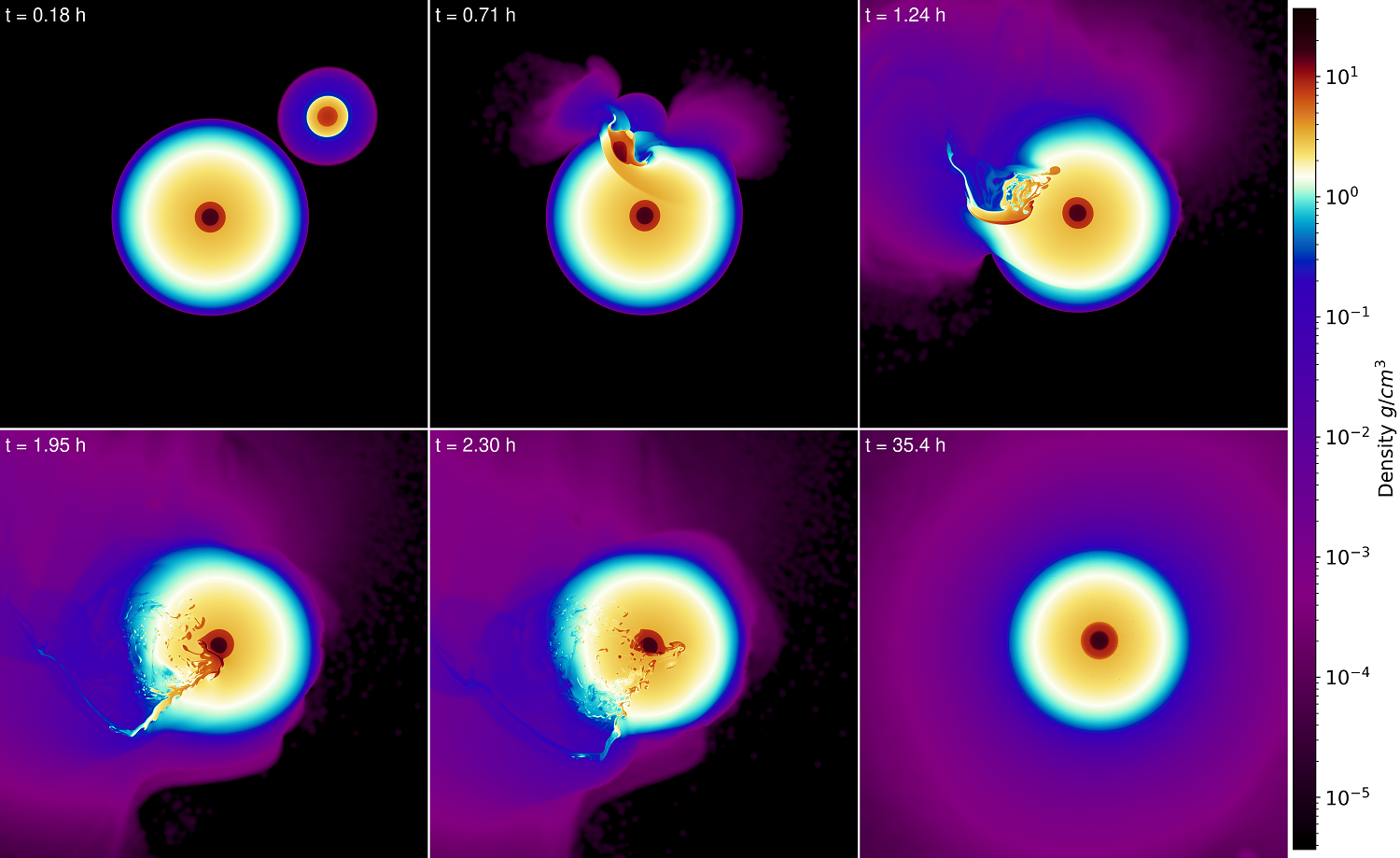
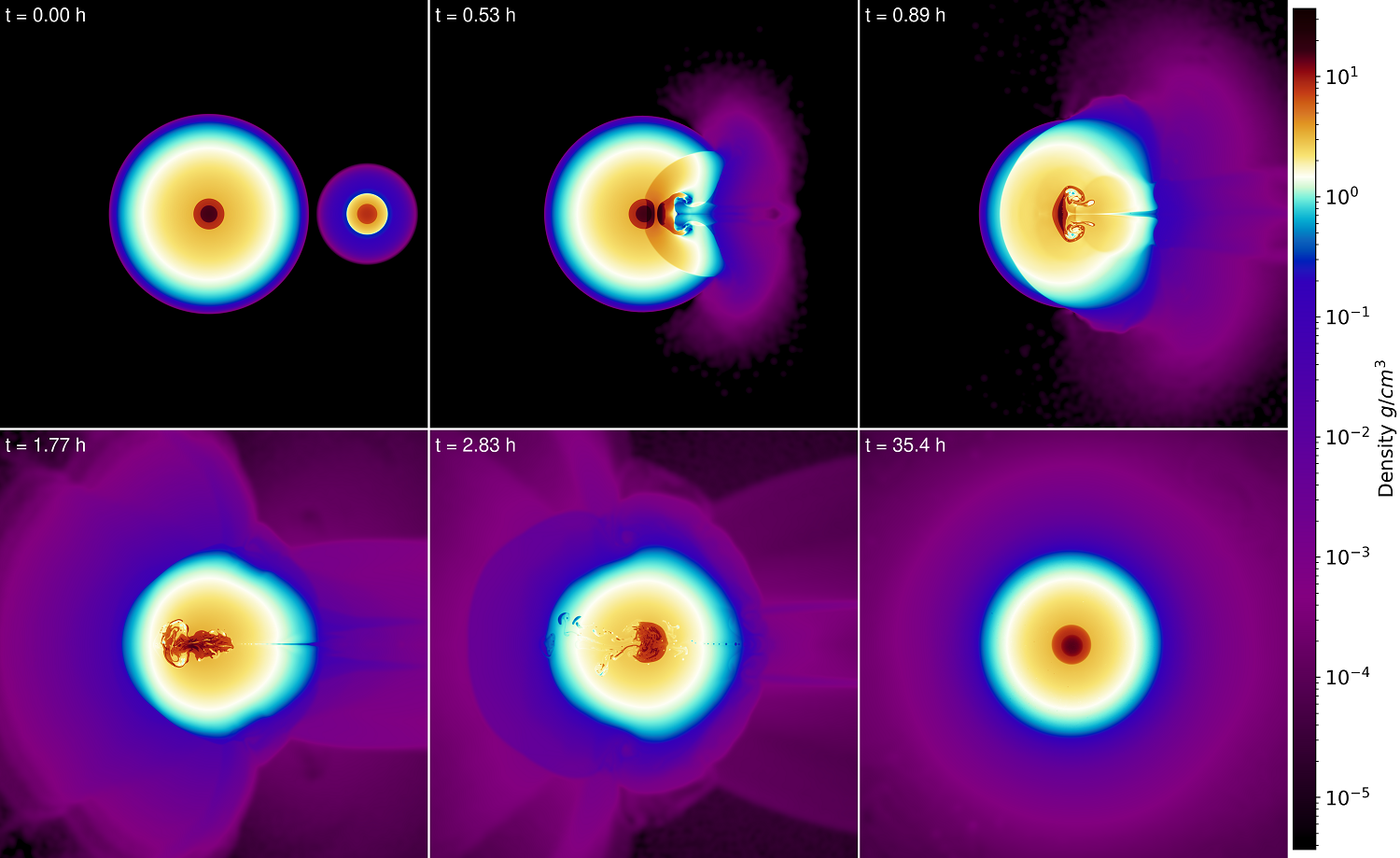
We simulate this oblique impact, as well as a head-on and an intermediate impact with SPH to see the effect on the core-envelope structure. The oblique impact does not disrupt the core and even though some impactor material gets mixed into the envelope, most of the mass coalesces onto the core (see Figure 2). In the head-on (see Figure 3) and intermediate impact, the core is fully or partially disrupted, but, in all cases, the heavy elements quickly settle in a massive pure heavy-element core which confirms the findings of [2]. Parts of the heavy elements, especially those originating in the impactor are strongly shock- and compression heated, leading to a very hot core.

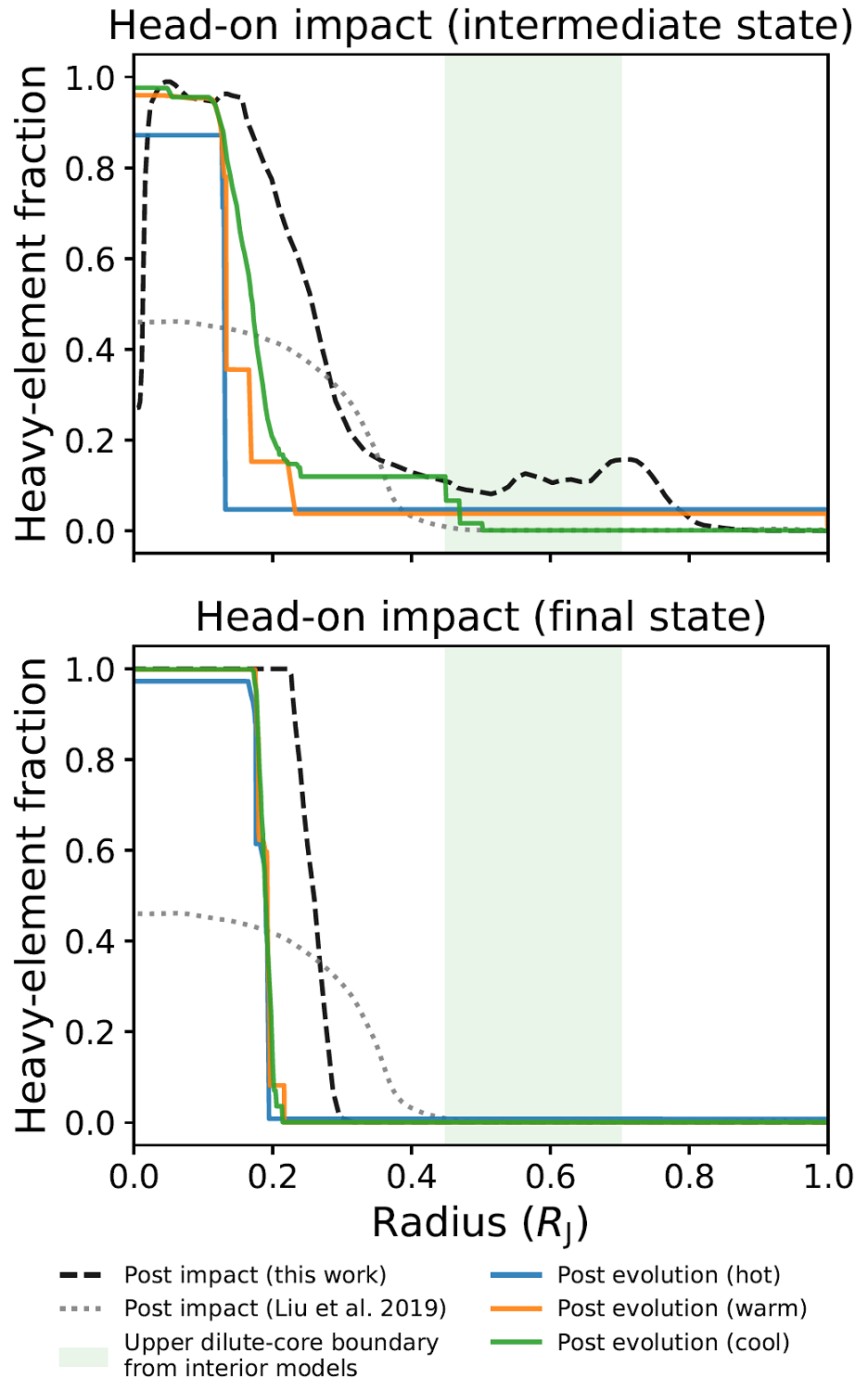
The thermal evolution simulations show that when considering reasonable interior temperatures for Jupiter post-impact, giant impacts do not lead to an extended dilute core as inferred by interior models. Convective mixing tends to homogenize the planetary envelope, leaving a distinct compact core (see Figure 4).

Conclusions: We explored the possibility that Jupiter’s fuzzy core is the result of a giant impact. We find that giant impacts on growing Jupiter are unlikely and rather oblique. Such an impact is not able to disturb Jupiter’s core enough to create a fuzzy core. Even in a head-on impact, no fuzzy core remains. If a fuzzy core were formed by a GI, the thermal evolution would quickly result in a homogeneous envelope with a compact core. Jupiter’s fuzzy core has thus not formed via a giant impact. The formation is likely related to Jupiter’s formation history, which also more naturally explains why Saturn also has a fuzzy core.

Figure 1: Probability for a collision occurring during Jupiter’s growth.


Figure 2: Density slices through the oblique collision with 10^9 particles with sidelength of 50 R.


Figure 3: Density slices through the head-on collision with 10^9 particles with sidelength of 50 R.


Figure 4: Heavy-element fraction after the impact and after the post-impact evolution.

References:

[1] Liu, S.-F. et al. Nature 572, 355–357 (2019).

[2] Sandnes, T. D., Eke, V. R., Kegerreis, J. A., Massey, R. J. & Teodoro, L. F. A. https://doi.org/10.48550/arXiv.2412.06094 (2024).

[3] Shibata, S. & Helled, R. A&A 689, A26 (2024).

[4] Shibata, S., Helled, R. & Kobayashi, H. Monthly Notices of the Royal Astronomical Society 519, 1713–1731 (2023).

[5] Potter, D., Stadel, J. & Teyssier, R. Comput. Astrophys. 4, 2 (2017).

[6] Müller, S. & Helled, R. ApJ 967, 7 (2024).

How to cite: Meier, T., Reinhardt, C., Shibata, S., Mülller, S., Stadel, J., and Helled, R.: On the origin of Jupiter’s fuzzy core: constraints from N-body, impact, and evolution simulations, EPSC-DPS Joint Meeting 2025, Helsinki, Finland, 7–13 Sep 2025, EPSC-DPS2025-461, https://doi.org/10.5194/epsc-dps2025-461, 2025.

Posters: Thu, 11 Sep, 18:00–19:30 | Lämpiö foyer

Display time: Thu, 11 Sep, 08:30–19:30
Chairpersons: Benjamin Idini, Paula Wulff
L48
|
EPSC-DPS2025-1831
|
ECP
|
On-site presentation
H-He and the extension of Jupiter’s dilute core
(withdrawn)
Benjamin Idini
L49
|
EPSC-DPS2025-1293
|
ECP
|
On-site presentation
Maayan Ziv, Eli Galanti, and Yohai Kaspi

Understanding the interiors of both Jupiter and Saturn is essential for building a consistent picture of giant planet formation and evolution. While the two planets share many similarities, each provides unique observational windows into its internal structure: Jupiter through atmospheric abundances measured by the Galileo entry probe and the Juno mission, and Saturn through oscillation modes detected via ring seismology. In both cases, high-precision gravity measurements, by Juno for Jupiter and Cassini for Saturn, offer strong constraints on interior models. However, despite their accuracy, these measurements cannot uniquely determine the internal structure, given the complexity and variability of possible structural configurations.

To address this, we develop a unified modeling framework that combines NeuralCMS, a deep neural network trained on interior models computed with the concentric Maclaurin spheroid (CMS) method, with a self-consistent wind model. This approach enables efficient exploration of a wide parameter space of Jupiter interior models without relying on prior assumptions. Using clustering analysis on the multidimensional model space, we identify four key classes of interior structures, characterized by differences in core configuration and envelope properties. We also show that Jupiter’s structure can be effectively described using only two key parameters, significantly reducing the complexity of the problem.

We then extend this approach to model Saturn’s interior, enabling a systematic and meaningful comparison between the two planets within a shared framework. The comparative analysis provides a broader perspective on the diversity of giant planet interiors and the processes that shape them. This work demonstrates the value of unified, data-driven modeling approaches in advancing our understanding of giant planet interiors across the Solar System.

How to cite: Ziv, M., Galanti, E., and Kaspi, Y.: From Jupiter to Saturn: Characterizing Interior Structures with Machine Learning, EPSC-DPS Joint Meeting 2025, Helsinki, Finland, 7–13 Sep 2025, EPSC-DPS2025-1293, https://doi.org/10.5194/epsc-dps2025-1293, 2025.

L50
|
EPSC-DPS2025-413
|
ECP
|
On-site presentation
Caleb Keaveney and Juan Lora

Uranus is a unique world in the solar system, with its extreme obliquity and low apparent internal heat flux raising compelling atmospheric and climate dynamics questions. Observations reveal an altogether different circulation regime from the gas giants, with a single mid-latitude prograde jet in each hemisphere and a weak subrotating equatorial jet. Indications of a warm equator and poles with cool mid-latitudes, as well as density gradients associated with nonuniform abundance of methane and hydrogen sulfide, can be linked to vertical motion in the upper atmosphere and vertical structure in the jets (Fletcher et al., 2021). Multiple haze and aerosol layers are likely present as well, which are a major component of the atmosphere’s radiation budget (Irwin et al., 2022). All these observations suggest a complex climate system and global circulation, but they do not provide an especially clear or self-consistent model. This motivates greater observational efforts which are ongoing, particularly with the development of the Uranus Orbiter and Probe mission. However, such efforts will take a long time to get off the ground, and long-term variability in the Uranus climate system cannot be studied directly with observations due to the long orbital period and radiative timescales. Thus, global climate modeling is necessary to fully understand the dynamics of the Uranian climate.

Here we present progress on the development of a comprehensive general circulation model (GCM) for Uranus to investigate climatic processes. The GCM is built on the GFDL Finite-Volume Cubed-Sphere (FV3) dynamical core, which solves the nonhydrostatic Euler equations for a shallow atmosphere on a highly parallelizable finite-volume grid (Harris et al., 2021). We have made modifications to incorporate Uranus’s planetary constants, extend the model bottom to higher pressures, and introduce parameterizations of unresolved physical processes relevant for Uranus. These include several options, of varying complexity, to parameterize radiative heating and cooling: Newtonian cooling; a two-stream gray radiation scheme based on Liu & Schneider (2010); and a correlated-k radiative transfer scheme modified from Lora et al. (2015), including full opacity contributions from molecular and collision-induced absorption, Rayleigh scattering, and scattering and absorption by aerosol layers as described by Irwin et al. (2022).

Our work focuses on understanding jet formation and overturning circulations driven by baroclinic eddies and momentum transport in Uranus's atmosphere. The connection between this global circulation and chemical tracer gradients—particularly methane and hydrogen sulfide—is another area of interest, as is the influence of Uranus’s extreme seasonal forcing, which remains poorly understood. The hierarchy of simulation complexity enabled by our various model configurations will enable us to diagnose the dominant mechanisms controlling Uranus's climate. The temperature and wind structures simulated with a simple Newtonian cooling case, which show the development of mid-latitude prograde jets and an equatorial retrograde jet, are consistent with observations (Figure 1). The prograde jets are eddy-driven as indicated by the distribution of eddy angular momentum flux divergence, which reveals deposition of prograde angular momentum into the mid-latitudes by baroclinic Rossby waves. Prograde angular momentum is fluxed out of low latitudes in the process, resulting in a weak subrotating jet centered on the equator. Associated with these jets are three meridional overturning cells. Separately, the correlated-k radiative transfer scheme, including all opacity contributions, an enthalpy-conservative dry convective adjustment scheme, and a thermosphere heat conduction scheme (Milcareck et al., 2024) produces a Uranus-like vertical temperature profile (Figure 2) between 10 bar and the lower stratosphere, with a too-cold upper stratosphere, consistent with previous modeling challenges. We will show progress in integrating this correlated-k radiative transfer scheme with the GCM dynamics, with simulations including full seasonally varying radiation, a weak intrinsic heat flux, and a parameterization of interior drag.

Figure 1: Zonal and time mean temperature (top) and zonal wind (bottom) for Newtonian cooling simulation over one Uranus year.

Figure 2: Radiative-convective equilibrium temperature profiles from correlated-k radiative transfer scheme. Blue curve shows global mean simulation, green shows equatorial profile, red shows Orton et al. (2014) observations. 

References

Fletcher, L. N., de Pater, I., Orton, G. S., Hofstadter, M. D., Irwin, P. G. J., Roman, M. T., & Toledo, D. (2020). Ice Giant Circulation Patterns: Implications for Atmospheric Probes. Space Science Reviews, 216(2), 21. https://doi.org/10.1007/s11214-020-00646-1

Irwin, P. G. J., Teanby, N. A., Fletcher, L. N., Toledo, D., Orton, G. S., Wong, M. H., Roman, M. T., Pérez-Hoyos, S., James, A., & Dobinson, J. (2022). Hazy Blue Worlds: A Holistic Aerosol Model for Uranus and Neptune, Including Dark Spots. Journal of Geophysical Research: Planets, 127(6), e2022JE007189. https://doi.org/10.1029/2022JE007189

Harris, L., Chen, X., Putman, W., Zhou, L., & Chen, J.-H. (2021). A Scientific Description of the GFDL Finite-Volume Cubed-Sphere Dynamical Core. Geophysical Fluid Dynamics Laboratory. https://repository.library.noaa.gov/view/noaa/30725

Liu, J., & Schneider, T. (2010). Mechanisms of jet formation on the giant planets. Journal of the Atmospheric Sciences, 67(11), 3652–3672. https://doi.org/10.1175/2010JAS3492.1

Lora, J. M., Lunine, J. I., & Russell, J. L. (2015). GCM simulations of Titan’s middle and lower atmosphere and comparison to observations. Icarus, 250, 516–528. https://doi.org/10.1016/j.icarus.2014.12.030

Milcareck, G., Guerlet, S., Montmessin, F., Spiga, A., Leconte, J., Millour, E., Clément, N., Fletcher, L. N., Roman, M. T., Lellouch, E., Moreno, R., Cavalié, T., & Carrión-González, Ó. (2024). Radiative-convective models of the atmospheres of Uranus and Neptune: Heating sources and seasonal effects. Astronomy & Astrophysics. http://arxiv.org/abs/2403.13399

Orton, G. S., Moses, J. I., Fletcher, L. N., Mainzer, A. K., Hines, D., Hammel, H. B., Martin-Torres, J., Burgdorf, M., Merlet, C., & Line, M. R. (2014). Mid-infrared spectroscopy of Uranus from the Spitzer infrared spectrometer: 2. Determination of the mean composition of the upper troposphere and stratosphere. Icarus, 243, 471–493. https://doi.org/10.1016/j.icarus.2014.07.012

How to cite: Keaveney, C. and Lora, J.: Toward a Comprehensive Global Climate Model of Uranus: Radiative-Convective and Dynamical Simulations, EPSC-DPS Joint Meeting 2025, Helsinki, Finland, 7–13 Sep 2025, EPSC-DPS2025-413, https://doi.org/10.5194/epsc-dps2025-413, 2025.

L51
|
EPSC-DPS2025-155
|
ECP
|
On-site presentation
Anuja Raorane, Ramon Brasser, Soko Matsumura, Tommy Lau, Man Hoi Lee, and Audrey Bouvier

The formation of gas giants has greatly influenced the structure of our solar system while their evolution has played a crucial role in shaping its history. Consequently, the growth of Jupiter has been studied quite extensively. However, little attention has been paid to Saturn and the other giants in the outer solar system.

Here we explore, through 𝑁-body simulations, the implications of the simplest disc and pebble accretion model on the formation of the giant planets in the solar system. A steady-state accretion scenario with an assumed ring structure in the disc at 5 AU was adopted for the simulations. A 10-parameter space was explored, including disk parameters related to gas — such as the gas diffusion rate and the strength of disk turbulence — as well as parameters concerning planetesimals, including their number, mass, and spatial distribution.

In this framework, giant planet formation is most sensitive to the accretion sticking efficiency in addition to all the gas disk parameters. The probability distribution of the final location of the giant planets is approximately constant in log r, suggesting there is a slight preference for formation closer to the Sun, but no preference for more massive planets to form closer. We compute the average formation time for proto-Jupiter to reach 10 Earth masses to be 1.1 ± 0.3 Myr and for proto-Saturn 3.3 ± 0.4 Myr, while for the ice giants this increases to ~5 Myr.

The formation timescales of the cores of the gas giants are distinct, suggesting that they formed sequentially. Accordingly, ice giants formed at the very end of the gas disc’s lifetime resulting in their low gas mass. A larger parameter space and extended simulation times are required to capture the full range of possible outcomes, with particular emphasis on producing all three types of giant planets within a single simulation.

How to cite: Raorane, A., Brasser, R., Matsumura, S., Lau, T., Lee, M. H., and Bouvier, A.: Giant Planet Formation in the Solar System, EPSC-DPS Joint Meeting 2025, Helsinki, Finland, 7–13 Sep 2025, EPSC-DPS2025-155, https://doi.org/10.5194/epsc-dps2025-155, 2025.

L52
|
EPSC-DPS2025-438
|
On-site presentation
Gerald Eichstädt, Shawn Brueshaber, Cheng Li, Steven Levin, Shannon Brown, Glenn Orton, John Rogers, Candice Hansen-Koharcheck, and Scott Bolton

JunoCam images show a stable and approximately irrotational north polar cyclone, surrounded by eight circumpolar cyclones (CPCs) (Figure 1). The CPCs have been essentially stable over almost a decade since their discovery in 2016. They show only a minor zonal drift. Some of the CPCs develop and maintain a counter-rotating core that remains sustained over several months or longer. Those CPCs show a much stronger signature in MWR data than CPCs without a large embedded counter-rotating vortex. Between the north polar cyclone and the surrounding CPCs, up to about two additional large anti-cyclones occur that are not as stable or as long-lasting as the CPCs.


Figure 1: North polar CPC cluster seen by MWR and JunoCam. The north polar cyclone is nearly invisible in MWR data. CPCs with counter-rotating core tend to be brighter in MWR.

We have used a two-layer fluid dynamical model. In its first 2D layer we have assumed a steady flow with a north polar cyclone surrounded by CPCs with an optional counter-rotating core. A coupled second 2D layer behaves like an incompressible Euler flow, except for its coupling defined by a vorticity flux proportional to the vorticity difference between the two layers. This model develops almost no vertical vorticity flux for the north polar cyclone, but more vorticity flux for CPCs with a counter-rotating core than for those without such a feature, see Figure 2.

Figure 2
First row: Two-layer fluid model with an assumed steady 2D flow in layer 1 in the left panel, the simulated fluid layer 2 in the right panel, and the required vorticity flux at the center. Yellow means north anticylonic, blue means cyclonic vorticity.
Second row: Simulated vorticity flux blurred with color scheme adjusted to that of MWR.
 
The model vorticity flux resembles MWR data while the simulated fluid layer resembles JunoCam data. It is important to note that JunoCam is an optical imager and therefore sees the cloud tops, while MWR is a microwave radiometer whose 6 channels see thermal emission from about the 1-bar level to about the 100-bar level. Vertical vorticity flux between simulated layers might be interpreted as related to convection and induced heat transport between otherwise geostrophic fluid layers. This may then show up in temperature deviations in MWR data. Since the north polar cyclone and the CPCs without a counter-rotating core are closer to an equilibrium, and require less vorticity flux to remain stable, their geostrophic layer shows less temperature anomalies in MWR. However, this conceivable physical interpretation is beyond the limitations of the simplified empirical model.
 
Once an approximate underlying steady flow is inferred from MWR and JunoCam data, another deeper layer can be proposed to enable that inferred and assumed steady flow pattern. Such a deeper flow might host a rotationally symmetrical zonal flow that is suggested by observations of Jupiter's lower latitudes. The three-layer extension of the model starts with members of the family of rotationally symmetrical zonal flows, and attempts to infer a member that is suitable to induce an overlying fluid layer that resembles the CPC cluster that was previously assumed as an underlying steady flow to explain MWR and JunoCam data, see Figure 3.
 
Figure 3: A three-layer fluid-dynamical model with a rotationally symmetrical flow in layer 0 shown in the left panel. This layer induces a structure of CPCs (blue) with anticyclonic (orange) cores as shown in layer 2 in the right panel via an intermediate layer 1 as shown in the center panel.
 
For stable CPCs to form from a rotationally symmetrical zonal flow, a cylonic annulus with anticyclonic borders is required. The induced overlying layer will develop a cluster of CPCs if the coupling is adjusted to a suitable range. The number of CPCs is related to the width of the annulus, and depends to some degree on its structure in detail.
For a counter-rotating core to form and to be kept stable, the cyclonic annulus is best split into two with a suitable anticyclonic annulus inserted. Once the cyclones form in the overlying layer, they develop an anticyclonic core, if their centers happen to be located above the inserted anticylconic annulus. The modeled vorticity flux will accumulate anticyclonic vorticity in the core of the CPC from underneath.
Anticyclones can form between the north polar cyclone and the CPCs, if the shielding of the polar cyclone is modeled in the bottom-most layer as an anticyclonic annulus that is separated from the polar vortex.
The north polar cyclone needs to be shielded at some point within the polygon enclosed by the centers of the CPCs since otherwise the enclosed circulation would induce a net zonal CPC drift, see Figure 4a.
 
Figure 4
a: A cyclonic solid body vortex shielded by an anticyclonic annulus. Its radius can vary between that of the solid body vortex and that of the inner shielding of the cylconic annulus.
b: Model with two to three anticyclones forming from an underlying anticyclonic ring inside the CPC cluster.
 
The degree of freedom can be used to model an annulus that induces the formation of two or more large anticyclones, as shown in Figure 4b.
 
Distinct morphological structures within the CPCs tend to develop from an annular structure more naturally if the annuli of cyclonic and anticyclonic vorticity are separated more distinctly than based on a Gaussian-like cross section of their stream function, see Figure 5a.
 
Figure 5
a: An underlying steady flow with sharply defined annuli induces distinct structures.
b: An underlying steady flow that induces FFR-like flow.
 
Simulated structures resembling folded filamentary regions (FFRs) tend to form if the underlying concentric annuli structure does not show a sufficiently clear excess of cyclonic vorticity together with a border of shielding anticyclonic vorticity as a function of radius, as illustrated in Figure 5b. In that case, local chaotic turbulence tends to form easier than a distinct filament roll-up into large vortices. This scenario appears to be present outside the polar CPC cluster.


How to cite: Eichstädt, G., Brueshaber, S., Li, C., Levin, S., Brown, S., Orton, G., Rogers, J., Hansen-Koharcheck, C., and Bolton, S.: An empirical three-layer fluid dynamical model for a combined JunoCam and MWR snapshot of Jupiter's north polar region, EPSC-DPS Joint Meeting 2025, Helsinki, Finland, 7–13 Sep 2025, EPSC-DPS2025-438, https://doi.org/10.5194/epsc-dps2025-438, 2025.

L53
|
EPSC-DPS2025-730
|
ECP
|
On-site presentation
Louis Siebenaler and Yamila Miguel

Interior models of giant planets in the Solar System traditionally assume convection as the dominant heat transport mechanism in the molecular hydrogen envelope. However, several observations of Jupiter are challenging to explain under this assumption, including the measured abundances of CO and water in the atmosphere, as well as the depth of the zonal winds. A stable layer located around the kilobar level has been proposed to reconcile these observations, an idea that has gained more support with recent Juno measurements of alkali metals, which suggest a depletion in the deep atmosphere. While the presence of a stable layer around the kilobar level appears promising, the degree of alkali depletion required to sustain it remains unclear.

In this work, we compute new opacity tables to determine the specific atmospheric compositions that can give rise to stable stratification in the outer envelopes of Jupiter and Saturn. Using evolution models, we investigate the long-term conditions that allow stable layers to persist, and how their depth changes over time. In addition, we investigate how stable layers influence key observables, such as the effective temperature and the atmospheric helium abundance.

How to cite: Siebenaler, L. and Miguel, Y.: Conditions for stable layers in Jupiter and Saturn over time, EPSC-DPS Joint Meeting 2025, Helsinki, Finland, 7–13 Sep 2025, EPSC-DPS2025-730, https://doi.org/10.5194/epsc-dps2025-730, 2025.

L54
|
EPSC-DPS2025-1782
|
ECP
|
On-site presentation
Abel George, Liza Verma, and Ishan Sharma

Introduction: Planetary rings, such as those of Saturn, are thin, rotating systems composed of numerous small particles. Due to their small aspect ratio, they can be approximated as shallow fluid layers in the continuum limit.

Scientific context: We apply rotating shallow water theory to model these rings, adapting it to account for the parent planet’s gravitational potential and magnetic field. The dynamics are further influenced by particle charging via solar wind, satellite interactions, photoionization, and triboelectric effects. These introduce electromagnetic forces, motivating the use of shallow water magnetohydrodynamics (SWMHD).

Method and Results: We derive the SWMHD equations for a rotating annular channel subject to radial gravity and an external magnetic field, representing the planetary ring system. Analytical exploration of the resulting wave modes reveals the dependence of wave frequencies on geometric and physical parameters like aspect ratio, channel width, fluid column height, and gravity harmonics. We identify critical parameter thresholds where certain wave modes cease to exist. In the asymptotic limit of a large-radius channel, the system behavior converges to that of classical rotating channel flows, validating the model. 

References
• Klimachkov, D. A., & Petrosyan, A. S. (2017). Parametric instabilities in shallow water magnetohydrodynamics
of astrophysical plasma in external magnetic field. Physics Letters A, 381(1), 106–113. https://doi.org/
10.1016/j.physleta.2016.10.011
• Fedotova, M. A., Klimachkov, D. A., & Petrosyan, A. S. (2020). The shallow-water magnetohydrodynamic
theory of stratified rotating astrophysical plasma flows: beta-plane approximation and magnetic Rossby waves.
Plasma Physics Reports, 46(1), 50–64. https://doi.org/10.1134/S1063780X20010079
• Zeitlin, V. (2013). Remarks on rotating shallow-water magnetohydrodynamics. Nonlinear Processes in Geophysics, 20(6), 893–898. https://doi.org/10.5194/npg-20-893-2013
• Gledzer, A. E., et al. (2018). On the structures observed in thin rotating layers of a conductive fluid and the
anomalies of the geomagnetic field. Izvestiya, Physics of the Solid Earth, 54(4), 574–586. https://doi.
org/10.1134/S1069351318040031 

How to cite: George, A., Verma, L., and Sharma, I.: Shallow water magnetohydrodynamic theory with application to Planetary ring, EPSC-DPS Joint Meeting 2025, Helsinki, Finland, 7–13 Sep 2025, EPSC-DPS2025-1782, https://doi.org/10.5194/epsc-dps2025-1782, 2025.