
 1,1,1,1,
- 1University of Bern, Physics Institute, Space Research and Planetary Sciences, Switzerland
- 2University of Bern, Institute for Applied Physics, Switzerland
Background
Europa's icy surface is exposed to low pressures and subject to intense radiation, resulting in complex processes such as sublimation and radiolytic modification that influence its spectral properties. Interpreting reflectance spectra from future missions like Europa Clipper and JUICE requires understanding how salts in Europa’s surface ice evolve under such conditions. Specifically, the formation and stability of hydrated salts such as hydrohalite (NaCl·2H₂O) are of great interest.
Methods
Granular icy analogs containing NaCl, MgSO₄, and MgCl₂ were produced by flash-freezing brine droplets with 5 wt% salt content. These samples were put in a vacuum chamber, simulating the surface evolution at low pressures and temperatures over hundreds of hours. A novel application of a thermopile sensor, with a custom sensor mount and calibration algorithm, allowed direct surface temperature measurement (160–185 K), enabling us to scale laboratory sublimation timescales to equivalent durations under Europa conditions. Reflectance spectra were acquired in the 400–2500 nm range using a hyperspectral imaging system. In a separate set of experiments, NaCl analogs were irradiated with 2 keV electrons to simulate Europa’s radiation environment and study the stability of observed spectral features.
Results
Sublimation caused notable changes in the reflectance spectra of all analog samples over hundreds of hours, which can be scaled to Europa-equivalent timescales of less than 10’000 years. The broad water absorption bands around 1.5 µm and 2.0 µm became shallower over time, and the overall reflectance increased, indicating the formation of optically dominant salt crusts on the surface due to water loss. The equivalent geometric albedo of all samples increased by more than 10% during sublimation, implying a substantial change in the surface's thermal properties.
In the NaCl-containing samples, a distinct narrow absorption band emerged at 1.98 µm, consistent with the formation of hydrohalite (NaCl·2H₂O) during sublimation, as can be seen in Figure 1. In contrast, samples containing MgSO₄ and MgCl₂ did not show narrow hydration bands during sublimation. However, changes in the shape of the 2 µm band were observed, with a slight skew in the MgSO₄ sample and a strong asymmetry in the MgCl₂ sample, both toward shorter wavelengths.
To investigate the stability of the hydrohalite feature, the NaCl samples were exposed to 2 keV electron irradiation at a total dose of 3.4 × 10¹⁶ electrons / cm². The 1.98 µm feature was significantly diminished after irradiation, corresponding to just a few years of surface exposure on Europa (see Figure 2). This shows a rapid dehydration of hydrohalite under electron bombardment.
These spectral and physical changes highlight the importance of accounting for sublimation and radiation effects when interpreting Europa’s surface composition from remote sensing data.
The presented data is publicly available under the DOI’s 10.26302/SSHADE/EXPERIMENT_RO_20240312_001 and 10.26302/SSHADE/EXPERIMENT_RO_20240701_000.
Conclusions
Our results demonstrate that sublimation alters the reflectance spectra of salty ice on Europa over short geological timescales. Sublimation processes must be accounted for in spectral interpretations to avoid overestimating bulk salt abundances. The formation of hydrohalite during sublimation and its rapid destruction under irradiation implies it is unlikely to be stable under typical conditions on Europa’s surface. If hydrohalite is present on the surface, it is either freshly exposed material (<10 years) or sustained by thermal anomalies (>145 K). Thus, any detection of hydrohalite in future observations would strongly indicate recent surface activity.
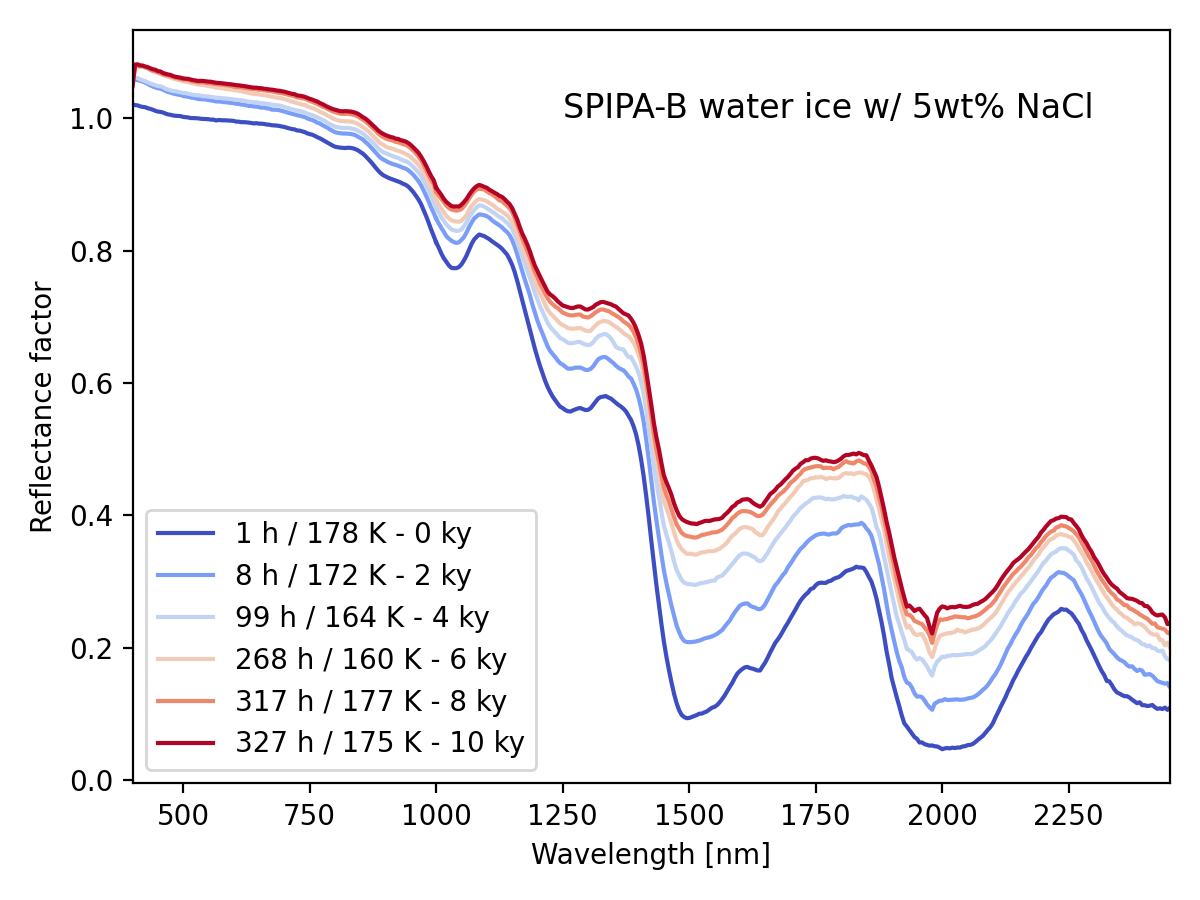
Figure 1: Sublimation of a grainy ice analog containing 5 wt% NaCl. The relative laboratory time and the measured surface temperature for all spectra are shown in the legend. The estimated timescales in the unit of 1000 years (ky), when the sublimation kinetics are scaled to Europa’s equatorial conditions, are given after the dash.
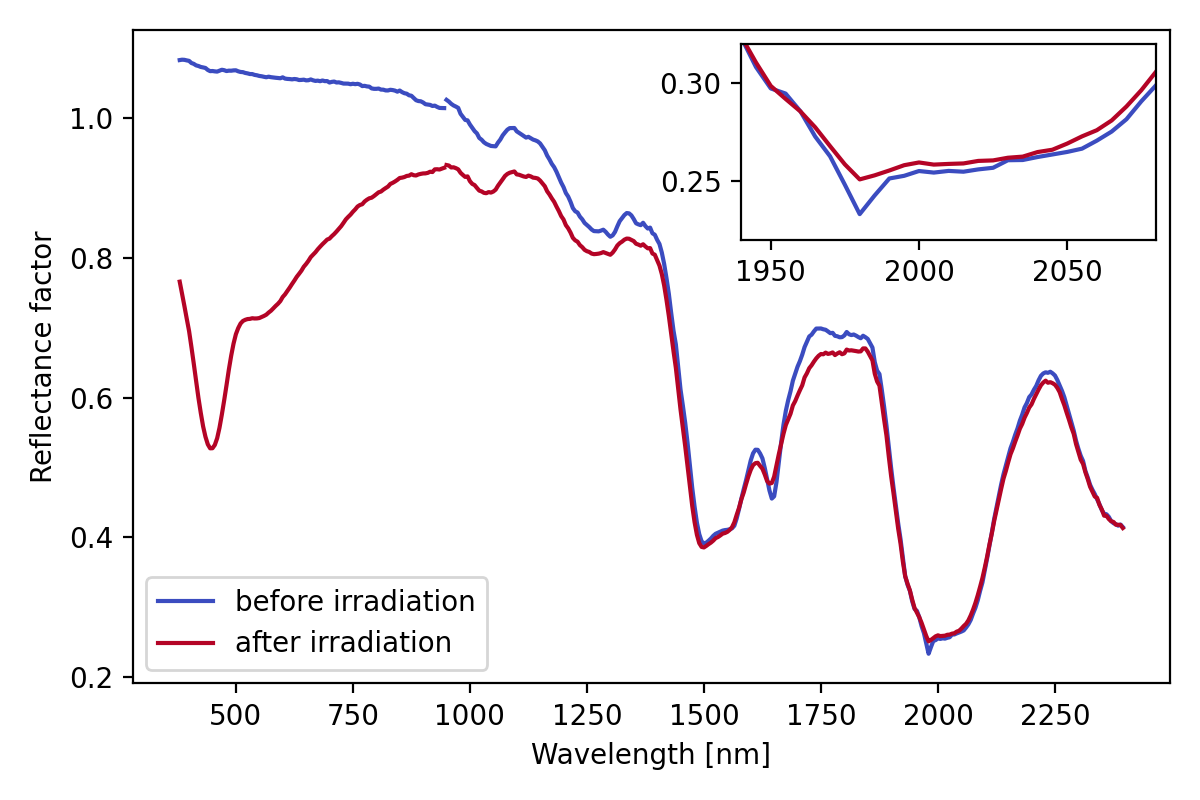
Figure 2: The reflectance spectra of a grainy ice analog with 5 wt% NaCl. The two lines show the reflectance before and after irradiation with 2 keV for 10 min with a current of 10 µA. The irradiation leads to the formation of color centers in the Vis and reduces the depth of the absorption band at 1.98 µm.
How to cite: Ottersberg, R., Pommerol, A., Stöckli, L. L., Obersnel, L., Galli, A., Murk, A., Wurz, P., and Thomas, N.: Evolution of Granular Salty Ice Analogs for Europa: Sublimation and Irradiation, EPSC-DPS Joint Meeting 2025, Helsinki, Finland, 7–12 Sep 2025, EPSC-DPS2025-529, https://doi.org/10.5194/epsc-dps2025-529, 2025.


