
 1,2,3,4,2,2,3,2,3,7,8,10,
- 1Universidad del País Vasco / Euskal Herriko Unibertsitatea, Escuela de Ingenieria de Bilbao, Física Aplicada I, Bilbao, Spain (ricardo.hueso@ehu.es)
- 2INAF-IAPS, Institute of Space Astrophysiscs and Planetology, Rome, Italy
- 3DLR, Institute of Planetary Research, Berlin, German
- 4CSIC-IAA Astrophysics Institute of Andalucia, Granada, Spain
- 5INAF-OAPD, Astronomical Observatory of Padova, Italy
- 6CISAS G. Colombo, Padova University, Italy
- 7Italian Space Agency (ASI), Rome, Italy
- 8School of Physical Sciences, Open University, Milton Keynes, UK
- 9JAXA-Institute of Space and Astronautical Science, Sagamihara, Japan
- 10NASA Goddard Space Flight Center, Code 690, Greenbelt, MD 20771, USA
- *A full list of authors appears at the end of the abstract
JUICE (JUpiter ICy moons Explorer) was launched in April 2023 and will arrive at the Jupiter system in July 2031 [1, 2] after a tour that includes various gravitational assist maneuvers with the Earth, the Moon, and Venus. The first of these maneuvers was a Lunar and Earth Gravitational Assist (LEGA) that was run on August 19-20 2024, and provided an opportunity to test JUICE instruments’ performance in a real operational scenario. JANUS (Jovis, Amorum ac Natorum Undique Scrutator) [3] is the camera system on board JUICE. The instrument obtains images in the 340-1080 nm wavelength range with 13 filters in a filter wheel, and it uses a CMOS detector with 2000x1504 pixels with an angular resolution of 15 microrad/pixel.
JANUS imaged the Earth over 30 min. at a closest distance of 8,408 km obtaining sequences of single and multi-filter images. The set of observations started with a night-side inbound over the north of the Mozambique Channel with an elongated strip of observations that ended over the day-side over the Pacific Ocean. JANUS obtained night-side observations of Earth’s airglow and city lights from low population areas with some illumination of Earth’s surface provided by the Moon (Fig. 1). Observations at the terminator included dawn observations of Luzon in the Philippines (Fig. 2), followed by multi-filter images of meteorological systems over the Pacific Ocean with tangent illumination. Later morning observations of tropical convective clouds show elongated shadows that provide a means to measure cloud altitudes from the geometry of the shadows over the ocean. Observations in the 940 nm wavelength are sensitive to water absorption in the atmosphere and are also indicative of cloud altitude (Fig. 3). Images of the ocean in the green filter showed features compatible with internal waves.
Many of these observations are analogs to the observations of Jupiter’s atmosphere that JANUS will acquire. Earth’s airglow observations are akin to observations of the auroral oval in Jupiter. City lights of different intensity can be compared with expected observations of lightning on Jupiter, and water and multi-filter observations of tropical clouds with their projected shadows serve us to prepare for studies of relative cloud altitude determination on Jupiter’s atmosphere. Consecutive observations of cloud fields separated by a few minutes will be examined to develop image stacking and image correlation comparisons to improve image quality. These observations also allow us to quantify their potential for wind retrievals from image correlation algorithms. Weakly contrasted features in the ocean will be presented and compared with wave features on Jupiter. Finally, a full portrait of the Earth and the Moon was obtained days later after LEGA at a distance of about 5.6 million km at a phase angle of 70º in all filters (Fig. 4). The sequence includes exotic views of the Earth-Moon system in Ha and Na filters. Spectral trends over JANUS’ filter bandwidths of different locations on Earth will be presented. The performance of the JANUS camera will be compared to hyperspectral data acquired by the EnMAP satellite mission [4, 5] close to the time of the JUICE flyby and to data from the PRISMA mission [6].
Figures
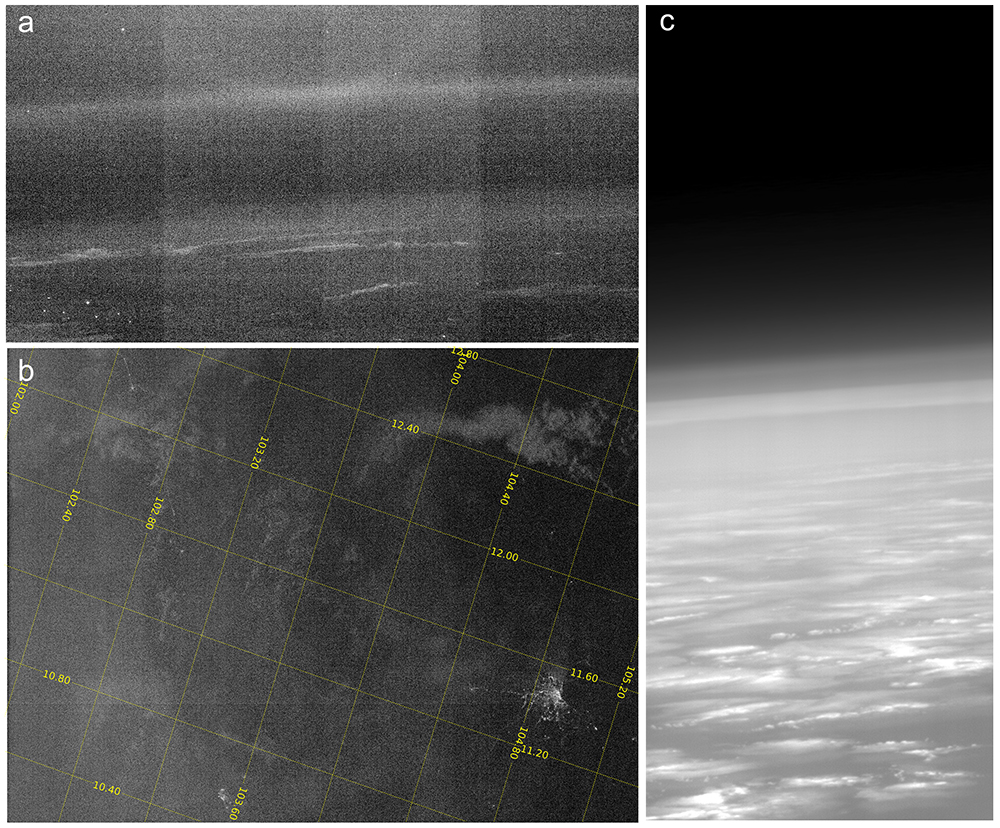
Figure 1: Limb and night-side images of the Earth. (a) Night-side observation of Earth’s limb with airglow, stars and city lights from Madagascar. Clouds are illuminated by moonlight. (b) Clouds and city lights from Nom Pen in Cambodia. (c) Day-side limb view of the Earth.
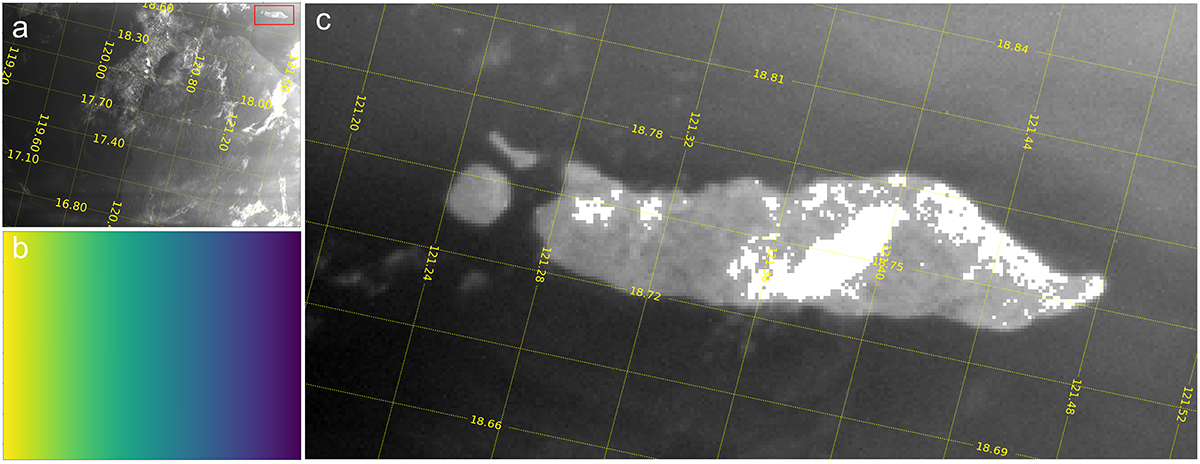
Figure 2: JANUS panchromatic observation of Luzon Island in the Philippines before dawn. (a) Full frame image of 2000x1500 pixels. North is up and East is to the right. (b) Incidence angle from 91.5º (right) to 93.5º (left). (c) Fuga island north of Luzon. The mean emission angle and incidence angles of this region is 91.8º and 1.8º respectively. Saturated pixels correspond to elevated clouds over the island. The image was obtained at a distance of 9,334km and the pixel size is about 140m.
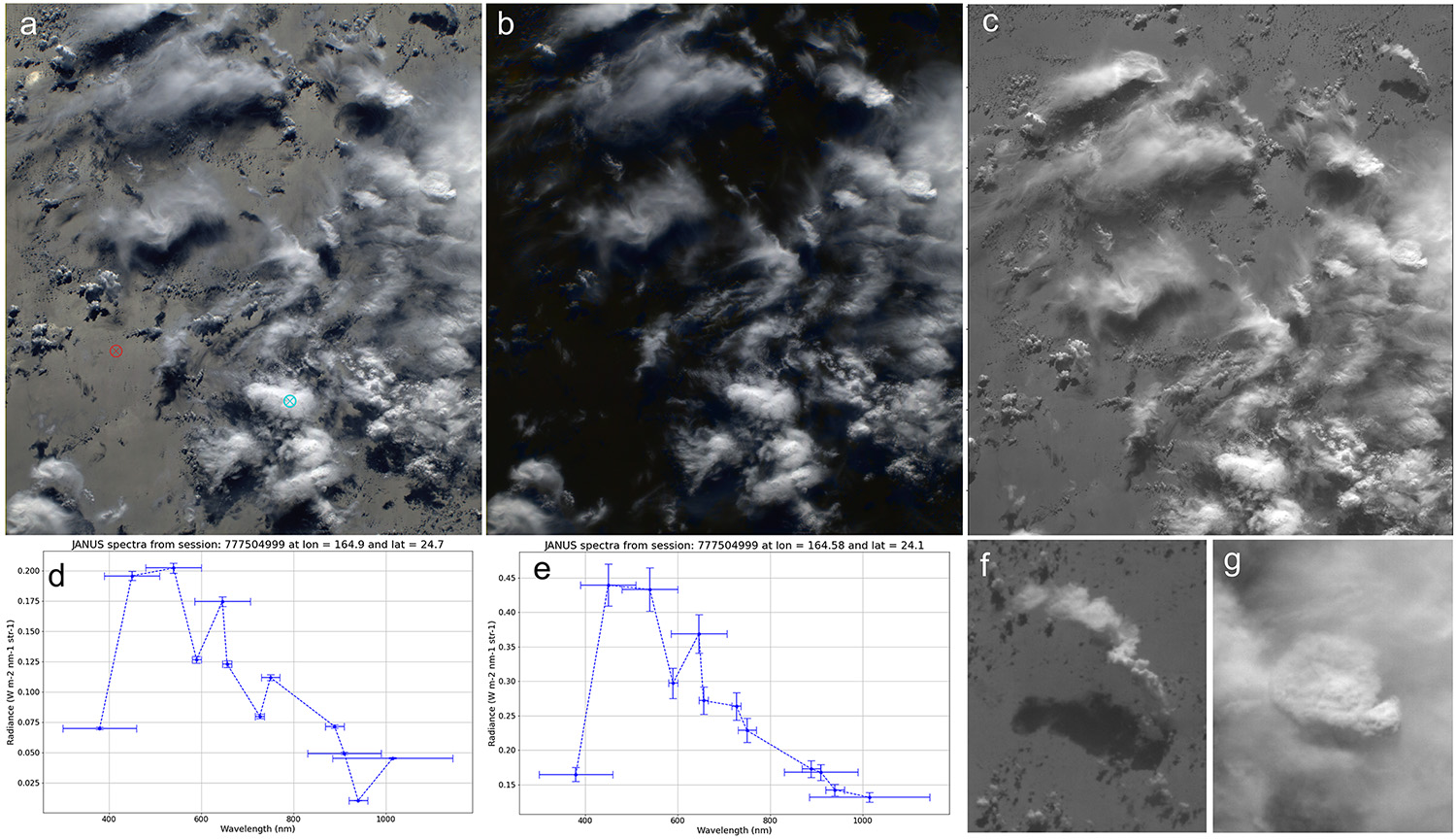
Figure 3: Multi-filter images of the Pacific Ocean. (a) RGB color composite. The color of the ocean is affected by sunglint. (b) Observation in the CMT_Strong JANUS filter at 940 nm. This filter is highly sensitive to absorption from atmospheric water and only elevated clouds are visible in the image. (c) Observation in the violet filter with the lowest contrast between clouds and ocean. (d) Spectral trends from JANUS filters for the ocean (red circle in a). (e) Spectral trends from JANUS filters from a convective cloud (blue circle in a). (f) and (g) Zoom over elevated clouds and shadows from panel (c).
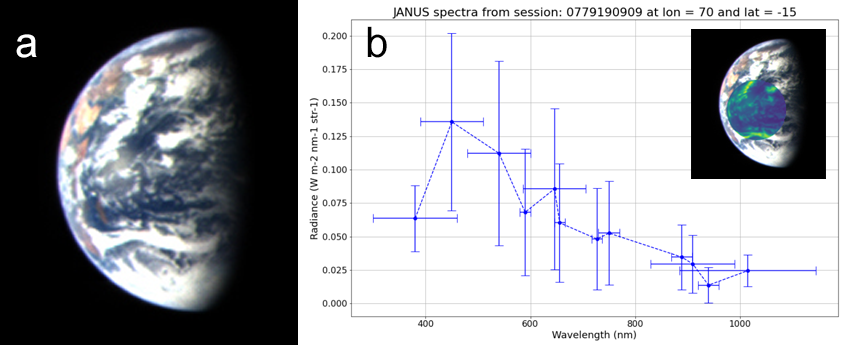
Figure 4: Multi-filter images of the Earth. (a) RGB color composite of the Earth from a distance of 5.645 million km. (b) Spectral trend over the Indian Ocean with effects from clouds and sunglint.
References: [1] Grasset et al. JUpiter ICy moons Explorer (JUICE): An ESA mission to orbit Ganymede and to characterise the Jupiter system. Planetary and Space Science, 78 (2013). [2] Witasse et al. The JUpiter ICy moons Explorer (JUICE) mission: status report, science objectives, plans for the cruise phase, collaboration with Europa Clipper. AGU Fall Meeting 2023, (2023). [3] Palumbo et al. The JANUS (Jovis Amorum ac Natorum Undique Scrutator) VIS-NIR Multi-Band Imager for the JUICE Mission. Space Science Reviews, 221 (2025). [4] Chabrillat, S. et al. (2024), The EnMAP spaceborne imaging spectroscopy mission: Initial scientific results two years after launch. Remote Sensing of Environment, 315, 114379. doi: 10.1016/j.rse.2024.114379. [5] Storch, T. et al. (2023) The EnMAP imaging spectroscopy mission towards operations. Remote Sensing of Environment, 294, 113632. doi: 10.1016/j.rse.2023.113632ISSN 0034-4257. [6] Vangi et al. (2021) The New Hyperspectral Satellite PRISMA: Imagery for Forest Types Discrimination, Sensors 2021, 21, 1182; https://doi.org/10.3390/s21041182.
Acknowledgments: JANUS has been funded by the respective Space Agencies: ASI (lead funding agency), DLR, Spanish Research Ministry and the UK Space Agency. Main hardware-provider Companies and Institutes are Leonardo SpA (Prime Industry), DLR-Berlin, CSIC-IAA and Sener. PI and Italian team members acknowledge ASI support in the frame of ASI-INAF agreement n. 2023-6-HH.0.
Pasquale Palumbo, Ganna Portyankina, Thomas Roatsch, Luisa Maria Lara, Manish Patel, Cecilia Tubiana, Alessio Aboudan, Livio Agostini, Luca Penasa, Alice Lucchetti, Klaus-Dieter Matz, Romolo Politi, Frank Trauthan, Angelo Zinzi, Jose Maria Castro-Marin, Vincenzo Della Corte, Stubbe Hviid, Ralf Jaumann, Harald Michaelis, Nicole Schmitz, Christian Althaus, Fernando Álvarez, Michael Aye, Mirco Bartolomei, Thomas Behnke, Thomas Bilotta, Giacomo Colombatti, Antonio Colosimo, Athena Coustenis, Gabriele Cremonese, Chiaki Crews, Alessandro Dattolo, Tilmann Denk, Bjorn Fiethe, Miguel Herranz, Olaf Hillenmaier, Ricardo Hueso, Alexander Koncz, Jaime Jimenez-Ortega, Alexander Lichopoj, Lorenzo Livi, Xavi Llamas, Ignacio Martinez-Navajas, Elena Mazzotta Epifani, Volker Mertens, Maurizio Pajola, Francesco Sarti, Rolf Schroedter, Katrin Stephan, Federico Tosi, Belinda Wendler, Dennis Wendler, Friederike Wolff, Michele Zusi, Sebastiano Chiodini, Iacopo Ficai Veltroni, Antonio Jesus García-Segura, Davide Greggio, Thomas Kenkmann, Demetrio Magrin, Harald Michalik, Matteo Munari, Giovanni Enrico Noci, Mark Leese, Riccardo Paolinetti, Pietro Schipani, Mattew Soman, Konstantin Stefanov, Andrea Turella, Oded Aharonson, Jim Bell III, Ivano Bertini, Andrew Coates, Gaetano Di Achille, Davide Grassi, Olivier Groussin, Klaus Gwinner, Junichi Haruyama, Ernst Hauber, Harald Hiesinger, Yves Langevin, Valery Lainey, Rosaly Lopes, Simone Marchi, Lucia Marinangeli, Francesco Marzari, Matteo Massironi, Giuseppe Mitri, Stefano Mottola, Jurgen Oberst, Frank Postberg, Francois Poulet, Frank Preusker, Juergen Schmidt, Nick Schneider, Amy Simon, Yukihiro Takahashi, Daniela Tirsch, Mathieu Vincendon, Mattew Balme, Carlo Bettanini, Patrizia Borin, Stephan Elgner, Francesca Esposito, Luigi Ferranti, Sabrina Ferrari, Sonia Fornasier, Valentina Galluzzi, Lorenza Giacomini, Andrew Griffiths, Laura Guzzetta, Geraint Jones, Elke Kersten, Laetitia Ledeit, Elena Martellato, Vito Mennella, Carl Murray, Katrin Otto, Maria Pelizzo, Ciprian Popa, Riccardo Pozzobon, Olga Prieto Ballesteros, Cristina Re, Alessandra Rotundi, Mitsuo Sato, Nico Schmedemann, Daigo Shoji, Emanuele Simioni, Giuseppe Sindoni, David Williams, Yoav Yair
How to cite: Hueso, R., Palumbo, P., Portyankina, G., Lara, L. M., Tubiana, C., Lucchetti, A., Penasa, L., Stephan, K., Antuñano, A., Roatsch, T., Aboudan, A., Agostini, L., Kersten, E., Matz, K.-D., Politti, R., Trauthan, F., Zinzi, A., Patel, M., Junichi, H., and Simon, A. and the JANUS Team: From Earth to Jupiter: JANUS observations of Earth in preparation of the Jupiter’s atmosphere investigation, EPSC-DPS Joint Meeting 2025, Helsinki, Finland, 7–12 Sep 2025, EPSC-DPS2025-553, https://doi.org/10.5194/epsc-dps2025-553, 2025.


