
 1,
1,- 1Aix-Marseille Université, Institut Origines, CNRS, CNES, LAM, Marseille, France
- 2Southwest Research Institute, Boulder, United States
- 3IRAP, University of Toulouse, CNRS, Toulouse, France
- 4Astronomy & Astrophysics Section, School of Cosmic Physics, Dublin Institute for Advanced Studies, 31 Fitzwilliam Place, Dublin D02 XF86, Ireland
Gravity data from the Galileo mission suggest that Callisto has a partially differentiated interior, in contrast to the globally molten state of Ganymede. This dichotomy poses unique challenges to theories of the formation and evolution of the Galilean moons. During their formation, both moons were exposed to multiple heating mechanisms, including tidal dissipation, radiogenic heating from short-lived isotopes, impact-driven accretional heating, and thermal input from the circumplanetary disk.
In this study, we investigate the range of accretion conditions that could produce Callisto's incomplete differentiation while allowing Ganymede to undergo global melting. Our analysis focuses on key parameters such as the timing of accretion onset, its duration, and the impactor size distribution.
We find that the divergent internal structures of Ganymede and Callisto can arise under similar formation conditions, assuming an identical impactor size distribution and composition in the Jovian circumplanetary disk. Our results indicate that both satellites accreted gradually over periods longer than 2 million years, with accretion stopping at least 5.5 million years after the formation of calcium-aluminum-rich inclusions in the protosolar nebula. Our model also shows that Callisto can remain undifferentiated despite the accretion of a substantial influx of kilometer-sized impactors, while still allowing for the full differentiation of Ganymede.
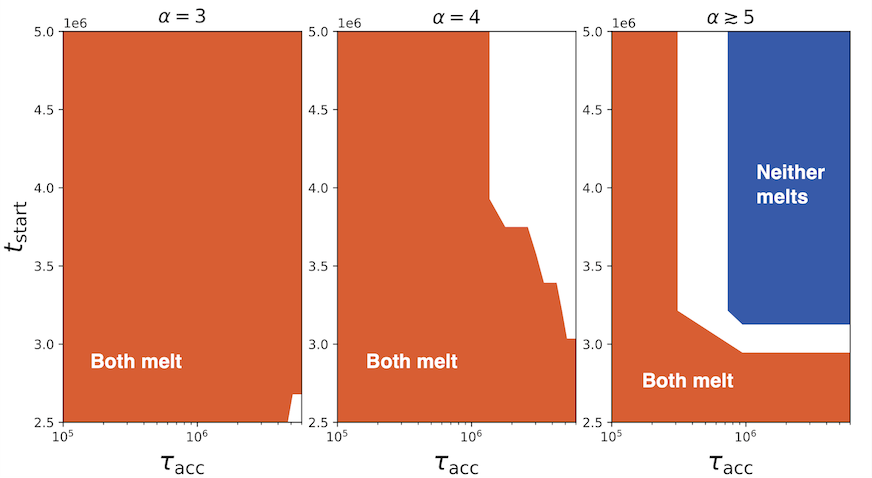
Figure 1. Final states of Callisto and Ganymede as functions of accretion parameters tstart, τacc, and α which are respectively the timing of accretion onset, the duration of accretion, and the impactor size distribution. The white region indicates where Ganymede undergoes melting, while Callisto remains undifferentiated. From left to right, the panels display increasing values of α, ranging from 3 to 5, with a total of 100 simulations per panel.
How to cite: Bennacer, Y., Mousis, O., Monnereau, M., Hue, V., and Schneeberger, A.: Formation Conditions Leading to an Unmelted Callisto and a Differentiated Ganymede , EPSC-DPS Joint Meeting 2025, Helsinki, Finland, 7–12 Sep 2025, EPSC-DPS2025-777, https://doi.org/10.5194/epsc-dps2025-777, 2025.


