
 1,2,3,4,2,
- 1LATMOS/IPSL, UVSQ Université Paris-Saclay, Sorbonne Université, CNRS, Paris, France (salman.raza@latmos.ipsl.fr)
- 2Université Paris-Saclay GEOPS UMR 8146, Orsay, France
- 3LMD-IPSL, CNRS, Sorbonne Université, Paris, France
- 4UGA, CNRS, Institut des Géosciences de l’Environnement (IGE), UMR 5001, 38041 Grenoble, France
- 5LESIA, Observatoire de Paris, Université PSL, Paris France
Introduction and Abstract
The RADAR onboard Cassini probe (2004-2017), operating in active and passive (or radiometry) mode at 2.2-cm wavelength recorded the backscatter from the surface (through normalized radar backscatter cross section σ0 ) in its active mode, while it measured brightness temperatures (Tb) in its passive mode. Both resolved and unresolved observations of Enceladus have concluded on the extremely radar-brightness of Enceladus, the largest in the Solar system [1,2]. Such radar-brightness can be partially explained by the presence of ultra-clean water ice particles at Enceladus’s surface, in particular in the SPT (South Polar Terrain), which offers favorable medium for scattering. Nevertheless, so far none of the purely random wave scattering models had succeeded to reproduce the measured σ0 or radar albedos. Furthermore, during Cassini’s unique close flyby of Enceladus’ SPT (E16 flyby) swathing an area of few tens of kilometers, Cassini RADAR used as a radiometer revealed thermal anomalies that had not been detected in the infrared [3]. However, the amplitude of the internal heat flux remained to be constrained.
To understand better both the scattering and thermal anomalies of Enceladus’ SPT, we developed a model able to jointly simulate E16 Cassini active and passive observations. For the first time, our concurrent active and passive radar simulations considering a rough, undulating surface reproduces the observed radar brightness and thermal emission measurements at microwave wavelengths. This unified approach put constraints on the SPT’s subsurface properties, refining estimates of ice grain size, subsurface porosity, and endogenic heat flux.
Method
To predict backscatter (σ0) and thermal emission in the microwave domain we combine two models: (1) a thermal model providing depth profiles of the physical temperature beneath the surface at E16 flyby epoch (2) a radiative transfer model to simulate both active and passive observations.
Thermal Model
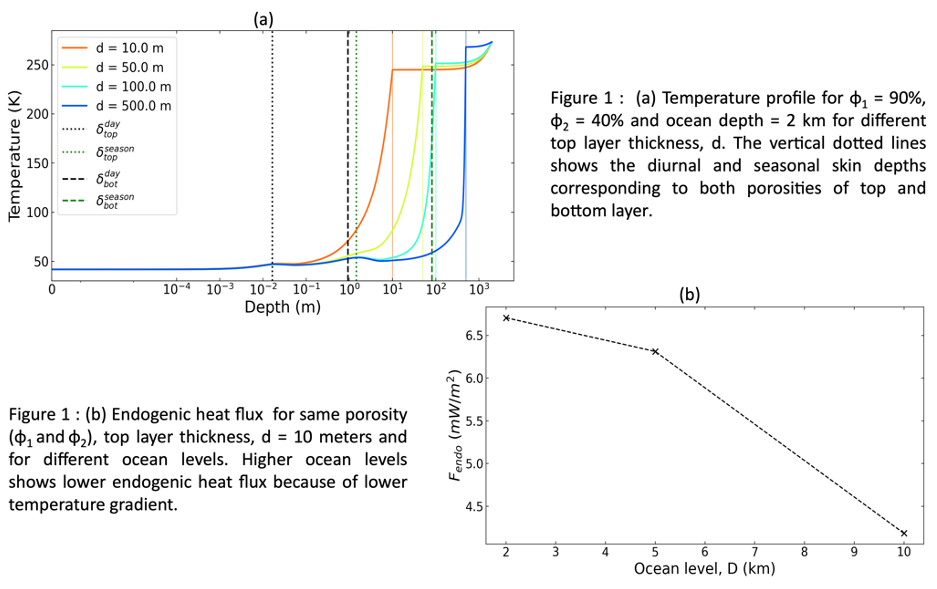
We adapted a multi-layer thermal model called MultIHeaTS [4] to the case of Enceladus. We account for Solar flux and radiative flux equilibrium at surface and a constant temperature at the bottom. The subsurface of Enceladus is modeled as bi-layer medium with an icy porous regolith overlying a denser water ice substrate. Main parameters of model are porosities of the top and bottom layers ϕ1 and ϕ2 (primarily control effective thermal properties), thickness d of top layer and the ocean level i.e ice shell thickness, D at the SPT region. Based on plume deposition rate modeling [5] a value of up to 90% was assumed for ϕ1. The thickness d is unknown, but [5] suggest it could be up to 700 meters and at least few decimeters based on [6]. We thus vary d from 1 m to 500 meters. Lastly, ice shell thickness, D is assumed to be in the range 2 to 5 km as the average ice shell thickness in the SPT region falls within this range [10]. At these depths, we assume the presence of an ocean, where the temperature corresponds to the melting point of water ice. Once thermal equilibrium is reached, the heat flux driven by temperature gradient is calculated providing the endogenic heat flux for the given subsurface properties.
Fig. 1a displays simulated temperature profiles obtained for D = 2.0 km at the SPT for different values top layer thickness. Temperature profiles clearly show a discontinuity at transition from top to the bottom layer, top layer acting like an insulating layer (especially if very porous). Fig. 1b shows the endogenic heat flux for same porosities, top layer thickness, d = 10 meters and for different ocean levels.
Radiative Transfer Model
We use Snow Microwave Radiative Transfer model (SMRT), a multi-layer RT model initially designed for snow or sea-ice [8]. Permittivity of water ice is assumed constant with temperature [11], effective permittivity depends on its porosity and includes possible contaminants fraction, assumed as organic dust. The parameters of RT model are thus dust fraction and water ice grain radius size (r1, r2) in the top and bottom layers. It is consistent with the assumptions on ϕ1, ϕ2 and d considered in thermal model. We vary r from 100 microns to 1 mm [9]. We consider two types of surface- smooth where reflections and transmissions are specular in nature given by Fresnel coefficients and rough, gently undulating surface parameterized statistically by root mean squared slope (s), which applies geometrical optics solution with Kirchhoff’s approximation [12].
Results, conclusion and discussion
Figure 2 compares modeled radar backscatter and brightness temperatures for a bi-layer medium at one E16 swath location, using the thermal profile from our thermal model. Results shows a clear anti-correlation between σ0 and Tb. Smooth surface assumption fail to reproduce the observed high σ0, while a gently undulating rough surface of moderate RMS slope reproduces both high σ0 and Tb for a highly porous (more than 80%) layer of clean water ice having a thickness of around 50 meters and containing large ice grains (500–600 µm). This provides an insight to an outstanding puzzle, as no prior random scattering model could explain Enceladus’ extreme radar brightness. Rough surface causes diffuse reflection and transmission, consequently volume scattering from the diffused transmitted waves in the porous icy regolith favors the radar back-scatter. Surprisingly for these high σ0 cases, electrical skin depth is much shallower (around 3 m) than the expected for a homogeneous pure water ice substrate. Moreover, it is consistent with high similarity between the optical and SAR images of the SPT region observed during E16.
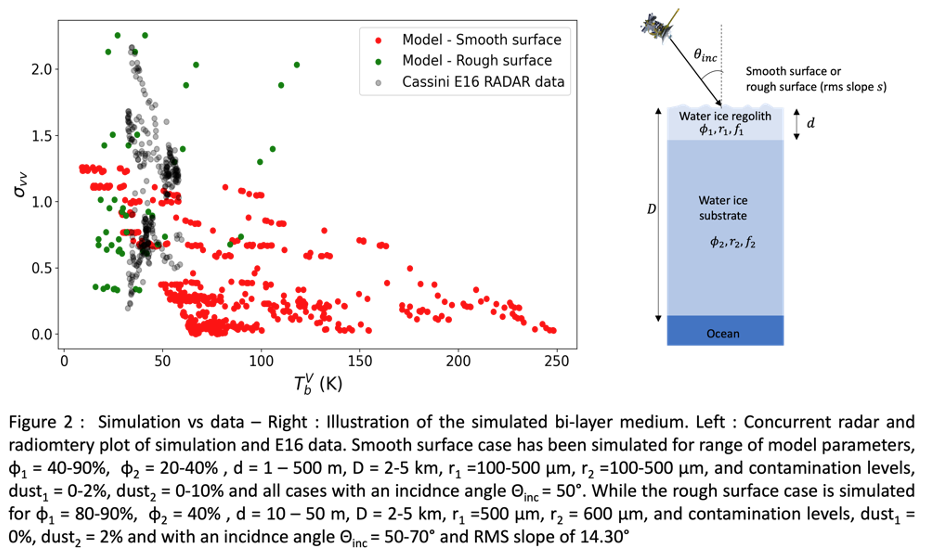
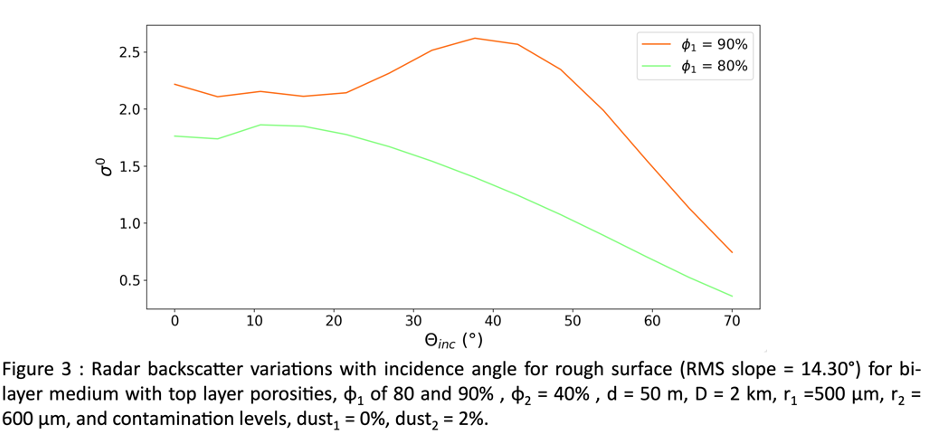
Figure 3 demonstrates that σ0 remains stable and as high as 2 across incidence angles (up to 50◦) for highly porous medium, which may explain Enceladus’ high disk-integrated radar albedo [2]. Finally, from the best deduced parameters (ϕ1, ϕ2, d and D), thermal model constrains endogenic heat flux to 4–6 mW/m2 (Figure 1b).
How to cite: Raza, M. S., Le Gall, A., Schmidt, F., Bonnefoy, L., Picard, G., Mergny, C., and Leyrat, C.: Enceladus’ SPT surface and subsurface properties as constrained by Cassini RADAR observations, EPSC-DPS Joint Meeting 2025, Helsinki, Finland, 7–13 Sep 2025, EPSC-DPS2025-797, https://doi.org/10.5194/epsc-dps2025-797, 2025.


