

- Faculty of Aerospace Engineering, TU Delft, Delft, The Netherlands
Understanding the internal structure of icy moons is essential to assess their potential habitability. Ganymede, the largest moon in the Solar System, is the only one known to have its own magnetic field [1] and likely harbors a subsurface ocean [2, 3], making it a prime target for future exploration such as ESA’s Juice mission. Constraining its internal structure is essential to assess its potential habitability.
Different observables (e.g., gravity, magnetic induction, tidal response, and libration) provide insight into the moon’s interior structure. While each observable is sensitive to different interior parameters, previous studies have typically considered them independently [2, 4, 5, 6]. This often results in degeneracies between interior parameters. To tackle this, we propose a joint inversion of interior properties.
To this end, we perform a global sensitivity analysis to understand how different observations relate to interior parameters, followed by a Bayesian inversion to combine these datasets into a single probabilistic model. This framework is adaptable to other icy moons and can be expanded to include new data types.
Sensitivity Analysis
In this work, we consider a five-layer spherical model of Ganymede’s interior, consisting of a metallic core, a silicate mantle, a high-pressure ice, a liquid salty ocean and an ice shell, all consistent with the moon’s mass and moment of inertia. The magnetic induction response is calculated following [7], the tidal response is computed using LOVE3D [8], and the libration response is based on [9].
To identify which parameters most influence each observable, we first vary each parameter independently. This confirms well-known behaviors. For instance, magnetic induction is most sensitive to ocean thickness and conductivity, tidal displacement to the ice shell's thickness and rigidity, and libration amplitude to shell rigidity. While informative, this single-parameter approach does not capture the non-uniqueness of the problem. To address this, we conduct a Monte Carlo analysis with 150k samples in which we vary all parameters simultaneously. We analyze the results using correlation coefficients to identify key dependencies between interior parameters and observables, and two-dimensional histograms to visualize the most relevant trends (see Figure 1).
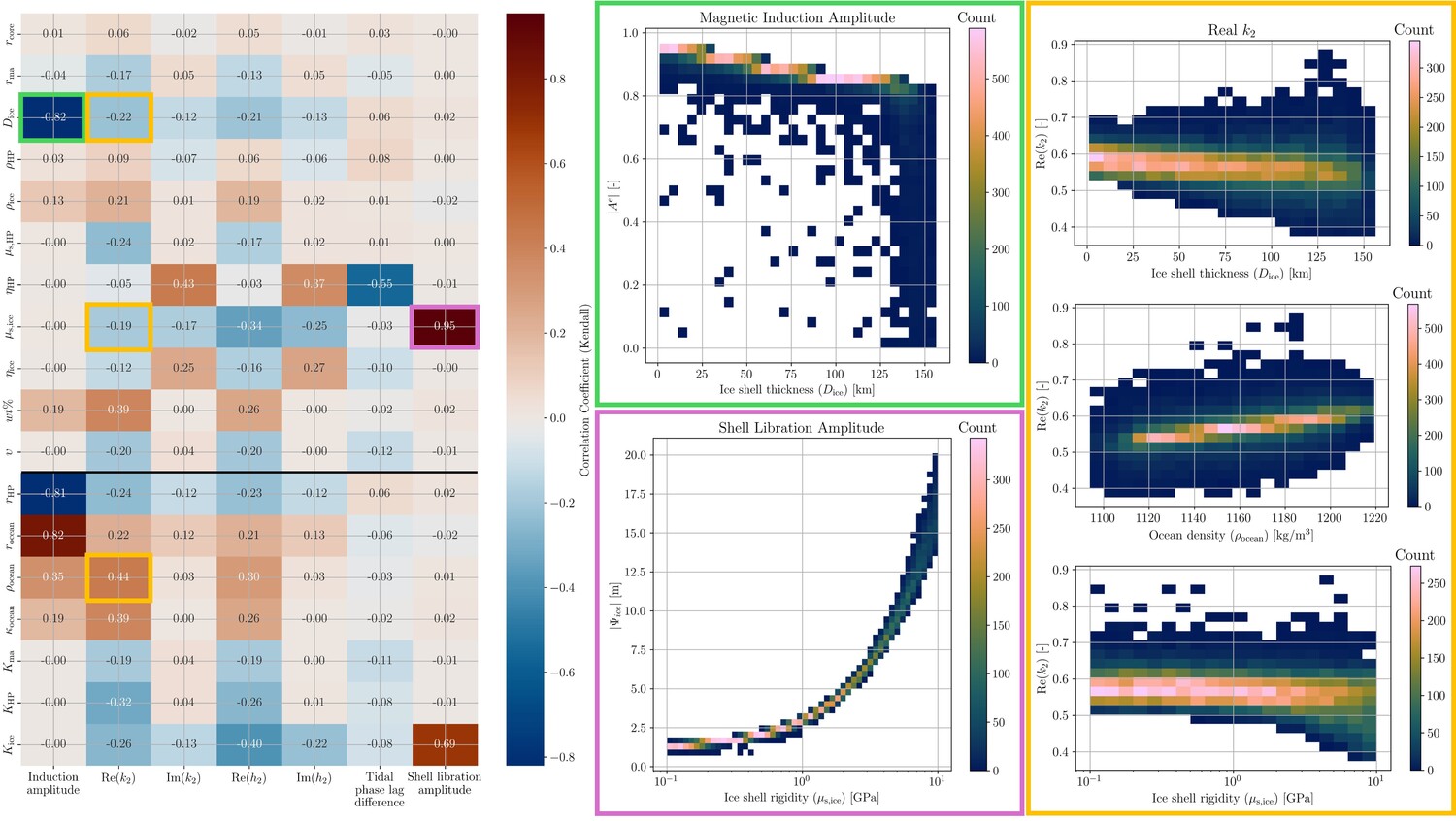
Figure 1: Matrix of correlation coefficients and major trends in Ganymede's responses.
The Monte Carlo analysis confirms the same trends as the previous one, but makes parameter degeneracies evident. In particular, the interplay between shell thickness, ocean density, and shear modulus makes it challenging to constrain all three parameters simultaneously using tidal observations alone. However, other observables may help resolve these ambiguities, such as libration data for the shell's shear modulus and magnetic measurements for ocean composition, highlighting the need for a joint inversion approach.
These insights help to prioritize the most informative measurements and to define the most influential model parameters, which will be the focus of the inversion process.
Bayesian Inversion
The sensitivity analysis evidences the advantage of using multiple observations to estimate interior parameters. In a second step, we plan to perform a Bayesian inversion to estimate the uncertainties to which relevant interior parameters can be recovered using Juice observations [10]. This approach builds on recent Bayesian methods used for Europa [11, 12, 13] and extends them to incorporate a broader range of observations.
With the Bayesian inversion, we hope to provide a unified framework that can be used to most efficiently exploit Juice data and reveal the structure of Ganymede’s interior.
Bibliography
[1] O. Grasset, M. K. Dougherty, A. Coustenis, E. J. Bunce, C. Erd, D. Titov, M. Blanc, A. Coates, P. Drossart, L. N. Fletcher and others, "JUpiter ICy moons Explorer (JUICE): An ESA mission to orbit Ganymede and to characterise the Jupiter system," Planetary and Space Science, vol. 78, p. 1–21, 2013.
[2] M. G. Kivelson, K. K. Khurana and M. Volwerk, "The Permanent and Inductive Magnetic Moments of Ganymede," Icarus, vol. 157, p. 507–522, June 2002.
[3] S. Vance, M. Bouffard, M. Choukroun and C. Sotin, "Ganymede's internal structure including thermodynamics of magnesium sulfate oceans in contact with ice," Planetary and Space Science, vol. 96, pp. 62-70, 2014.
[4] S. Kamata, J. Kimura, K. Matsumoto, F. Nimmo, K. Kuramoto and N. Namiki, "Tidal deformation of Ganymede: Sensitivity of Love numbers on the interior structure," Journal of Geophysical Research: Planets, vol. 121, p. 1362–1375, 2016.
[5] F. Sohl, T. Spohn, D. Breuer and K. Nagel, "Implications from Galileo observations on the interior structure and chemistry of the Galilean satellites," Icarus, vol. 157, p. 104–119, 2002.
[6] G. Schubert, J. D. Anderson, T. Spohn and W. B. McKinnon, "Interior composition, structure and dynamics of the Galilean satellites," Jupiter: The planet, satellites and magnetosphere, vol. 1, p. 281–306, 2004.
[7] S. D. Vance, M. J. Styczinski, B. G. Bills, C. J. Cochrane, K. M. Soderlund, N. Gómez-Pérez and C. Paty, "Magnetic induction responses of Jupiter's ocean moons including effects from adiabatic convection," Journal of Geophysical Research: Planets, vol. 126, p. e2020JE006418, 2021.
[8] M. Rovira-Navarro, I. Matsuyama and A. Berne, "A Spectral Method to Compute the Tides of Laterally Heterogeneous Bodies," The Planetary Science Journal, vol. 5, p. 129, May 2024.
[9] T. Van Hoolst, R.-M. Baland and A. Trinh, "On the librations and tides of large icy satellites," Icarus, vol. 226, p. 299–315, 2013.
[10] P. Gregory, Bayesian logical data analysis for the physical sciences: A comparative approach with Mathematica® support, Cambridge University Press, 2005.
[11] F. Petricca, A. Genova, J. C. Castillo-Rogez, M. J. Styczinski, C. J. Cochrane and S. D. Vance, "Characterization of icy moon hydrospheres through joint inversion of gravity and magnetic field measurements," Geophysical Research Letters, vol. 50, p. e2023GL104016, 2023.
[12] J. B. Biersteker, B. P. Weiss, C. J. Cochrane, C. D. K. Harris, X. Jia, K. K. Khurana, J. Liu, N. Murphy and C. A. Raymond, "Revealing the interior structure of icy moons with a Bayesian approach to magnetic induction measurements," The Planetary Science Journal, vol. 4, p. 62, 2023.
[13] I. Matsuyama and A. Trinh, "Gravity constraints on the interior structure of Europa," March 2020.
How to cite: Marzolini, A. and Rovira-Navarro, M.: Characterizing Ganymede’s Interior with Gravity, Tidal, Rotation and Magnetic Observations, EPSC-DPS Joint Meeting 2025, Helsinki, Finland, 7–13 Sep 2025, EPSC-DPS2025-804, https://doi.org/10.5194/epsc-dps2025-804, 2025.


