
 1,1,1,3,4,1
- 1Dartmouth College, Hanover, USA
- 2The Open University, Milton Keynes, UK
- 3Los Alamos National Laboratory, Los Alamos, USA
- 4Cornell University, Ithaca, USA
Introduction: There is a growing consensus that ocean-derived impurities, and particularly salts, play a key role in the geophysical evolution and habitability of planetary ice shells [1]. This is bolstered by several observations including 1) the association of endogenic material with geologically young surface features, 2) the ability of salts to depress the freezing temperature and extend the longevity of liquids within planetary ices, 3) the critical role salts play in governing the material properties, biogeochemistry, and habitability of salt-rich ice, and 4) the fundamental role small melt fractions and impurity levels play in the analogous terrestrial mantle-lithosphere system [2]. As the primary medium for the transport and expression of observable signatures from underlying oceans these impurity enriched ices provide a geological record of subsurface ocean properties and processes.
Given these geophysical and astrobiological implications, there has been a recent effort to constrain the material entrainment rates occurring at ice-ocean and ice-brine interfaces [3]. Bred from multiphase models of analogous terrestrial systems (sea ice, magma chamber dynamics, solidifying metal alloys), these investigations have produced parameterizations linking interface conditions to material entrainment rates and resultant ice properties [2-3]. Moreover, they have been validated against salinity profiles and material entrainment rates observed in natural and laboratory grown sea ice cores [3]. That said, it is likely that the ocean compositions of other ocean worlds in the solar system may differ from that of the Earth. If this is the case, it bodes the question, are all salts species entrained at an equal rate? Recent research suggests that ion fractionation, the preferential entrainment/rejection of salt species into/out of the forming ice, could be prevalent under ice-ocean world thermodynamic conditions [4]. If so, ionic speciation within planetary ices may not be directly representative of the progenitor fluid reservoir from whence they came.
While there exist extensive ionic composition measurements for ice cores derived from our own NaCl-dominated ocean, investigations of ion fractionation in natural ices have been inconclusive and even contradictory [4-5], and there currently exists a dearth of empirical data related to the ionic composition of ices formed from alternate ocean chemistries [2]. As such, there remains a large gap in our understanding of the entrainment rates of various salt species in ices formed from planetary relevant brines. Moreover, contemporary models of ice-brine systems that include the physics needed to describe ion fractionation (e.g., multispecies ion diffusion, salt precipitation) [6] are in desperate need of empirical measurements to assess their accuracy.
These are potentially critical processes operating within the ice shells of ocean worlds, controlling their geochemistry, geophysics, and habitability [4]. As such, a well constrained dataset of salt entrainment rates in compositionally diverse ices is needed to improve our understanding of the physics governing these high-priority systems and benchmark evolving predictive models of planetary ice-brine systems to guarantee their accuracy and optimize their utility for upcoming missions (e.g., Europa Clipper, Dragonfly).
Methods: To bridge this knowledge gap, we have carried out novel top-down ice growth experiments (Figure 1) and established a database of physical, thermal, chemical, and material properties of compositionally diverse saline ices grown from putative ice-ocean world ocean compositions (NaCl, MgSO4, and Na2CO3 dominated). Leveraging the ionic composition and temperature profiles of these ices alongside the equilibrium geochemistry software PHREEQC, we additionally simulate their mineralogical assemblages and interstitial brine properties (e.g., water activity, ionic concentration) – key characteristics when assessing aqueous environment habitability [7].
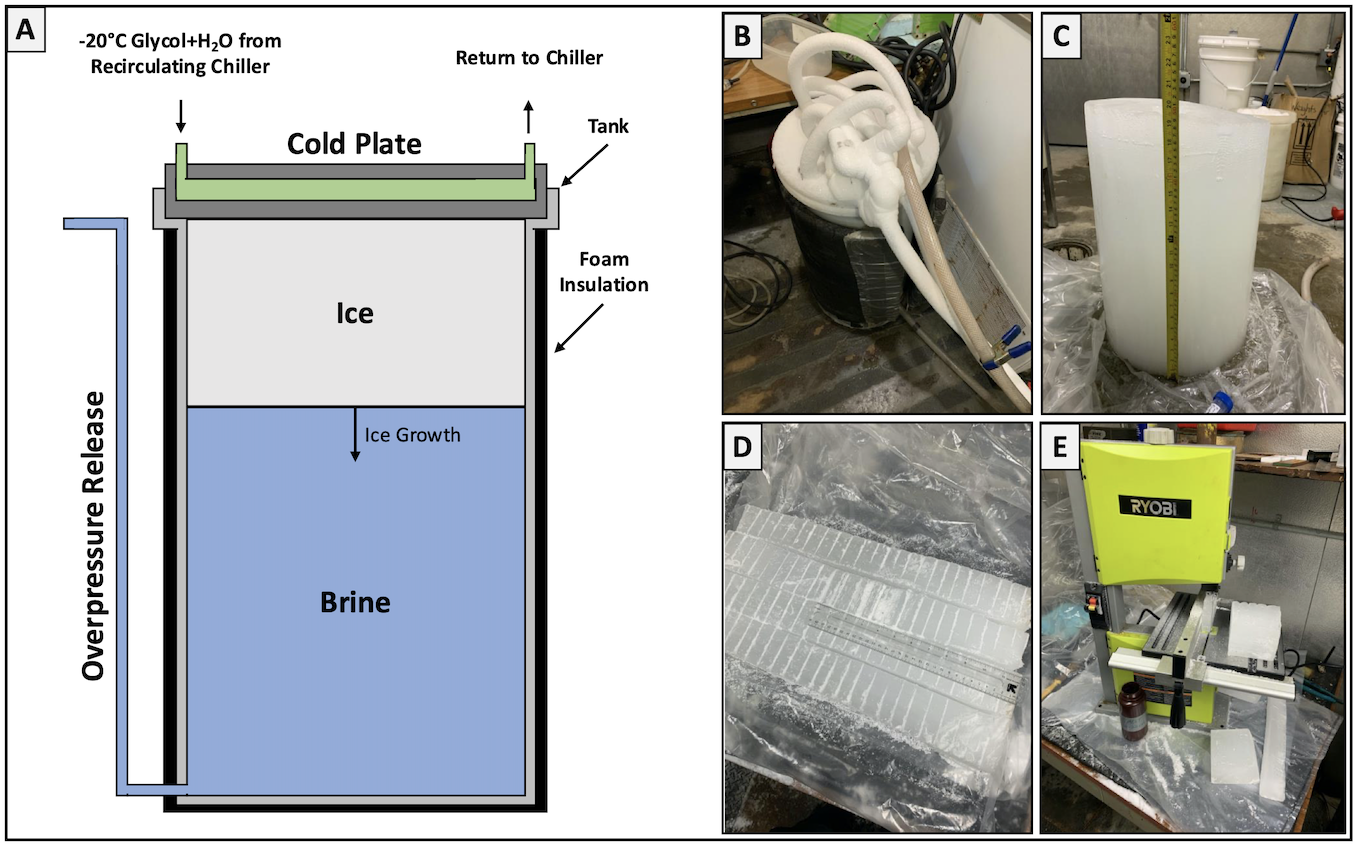
Figure 1 – Ice growth apparatus and vertical sectioning for ionic composition/fractionation analysis.
Results: Here we present ionic composition and fractionation profiles of these ices, as well as their associated hydrate minerology and liquid phase properties (e.g., Figure 2). We describe the novel physics that govern the diverse evolution of these complex multiphase systems, such as multispecies ion diffusion and thermochemically dependent precipitation pathways. We show that:
- Ion fractionation signals are present in all of our analog ice samples.
- Depletions and amplifications in relative ion abundance, compared to the source fluid, range from -40% to +77%.
- The level of fractionation is dependent on both the thermal and chemical conditions under which the ice forms.
- The simulated precipitate mineralogical assemblages throughout the ice columns are consistent with the fractionation signals.
- The observed amplifications and depletions of relative ion concentrations (compared to the parent underlying fluid) are consistent with the processes of hydrate precipitation and multispecies diffusion, respectively.
- The ionic composition of saline ices are not necessarily a reflection of the relative ion abundances of the fluid from whence they formed – i.e., all salts are not entrained at an equal rate.
We discuss the important implications these results have for our understanding of ice-ocean world geophysics, habitability, and mission science interpretation.
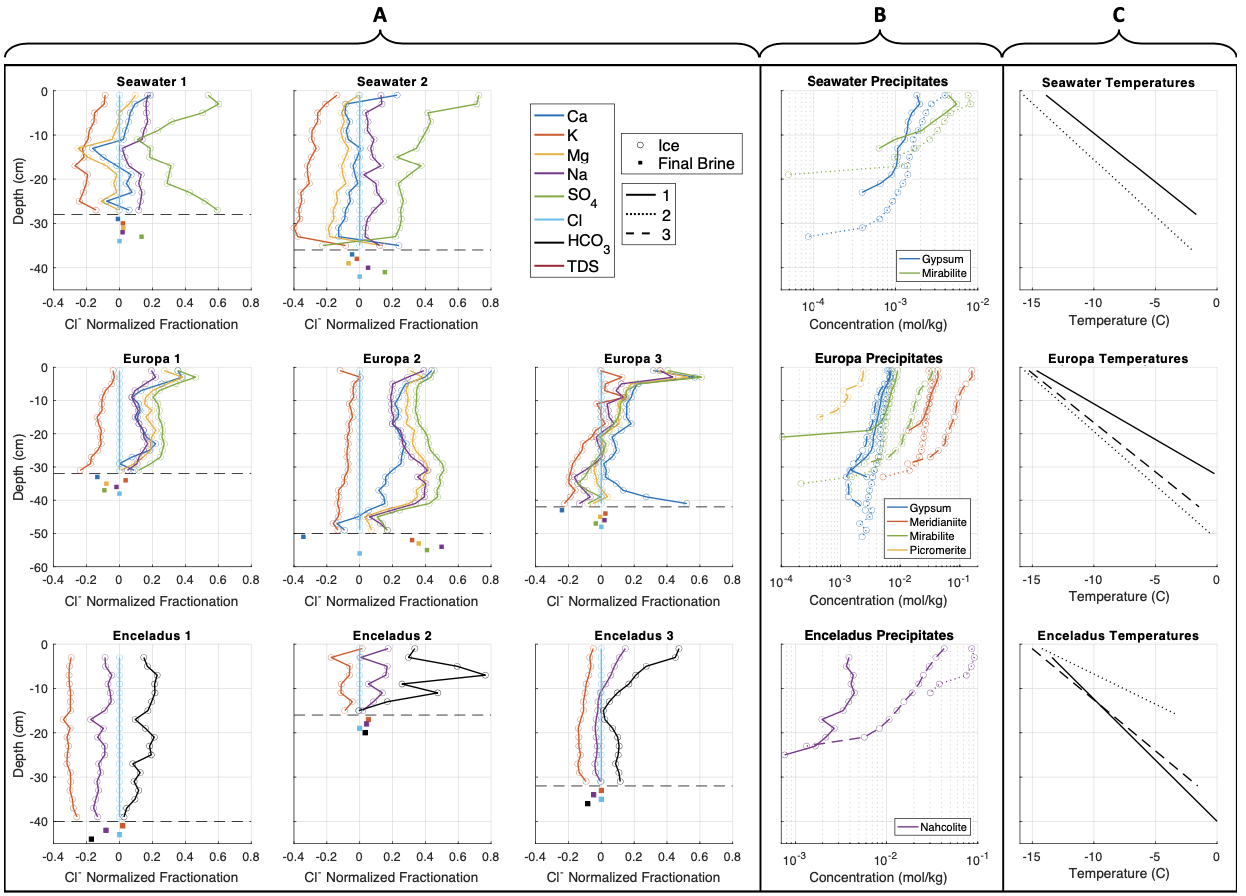
Figure 2 – Ion fractionation profiles in analog ice cores (A). Amplifications relative to Cl- correlate with precipitated minerals, while depletions are associated with amplified diffusion rates. Simulated mineralogical assemblages (B) using in situ temperatures (C) agree with observed fractionation signals.
Conclusions: Through novel laboratory measurements we demonstrate that ion fractionation in planetary ices is likely a prevalent process, capable of generating heterogeneous and compositionally diverse ices – even from the same parent fluid. The resultant geochemical complexity of these ices directly correlates to associated variations in ice material properties (e.g., melting points, strengths, viscosity, porosity, etc.) that will significantly impact the geophysical processes and habitability of planetary ice shells. As high-priority planetary science and astrobiology targets for current and upcoming missions constraining the chemical and thermophysical properties of planetary ices and their relationships to the characteristics of their underlying oceans will be imperative for constraining predictive models of these environments and maximizing the science return from observational datasets.
References: [1] Vance S. D. (2021) JGR: Planets, 126.1. [2] Buffo J. J. et al. (2023) JGR: Planets, 128.3. [3] Buffo J. J. et al. (2020) JGR: Planets, 125.10. [4] Wolfenbarger N. S. et al. (2022) Astrobiology, 22.8, 937-961. [5] Maus S. et la., (2011) AoG, 52.57. [6] Meyer et al., (2024), AbSciCon, 412.03. [7] Wolfenbarger N. S. et al., (2022) GRL, 49.22.
How to cite: Buffo, J., Fox-Powell, M., Murdza, A., Tomlinson, T., Schultz, A., Barton, T., Gurd, C., McEwen, A., Wolfenbarger, N., Chivers, C., Schmidt, B., and Meyer, C.: As Above, Not So Below: Ion Fractionation in Planetary Analog Ices, EPSC-DPS Joint Meeting 2025, Helsinki, Finland, 7–13 Sep 2025, EPSC-DPS2025-823, https://doi.org/10.5194/epsc-dps2025-823, 2025.


