
 1,1,
1,1,- 1Center for Earth and Planetary Studies, Smithsonian National Air and Space Museum, Washington, DC, USA (nichols-flemingf@si.edu)
- 2Planetary Science Institute, Tucson, AZ, USA
Dione, the fourth largest moon of Saturn, is primarily composed of water ice [1] with a surface that shows abundant evidence of tectonic resurfacing, both contractional and extensional [e.g., 2–4]. There appear to be at least two eras of tectonism on Dione: the more recent formation of the Wispy Terrains on the trailing hemisphere—some of the most recent tectonic landforms—and the leading hemisphere, dominated by more ancient tectonic features, including ridges (Figure 1) [5]. The pattern of fractures preserved in icy planetary shells forms in response to stresses, and those patterns can be diagnostic of the stress fields in which they formed [e.g., 3,6]. The long geological history of tectonism preserved on Dione can thus provide a temporal record of the stress history, which can be linked to changes in orbital dynamics and interior environments (e.g., formation or freezing of subsurface oceans) [7].
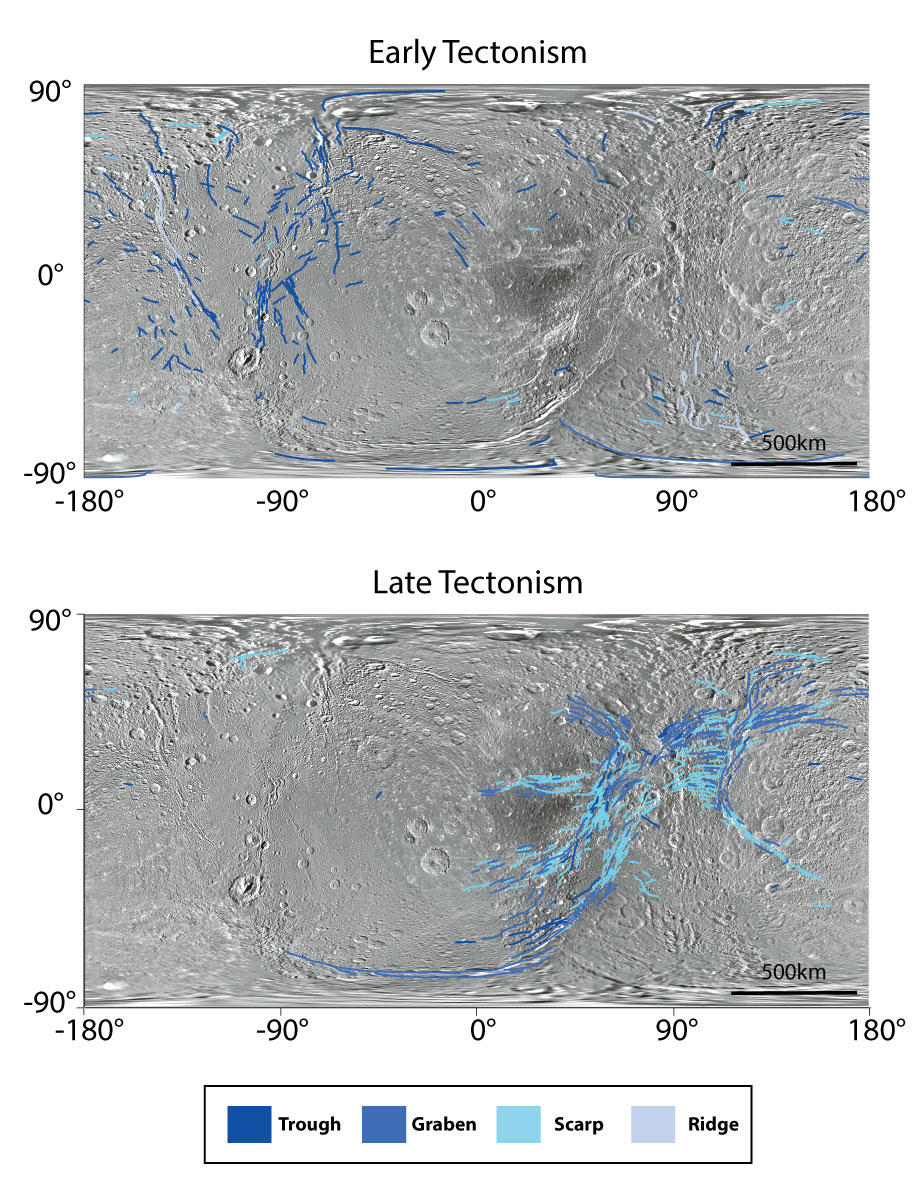
Figure 1. Global distribution of ancient (above) and recent (below) tectonic structures across Dione. Scarps are interpreted as normal fault scarps.
Here, we use SatStress [8,9] to create model stress fields to compare with Dione’s observed fracture pattern. We divide each mapped feature into 1-km segments and compare each segment to the predicted orientation from our models at that location on Dione’s surface. Preliminary results show that both diurnal stresses and stresses due to non-synchronous rotation (NSR) can replicate the fracture pattern of more recent tectonism observed in the Wispy Terrain. Predicted orientations of diurnal stresses match 63% and 82% of our observed orientations within 15° and 30°, respectively. Similarly, the predicted orientations of stresses due to NSR match 68% and 80% of observed orientations within 15° and 30°, respectively. In both cases, our modeled global stress mechanisms reproduce the observed orientations more accurately than an isotropic population with random orientations like what would be expected from ice shell thickening alone (Figure 2). While the predicted fractures from diurnal tides and NSR match the observations at a similar level, it is important to note that diurnal stresses are on the order of tens of kPa while NSR produces much higher stresses on the order of MPa.

Figure 2. Preliminary SatStressGUI modeling results for late tectonism. The angle between predicted and modeled fracture orientations, or the orientation misfit, for each 1-km segment of a mapped graben, scarp, or trough is shown for different stress models.
Future work will include the analysis of ancient tectonic features and including additional stress mechanisms such as orbital recession and despinning. This will enable us to determine if there has been a shift in the dominant stress mechanisms throughout Dione’s geologic history. Changes in stress magnitudes and mechanisms may indicate alterations in planetary interiors, such as variations in shell thickness or ocean depth, or modifications to orbital parameters like eccentricity or obliquity.
References: [1] Thomas, P. C. (2010) Icarus, 208, 395–401. [2] Kirchoff, M. R. and Schenk, P. (2015) Icarus, 256, 78–89. [3] Collins, G. C. et al. Planetary Tectonics, Cambridge University Press (2009). [4] Collins, G. C. (2010) AGU 2010, P24A-08. [5] Martin, E. S. et al. (2024) AGU 2024, P31A-09. [6] Kattenhorn, S. A. and Hurford, T. Europa, (2009), p. 199. [7] Martin, E. S. et al. (2015) 46th LPSC, Abstract No. 1620. [8] Wahr, J. et al. (2009) Icarus, 200, 188–206. [9] Patthoff, D. A. et al. (2019) Icarus, 321, 445–457.
How to cite: Nichols-Fleming, F., Martin, E. S., Patthoff, D. A., and Watters, T. R.: Constraining the Evolution of Dione from Changes to the Dominant Stress Mechanisms and Tectonic Record, EPSC-DPS Joint Meeting 2025, Helsinki, Finland, 7–12 Sep 2025, EPSC-DPS2025-879, https://doi.org/10.5194/epsc-dps2025-879, 2025.


