

- Charles University, Faculty of Mathematics and Physics, Department of Geophysics, Prague, Czech Republic (terka.kosikova@gmail.com)
Introduction
Understanding the internal structure and composition of icy bodies in the Solar System is a central objective in planetary science, offering insights into their formation, thermal evolution, and potential habitability. However, this understanding is limited by a lack of direct observations, due to their distance from Earth and the fact that most data come from orbit. While missions like Voyager, Galileo, and Juno have greatly advanced our knowledge of Jupiter and its moons, major questions—such as the detailed nature of subsurface oceans and internal structures—remain unsolved. Upcoming missions like JUICE and Europa Clipper aim to reduce these uncertainties by measuring the tidal deformation and refining models of interior composition and structure [1–3].
Our work models the internal structures of Europa and Ganymede using a Bayesian framework to explore the range of possible configurations. We map the posterior probability distribution based on observed satellite parameters and thermodynamic properties [4–6]. We analysed how structural outcomes are influenced by variations in factors such as salt composition and concentration, and we examined correlations between key internal parameters. Our analysis also includes expected measurements of the Love number, which express gravitational changes due to tidal deformation.
Model
The internal density, pressure, and temperature profiles of the satellites are calculated numerically based on known structural parameters. Each satellite is assumed to be fully differentiated into three layers: a hydrosphere, silicate mantle, and iron core. From this, we derive observable quantities such as total mass (M), moment of inertia (MOI), radius (Rsurf), and Love numbers k2 and h2, using a library based on [7, 8].
To explore interior structures that fit observed values (M, MOI, Rsurf) and their uncertainties, we use statistical inversion with the Markov chain Monte Carlo method using the emcee sampler [9]. We test various combinations of constraints, including known k2 values and ocean salinity ranges, and study how these affect parameter estimates and correlations.
Results
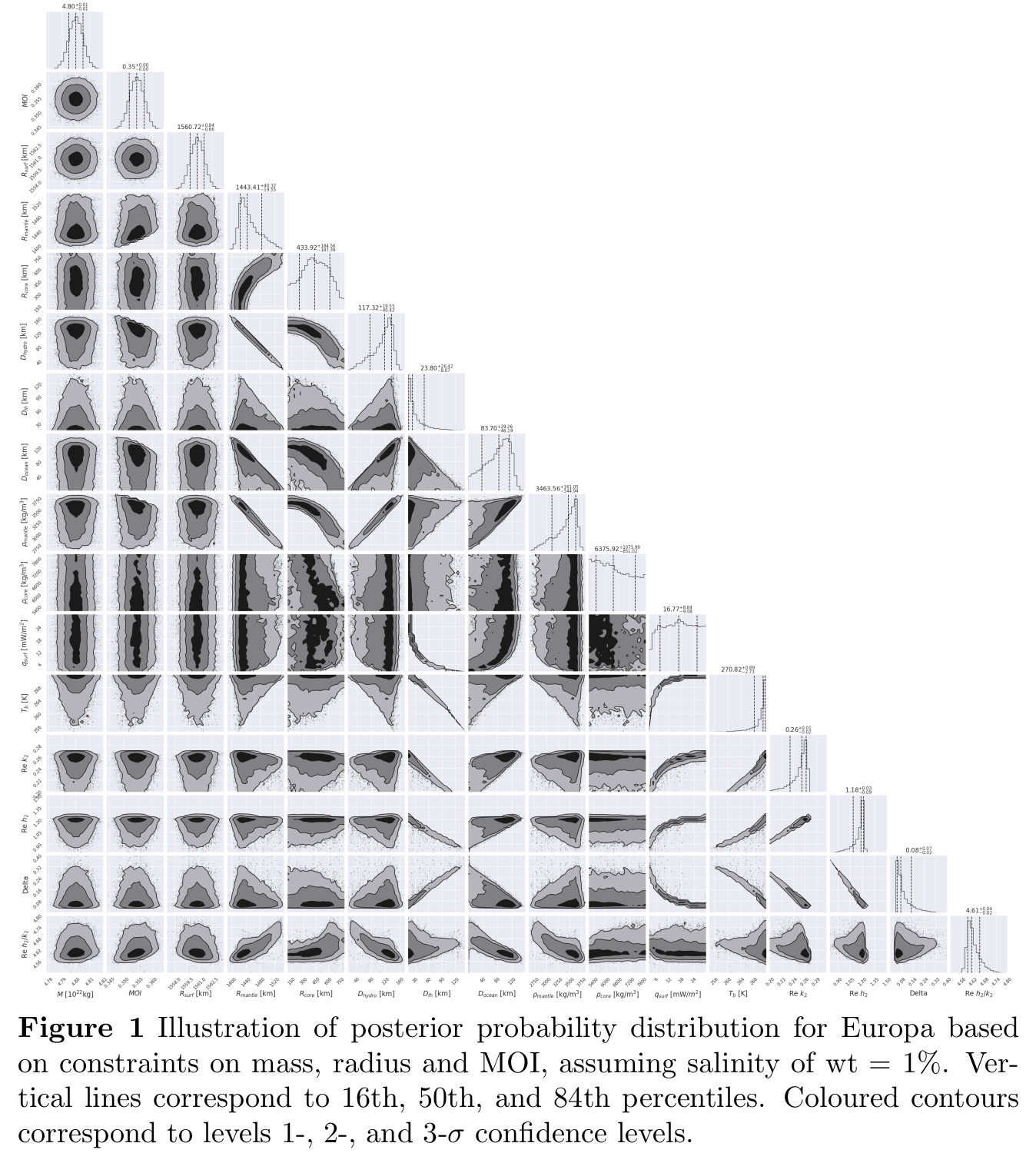
An illustration of results for Europa with fixed ocean salinity is shown in Figure 1. The surface heat flux is poorly constrained and exhibits an almost uniform probability distribution over the allowed range. As expected, surface heat flux influences the temperature at the ice Ih/water interface, and we observe an almost linear decrease of the ice shell thickness with increasing temperature at ice Ih/water interface. Similarly, Love numbers k2 and h2 are strongly correlated with the ice shell thickness. In the deeper interior, we observe a trade-off between mantle radius, mantle density, and core radius, reflecting the limited ability to independently constrain these parameters.
Interestingly, the h2/k2 ratio suppresses the influence of the hydrosphere and increases its correlation with the deeper interior structure. Furthermore, when k2 is included among the observed parameters, anticipating future measurements, the parameter ranges within the 3σ confidence interval decrease significantly for the ice shell thickness, temperature at the ice Ih/ocean interface, h2, and the h2/k2 ratio. The lower bound of the surface heat flux is also slightly more constrained. Moreover, we observe an even stronger correlation between the h2/k2 ratio and the deeper interior layers.
In contrast, when the salt concentration in the ocean is treated as a free parameter, the concentration unsurprisingly follows a nearly uniform distribution over the allowed range. However, we find a strong anti-correlation between the concentration and the h2/k2 ratio, while the correlation between h2/k2 and the deeper interior is reduced.
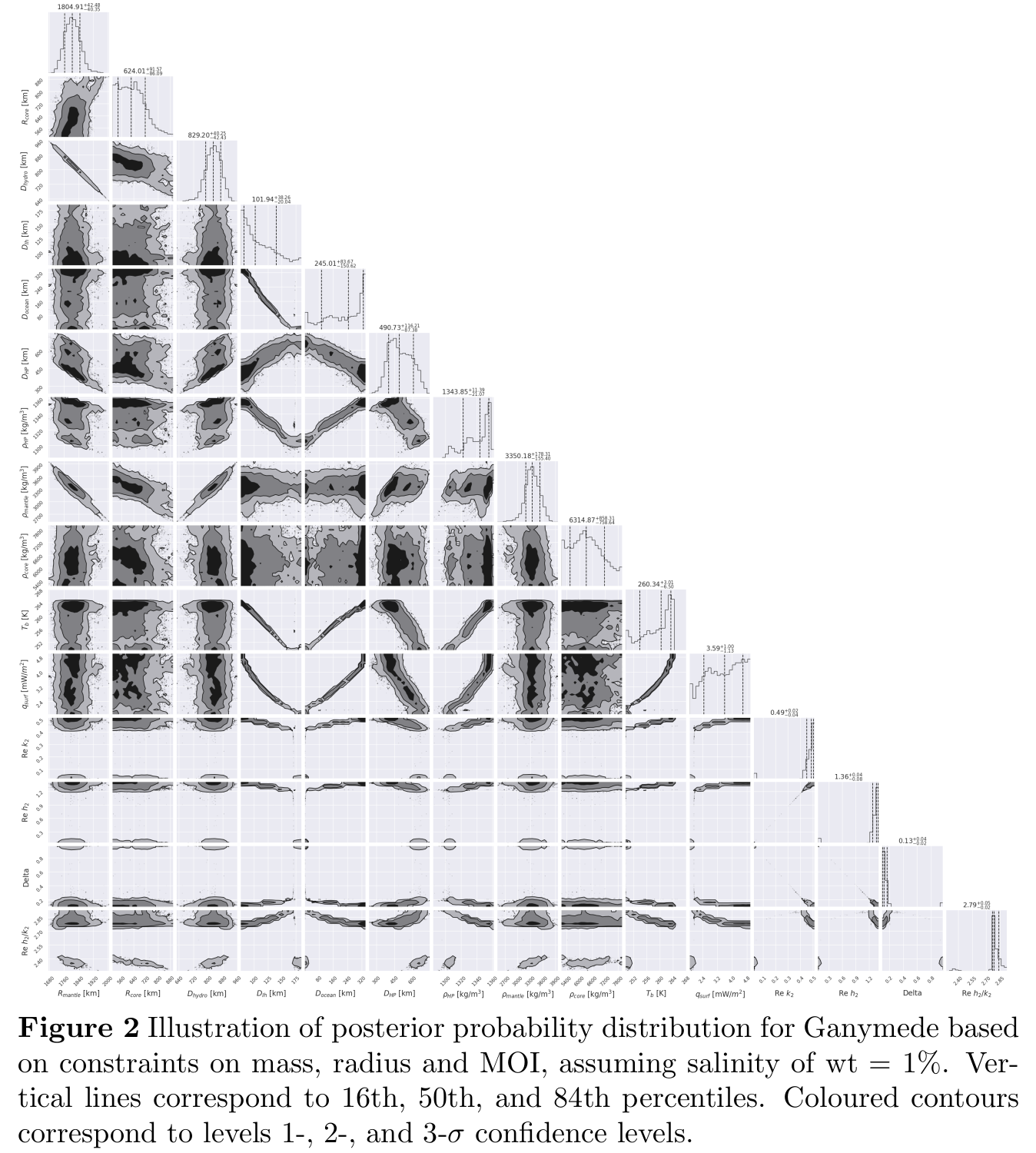
The results for Ganymede are illustrated in Figure 2. The parameter dependencies and trade-offs follow similar trends to those observed for Europa. When examining the probability distributions of Love numbers, two different solutions occur. Lower values correspond to the case without a subsurface ocean present, while higher values are associated with models that include an ocean within the hydrosphere.
Additionally, the correlation between the h2/k2 ratio and mantle/core properties is weakened, with increased sensitivity density of high-pressure ice layers.
Summary
We investigated the internal structure of icy bodies, focusing on Europa and Ganymede, by fitting constraints on mass, radius, and MOI while considering variations in ocean salt concentration and incorporating a prospective constraint on Love number k2. Our results reveal several parameter trade-offs in both moons. For Europa, including the value of k2 among observables strengthens the correlation between the h2/k2 ratio and parameters of mantle and core. In contrast, for Ganymede, the h2/k2 ratio appears to be more sensitive to the density of high-pressure ices. In the future, we aim to incorporate magnetic induction data into the analysis, particularly for Ganymede, to further constrain its interior.
References
[1] Cappuccio et al. Planetary and Space Science, 187 (2020), 104902.
[2] Cappuccio et al. The Planetary Science Journal 3.8 (2022), p. 199.
[3] Mazarico et al. Space Science Reviews 219.4, (2023), 30.
[4] Choukroun and Grasset. The Journal of Chemical Physics 133 (2010), p. 144502.
[5] McDougall and Barker. SCOR/IAPSO WG 127 (2011), pp. 1–28.
[6] Journaux et al. Journal of Geophysical Research: Planets 125 (2020). e2019JE006176.
[7] Sabadini and Vermeersen. Global Dynamics of the Earth: Applications of Normal Mode Relaxation Theory to Solid-Earth Geophysics. 2004.
[8] Walterová et al. Is there a semi-molten layer at the base of the lunar mantle? [software]. Version v1.0.0. 2023.
[9] Foreman-Mackey et al. Publications of the Astronomical Society of the Pacific 125 (2013), pp. 306–312.
How to cite: Košíková, T. and Běhounková, M.: Statistical Modelling of Europa and Ganymede structure: The Role of Love Numbers and Ocean Composition, EPSC-DPS Joint Meeting 2025, Helsinki, Finland, 7–13 Sep 2025, EPSC-DPS2025-889, https://doi.org/10.5194/epsc-dps2025-889, 2025.


