
 2,3,
2,3,- 1Johns Hopkins Applied Physics Laboratory, Laurel, Md, USA (karl.hibbitts@jhuapl.edu)
- 2Univ. Lille, CNRS, UMR 8523 - PhLAM - Physique des Lasers Atomes et Molécules, 59000 Lille, France
- 3Jet Propulsion Laboratory, Pasadena, Ca, USA
- 4Planetary Science Institute, Tucson, Az, USA
Introduction: The non-ice materials on the surface of Europa provide insight into its geologic history, the exogenous processes that affect its surface, and by extension the composition of its subcrustal ocean. Europa has been known to be covered by water ice and other (non-ice) materials, both trace and in abundance. Here we report on the use of spectroscopy at visible wavelengths to help constrain the composition of the non-ice material(s) on Europa’s surface. The visible to near infrared brightness and color of salts are affected by energetic particle radiation [e.g. 1,2].
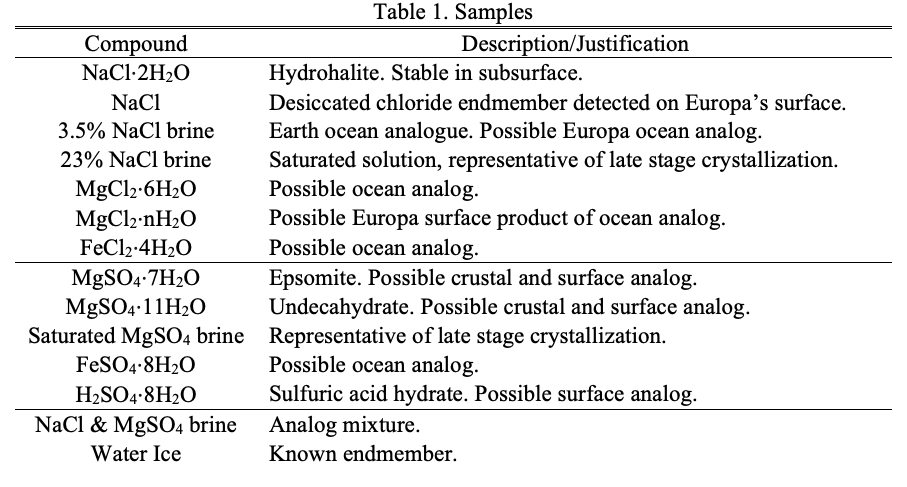
Methods: Fourteen different materials investigated potentially representative of Europa’s surface, frozen subsurface and ocean compositions were investigated. They include halides and sulfates of Na, Mg, and Fe as well sulfuric acid octahydrate and water ice (Table 1). Visible and infrared reflectance spectra from ~ 400 to ~ 2500 nm or 8000nm were obtained of the materials in pellet form before and after irradiation using the LabSPEC facility at the John Hopkins Applied Physics Laboratory. All samples were in the form of pellets, pressed from powdered samples. Cryogenic temperature (~ 100K) was maintained for any material not thermally stable at room temperature. However, grain size was unconstrained.
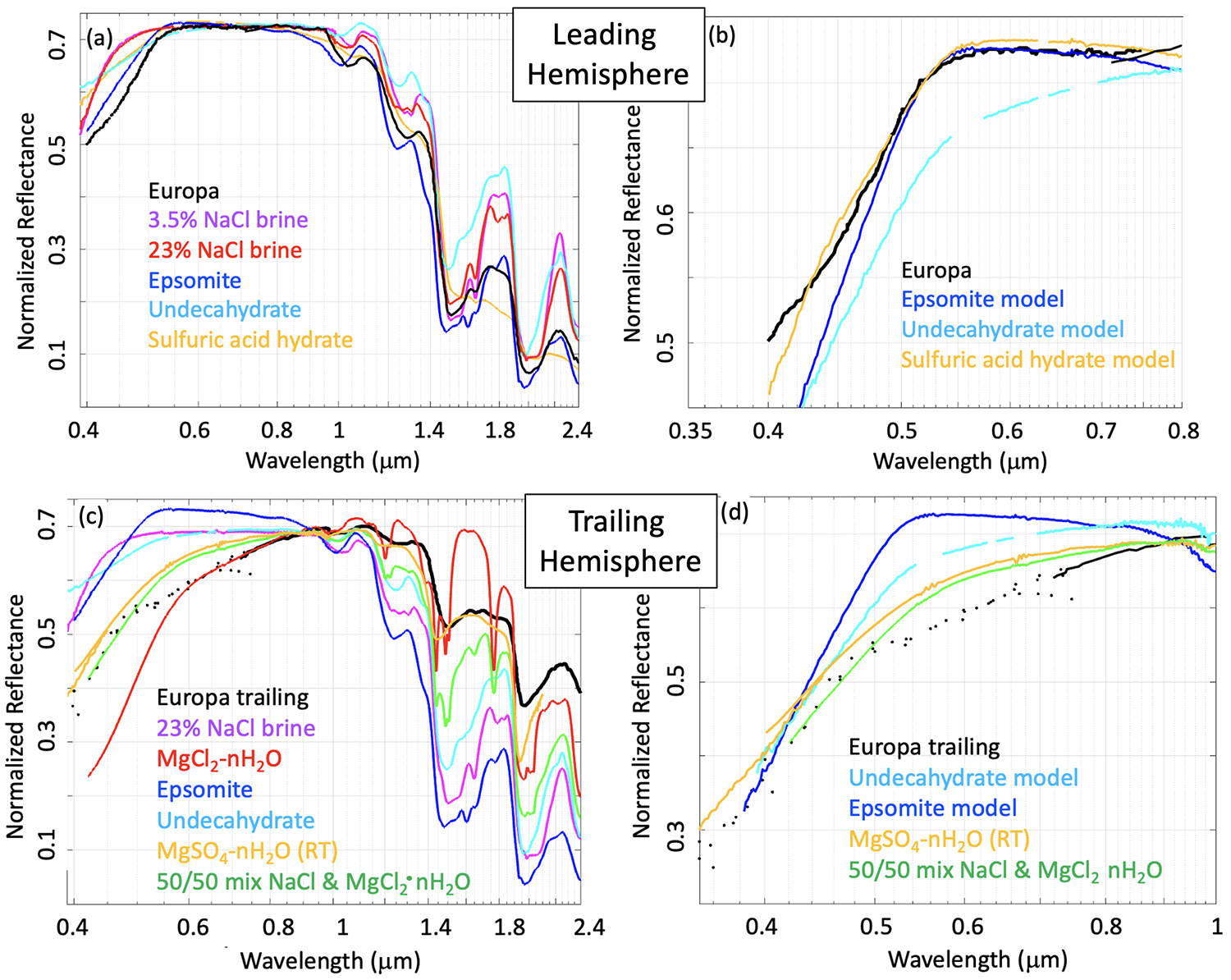
 Results and Conclusions: We have found that the visible spectrum of each material was altered by electron irradiation while the infrared was largely not affected. The materials investigated included cryogenic brines, salts, and hydrates. For NaCl brines, the discoloration in visible and near infrared is sensitive to even small amounts of NaCl being present. We confirm the 460-nm absorption band observed on the leading hemisphere of Europa is indicative of desiccated NaCl, and is not representative of either hydrohalite nor its frozen cryogenic brine. The color of Europa’s leading hemisphere is more consistent with either or both hydrated sulfuric acid or magnesium sulfates (Figure 1a,b) . Other chlorides, such as variants of MgCl2 are not present in abundance. A small amount of brine may also be present to account for the ~ 15% of NaCl being necessary to produce the observed depth of the color center. The color of the trailing hemisphere is also consistent with magnesium sulfates but the extensive irradiation and effects on the spectra of these and other potential surface materials has not been adequately simulated in the laboratory at relevant fluxes to confirm this (Figure 1c,d). MgSO4 is likely a precipitate from the ocean and not a radiolytic product and it is possible that radiolytic hydrated sulfuric acid could have formed from the degradation of the sulfate. Thus, the interior ocean appears to contain sulfates as well as chlorides, with the magnesium sulfates potentially preferentially concentrating in the crust.
Additional laboratory work, as well as higher spatial resolution spectral mapping of Europa’s surface are needed to better constrain Europa’s surface composition. Further irradiation of cryogenic samples, especially with ions for altering the physical structure, will be necessary for refining a spectral match to Europa’s surface, especially in the infrared. We emphasize that the spectral identification of a component responsible for coloring the surface of Europa must also not be inconsistent with spectral features in the infrared and also that infrared spectra of relevant materials need to account for the spectral effects of damaging ion irradiation. For instance, subtle features, such as near 1350 nm may or may not persist under ion irradiation. Also, other types of materials need to be considered that also darken and redden in the visible, such as nano-phase metallic iron [e.g. 3], which may be a component of meteoritic contamination.
Figure 1. The VNIR spectrum of Europa’s leading hemisphere (a & b) are best matched by magnesium sulfate epsomite, magnesium undecahydrate, and hydrated sulfuric acid. The infrared is best matched by the NaCl brines, because that portion of the spectrum of the disk-integrated leading hemisphere is dominated by water-ice. It is also likely the match of sulfuric acid hydrate would improve with different sample preparations and smaller grain sizes. The trailing hemisphere (c & d) is best matched by hydrated magnesium sulfate but also a mixture of NaCl and partially hydrated MgCl2. However, MgCl2•nH2O significantly mismatches in the shortwave. An additional material absorbing at 0.6 mm continues to be needed.
Acknowledgements: This work was supported primarily by the Solar Systems Working Grant # 80NSSC20K1044 with some support also provided through the Europa Clipper MISE Contract to APL.
References: [1] Hand, K. P., & Carlson, R. W. 2015, GRL, 42; [2] Hibbitts, C. A., Stockstill-Cahill, K., Wing, B., & Paranicas, C. 2019, Icar, 326; [3] Clark, R. N., Cruikshank, D. P., Jaumann, R., et al. 2012, Icar, 218, 2.
How to cite: Hibbitts, C., Stockstill-Cahill, K., Lloyd, E., Gloesener, E., Choukroun, M., Paranicas, C., and Clark, R.: Inferring Europa Surface Composition through Visible – Infrared Spectra of keV Electron-Irradiated Cryogenic Salts and Hydrates, EPSC-DPS Joint Meeting 2025, Helsinki, Finland, 7–12 Sep 2025, EPSC-DPS2025-962, https://doi.org/10.5194/epsc-dps2025-962, 2025.


